Lean Manufacturing &
Philosophy
S G Deshmukh
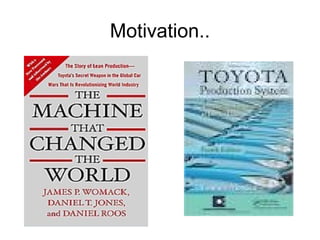
Motivation..
Taichi Ohno (1912-1990)
Taiichi Ohno was a
Japanese industrial
engineer and businessman.
He is considered to be the
father of the Toyota
Production System, which
became Lean
Manufacturing in the U.S.
He devised the seven
wastes as part of this
system.
Lean Manufacturing Definition
“A philosophy of production that
emphasizes the minimization of the
amount of all the resources (including
time) used in the various activities of the
enterprise. It involves identifying and
eliminating non­value­adding activities in
design, production, supply chain
management, and dealing with the
customers. . .”
–– APICSAPICS
Youtube : Toyota Global Story
(20. minutes)
• https://www.youtube.com/watch?
v=T5zcCk-uF3g
Lean Enterprise Definition
“An enterprise with a focus on waste elimination and
the customer’s needs in all parts of its operations,
manufacturing, and administration. Emphasis is
given to lean structures and processes, flexibility of
response, and methods and techniques to
continually seize new opportunities as they arise.”
– APICS
Lean Thinking Principles
1. Accurately specify the value of the products or services
(applies to both factory and office areas, not just to
manufacturing).
2. Identify the value stream for each product or service
and remove wasted actions
3. Make the product or service value flow without
interruptions.
4. Let customers pull products or services from the
producer.
5. Pursue perfection and continuously improve.
Lean Manufacturing Characteristics
• Focus is on the improvement of
resource utilization:
– Equipment setup time reduced
– Scheduled machine maintenance
– Orderly, clean workplace
– Pull production being used
– JIT inventory control
– Factory layout in workcell
arrangement by products
– Active error elimination
– Improved quality, etc.
Importance of Waste Elimination
Lean deals with the elimination or reduction of
many types of non value­ added activities, often
referred to as waste
The driving force for waste elimination is improved value in
the products and services customers buy.
Anything that DOES NOT add VALUE is waste
Lean Manufacturing System (LMS)
The Lean Manufacturing system has been
described as one,
which seeks to eliminate unnecessary wasteful
processes,
to align processes in a continuous flow
to use resources in order to solve problems in a
never­ending process.
Lean Manufacturing System
(Some more definitions)
More and more with less and less-
less human effort, less equipment, less time and
less space-while coming closer to providing
customers with exactly what they want .
A comprehensive process improvement
methodology that streamlines operations from
concept to customer delivery, reduces inventory,
speeds production, reduces cost and improves
quality and response time using state of art
Industrial Engineering tools.
NIST perspective on Lean
• A systematic approach in identifying and
eliminating waste through continuous
improvement, flows the product at the pull
of the customer in pursuit of perfection
Basic tenets of Lean
• Understand customer value
• Appreciate Pull system
• Deploy Value stream mapping
• Follow the principle of “Flow”
• Aim at perfection
Comment.
• The perfection is basically with an
understanding that : There is no end to
reduce time, cost , space, mistakes and
efforts” Once we manage these, we get
closer to Lean
Lean Organization Characteristics
• Strong leadership committed to all lean principles.
• Effective production & delivery of products and services
based on customer demand.
• An exceptionally safe orderly and clean work
environment
• A commitment to design & build quality in to products,
services & supporting processes.
• A team work culture where every one is empowered to
make and act upon decisions.
• Appropriate and active use of visual management
tools.
• Continuous improvement is an obvious way of life
throughout the organization
• A strategy embracing Lean principles
Steps of Lean Manufacturing System
Implementation
• Step 1: Specify Value: Define value in terms of a specific product,
which meets the customer's needs at a specific price and at a specific
time.
• Step 2: Map Identify the value stream: The set of all specific actions
required to bring a specific product through the three critical
management tasks of any business: the problem-solving task, the
information management task, and the physical transformation task.
Create a map of the Current State and the Future State of the value
stream. Identify & categorize waste in the Current State, & eliminate it!
• Step 3: Flow: Make the remaining steps in the value stream flow.
Eliminate functional barriers and develop a product-focused
organization that dramatically improves lead-time.
• Step 4: Pull: Let the customer pull products as needed, eliminating the
need for a sales forecast.
• Step 5: Perfection: There is no end to the process of reducing effort,
time, space, cost, and mistakes. Return to the first step and begin the
next lean transformation.
Benefits of Implementing Lean
Manufacturing System
a. Elimination of waste
b. Lower cost
c. Higher quality
d. Shorter throughput
e. More flexibility through flexible production lines
f. Customer satisfaction
g. Less inventory
h. Speedy execution of orders
i. A force of dedicated, motivated, multi-skilled
workmen
j. Optimal resources
k. Increased productivity
l. Perfect first time quality
m. Continuous improvement
n. Improved confidence and mutual trust at every
level of organization
Seven Popular Wastes from TPS
1. Defects
2. Overproduction
3. Transportation
4. Waiting
5. Inventories
6. Motion
7. Processing
Youtube video on Seven
Wastes
• https://www.youtube.com/watch?
v=mAYMcSUDcX0
Getting Started..1..
• Identify potential companies interested in
LMS (auto component is one of them
(Gurgaon, Noida))
• Identify imperatives for these companies to
get started
• Sensitize the company personnel
• Understand the existing system and ways of
migrating to LMS
Getting Started..2..
• Learn from best practices of each other
(German and Indian companies)
• Document these practices Train and
Educate
• Prepare repository of knowledge base in
LMS
• Exchange notes between stakeholders
Remarks..
• According to Ohno, Lean Philosophy is
directed to
• :Maximize the work effort of a company’s
number 1 resource, namely “people”.
Youtube on “ Toyota Lean
Manufacturing System” (15 Minutes)
• https://www.youtube.com/watch?
v=8KJaEOiHxNw
Lean Manufacturing at Boeing
• https://www.youtube.com/watch?
v=9_9WyiPhoHA
Remark..
• Lean may not operate where customer
demand is unstable, unpredictable
Lean on Facebook !
• https://www.facebook.com/pages/Lean-
On-Discovering-Lean-
Manufacturing/1531276217158436
https://www.facebook.com/LeanMentality
Thanks

Lean manufacturing system (lms) 19-march-sgd

  • 1.
  • 2.
  • 3.
    Taichi Ohno (1912-1990) TaiichiOhno was a Japanese industrial engineer and businessman. He is considered to be the father of the Toyota Production System, which became Lean Manufacturing in the U.S. He devised the seven wastes as part of this system.
  • 4.
    Lean Manufacturing Definition “Aphilosophy of production that emphasizes the minimization of the amount of all the resources (including time) used in the various activities of the enterprise. It involves identifying and eliminating non­value­adding activities in design, production, supply chain management, and dealing with the customers. . .” –– APICSAPICS
  • 5.
    Youtube : ToyotaGlobal Story (20. minutes) • https://www.youtube.com/watch? v=T5zcCk-uF3g
  • 6.
    Lean Enterprise Definition “Anenterprise with a focus on waste elimination and the customer’s needs in all parts of its operations, manufacturing, and administration. Emphasis is given to lean structures and processes, flexibility of response, and methods and techniques to continually seize new opportunities as they arise.” – APICS
  • 7.
    Lean Thinking Principles 1.Accurately specify the value of the products or services (applies to both factory and office areas, not just to manufacturing). 2. Identify the value stream for each product or service and remove wasted actions 3. Make the product or service value flow without interruptions. 4. Let customers pull products or services from the producer. 5. Pursue perfection and continuously improve.
  • 8.
    Lean Manufacturing Characteristics •Focus is on the improvement of resource utilization: – Equipment setup time reduced – Scheduled machine maintenance – Orderly, clean workplace – Pull production being used – JIT inventory control – Factory layout in workcell arrangement by products – Active error elimination – Improved quality, etc.
  • 9.
    Importance of WasteElimination Lean deals with the elimination or reduction of many types of non value­ added activities, often referred to as waste The driving force for waste elimination is improved value in the products and services customers buy. Anything that DOES NOT add VALUE is waste
  • 10.
    Lean Manufacturing System(LMS) The Lean Manufacturing system has been described as one, which seeks to eliminate unnecessary wasteful processes, to align processes in a continuous flow to use resources in order to solve problems in a never­ending process.
  • 11.
    Lean Manufacturing System (Somemore definitions) More and more with less and less- less human effort, less equipment, less time and less space-while coming closer to providing customers with exactly what they want . A comprehensive process improvement methodology that streamlines operations from concept to customer delivery, reduces inventory, speeds production, reduces cost and improves quality and response time using state of art Industrial Engineering tools.
  • 12.
    NIST perspective onLean • A systematic approach in identifying and eliminating waste through continuous improvement, flows the product at the pull of the customer in pursuit of perfection
  • 13.
    Basic tenets ofLean • Understand customer value • Appreciate Pull system • Deploy Value stream mapping • Follow the principle of “Flow” • Aim at perfection
  • 14.
    Comment. • The perfectionis basically with an understanding that : There is no end to reduce time, cost , space, mistakes and efforts” Once we manage these, we get closer to Lean
  • 15.
    Lean Organization Characteristics •Strong leadership committed to all lean principles. • Effective production & delivery of products and services based on customer demand. • An exceptionally safe orderly and clean work environment • A commitment to design & build quality in to products, services & supporting processes. • A team work culture where every one is empowered to make and act upon decisions. • Appropriate and active use of visual management tools. • Continuous improvement is an obvious way of life throughout the organization • A strategy embracing Lean principles
  • 16.
    Steps of LeanManufacturing System Implementation • Step 1: Specify Value: Define value in terms of a specific product, which meets the customer's needs at a specific price and at a specific time. • Step 2: Map Identify the value stream: The set of all specific actions required to bring a specific product through the three critical management tasks of any business: the problem-solving task, the information management task, and the physical transformation task. Create a map of the Current State and the Future State of the value stream. Identify & categorize waste in the Current State, & eliminate it! • Step 3: Flow: Make the remaining steps in the value stream flow. Eliminate functional barriers and develop a product-focused organization that dramatically improves lead-time. • Step 4: Pull: Let the customer pull products as needed, eliminating the need for a sales forecast. • Step 5: Perfection: There is no end to the process of reducing effort, time, space, cost, and mistakes. Return to the first step and begin the next lean transformation.
  • 17.
    Benefits of ImplementingLean Manufacturing System a. Elimination of waste b. Lower cost c. Higher quality d. Shorter throughput e. More flexibility through flexible production lines f. Customer satisfaction g. Less inventory h. Speedy execution of orders i. A force of dedicated, motivated, multi-skilled workmen j. Optimal resources k. Increased productivity l. Perfect first time quality m. Continuous improvement n. Improved confidence and mutual trust at every level of organization
  • 18.
    Seven Popular Wastesfrom TPS 1. Defects 2. Overproduction 3. Transportation 4. Waiting 5. Inventories 6. Motion 7. Processing
  • 19.
    Youtube video onSeven Wastes • https://www.youtube.com/watch? v=mAYMcSUDcX0
  • 20.
    Getting Started..1.. • Identifypotential companies interested in LMS (auto component is one of them (Gurgaon, Noida)) • Identify imperatives for these companies to get started • Sensitize the company personnel • Understand the existing system and ways of migrating to LMS
  • 21.
    Getting Started..2.. • Learnfrom best practices of each other (German and Indian companies) • Document these practices Train and Educate • Prepare repository of knowledge base in LMS • Exchange notes between stakeholders
  • 22.
    Remarks.. • According toOhno, Lean Philosophy is directed to • :Maximize the work effort of a company’s number 1 resource, namely “people”.
  • 23.
    Youtube on “Toyota Lean Manufacturing System” (15 Minutes) • https://www.youtube.com/watch? v=8KJaEOiHxNw
  • 24.
    Lean Manufacturing atBoeing • https://www.youtube.com/watch? v=9_9WyiPhoHA
  • 25.
    Remark.. • Lean maynot operate where customer demand is unstable, unpredictable
  • 26.
    Lean on Facebook! • https://www.facebook.com/pages/Lean- On-Discovering-Lean- Manufacturing/1531276217158436 https://www.facebook.com/LeanMentality
  • 27.