"Make Green, Go Green, by Going Lean”
How to Go Green? How to Go Lean? Why?
Doing nothing is not an option! Governor Arnold Schwarzenegger signed into law emission reduction targets for California:  By 2010, reduce GHG emissions to 2000 levels,  By 2020, reduce the GHG emissions to 1990 levels,  By 2050, reduce GHG emissions to 80 percent below 1990 levels
Green and Lean 15-30% of a manufacturing company’s monthly energy bill creates greenhouse gases. The energy management within a facility - benchmark competitors. Lean methodologies can be used to reduce waste in the consumption of energy within a manufacturing facility.  The ultimate goal - eliminate equipment not needed in the process.  If elimination is not possible, minimize the use plot energy consumption to predict maintenance schedules and replacement cycles.
Analysis of Electric Industry CO 2  Impacts The electric industry cannot provide substantial reductions in CO 2   emissions in the near future to meet goals Limited potential to switch to “greener energy” near-term CO 2  reduction must come from reducing demand supported by new energy efficient technologies conservation programs A market-based collaborative systematic approach to demand reduction is a critical success factor (profit potential)
The Economic Case For Change Asset performance management can reduce energy consumption by 6% to 11%. DOE has established a minimum 10% energy reduction guideline as attainable through the application of proper maintenance and technology solutions.
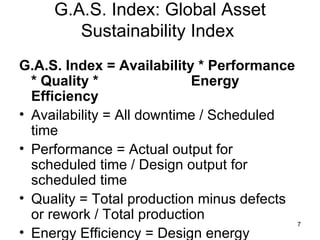
G.A.S. Index: Global Asset Sustainability Index  G.A.S. Index = Availability * Performance * Quality *    Energy Efficiency Availability = All downtime / Scheduled time Performance = Actual output for scheduled time / Design output for scheduled time Quality = Total production minus defects or rework / Total production  Energy Efficiency = Design energy consumption/Actual energy consumption
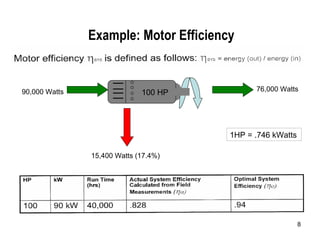
Example: Motor Efficiency 76,000 Watts 1HP = .746 kWatts 15,400 Watts (17.4%) 90,000 Watts 100 HP
Motor Efficiency Savings Energy Savings = 90kW x 8,000 hrs./year x (1-(.828/.94)) = 87,336 kWh/yr. At an average cost of 11 cents per kWh, the estimated savings would be $9,607 per year.  Motor operating cost:  (100 HP x .746 kW/HP x 8,000 hrs. x $.11/KWh ) / .94 efficiency = $69,838 per yr.
Repair v. Buy Break even analyses must be based on the increased cost of purchasing a new, more energy efficient equipment versus the energy consumption reduction. The cost energy today ranges from 10-13 cents per kilowatt-hour.
Lean Definition “A philosophy of production that emphasizes the  minimization  of the amount of all the  resources  (including time) used in the various activities of the enterprise.” -  APICS Dictionary, 10 th  ed.
Lean Enterprise “An enterprise with a focus on  waste  elimination and the  customer’s  needs in all parts of its operations, manufacturing and administration. Emphasis is given to lean structures and processes, flexibility of response and methods and techniques to continually seize new opportunities as they arise.”  -  APICS Lean SIG
Early Lean Processes Mass Production Early 1900’s Ford Motor Company was a pioneer Assembly line production High volume production Limited number of products Significant cost reductions
Today More than 96% of all U.S. companies have less than 250 employees  Global competition / low cost labor Demands by customers: Higher quality Innovation Mass customization Flexibility Lower Costs Limited resources Source: U.S. Bureau of Census, 2004
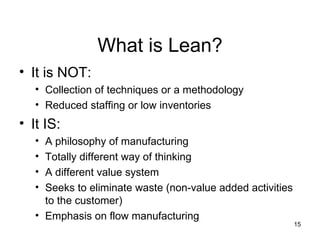
What is Lean? It is NOT: Collection of techniques or a methodology Reduced staffing or low inventories It IS: A philosophy of manufacturing Totally different way of thinking  A different value system Seeks to eliminate waste (non-value added activities to the customer) Emphasis on flow manufacturing
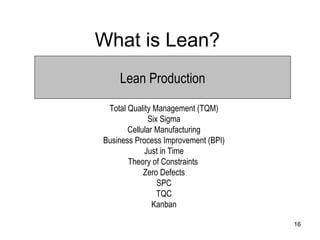
What is Lean? Lean Production Total Quality Management (TQM) Six Sigma Cellular Manufacturing Business Process Improvement (BPI) Just in Time Theory of Constraints  Zero Defects SPC TQC Kanban
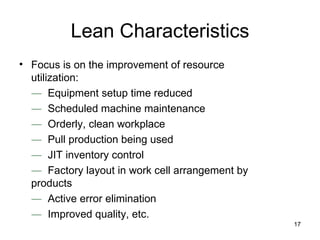
Lean Characteristics Focus is on the improvement of resource utilization: ―   Equipment setup time reduced ―   Scheduled machine maintenance ―   Orderly, clean workplace ―   Pull production being used ―   JIT inventory control ―   Factory layout in work cell arrangement by products ―  Active error elimination ―  Improved quality, etc.
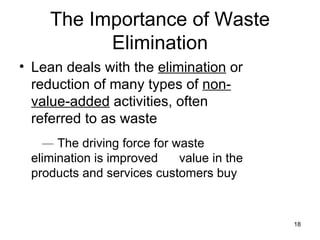
The Importance of Waste Elimination Lean deals with the  elimination  or reduction of many types of  non-value-added  activities, often referred to as waste   ―   The driving force for waste elimination is improved  value in the products and services customers buy
Seven Popular Wastes Overproduction Waiting Excessive transportation Inappropriate processing (the hidden factory) Unnecessary inventories Unnecessary motion Defects - Taiichi Ohno Toyota Production System
The Nature of Wastes 1. Overproduction Target and achievement unclear Processes not statistically capable 2. Waiting Operators waiting Operators slower than production line 3. Excessive Transportation Widely spaced equipment waiting Forklifts not available when needed
The Nature of Wastes (continued) 4. Inappropriate Processing Variability in operator’s performance Processes not statistically capable 5. Inventory Large safety stocks Variable procurement lead times
The Nature of Wastes (continued) 6. Motion Double handling Non-standard layouts Equipment widely spaced from each other 7. Defects Low material yields Excessive process variability
Correcting Wastes 1. Overproduction Eliminate by reducing setup times. Synchronizing quantities and timing between processes. Make only what is needed now. 2. Waiting Eliminate through synchronizing work flow. Balancing uneven loads with flexible workers and equipment.
Correcting Wastes (continued) 3. Excessive Transportation Establish layouts and locations to make transport and handling unnecessary, if possible. 4. Inappropriate Processing Why should this item be made? Why is each process necessary? Are any processes being performed that are not part of the work flow?
Correcting Wastes (continued) 5. Inventory Reduce by shortening setup times. Improving work skills. Smoothing fluctuations in demand for the product. Reducing all the other wastes reduces the waste in stocks. 6. Motion Study motion for economy and consistency. Economy improves productivity, and consistency improves quality.  Improve the motions, then mechanize or automate. Otherwise, there is a danger of automating waste.
Correcting Wastes (continued) 7. Defects Develop the production process to prevent defects. Eliminate the need for inspection. At each process, produce no defects.  Design processes to be failsafe (Poka yoke). Quality processes yields quality products – automatically.
Can you think of other actions to eliminate waste in your company?
Leadership Function Initiate needed change by  identifying  a vision Aligning  employees to that vision Motivating  to achieve that vision
Leadership – Lean Change Infrastructure Project & Training Plans ___________________________________________________________________________________________________________________________________________________________________________ Vision &  Lean Strategy Value – No Waste – Flow – Pull – Standard Work – JIT – Champion CEO Plant Management/President Vice President Sponsors: Manufacturing Engineering Quality Lean Office Facilitator Facilitator Facilitator Team Team Team Team Team Team
Transparent Workplace
Transparent Workplace Define Processes Value-Added Activities A Value-Added Step Value versus Non-Value-Added Value-Stream Mapping Typical Process Flow Analysis Visual Order – The Five S’s Visual Control
A particular method of doing something which involves a number of steps, activities, or operations Processes are found in manufacturing & service industries Example: Transparent Workplace – Processes Definition Grind Type Contract Turn Mill Drill Obtain Signature Type Envelope Mail Manufacturing Office
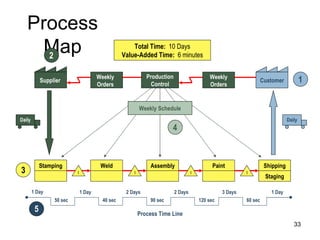
Process Map Supplier Customer Stamping Weld Assembly Paint Shipping Staging Weekly Orders Weekly Orders Weekly Schedule 1 2 3 4 5 Production Control I I I I Daily Daily Total Time:   10 Days Value-Added Time:   6 minutes 1 Day 1 Day 2 Days 3 Days 1 Day 2 Days 50 sec 40 sec 90 sec 120 sec 60 sec Process Time Line
Map customer requirements (orders) Map order information flows Map physical product/material flows Map plant/office information flows Add a process time line Summarize current state Ask questions at each step to determine waste or non-value-added areas Transparent Workplace – Value-Stream Mapping Process
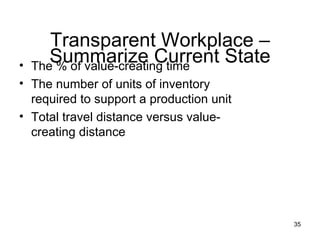
The % of value-creating time The number of units of inventory required to support a production unit Total travel distance versus value-creating distance Transparent Workplace – Summarize Current State
Add value to products & services that customers are willing to pay for Improvements that change a product’s or service’s  form ,  fit  or  function Other activities use resources but add no value Some non-value-added activities may be necessary Based on current knowledge or technology Long term goal - Eliminate  Remaining non-value-added activities should be eliminated now! Transparent Workplace – What Are Value-Added Activities?
A process that physically changes the work passing through it that makes it more valuable to the customer A step requested by the customer - they are willing to pay for it Transparent Workplace – A Value-Added Step
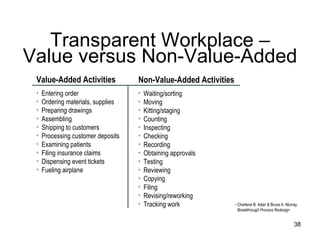
Transparent Workplace – Value versus Non-Value-Added Value-Added Activities Entering order Ordering materials, supplies Preparing drawings Assembling Shipping to customers Processing customer deposits Examining patients Filing insurance claims Dispensing event tickets Fueling airplane Non-Value-Added Activities Waiting/sorting Moving Kitting/staging Counting Inspecting Checking Recording Obtaining approvals Testing Reviewing Copying Filing Revising/reworking Tracking work Charlene B. Adair & Bruce A. Murray, Breakthrough Process Redesign
Value Stream Costing
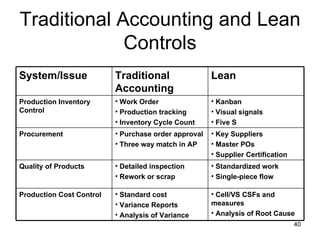
Traditional Accounting and Lean Controls Cell/VS CSFs and measures Analysis of Root Cause Standard cost Variance Reports Analysis of Variance Production Cost Control Standardized work Single-piece flow Detailed inspection Rework or scrap Quality of Products Key Suppliers Master POs Supplier Certification Purchase order approval Three way match in AP Procurement Kanban Visual signals Five S Work Order Production tracking Inventory Cycle Count Production Inventory Control Lean Traditional Accounting System/Issue
Costs Outside the Value Stream Identify tasks not related to the Value Stream Exp. - ISO 9000 These costs are not allocated to the Value Stream They are treated as sustaining costs of the business Budgeted Controlled No need for full absorption costing Value Stream costing proves relevant, accurate cost info about the Value Stream
Observe & record the flows of orders, materials, goods and information for a product family Product family:  A group of product variants passing through similar processing steps that use common equipment Mapping identifies waste situations for improvements Transparent Workplace – Value-Stream Mapping (VSM)
What are some value-added  & non-value-added activities  at your company?
To eliminate waste, you must first find it Visual order makes waste evident and is a good starting point for managing resources Toyota Production - Five S’s as the method for exposing waste & poor utilization of resources  Transparent Workplace – Visual Order – The Five S’s
S ort S et in order S hine S tandardize S ustain Transparent Workplace – Visual Order – The Five S’s
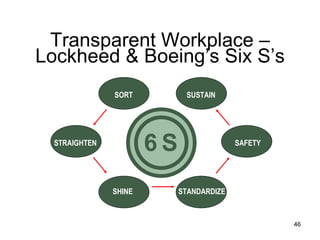
Transparent Workplace – Lockheed & Boeing’s Six S’s SORT SUSTAIN STRAIGHTEN SAFETY SHINE STANDARDIZE 6   S
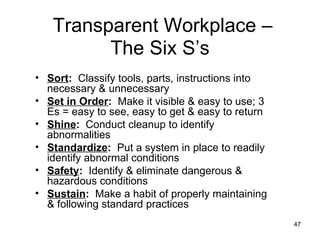
Sort :   Classify tools, parts, instructions into necessary & unnecessary Set in Order :   Make it visible & easy to use; 3 Es = easy to see, easy to get & easy to return Shine :   Conduct cleanup to identify abnormalities Standardize :   Put a system in place to readily identify abnormal conditions Safety :   Identify & eliminate dangerous & hazardous conditions Sustain :   Make a habit of properly maintaining & following standard practices Transparent Workplace – The Six S’s
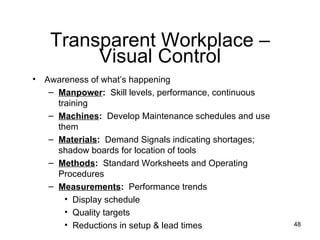
Awareness of what’s happening Manpower :   Skill levels, performance, continuous training Machines :   Develop Maintenance schedules and use them Materials :   Demand Signals indicating shortages; shadow boards for location of tools Methods :   Standard Worksheets and Operating Procedures Measurements :   Performance trends  Display schedule Quality targets  Reductions in setup & lead times Transparent Workplace – Visual Control
Pull versus Push Production Strategy Value Value  Stream Flow Pull Perfection Lean Principles
Pull No one upstream should produce any good or service  until the customer downstream asks for it Kanban Value Value  Stream Flow Pull Perfection Lean Principles
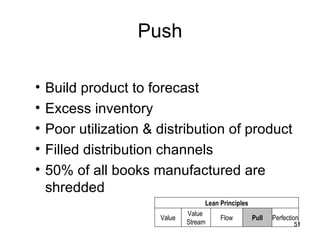
Push Build product to forecast  Excess inventory Poor utilization & distribution of product Filled distribution channels 50% of all books manufactured are shredded Value Value  Stream Flow Pull Perfection Lean Principles
Pull Design  Schedule based on actual demand signals Produce exactly what the customer wants Flow takes place throughout the supply chain, not just inside your production facility Value Value  Stream Flow Pull Perfection Lean Principles
Pull Benefits High throughput Excellent protection against stock-outs Higher flexibility Less congestion  Shorter lead times Higher customer service Value Value  Stream Flow Pull Perfection Lean Principles
Perfection Begins with visualizing the “perfect” process Continuous process to remove waste by eliminating effort, time, space and defects Value Value  Stream Flow Pull Perfection Lean Principles
Final Thoughts – Lean and Green There is a social responsibility component to saving energy and reducing the amount of CO 2  emissions. Green as a marketing tool. Select an small area with high visibility and a manageable number of variables for the first G.A.S. Assessment and Lean project. The journey is never-ending and definitely not easy (especially at first) but the results are well worth the effort.

Make green go green by going lean

  • 1.
    "Make Green, GoGreen, by Going Lean”
  • 2.
    How to GoGreen? How to Go Lean? Why?
  • 3.
    Doing nothing isnot an option! Governor Arnold Schwarzenegger signed into law emission reduction targets for California: By 2010, reduce GHG emissions to 2000 levels, By 2020, reduce the GHG emissions to 1990 levels, By 2050, reduce GHG emissions to 80 percent below 1990 levels
  • 4.
    Green and Lean15-30% of a manufacturing company’s monthly energy bill creates greenhouse gases. The energy management within a facility - benchmark competitors. Lean methodologies can be used to reduce waste in the consumption of energy within a manufacturing facility. The ultimate goal - eliminate equipment not needed in the process. If elimination is not possible, minimize the use plot energy consumption to predict maintenance schedules and replacement cycles.
  • 5.
    Analysis of ElectricIndustry CO 2 Impacts The electric industry cannot provide substantial reductions in CO 2 emissions in the near future to meet goals Limited potential to switch to “greener energy” near-term CO 2 reduction must come from reducing demand supported by new energy efficient technologies conservation programs A market-based collaborative systematic approach to demand reduction is a critical success factor (profit potential)
  • 6.
    The Economic CaseFor Change Asset performance management can reduce energy consumption by 6% to 11%. DOE has established a minimum 10% energy reduction guideline as attainable through the application of proper maintenance and technology solutions.
  • 7.
    G.A.S. Index: GlobalAsset Sustainability Index G.A.S. Index = Availability * Performance * Quality * Energy Efficiency Availability = All downtime / Scheduled time Performance = Actual output for scheduled time / Design output for scheduled time Quality = Total production minus defects or rework / Total production Energy Efficiency = Design energy consumption/Actual energy consumption
  • 8.
    Example: Motor Efficiency76,000 Watts 1HP = .746 kWatts 15,400 Watts (17.4%) 90,000 Watts 100 HP
  • 9.
    Motor Efficiency SavingsEnergy Savings = 90kW x 8,000 hrs./year x (1-(.828/.94)) = 87,336 kWh/yr. At an average cost of 11 cents per kWh, the estimated savings would be $9,607 per year. Motor operating cost: (100 HP x .746 kW/HP x 8,000 hrs. x $.11/KWh ) / .94 efficiency = $69,838 per yr.
  • 10.
    Repair v. BuyBreak even analyses must be based on the increased cost of purchasing a new, more energy efficient equipment versus the energy consumption reduction. The cost energy today ranges from 10-13 cents per kilowatt-hour.
  • 11.
    Lean Definition “Aphilosophy of production that emphasizes the minimization of the amount of all the resources (including time) used in the various activities of the enterprise.” - APICS Dictionary, 10 th ed.
  • 12.
    Lean Enterprise “Anenterprise with a focus on waste elimination and the customer’s needs in all parts of its operations, manufacturing and administration. Emphasis is given to lean structures and processes, flexibility of response and methods and techniques to continually seize new opportunities as they arise.” - APICS Lean SIG
  • 13.
    Early Lean ProcessesMass Production Early 1900’s Ford Motor Company was a pioneer Assembly line production High volume production Limited number of products Significant cost reductions
  • 14.
    Today More than96% of all U.S. companies have less than 250 employees Global competition / low cost labor Demands by customers: Higher quality Innovation Mass customization Flexibility Lower Costs Limited resources Source: U.S. Bureau of Census, 2004
  • 15.
    What is Lean?It is NOT: Collection of techniques or a methodology Reduced staffing or low inventories It IS: A philosophy of manufacturing Totally different way of thinking A different value system Seeks to eliminate waste (non-value added activities to the customer) Emphasis on flow manufacturing
  • 16.
    What is Lean?Lean Production Total Quality Management (TQM) Six Sigma Cellular Manufacturing Business Process Improvement (BPI) Just in Time Theory of Constraints Zero Defects SPC TQC Kanban
  • 17.
    Lean Characteristics Focusis on the improvement of resource utilization: ― Equipment setup time reduced ― Scheduled machine maintenance ― Orderly, clean workplace ― Pull production being used ― JIT inventory control ― Factory layout in work cell arrangement by products ― Active error elimination ― Improved quality, etc.
  • 18.
    The Importance ofWaste Elimination Lean deals with the elimination or reduction of many types of non-value-added activities, often referred to as waste ― The driving force for waste elimination is improved value in the products and services customers buy
  • 19.
    Seven Popular WastesOverproduction Waiting Excessive transportation Inappropriate processing (the hidden factory) Unnecessary inventories Unnecessary motion Defects - Taiichi Ohno Toyota Production System
  • 20.
    The Nature ofWastes 1. Overproduction Target and achievement unclear Processes not statistically capable 2. Waiting Operators waiting Operators slower than production line 3. Excessive Transportation Widely spaced equipment waiting Forklifts not available when needed
  • 21.
    The Nature ofWastes (continued) 4. Inappropriate Processing Variability in operator’s performance Processes not statistically capable 5. Inventory Large safety stocks Variable procurement lead times
  • 22.
    The Nature ofWastes (continued) 6. Motion Double handling Non-standard layouts Equipment widely spaced from each other 7. Defects Low material yields Excessive process variability
  • 23.
    Correcting Wastes 1.Overproduction Eliminate by reducing setup times. Synchronizing quantities and timing between processes. Make only what is needed now. 2. Waiting Eliminate through synchronizing work flow. Balancing uneven loads with flexible workers and equipment.
  • 24.
    Correcting Wastes (continued)3. Excessive Transportation Establish layouts and locations to make transport and handling unnecessary, if possible. 4. Inappropriate Processing Why should this item be made? Why is each process necessary? Are any processes being performed that are not part of the work flow?
  • 25.
    Correcting Wastes (continued)5. Inventory Reduce by shortening setup times. Improving work skills. Smoothing fluctuations in demand for the product. Reducing all the other wastes reduces the waste in stocks. 6. Motion Study motion for economy and consistency. Economy improves productivity, and consistency improves quality. Improve the motions, then mechanize or automate. Otherwise, there is a danger of automating waste.
  • 26.
    Correcting Wastes (continued)7. Defects Develop the production process to prevent defects. Eliminate the need for inspection. At each process, produce no defects. Design processes to be failsafe (Poka yoke). Quality processes yields quality products – automatically.
  • 27.
    Can you thinkof other actions to eliminate waste in your company?
  • 28.
    Leadership Function Initiateneeded change by identifying a vision Aligning employees to that vision Motivating to achieve that vision
  • 29.
    Leadership – LeanChange Infrastructure Project & Training Plans ___________________________________________________________________________________________________________________________________________________________________________ Vision & Lean Strategy Value – No Waste – Flow – Pull – Standard Work – JIT – Champion CEO Plant Management/President Vice President Sponsors: Manufacturing Engineering Quality Lean Office Facilitator Facilitator Facilitator Team Team Team Team Team Team
  • 30.
  • 31.
    Transparent Workplace DefineProcesses Value-Added Activities A Value-Added Step Value versus Non-Value-Added Value-Stream Mapping Typical Process Flow Analysis Visual Order – The Five S’s Visual Control
  • 32.
    A particular methodof doing something which involves a number of steps, activities, or operations Processes are found in manufacturing & service industries Example: Transparent Workplace – Processes Definition Grind Type Contract Turn Mill Drill Obtain Signature Type Envelope Mail Manufacturing Office
  • 33.
    Process Map SupplierCustomer Stamping Weld Assembly Paint Shipping Staging Weekly Orders Weekly Orders Weekly Schedule 1 2 3 4 5 Production Control I I I I Daily Daily Total Time: 10 Days Value-Added Time: 6 minutes 1 Day 1 Day 2 Days 3 Days 1 Day 2 Days 50 sec 40 sec 90 sec 120 sec 60 sec Process Time Line
  • 34.
    Map customer requirements(orders) Map order information flows Map physical product/material flows Map plant/office information flows Add a process time line Summarize current state Ask questions at each step to determine waste or non-value-added areas Transparent Workplace – Value-Stream Mapping Process
  • 35.
    The % ofvalue-creating time The number of units of inventory required to support a production unit Total travel distance versus value-creating distance Transparent Workplace – Summarize Current State
  • 36.
    Add value toproducts & services that customers are willing to pay for Improvements that change a product’s or service’s form , fit or function Other activities use resources but add no value Some non-value-added activities may be necessary Based on current knowledge or technology Long term goal - Eliminate Remaining non-value-added activities should be eliminated now! Transparent Workplace – What Are Value-Added Activities?
  • 37.
    A process thatphysically changes the work passing through it that makes it more valuable to the customer A step requested by the customer - they are willing to pay for it Transparent Workplace – A Value-Added Step
  • 38.
    Transparent Workplace –Value versus Non-Value-Added Value-Added Activities Entering order Ordering materials, supplies Preparing drawings Assembling Shipping to customers Processing customer deposits Examining patients Filing insurance claims Dispensing event tickets Fueling airplane Non-Value-Added Activities Waiting/sorting Moving Kitting/staging Counting Inspecting Checking Recording Obtaining approvals Testing Reviewing Copying Filing Revising/reworking Tracking work Charlene B. Adair & Bruce A. Murray, Breakthrough Process Redesign
  • 39.
  • 40.
    Traditional Accounting andLean Controls Cell/VS CSFs and measures Analysis of Root Cause Standard cost Variance Reports Analysis of Variance Production Cost Control Standardized work Single-piece flow Detailed inspection Rework or scrap Quality of Products Key Suppliers Master POs Supplier Certification Purchase order approval Three way match in AP Procurement Kanban Visual signals Five S Work Order Production tracking Inventory Cycle Count Production Inventory Control Lean Traditional Accounting System/Issue
  • 41.
    Costs Outside theValue Stream Identify tasks not related to the Value Stream Exp. - ISO 9000 These costs are not allocated to the Value Stream They are treated as sustaining costs of the business Budgeted Controlled No need for full absorption costing Value Stream costing proves relevant, accurate cost info about the Value Stream
  • 42.
    Observe & recordthe flows of orders, materials, goods and information for a product family Product family: A group of product variants passing through similar processing steps that use common equipment Mapping identifies waste situations for improvements Transparent Workplace – Value-Stream Mapping (VSM)
  • 43.
    What are somevalue-added & non-value-added activities at your company?
  • 44.
    To eliminate waste,you must first find it Visual order makes waste evident and is a good starting point for managing resources Toyota Production - Five S’s as the method for exposing waste & poor utilization of resources Transparent Workplace – Visual Order – The Five S’s
  • 45.
    S ort Set in order S hine S tandardize S ustain Transparent Workplace – Visual Order – The Five S’s
  • 46.
    Transparent Workplace –Lockheed & Boeing’s Six S’s SORT SUSTAIN STRAIGHTEN SAFETY SHINE STANDARDIZE 6 S
  • 47.
    Sort : Classify tools, parts, instructions into necessary & unnecessary Set in Order : Make it visible & easy to use; 3 Es = easy to see, easy to get & easy to return Shine : Conduct cleanup to identify abnormalities Standardize : Put a system in place to readily identify abnormal conditions Safety : Identify & eliminate dangerous & hazardous conditions Sustain : Make a habit of properly maintaining & following standard practices Transparent Workplace – The Six S’s
  • 48.
    Awareness of what’shappening Manpower : Skill levels, performance, continuous training Machines : Develop Maintenance schedules and use them Materials : Demand Signals indicating shortages; shadow boards for location of tools Methods : Standard Worksheets and Operating Procedures Measurements : Performance trends Display schedule Quality targets Reductions in setup & lead times Transparent Workplace – Visual Control
  • 49.
    Pull versus PushProduction Strategy Value Value Stream Flow Pull Perfection Lean Principles
  • 50.
    Pull No oneupstream should produce any good or service until the customer downstream asks for it Kanban Value Value Stream Flow Pull Perfection Lean Principles
  • 51.
    Push Build productto forecast Excess inventory Poor utilization & distribution of product Filled distribution channels 50% of all books manufactured are shredded Value Value Stream Flow Pull Perfection Lean Principles
  • 52.
    Pull Design Schedule based on actual demand signals Produce exactly what the customer wants Flow takes place throughout the supply chain, not just inside your production facility Value Value Stream Flow Pull Perfection Lean Principles
  • 53.
    Pull Benefits Highthroughput Excellent protection against stock-outs Higher flexibility Less congestion Shorter lead times Higher customer service Value Value Stream Flow Pull Perfection Lean Principles
  • 54.
    Perfection Begins withvisualizing the “perfect” process Continuous process to remove waste by eliminating effort, time, space and defects Value Value Stream Flow Pull Perfection Lean Principles
  • 55.
    Final Thoughts –Lean and Green There is a social responsibility component to saving energy and reducing the amount of CO 2 emissions. Green as a marketing tool. Select an small area with high visibility and a manageable number of variables for the first G.A.S. Assessment and Lean project. The journey is never-ending and definitely not easy (especially at first) but the results are well worth the effort.

Editor's Notes

  • #3 I think everyone knows how to make green. So the question is how to you make more green by going green and going lean? Going Green is one of the hottest subjects in the world today and specifically, it has many ramifications to the manufacturing world. Going green is easy to understand, but much harder to implement. It in a nutshell means going easy on the planet; the environment that we inhabit. Industry has not regarded this an an important issue until the EPA really handed down the first regulations on limiting hydrocarbon and nitrous oxide emissions from cars. Smokestack emissions came later. Going lean is not easy either. It takes work with a continuous improvement mindset. But both green and lean initiatives can save you money and that improves profitability.
  • #4 I’m the guy to talk about this subject. I spent 6 years in Silicon Valley when Green was getting it’s first traction. This schedule is quite ambitious, but you have to start somewhere. Stretch goals are good and believe me, these are stretch goals.
  • #8 This is where Lean and Green converge. This really is an equation about minimizing and eliminating waste.
  • #10 At 100% effeciency = annual cost to operate the motor would be $65,468. 8.760 hours per year.
  • #12 going Key features of the Lean Definition are the minimization of all resources including time.
  • #13 The Lean Enterprise Definition focuses on waste elimination and customer needs. Flexible to respond to new opportunities
  • #14 Workers became specialized – did not travel with the product – the product moved to them Large work force; high wages Made to inventory – pushed the market – lower prices Any color as long as it is black; consumer input was limited ; price driven Vertical supply base…mining raw material to finished product
  • #15 Customers are selective – more choices – want a name i.e Nike; Lexus, Starbucks Consumer wants quality; no surprises; low costs
  • #16 It is not Reduction of staff or lowering inventory It is Elimination of waste Emphasis flow manufacturing- not silos
  • #17 It is all of these JIT works now. Tier 1 suppliers locate close to their customers
  • #18 Run lots of parts and assemblies minimizing setup times. Schedule machine maintenance during off peak hours Clean – 6 S’s coming up shortly. Pull system rather than push; Kanban JIT- was always late a few years ago. Now tier one suppliers locate as close as possible to their customers. Reduce transpotation costs (waste) and reduce their carbon footprint. Linear or U shaped factory flow Errors are bad – scrap parts wasted energy costs include material, time, energy. Approach zero defects and reduce energy consumption.
  • #19 When you eliminate waste you improve the value of the goods and services that you produce
  • #20 These are the classical seven examples of waste that you see in all of the Lean books and classes and it’s comprehensive.
  • #21 People overproduce when targets are unclear or processes are not capable. Example Using a piece of equipment that cannot hold the tolerance required per the print. You may be within tolerance sometime, but that’s not good enough. That machine is not capable. Waiting – DDC flow was not constant and operators had chairs chained to their machines. Operators slower than the line. If incentive plans are not in place, this is a likely outcome. Excessive Transportation – Equipment is too far apart. Move orders are required to move anything to the next station.
  • #22 The hidden factory Inventory – large safety stocks to make sure material is in house. You should only produce what the customer requests. If lead times for material or production vary greatly, some inventory is needed.
  • #23 6. Motion – Handling parts, paper, or emails twice. None standard (not linear or U shaped) and equipment too far apart. 7. Defects – produces low output. Process variability could be the culprit.
  • #24 So now, here are some example of how to correct those wastes.
  • #30 Must be a top down initiative!
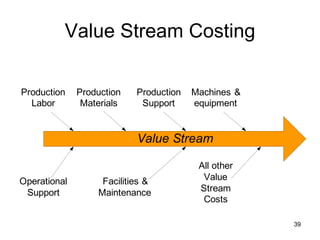
  • #40 Fishbone diagram displays inputs to the Value Stream
  • #41 VS=Value Stream CSF=Critical Success Factors
  • #42 In Lean we do not allocate most of these costs are fixed or semi variable Allocation disguises the profitability of the value stream Hides the effects of allocated activities – maybe these are non value added and should be eliminated
  • #43 Recap Value Stream Mapping…
  • #50 Lean is also based on pulls it through
  • #51 Lean is also based on pulls it through
  • #52 Build to Forecast – limited flexibility to changes in demand
  • #53 Design – starts with the design of the product or process and continues through the flow path to the customer
  • #54 Produce exactly what the customer demands. Flexible to customer requirements Less inventory stack up