Anshu Chauhan
MS – Textile Dyeing & Finishing, Wuhan
Textile University (China)
Asst. Manager
(Marketing & Technical Services)
Colorant Limited
11th Sep,2015
Lean Management Concepts In Textiles
Contents
1. Lean Management: Introduction
2. Wastes & Its Types
3. Principles of Lean
4. Lean Tools
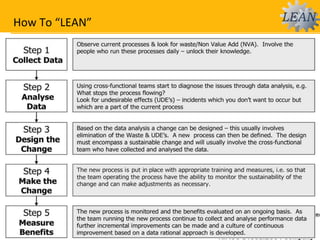
5. How to LEAN
6. LEAN Pros and Cons
7. Implementation in Textile industry
8. Conclusion
Lean Management: Introduction
A systematic approach in
identifying
and
eliminating waste,
or
non-value added-activities
through
continuous improvement
By
making products through
improved speed & flexibility
with
best quality & lowest cost
What is LEAN?
Value
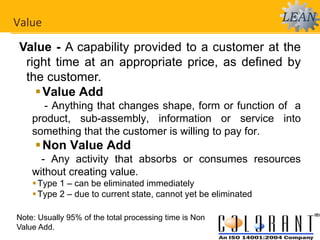
Value - A capability provided to a customer at the
right time at an appropriate price, as defined by
the customer.
Value Add
- Anything that changes shape, form or function of a
product, sub-assembly, information or service into
something that the customer is willing to pay for.
Non Value Add
- Any activity that absorbs or consumes resources
without creating value.
Type 1 – can be eliminated immediately
Type 2 – due to current state, cannot yet be eliminated
Note: Usually 95% of the total processing time is Non
Value Add.
Wastes & Its Types
Waste
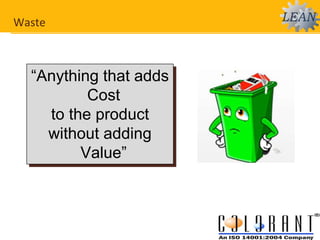
“Anything that adds
Cost
to the product
without adding
Value”
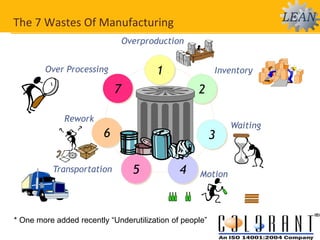
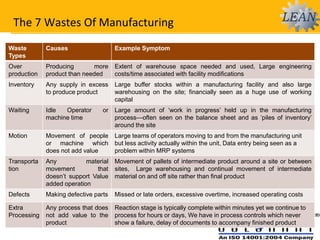
The 7 Wastes Of Manufacturing
Overproduction
Waiting
Inventory
Transportation
Motion
Over Processing
Rework
1
6
7
5 4
3
2
* One more added recently “Underutilization of people”
The 7 Wastes Of Manufacturing
Waste
Types
Causes Example Symptom
Over
production
Producing more
product than needed
Extent of warehouse space needed and used, Large engineering
costs/time associated with facility modifications
Inventory Any supply in excess
to produce product
Large buffer stocks within a manufacturing facility and also large
warehousing on the site; financially seen as a huge use of working
capital
Waiting Idle Operator or
machine time
Large amount of ‘work in progress’ held up in the manufacturing
process—often seen on the balance sheet and as ‘piles of inventory’
around the site
Motion Movement of people
or machine which
does not add value
Large teams of operators moving to and from the manufacturing unit
but less activity actually within the unit, Data entry being seen as a
problem within MRP systems
Transporta
tion
Any material
movement that
doesn’t support Value
added operation
Movement of pallets of intermediate product around a site or between
sites, Large warehousing and continual movement of intermediate
material on and off site rather than final product
Defects Making defective parts Missed or late orders, excessive overtime, increased operating costs
Extra
Processing
Any process that does
not add value to the
product
Reaction stage is typically complete within minutes yet we continue to
process for hours or days, We have in process controls which never
show a failure, delay of documents to accompany finished product
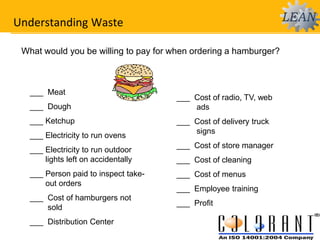
Understanding Waste
What would you be willing to pay for when ordering a hamburger?
___ Meat
___ Dough
___ Ketchup
___ Electricity to run ovens
___ Electricity to run outdoor
lights left on accidentally
___ Person paid to inspect take-
out orders
___ Cost of hamburgers not
sold
___ Distribution Center
___ Cost of radio, TV, web
ads
___ Cost of delivery truck
signs
___ Cost of store manager
___ Cost of cleaning
___ Cost of menus
___ Employee training
___ Profit
Principles of LEAN
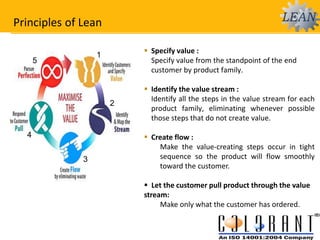
Principles of Lean
1
2
3
4
5
 Specify value :
Specify value from the standpoint of the end
customer by product family.
 Identify the value stream :
Identify all the steps in the value stream for each
product family, eliminating whenever possible
those steps that do not create value.
 Create flow :
Make the value-creating steps occur in tight
sequence so the product will flow smoothly
toward the customer.
 Let the customer pull product through the value
stream:
Make only what the customer has ordered.
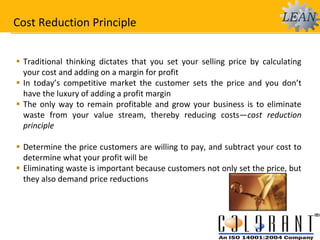
Cost Reduction Principle
 Traditional thinking dictates that you set your selling price by calculating
your cost and adding on a margin for profit
 In today’s competitive market the customer sets the price and you don’t
have the luxury of adding a profit margin
 The only way to remain profitable and grow your business is to eliminate
waste from your value stream, thereby reducing costs—cost reduction
principle
 Determine the price customers are willing to pay, and subtract your cost to
determine what your profit will be
 Eliminating waste is important because customers not only set the price, but
they also demand price reductions
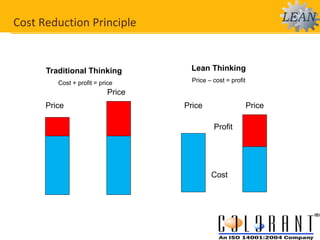
Cost Reduction Principle
Price
Price
Traditional Thinking
Cost + profit = price
Cost
Profit
Price Price
Lean Thinking
Price – cost = profit
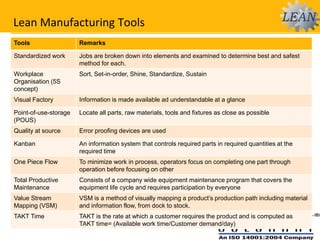
Lean Manufacturing Tools
Tools Remarks
Standardized work Jobs are broken down into elements and examined to determine best and safest
method for each.
Workplace
Organisation (5S
concept)
Sort, Set-in-order, Shine, Standardize, Sustain
Visual Factory Information is made available ad understandable at a glance
Point-of-use-storage
(POUS)
Locate all parts, raw materials, tools and fixtures as close as possible
Quality at source Error proofing devices are used
Kanban An information system that controls required parts in required quantities at the
required time
One Piece Flow To minimize work in process, operators focus on completing one part through
operation before focusing on other
Total Productive
Maintenance
Consists of a company wide equipment maintenance program that covers the
equipment life cycle and requires participation by everyone
Value Stream
Mapping (VSM)
VSM is a method of visually mapping a product’s production path including material
and information flow, from dock to stock.
TAKT Time TAKT is the rate at which a customer requires the product and is computed as
TAKT time= (Available work time/Customer demand/day)
How to LEAN
How To “LEAN”
HOW TO MAKE LEAN
SUSTAINABLE ?
LEAN SYSTEM = Rules + Tools
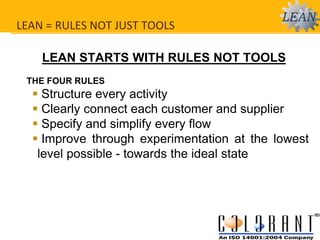
LEAN = RULES NOT JUST TOOLS
LEAN STARTS WITH RULES NOT TOOLS
THE FOUR RULES
 Structure every activity
 Clearly connect each customer and supplier
 Specify and simplify every flow
 Improve through experimentation at the lowest
level possible - towards the ideal state
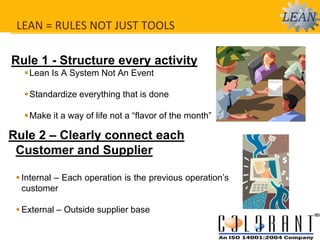
Rule 1 - Structure every activity
Lean Is A System Not An Event
Standardize everything that is done
Make it a way of life not a “flavor of the month”
Rule 2 – Clearly connect each
Customer and Supplier
 Internal – Each operation is the previous operation’s
customer
 External – Outside supplier base
LEAN = RULES NOT JUST TOOLS
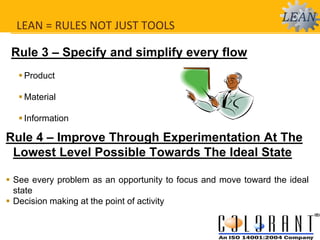
Rule 3 – Specify and simplify every flow
 Product
 Material
 Information
Rule 4 – Improve Through Experimentation At The
Lowest Level Possible Towards The Ideal State
 See every problem as an opportunity to focus and move toward the ideal
state
 Decision making at the point of activity
LEAN = RULES NOT JUST TOOLS
Lean Pros And Cons
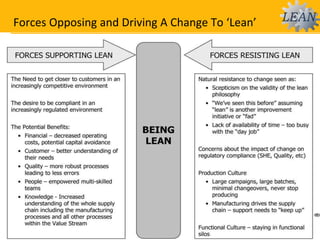
Forces Opposing and Driving A Change To ‘Lean’
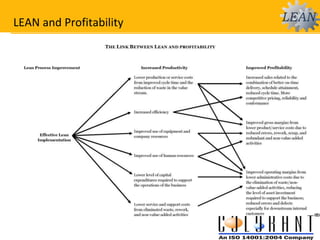
LEAN and Profitability
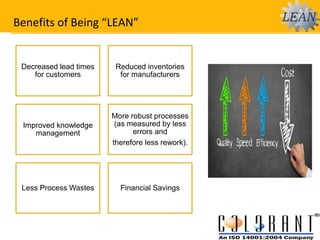
Benefits of Being “LEAN”
Decreased lead times
for customers
Reduced inventories
for manufacturers
Improved knowledge
management
More robust processes
(as measured by less
errors and
therefore less rework).
Less Process Wastes Financial Savings
Lean In Textiles
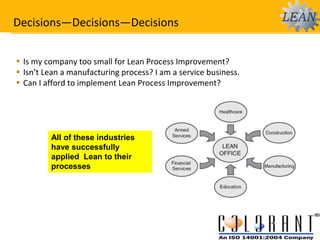
Decisions—Decisions—Decisions
 Is my company too small for Lean Process Improvement?
 Isn’t Lean a manufacturing process? I am a service business.
 Can I afford to implement Lean Process Improvement?
All of these industries
have successfully
applied Lean to their
processes
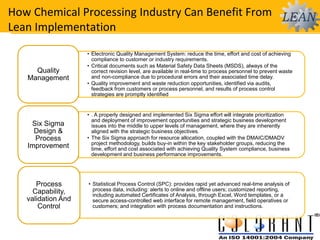
How Chemical Processing Industry Can Benefit From
Lean Implementation
• Electronic Quality Management System: reduce the time, effort and cost of achieving
compliance to customer or industry requirements.
• Critical documents such as Material Safety Data Sheets (MSDS), always of the
correct revision level, are available in real-time to process personnel to prevent waste
and non-compliance due to procedural errors and their associated time delay.
• Quality improvement and waste reduction opportunities, identified via audits,
feedback from customers or process personnel, and results of process control
strategies are promptly identified
Quality
Management
• . A properly designed and implemented Six Sigma effort will integrate prioritization
and deployment of improvement opportunities and strategic business development
issues into the middle to upper levels of management, where they are inherently
aligned with the strategic business objectives.
• The Six Sigma approach for resource allocation, coupled with the DMAIC/DMADV
project methodology, builds buy-in within the key stakeholder groups, reducing the
time, effort and cost associated with achieving Quality System compliance, business
development and business performance improvements.
Six Sigma
Design &
Process
Improvement
• Statistical Process Control (SPC): provides rapid yet advanced real-time analysis of
process data, including: alerts to online and offline users; customized reporting,
including automated Certificates of Analysis, through Excel, Word templates, or a
secure access-controlled web interface for remote management, field operatives or
customers; and integration with process documentation and instructions.
Process
Capability,
validation And
Control
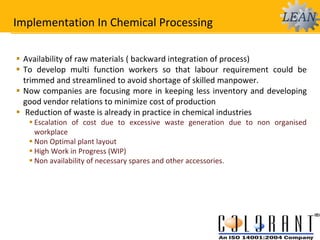
Implementation In Chemical Processing
 Availability of raw materials ( backward integration of process)
 To develop multi function workers so that labour requirement could be
trimmed and streamlined to avoid shortage of skilled manpower.
 Now companies are focusing more in keeping less inventory and developing
good vendor relations to minimize cost of production
 Reduction of waste is already in practice in chemical industries
 Escalation of cost due to excessive waste generation due to non organised
workplace
 Non Optimal plant layout
 High Work in Progress (WIP)
 Non availability of necessary spares and other accessories.
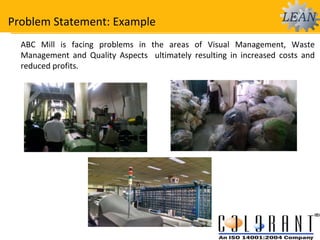
Problem Statement: Example
ABC Mill is facing problems in the areas of Visual Management, Waste
Management and Quality Aspects ultimately resulting in increased costs and
reduced profits.
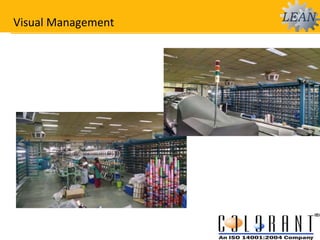
Visual Management
ISSUES
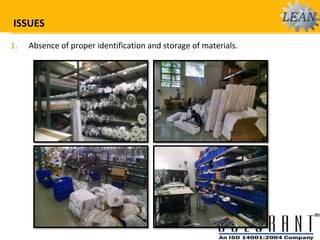
1. Absence of proper identification and storage of materials.
PROBABLE SOLUTIONS
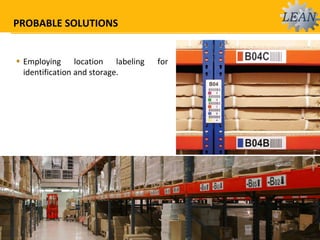
 Employing location labeling for
identification and storage.
 Material Identification
(colour) codes.
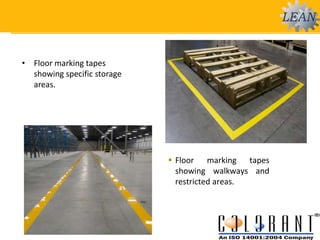
 Floor marking tapes
showing walkways and
restricted areas.
• Floor marking tapes
showing specific storage
areas.
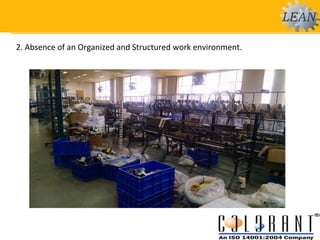
2. Absence of an Organized and Structured work environment.
PROBABLE SOLUTIONS
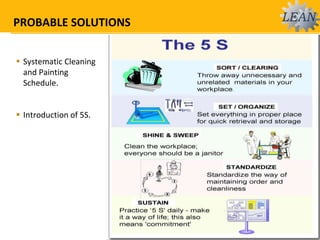
 Systematic Cleaning
and Painting
Schedule.
 Introduction of 5S.
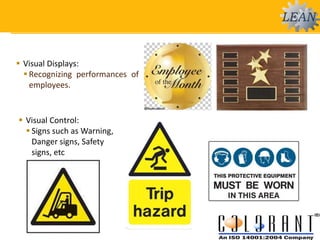
 Visual Displays:
 Recognizing performances of
employees.
 Visual Control:
 Signs such as Warning,
Danger signs, Safety
signs, etc
Reducing Textile Cutting waste
• Optimum, uniform width
• Maximum practical length
• Minimum defects
• Protective packaging, with clean, increased ends at beginning and end of roll
• Minimum shade variation
• Convert scrap fabric into yardage.
Conclusion
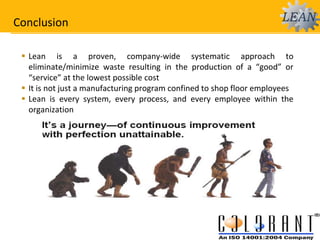
 Lean is a proven, company-wide systematic approach to
eliminate/minimize waste resulting in the production of a “good” or
“service” at the lowest possible cost
 It is not just a manufacturing program confined to shop floor employees
 Lean is every system, every process, and every employee within the
organization
Thank You

Lean management in textile processing

  • 1.
    Anshu Chauhan MS –Textile Dyeing & Finishing, Wuhan Textile University (China) Asst. Manager (Marketing & Technical Services) Colorant Limited 11th Sep,2015 Lean Management Concepts In Textiles
  • 2.
    Contents 1. Lean Management:Introduction 2. Wastes & Its Types 3. Principles of Lean 4. Lean Tools 5. How to LEAN 6. LEAN Pros and Cons 7. Implementation in Textile industry 8. Conclusion
  • 3.
  • 4.
    A systematic approachin identifying and eliminating waste, or non-value added-activities through continuous improvement By making products through improved speed & flexibility with best quality & lowest cost What is LEAN?
  • 5.
    Value Value - Acapability provided to a customer at the right time at an appropriate price, as defined by the customer. Value Add - Anything that changes shape, form or function of a product, sub-assembly, information or service into something that the customer is willing to pay for. Non Value Add - Any activity that absorbs or consumes resources without creating value. Type 1 – can be eliminated immediately Type 2 – due to current state, cannot yet be eliminated Note: Usually 95% of the total processing time is Non Value Add.
  • 6.
  • 7.
    Waste “Anything that adds Cost tothe product without adding Value”
  • 8.
    The 7 WastesOf Manufacturing Overproduction Waiting Inventory Transportation Motion Over Processing Rework 1 6 7 5 4 3 2 * One more added recently “Underutilization of people”
  • 9.
    The 7 WastesOf Manufacturing Waste Types Causes Example Symptom Over production Producing more product than needed Extent of warehouse space needed and used, Large engineering costs/time associated with facility modifications Inventory Any supply in excess to produce product Large buffer stocks within a manufacturing facility and also large warehousing on the site; financially seen as a huge use of working capital Waiting Idle Operator or machine time Large amount of ‘work in progress’ held up in the manufacturing process—often seen on the balance sheet and as ‘piles of inventory’ around the site Motion Movement of people or machine which does not add value Large teams of operators moving to and from the manufacturing unit but less activity actually within the unit, Data entry being seen as a problem within MRP systems Transporta tion Any material movement that doesn’t support Value added operation Movement of pallets of intermediate product around a site or between sites, Large warehousing and continual movement of intermediate material on and off site rather than final product Defects Making defective parts Missed or late orders, excessive overtime, increased operating costs Extra Processing Any process that does not add value to the product Reaction stage is typically complete within minutes yet we continue to process for hours or days, We have in process controls which never show a failure, delay of documents to accompany finished product
  • 10.
    Understanding Waste What wouldyou be willing to pay for when ordering a hamburger? ___ Meat ___ Dough ___ Ketchup ___ Electricity to run ovens ___ Electricity to run outdoor lights left on accidentally ___ Person paid to inspect take- out orders ___ Cost of hamburgers not sold ___ Distribution Center ___ Cost of radio, TV, web ads ___ Cost of delivery truck signs ___ Cost of store manager ___ Cost of cleaning ___ Cost of menus ___ Employee training ___ Profit
  • 11.
  • 12.
    Principles of Lean 1 2 3 4 5 Specify value : Specify value from the standpoint of the end customer by product family.  Identify the value stream : Identify all the steps in the value stream for each product family, eliminating whenever possible those steps that do not create value.  Create flow : Make the value-creating steps occur in tight sequence so the product will flow smoothly toward the customer.  Let the customer pull product through the value stream: Make only what the customer has ordered.
  • 13.
    Cost Reduction Principle Traditional thinking dictates that you set your selling price by calculating your cost and adding on a margin for profit  In today’s competitive market the customer sets the price and you don’t have the luxury of adding a profit margin  The only way to remain profitable and grow your business is to eliminate waste from your value stream, thereby reducing costs—cost reduction principle  Determine the price customers are willing to pay, and subtract your cost to determine what your profit will be  Eliminating waste is important because customers not only set the price, but they also demand price reductions
  • 14.
    Cost Reduction Principle Price Price TraditionalThinking Cost + profit = price Cost Profit Price Price Lean Thinking Price – cost = profit
  • 15.
  • 16.
    Lean Manufacturing Tools ToolsRemarks Standardized work Jobs are broken down into elements and examined to determine best and safest method for each. Workplace Organisation (5S concept) Sort, Set-in-order, Shine, Standardize, Sustain Visual Factory Information is made available ad understandable at a glance Point-of-use-storage (POUS) Locate all parts, raw materials, tools and fixtures as close as possible Quality at source Error proofing devices are used Kanban An information system that controls required parts in required quantities at the required time One Piece Flow To minimize work in process, operators focus on completing one part through operation before focusing on other Total Productive Maintenance Consists of a company wide equipment maintenance program that covers the equipment life cycle and requires participation by everyone Value Stream Mapping (VSM) VSM is a method of visually mapping a product’s production path including material and information flow, from dock to stock. TAKT Time TAKT is the rate at which a customer requires the product and is computed as TAKT time= (Available work time/Customer demand/day)
  • 17.
  • 18.
  • 19.
    HOW TO MAKELEAN SUSTAINABLE ? LEAN SYSTEM = Rules + Tools
  • 20.
    LEAN = RULESNOT JUST TOOLS LEAN STARTS WITH RULES NOT TOOLS THE FOUR RULES  Structure every activity  Clearly connect each customer and supplier  Specify and simplify every flow  Improve through experimentation at the lowest level possible - towards the ideal state
  • 21.
    Rule 1 -Structure every activity Lean Is A System Not An Event Standardize everything that is done Make it a way of life not a “flavor of the month” Rule 2 – Clearly connect each Customer and Supplier  Internal – Each operation is the previous operation’s customer  External – Outside supplier base LEAN = RULES NOT JUST TOOLS
  • 22.
    Rule 3 –Specify and simplify every flow  Product  Material  Information Rule 4 – Improve Through Experimentation At The Lowest Level Possible Towards The Ideal State  See every problem as an opportunity to focus and move toward the ideal state  Decision making at the point of activity LEAN = RULES NOT JUST TOOLS
  • 23.
  • 24.
    Forces Opposing andDriving A Change To ‘Lean’
  • 25.
  • 26.
    Benefits of Being“LEAN” Decreased lead times for customers Reduced inventories for manufacturers Improved knowledge management More robust processes (as measured by less errors and therefore less rework). Less Process Wastes Financial Savings

  • 27.
  • 28.
    Decisions—Decisions—Decisions  Is mycompany too small for Lean Process Improvement?  Isn’t Lean a manufacturing process? I am a service business.  Can I afford to implement Lean Process Improvement? All of these industries have successfully applied Lean to their processes
  • 29.
    How Chemical ProcessingIndustry Can Benefit From Lean Implementation • Electronic Quality Management System: reduce the time, effort and cost of achieving compliance to customer or industry requirements. • Critical documents such as Material Safety Data Sheets (MSDS), always of the correct revision level, are available in real-time to process personnel to prevent waste and non-compliance due to procedural errors and their associated time delay. • Quality improvement and waste reduction opportunities, identified via audits, feedback from customers or process personnel, and results of process control strategies are promptly identified Quality Management • . A properly designed and implemented Six Sigma effort will integrate prioritization and deployment of improvement opportunities and strategic business development issues into the middle to upper levels of management, where they are inherently aligned with the strategic business objectives. • The Six Sigma approach for resource allocation, coupled with the DMAIC/DMADV project methodology, builds buy-in within the key stakeholder groups, reducing the time, effort and cost associated with achieving Quality System compliance, business development and business performance improvements. Six Sigma Design & Process Improvement • Statistical Process Control (SPC): provides rapid yet advanced real-time analysis of process data, including: alerts to online and offline users; customized reporting, including automated Certificates of Analysis, through Excel, Word templates, or a secure access-controlled web interface for remote management, field operatives or customers; and integration with process documentation and instructions. Process Capability, validation And Control
  • 30.
    Implementation In ChemicalProcessing  Availability of raw materials ( backward integration of process)  To develop multi function workers so that labour requirement could be trimmed and streamlined to avoid shortage of skilled manpower.  Now companies are focusing more in keeping less inventory and developing good vendor relations to minimize cost of production  Reduction of waste is already in practice in chemical industries  Escalation of cost due to excessive waste generation due to non organised workplace  Non Optimal plant layout  High Work in Progress (WIP)  Non availability of necessary spares and other accessories.
  • 31.
    Problem Statement: Example ABCMill is facing problems in the areas of Visual Management, Waste Management and Quality Aspects ultimately resulting in increased costs and reduced profits.
  • 32.
  • 33.
    ISSUES 1. Absence ofproper identification and storage of materials.
  • 34.
    PROBABLE SOLUTIONS  Employinglocation labeling for identification and storage.
  • 35.
  • 36.
     Floor markingtapes showing walkways and restricted areas. • Floor marking tapes showing specific storage areas.
  • 37.
    2. Absence ofan Organized and Structured work environment.
  • 38.
    PROBABLE SOLUTIONS  SystematicCleaning and Painting Schedule.  Introduction of 5S.
  • 39.
     Visual Displays: Recognizing performances of employees.  Visual Control:  Signs such as Warning, Danger signs, Safety signs, etc
  • 40.
    Reducing Textile Cuttingwaste • Optimum, uniform width • Maximum practical length • Minimum defects • Protective packaging, with clean, increased ends at beginning and end of roll • Minimum shade variation • Convert scrap fabric into yardage.
  • 41.
    Conclusion  Lean isa proven, company-wide systematic approach to eliminate/minimize waste resulting in the production of a “good” or “service” at the lowest possible cost  It is not just a manufacturing program confined to shop floor employees  Lean is every system, every process, and every employee within the organization
  • 42.

Editor's Notes

  • #15 Show left hand side first, 1. Determine Cost to produce an item 2. Add profit you want 3. This gives you Price to the customer If you want to increase your profit under this system, how do you do it? --->>> Raise the price to the customer. reveal right hand side This is what most companies operated in the 60’s and 70’s, just pass the cost along to the customer. But as the markets get more and more competitive, do you think this strategy will still work?? NO!! So if Cascade wants to increase their profits now a days, how could they do it?? Discussion Transition to next slide...