PRESENTED BY – KRISHNA HEDAFinding the WasteThe 8 Waste
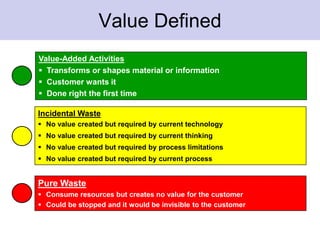
What is Value?A measurement of the worth of a product, or service, by a customer based on it’s usefulness in satisfying a customer needAn activity, process or operation that changes the product from one form to another in order to get it closer to the customer’s specificationsIt is something that the customer is willing to pay for
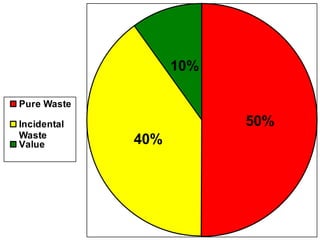
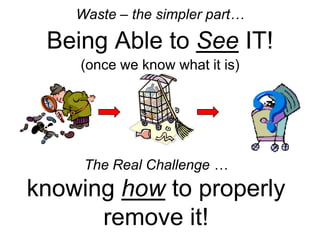
What is Waste?Any activity that adds costs or time but does not add valueConsuming more resources (time, money, space, etc) than are necessary to produce the goods, or services, that the customer wantsPure Waste: Actions that could be stopped without effecting the customer Incidental Waste: Actions that need to be done based on how the current system operates but do not add value
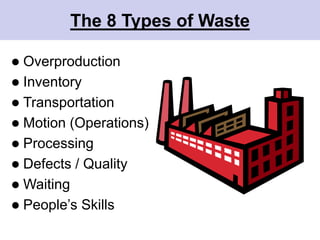
The 8 Types of WasteOverproduction
Inventory
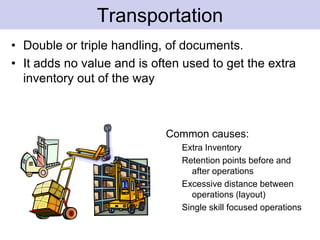
Transportation
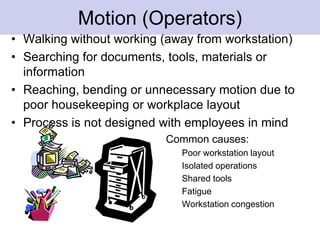
Motion (Operations)
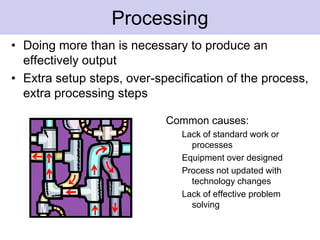
Processing
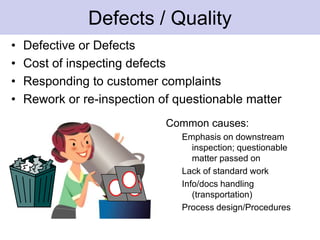
Defects / Quality
Waiting
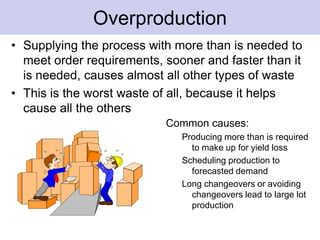
People’s SkillsOverproductionSupplying the process with more than is needed to meet order requirements, sooner and faster than it is needed, causes almost all other types of wasteThis is the worst waste of all, because it helps cause all the othersCommon causes:Producing more than is required to make up for yield lossScheduling production to forecasted demandLong changeovers or avoiding changeovers lead to large lot production
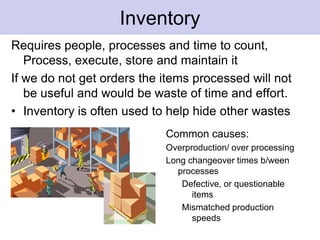
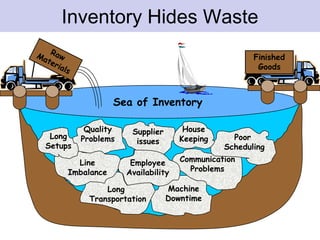
InventoryRequires people, processes and time to count, Process, execute, store and maintain itIf we do not get orders the items processed will not be useful and would be waste of time and effort.Inventory is often used to help hide other wastesCommon causes:Overproduction/ over processingLong changeover times b/ween processesDefective, or questionable itemsMismatched production speeds
Inventory Hides WasteMachineDowntimeSupplierissuesQualityProblemsPoor SchedulingLineImbalanceLongSetupsHouseKeepingEmployeeAvailabilityCommunicationProblemsLong TransportationRaw MaterialsFinished GoodsSea of InventoryEmployeeAvailability
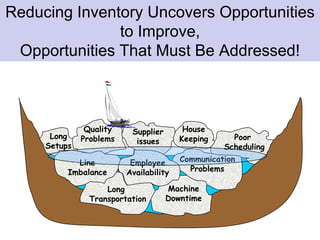
Reducing Inventory Uncovers Opportunities to Improve,Opportunities That Must Be Addressed!MachineDowntimeSupplierissuesQualityProblemsPoor SchedulingLineImbalanceLongSetupsHouseKeepingEmployeeAvailabilityCommunicationProblemsLong TransportationEmployeeAvailability
TransportationDouble or triple handling, of documents.It adds no value and is often used to get the extra inventory out of the way Common causes:Extra InventoryRetention points before and after operationsExcessive distance between operations (layout)Single skill focused operations
Motion (Operators)Walking without working (away from workstation) Searching for documents, tools, materials or informationReaching, bending or unnecessary motion due to poor housekeeping or workplace layoutProcess is not designed with employees in mindCommon causes:Poor workstation layoutIsolated operationsShared toolsFatigueWorkstation congestion
ProcessingDoing more than is necessary to produce an effectively outputExtra setup steps, over-specification of the process, extra processing stepsCommon causes:Lack of standard work or processesEquipment over designedProcess not updated with technology changesLack of effective problem solving
Defects / QualityDefective or DefectsCost of inspecting defectsResponding to customer complaintsRework or re-inspection of questionable matterCommon causes:Emphasis on downstream inspection; questionable matter passed onLack of standard workInfo/docs handling (transportation)Process design/Procedures
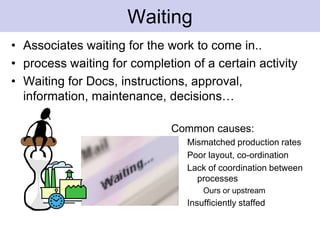
WaitingAssociates waiting for the work to come in..process waiting for completion of a certain activityWaiting for Docs, instructions, approval, information, maintenance, decisions…Common causes:Mismatched production ratesPoor layout, co-ordinationLack of coordination between processesOurs or upstreamInsufficiently staffed
People’s SkillsEmployees are seen as a source of labor only, not seen as true process expertsPeople are told what to do, and asked not to thinkEmployees are not involved in finding solutions, opportunities to improve our process are missedCommon causes:Management does not involve employees in problem solvingNarrowly defined jobs and expectationsOld school management, worker relationships
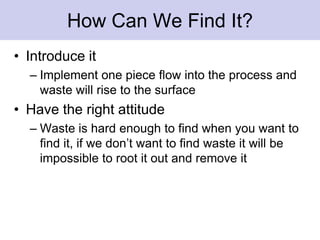
How Does Waste Get There? Forget to change solutions when we change the processFail to understand why we do something a certain way, so we continue doing that way even if the limitation has been removedBuild it into our processesRoot cause of problems is not addressed or a band aid solution is implemented

Types of waste - lean Concept Krishna Heda

  • 1.
    PRESENTED BY –KRISHNA HEDAFinding the WasteThe 8 Waste
  • 2.
    What is Value?Ameasurement of the worth of a product, or service, by a customer based on it’s usefulness in satisfying a customer needAn activity, process or operation that changes the product from one form to another in order to get it closer to the customer’s specificationsIt is something that the customer is willing to pay for
  • 3.
    What is Waste?Anyactivity that adds costs or time but does not add valueConsuming more resources (time, money, space, etc) than are necessary to produce the goods, or services, that the customer wantsPure Waste: Actions that could be stopped without effecting the customer Incidental Waste: Actions that need to be done based on how the current system operates but do not add value
  • 5.
    The 8 Typesof WasteOverproduction
  • 6.
  • 7.
  • 8.
  • 9.
  • 10.
  • 11.
  • 12.
    People’s SkillsOverproductionSupplying theprocess with more than is needed to meet order requirements, sooner and faster than it is needed, causes almost all other types of wasteThis is the worst waste of all, because it helps cause all the othersCommon causes:Producing more than is required to make up for yield lossScheduling production to forecasted demandLong changeovers or avoiding changeovers lead to large lot production
  • 13.
    InventoryRequires people, processesand time to count, Process, execute, store and maintain itIf we do not get orders the items processed will not be useful and would be waste of time and effort.Inventory is often used to help hide other wastesCommon causes:Overproduction/ over processingLong changeover times b/ween processesDefective, or questionable itemsMismatched production speeds
  • 14.
    Inventory Hides WasteMachineDowntimeSupplierissuesQualityProblemsPoorSchedulingLineImbalanceLongSetupsHouseKeepingEmployeeAvailabilityCommunicationProblemsLong TransportationRaw MaterialsFinished GoodsSea of InventoryEmployeeAvailability
  • 15.
    Reducing Inventory UncoversOpportunities to Improve,Opportunities That Must Be Addressed!MachineDowntimeSupplierissuesQualityProblemsPoor SchedulingLineImbalanceLongSetupsHouseKeepingEmployeeAvailabilityCommunicationProblemsLong TransportationEmployeeAvailability
  • 16.
    TransportationDouble or triplehandling, of documents.It adds no value and is often used to get the extra inventory out of the way Common causes:Extra InventoryRetention points before and after operationsExcessive distance between operations (layout)Single skill focused operations
  • 17.
    Motion (Operators)Walking withoutworking (away from workstation) Searching for documents, tools, materials or informationReaching, bending or unnecessary motion due to poor housekeeping or workplace layoutProcess is not designed with employees in mindCommon causes:Poor workstation layoutIsolated operationsShared toolsFatigueWorkstation congestion
  • 18.
    ProcessingDoing more thanis necessary to produce an effectively outputExtra setup steps, over-specification of the process, extra processing stepsCommon causes:Lack of standard work or processesEquipment over designedProcess not updated with technology changesLack of effective problem solving
  • 19.
    Defects / QualityDefectiveor DefectsCost of inspecting defectsResponding to customer complaintsRework or re-inspection of questionable matterCommon causes:Emphasis on downstream inspection; questionable matter passed onLack of standard workInfo/docs handling (transportation)Process design/Procedures
  • 20.
    WaitingAssociates waiting forthe work to come in..process waiting for completion of a certain activityWaiting for Docs, instructions, approval, information, maintenance, decisions…Common causes:Mismatched production ratesPoor layout, co-ordinationLack of coordination between processesOurs or upstreamInsufficiently staffed
  • 21.
    People’s SkillsEmployees areseen as a source of labor only, not seen as true process expertsPeople are told what to do, and asked not to thinkEmployees are not involved in finding solutions, opportunities to improve our process are missedCommon causes:Management does not involve employees in problem solvingNarrowly defined jobs and expectationsOld school management, worker relationships
  • 22.
    How Does WasteGet There? Forget to change solutions when we change the processFail to understand why we do something a certain way, so we continue doing that way even if the limitation has been removedBuild it into our processesRoot cause of problems is not addressed or a band aid solution is implemented