Presented by Aysel Muradlı
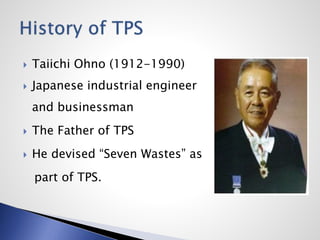
 Taiichi Ohno (1912-1990)
 Japanese industrial engineer
and businessman
 The Father of TPS
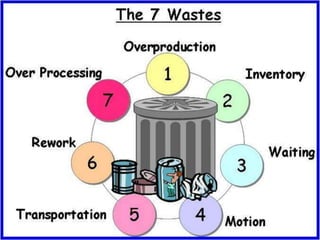
 He devised “Seven Wastes” as
part of TPS.
 A production system which is steeped in the
philosophy of "the complete elimination of all
waste" imbuing all aspects of production in
pursuit of the most efficient methods.
 It was developed by Taiichi Ohno, Sakichi
Toyoda, Kiichiro Toyoda, Eiji Toyoda.
 The Toyota Production System (TPS) was
established based on two concepts:
 Jidoka
 Just-in-Time
 “Jidoka” can be loosely translated as
"automation with a human touch“.
 It means that when a problem occurs, the
equipment stops immediately, preventing
defective products from being produced.
 As a result, only products satisfying quality
standards will be passed on to the following
processes on the production line.
 When a problem arises and is communicated
via the "andon" (problem display board).
 Each operator can be in charge of many
machines, resulting in higher productivity,
while continuous improvements lead to
greater processing capacity.
 Quality must be built in during the
manufacturing process!
 Producing quality products efficiently through
the complete elimination of waste,
inconsistencies, and unreasonable requirements
on the production line.
 In order to deliver a vehicle ordered by a
customer as quickly as possible, the vehicle is
efficiently built within the shortest possible
period of time.
 Making only "what is needed, when it is needed,
and in the amount needed!"
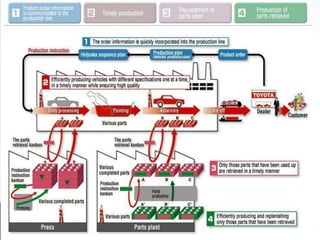
 Unique production control method
 Idea borrowed from super markets so called
“super market method”.
 When a process goes to the preceding
process to retrieve parts, it uses kanban signs
to communicate what parts have been used.
 Reduces excess production.
1) Reduced setup times
2) Small-lot production
3) Employee involvement and empowerment
4) Quality at the source
5) Equipment maintenance
6) Pull production
7) Supplier involvement
 All setup practices are wasteful because they
add no value and they tie up labor and
equipment.
 By organizing procedures, using carts, and
training workers to do their own
setups, Toyota managed to slash setup times
from months to hours and sometimes even
minutes.
 Producing things in large batches results in
huge setup costs, high capital cost of high-
speed dedicated machinery, larger
inventories, extended lead times, and larger
defect costs.
 Because Toyota has found the way to make
setups short and inexpensive, it became
possible for them to economically produce a
variety of things in small quantities.
 Toyota organized their workers by
forming teams and gave them the
responsibility and training to do many
specialized tasks.
 Teams are also given responsibility for
housekeeping and minor equipment repair.
 Each team has a leader who also works as
one of them on the line.
 To eliminate product defects, they must be
discovered and corrected as soon as
possible.
 Since workers are at the best position to
discover a defect and to immediately fix it,
they are assigned this responsibility.
 If a defect cannot be readily fixed, any worker
can halt the entire line by pulling a cord
(called Jidoka).
 Toyota operators are assigned primary
responsibility for basic maintenance since
they are in the best position to defect signs
of malfunctions.
 Maintenance specialists diagnose and fix only
complex problems, improve the performance
of equipment, and train workers in
maintenance.
 To reduce inventory holding costs and lead
times, Toyota developed the pull production
method wherein the quantity of work
performed at each stage of the process is
dictated solely by demand for materials from
the immediate next stage.
 The Kanban scheme coordinates the flow of
small containers of materials between stages.
This is where the term Just-in-Time (JIT)
originated.
 Toyota treats its suppliers as partners, as
integral elements of Toyota Production
System (TPS).
 Suppliers are trained in ways to reduce setup
times, inventories, defects, machine
breakdowns etc., and take responsibility to
deliver their best possible parts.
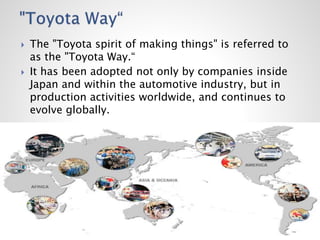
 The "Toyota spirit of making things" is referred to
as the "Toyota Way.“
 It has been adopted not only by companies inside
Japan and within the automotive industry, but in
production activities worldwide, and continues to
evolve globally.
Toyota Production System (broad)

Toyota Production System (broad)

  • 1.
  • 2.
     Taiichi Ohno(1912-1990)  Japanese industrial engineer and businessman  The Father of TPS  He devised “Seven Wastes” as part of TPS.
  • 4.
     A productionsystem which is steeped in the philosophy of "the complete elimination of all waste" imbuing all aspects of production in pursuit of the most efficient methods.  It was developed by Taiichi Ohno, Sakichi Toyoda, Kiichiro Toyoda, Eiji Toyoda.
  • 5.
     The ToyotaProduction System (TPS) was established based on two concepts:  Jidoka  Just-in-Time
  • 6.
     “Jidoka” canbe loosely translated as "automation with a human touch“.  It means that when a problem occurs, the equipment stops immediately, preventing defective products from being produced.  As a result, only products satisfying quality standards will be passed on to the following processes on the production line.
  • 7.
     When aproblem arises and is communicated via the "andon" (problem display board).  Each operator can be in charge of many machines, resulting in higher productivity, while continuous improvements lead to greater processing capacity.  Quality must be built in during the manufacturing process!
  • 8.
     Producing qualityproducts efficiently through the complete elimination of waste, inconsistencies, and unreasonable requirements on the production line.  In order to deliver a vehicle ordered by a customer as quickly as possible, the vehicle is efficiently built within the shortest possible period of time.  Making only "what is needed, when it is needed, and in the amount needed!"
  • 9.
     Unique productioncontrol method  Idea borrowed from super markets so called “super market method”.  When a process goes to the preceding process to retrieve parts, it uses kanban signs to communicate what parts have been used.  Reduces excess production.
  • 11.
    1) Reduced setuptimes 2) Small-lot production 3) Employee involvement and empowerment 4) Quality at the source 5) Equipment maintenance 6) Pull production 7) Supplier involvement
  • 12.
     All setuppractices are wasteful because they add no value and they tie up labor and equipment.  By organizing procedures, using carts, and training workers to do their own setups, Toyota managed to slash setup times from months to hours and sometimes even minutes.
  • 13.
     Producing thingsin large batches results in huge setup costs, high capital cost of high- speed dedicated machinery, larger inventories, extended lead times, and larger defect costs.  Because Toyota has found the way to make setups short and inexpensive, it became possible for them to economically produce a variety of things in small quantities.
  • 14.
     Toyota organizedtheir workers by forming teams and gave them the responsibility and training to do many specialized tasks.  Teams are also given responsibility for housekeeping and minor equipment repair.  Each team has a leader who also works as one of them on the line.
  • 15.
     To eliminateproduct defects, they must be discovered and corrected as soon as possible.  Since workers are at the best position to discover a defect and to immediately fix it, they are assigned this responsibility.  If a defect cannot be readily fixed, any worker can halt the entire line by pulling a cord (called Jidoka).
  • 16.
     Toyota operatorsare assigned primary responsibility for basic maintenance since they are in the best position to defect signs of malfunctions.  Maintenance specialists diagnose and fix only complex problems, improve the performance of equipment, and train workers in maintenance.
  • 17.
     To reduceinventory holding costs and lead times, Toyota developed the pull production method wherein the quantity of work performed at each stage of the process is dictated solely by demand for materials from the immediate next stage.  The Kanban scheme coordinates the flow of small containers of materials between stages. This is where the term Just-in-Time (JIT) originated.
  • 18.
     Toyota treatsits suppliers as partners, as integral elements of Toyota Production System (TPS).  Suppliers are trained in ways to reduce setup times, inventories, defects, machine breakdowns etc., and take responsibility to deliver their best possible parts.
  • 19.
     The "Toyotaspirit of making things" is referred to as the "Toyota Way.“  It has been adopted not only by companies inside Japan and within the automotive industry, but in production activities worldwide, and continues to evolve globally.

Editor's Notes

  • #4 1. Delay, waiting or time spent in a queue with no value being added 2. Producing more than you need 3. Over processing or undertaking non-value added activity 4. Transportation 5. Unnecessary movement or motion 6. Inventory 7. Production of Defects