 Michigan State University, 2014
Applying Lean Thinking to Legal Services
Jim Manley
The Demmer Center for Business Transformation
Eli Broad College of Business
Michigan State University
jbm@msu.edu (517) 662-9698
Dan Linna
Honigman, Miller, Schwartz and Cohn LLP
dlinna@honigman.com @DanLinna
Detroit Legal Innovation and Technology
@legalhackDET
July 15, 2014
 Michigan State University, 2014- 2 -
Jim’s Goals
• AC then CA
• R-I-CTA
• More questions than answers
• More curiosity than satisfaction
 Michigan State University, 2014- 3 -
 Michigan State University, 2014- 4 -
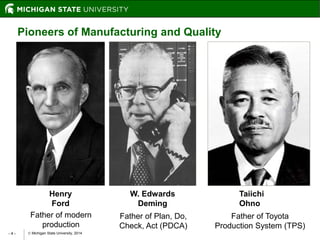
Henry
Ford
W. Edwards
Deming
Taiichi
Ohno
Father of modern
production
Father of Toyota
Production System (TPS)
Father of Plan, Do,
Check, Act (PDCA)
Pioneers of Manufacturing and Quality
 Michigan State University, 2014- 5 -
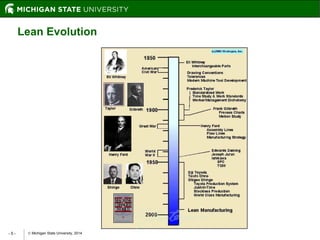
Lean Evolution
 Michigan State University, 2014- 6 -
 Michigan State University, 2014- 7 -
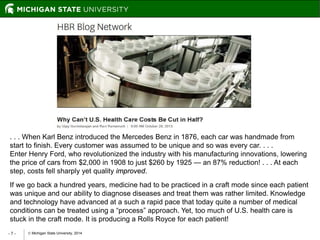
. . . When Karl Benz introduced the Mercedes Benz in 1876, each car was handmade from
start to finish. Every customer was assumed to be unique and so was every car. . . .
Enter Henry Ford, who revolutionized the industry with his manufacturing innovations, lowering
the price of cars from $2,000 in 1908 to just $260 by 1925 — an 87% reduction! . . . At each
step, costs fell sharply yet quality improved.
If we go back a hundred years, medicine had to be practiced in a craft mode since each patient
was unique and our ability to diagnose diseases and treat them was rather limited. Knowledge
and technology have advanced at a such a rapid pace that today quite a number of medical
conditions can be treated using a “process” approach. Yet, too much of U.S. health care is
stuck in the craft mode. It is producing a Rolls Royce for each patient!
 Michigan State University, 2014- 8 -
 Michigan State University, 2014- 9 -
Why apply lean to knowledge work?
Can generate significant benefits, including:
• Faster response time
• Higher quality and creativity
• Lower costs
• Reduced drudgery and frustration
• Greater job satisfaction
 Michigan State University, 2014- 10 -
 Michigan State University, 2014- 11 -
The relationship between lean and other methods
Lean Systems Thinking encompasses:
• Lean Tools and Methods (5S, A3, Standard Work, etc…)
• Six Sigma (SIPOC, DMAIC, etc…)
• Project Management
• Theory of Constraints
• Others…
 Michigan State University, 2014- 12 -
Project Management
• What is a project?
– a temporary group activity designed to produce a unique
product, service or result.
• What is project management?
– the application of knowledge, skills and techniques to
execute projects effectively and efficiently.
Project Management Institute, What is Project Management, at http://www.pmi.org/About-Us/About-
Us-What-is-Project-Management.aspx (last visited July 14, 2014).
 Michigan State University, 2014- 13 -
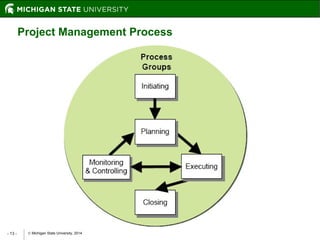
Project Management Process
 Michigan State University, 2014- 14 -
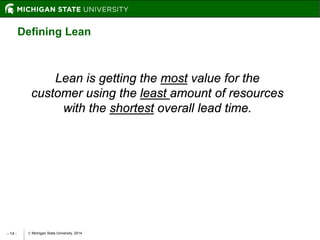
Lean is getting the most value for the
customer using the least amount of resources
with the shortest overall lead time.
Defining Lean
 Michigan State University, 2014- 15 -
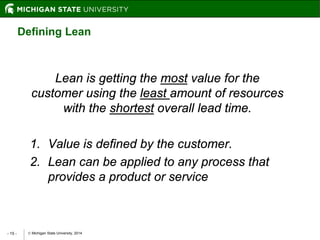
Lean is getting the most value for the
customer using the least amount of resources
with the shortest overall lead time.
1. Value is defined by the customer.
2. Lean can be applied to any process that
provides a product or service
Defining Lean
 Michigan State University, 2014- 16 -
 Michigan State University, 2014- 17 -
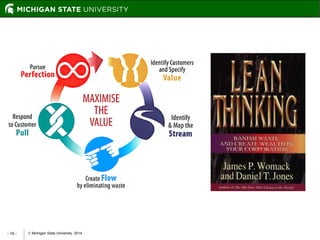
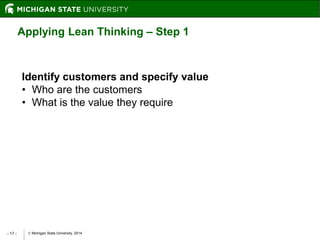
Applying Lean Thinking – Step 1
Identify customers and specify value
• Who are the customers
• What is the value they require
 Michigan State University, 2014- 18 -
• “BIG C” the end customer
Who are the customers?
 Michigan State University, 2014- 19 -
• “BIG C” the end customer
• “Little c” every person or activity in a
value stream
Who are the customers?
 Michigan State University, 2014- 20 -
Applying Lean Thinking – Step 2
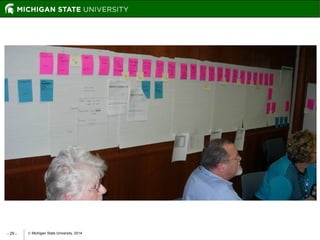
Identify and map the stream
• What are activities and steps in the process?
• What is the sequence and dependencies?
• How does the material flow?
• How does the information flow?
• What is the total lead time from order to delivered
value?
“If you cannot describe what you are doing as a process, you do not
know what you are doing.”
- Dr. W. Edwards Deming
 Michigan State University, 2014- 21 -
Applying Lean Thinking – Step 2
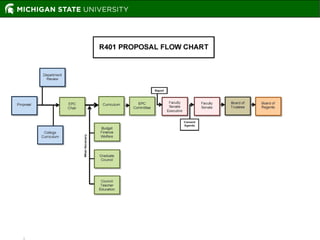
Types of Process Maps
• Flow Charts – Good for showing decisions and
loops
• Value Stream Maps – Good for showing how value
is added (tend to be linear)
• Spaghetti Maps – Good for showing physical
movement of people and material
• Swim Lane Map – Good combination of first two
maps
 Michigan State University, 2014- 22 -
Value
anything the Customer is willing to pay for
 Michigan State University, 2014- 23 -
Value
anything the Customer is willing to pay for
Value Stream
the flow of activities that deliver that value
 Michigan State University, 2014- 24 -
Value
anything the Customer is willing to pay for
Value Stream
the flow of activities that deliver that value
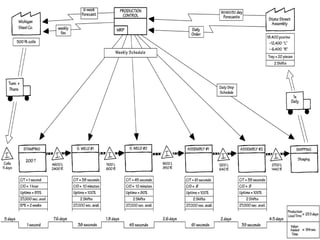
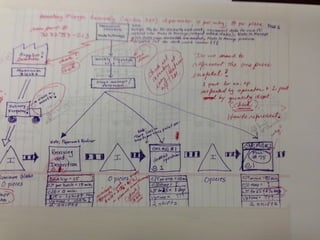
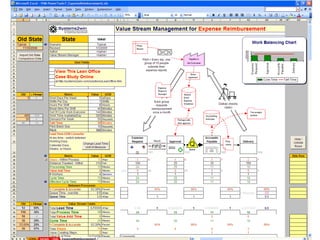
Value Stream Map
a simple diagram of every step involved
in the material and information flows
needed to bring a product from order to
delivery.
 Michigan State University, 2014- 25 -
 Michigan State University, 2014- 26 -
 Michigan State University, 2014- 28 -
 Michigan State University, 2014- 29 -
 Michigan State University, 2014- 30 -
Current State Mapping Rules
(Yes, rules)
• Observe with respect!
• Actively listen as individuals answer your questions
• Stay in the current state.
• Capture, not discuss improved or future state ideas in a
“parking lot”
• Don’t take it, or make it personal.
• Record everything using technology advantageously
• Make several passes to fill in detail
 Michigan State University, 2014- 31 -
As you walk the value stream …
(Yes, walk the actual Gemba)
• Develop “eyes for flow and waste”
• Gather data, especially …
– Backlog or inventory
– Total touches
– Actual personnel
– Defects, scrap, rejects, or rework
– Schedules and metrics
 Michigan State University, 2014- 32 -
The Purpose of Mapping
• Compare planned to actual
• Establish baseline metrics
• Identify opportunities to eliminate
– Waste (Muda)
– Unevenness (Mura)
– Overburden (Muri)
– Complexity
 Michigan State University, 2014- 33 -
Applying Lean Thinking – Step 3
Create Flow by eliminating waste
• What is the flow
• What is interrupting the flow?
 Michigan State University, 2014- 34 -
• Eyes for Flow
• Eyes for Waste
Lean System Thinkers Develop:
 Michigan State University, 2014- 35 -
Any activity that consumes resources without
creating value for the customer.
MUDA (Waste)
 Michigan State University, 2014- 36 -
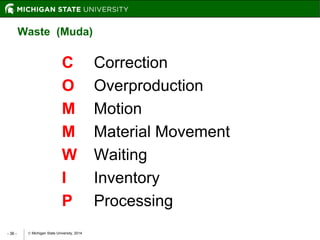
Waste (Muda)
C Correction
O Overproduction
M Motion
M Material Movement
W Waiting
I Inventory
P Processing
 Michigan State University, 2014- 37 -
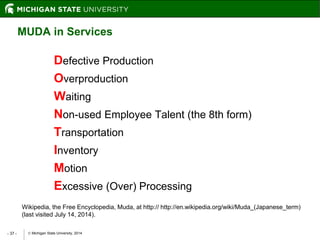
MUDA in Services
Defective Production
Overproduction
Waiting
Non-used Employee Talent (the 8th form)
Transportation
Inventory
Motion
Excessive (Over) Processing
Wikipedia, the Free Encyclopedia, Muda, at http:// http://en.wikipedia.org/wiki/Muda_(Japanese_term)
(last visited July 14, 2014).
 Michigan State University, 2014- 38 -
1 - Defective Production
• Correcting and reworking work product
– E.g., poor communication of assignment results in having
to redo a memo, file an amended complaint, etc.
 Michigan State University, 2014- 39 -
2 - Overproduction
• Doing more than required, or doing it sooner than
required
– E.g., reinventing the wheel when researching legal issues
rather than starting with work previously done
 Michigan State University, 2014- 40 -
3 - Waiting
• Wasted time waiting for the next step
– E.g., waiting for your colleague or client to respond to your
email requesting information
 Michigan State University, 2014- 41 -
4 - Non-used Employee Talent
• Underutilizing people’s talents, skills, and knowledge
– E.g., failing to allocate work to associates, paralegals,
assistants, and outside entities
 Michigan State University, 2014- 42 -
5 - Transportation
• Unnecessary or inefficient movement of documents and
information
– E.g., managing a legal project by providing input to your
colleagues one email at a time, ten emails per day
 Michigan State University, 2014- 43 -
6 - Inventory
• Work in progress
– E.g., a first draft of an agreement sitting on your desk
 Michigan State University, 2014- 44 -
7 - Motion
• Wasted movement that does not add value
– E.g., searching for a missing paper file
 Michigan State University, 2014- 45 -
8 - Excessive (Over) Processing
• More work or higher quality work than the client expects
– E.g., continuing legal research beyond the point of having
two precedents until you have a string cite of five
precedents
 Michigan State University, 2014- 46 -
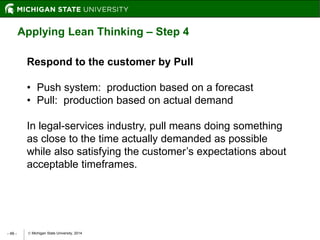
Applying Lean Thinking – Step 4
Respond to the customer by Pull
• Push system: production based on a forecast
• Pull: production based on actual demand
In legal-services industry, pull means doing something
as close to the time actually demanded as possible
while also satisfying the customer’s expectations about
acceptable timeframes.
 Michigan State University, 2014- 47 -
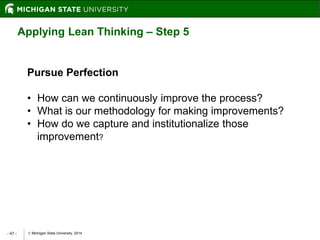
Applying Lean Thinking – Step 5
Pursue Perfection
• How can we continuously improve the process?
• What is our methodology for making improvements?
• How do we capture and institutionalize those
improvement?
 Michigan State University, 2014- 48 -
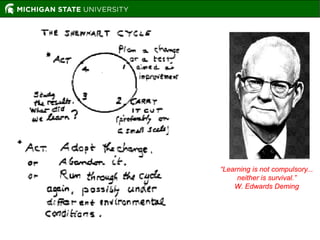
“Learning is not compulsory...
neither is survival.”
W. Edwards Deming
 Michigan State University, 2014- 49 -
What are the market pressures for legal services?
• Law Firms
• Corporate Legal Departments
• Legal Aid Services
• Access to Justice
• Solo Practitioners
 Michigan State University, 2014
Thank you!
Jim Manley
The Demmer Center for Business Transformation
Eli Broad College of Business
Michigan State University
jbm@msu.edu (517) 662-9698
Dan Linna
Honigman, Miller, Schwartz and Cohn LLP
dlinna@honigman.com @DanLinna
Detroit Legal Innovation and Technology
@legalhackDET
July 15, 2014