
McGraw-Hill/Irwin                                                                         9-1
                    Copyright © 2009 by The McGraw-Hill Companies, Inc. All rights reserved.
Learning Objectives
  L01: Similarities and differences between leading and
     managing
    L02: Sources of power in organizations
    L03: Personal traits and skills of effective leaders
    L04: Distinguish between charismatic and
     transformational leaders
    L05: Opportunities to be a leader in an organization
    L06: How to further your own leadership development


                                                       9-2
Vision – what is it?
 Mental image of a possible and desirable future state of
  the organization.

 Expresses the leader’s ambitions for the organization.


 Creates high performance aspirations, the nature of
  corporate or business strategy, or the kind of workplace.

         Without vision, managers do not develop
                     into strong leaders
                                                              9-3
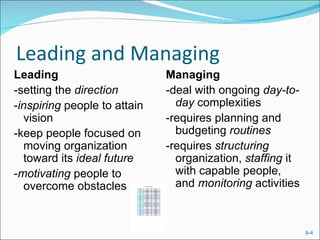
Leading and Managing
Leading                       Managing
-setting the direction        -deal with ongoing day-to-
-inspiring people to attain     day complexities
  vision                      -requires planning and
-keep people focused on         budgeting routines
  moving organization         -requires structuring
  toward its ideal future       organization, staffing it
-motivating people to           with capable people,
  overcome obstacles            and monitoring activities


                                                            9-4
Leadership Styles
 Supervisory Leadership
    provides guidance, support and corrective feedback
     for day-to-day activities
 Strategic Leadership
   gives purpose and meaning to organizations by
    anticipating and envisioning a viable future
   works with others to initiate changes that create such a
    future


                                                               9-5
Sources of Power
R   Legitimate power
       right or authority to tell others what to do
h   Reward power
       influences others because of control over rewards
a   Coercive power
       control over punishment
i   Referent power
       appealing personal characteristics
a   Expert power
       expertise or knowledge that others can learn from or
        gain from
                                                               9-6
Traditional Approaches to Leadership
o       Trait approach
        focuses on individual leaders
        determines personal characteristics that great
         leaders share
d       Behavioral approach
        identifies what good leaders do
        what behaviors they exhibit
9       Situational approach
        effective leadership behavior varies from situation to
         situation

                                                                  9-7
Important Traits for Leaders
 Drive
    high level of effort; high need for achievement,
     constant striving to accomplish
 Leadership motivation
    extraverted, high need for power.
 Integrity:
    Honest, credible, “walks the walk”
 Self-confidence
    overcome obstacles, decide despite uncertainty
 Knowledge of the business
    high level of knowledge about their industries,
     companies, and technical matters; intelligent
                                                        9-8
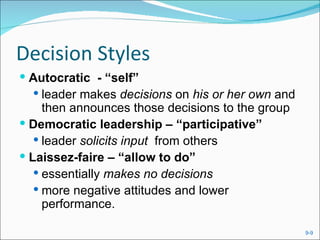
Decision Styles
 Autocratic - “self”
   leader makes decisions on his or her own and
     then announces those decisions to the group
 Democratic leadership – “participative”
    leader solicits input from others
 Laissez-faire – “allow to do”
    essentially makes no decisions
    more negative attitudes and lower
     performance.

                                                   9-9
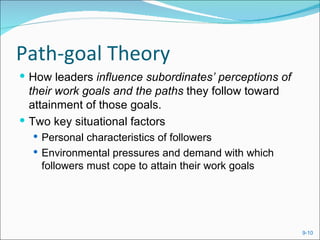
Path-goal Theory
 How leaders influence subordinates’ perceptions of
  their work goals and the paths they follow toward
  attainment of those goals.
 Two key situational factors
   Personal characteristics of followers
   Environmental pressures and demand with which
    followers must cope to attain their work goals


                                                       9-10
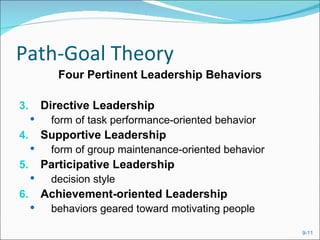
Path-Goal Theory
            Four Pertinent Leadership Behaviors

3.       Directive Leadership
         form of task performance-oriented behavior
4.       Supportive Leadership
         form of group maintenance-oriented behavior
5.       Participative Leadership
         decision style
6.       Achievement-oriented Leadership
         behaviors geared toward motivating people

                                                        9-11
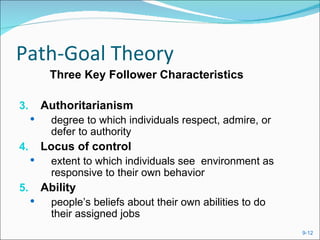
Path-Goal Theory
          Three Key Follower Characteristics

3.       Authoritarianism
          degree to which individuals respect, admire, or
           defer to authority
4.       Locus of control
          extent to which individuals see environment as
           responsive to their own behavior
5.       Ability
          people’s beliefs about their own abilities to do
           their assigned jobs
                                                              9-12
Path-Goal Theory
                   Functions of the leader
2.       Provide coaching and direction
          Make path to work goals easier
3.       Reduce frustrating barriers to goal attainment
4.       Increase opportunities for personal satisfaction
          Increase payoffs to people for achieving
           performance goals


                                                            9-13
Contemporary Perspectives
 Charismatic leader
   dominant, exceptionally self-confident
   strong conviction of moral righteousness
 Transformational leader
   motivates people to transcend their personal interests
   for good of group
 Transactional leader
   manage through transactions, using their legitimate,
   reward and coercive powers to give commands and
   exchange rewards for services rendered

                                                             9-14
Nontraditional Leadership
Roles
 Servant leader
    serves others’ needs while strengthening organization
 Bridge leader
    bridges conflicting value systems or different cultures
 Shared leadership
    rotating leadership
    people rotate through leadership role based on which
     person has most relevant skills


                                                               9-15
Good leaders need courage
 Seeing things as they are and facing them head-on,
  making no excuses and harboring no wishful
  illusions
 Saying what needs to be said to those who need to
  hear it
 Persisting despite resistance, criticism, abuse, and
  setbacks


                                                         9-16
For Review Only


                  9-17
Vroom’s Model
 Emphasizes participative dimension of
  leadership, i.e. how leaders go about making
  decisions.
 Factors involved to analyze problems
   decision significance
   importance of commitment
   leader’s expertise
   likelihood of commitment
   group support for objectives and group expertise
   team competence


                                                       9-18
Vroom’s Five Leader Decision Styles
d       Decide
        make decision alone
        announce or sell it to group
2. Consult individually
        present problem to group members individually
        get suggestions, and then make decision
3. Consult group
        present problem to group members
        get suggestions, and then make decision

                                                         9-19
Vroom’s Five Leader Decision Styles
1.       Facilitate
          present problem to group in a meeting
          act as facilitator to get ideas
2.       Delegate
          permit group to make decision within prescribed
           limits


                                                             9-20
Ohio State Studies
 Examined performance and maintenance behaviors
  of leaders
 Found that supervisors who scored high on
  maintenance behaviors had fewer grievances and
  less turnover in their work units than those who were
  low on this dimension
 When a leader rates high on performance-oriented
  behaviors, he or she should also be maintenance-
  oriented.


                                                          9-21
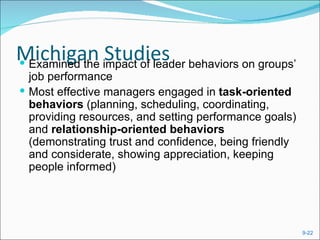
Michigan impact of leader behaviors on groups’
 Examined the
               Studies
  job performance
 Most effective managers engaged in task-oriented
  behaviors (planning, scheduling, coordinating,
  providing resources, and setting performance goals)
  and relationship-oriented behaviors
  (demonstrating trust and confidence, being friendly
  and considerate, showing appreciation, keeping
  people informed)


                                                        9-22
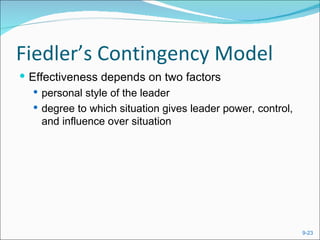
Fiedler’s Contingency Model
 Effectiveness depends on two factors
    personal style of the leader
    degree to which situation gives leader power, control,
     and influence over situation


                                                              9-23
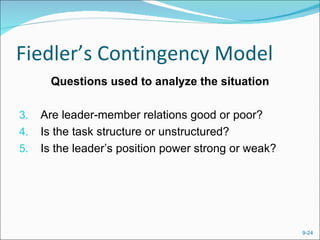
Fiedler’s Contingency Model
       Questions used to analyze the situation

3.   Are leader-member relations good or poor?
4.   Is the task structure or unstructured?
5.   Is the leader’s position power strong or weak?


                                                      9-24
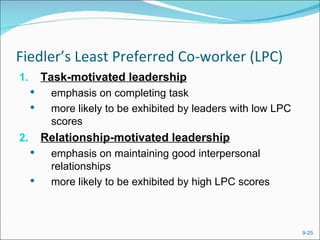
Fiedler’s Least Preferred Co-worker (LPC)
1.       Task-motivated leadership
         emphasis on completing task
         more likely to be exhibited by leaders with low LPC
          scores
2.       Relationship-motivated leadership
         emphasis on maintaining good interpersonal
          relationships
         more likely to be exhibited by high LPC scores


                                                                9-25
Substitutes for Leadership
Workplace factors that can exert same influence on
  employees as leaders
Group maintenance substitutes
 closely knit groups
 job is inherently satisfying
Task performance substitutes
 people with experience and ability
 rigid rules and procedures


                                                     9-26

Chap009 BUS137

  • 1.
    McGraw-Hill/Irwin 9-1 Copyright © 2009 by The McGraw-Hill Companies, Inc. All rights reserved.
  • 2.
    Learning Objectives L01: Similarities and differences between leading and managing  L02: Sources of power in organizations  L03: Personal traits and skills of effective leaders  L04: Distinguish between charismatic and transformational leaders  L05: Opportunities to be a leader in an organization  L06: How to further your own leadership development 9-2
  • 3.
    Vision – whatis it?  Mental image of a possible and desirable future state of the organization.  Expresses the leader’s ambitions for the organization.  Creates high performance aspirations, the nature of corporate or business strategy, or the kind of workplace. Without vision, managers do not develop into strong leaders 9-3
  • 4.
    Leading and Managing Leading Managing -setting the direction -deal with ongoing day-to- -inspiring people to attain day complexities vision -requires planning and -keep people focused on budgeting routines moving organization -requires structuring toward its ideal future organization, staffing it -motivating people to with capable people, overcome obstacles and monitoring activities 9-4
  • 5.
    Leadership Styles  SupervisoryLeadership  provides guidance, support and corrective feedback for day-to-day activities  Strategic Leadership  gives purpose and meaning to organizations by anticipating and envisioning a viable future  works with others to initiate changes that create such a future 9-5
  • 6.
    Sources of Power R Legitimate power  right or authority to tell others what to do h Reward power  influences others because of control over rewards a Coercive power  control over punishment i Referent power  appealing personal characteristics a Expert power  expertise or knowledge that others can learn from or gain from 9-6
  • 7.
    Traditional Approaches toLeadership o Trait approach  focuses on individual leaders  determines personal characteristics that great leaders share d Behavioral approach  identifies what good leaders do  what behaviors they exhibit 9 Situational approach  effective leadership behavior varies from situation to situation 9-7
  • 8.
    Important Traits forLeaders  Drive  high level of effort; high need for achievement, constant striving to accomplish  Leadership motivation  extraverted, high need for power.  Integrity:  Honest, credible, “walks the walk”  Self-confidence  overcome obstacles, decide despite uncertainty  Knowledge of the business  high level of knowledge about their industries, companies, and technical matters; intelligent 9-8
  • 9.
    Decision Styles  Autocratic- “self”  leader makes decisions on his or her own and then announces those decisions to the group  Democratic leadership – “participative”  leader solicits input from others  Laissez-faire – “allow to do”  essentially makes no decisions  more negative attitudes and lower performance. 9-9
  • 10.
    Path-goal Theory  Howleaders influence subordinates’ perceptions of their work goals and the paths they follow toward attainment of those goals.  Two key situational factors  Personal characteristics of followers  Environmental pressures and demand with which followers must cope to attain their work goals 9-10
  • 11.
    Path-Goal Theory Four Pertinent Leadership Behaviors 3. Directive Leadership  form of task performance-oriented behavior 4. Supportive Leadership  form of group maintenance-oriented behavior 5. Participative Leadership  decision style 6. Achievement-oriented Leadership  behaviors geared toward motivating people 9-11
  • 12.
    Path-Goal Theory Three Key Follower Characteristics 3. Authoritarianism  degree to which individuals respect, admire, or defer to authority 4. Locus of control  extent to which individuals see environment as responsive to their own behavior 5. Ability  people’s beliefs about their own abilities to do their assigned jobs 9-12
  • 13.
    Path-Goal Theory Functions of the leader 2. Provide coaching and direction  Make path to work goals easier 3. Reduce frustrating barriers to goal attainment 4. Increase opportunities for personal satisfaction  Increase payoffs to people for achieving performance goals 9-13
  • 14.
    Contemporary Perspectives  Charismaticleader  dominant, exceptionally self-confident  strong conviction of moral righteousness  Transformational leader  motivates people to transcend their personal interests for good of group  Transactional leader  manage through transactions, using their legitimate, reward and coercive powers to give commands and exchange rewards for services rendered 9-14
  • 15.
    Nontraditional Leadership Roles  Servantleader  serves others’ needs while strengthening organization  Bridge leader  bridges conflicting value systems or different cultures  Shared leadership  rotating leadership  people rotate through leadership role based on which person has most relevant skills 9-15
  • 16.
    Good leaders needcourage  Seeing things as they are and facing them head-on, making no excuses and harboring no wishful illusions  Saying what needs to be said to those who need to hear it  Persisting despite resistance, criticism, abuse, and setbacks 9-16
  • 17.
  • 18.
    Vroom’s Model  Emphasizesparticipative dimension of leadership, i.e. how leaders go about making decisions.  Factors involved to analyze problems  decision significance  importance of commitment  leader’s expertise  likelihood of commitment  group support for objectives and group expertise  team competence 9-18
  • 19.
    Vroom’s Five LeaderDecision Styles d Decide  make decision alone  announce or sell it to group 2. Consult individually  present problem to group members individually  get suggestions, and then make decision 3. Consult group  present problem to group members  get suggestions, and then make decision 9-19
  • 20.
    Vroom’s Five LeaderDecision Styles 1. Facilitate  present problem to group in a meeting  act as facilitator to get ideas 2. Delegate  permit group to make decision within prescribed limits 9-20
  • 21.
    Ohio State Studies Examined performance and maintenance behaviors of leaders  Found that supervisors who scored high on maintenance behaviors had fewer grievances and less turnover in their work units than those who were low on this dimension  When a leader rates high on performance-oriented behaviors, he or she should also be maintenance- oriented. 9-21
  • 22.
    Michigan impact ofleader behaviors on groups’  Examined the Studies job performance  Most effective managers engaged in task-oriented behaviors (planning, scheduling, coordinating, providing resources, and setting performance goals) and relationship-oriented behaviors (demonstrating trust and confidence, being friendly and considerate, showing appreciation, keeping people informed) 9-22
  • 23.
    Fiedler’s Contingency Model Effectiveness depends on two factors  personal style of the leader  degree to which situation gives leader power, control, and influence over situation 9-23
  • 24.
    Fiedler’s Contingency Model Questions used to analyze the situation 3. Are leader-member relations good or poor? 4. Is the task structure or unstructured? 5. Is the leader’s position power strong or weak? 9-24
  • 25.
    Fiedler’s Least PreferredCo-worker (LPC) 1. Task-motivated leadership  emphasis on completing task  more likely to be exhibited by leaders with low LPC scores 2. Relationship-motivated leadership  emphasis on maintaining good interpersonal relationships  more likely to be exhibited by high LPC scores 9-25
  • 26.
    Substitutes for Leadership Workplacefactors that can exert same influence on employees as leaders Group maintenance substitutes  closely knit groups  job is inherently satisfying Task performance substitutes  people with experience and ability  rigid rules and procedures 9-26