LEADERSHIP
Team Members
Vinay Kumar. D
Srinavas Raju
Hussein Vali
Shruthi
Definition of Leadership:
Leadership refers to the relation between an
individual and a group around some common interest
and behaving in a manner directed or determined by
him. Leadership may be defined in terms of totality of
functions performed by executives as individuals and
as a group.
or
Leader is a person who leads his team in an
Organization or business for better results in doing
their task or job given
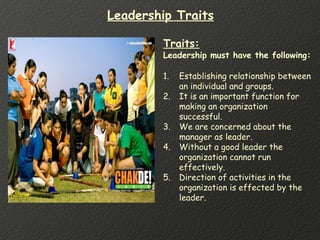
Traits:
Leadership must have the following:
1. Establishing relationship between
an individual and groups.
2. It is an important function for
making an organization
successful.
3. We are concerned about the
manager as leader.
4. Without a good leader the
organization cannot run
effectively.
5. Direction of activities in the
organization is effected by the
leader.
Leadership Traits
Motivating Employees:
Motivating is necessary for work performance. A good
leader by exercising his leadership motivates the employees
for high performance. Good leadership in an organization
itself motivates and understands an employee by doing this it
helps the leader to take individual attention and keeping the
motivation level high among the subordinates.
Creating Confidence:
A good leader may create confidence in his followers by
directing, giving advice and Getting good results in the
organization. he tries to maintain the level of confidence
towards his capacity.
Building Morale:
High moral leads to high productivity and organization stability.
Good leadership in an organization will raise high their employee`s
moral thus ensuring productivity and stability in the organization.
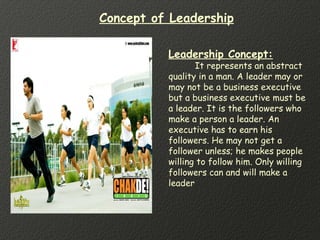
Leadership Concept:
It represents an abstract
quality in a man. A leader may or
may not be a business executive
but a business executive must be
a leader. It is the followers who
make a person a leader. An
executive has to earn his
followers. He may not get a
follower unless; he makes people
willing to follow him. Only willing
followers can and will make a
leader
Concept of Leadership
Characteristics of Leadership:
1. Leadership is a personal quality of character and behavior in a
man.
2. Attaining specified goals to the maximum satisfaction of both
the leader and the follower.
3. A leader must lead his group with authority and confidence.
4. A leader motivates his group to work for the attainment of a
goal.
5. It is a process of directing, guiding and influencing.
Theories of leadership:
1. Trait Theory
2. Behavioural Theory
3. Situational Theory
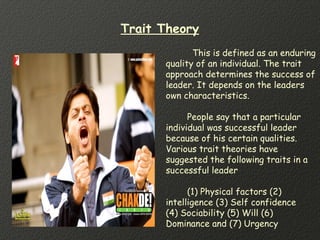
Trait Theory
This is defined as an enduring
quality of an individual. The trait
approach determines the success of
leader. It depends on the leaders
own characteristics.
People say that a particular
individual was successful leader
because of his certain qualities.
Various trait theories have
suggested the following traits in a
successful leader
(1) Physical factors (2)
intelligence (3) Self confidence
(4) Sociability (5) Will (6)
Dominance and (7) Urgency
There are variations in trait established by various
researches they are;
No Common traits:
There cannot be common traits for a successful leader.
his was evident by various researches conducted on leadership
raits.
Degree of traits:
No evidence has been given about the degree of the
Various traits. The degree varies.
Problem of Measurement:
There is a problem of measuring traits. The various
ests cannot give definite conclusion. There have been many people
with the traits specified for leader, but they were not good leaders.
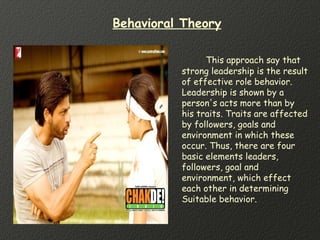
Behavioral Theory
This approach say that
strong leadership is the result
of effective role behavior.
Leadership is shown by a
person's acts more than by
his traits. Traits are affected
by followers, goals and
environment in which these
occur. Thus, there are four
basic elements leaders,
followers, goal and
environment, which effect
each other in determining
Suitable behavior.
Situational Theory
The prime attention is given to the situation in which
Leadership is exercised. Research is being done to the
situation that surrounds the exercise of leadership. The point
is that in one situation leader may be successful while in
others he may not. Ohio state university research has given
Four situation variables that affect the performance of
Leadership.
They are
1. The cultural environment
2. Differences between individuals
3. Differences between jobs
4. Differences between organization
Leadership (with example)

Leadership (with example)

  • 1.
    LEADERSHIP Team Members Vinay Kumar.D Srinavas Raju Hussein Vali Shruthi
  • 2.
    Definition of Leadership: Leadershiprefers to the relation between an individual and a group around some common interest and behaving in a manner directed or determined by him. Leadership may be defined in terms of totality of functions performed by executives as individuals and as a group. or Leader is a person who leads his team in an Organization or business for better results in doing their task or job given
  • 3.
    Traits: Leadership must havethe following: 1. Establishing relationship between an individual and groups. 2. It is an important function for making an organization successful. 3. We are concerned about the manager as leader. 4. Without a good leader the organization cannot run effectively. 5. Direction of activities in the organization is effected by the leader. Leadership Traits
  • 4.
    Motivating Employees: Motivating isnecessary for work performance. A good leader by exercising his leadership motivates the employees for high performance. Good leadership in an organization itself motivates and understands an employee by doing this it helps the leader to take individual attention and keeping the motivation level high among the subordinates. Creating Confidence: A good leader may create confidence in his followers by directing, giving advice and Getting good results in the organization. he tries to maintain the level of confidence towards his capacity. Building Morale: High moral leads to high productivity and organization stability. Good leadership in an organization will raise high their employee`s moral thus ensuring productivity and stability in the organization.
  • 6.
    Leadership Concept: It representsan abstract quality in a man. A leader may or may not be a business executive but a business executive must be a leader. It is the followers who make a person a leader. An executive has to earn his followers. He may not get a follower unless; he makes people willing to follow him. Only willing followers can and will make a leader Concept of Leadership
  • 7.
    Characteristics of Leadership: 1.Leadership is a personal quality of character and behavior in a man. 2. Attaining specified goals to the maximum satisfaction of both the leader and the follower. 3. A leader must lead his group with authority and confidence. 4. A leader motivates his group to work for the attainment of a goal. 5. It is a process of directing, guiding and influencing. Theories of leadership: 1. Trait Theory 2. Behavioural Theory 3. Situational Theory
  • 8.
    Trait Theory This isdefined as an enduring quality of an individual. The trait approach determines the success of leader. It depends on the leaders own characteristics. People say that a particular individual was successful leader because of his certain qualities. Various trait theories have suggested the following traits in a successful leader (1) Physical factors (2) intelligence (3) Self confidence (4) Sociability (5) Will (6) Dominance and (7) Urgency
  • 10.
    There are variationsin trait established by various researches they are; No Common traits: There cannot be common traits for a successful leader. his was evident by various researches conducted on leadership raits. Degree of traits: No evidence has been given about the degree of the Various traits. The degree varies. Problem of Measurement: There is a problem of measuring traits. The various ests cannot give definite conclusion. There have been many people with the traits specified for leader, but they were not good leaders.
  • 11.
    Behavioral Theory This approachsay that strong leadership is the result of effective role behavior. Leadership is shown by a person's acts more than by his traits. Traits are affected by followers, goals and environment in which these occur. Thus, there are four basic elements leaders, followers, goal and environment, which effect each other in determining Suitable behavior.
  • 12.
    Situational Theory The primeattention is given to the situation in which Leadership is exercised. Research is being done to the situation that surrounds the exercise of leadership. The point is that in one situation leader may be successful while in others he may not. Ohio state university research has given Four situation variables that affect the performance of Leadership. They are 1. The cultural environment 2. Differences between individuals 3. Differences between jobs 4. Differences between organization