By: S Peter
Effective leadership is
putting first thing first
Effective management is
DISCIPLINE – carrying it
out
Managers have subordinates
Authoritarian, transactional style
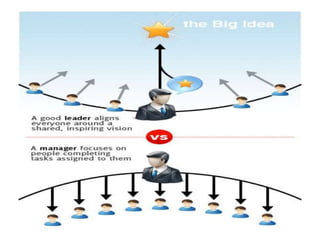
Work focus
Seek comfort
Leaders have followers
Charismatic, transformational style
People focus
Seek risk
Management Functions
1.Planning ----------Action plans
2. Organizing ------Chain of command
3. Commanding Transformed to leading
4. Controlling
5. Controlling --- Performance measuring
Inspired leaders are not
necessarily good organizers and
excellent managers
The most effective managers are
also leaders
And the quality of leadership has
become and increasingly important
part of management ability
Leadership Styles
Coercive – Do what I tell you
Affiliative – People come first
Pacesetting – Do as I do , Now
Authoritative – Come with me
Democratic – What do you think?
Coaching – Try this
Leadership Vs Management
“Managers are people who do things
right and Leaders are people who
do the things right”
Peter Drucker
Management Vs Leadership
3 Assumptions
Leadership equals management
Leadership and management are not
equal
Leadership and management are
complementary
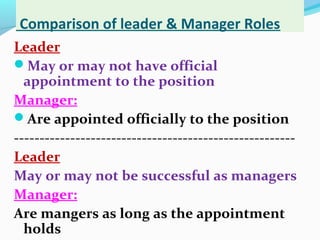
Comparison of leader & Manager Roles
Leader
May or may not have official
appointment to the position
Manager:
Are appointed officially to the position
-------------------------------------------------------
Leader
May or may not be successful as managers
Manager:
Are mangers as long as the appointment
holds
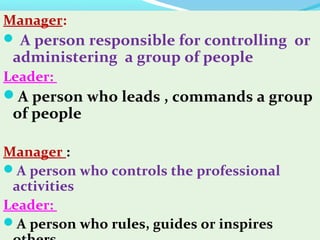
Manager:
 A person responsible for controlling or
administering a group of people
Leader:
A person who leads , commands a group
of people
Manager :
A person who controls the professional
activities
Leader:
A person who rules, guides or inspires
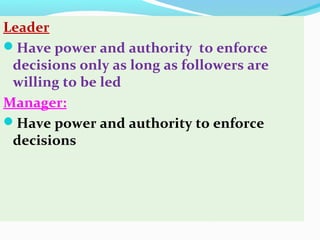
Leader
Have power and authority to enforce
decisions only as long as followers are
willing to be led
Manager:
Have power and authority to enforce
decisions
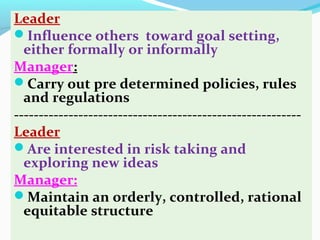
Leader
Influence others toward goal setting,
either formally or informally
Manager:
Carry out pre determined policies, rules
and regulations
----------------------------------------------------------
Leader
Are interested in risk taking and
exploring new ideas
Manager:
Maintain an orderly, controlled, rational
equitable structure
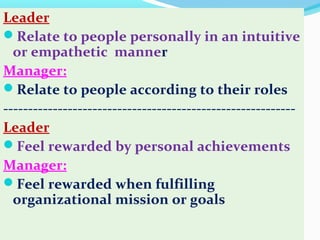
Leader
Relate to people personally in an intuitive
or empathetic manner
Manager:
Relate to people according to their roles
-----------------------------------------------------------
Leader
Feel rewarded by personal achievements
Manager:
Feel rewarded when fulfilling
organizational mission or goals
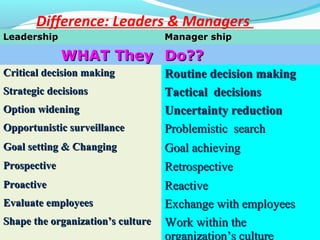
Difference: Leaders & Managers
LeadershipLeadership Manager shipManager ship
WHAT TheyWHAT They Do??Do??
Critical decision makingCritical decision making Routine decision makingRoutine decision making
Strategic decisionsStrategic decisions Tactical decisionsTactical decisions
Option wideningOption widening Uncertainty reductionUncertainty reduction
Opportunistic surveillanceOpportunistic surveillance Problemistic searchProblemistic search
Goal setting & ChangingGoal setting & Changing Goal achievingGoal achieving
ProspectiveProspective RetrospectiveRetrospective
ProactiveProactive ReactiveReactive
Evaluate employeesEvaluate employees Exchange with employeesExchange with employees
Shape the organization’s cultureShape the organization’s culture Work within theWork within the
organization’s culture
LeadershipLeadership Manager shipManager ship
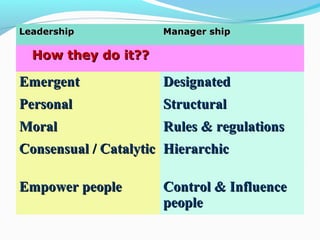
How they do it??How they do it??
EmergentEmergent DesignatedDesignated
PersonalPersonal StructuralStructural
MoralMoral Rules & regulationsRules & regulations
Consensual / CatalyticConsensual / Catalytic HierarchicHierarchic
Empower peopleEmpower people Control & InfluenceControl & Influence
peoplepeople
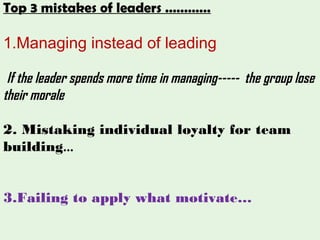
Top 3 mistakes of leaders …………
1.Managing instead of leading
If the leader spends more time in managing----- the group lose
their morale
2. Mistaking individual loyalty for team
building…
3.Failing to apply what motivate…
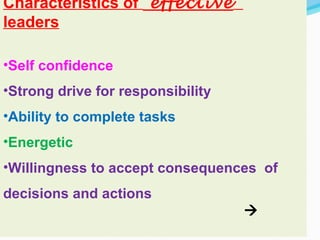
Characteristics of effective
leaders
•Self confidence
•Strong drive for responsibility
•Ability to complete tasks
•Energetic
•Willingness to accept consequences of
decisions and actions


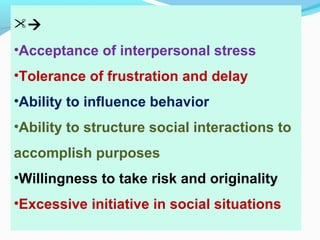
•Acceptance of interpersonal stress
•Tolerance of frustration and delay
•Ability to influence behavior
•Ability to structure social interactions to
accomplish purposes
•Willingness to take risk and originality
•Excessive initiative in social situations
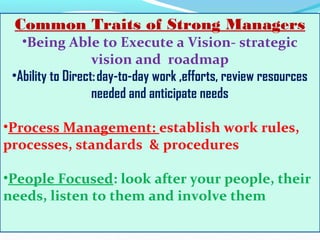
Common Traits of Strong Managers
•Being Able to Execute a Vision- strategic
vision and roadmap
•Ability to Direct: day-to-day work ,efforts, review resources
needed and anticipate needs
•Process Management: establish work rules,
processes, standards & procedures
•People Focused: look after your people, their
needs, listen to them and involve them
•Leadership and management must
go hand in hand.
•They are not the same thing
•But they are necessarily linked, and
complementary.
•Any effort to separate the two is
likely to cause more problems than
it solves.
. The manager’s job is to plan,
organize and coordinate.
?
Leader Vs Manager

Leader Vs Manager

  • 1.
  • 2.
    Effective leadership is puttingfirst thing first Effective management is DISCIPLINE – carrying it out
  • 3.
    Managers have subordinates Authoritarian,transactional style Work focus Seek comfort Leaders have followers Charismatic, transformational style People focus Seek risk
  • 4.
    Management Functions 1.Planning ----------Actionplans 2. Organizing ------Chain of command 3. Commanding Transformed to leading 4. Controlling 5. Controlling --- Performance measuring
  • 5.
    Inspired leaders arenot necessarily good organizers and excellent managers The most effective managers are also leaders And the quality of leadership has become and increasingly important part of management ability
  • 6.
    Leadership Styles Coercive –Do what I tell you Affiliative – People come first Pacesetting – Do as I do , Now Authoritative – Come with me Democratic – What do you think? Coaching – Try this
  • 7.
    Leadership Vs Management “Managersare people who do things right and Leaders are people who do the things right” Peter Drucker
  • 8.
    Management Vs Leadership 3Assumptions Leadership equals management Leadership and management are not equal Leadership and management are complementary
  • 9.
    Comparison of leader& Manager Roles Leader May or may not have official appointment to the position Manager: Are appointed officially to the position ------------------------------------------------------- Leader May or may not be successful as managers Manager: Are mangers as long as the appointment holds
  • 10.
    Manager:  A personresponsible for controlling or administering a group of people Leader: A person who leads , commands a group of people Manager : A person who controls the professional activities Leader: A person who rules, guides or inspires
  • 11.
    Leader Have power andauthority to enforce decisions only as long as followers are willing to be led Manager: Have power and authority to enforce decisions
  • 12.
    Leader Influence others towardgoal setting, either formally or informally Manager: Carry out pre determined policies, rules and regulations ---------------------------------------------------------- Leader Are interested in risk taking and exploring new ideas Manager: Maintain an orderly, controlled, rational equitable structure
  • 13.
    Leader Relate to peoplepersonally in an intuitive or empathetic manner Manager: Relate to people according to their roles ----------------------------------------------------------- Leader Feel rewarded by personal achievements Manager: Feel rewarded when fulfilling organizational mission or goals
  • 14.
    Difference: Leaders &Managers LeadershipLeadership Manager shipManager ship WHAT TheyWHAT They Do??Do?? Critical decision makingCritical decision making Routine decision makingRoutine decision making Strategic decisionsStrategic decisions Tactical decisionsTactical decisions Option wideningOption widening Uncertainty reductionUncertainty reduction Opportunistic surveillanceOpportunistic surveillance Problemistic searchProblemistic search Goal setting & ChangingGoal setting & Changing Goal achievingGoal achieving ProspectiveProspective RetrospectiveRetrospective ProactiveProactive ReactiveReactive Evaluate employeesEvaluate employees Exchange with employeesExchange with employees Shape the organization’s cultureShape the organization’s culture Work within theWork within the organization’s culture
  • 15.
    LeadershipLeadership Manager shipManagership How they do it??How they do it?? EmergentEmergent DesignatedDesignated PersonalPersonal StructuralStructural MoralMoral Rules & regulationsRules & regulations Consensual / CatalyticConsensual / Catalytic HierarchicHierarchic Empower peopleEmpower people Control & InfluenceControl & Influence peoplepeople
  • 17.
    Top 3 mistakesof leaders ………… 1.Managing instead of leading If the leader spends more time in managing----- the group lose their morale 2. Mistaking individual loyalty for team building… 3.Failing to apply what motivate…
  • 18.
    Characteristics of effective leaders •Selfconfidence •Strong drive for responsibility •Ability to complete tasks •Energetic •Willingness to accept consequences of decisions and actions 
  • 19.
     •Acceptance of interpersonalstress •Tolerance of frustration and delay •Ability to influence behavior •Ability to structure social interactions to accomplish purposes •Willingness to take risk and originality •Excessive initiative in social situations
  • 20.
    Common Traits ofStrong Managers •Being Able to Execute a Vision- strategic vision and roadmap •Ability to Direct: day-to-day work ,efforts, review resources needed and anticipate needs •Process Management: establish work rules, processes, standards & procedures •People Focused: look after your people, their needs, listen to them and involve them
  • 22.
    •Leadership and managementmust go hand in hand. •They are not the same thing •But they are necessarily linked, and complementary. •Any effort to separate the two is likely to cause more problems than it solves. . The manager’s job is to plan, organize and coordinate.
  • 23.