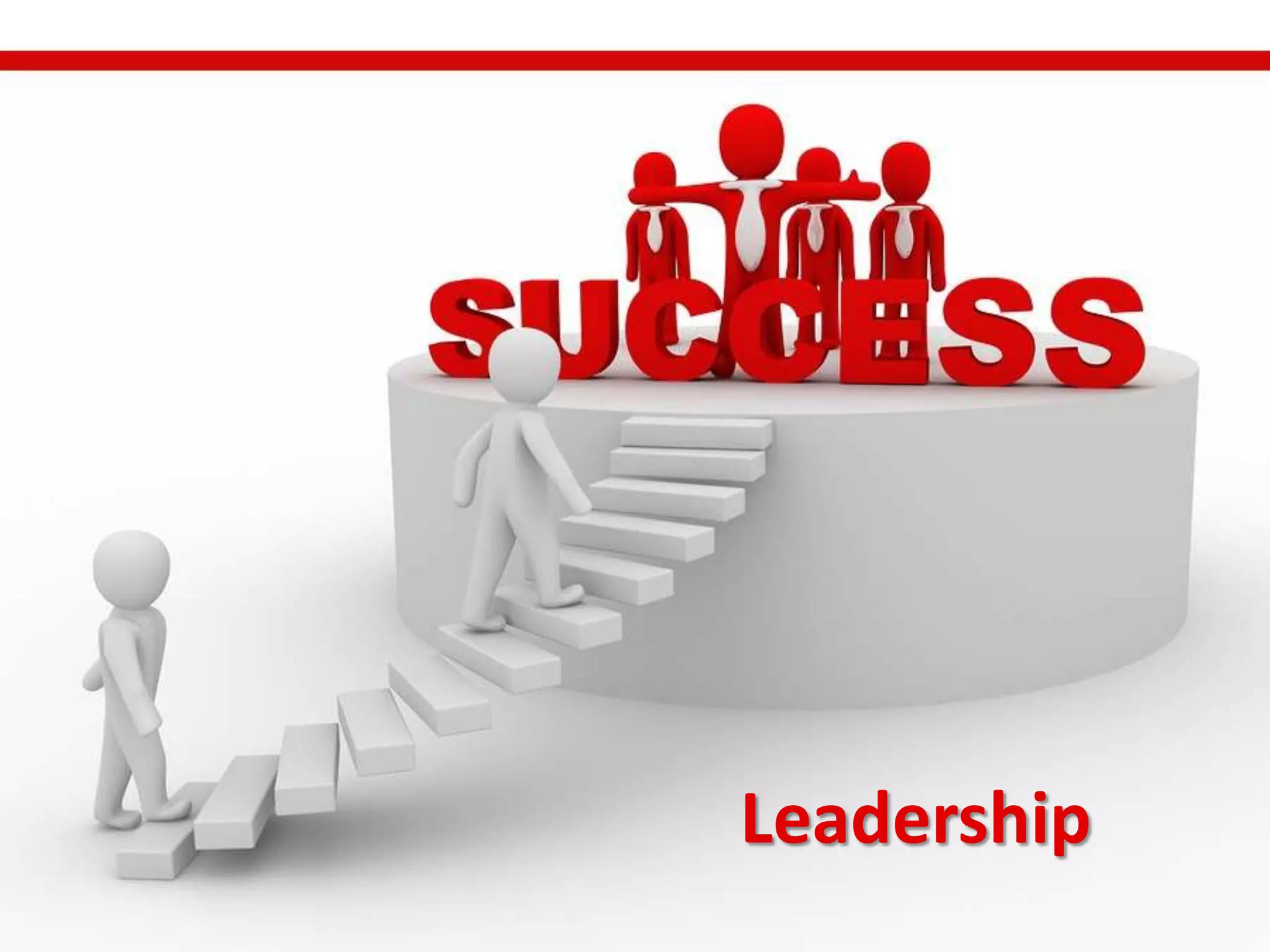
Leadership
    StoryA group of workers and their leaders are set a task of clearing a road through a dense jungle on a remote island to get to the coast where an estuary provides  a perfect site for a port. The leaders organise the labour into efficient units and monitor the distribution and use of capital assets – progress is excellent. The leaders continue to monitor and evaluate progress, making adjustments along the way to ensure the progress is maintained and efficiency increased wherever possible. Then, one day amidst all the hustle and bustle and activity, one person climbs up a nearby tree. The person surveys the scene from the top of the tree.
Leadership StoryAnd shouts down to the assembled group below…“Wrong Way!”(Story adapted from Stephen Covey (2004) “The Seven Habits of Highly Effective People” Simon & Schuster).“Management is doing things right, leadership is doing the right things”    (Warren Bennis and Peter Drucker)
DefinitionThe ability to positively influence people and systems to have a meaningful impact and achieve results.Leading People
Influencing People
Commanding People
Guiding  PeopleCharacteristics of LeadershipLeader must have followersIt is working relationship between leader and followersPurpose is to achieve some common goal or goalsA leader influences his followers willingly not by forceLeadership is exercised in a given situationLeadership is a power relationshipIt is a continuous process
A Question…A leader need not be a manager but a manager must have many of the qualities of a good leader?????Managerial Leadership
SignificanceSetting GoalsMotivating EmployeesBuilding moraleCreating ConfidenceDisciplineDeveloping Team-workFacilitates ChangeRepresenting the group
Leadership Styles Leader by the position achieved
 Leader by personality, charisma
 Leader by moral example
 Leader by power held
 Intellectual leader
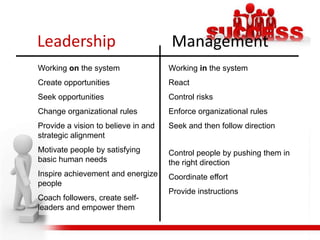
 Leader because of ability to accomplish thingsLeadershipManagementWorking in the systemReactControl risksEnforce organizational rulesSeek and then follow directionControl people by pushing them in the right directionCoordinate effortProvide instructionsWorking on the systemCreate opportunitiesSeek opportunitiesChange organizational rulesProvide a vision to believe in and strategic alignmentMotivate people by satisfying basic human needsInspire achievement and energize peopleCoach followers, create self-leaders and empower them
LeadershipManagementEstablishing DirectionDevelop future visionDevelop change strategies to achieve visionAligning PeopleCommunicate directly by words & deeds to those whose cooperation neededInfluence creation of coalition/teams that understand & accept vision and strategiesMotivating/inspiringEnergy to overcome barriers (ex. Political resource, bureaucratic) to change by satisfying basic needsTends to ProduceChange often dramaticProvides potential for very useful change (ex. New products)Planning/BudgetingDevelop detailed steps/ timetables for resultsAllocate necessary resourcesOrganizing/StaffingDevelop necessary planning, staffing, delegation structuresProvide policies/procedures for guidance and methods/systems for monitoringControl/Problem SolvingMonitor results vs. plan in detailIdentify results/plan deviations and plan and organize to correctTends to ProduceOrder/predictabilityKey results expected by stakeholdersAgendaNetwork Development for Agenda AchievementExecutionOutcomes
The manager administers; the leader innovates.
The manager maintains; the leader develops.
The manager accepts reality; the leader investigates it.
The manager focuses on systems and structures; the leader focuses on people.
The manager relies on control; the leader inspires trust.
The manager has a short-range view; the leader has a long-range perspective.
The manager asks how and when; the leader asks what and why.
The manager has his or her eye always on the bottom line; the leader has his or her eye on the horizon.
The manager imitates; the leader originates.
The manager accepts the status quo; the leader challenges it.
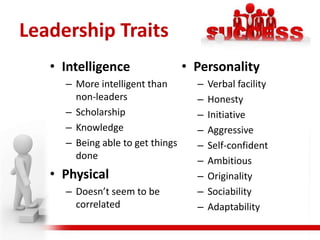
The manager is the classic good soldier; the leader is his or her own person.Leadership TraitsIntelligenceMore intelligent than non-leadersScholarshipKnowledgeBeing able to get things donePhysicalDoesn’t seem to be correlatedPersonality Verbal facility Honesty InitiativeAggressiveSelf-confidentAmbitiousOriginalitySociabilityAdaptability
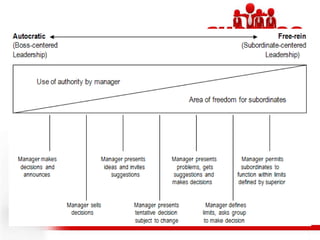
Leadership stylesAutocratic: Leader makes decisions without reference to anyone else
 High degree of dependency on the leader
 Can create de-motivation and alienation of staff
 May be valuable in some types of business where decisions need to be made quickly and decisivelyDemocratic:Encourages decision making from different perspectives – leadership may be emphasised throughout  the organisationConsultative: process of consultation before decisions are takenPersuasive: Leader takes decision and seeks to persuade others that the decision is correct
Laissez-Faire:‘Let it be’ – the leadership responsibilities are shared by allCan be very useful in businesses where creative ideas are importantCan be highly motivational, as people have control over their working lifeCan make coordination and decision making time-consuming and lacking in overall directionRelies on good team workRelies on good interpersonal relations
Paternalistic: Leader acts as a ‘father figure’
 Paternalistic leader makes decision but may consult

Leadership

  • 1.
  • 2.
    StoryA group of workers and their leaders are set a task of clearing a road through a dense jungle on a remote island to get to the coast where an estuary provides a perfect site for a port. The leaders organise the labour into efficient units and monitor the distribution and use of capital assets – progress is excellent. The leaders continue to monitor and evaluate progress, making adjustments along the way to ensure the progress is maintained and efficiency increased wherever possible. Then, one day amidst all the hustle and bustle and activity, one person climbs up a nearby tree. The person surveys the scene from the top of the tree.
  • 3.
    Leadership StoryAnd shoutsdown to the assembled group below…“Wrong Way!”(Story adapted from Stephen Covey (2004) “The Seven Habits of Highly Effective People” Simon & Schuster).“Management is doing things right, leadership is doing the right things” (Warren Bennis and Peter Drucker)
  • 4.
    DefinitionThe ability topositively influence people and systems to have a meaningful impact and achieve results.Leading People
  • 5.
  • 6.
  • 7.
    Guiding PeopleCharacteristicsof LeadershipLeader must have followersIt is working relationship between leader and followersPurpose is to achieve some common goal or goalsA leader influences his followers willingly not by forceLeadership is exercised in a given situationLeadership is a power relationshipIt is a continuous process
  • 8.
    A Question…A leaderneed not be a manager but a manager must have many of the qualities of a good leader?????Managerial Leadership
  • 9.
    SignificanceSetting GoalsMotivating EmployeesBuildingmoraleCreating ConfidenceDisciplineDeveloping Team-workFacilitates ChangeRepresenting the group
  • 10.
    Leadership Styles Leaderby the position achieved
  • 11.
    Leader bypersonality, charisma
  • 12.
    Leader bymoral example
  • 13.
    Leader bypower held
  • 14.
  • 15.
    Leader becauseof ability to accomplish thingsLeadershipManagementWorking in the systemReactControl risksEnforce organizational rulesSeek and then follow directionControl people by pushing them in the right directionCoordinate effortProvide instructionsWorking on the systemCreate opportunitiesSeek opportunitiesChange organizational rulesProvide a vision to believe in and strategic alignmentMotivate people by satisfying basic human needsInspire achievement and energize peopleCoach followers, create self-leaders and empower them
  • 16.
    LeadershipManagementEstablishing DirectionDevelop futurevisionDevelop change strategies to achieve visionAligning PeopleCommunicate directly by words & deeds to those whose cooperation neededInfluence creation of coalition/teams that understand & accept vision and strategiesMotivating/inspiringEnergy to overcome barriers (ex. Political resource, bureaucratic) to change by satisfying basic needsTends to ProduceChange often dramaticProvides potential for very useful change (ex. New products)Planning/BudgetingDevelop detailed steps/ timetables for resultsAllocate necessary resourcesOrganizing/StaffingDevelop necessary planning, staffing, delegation structuresProvide policies/procedures for guidance and methods/systems for monitoringControl/Problem SolvingMonitor results vs. plan in detailIdentify results/plan deviations and plan and organize to correctTends to ProduceOrder/predictabilityKey results expected by stakeholdersAgendaNetwork Development for Agenda AchievementExecutionOutcomes
  • 17.
    The manager administers;the leader innovates.
  • 18.
    The manager maintains;the leader develops.
  • 19.
    The manager acceptsreality; the leader investigates it.
  • 20.
    The manager focuseson systems and structures; the leader focuses on people.
  • 21.
    The manager relieson control; the leader inspires trust.
  • 22.
    The manager hasa short-range view; the leader has a long-range perspective.
  • 23.
    The manager askshow and when; the leader asks what and why.
  • 24.
    The manager hashis or her eye always on the bottom line; the leader has his or her eye on the horizon.
  • 25.
    The manager imitates;the leader originates.
  • 26.
    The manager acceptsthe status quo; the leader challenges it.
  • 27.
    The manager isthe classic good soldier; the leader is his or her own person.Leadership TraitsIntelligenceMore intelligent than non-leadersScholarshipKnowledgeBeing able to get things donePhysicalDoesn’t seem to be correlatedPersonality Verbal facility Honesty InitiativeAggressiveSelf-confidentAmbitiousOriginalitySociabilityAdaptability
  • 28.
    Leadership stylesAutocratic: Leadermakes decisions without reference to anyone else
  • 29.
    High degreeof dependency on the leader
  • 30.
    Can createde-motivation and alienation of staff
  • 31.
    May bevaluable in some types of business where decisions need to be made quickly and decisivelyDemocratic:Encourages decision making from different perspectives – leadership may be emphasised throughout the organisationConsultative: process of consultation before decisions are takenPersuasive: Leader takes decision and seeks to persuade others that the decision is correct
  • 32.
    Laissez-Faire:‘Let it be’– the leadership responsibilities are shared by allCan be very useful in businesses where creative ideas are importantCan be highly motivational, as people have control over their working lifeCan make coordination and decision making time-consuming and lacking in overall directionRelies on good team workRelies on good interpersonal relations
  • 33.
    Paternalistic: Leader actsas a ‘father figure’
  • 34.
    Paternalistic leadermakes decision but may consult

Editor's Notes