Master Gardener Lawns
Cliff Ruth
Extension Area Agent
NCSU/NCCES
Select Turf Based on the Following:
‱ CLIMATE - NC is in the transition zone
‱ TYPE OF LAWN DESIRED - Will lawn be grown for
show, outdoor living, play area, etc.
‱ MAINTENANCE REQUIREMENTS
‱ SITE CONSIDERATIONS - Shade, slope, air circulation,
exposure and other microclimatic effects
Warm Season Grasses
‱ BERMUDAGRASS
‱ ZOYSIAGRASS
‱ CENTIPEDEGRASS
‱ ST. AUGUSTINEGRASS
‱ BAHIAGRASS
Cool-Season Grasses
GROW WELL IN SPRING AND FALL; MAY GO
“DORMANT” IN SUMMER
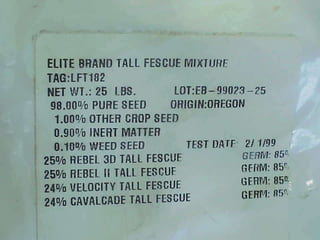
‱ Tall Fescue
‱ Kentucky Bluegrass
‱ Fine Fescue (creeping red fescue, hard fescue, sheeps
fescue)
‱ Ryegrass (Annual or Perennial)
‱ Bentgrass
Starting a New Lawn
‱ Cool-season grasses best planted in the Fall
‱ Warm-season grasses best planted April - July
‱ Good site preparation is essential
6 Steps to a Healthy Lawn
‱ Select the right grass
‱ Soil test
‱ Plant correctly
‱ Fertilize correctly
‱ Mow correctly
‱ Water correctly
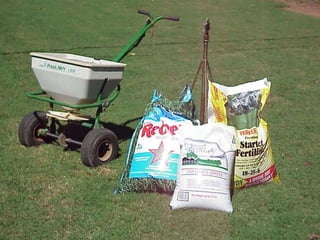
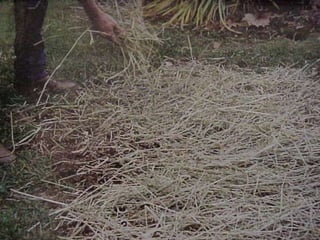
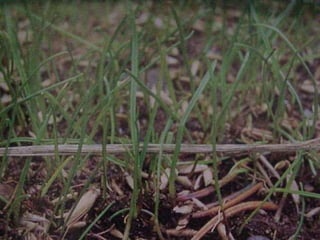
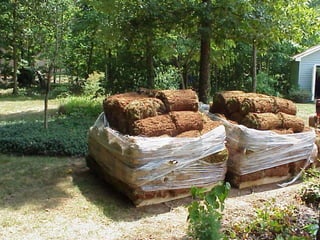
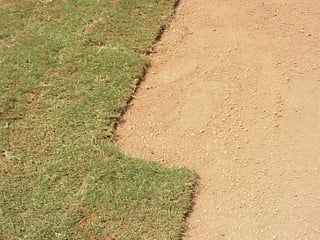
Planting
‱ SEEDING
‱ SPRIGGING
‱ PLUGGING
‱ SODDING
Site Preparation
‱ CONTROL PERENNIAL WEEDS (EX.
BERMUDAGRASS)
‱ PROPER GRADING AND DEBRIS REMOVAL
‱ LIME AND FERTILIZE ACCORDING TO SOIL TEST
(75# LIME AND 40# 5-10-10)
Reseeding - Partial Renovation
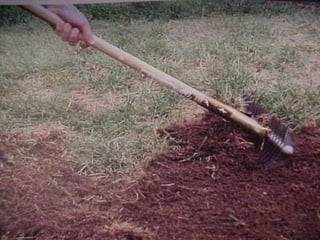
‱ GOOD SEED/SOIL CONTACT IS ESSENTIAL
‱ RAKE SMALL AREAS
‱ CORE AERATION FOR LARGER AREAS
‱ SLIT SEEDER
Irrigation
‱ IT IS DIFFICULT TO EFFECTIVELY IRRIGATE
WITHOUT A PERMANENT SYSTEM
‱ CONSIDER ALLOWING COOL-SEASON TURF TO GO
DORMANT
Irrigation
‱ IMPROPER IRRIGATION RESULTS IN WASTE,
ADDED COST, AND UNHEALTHY PLANTS
‱ APPLY WATER AT FIRST SIGNS OF MOISTURE
STRESS
‱ EARLY MORNING (2-8 AM) IS THE BEST TIME TO
IRRIGATE
Irrigation
‱ ESTABLISHED LAWNS SHOULD BE WATERED TO A
DEPTH OF 4-6 INCHES OR APPROXIMATELY 1” PER
WEEK (640 GALLONS PER 1000 SQ. FT.)
‱ KEY FOR NEW LAWNS
KEEP TOP 1/2 INCH MOIST.
GRADUALLY WEAN TURF AFTER 15 TO 20 DAYS
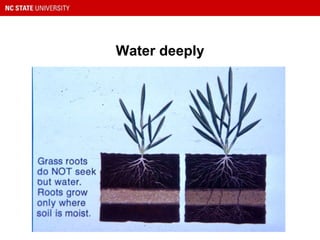
Water deeply
Mowing
‱ PROPER MOWING IS KEY TO LONG-TERM LAWN
SURVIVAL
‱ CLEANEST CUT AND BEST MOWING IS OBTAINED
WITH SHARP BLADES
‱ MOW OFTEN ENOUGH THAT NO MORE THAN 50%
OF LEAF SURFACE IS REMOVED
Mowing
‱ TALL FESCUE AND KY. BLUGRASS SHOULD BE
MAINTAINED AT 2.5 TO 3.5 INCHES
‱ IT IS NOT NECESSARY TO BAG CLIPPINGS UNLESS
EXCESSIVE
‱ CLIPPINGS DO NOT CAUSE THATCH
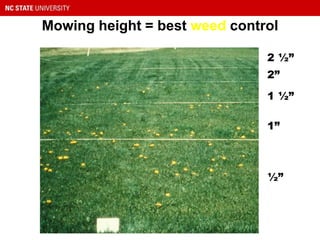
‱ MOWING TOO LOW = WEEDS!
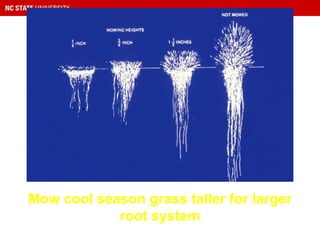
Mow cool season grass taller for larger
root system
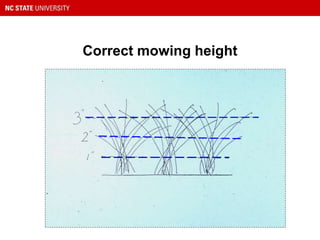
Correct mowing height
Mowing height = best weed control
2 œ”
2”
1 œ”
1”
œ”
Reasons to leave clippings on
the lawn
‱ Less work
‱ No longer accepted in
NC landfills
‱ Acts as mulch:
– Moisture retention
– Weed suppression
Nutrient recycling
100 lb dry clippings:
4 lb. N
œ lb. P
3 lb. K
Fertilization
‱ SOIL TEST EVERY 2-3 YEARS
‱ AVOID FERTILIZING COOL SEASON GRASSES
AFTER LATE MARCH AND BEFORE LATE AUGUST
‱ HOLIDAY REMINDERS: VALENTINES DAY, LABOR
DAY, AND THANKSGIVING DAY
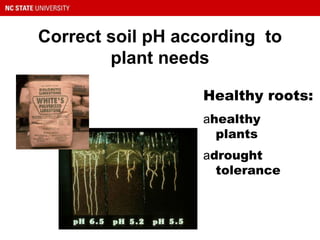
LIME
‱ MOST UNLIMED NC PIEDMONT AND MOUNTAIN
SOILS ARE ACIDIC (PH 5.5 OR LESS)
‱ ALL TURFGRASSES EXCEPT CENTIPEDEGRASS
GROW BEST AT 6.0 TO 7.0
‱ LIME RAISES PH AND PROVIDES CA AND MG
Correct soil pH according to
plant needs
Healthy roots:
ahealthy
plants
adrought
tolerance
Coring (Aerification)
‱ Best method to reduce compaction & improve water
penetration
‱ Use hollow tines which remove plugs
‱ Core during active growth
– Quick recover
Weed Control
‱ Winter Annuals (Ex. Annual bluegrass, chickweed, wild
onions, and henbit)
‱ Summer Annuals (Ex. Wild lespedeza, crabgrass, and
goosegrass, foxtail)
‱ Perennials (Ex. White clover, dandelions, and plantains)
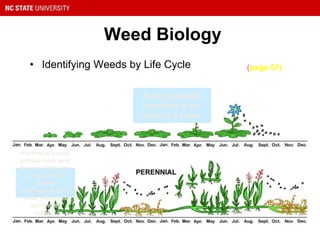
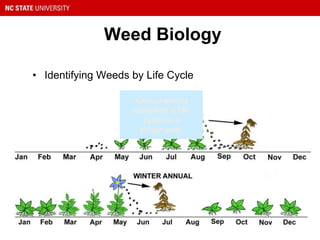
Weed Biology
‱ Identifying Weeds by Life Cycle (page 51)
Biennial weeds
complete a life
cycle in 2 years.
Perennial weeds
persist from year
to year. They can
be spread by
seeds
and regrow from
roots, rhizomes,
stolons or
tubers.
Weed Biology
‱ Identifying Weeds by Life Cycle
Annual weeds
complete a life
cycle in a
single year.
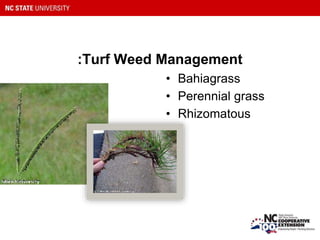
:Turf Weed Management
‱ Bahiagrass
‱ Perennial grass
‱ Rhizomatous
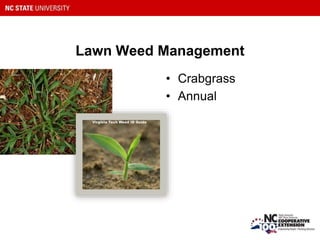
Lawn Weed Management
‱ Crabgrass
‱ Annual
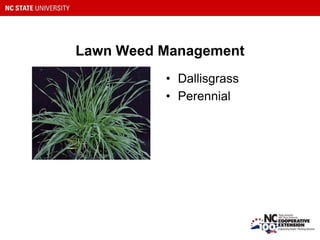
Lawn Weed Management
‱ Dallisgrass
‱ Perennial
Lawn Weed Management
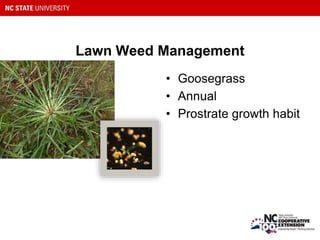
‱ Goosegrass
‱ Annual
‱ Prostrate growth habit
Lawn Weed Management
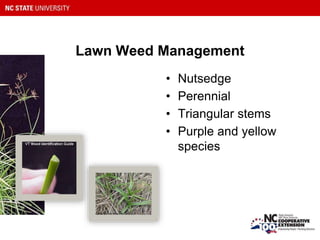
‱ Nutsedge
‱ Perennial
‱ Triangular stems
‱ Purple and yellow
species
Lawn Weed Management
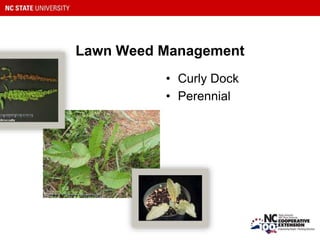
‱ Curly Dock
‱ Perennial
Lawn Weed Management
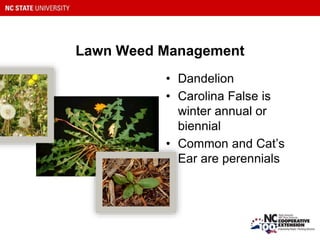
‱ Dandelion
‱ Carolina False is
winter annual or
biennial
‱ Common and Cat’s
Ear are perennials
Pasture Weed Management
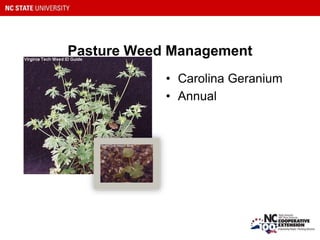
‱ Carolina Geranium
‱ Annual
Lawn Weed Management
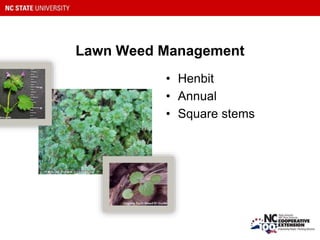
‱ Henbit
‱ Annual
‱ Square stems
Lawn Weed Management
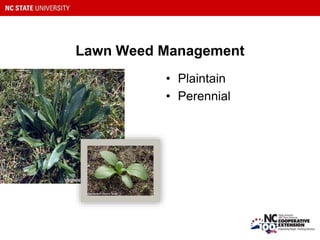
‱ Plaintain
‱ Perennial
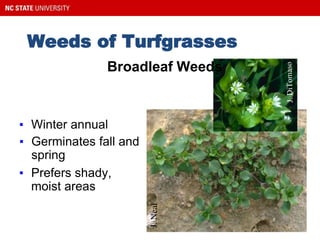
Weeds of Turfgrasses
Common Chickweed
â–Ș Winter annual
â–Ș Germinates fall and
spring
â–Ș Prefers shady,
moist areas
Broadleaf Weeds
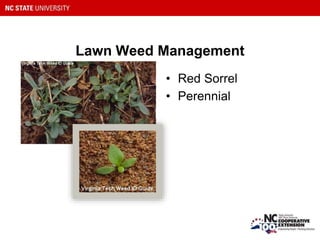
Lawn Weed Management
‱ Red Sorrel
‱ Perennial
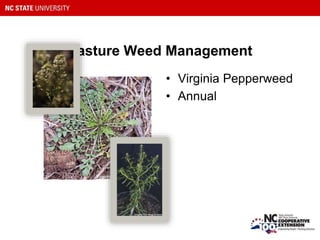
Pasture Weed Management
‱ Virginia Pepperweed
‱ Annual
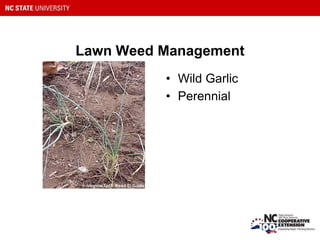
Lawn Weed Management
‱ Wild Garlic
‱ Perennial
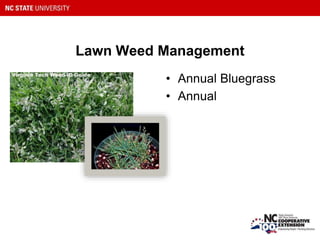
Lawn Weed Management
‱ Annual Bluegrass
‱ Annual
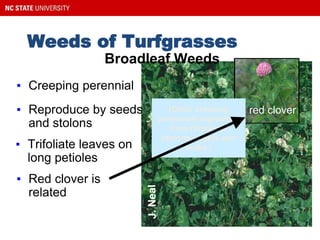
Weeds of Turfgrasses
â–Ș Creeping perennial
White clover
â–Ș Trifoliate leaves on
long petioles
red clover
â–Ș Red clover is
related
Broadleaf Weeds
â–Ș Reproduce by seeds
and stolons
(Other creeping
perennials reproduce
from rhizomes,
stolons, tubers and
bulbs.)
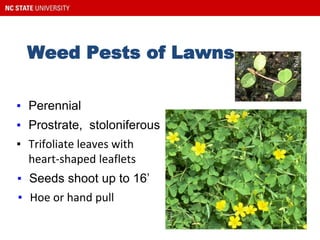
Weed Pests of Lawns
Woodsorrel
â–Ș Seeds shoot up to 16’
â–Ș Trifoliate leaves with
heart-shaped leaflets
â–Ș Prostrate, stoloniferous
â–Ș Perennial
Identifying Weeds
â–Ș Hoe or hand pull
Conditions for applying Pre-
emergent herbicides
‱ Use BEFORE weeds germinate
‱ For summer weeds such as, crabgrass, goosegrass &
foxtail
– Apply early to mid Spring
‱ Winter annual weeds such as bluegrass, henbit, wild
onions
– Apply in September
Conditions for Applying
Post-emergence Herbicides
‱ Actively growing weeds
‱ Daytime temperatures between 60 and 80 F
‱ Adequate soil moisture
‱ Ample leaf surface area ( Apply before mowing)
Crabgrass Control
‱ Crabgrass is the most prevalent grassy weed
‱ Annual which germinates April -Summer. Plants killed by
frost
– Under normal conditions germination begins around
March 10 - April 1
‱ Pre-emergence or Post-emergence control
‱ Numerous products available. Most common
active ingredients are: benefin(Balan),
pendimethalin (Halts), and prodiamine
Insect Control
‱ Ants
‱ Army/Cutworms
‱ Bees/Wasps
‱ White Grubs
‱ Leafhoppers/Spittlebugs
‱ Sod Webworms
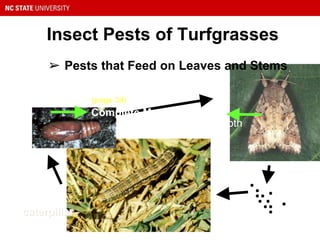
Insect Pests of Turfgrasses
Cutworms and armyworms
adult moth
eggs
caterpillar
pupa
➱ Pests that Feed on Leaves and Stems
Complete Metamorphosis
caterpillar
(page 34)
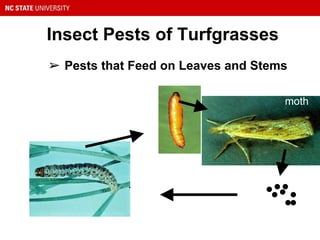
Insect Pests of Turfgrasses
Sod webworm
➱ Pests that Feed on Leaves and Stems
eggs
sod webworm
pupa
adult
moth
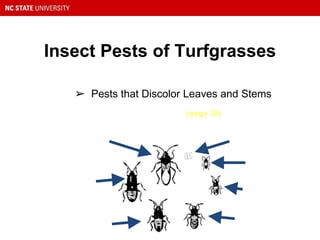
Insect Pests of Turfgrasses
Identifying Insect Pests
➱ Pests that Discolor Leaves and Stems
chinch bugs (page 35)
Gradual Metamorphosis
eggs
1st nymph
2nd nymph
3rd nymph4th nymph
5th nymph
adult bug
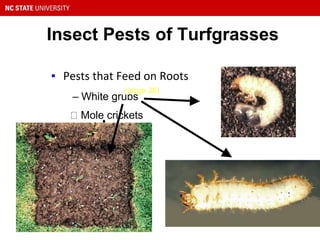
Insect Pests of Turfgrasses
â–Ș Pests that Feed on Roots
– White grubs
Mole crickets
(page 36)
Insect Pests of Turfgrasses
Identifying Insect Pests
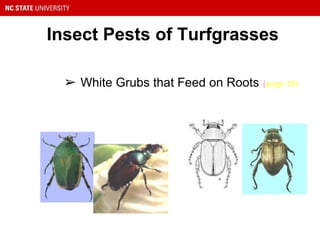
➱ White Grubs that Feed on Roots
green June beetle
White Grubs are the larvae of beetles such as the
Japanese beetle
masked chafer
Oriental beetle
(page 36)
Weeds of Turfgrasses
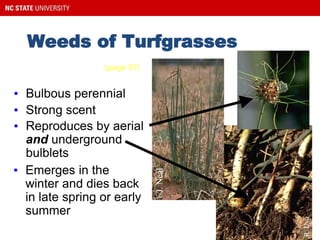
Wild Garlic
â–Ș Bulbous perennial
â–Ș Strong scent
â–Ș Reproduces by aerial
and underground
bulblets
â–Ș Emerges in the
winter and dies back
in late spring or early
summer
(page 57)
Diseases of Plants
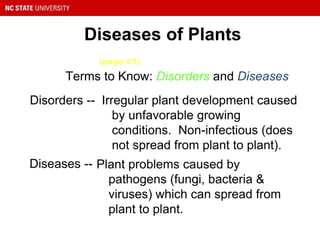
Terms to Know: Disorders and Diseases
Plant problems caused by
pathogens (fungi, bacteria &
viruses) which can spread from
plant to plant.
Diseases --
Irregular plant development caused
by unfavorable growing
conditions. Non-infectious (does
not spread from plant to plant).
Disorders --
(page 61)
Plant Diseases
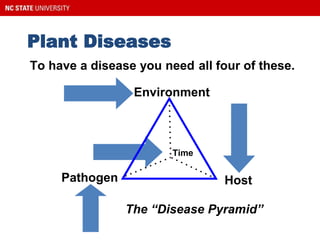
To have a disease you need all four of these.
Environment
HostPathogen
Time
The “Disease Pyramid”
Diseases of Turfgrasses
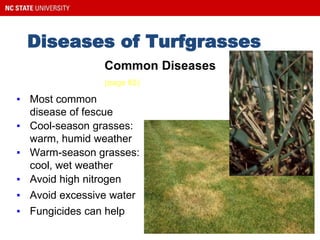
Brown patch
â–Ș Most common
disease of fescue
â–Ș Cool-season grasses:
warm, humid weather
â–Ș Warm-season grasses:
cool, wet weather
Common Diseases
(page 65)
â–Ș Avoid high nitrogen
â–Ș Avoid excessive water
â–Ș Fungicides can help
F H Baker
Diseases of Turfgrasses
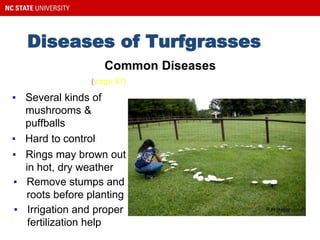
Fairy Rings
â–Ș Several kinds of
mushrooms &
puffballs
â–Ș Hard to control
â–Ș Rings may brown out
in hot, dry weather
Common Diseases
(page 67)
â–Ș Remove stumps and
roots before planting
â–Ș Irrigation and proper
fertilization help
Diseases of Turfgrasses
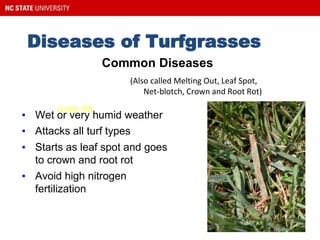
Helminthosporium
Diseases
(Also called Melting Out, Leaf Spot,
Net-blotch, Crown and Root Rot)
â–Ș Wet or very humid weather
â–Ș Attacks all turf types
â–Ș Starts as leaf spot and goes
to crown and root rot
Common Diseases
(page 69)
â–Ș Avoid high nitrogen
fertilization
Diseases of Turfgrasses
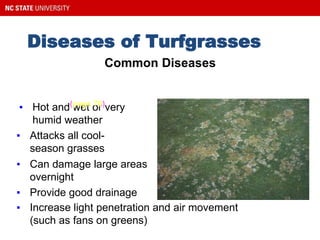
Pythium Blight (Also called Cottony Blight and Greasy Spot)
â–Ș Hot and wet or very
humid weather
â–Ș Attacks all cool-
season grasses
â–Ș Can damage large areas
overnight
Common Diseases
(page 70)
â–Ș Provide good drainage
â–Ș Increase light penetration and air movement
(such as fans on greens)
Conclusion
‱ Get clarification on location
‱ Look at management strategy
‱ Identify the problem
‱ Look at alternative solutions
Questions

Lawn Presentation for Master Gardeners

  • 1.
    Master Gardener Lawns CliffRuth Extension Area Agent NCSU/NCCES
  • 2.
    Select Turf Basedon the Following: ‱ CLIMATE - NC is in the transition zone ‱ TYPE OF LAWN DESIRED - Will lawn be grown for show, outdoor living, play area, etc. ‱ MAINTENANCE REQUIREMENTS ‱ SITE CONSIDERATIONS - Shade, slope, air circulation, exposure and other microclimatic effects
  • 3.
    Warm Season Grasses ‱BERMUDAGRASS ‱ ZOYSIAGRASS ‱ CENTIPEDEGRASS ‱ ST. AUGUSTINEGRASS ‱ BAHIAGRASS
  • 4.
    Cool-Season Grasses GROW WELLIN SPRING AND FALL; MAY GO “DORMANT” IN SUMMER ‱ Tall Fescue ‱ Kentucky Bluegrass ‱ Fine Fescue (creeping red fescue, hard fescue, sheeps fescue) ‱ Ryegrass (Annual or Perennial) ‱ Bentgrass
  • 5.
    Starting a NewLawn ‱ Cool-season grasses best planted in the Fall ‱ Warm-season grasses best planted April - July ‱ Good site preparation is essential
  • 6.
    6 Steps toa Healthy Lawn ‱ Select the right grass ‱ Soil test ‱ Plant correctly ‱ Fertilize correctly ‱ Mow correctly ‱ Water correctly
  • 7.
  • 8.
    Site Preparation ‱ CONTROLPERENNIAL WEEDS (EX. BERMUDAGRASS) ‱ PROPER GRADING AND DEBRIS REMOVAL ‱ LIME AND FERTILIZE ACCORDING TO SOIL TEST (75# LIME AND 40# 5-10-10)
  • 10.
    Reseeding - PartialRenovation ‱ GOOD SEED/SOIL CONTACT IS ESSENTIAL ‱ RAKE SMALL AREAS ‱ CORE AERATION FOR LARGER AREAS ‱ SLIT SEEDER
  • 17.
    Irrigation ‱ IT ISDIFFICULT TO EFFECTIVELY IRRIGATE WITHOUT A PERMANENT SYSTEM ‱ CONSIDER ALLOWING COOL-SEASON TURF TO GO DORMANT
  • 18.
    Irrigation ‱ IMPROPER IRRIGATIONRESULTS IN WASTE, ADDED COST, AND UNHEALTHY PLANTS ‱ APPLY WATER AT FIRST SIGNS OF MOISTURE STRESS ‱ EARLY MORNING (2-8 AM) IS THE BEST TIME TO IRRIGATE
  • 19.
    Irrigation ‱ ESTABLISHED LAWNSSHOULD BE WATERED TO A DEPTH OF 4-6 INCHES OR APPROXIMATELY 1” PER WEEK (640 GALLONS PER 1000 SQ. FT.) ‱ KEY FOR NEW LAWNS
KEEP TOP 1/2 INCH MOIST. GRADUALLY WEAN TURF AFTER 15 TO 20 DAYS
  • 20.
  • 21.
    Mowing ‱ PROPER MOWINGIS KEY TO LONG-TERM LAWN SURVIVAL ‱ CLEANEST CUT AND BEST MOWING IS OBTAINED WITH SHARP BLADES ‱ MOW OFTEN ENOUGH THAT NO MORE THAN 50% OF LEAF SURFACE IS REMOVED
  • 22.
    Mowing ‱ TALL FESCUEAND KY. BLUGRASS SHOULD BE MAINTAINED AT 2.5 TO 3.5 INCHES ‱ IT IS NOT NECESSARY TO BAG CLIPPINGS UNLESS EXCESSIVE ‱ CLIPPINGS DO NOT CAUSE THATCH ‱ MOWING TOO LOW = WEEDS!
  • 23.
    Mow cool seasongrass taller for larger root system
  • 24.
  • 25.
    Mowing height =best weed control 2 œ” 2” 1 œ” 1” œ”
  • 26.
    Reasons to leaveclippings on the lawn ‱ Less work ‱ No longer accepted in NC landfills ‱ Acts as mulch: – Moisture retention – Weed suppression Nutrient recycling 100 lb dry clippings: 4 lb. N œ lb. P 3 lb. K
  • 27.
    Fertilization ‱ SOIL TESTEVERY 2-3 YEARS ‱ AVOID FERTILIZING COOL SEASON GRASSES AFTER LATE MARCH AND BEFORE LATE AUGUST ‱ HOLIDAY REMINDERS: VALENTINES DAY, LABOR DAY, AND THANKSGIVING DAY
  • 28.
    LIME ‱ MOST UNLIMEDNC PIEDMONT AND MOUNTAIN SOILS ARE ACIDIC (PH 5.5 OR LESS) ‱ ALL TURFGRASSES EXCEPT CENTIPEDEGRASS GROW BEST AT 6.0 TO 7.0 ‱ LIME RAISES PH AND PROVIDES CA AND MG
  • 29.
    Correct soil pHaccording to plant needs Healthy roots: ahealthy plants adrought tolerance
  • 30.
    Coring (Aerification) ‱ Bestmethod to reduce compaction & improve water penetration ‱ Use hollow tines which remove plugs ‱ Core during active growth – Quick recover
  • 31.
    Weed Control ‱ WinterAnnuals (Ex. Annual bluegrass, chickweed, wild onions, and henbit) ‱ Summer Annuals (Ex. Wild lespedeza, crabgrass, and goosegrass, foxtail) ‱ Perennials (Ex. White clover, dandelions, and plantains)
  • 32.
    Weed Biology ‱ IdentifyingWeeds by Life Cycle (page 51) Biennial weeds complete a life cycle in 2 years. Perennial weeds persist from year to year. They can be spread by seeds and regrow from roots, rhizomes, stolons or tubers.
  • 33.
    Weed Biology ‱ IdentifyingWeeds by Life Cycle Annual weeds complete a life cycle in a single year.
  • 34.
    :Turf Weed Management ‱Bahiagrass ‱ Perennial grass ‱ Rhizomatous
  • 35.
    Lawn Weed Management ‱Crabgrass ‱ Annual
  • 36.
    Lawn Weed Management ‱Dallisgrass ‱ Perennial
  • 37.
    Lawn Weed Management ‱Goosegrass ‱ Annual ‱ Prostrate growth habit
  • 38.
    Lawn Weed Management ‱Nutsedge ‱ Perennial ‱ Triangular stems ‱ Purple and yellow species
  • 39.
    Lawn Weed Management ‱Curly Dock ‱ Perennial
  • 40.
    Lawn Weed Management ‱Dandelion ‱ Carolina False is winter annual or biennial ‱ Common and Cat’s Ear are perennials
  • 41.
    Pasture Weed Management ‱Carolina Geranium ‱ Annual
  • 42.
    Lawn Weed Management ‱Henbit ‱ Annual ‱ Square stems
  • 43.
    Lawn Weed Management ‱Plaintain ‱ Perennial
  • 44.
    Weeds of Turfgrasses CommonChickweed â–Ș Winter annual â–Ș Germinates fall and spring â–Ș Prefers shady, moist areas Broadleaf Weeds
  • 45.
    Lawn Weed Management ‱Red Sorrel ‱ Perennial
  • 46.
    Pasture Weed Management ‱Virginia Pepperweed ‱ Annual
  • 47.
    Lawn Weed Management ‱Wild Garlic ‱ Perennial
  • 48.
    Lawn Weed Management ‱Annual Bluegrass ‱ Annual
  • 49.
    Weeds of Turfgrasses â–ȘCreeping perennial White clover â–Ș Trifoliate leaves on long petioles red clover â–Ș Red clover is related Broadleaf Weeds â–Ș Reproduce by seeds and stolons (Other creeping perennials reproduce from rhizomes, stolons, tubers and bulbs.)
  • 50.
    Weed Pests ofLawns Woodsorrel â–Ș Seeds shoot up to 16’ â–Ș Trifoliate leaves with heart-shaped leaflets â–Ș Prostrate, stoloniferous â–Ș Perennial Identifying Weeds â–Ș Hoe or hand pull
  • 51.
    Conditions for applyingPre- emergent herbicides ‱ Use BEFORE weeds germinate ‱ For summer weeds such as, crabgrass, goosegrass & foxtail – Apply early to mid Spring ‱ Winter annual weeds such as bluegrass, henbit, wild onions – Apply in September
  • 52.
    Conditions for Applying Post-emergenceHerbicides ‱ Actively growing weeds ‱ Daytime temperatures between 60 and 80 F ‱ Adequate soil moisture ‱ Ample leaf surface area ( Apply before mowing)
  • 53.
    Crabgrass Control ‱ Crabgrassis the most prevalent grassy weed ‱ Annual which germinates April -Summer. Plants killed by frost – Under normal conditions germination begins around March 10 - April 1 ‱ Pre-emergence or Post-emergence control ‱ Numerous products available. Most common active ingredients are: benefin(Balan), pendimethalin (Halts), and prodiamine
  • 55.
    Insect Control ‱ Ants ‱Army/Cutworms ‱ Bees/Wasps ‱ White Grubs ‱ Leafhoppers/Spittlebugs ‱ Sod Webworms
  • 56.
    Insect Pests ofTurfgrasses Cutworms and armyworms adult moth eggs caterpillar pupa ➱ Pests that Feed on Leaves and Stems Complete Metamorphosis caterpillar (page 34)
  • 57.
    Insect Pests ofTurfgrasses Sod webworm ➱ Pests that Feed on Leaves and Stems eggs sod webworm pupa adult moth
  • 58.
    Insect Pests ofTurfgrasses Identifying Insect Pests ➱ Pests that Discolor Leaves and Stems chinch bugs (page 35) Gradual Metamorphosis eggs 1st nymph 2nd nymph 3rd nymph4th nymph 5th nymph adult bug
  • 59.
    Insect Pests ofTurfgrasses â–Ș Pests that Feed on Roots – White grubs Mole crickets (page 36)
  • 60.
    Insect Pests ofTurfgrasses Identifying Insect Pests ➱ White Grubs that Feed on Roots green June beetle White Grubs are the larvae of beetles such as the Japanese beetle masked chafer Oriental beetle (page 36)
  • 61.
    Weeds of Turfgrasses WildGarlic â–Ș Bulbous perennial â–Ș Strong scent â–Ș Reproduces by aerial and underground bulblets â–Ș Emerges in the winter and dies back in late spring or early summer (page 57)
  • 62.
    Diseases of Plants Termsto Know: Disorders and Diseases Plant problems caused by pathogens (fungi, bacteria & viruses) which can spread from plant to plant. Diseases -- Irregular plant development caused by unfavorable growing conditions. Non-infectious (does not spread from plant to plant). Disorders -- (page 61)
  • 63.
    Plant Diseases To havea disease you need all four of these. Environment HostPathogen Time The “Disease Pyramid”
  • 64.
    Diseases of Turfgrasses Brownpatch â–Ș Most common disease of fescue â–Ș Cool-season grasses: warm, humid weather â–Ș Warm-season grasses: cool, wet weather Common Diseases (page 65) â–Ș Avoid high nitrogen â–Ș Avoid excessive water â–Ș Fungicides can help
  • 65.
    F H Baker Diseasesof Turfgrasses Fairy Rings â–Ș Several kinds of mushrooms & puffballs â–Ș Hard to control â–Ș Rings may brown out in hot, dry weather Common Diseases (page 67) â–Ș Remove stumps and roots before planting â–Ș Irrigation and proper fertilization help
  • 66.
    Diseases of Turfgrasses Helminthosporium Diseases (Alsocalled Melting Out, Leaf Spot, Net-blotch, Crown and Root Rot) â–Ș Wet or very humid weather â–Ș Attacks all turf types â–Ș Starts as leaf spot and goes to crown and root rot Common Diseases (page 69) â–Ș Avoid high nitrogen fertilization
  • 67.
    Diseases of Turfgrasses PythiumBlight (Also called Cottony Blight and Greasy Spot) â–Ș Hot and wet or very humid weather â–Ș Attacks all cool- season grasses â–Ș Can damage large areas overnight Common Diseases (page 70) â–Ș Provide good drainage â–Ș Increase light penetration and air movement (such as fans on greens)
  • 68.
    Conclusion ‱ Get clarificationon location ‱ Look at management strategy ‱ Identify the problem ‱ Look at alternative solutions
  • 69.