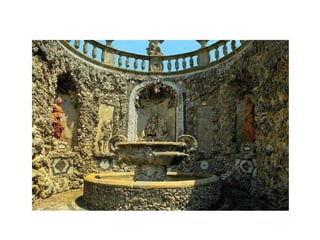
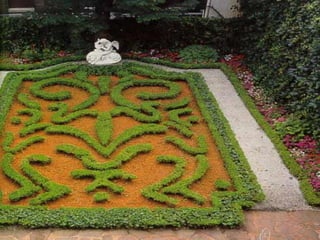
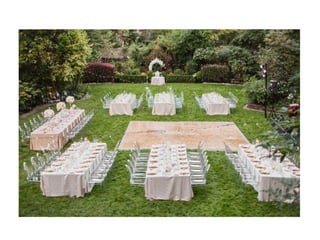



STYLES AND TYPES
OF GARDENS
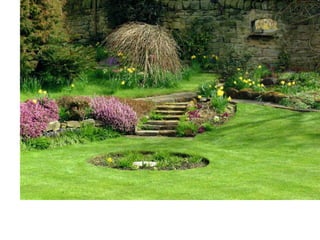
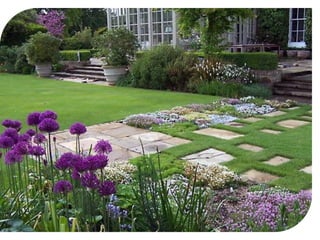
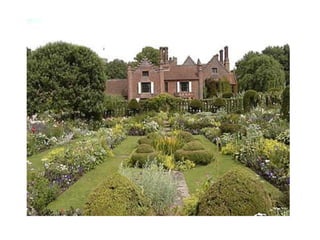
•Formal
•Informal
•Free
•Wild
Features of a formal gardens
•First plan is made on paper and then land is selected accordingly
•Land is levelled
•Symmetrical design
•Geometrical: Square, rectangular, circular beds and borders
•Roads and paths cut at right angle
•Balance is symmetrical as same feature replicated on both sides of
central axis
•Hedges, edges and topiary are trimmed
•Trees can be selected as individual feature
•Mughal, Persian, Italian, French and American gardens
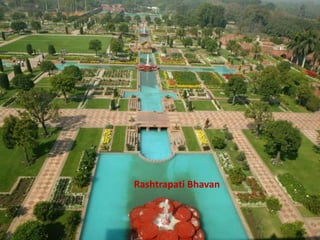
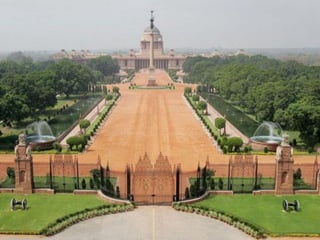
Rashtrapati Bhavan
Features of informal gardens
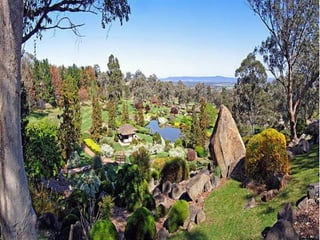
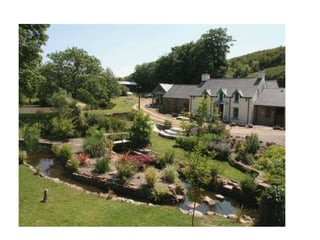
• Plan is forced to fit the land
• Main aim is to capture natural scenery
• Land is not levelled
• Asymmetrical design
• Non-geometrical beds and borders
• Untrimmed hedges, edges and topiary
• Individual plants are not selected as feature
• Japanese, Chinese, English gardens
Free and Wild style of gardening
In Free style gardening best of both formal
and informal styles are selected to secure the
most picturesque effect
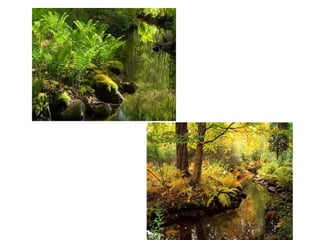
Wild style gardening no rules are followed but
aim is to make the garden beautiful and
natural.
Types of Gardens
•Formal garden:
–Persian/ Islamic
–Mughal
–French
–Italian
–American
•Informal gardens:
–English
–Japanese
–Chinese
Mughal gardens
Mughal gardens are a group of gardens built by the 
Mughals in the Islamic style of architecture.
This style was influenced by Persian gardens.
Significant use of rectilinear layouts are made within
the walled enclosures.
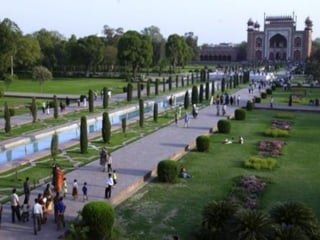
Some of the typical features include Pools, fountains
and canals inside the gardens.
Features of Mughal gardens
• Site and Style of design
• Walls and Gates
• Terraces
• Running water
• Baradari
• Tomb and Mosque
• Fruit plants and flowers
• Site and style: Hill slopes and Perennial revulet
• Gates made out of strong wooden gates at the entrance
which was studded with bold iron nails and pointed iron
spikes.
• Walls:Residences and gardens are surrounded by high
walls (for Security)
• Terraces: 8 terraces, symbol of Paradise, Some time 7 also
• Running water; Streams and fountains
• Baradari: Arbour like stracture made up of Stone masonry
items, 12 doors
• Tomb and Mosaue: common practice of Mughals
• Trees and plants: Fruit trees, flowers(rose, jasmine,
hollyhock etc.)
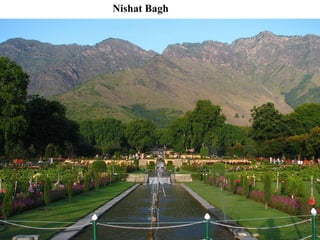
Nishat Bagh
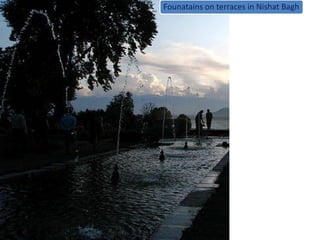
Founatains on terraces in Nishat Bagh
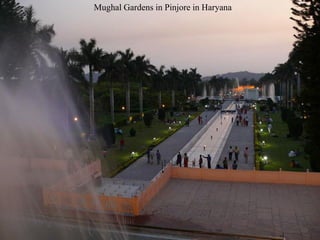
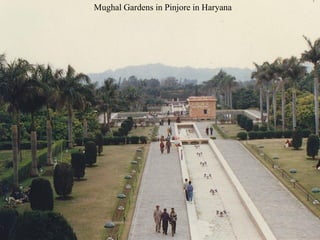
Mughal Gardens in Pinjore in Haryana
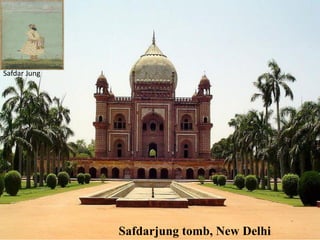
Safdarjung tomb, New Delhi
Safdar Jung
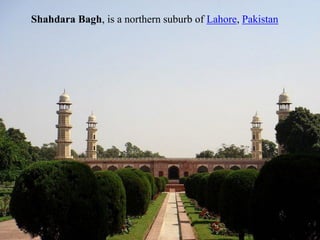
Shahdara Bagh
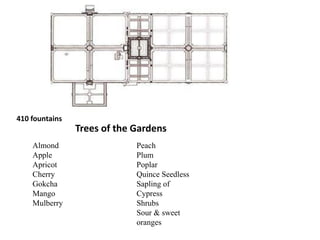
Shahdara Bagh, is a northern suburb of Lahore, Pakistan
410 fountains
Almond
Apple
Apricot
Cherry
Gokcha
Mango
Mulberry
Peach
Plum
Poplar
Quince Seedless
Sapling of
Cypress
Shrubs
Sour & sweet
oranges
Trees of the Gardens
Some examples of Mughal gardens are
Shalimar garden-Lohare
Lalbagh fort at Dhaka
Shalimar garden (J&K)
Sites of Mughal gardens
India
Humayun's Tomb, Delhi (Nizamuddin)
Taj Mahal, Agra
Ram Bagh, Agra
Mehtab Bagh, Agra
Safdarjung's Tomb
Shalimar Bagh(Srinagar), Jammu and
Kashmir
Nishat Gardens, Jammu and Kashmir
Yadvindra Gardens, Pinjore
Khusro Bagh, Allahabad
Roshanara Bagh
Pakistan
Chauburji (The Gate to the
Mughal Gardens)
Lahore Fort
Shahdara Bagh
Shalimar Gardens (Lahore)
Hazuri Bagh
Features of Persian gardens
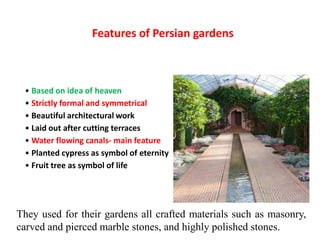
• Based on idea of heaven
• Strictly formal and symmetrical
• Beautiful architectural work
• Laid out after cutting terraces
• Water flowing canals- main feature
• Planted cypress as symbol of eternity
• Fruit tree as symbol of life
They used for their gardens all crafted materials such as masonry,
carved and pierced marble stones, and highly polished stones.
French garden
Symmetry and geometry
very intricate and artificial
In the sixteenth-century France, the court life was
shrouded with stiff formality and exactness. Matching with
that the French style of garden designs were also very
intricate and artificial.
Until this time the French gardens were nothing but copies
of Italian style.
The new style of gardening now known as French style is
largely, rather solely, due to the efforts of Le Notre who
served in the Royal Garden of Louis XIV from 1643 to 1700.
He elevated the art of garden design to a standard which
had never since been reached. It was Le Notre who showed
to the world the impact in impressiveness of scale, on
garden design.
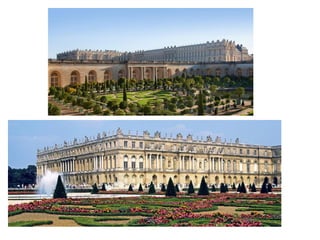
His main creations, the gardens at Versailles, have avenues
which are memorable for their tremendous length and width.
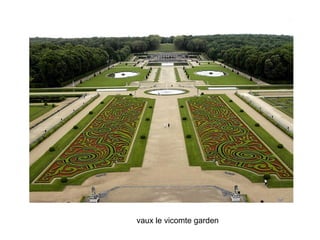
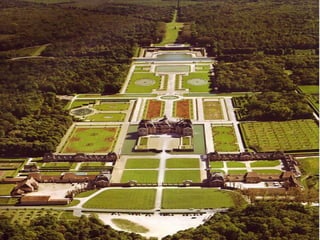
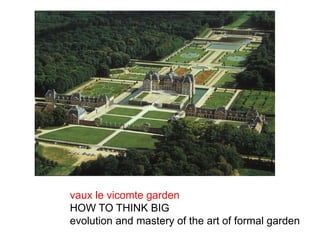
To design a garden at Vauxe-le-Vicomte, his first master
piece, Le Notre had removed three villages to create his
vista. The moral of French garden style of Le Notre seems
to teach the lesson “How to Think Big”.
vaux le vicomte garden
HOW TO THINK BIG
evolution and mastery of the art of formal garden
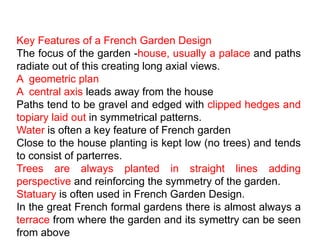
Key Features of a French Garden Design
The focus of the garden -house, usually a palace and paths
radiate out of this creating long axial views.
A geometric plan
A central axis leads away from the house
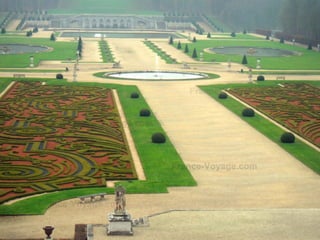
Paths tend to be gravel and edged with clipped hedges and
topiary laid out in symmetrical patterns.
Water is often a key feature of French garden
Close to the house planting is kept low (no trees) and tends
to consist of parterres.
Trees are always planted in straight lines adding
perspective and reinforcing the symmetry of the garden.
Statuary is often used in French Garden Design.
In the great French formal gardens there is almost always a
terrace from where the garden and its symettry can be seen
from above
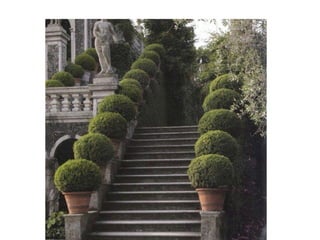
Italian Garden
• There is a similarity between the Persian and
Mughal styles - Use of heavy masonary features
• Glamorous outdoor hall - Showing off wealth and
status
• Prominent features are massive flight of stairs,
generally of marble, to connect the different levels in
the garden
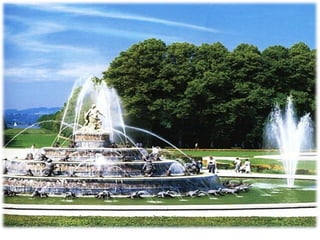
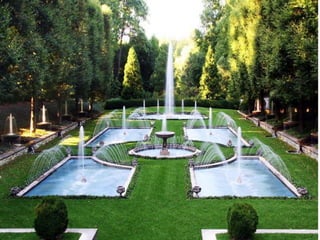
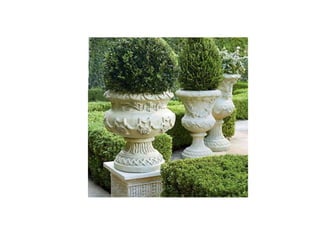
Features of Italian garden
• Decorative urns
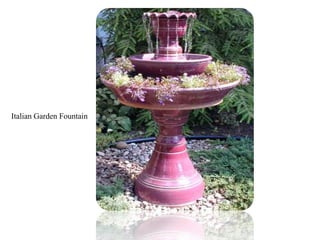
• Fountains generally in combination with
stone sculptures
• Statues
Italian Garden Fountain
❖ The English garden, also called English landscape park
❖ Is a style of Landscape garden which emerged in England
in the early 18th century, and spread across Europe
Replacing the more formal, symmetrical of the 17th
century as the principal gardening style of Europe.
The English garden presented an idealized view of nature,
English garden
Key factors of English gardening
•Typical grassland climate in England
•High annual rainfall
•Gardening is hobby of rich peoples
•English men were very fond of flowers
•British garden architects Repton and Capability
Brown advocated the concept that British gardens
should look like the countryside
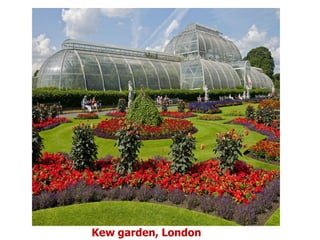
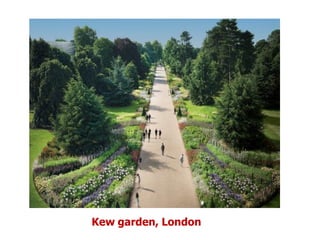
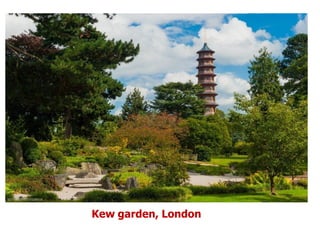
Essential features of English
gardens
• Lawn
• Herbaceous border, and
• Rockery
• Shrubbery
Kew garden, London
Kew garden, London
Kew garden, London
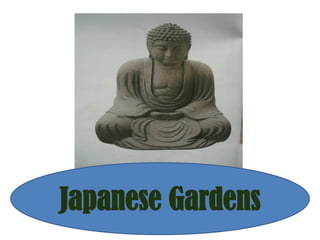
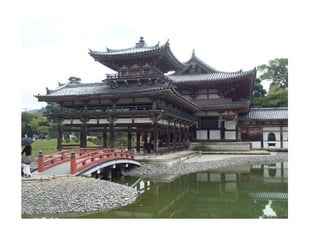
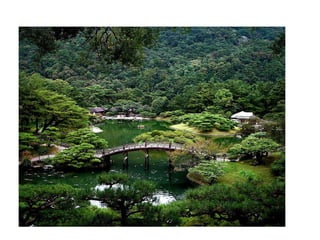
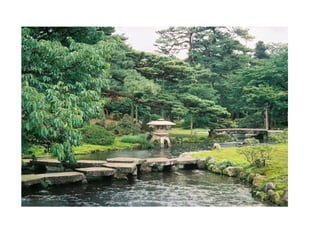
Japanese Gardens
are traditional gardens whose designs are
accompanied by
Japanese aesthetic and philosophical ideas, avoid
artificial ornamentation, and highlight the natural
landscape
The main purpose of a Japanese garden is to
attempt to be a space that captures the natural
beauties of nature.
❖Japanese garden based on idea of heaven
❖Informal style
“Unless a garden has an air of peace, it is not
worth place for visiting and garden should be a
place where mind finds rest and relaxation”
Features of Japanese gardens
•Ornamental water: pond or stream, or, in the dry
rock garden, represented by white sand,
waterfalls, fountains, wells, water basins
•Islands
•Bridges
•Stone lanterns
•Stones
•Pergolas
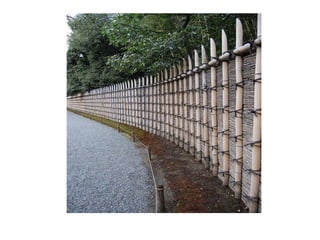
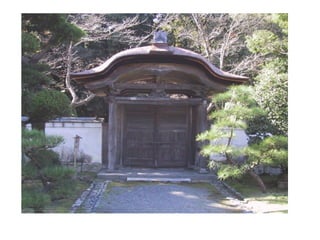
•Fences and gates
•Plants
In Buddhist symbolism, water and stone are
the yin and yang, two opposites that complement
and complete each other. A traditional garden
will usually have an irregular-shaped pond or, in
larger gardens, two or more ponds connected by
a channel or stream, and a cascade, a miniature
version of Japan's famous mountain waterfalls.
Ornamental water: pond or stream, or, in the
dry rock garden, represented by white sand,
•waterfalls, fountains, wells, water basins
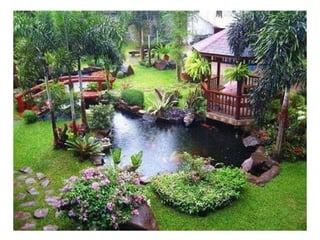
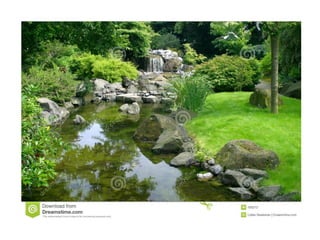
In traditional gardens, the ponds and streams
are carefully placed according to
Buddhist geomancy, the art and science of
putting things in the place most likely to attract
good fortune.
"The Creation of Gardens“ Manual
"ocean style"
"broad river style"
marsh pond"
mountain torrent style
rose letters
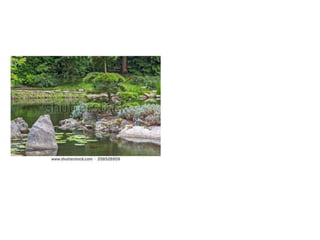
Traditional Japanese gardens have small islands in the
lakes. In sacred temple gardens, there is usually an island
which represents Mount Penglai or Mount Hōrai, the
traditional home of the Eight Immortals.
Islands
"mountainous island
rocky island
"cloud island
misty island
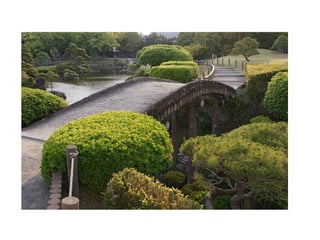
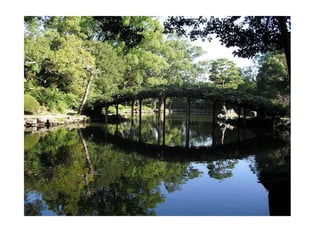
Garden bridges
The bridge symbolized the path to paradise and
immortality.
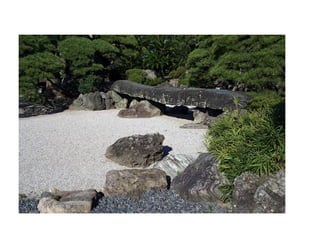
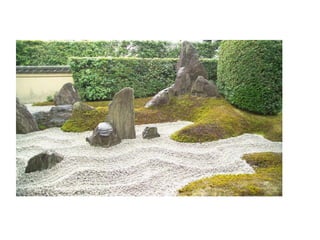
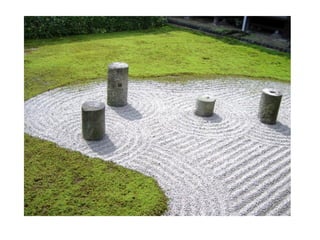
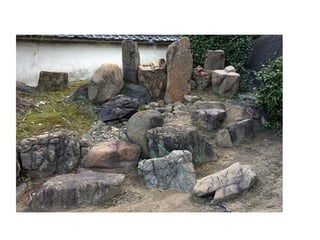
Rocks and sand
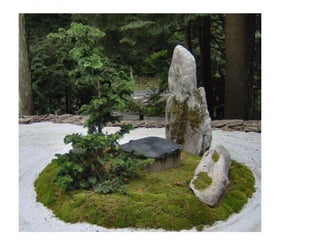
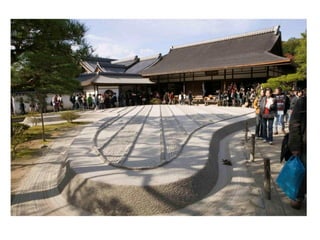
Rock, sand and gravel are an essential feature of
the Japanese garden.
A vertical rock may represent Mount Horai, the
legendary home of the Eight Immortals.
A flat rock might represent the earth.
Sand or gravel can represent a beach, or a flowing
river.
Rocks and water also symbolize yin and yang
(in and yō in Japanese) in Buddhist philosophy; the
hard rock and soft water complement each other,
and water, though soft, can wear away rock.
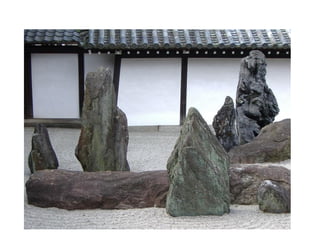
Rocks are arranged in careful compositions of
two, three, five or seven rocks, with three being
the most common. In a three-arrangement, a
tallest rock usually represents heaven, the
shortest rock is the earth, and the medium-sized
rock is humanity, the bridge between heaven
and earth.
White sand represented purity
Stone lanterns and water basins
During the Momoyama period they were introduced to the
tea garden by the first great tea masters, and in later
gardens they were used purely for decoration.
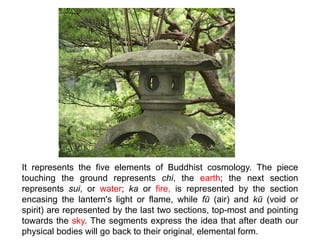
It represents the five elements of Buddhist cosmology. The piece
touching the ground represents chi, the earth; the next section
represents sui, or water; ka or fire, is represented by the section
encasing the lantern's light or flame, while fū (air) and kū (void or
spirit) are represented by the last two sections, top-most and pointing
towards the sky. The segments express the idea that after death our
physical bodies will go back to their original, elemental form.
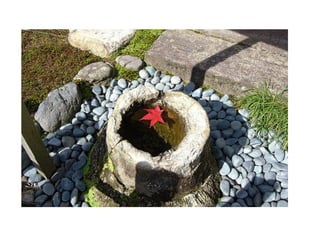
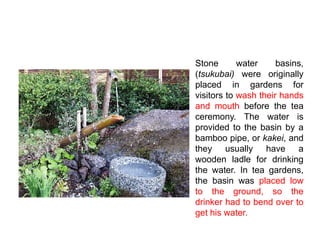
Stone water basins,
(tsukubai) were originally
placed in gardens for
visitors to wash their hands
and mouth before the tea
ceremony. The water is
provided to the basin by a
bamboo pipe, or kakei, and
they usually have a
wooden ladle for drinking
the water. In tea gardens,
the basin was placed low
to the ground, so the
drinker had to bend over to
get his water.
Garden fences, gates
Tree and flower
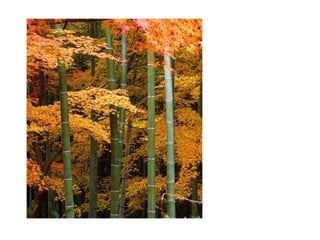
Trees are carefully chosen and arranged for their autumn
colors.
Moss is often used to suggest that the garden is ancient.
Flowers are also carefully chosen by their season of
flowering.
Formal flowerbeds are rare in older gardens, but more
common in modern gardens.
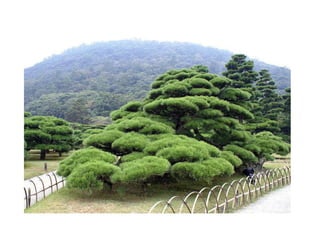
Some plants are chosen for their religious symbolism, such
as the lotus, sacred in Buddhist teachings, or the pine,
which represents longevity.
The trees are carefully trimmed to provide attractive
scenes, and to prevent them from blocking other views
of the garden.
Fish
The use of fish, particularly colored carp or goldfish as
a decorative element in gardens was borrowed from
the Chinese garden.
Japanese gardens style
• Hill gardens (Tsukiyama-sansui)
• Flat gardens (Hira-niwa)
• Tea gardens (Soto-roji and Uchi-roji)
• Passage gardens ( Roji-niwa)
• Sand gardens ( Ryoanji)
The tea garden was created during the Muromachi
period (1333–1573) and Momoyama period(1573–1600) as a
setting for the Japanese tea ceremony, or chanoyu.
The style of garden takes its name from the roji, or path to
the teahouse, which is supposed to inspire the visitor to
meditation to prepare him for the ceremony.
There is an outer garden, with a gate and covered arbor
where guests wait for the invitation to enter. They then pass
through a gate to the inner garden, where they wash their
hands and rinse their mouth, as they would before entering a
Shinto shrine, before going into the teahouse itself. The path
is always kept moist and green, so it will look like a remote
mountain path, and there are no bright flowers that might
distract the visitor from his meditation.
Early tea houses had no windows, but later teahouses have a
wall which can be opened for a view of the garden.

Garden styles and type (2)

  • 1.
    STYLES AND TYPES OFGARDENS •Formal •Informal •Free •Wild
  • 2.
    Features of aformal gardens •First plan is made on paper and then land is selected accordingly •Land is levelled •Symmetrical design •Geometrical: Square, rectangular, circular beds and borders •Roads and paths cut at right angle •Balance is symmetrical as same feature replicated on both sides of central axis •Hedges, edges and topiary are trimmed •Trees can be selected as individual feature •Mughal, Persian, Italian, French and American gardens
  • 3.
  • 4.
    Features of informalgardens • Plan is forced to fit the land • Main aim is to capture natural scenery • Land is not levelled • Asymmetrical design • Non-geometrical beds and borders • Untrimmed hedges, edges and topiary • Individual plants are not selected as feature • Japanese, Chinese, English gardens
  • 7.
    Free and Wildstyle of gardening In Free style gardening best of both formal and informal styles are selected to secure the most picturesque effect Wild style gardening no rules are followed but aim is to make the garden beautiful and natural.
  • 9.
    Types of Gardens •Formalgarden: –Persian/ Islamic –Mughal –French –Italian –American •Informal gardens: –English –Japanese –Chinese
  • 10.
    Mughal gardens Mughal gardensare a group of gardens built by the Mughals in the Islamic style of architecture. This style was influenced by Persian gardens. Significant use of rectilinear layouts are made within the walled enclosures. Some of the typical features include Pools, fountains and canals inside the gardens.
  • 11.
    Features of Mughalgardens • Site and Style of design • Walls and Gates • Terraces • Running water • Baradari • Tomb and Mosque • Fruit plants and flowers
  • 12.
    • Site andstyle: Hill slopes and Perennial revulet • Gates made out of strong wooden gates at the entrance which was studded with bold iron nails and pointed iron spikes. • Walls:Residences and gardens are surrounded by high walls (for Security) • Terraces: 8 terraces, symbol of Paradise, Some time 7 also • Running water; Streams and fountains • Baradari: Arbour like stracture made up of Stone masonry items, 12 doors • Tomb and Mosaue: common practice of Mughals • Trees and plants: Fruit trees, flowers(rose, jasmine, hollyhock etc.)
  • 13.
  • 16.
    Founatains on terracesin Nishat Bagh
  • 17.
    Mughal Gardens inPinjore in Haryana
  • 18.
    Mughal Gardens inPinjore in Haryana
  • 19.
    Safdarjung tomb, NewDelhi Safdar Jung
  • 20.
    Shahdara Bagh Shahdara Bagh,is a northern suburb of Lahore, Pakistan
  • 21.
  • 22.
    Some examples ofMughal gardens are Shalimar garden-Lohare Lalbagh fort at Dhaka Shalimar garden (J&K)
  • 23.
    Sites of Mughalgardens India Humayun's Tomb, Delhi (Nizamuddin) Taj Mahal, Agra Ram Bagh, Agra Mehtab Bagh, Agra Safdarjung's Tomb Shalimar Bagh(Srinagar), Jammu and Kashmir Nishat Gardens, Jammu and Kashmir Yadvindra Gardens, Pinjore Khusro Bagh, Allahabad Roshanara Bagh Pakistan Chauburji (The Gate to the Mughal Gardens) Lahore Fort Shahdara Bagh Shalimar Gardens (Lahore) Hazuri Bagh
  • 24.
    Features of Persiangardens • Based on idea of heaven • Strictly formal and symmetrical • Beautiful architectural work • Laid out after cutting terraces • Water flowing canals- main feature • Planted cypress as symbol of eternity • Fruit tree as symbol of life They used for their gardens all crafted materials such as masonry, carved and pierced marble stones, and highly polished stones.
  • 25.
    French garden Symmetry andgeometry very intricate and artificial In the sixteenth-century France, the court life was shrouded with stiff formality and exactness. Matching with that the French style of garden designs were also very intricate and artificial. Until this time the French gardens were nothing but copies of Italian style.
  • 26.
    The new styleof gardening now known as French style is largely, rather solely, due to the efforts of Le Notre who served in the Royal Garden of Louis XIV from 1643 to 1700. He elevated the art of garden design to a standard which had never since been reached. It was Le Notre who showed to the world the impact in impressiveness of scale, on garden design. His main creations, the gardens at Versailles, have avenues which are memorable for their tremendous length and width. To design a garden at Vauxe-le-Vicomte, his first master piece, Le Notre had removed three villages to create his vista. The moral of French garden style of Le Notre seems to teach the lesson “How to Think Big”.
  • 28.
  • 31.
    vaux le vicomtegarden HOW TO THINK BIG evolution and mastery of the art of formal garden
  • 32.
    Key Features ofa French Garden Design The focus of the garden -house, usually a palace and paths radiate out of this creating long axial views. A geometric plan A central axis leads away from the house Paths tend to be gravel and edged with clipped hedges and topiary laid out in symmetrical patterns. Water is often a key feature of French garden Close to the house planting is kept low (no trees) and tends to consist of parterres. Trees are always planted in straight lines adding perspective and reinforcing the symmetry of the garden. Statuary is often used in French Garden Design. In the great French formal gardens there is almost always a terrace from where the garden and its symettry can be seen from above
  • 33.
    Italian Garden • Thereis a similarity between the Persian and Mughal styles - Use of heavy masonary features • Glamorous outdoor hall - Showing off wealth and status • Prominent features are massive flight of stairs, generally of marble, to connect the different levels in the garden
  • 34.
    Features of Italiangarden • Decorative urns • Fountains generally in combination with stone sculptures • Statues
  • 39.
  • 44.
    ❖ The Englishgarden, also called English landscape park ❖ Is a style of Landscape garden which emerged in England in the early 18th century, and spread across Europe Replacing the more formal, symmetrical of the 17th century as the principal gardening style of Europe. The English garden presented an idealized view of nature, English garden
  • 45.
    Key factors ofEnglish gardening •Typical grassland climate in England •High annual rainfall •Gardening is hobby of rich peoples •English men were very fond of flowers •British garden architects Repton and Capability Brown advocated the concept that British gardens should look like the countryside
  • 46.
    Essential features ofEnglish gardens • Lawn • Herbaceous border, and • Rockery • Shrubbery
  • 47.
  • 48.
  • 49.
  • 53.
  • 54.
    are traditional gardenswhose designs are accompanied by Japanese aesthetic and philosophical ideas, avoid artificial ornamentation, and highlight the natural landscape The main purpose of a Japanese garden is to attempt to be a space that captures the natural beauties of nature.
  • 55.
    ❖Japanese garden basedon idea of heaven ❖Informal style “Unless a garden has an air of peace, it is not worth place for visiting and garden should be a place where mind finds rest and relaxation”
  • 56.
    Features of Japanesegardens •Ornamental water: pond or stream, or, in the dry rock garden, represented by white sand, waterfalls, fountains, wells, water basins •Islands •Bridges •Stone lanterns •Stones •Pergolas •Fences and gates •Plants
  • 57.
    In Buddhist symbolism,water and stone are the yin and yang, two opposites that complement and complete each other. A traditional garden will usually have an irregular-shaped pond or, in larger gardens, two or more ponds connected by a channel or stream, and a cascade, a miniature version of Japan's famous mountain waterfalls. Ornamental water: pond or stream, or, in the dry rock garden, represented by white sand, •waterfalls, fountains, wells, water basins
  • 58.
    In traditional gardens,the ponds and streams are carefully placed according to Buddhist geomancy, the art and science of putting things in the place most likely to attract good fortune. "The Creation of Gardens“ Manual "ocean style" "broad river style" marsh pond" mountain torrent style rose letters
  • 61.
    Traditional Japanese gardenshave small islands in the lakes. In sacred temple gardens, there is usually an island which represents Mount Penglai or Mount Hōrai, the traditional home of the Eight Immortals. Islands "mountainous island rocky island "cloud island misty island
  • 66.
    Garden bridges The bridgesymbolized the path to paradise and immortality.
  • 73.
    Rocks and sand Rock,sand and gravel are an essential feature of the Japanese garden. A vertical rock may represent Mount Horai, the legendary home of the Eight Immortals. A flat rock might represent the earth. Sand or gravel can represent a beach, or a flowing river. Rocks and water also symbolize yin and yang (in and yō in Japanese) in Buddhist philosophy; the hard rock and soft water complement each other, and water, though soft, can wear away rock.
  • 74.
    Rocks are arrangedin careful compositions of two, three, five or seven rocks, with three being the most common. In a three-arrangement, a tallest rock usually represents heaven, the shortest rock is the earth, and the medium-sized rock is humanity, the bridge between heaven and earth. White sand represented purity
  • 79.
    Stone lanterns andwater basins During the Momoyama period they were introduced to the tea garden by the first great tea masters, and in later gardens they were used purely for decoration.
  • 80.
    It represents thefive elements of Buddhist cosmology. The piece touching the ground represents chi, the earth; the next section represents sui, or water; ka or fire, is represented by the section encasing the lantern's light or flame, while fū (air) and kū (void or spirit) are represented by the last two sections, top-most and pointing towards the sky. The segments express the idea that after death our physical bodies will go back to their original, elemental form.
  • 82.
    Stone water basins, (tsukubai)were originally placed in gardens for visitors to wash their hands and mouth before the tea ceremony. The water is provided to the basin by a bamboo pipe, or kakei, and they usually have a wooden ladle for drinking the water. In tea gardens, the basin was placed low to the ground, so the drinker had to bend over to get his water.
  • 83.
  • 86.
    Tree and flower Treesare carefully chosen and arranged for their autumn colors. Moss is often used to suggest that the garden is ancient. Flowers are also carefully chosen by their season of flowering. Formal flowerbeds are rare in older gardens, but more common in modern gardens. Some plants are chosen for their religious symbolism, such as the lotus, sacred in Buddhist teachings, or the pine, which represents longevity.
  • 88.
    The trees arecarefully trimmed to provide attractive scenes, and to prevent them from blocking other views of the garden.
  • 90.
    Fish The use offish, particularly colored carp or goldfish as a decorative element in gardens was borrowed from the Chinese garden.
  • 91.
    Japanese gardens style •Hill gardens (Tsukiyama-sansui) • Flat gardens (Hira-niwa) • Tea gardens (Soto-roji and Uchi-roji) • Passage gardens ( Roji-niwa) • Sand gardens ( Ryoanji)
  • 92.
    The tea gardenwas created during the Muromachi period (1333–1573) and Momoyama period(1573–1600) as a setting for the Japanese tea ceremony, or chanoyu. The style of garden takes its name from the roji, or path to the teahouse, which is supposed to inspire the visitor to meditation to prepare him for the ceremony.
  • 93.
    There is anouter garden, with a gate and covered arbor where guests wait for the invitation to enter. They then pass through a gate to the inner garden, where they wash their hands and rinse their mouth, as they would before entering a Shinto shrine, before going into the teahouse itself. The path is always kept moist and green, so it will look like a remote mountain path, and there are no bright flowers that might distract the visitor from his meditation. Early tea houses had no windows, but later teahouses have a wall which can be opened for a view of the garden.