NURSERY
MANAGEMENT
PRACHI
T.O. FTC, SUNDER NAGAR
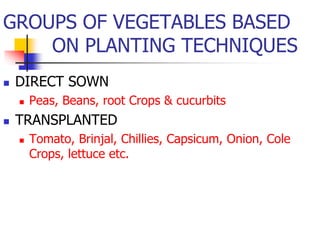
GROUPS OF VEGETABLES BASED
ON PLANTING TECHNIQUES


DIRECT SOWN




Peas, Beans, root Crops & cucurbits

TRANSPLANTED


Tomato, Brinjal, Chillies, Capsicum, Onion, Cole
Crops, lettuce etc.
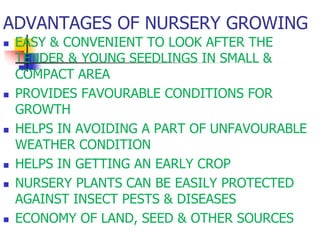
ADVANTAGES OF NURSERY GROWING











EASY & CONVENIENT TO LOOK AFTER THE
TENDER & YOUNG SEEDLINGS IN SMALL &
COMPACT AREA
PROVIDES FAVOURABLE CONDITIONS FOR
GROWTH
HELPS IN AVOIDING A PART OF UNFAVOURABLE
WEATHER CONDITION
HELPS IN GETTING AN EARLY CROP
NURSERY PLANTS CAN BE EASILY PROTECTED
AGAINST INSECT PESTS & DISEASES
ECONOMY OF LAND, SEED & OTHER SOURCES
PRINCIPLE
Plant growth is related to the efficiency with
which increasing radiation is intercepted &
converted into useful plant products.
Direct seeded crops often grow slowly through
the seedling stage and show poor light
interception & much of the light falls on the bare
soil which is wasted. Light interception improves
directly with leaf canopy cover until a point is
reached where mutual shading reduces the
functioning efficiency of lower leaves. The ratio
of the leaf area to the area of ground covered is
known as Leaf Area Index(LAI)

PRINCIPLE –cont.






Maximum assimilation usually occurs on LAI of
about 5, although different species differed for
it. This is particularly relevant for crops such as
cabbage, cauliflower, brussel’s sprout, broccoli
etc. which form a dense spreading canopy.
It is always desirable that an optimum LAI
should be achieved as quickly as possible.
Transplanted vegetables produce the necessary
leaf canopy at a much faster rate than the
direct seeded crop and retain this advantage
provided there are no post planting checks and
crop growth restrictions.


Cost of seed also influences the
choice between direct seeding and
transplanting
Choosing a vegetable nursery
site



1. Environmental factors
This refers to natural features of the land,
which may greatly influence the cost of
operation and facilitate management of the
nursery.








a) Proximity to planting site (main field)
are:
i) Cost of transporting the seedlings to
the field is minimized.
ii) Less risk of loss of seedlings during
transportation, and seedling failure
after transplanting.
iii) Reducing the chances of
transmitting or redistributing soil-borne
pathogens through seedling roots or
earth balls over long distances.









Land gradient (steepness of the land)
It is desirable to have the nursery on a level
ground with good drainage.
Nursery soils
Favourable soil conditions (good drainage,
absence of toxicity, fertile, etc.).
Water supply
A nursery should be located where a reliable,
abundant and inexpensive supply of
uncontaminated water is available. Water
supply could be from wells, boreholes, natural
streams or irrigation channel







Proximity to services
Labour supply
b) Markets
c) Supplies
d) Services
Types of nursery facilities








Greenhouses - environment fully
controlled
* Nethouse - environment partially
modified
* Open field - where climatic conditions
are normally favourable for the crops
grown.
Media for raising seedlings












Soil ,perlite, vermiculite and peat moss
sufficiently firm enough and dense to hold
seeds in place during germination.
- sufficiently porous to let excess water drain
away
- have a high water holding capacity.
- free from weed seeds, nematodes and
other pathogens.
- high cation exchange capacity so that it can
provide nutrients
- able to withstand sterilization treatment
Raising of Healthy Nursery








Quality Seed
Sufficient amount of Organic Matter in the
Nursery Area
Length of the nursery bed can be increased
or decreased depending on the land
availability
Breadth of the bed should not be 1 m & in no
case more than 1.2m to ensure weeding
without entering into the nursery bed
Raising of Healthy Nursery
Nursery Bed



3m X1m X15cm
20-25 Kg well rotten FYM + 200g
12:32:16/SSP+15-20g DM-45+20-25 ml
Chroropyriphos
DETAILED PROCEDURE










Seed treatment with fungicide with
captan/bavistin/Thiram @2-3g/ Kg
Sow the seeds in lines 5cm apart & cover with
thin layer of FYM
Cover the seeds with dry grass
Irrigate the beds twice in summers, both
morning & evening
One irrigation sufficient during winters
The beds must remain moist but not wet
otherwise “damping off disease of seedlings’’
appears
DETAILED PROCEDURE-cont.










Thick sowing & sowing with broadcasting also
leads to damping off
After germination remove the dry grass during
day time but cover the beds at night during
winter period
If the disease damping off appears in nursery,
spray the nursery bed with DM-45 @ 0.25%
For good healthy seedlings, urea spray of 0.3
per cent can be given when plants are 8-10cm
tall
After 4-6 weeks, the plants become 10-15 cm
tall and are ready for transplanting
DETAILED PROCEDURE-cont.










Stop irrigating the nursery beds 3-4 days before
the date of transplanting, so that the plants
harden
On the day of transplanting, irrigate the bed,
then uproot the seedlings for transplanting
Transplanting should always be done in the
afternoon & only the healthy seedlings should be
used for transplanting
Before transplanting the uprooted seedlings
should be dipped in 0.25% DM-45 & 0.05%
bavistin
Fix the plants well & water them daily till their
establishment in field
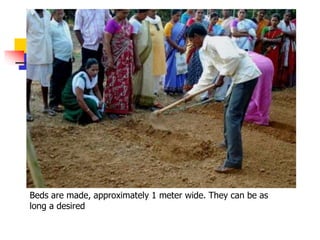
Beds are made, approximately 1 meter wide. They can be as
long a desired
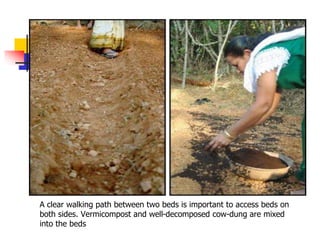
A clear walking path between two beds is important to access beds on
both sides. Vermicompost and well-decomposed cow-dung are mixed
into the beds
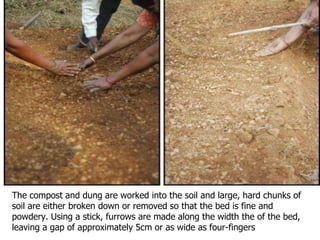
The compost and dung are worked into the soil and large, hard chunks of
soil are either broken down or removed so that the bed is fine and
powdery. Using a stick, furrows are made along the width the of the bed,
leaving a gap of approximately 5cm or as wide as four-fingers
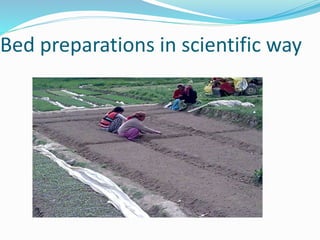
Bed preparations in scientific way
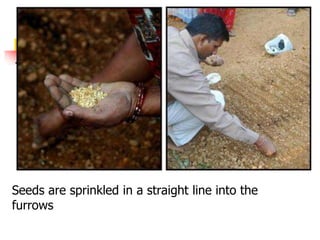
Seeds are sprinkled in a straight line into the
furrows
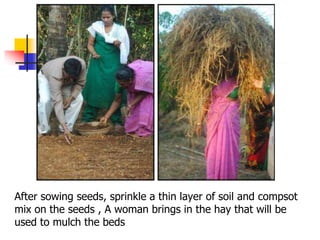
After sowing seeds, sprinkle a thin layer of soil and compsot
mix on the seeds , A woman brings in the hay that will be
used to mulch the beds
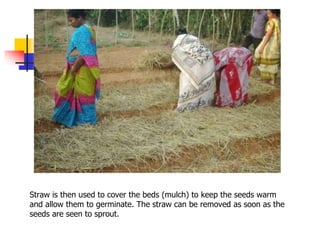
Straw is then used to cover the beds (mulch) to keep the seeds warm
and allow them to germinate. The straw can be removed as soon as the
seeds are seen to sprout.
Nursery raising in Cucurbits










RAISING OF PLANTS
Small polythene bags of 15cm X 10 cm of 100
gauge thickness
Make holes at the base of polythene with
needles
Fill the bags with mixture of soil & FYM
If the soil is sandy, silt can be added & all the
three ingredients can be mixed in equal
proportion
If the soil is clayey some sand can be added
Nursery raising in Cucurbits-cont







RAISING OF PLANTS
Keep the bags in a protected place where they
receive the sunshine & are safe from the
incidence of cold wind & frost
The seed is sown in each bag at 1-1.5cm
depth in the last week of Jan., or first week of
February
Bags should be watered after sowing & kept
moist till all the seeds have germinated
Nursery raising in Cucurbits-cont









TRANSPLANTING
Plants ready for transplanting after 25-30 days
of sowing
The development of first true leaf by the plant
is indicative of their proper stage of
development
With held irrigation 2-3 days before
transplanting
Bags should be placed near the hills/field
where these are to be transplanted
Nursery raising in Cucurbits-cont





TRANSPLANTING
Remove the polythene of seedlings by giving a
cut with the blade.
In the well prepared hill, dig small pit and the
soil ball holding the roots of the seedling is
placed carefully after removing the polythene
bag.
Formaline Treatment




5% soln of 40% commercial
formulation
1:7
SOIL SOLARIZATION




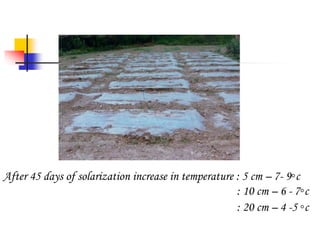
Plough & level the land uniformly
Incorporate FYM & irrigate
Spread transparent polysheet of 25-50 micron
or 100-200 gauge thackness foe 4-6 weeks
After 45 days of solarization increase in temperature : 5 cm – 7- 9◦c
: 10 cm – 6 - 7◦c
: 20 cm – 4 -5 ◦c
Multicelled plastic plug or pro-trays
nursery raising








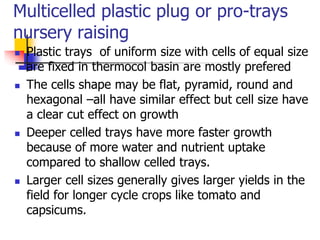
Plastic trays of uniform size with cells of equal size
are fixed in thermocol basin are mostly prefered
The cells shape may be flat, pyramid, round and
hexagonal –all have similar effect but cell size have
a clear cut effect on growth
Deeper celled trays have more faster growth
because of more water and nutrient uptake
compared to shallow celled trays.
Larger cell sizes generally gives larger yields in the
field for longer cycle crops like tomato and
capsicums.
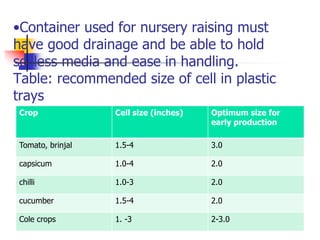
•Container used for nursery raising must
have good drainage and be able to hold
soilless media and ease in handling.
Table: recommended size of cell in plastic
trays
Crop

Cell size (inches)

Optimum size for
early production

Tomato, brinjal

1.5-4

3.0

capsicum

1.0-4

2.0

chilli

1.0-3

2.0

cucumber

1.5-4

2.0

Cole crops

1. -3

2-3.0
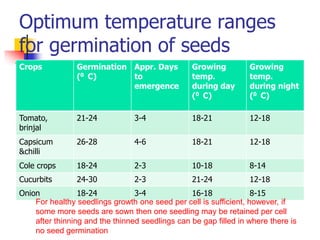
Optimum temperature ranges
for germination of seeds
Crops

Germination Appr. Days
(0 C)
to
emergence

Growing
temp.
during day
(0 C)

Growing
temp.
during night
(0 C)

Tomato,
brinjal

21-24

3-4

18-21

12-18

Capsicum
&chilli

26-28

4-6

18-21

12-18

Cole crops

18-24

2-3

10-18

8-14

Cucurbits

24-30

2-3

21-24

12-18

Onion
18-24
3-4
16-18
8-15
For healthy seedlings growth one seed per cell is sufficient, however, if
some more seeds are sown then one seedling may be retained per cell
after thinning and the thinned seedlings can be gap filled in where there is
no seed germination
Rooting media for raising seedlings









Mostly artificial soil-less media is used for
raising seedlings
Cocopeat
Vermiculite
Perlite
Mix above in the ratio of 3:1:1 before filling
in the plug trays.
Media containing coarse textured peat
provide better drainage and aeration
promoting better root development of
transplant.
Cocopeat: it is prepared from the waste of

coconut husk. It has good porosity, improved
drainage and air movement. It is free from infestation
of any pest.

Perlite: it is light rock material and is heat

expanded aluminium silicate rock.its role is to improve
aeration and drainage.

 Vermiculite: It is heat expanded mica. It is light in

wt. and has minerals (Ca & Mg) for enriching the mix.
It is neutral in reaction.
Advantages of soil-less media
Uniformity of mix
 Ease of handlings
 Versatility
 Sterility: free of diseases
 Good drainage and moisture retention
 Convenience of use
# After sowing the seeds a thick layer of
vermiculite is given to cover the seeds for
better germination as this media has good
water holding capacity.

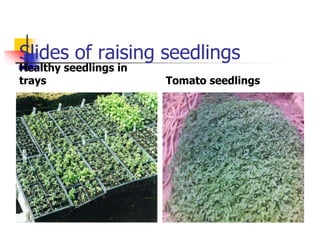
Slides of raising seedlings
Healthy seedlings in
trays

Tomato seedlings
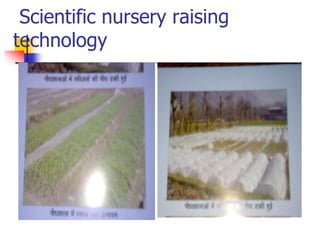
Scientific nursery raising
technology
Nursery management

Nursery management

  • 1.
  • 4.
    GROUPS OF VEGETABLESBASED ON PLANTING TECHNIQUES  DIRECT SOWN   Peas, Beans, root Crops & cucurbits TRANSPLANTED  Tomato, Brinjal, Chillies, Capsicum, Onion, Cole Crops, lettuce etc.
  • 5.
    ADVANTAGES OF NURSERYGROWING       EASY & CONVENIENT TO LOOK AFTER THE TENDER & YOUNG SEEDLINGS IN SMALL & COMPACT AREA PROVIDES FAVOURABLE CONDITIONS FOR GROWTH HELPS IN AVOIDING A PART OF UNFAVOURABLE WEATHER CONDITION HELPS IN GETTING AN EARLY CROP NURSERY PLANTS CAN BE EASILY PROTECTED AGAINST INSECT PESTS & DISEASES ECONOMY OF LAND, SEED & OTHER SOURCES
  • 6.
    PRINCIPLE Plant growth isrelated to the efficiency with which increasing radiation is intercepted & converted into useful plant products. Direct seeded crops often grow slowly through the seedling stage and show poor light interception & much of the light falls on the bare soil which is wasted. Light interception improves directly with leaf canopy cover until a point is reached where mutual shading reduces the functioning efficiency of lower leaves. The ratio of the leaf area to the area of ground covered is known as Leaf Area Index(LAI) 
  • 7.
    PRINCIPLE –cont.    Maximum assimilationusually occurs on LAI of about 5, although different species differed for it. This is particularly relevant for crops such as cabbage, cauliflower, brussel’s sprout, broccoli etc. which form a dense spreading canopy. It is always desirable that an optimum LAI should be achieved as quickly as possible. Transplanted vegetables produce the necessary leaf canopy at a much faster rate than the direct seeded crop and retain this advantage provided there are no post planting checks and crop growth restrictions.
  • 8.
     Cost of seedalso influences the choice between direct seeding and transplanting
  • 9.
    Choosing a vegetablenursery site   1. Environmental factors This refers to natural features of the land, which may greatly influence the cost of operation and facilitate management of the nursery.
  • 10.
        a) Proximity toplanting site (main field) are: i) Cost of transporting the seedlings to the field is minimized. ii) Less risk of loss of seedlings during transportation, and seedling failure after transplanting. iii) Reducing the chances of transmitting or redistributing soil-borne pathogens through seedling roots or earth balls over long distances.
  • 11.
          Land gradient (steepnessof the land) It is desirable to have the nursery on a level ground with good drainage. Nursery soils Favourable soil conditions (good drainage, absence of toxicity, fertile, etc.). Water supply A nursery should be located where a reliable, abundant and inexpensive supply of uncontaminated water is available. Water supply could be from wells, boreholes, natural streams or irrigation channel
  • 12.
         Proximity to services Laboursupply b) Markets c) Supplies d) Services
  • 13.
    Types of nurseryfacilities     Greenhouses - environment fully controlled * Nethouse - environment partially modified * Open field - where climatic conditions are normally favourable for the crops grown.
  • 14.
    Media for raisingseedlings        Soil ,perlite, vermiculite and peat moss sufficiently firm enough and dense to hold seeds in place during germination. - sufficiently porous to let excess water drain away - have a high water holding capacity. - free from weed seeds, nematodes and other pathogens. - high cation exchange capacity so that it can provide nutrients - able to withstand sterilization treatment
  • 15.
    Raising of HealthyNursery     Quality Seed Sufficient amount of Organic Matter in the Nursery Area Length of the nursery bed can be increased or decreased depending on the land availability Breadth of the bed should not be 1 m & in no case more than 1.2m to ensure weeding without entering into the nursery bed
  • 16.
    Raising of HealthyNursery Nursery Bed   3m X1m X15cm 20-25 Kg well rotten FYM + 200g 12:32:16/SSP+15-20g DM-45+20-25 ml Chroropyriphos
  • 17.
    DETAILED PROCEDURE       Seed treatmentwith fungicide with captan/bavistin/Thiram @2-3g/ Kg Sow the seeds in lines 5cm apart & cover with thin layer of FYM Cover the seeds with dry grass Irrigate the beds twice in summers, both morning & evening One irrigation sufficient during winters The beds must remain moist but not wet otherwise “damping off disease of seedlings’’ appears
  • 18.
    DETAILED PROCEDURE-cont.      Thick sowing& sowing with broadcasting also leads to damping off After germination remove the dry grass during day time but cover the beds at night during winter period If the disease damping off appears in nursery, spray the nursery bed with DM-45 @ 0.25% For good healthy seedlings, urea spray of 0.3 per cent can be given when plants are 8-10cm tall After 4-6 weeks, the plants become 10-15 cm tall and are ready for transplanting
  • 19.
    DETAILED PROCEDURE-cont.      Stop irrigatingthe nursery beds 3-4 days before the date of transplanting, so that the plants harden On the day of transplanting, irrigate the bed, then uproot the seedlings for transplanting Transplanting should always be done in the afternoon & only the healthy seedlings should be used for transplanting Before transplanting the uprooted seedlings should be dipped in 0.25% DM-45 & 0.05% bavistin Fix the plants well & water them daily till their establishment in field
  • 20.
    Beds are made,approximately 1 meter wide. They can be as long a desired
  • 21.
    A clear walkingpath between two beds is important to access beds on both sides. Vermicompost and well-decomposed cow-dung are mixed into the beds
  • 22.
    The compost anddung are worked into the soil and large, hard chunks of soil are either broken down or removed so that the bed is fine and powdery. Using a stick, furrows are made along the width the of the bed, leaving a gap of approximately 5cm or as wide as four-fingers
  • 23.
    Bed preparations inscientific way
  • 24.
    Seeds are sprinkledin a straight line into the furrows
  • 25.
    After sowing seeds,sprinkle a thin layer of soil and compsot mix on the seeds , A woman brings in the hay that will be used to mulch the beds
  • 26.
    Straw is thenused to cover the beds (mulch) to keep the seeds warm and allow them to germinate. The straw can be removed as soon as the seeds are seen to sprout.
  • 27.
    Nursery raising inCucurbits       RAISING OF PLANTS Small polythene bags of 15cm X 10 cm of 100 gauge thickness Make holes at the base of polythene with needles Fill the bags with mixture of soil & FYM If the soil is sandy, silt can be added & all the three ingredients can be mixed in equal proportion If the soil is clayey some sand can be added
  • 28.
    Nursery raising inCucurbits-cont     RAISING OF PLANTS Keep the bags in a protected place where they receive the sunshine & are safe from the incidence of cold wind & frost The seed is sown in each bag at 1-1.5cm depth in the last week of Jan., or first week of February Bags should be watered after sowing & kept moist till all the seeds have germinated
  • 29.
    Nursery raising inCucurbits-cont      TRANSPLANTING Plants ready for transplanting after 25-30 days of sowing The development of first true leaf by the plant is indicative of their proper stage of development With held irrigation 2-3 days before transplanting Bags should be placed near the hills/field where these are to be transplanted
  • 30.
    Nursery raising inCucurbits-cont    TRANSPLANTING Remove the polythene of seedlings by giving a cut with the blade. In the well prepared hill, dig small pit and the soil ball holding the roots of the seedling is placed carefully after removing the polythene bag.
  • 31.
    Formaline Treatment   5% solnof 40% commercial formulation 1:7
  • 32.
    SOIL SOLARIZATION    Plough &level the land uniformly Incorporate FYM & irrigate Spread transparent polysheet of 25-50 micron or 100-200 gauge thackness foe 4-6 weeks
  • 33.
    After 45 daysof solarization increase in temperature : 5 cm – 7- 9◦c : 10 cm – 6 - 7◦c : 20 cm – 4 -5 ◦c
  • 35.
    Multicelled plastic plugor pro-trays nursery raising     Plastic trays of uniform size with cells of equal size are fixed in thermocol basin are mostly prefered The cells shape may be flat, pyramid, round and hexagonal –all have similar effect but cell size have a clear cut effect on growth Deeper celled trays have more faster growth because of more water and nutrient uptake compared to shallow celled trays. Larger cell sizes generally gives larger yields in the field for longer cycle crops like tomato and capsicums.
  • 36.
    •Container used fornursery raising must have good drainage and be able to hold soilless media and ease in handling. Table: recommended size of cell in plastic trays Crop Cell size (inches) Optimum size for early production Tomato, brinjal 1.5-4 3.0 capsicum 1.0-4 2.0 chilli 1.0-3 2.0 cucumber 1.5-4 2.0 Cole crops 1. -3 2-3.0
  • 37.
    Optimum temperature ranges forgermination of seeds Crops Germination Appr. Days (0 C) to emergence Growing temp. during day (0 C) Growing temp. during night (0 C) Tomato, brinjal 21-24 3-4 18-21 12-18 Capsicum &chilli 26-28 4-6 18-21 12-18 Cole crops 18-24 2-3 10-18 8-14 Cucurbits 24-30 2-3 21-24 12-18 Onion 18-24 3-4 16-18 8-15 For healthy seedlings growth one seed per cell is sufficient, however, if some more seeds are sown then one seedling may be retained per cell after thinning and the thinned seedlings can be gap filled in where there is no seed germination
  • 38.
    Rooting media forraising seedlings       Mostly artificial soil-less media is used for raising seedlings Cocopeat Vermiculite Perlite Mix above in the ratio of 3:1:1 before filling in the plug trays. Media containing coarse textured peat provide better drainage and aeration promoting better root development of transplant.
  • 39.
    Cocopeat: it isprepared from the waste of coconut husk. It has good porosity, improved drainage and air movement. It is free from infestation of any pest. Perlite: it is light rock material and is heat expanded aluminium silicate rock.its role is to improve aeration and drainage.  Vermiculite: It is heat expanded mica. It is light in wt. and has minerals (Ca & Mg) for enriching the mix. It is neutral in reaction.
  • 40.
    Advantages of soil-lessmedia Uniformity of mix  Ease of handlings  Versatility  Sterility: free of diseases  Good drainage and moisture retention  Convenience of use # After sowing the seeds a thick layer of vermiculite is given to cover the seeds for better germination as this media has good water holding capacity. 
  • 41.
    Slides of raisingseedlings Healthy seedlings in trays Tomato seedlings
  • 42.