OBJECTIVES OF TRAINING
 To admit more sunlight and air to the center of the tree
and to expose maximum leaf surface to the sunlight.
 To direct the growth of the tree so that various cultural
operations, such as spraying and harvesting are
performed at the lowest cost.
 To protect the tree from sunburn and wind damage.
 To secure a balanced distribution of fruit-bearing parts
on the main limbs of the plant
TRAINING IN COFFEE
PURPOSE OF TRAINING
Height restriction:
Main purpose of training in coffee is to restrict the plant
growth at desirable Height for better management (spraying,
harvesting etc. )
Frame work:
To attain proper shape, strong frame work in coffee
Bearing wood:
To promote the production of bearing wood.
TYPES OF TRAINING
Single stem training :Suitable under Indian conditions.
Multiple stem training : Practiced in American and
Latin American countries.
SINGLE STEM TRAINING
 In this system the height of the bush is restricted at a
convenient height by a process called topping/ capping.
 It also helps in diversion of food material to thicken the
main stem and primary branches.
 It provides good ground cover and frame work.
Unlike multiple stem system the plants are not prone to
breakage as they have well balanced structure.
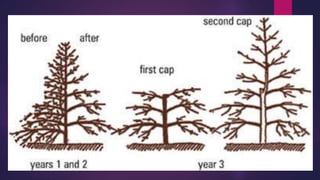
Topping
The vertically grown main stem is cut 5 cm above
the node near the prescribed topping height.
One of the top most primary branches is also cut
beyond basal node to prevent splitting of main stem
due to crop load.
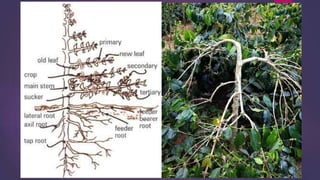
The new suckers arising from the main stem are
removed periodically
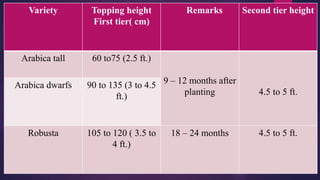
Variety Topping height
First tier( cm)
Remarks Second tier height
Arabica tall 60 to75 (2.5 ft.)
9 – 12 months after
planting 4.5 to 5 ft.
Arabica dwarfs 90 to 135 (3 to 4.5
ft.)
Robusta 105 to 120 ( 3.5 to
4 ft.)
18 – 24 months 4.5 to 5 ft.
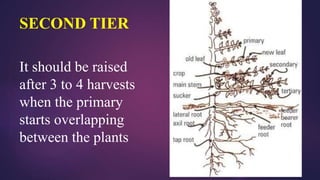
SECOND TIER
It should be raised
after 3 to 4 harvests
when the primary
starts overlapping
between the plants
MULTIPLE STEM SYSTEM( Agobiada system)
Countries:
Practiced in African and Latin American
countries. Here multiple stems are encouraged by
bending the main stem.
In India multiple stem training system is
practiced under certain circumstances viz.,
1)Replanted fields:
When old blocks are to be replanted with a new
material, the old plants are stumped and converted into
multiple stem to yield crops until the new plants come to
bearing.
2)High density planting:
Here coffee is planted very closely in the initial
years and later thinned Out to normal spacing
Coffee training

Coffee training

  • 2.
    OBJECTIVES OF TRAINING To admit more sunlight and air to the center of the tree and to expose maximum leaf surface to the sunlight.  To direct the growth of the tree so that various cultural operations, such as spraying and harvesting are performed at the lowest cost.  To protect the tree from sunburn and wind damage.  To secure a balanced distribution of fruit-bearing parts on the main limbs of the plant
  • 3.
    TRAINING IN COFFEE PURPOSEOF TRAINING Height restriction: Main purpose of training in coffee is to restrict the plant growth at desirable Height for better management (spraying, harvesting etc. ) Frame work: To attain proper shape, strong frame work in coffee Bearing wood: To promote the production of bearing wood.
  • 4.
    TYPES OF TRAINING Singlestem training :Suitable under Indian conditions. Multiple stem training : Practiced in American and Latin American countries.
  • 5.
    SINGLE STEM TRAINING In this system the height of the bush is restricted at a convenient height by a process called topping/ capping.  It also helps in diversion of food material to thicken the main stem and primary branches.  It provides good ground cover and frame work. Unlike multiple stem system the plants are not prone to breakage as they have well balanced structure.
  • 6.
    Topping The vertically grownmain stem is cut 5 cm above the node near the prescribed topping height. One of the top most primary branches is also cut beyond basal node to prevent splitting of main stem due to crop load. The new suckers arising from the main stem are removed periodically
  • 7.
    Variety Topping height Firsttier( cm) Remarks Second tier height Arabica tall 60 to75 (2.5 ft.) 9 – 12 months after planting 4.5 to 5 ft. Arabica dwarfs 90 to 135 (3 to 4.5 ft.) Robusta 105 to 120 ( 3.5 to 4 ft.) 18 – 24 months 4.5 to 5 ft.
  • 8.
    SECOND TIER It shouldbe raised after 3 to 4 harvests when the primary starts overlapping between the plants
  • 11.
    MULTIPLE STEM SYSTEM(Agobiada system) Countries: Practiced in African and Latin American countries. Here multiple stems are encouraged by bending the main stem. In India multiple stem training system is practiced under certain circumstances viz.,
  • 12.
    1)Replanted fields: When oldblocks are to be replanted with a new material, the old plants are stumped and converted into multiple stem to yield crops until the new plants come to bearing. 2)High density planting: Here coffee is planted very closely in the initial years and later thinned Out to normal spacing