1
Methods of lawn making, concepts of rock and
water garden
Lecture No. 4
LAWN
• It is the basic feature for home ground development
• In home garden
• improves the appearance of the house,
• enhances the beauty,
• Increase conveniences 2
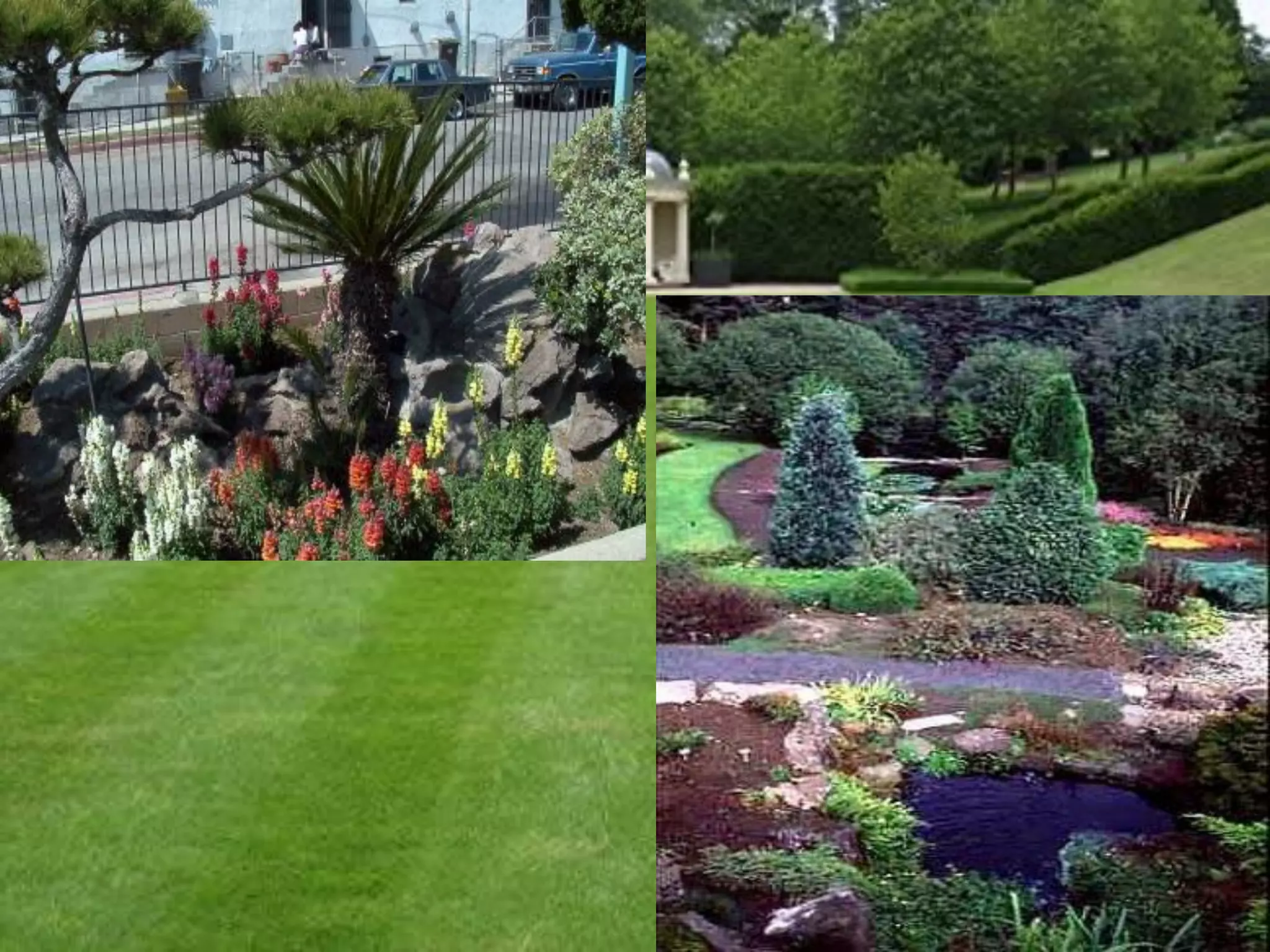
• Lawn is beautiful green ground cover with perennial grass.
• Also called as a natural green carpet.
• A lawn is the heart of a garden.
3
• Lawn also provide
–Perfect setting for
• flower beds
• A border
• A shrubbery
• A specimen of tree or a shrub
–Besides , the lawn has spiritual value too
• Lawn is source of charm and pride
• reducestension of mind after adays’hardwork
4
IMPORTANCE
• Lawn is one of the most important features of a garden
• “Without a lawn no garden is complete and beautiful as the
beauty of the garden largely depends on the condition of the
lawn.”
• Main point of attraction of the garden.
• Providesaplacefor takingsrest after theday’s hard work.
• Ideal place for holding parties and different Social functions.
5
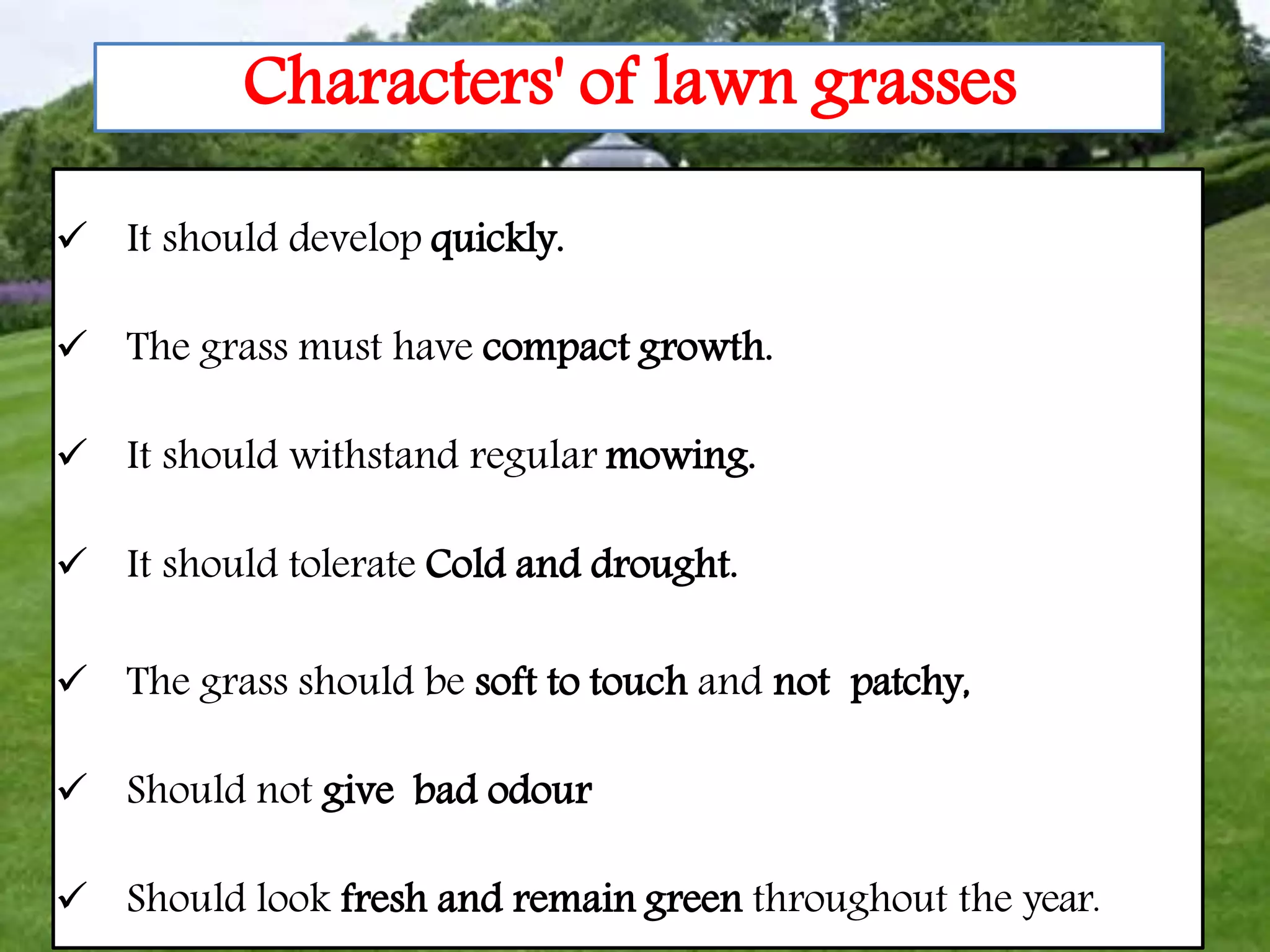
Characters' of lawn grasses
 It should develop quickly.
 The grass must have compact growth.
 It should withstand regular mowing.
 It should tolerate Cold and drought.
 The grass should be soft to touch and not patchy,
 Should not give bad odour
 Should look fresh and remain green throughout the year.
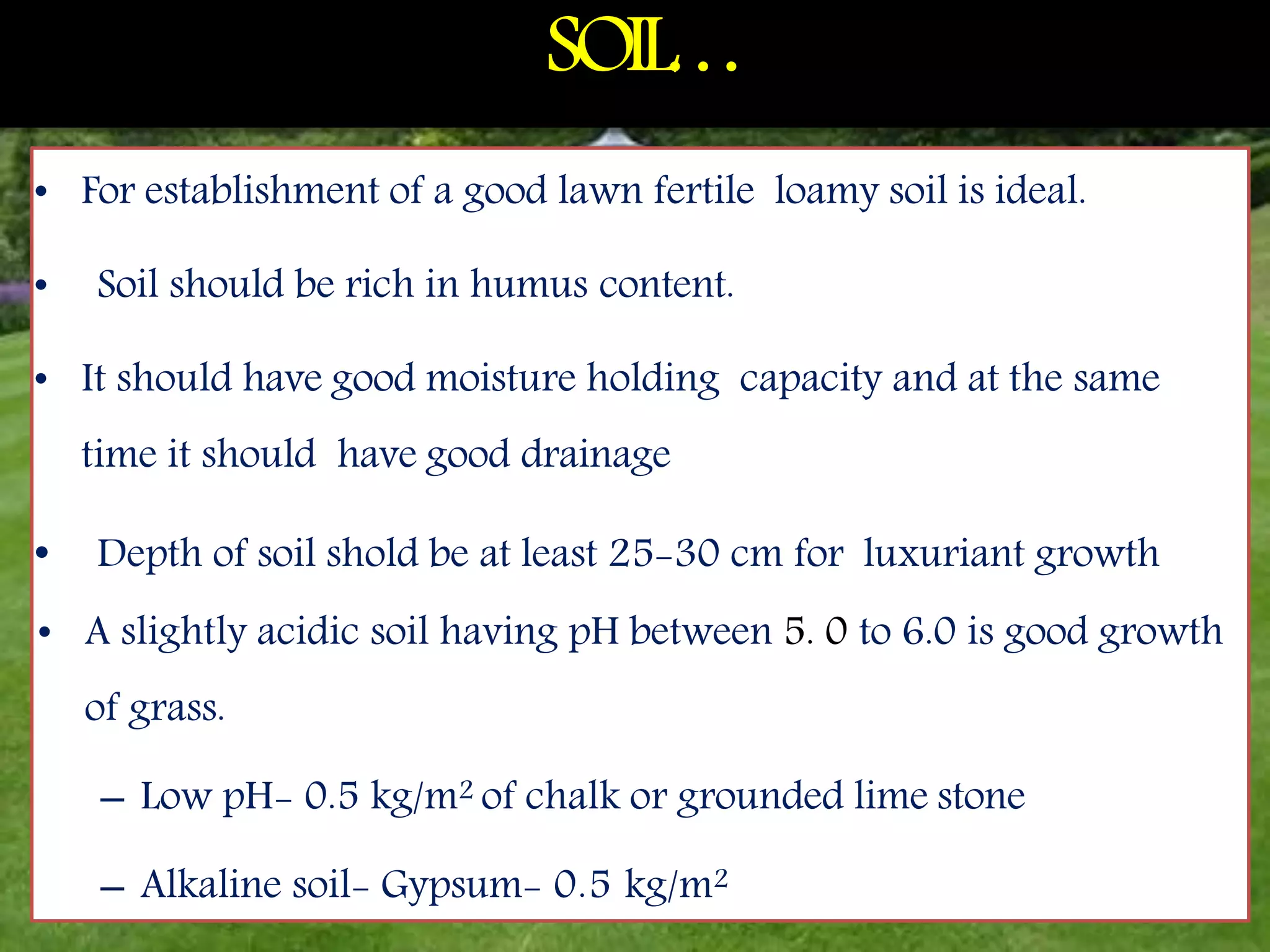
SOIL
…
6
• For establishment of a good lawn fertile loamy soil is ideal.
• Soil should be rich in humus content.
• It should have good moisture holding capacity and at the same
time it should have good drainage
• Depth of soil shold be at least 25-30 cm for luxuriant growth
• A slightly acidic soil having pH between 5. 0 to 6.0 is good growth
of grass.
– Low pH- 0.5 kg/m2 of chalk or grounded lime stone
– Alkaline soil- Gypsum- 0.5 kg/m2
Drainage…
• Selected site- proper drainage
• Grasses are shallow rooted herbs and no deep drainage is
necessary, but
• No water should stagnate in the root zone
• Clayey soils- Drainage pipes or by putting a layer of bricks and
rubbish 90cm bellow the surface
• Ordinary drainage –carried out with grading and levelling
13
• Rough surface leveling by eye estimation- prior to digging
• Shifting and filling of soil done –if necessary
• After rough levelling- thorough preparation of land is necessary-
by digging
• Digging should be done by trenching method- other wise the
gardener fail to dig to the desired depth
• Toensure proper depth- trench of 60cm deep and 45 cm width
dug at one side of the site
…Drainage..
8
• During digging- grass roots, stones etc., should be removed
• Special care should be taken to remove the roots of Motha
grass (Cyperus rotundus)
• Digging should be done during – April –May- sterilize the soil,
kill weed seeds, insects and harmful micro organisms
• Soil should be turned up subsequently 2-3 times at weekly
intervals, - each time clods of earth, if any are broken and roots of
weeds are removed
…
D
rainage
9
Manuring and Grading
• After digging is over – Soil is manured and graded
• If the soil is already fertile- Don’t apply organicmanure- weed seeds
• Poor soil-FYM, night soil manure, stable manure-
500kg/100 m2
• The manure is worked up to a depth of 15-20cm
• Any freshly dug soil will take long time for settleing
• In heavy rainfall areas- soil get settled due to pouring rain
• In low rainfall areas- flooding is done to notice the depression
and filled with soil and finally leveled using spirit level 16
Selection of grasses
11
Botanical Name Common name Situation
Cynodon
dactylon
Hariyali /Arugu
/Doob grass
Suitable for open sunny
location; drought resistant
Stenotaphrum
secundatum
St. Augustine grass
or Buffalo grass
Suitable for shady situation;
requires frequent watering
Sporobolus
tremulus
Chain grass (or)
Upparugu
Suitable for saline soils and
open sunny locations
Poa annua Annual blue grass Suitable for acid soils and
suitable for higher elevations
Pennisetum
clandestinum
Kikuyu grass Grow well in acids soils, suitable
for higher elevations.
Zoisia japonica Japan grass Suitable for poor sandy soil;
open sunny situation, slow in
growth
Selection of lawn grass species
Botanical Name Common name Situation
Z. matrella Manila grass Suitable for open sunny
situation
Z. tenuifolia Korean grass or
velvet grass or carpet
grass
Suitable for open sunny
situation
Cynodon sp. Bermuda grass (or)
Hyderabad grass
Suitable for open sunny
situation, needs mowing
Cynodon sp. Dwarf Bermuda Suitable for open sunny
situation
Festuca sp. Fescue grass Shade tolerant, survive on
inferior soils
Paspalum
vaginatum
Paspalum grass Suitable for open sunny
situation
Selection of lawn grass species
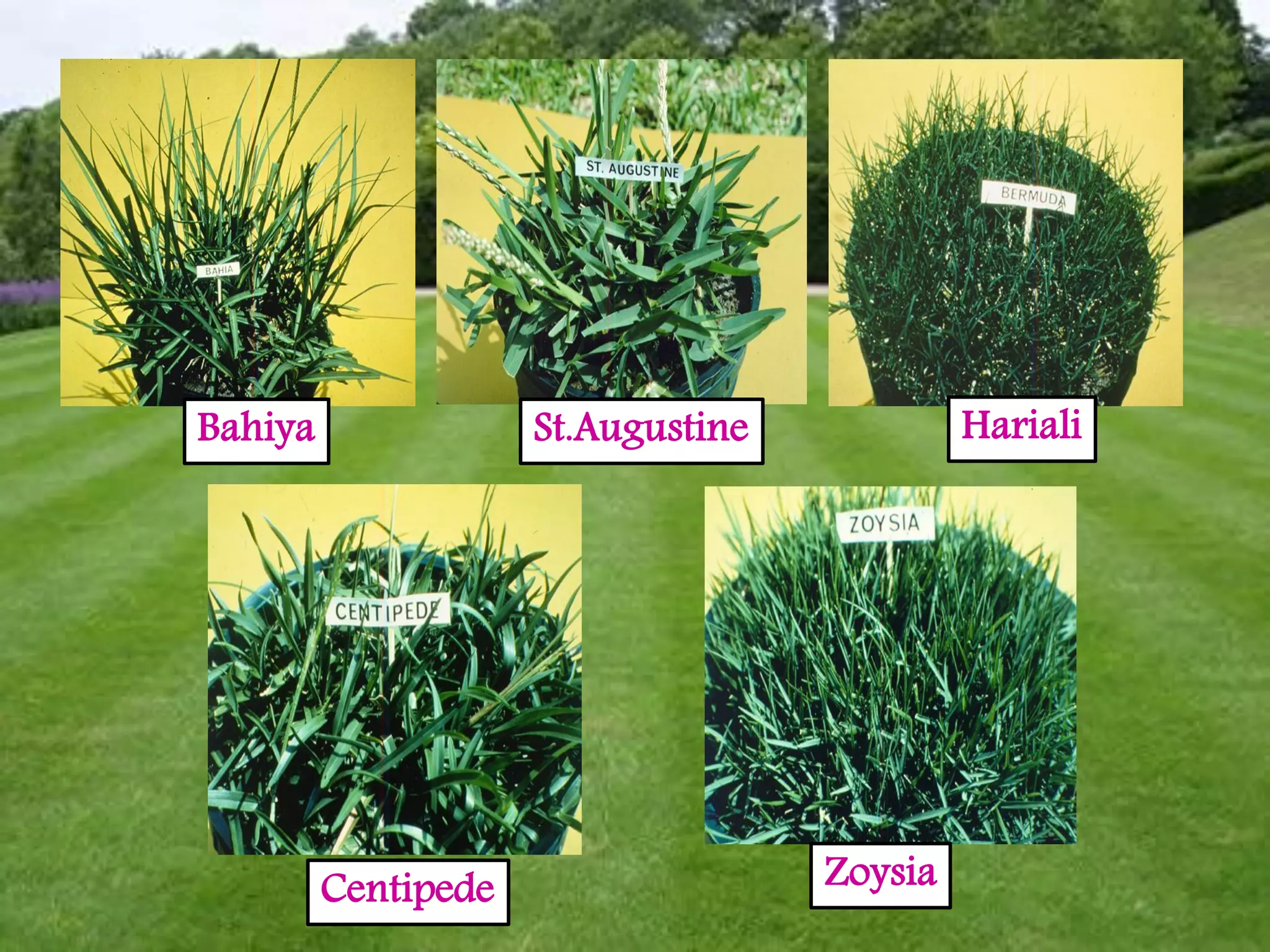
Hariali
St.Augustine
Zoysia
Centipede
Bahiya
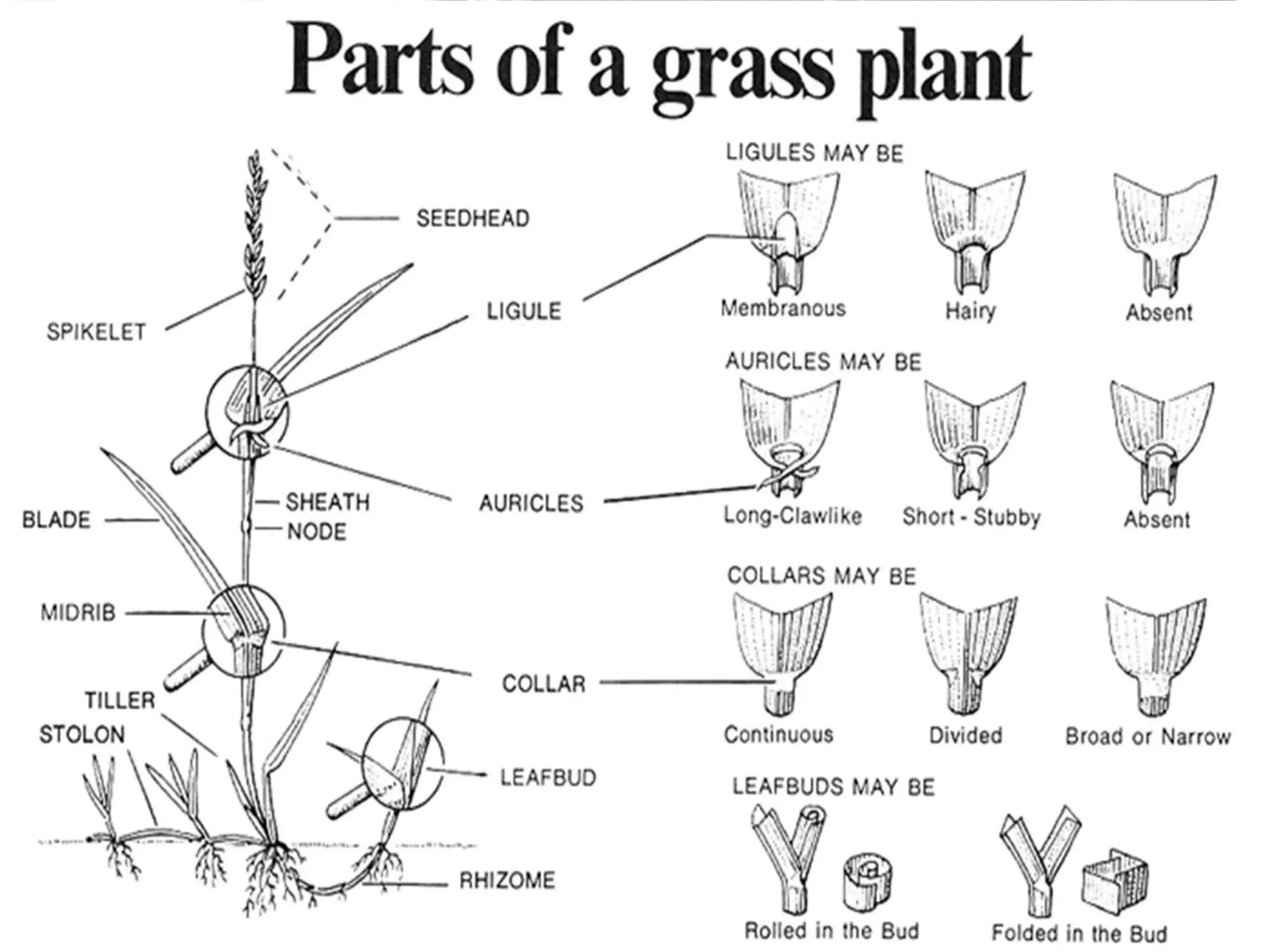
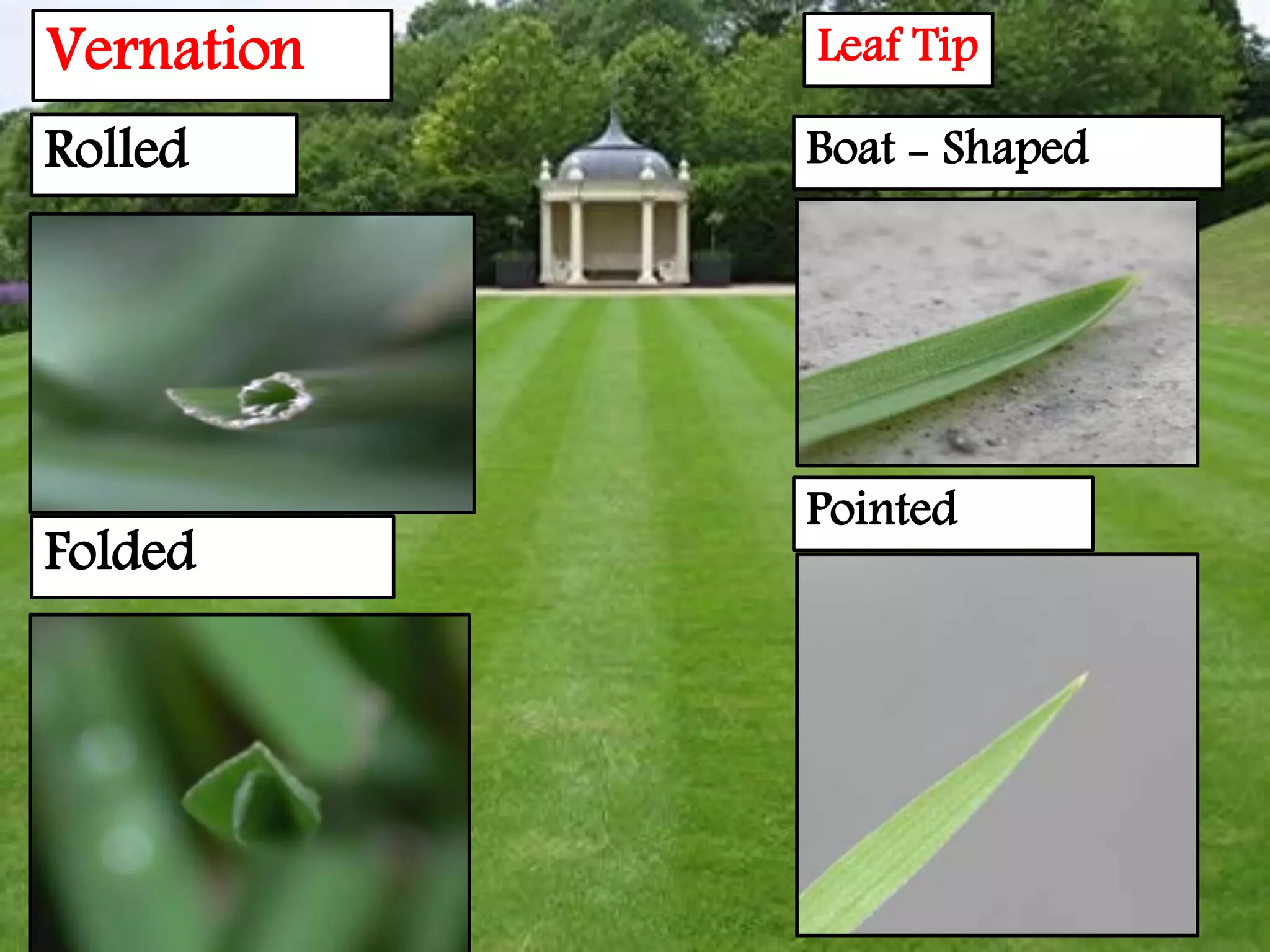
Look for the Identifying Parts :
Absent
Membranous
Fringe of Hairs
Ligule
Folded
Rolled Boat - Shaped
Pointed
Vernation Leaf Tip
Divided
Collar
Continuous
Constricted with twist
Long / Clawlike
Short / Stubby
Auricle
Absent
6
7
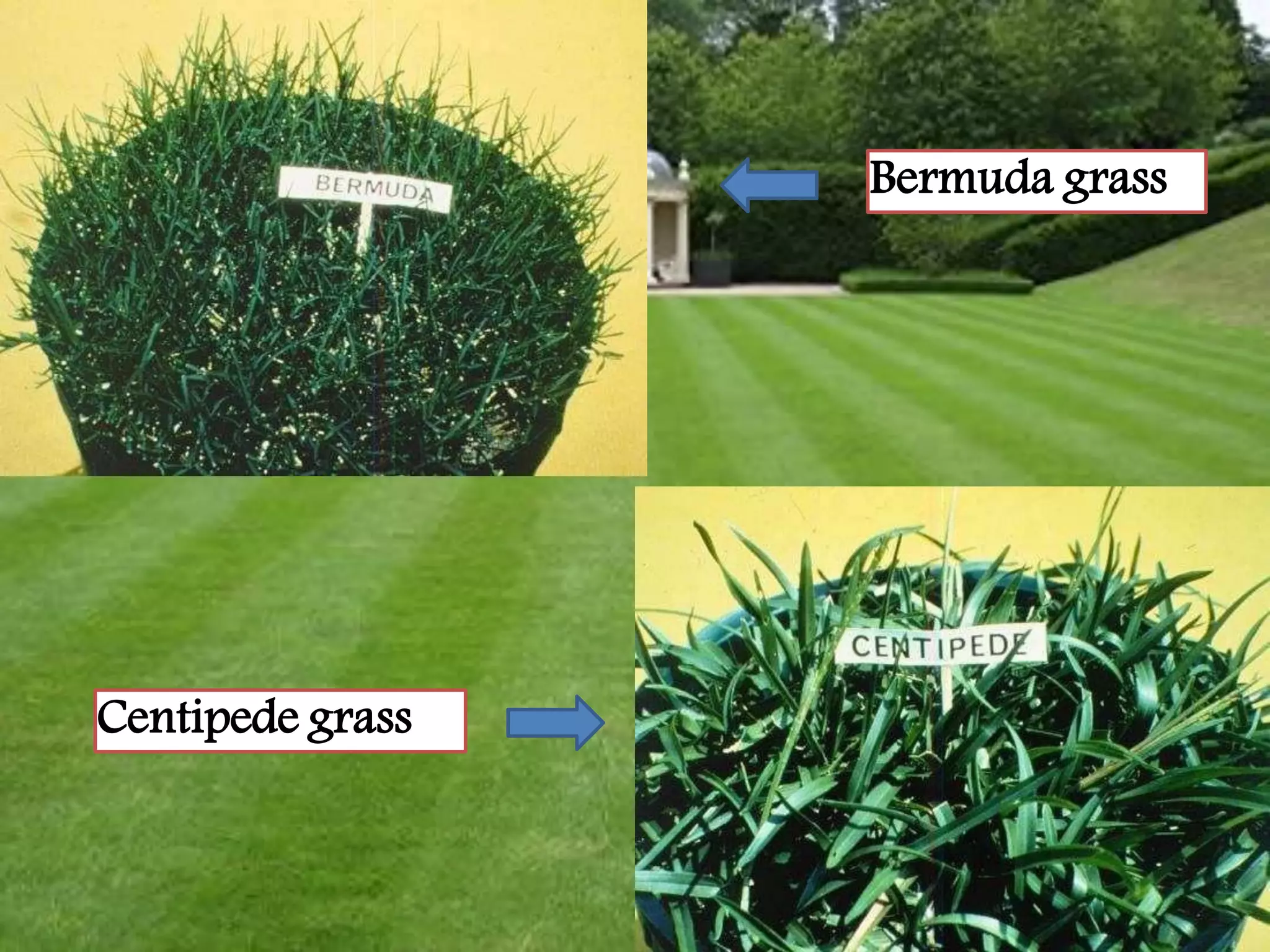
Bermuda grass
Centipede grass
6
8
St. Augustine
Zoysia
7
1
Annual rye
Kentucky blue
Winter grass
24
 Surface soil and sub – soil should be retain moisture
 Adequate drainage must be provided.
 The ground should be perfectly levelled and smooth.
 Ploughing is required to loosen the soil.
 Digging up to 35-45 cm depth is very important.
 The soil should be exposed to the sun for 15 to 20 days.
 Undesirable material like roots of the weeds, hard stones,
rocks, etc. is removed.
 The soil should be flooded with water several times to
encourage the growth of weeds
 About 5-7 cm depth of cowdung manure, activated
sludge or any other organic manure along with lime, is
to be added to the soil.
 Final weeding and watering should be given after
application of the manure.
 Soil preparation
26
PLANTING OF GRASS
• Planting of grass can be done at anytime of
the year.
• But in the tropical country like India it is better to
start the work of planting the grass in the beginning
of rainy season, because grass thus planted will get
quicker growth and better establishment..
27
KOREAN GRASS
 This grass is native of Japan and Korea.
 It has recently been introduced in India
 Korean grass has velvety growth besides having more
tolerance to cold.
 This grass is highly suitable for making lawn in small
areas and home gardens.
28
DOOB OR BERMUDA GRASS
 It is used very commonly for making lawn due to
its faster growth, hardiness, less water
requirements.
 This grass makes excellent turf.
 it can be grown on any type of soil.
29
1. Seed sowing
2. Dibbling
3. Turfing
4. Bricking
5. Turf plastering
6. Planting on polythene sheet
Method of planting Grasses
1. SEED SOWING
 Before sowing of seeds divide the entire plot.
 It should be 200 -300sq meter.
 500 g of seed will be required for 200 sq metre area.
 The entire amount of seeds should be mixed with double the
quantity of fine soil.
 Then the soil should be raked over in two directions so as to
mix the seeds uniformly with the soil.
 Then the ground should be rolled..
 Then watering must be done. 78
31
 The seeds will germinate within 3-5 weeks.
 After few weeks when the grass attains the height of
about 4-5 cm the first cutting should be done and
then the surface is rolled.
 The grass on the lawn should never be allowed to
grow more than 5 cm.
1. SEED SOWING
32
33
2. DIBBLING
• It is cheapest and slowest method of lawn
making but it is the most common method.
• A small bunch of grass along with roots and
little stem is taken.
• Planting is done at a spacing of 7-9 cm apart both row to
row and plant to plant, preferably when the soil is slightly
moist.
• The roots spread and grow underground in the course of 3-4
months making a fairly compact lawn.
34
3. TURFING
• It is also called sod method quickest method of forming a lawn.
• Small pieces of well prepared lawn or turf are cut into square
or rectangular shape preferably.
• Turf is a piece of earth with compact grass on it.
• Selected small piece of grass should be cut uniformly thick selected
from a place free from weeds and grasses along with soil are
placed on prepared ground side by side closely
• Slightly beat down flat into position.
• Any cavity or interspaces found should be filled with fine soil.
• It is the most costly way of making a lawn.
TUR
F
35
36
37
4. BRICKING
• It is done to replace few unhealthy patches in a well
maintained lawn.
• In this methods pieces of lawn along with soil in the shape
of bricks are planted and watered immediately.
38
• Grass roots with little stem of 4-5 cm long pieces are
mixed with garden soil, fresh cow dung water and roots i
e., rhizomes or stolons of doob grass.
• Spread this paste evenly over prepared field during
raining season.
• It is then covered by 2 cm soil and watered regularly.
5. Turf Plastering method
39
6. PLANTING ON POLYTHENE SHEET
• In this method lawn is grown on thick
polyethylene (800 gauge thickness)
• First cut the polyethylene into suitable pieces of desired
dimension.
• Spread a mixture of soil (3-4 cm thick) over the
polyethylene sheets & grow grass on it.
• It can be rolled and taken when temporary effect is to
be created.
Rock garden
Introduction:
• Rock garden - Chief landscape
elements
• Mimics the mountains
• Easiest to build up & maintain.
Alpine / Rock plants:
• Grow high up in mountains & comes up well in extreme
conditions even freezing point.
• Normally drought tolerant cacti & succulents also
grown under tropical & sub tropical conditions.
Alphine garden
• These plants are found on
mountain tops and tend to be
dwarfed with showy blooms.
• They grow on a medium consisting
of sand, organic matter and gravel.
• These plants are used to cool
climates.
• They include ferns, as well as many
kinds of begonias, peperomias, and
other plants
Rock Garden
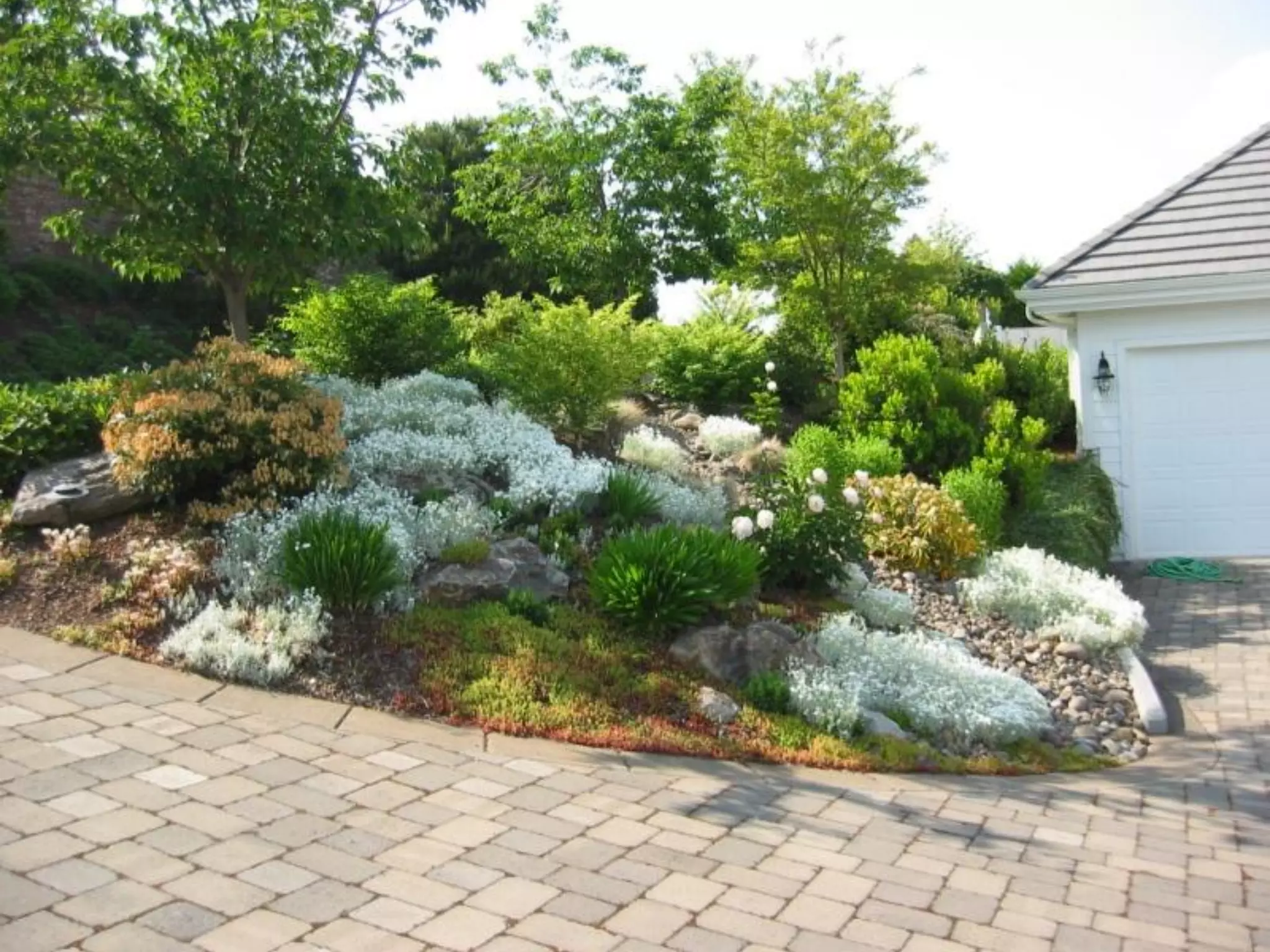
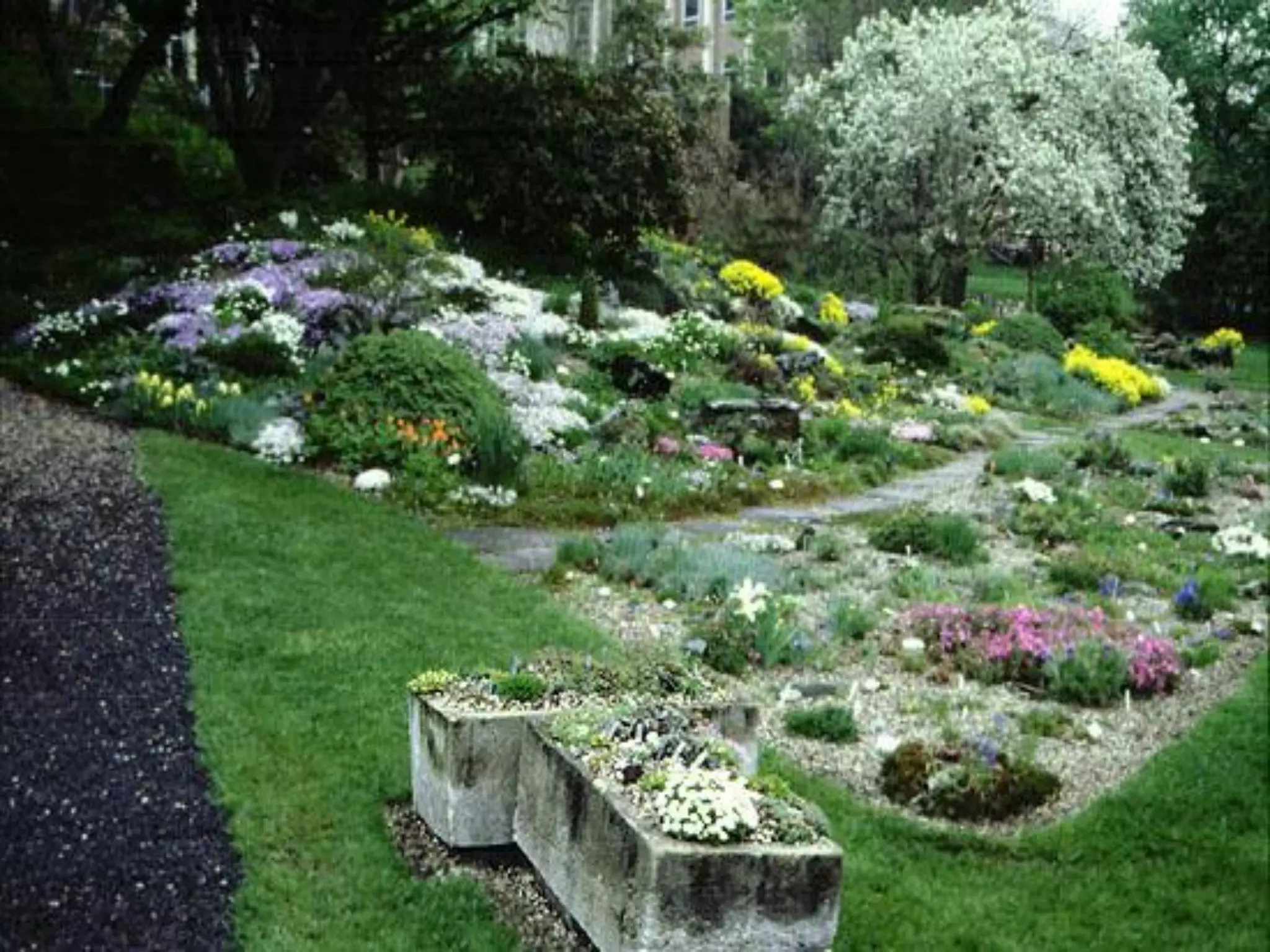
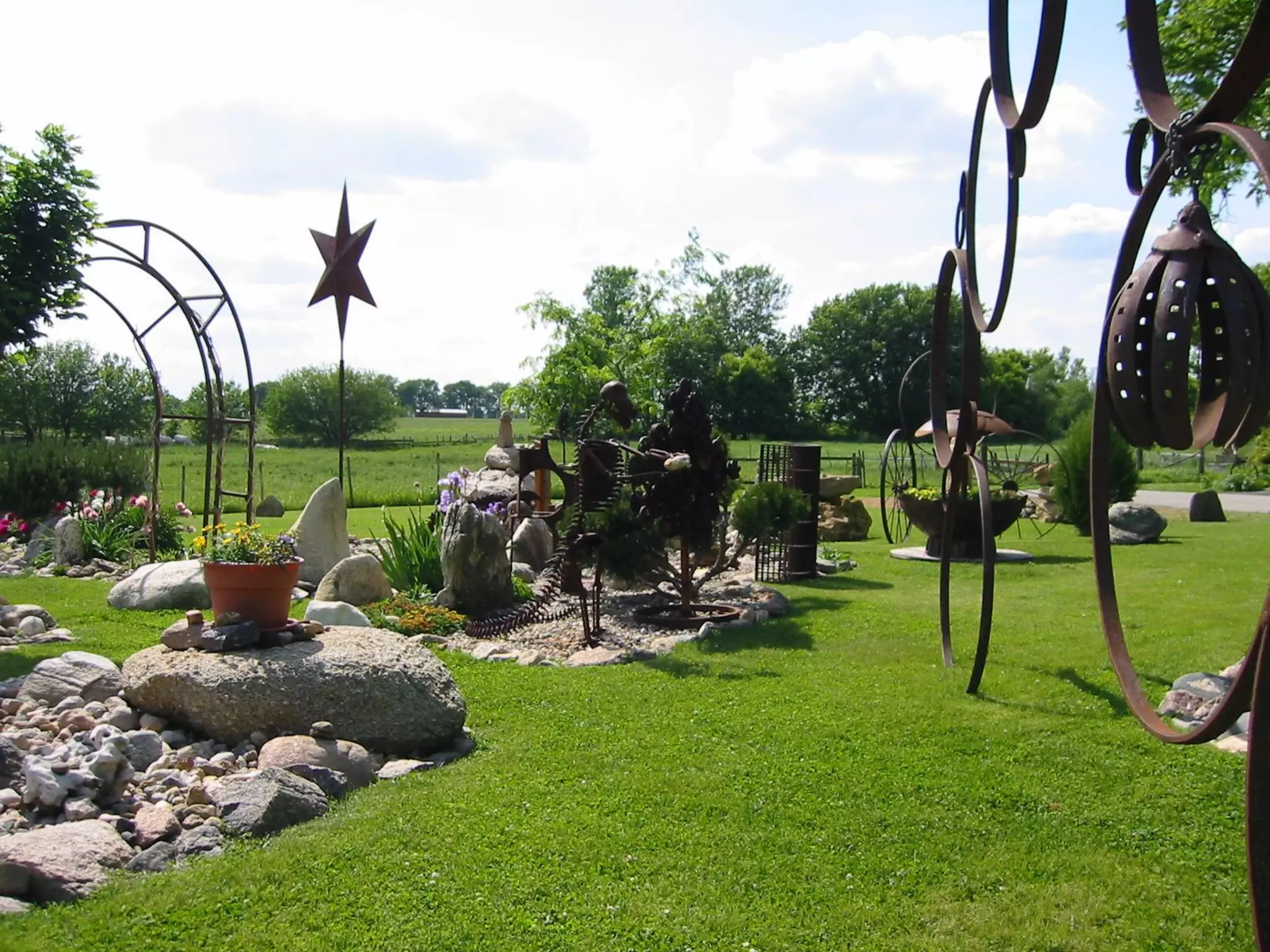
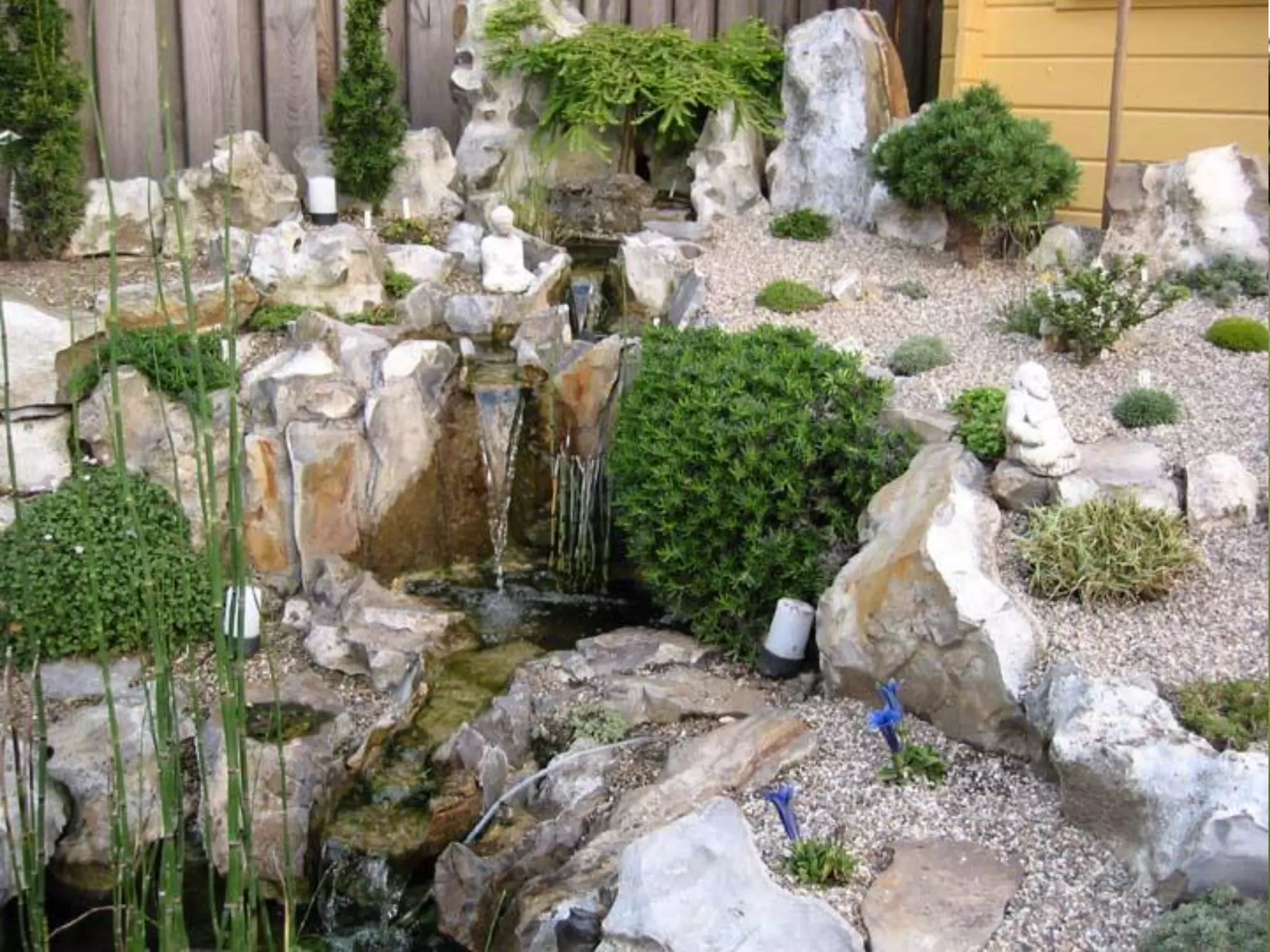
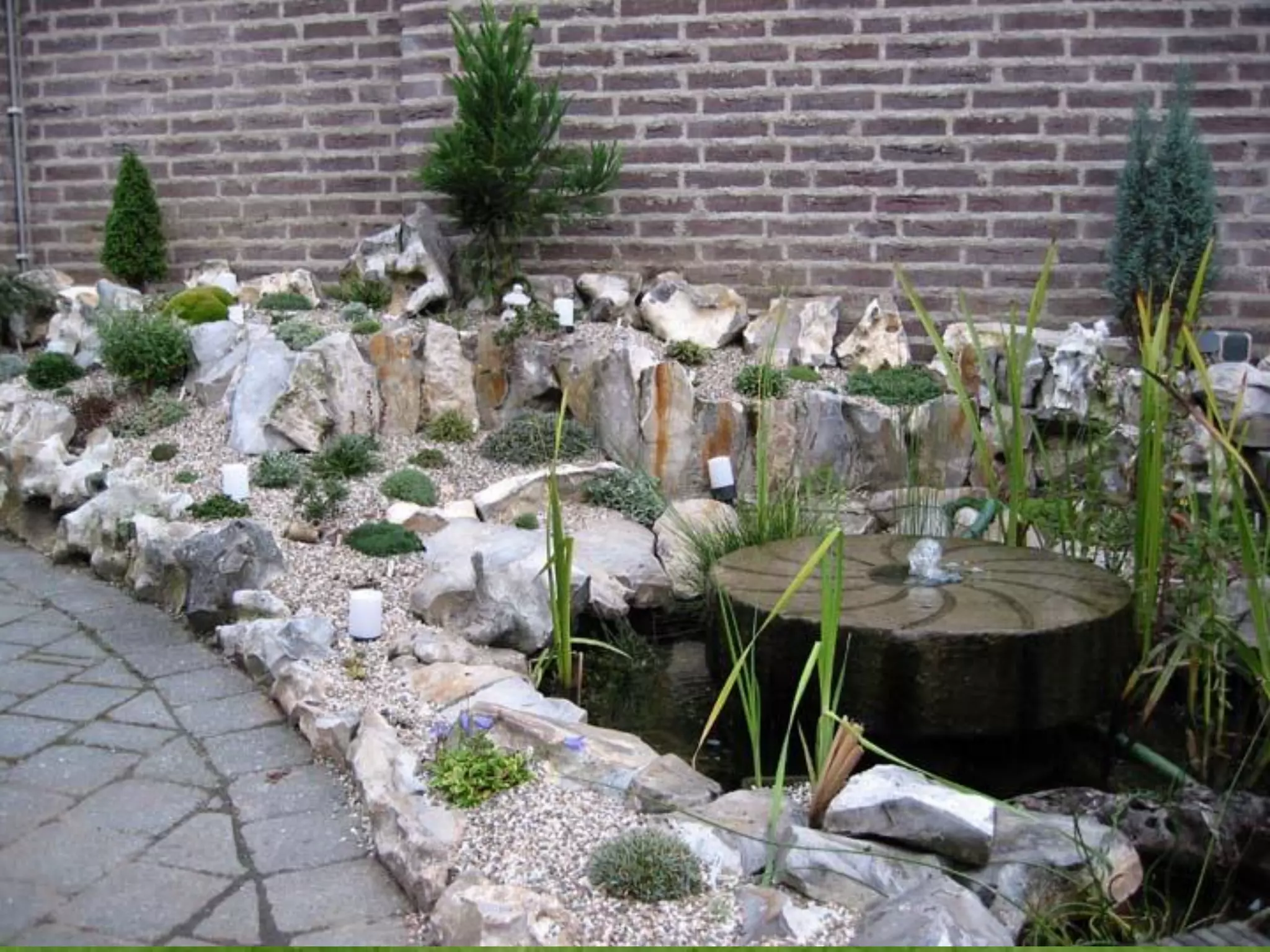
• A rock garden, also known as a rockery or an alpine garden, is a
type of garden that features extensive use of rocks or stones, along
with plants native to rocky or alpine environments.
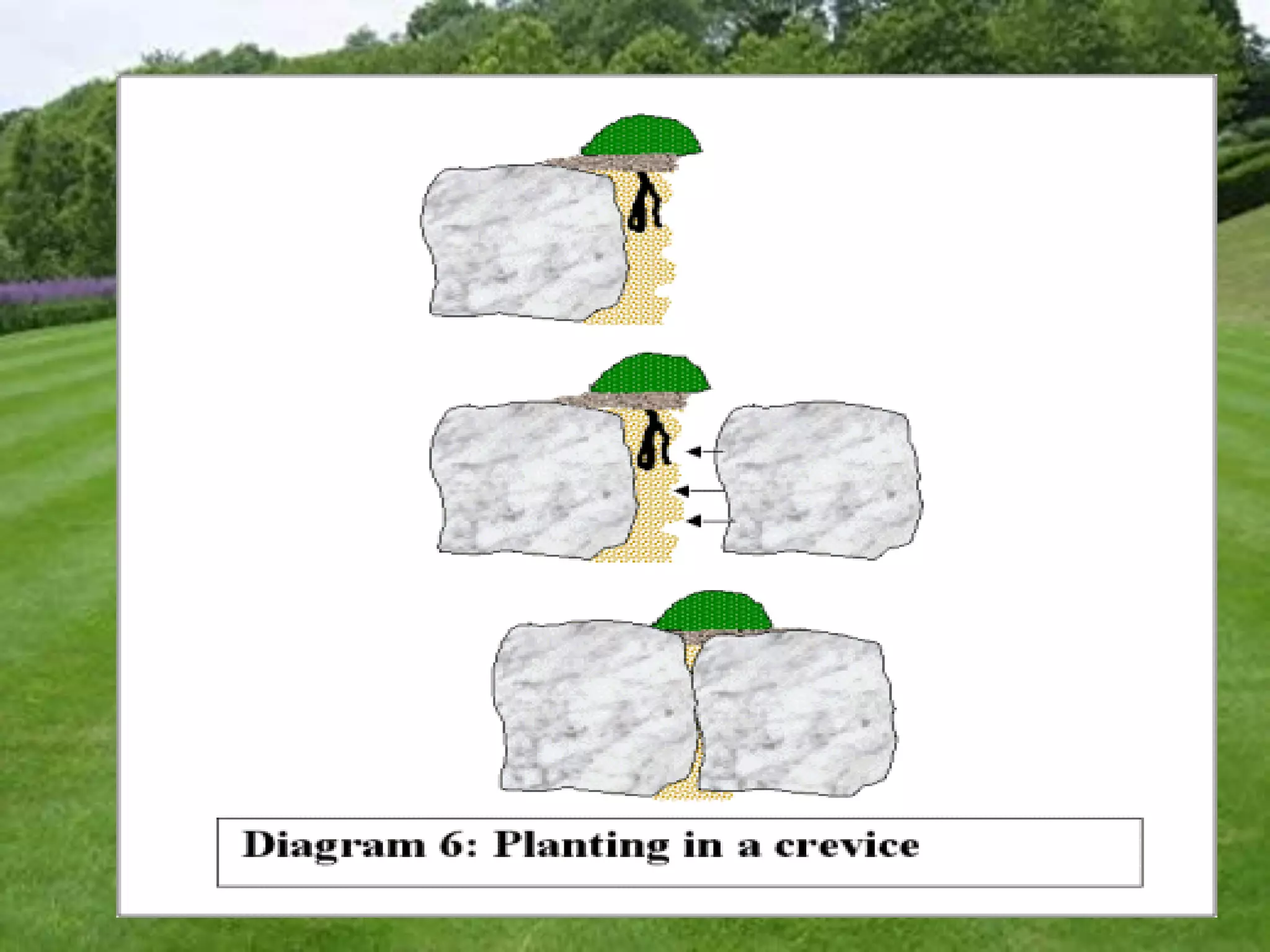
• The usual form of a rock garden is a pile of rocks, large and small,
esthetically arranged, and with small gaps between, where the plants
will be rooted.
• Some rock gardens incorporate bonsai
Soil for rock garden
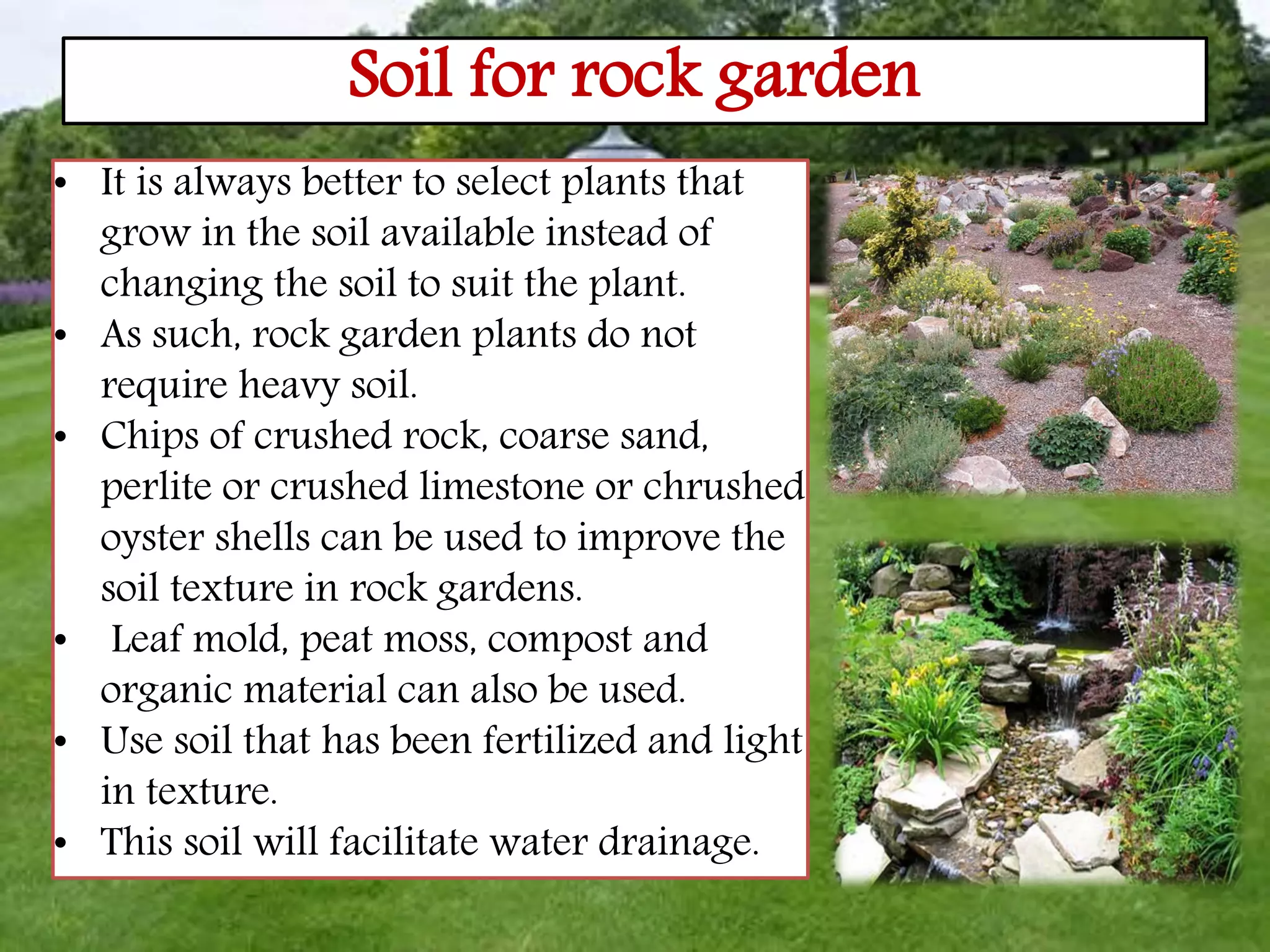
• It is always better to select plants that
grow in the soil available instead of
changing the soil to suit the plant.
• As such, rock garden plants do not
require heavy soil.
• Chips of crushed rock, coarse sand,
perlite or crushed limestone or chrushed
oyster shells can be used to improve the
soil texture in rock gardens.
• Leaf mold, peat moss, compost and
organic material can also be used.
• Use soil that has been fertilized and light
in texture.
• This soil will facilitate water drainage.
Conditions to be considered
• Lay out must be simple
• Rocks native to the area will look natural
• Large rocks with irregular shapes breaks monotony
• The rock is soft and porous, allowing moisture to seep through,
and some determined roots will be able to make their way
through the rock.
• Limestone perform better & solid rocks not suitable
• Limestone usually has depressions in it that can be filled with
dirt for planting mosses and lichens.
Plants:
• Wide species is available ( perennials, bulbous, cacti, succulents,
etc.,)
• Plant should tolerate harsh conditions
• Selection according to climate is must
Key for the success
• Requires full sun for most of the
day
• Requires shade for at least 3
hours during the hottest part of
the day
• Little or no direct sunlight
• Some or all parts of this plant
may be toxic
• Once established, these plants
require little or no supplemental
watering
• These plants will tolerate some
drought, but benefit from
periodic watering
• Needs regular weekly watering,
more often in extreme heat
• Keep constantly moist
Basalt
Limestone
Tuff
Rock Garden Care
• Occasional addition of manure or compost will give them
a boost.
• Cutting back any leggy plants after flowering, clipping off
dead stems and foliage, and dividing any plants that
become root-bound or too large for its space.
• Check for insects and diseases regularly.
• Slugs may be present because they enjoy the shelter found
among the rocks.
• Periodical weeding is must
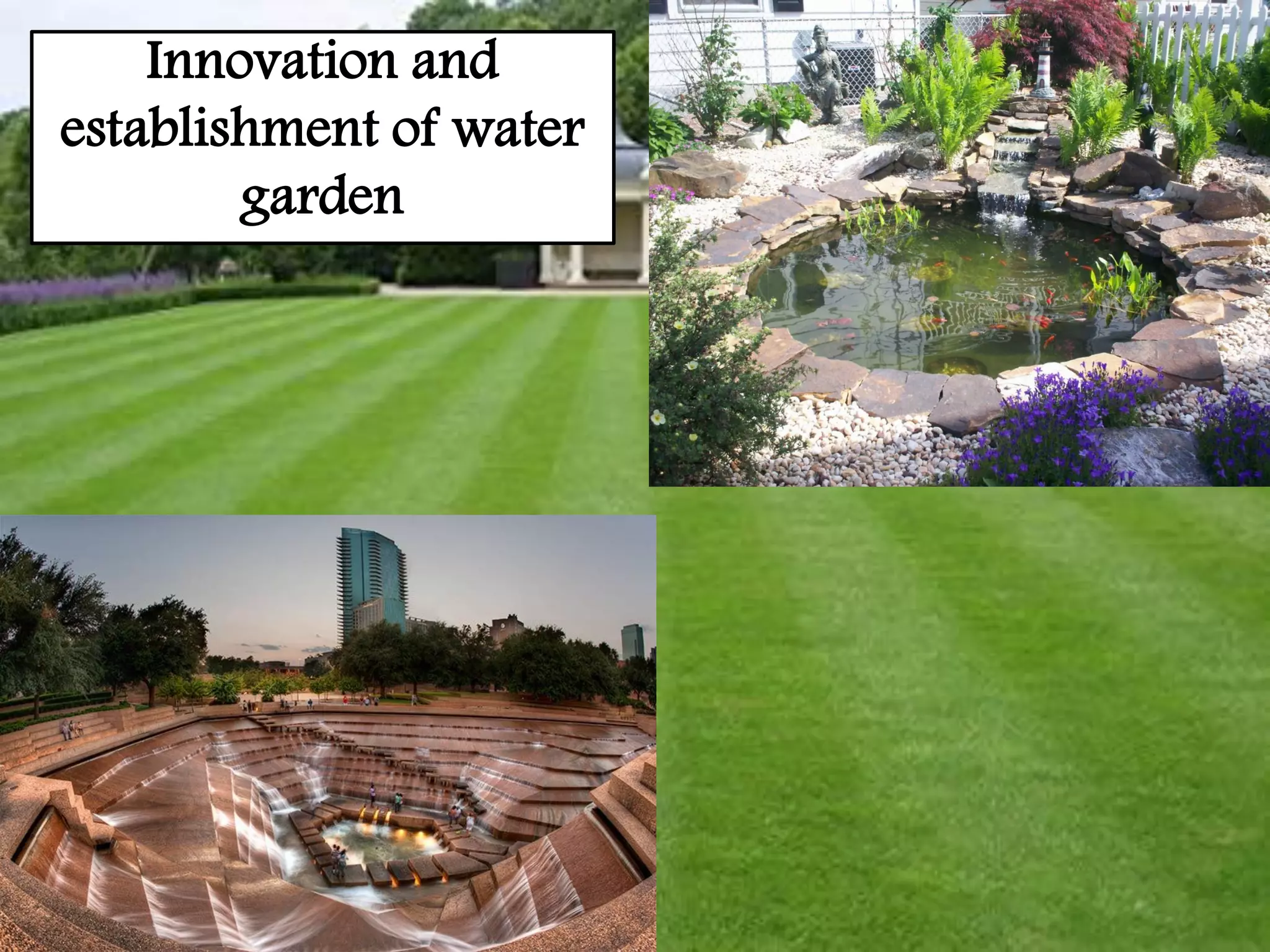
Innovation and
establishment of water
garden
INTRODUCTION
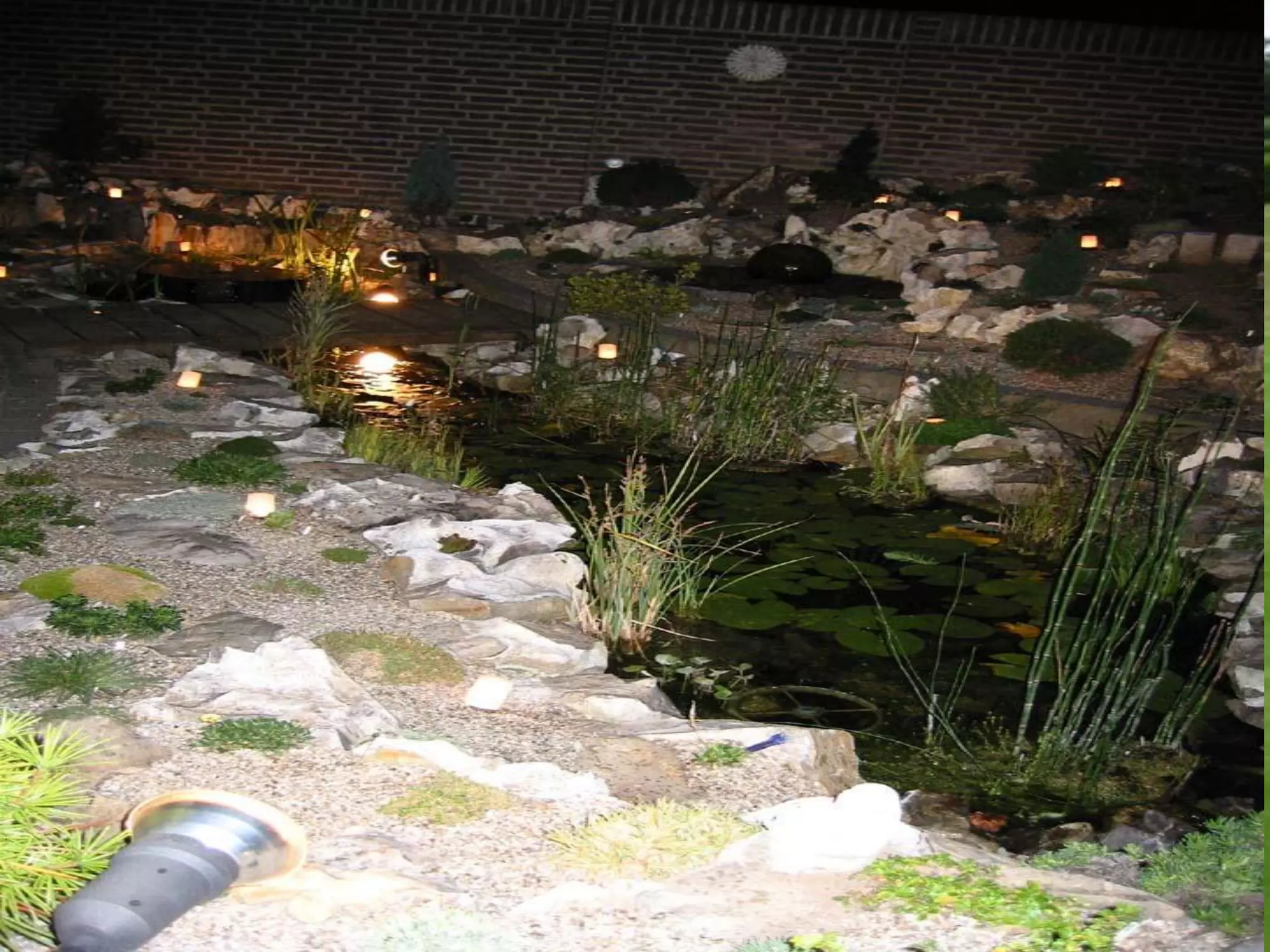
• Planned planting of aquatic and semi-aquatic plants in and
around pool is known as water gardening”.
• Water gardens or garden pools have become a popular part of
landscape architecture .
• The aesthetic value of water gardens is enhanced by the almost
endless variety of design and planting options that make each
one a unique and personal creation.
STEPS TO BE CONSIDERED
• Try laying out possible water garden designs using a garden hose
or rope
• Plan where pipes , filters and water pumps etc will be located and
how they will be concealed
• Plan where electrical and water lines should be placed for night
lighting, pumps, Fountains or water-falls and set foundations for
those structures as stepping stones, walking bridge, or the base of
a fountain
• Plan how the water will be drained
• Construct a catch basin in the deepest part of the water garden
will concentrate fish during drainings and make it easy to
capture them.
• To protect a liner from being punctured by roots and rocks, firmly
compact the dirt along the pool sides and bottom and covered it
with sand or old carpet before installing the liner.
• The water gardens interior may be decorated with sand , gravel or
rocks.
• Much of the enjoyment of owning a water garden is in designing
and landscaping the pool and the surrounding area
• Consider using rocks of various colors and shapes , fountains,
water falls , under water lighting , islands, bridges and
surrounding flower gardens.
STEPS TO BE CONSIDERED
Selecting a Site
• The location of the water garden is critical to its ecology
and maintenance.
• A water garden should be situated to receive at least 6
hours of sunlight each day.
• Away from tall shrubs and trees.
• Locating the water garden so that it can be viewed from
the house will increase your enjoyment and allow you to
supervise it.
• Easy access to water and electricity.
Pond Styles
It may be
(a) Natural (b) Artificial or Informal (c) Formal.
Installing pond
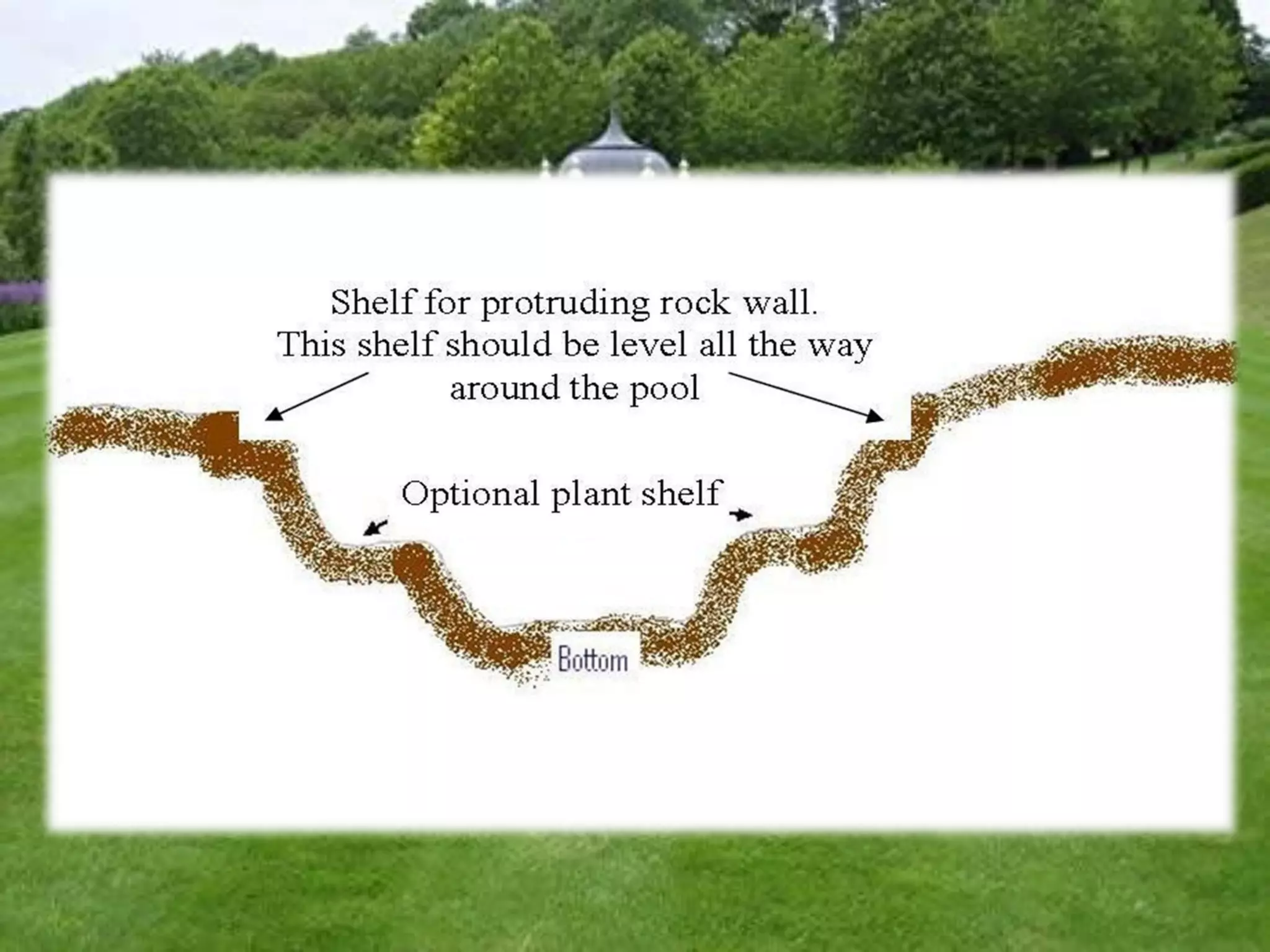
• While building a pond plant shelves should be included.
• Most water plants stay in pots placed on a pond shelf.
• Ponds need to be at least 600cm deep to allow for the water to
stay cool and deep enough for water plants and fish.
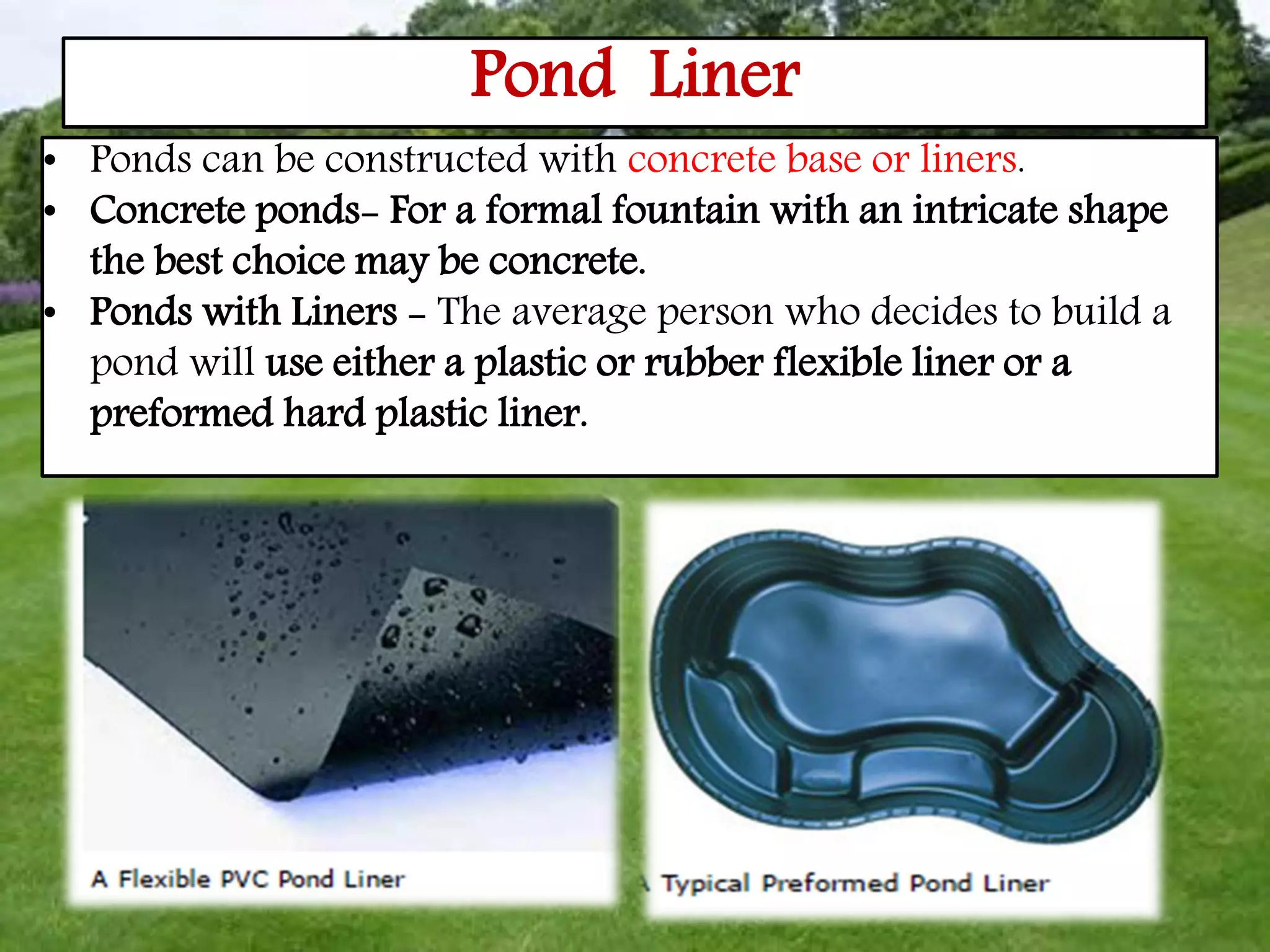
Pond Liner
• Ponds can be constructed with concrete base or liners.
• Concrete ponds- For a formal fountain with an intricate shape
the best choice may be concrete.
• Ponds with Liners - The average person who decides to build a
pond will use either a plastic or rubber flexible liner or a
preformed hard plastic liner.
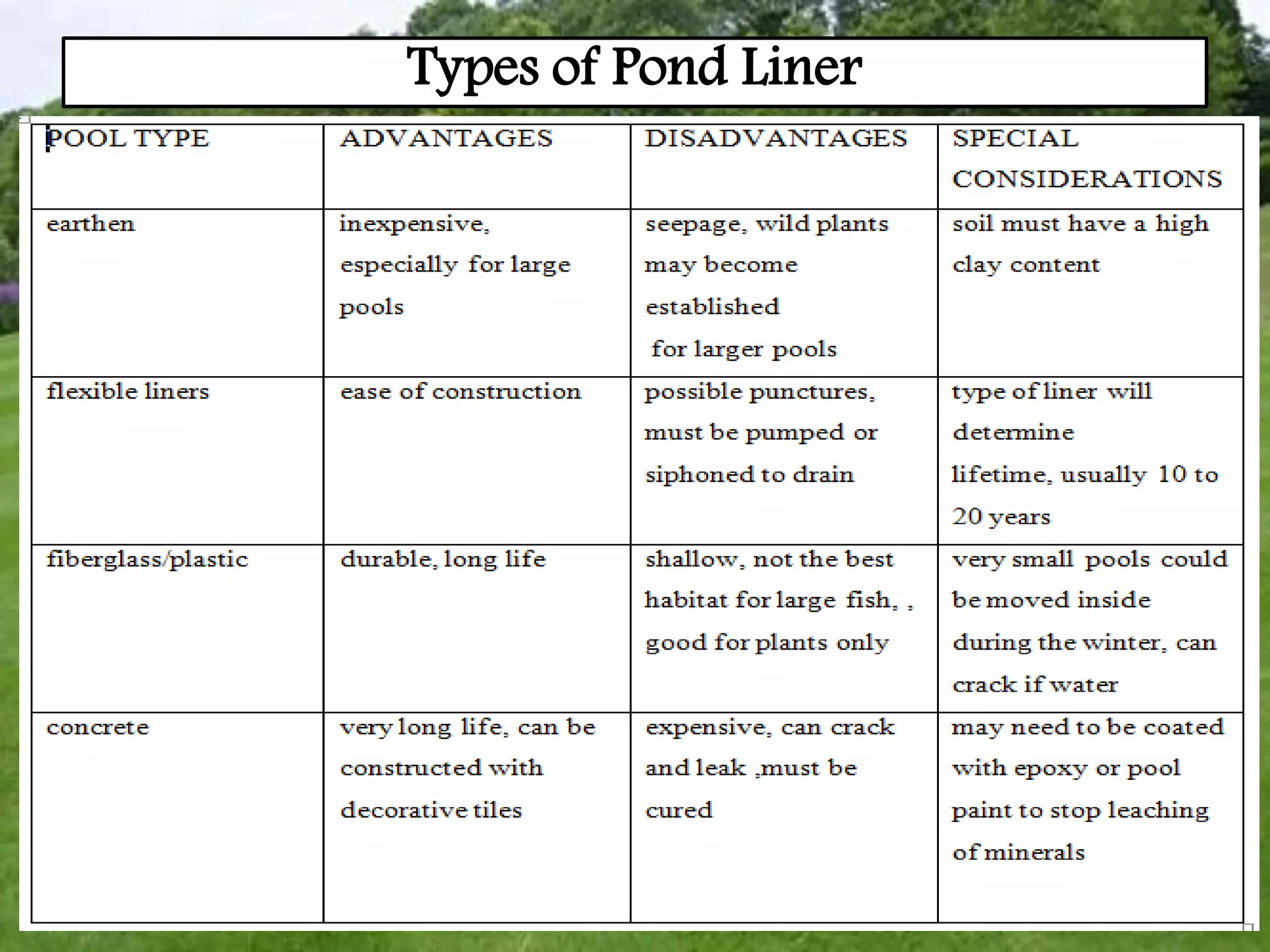
Types of Pond Liner
Flexible liner installation
• Outline with hose
• Excavate-9-12” deep and wide
• Level top ledges
• Install protective liner
• Secure with edging –
• Rock, stone or paver to the
• waters edge add a great
finish.
Installation of pumps
• A pump allows you to move water from one place to another,
such as from the pond to a waterfall or through a fountain.
• This action aerates the water and improves the water quality.
• A pump is also necessary to operate a filter that will further clean
the pond.
Submersible pumps
External pumps
Filters
• Mechanical filters that physically remove particles from the
water.
• A biological filter may take many forms but basically it is a
container that holds a filter media into which water flows.
• From here, water is pumped into and then back into the pond.
• Several types of bacteria
then live on this media and
do the work of cleaning the
pond water by converting
one chemical into another.
• This makes the water safe
for fish and helps reduce the
amount of algae.
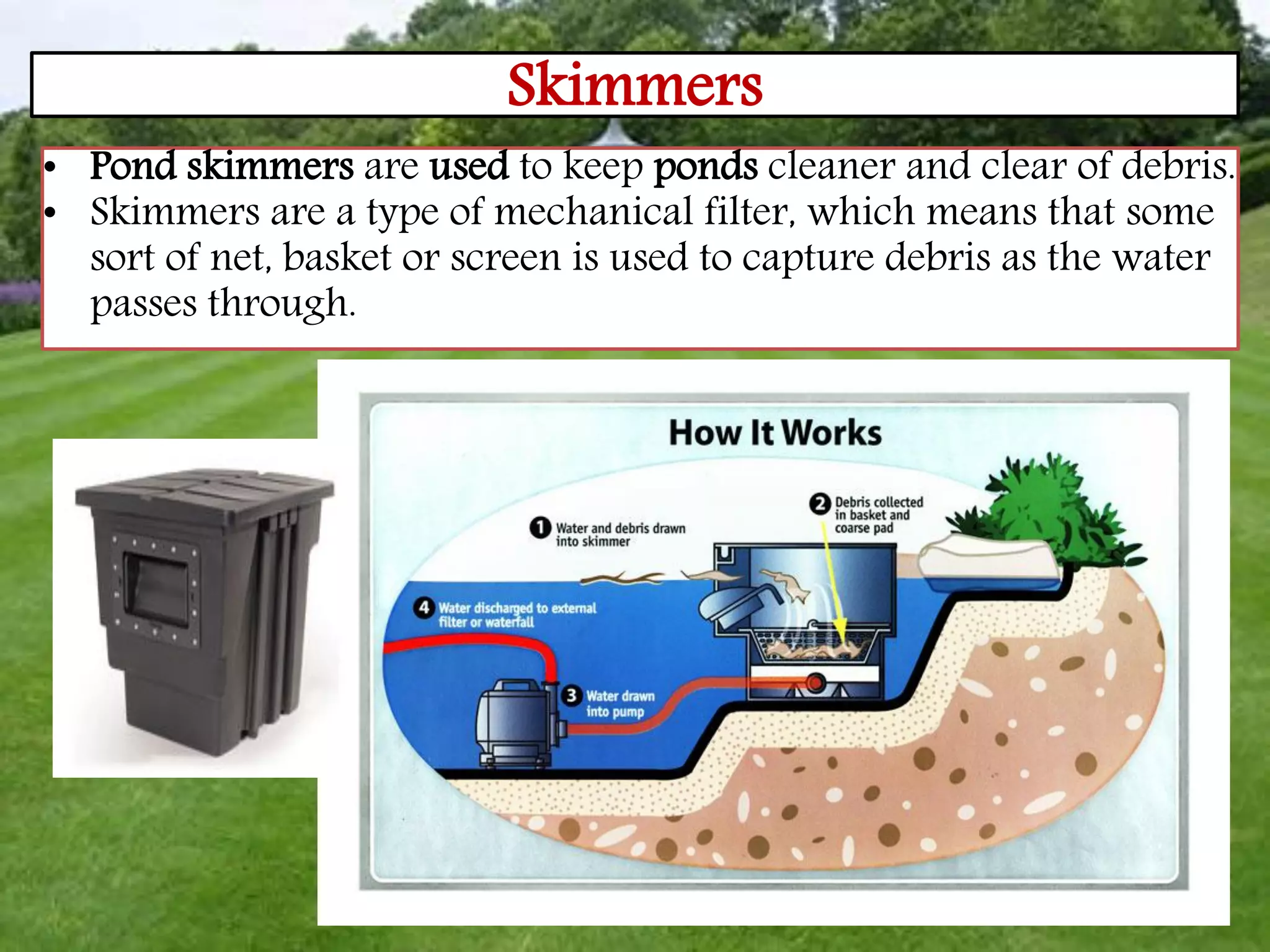
Skimmers
• Pond skimmers are used to keep ponds cleaner and clear of debris.
• Skimmers are a type of mechanical filter, which means that some
sort of net, basket or screen is used to capture debris as the water
passes through.
WATER QUALITY
• The first consideration is a supply of good quality water to fill the
pond
• Surface water from the creek or pond is not recommended as it
may contain contaminants, diseases and wild fish harms the water
garden ecosystem
• City water must be de-chlorinated before adding fish and ponds
• Water quality factors to consider are dissolved oxygen, ammonia,
nitrate, pH alkalinity, hardness, carbon-dioxide, and
contaminants or pollutants
Building the Waterfall
• The lush, calming noise of water hitting rocks begins to drown out the
sound of noisy cars, transporting you away into a more serene setting.
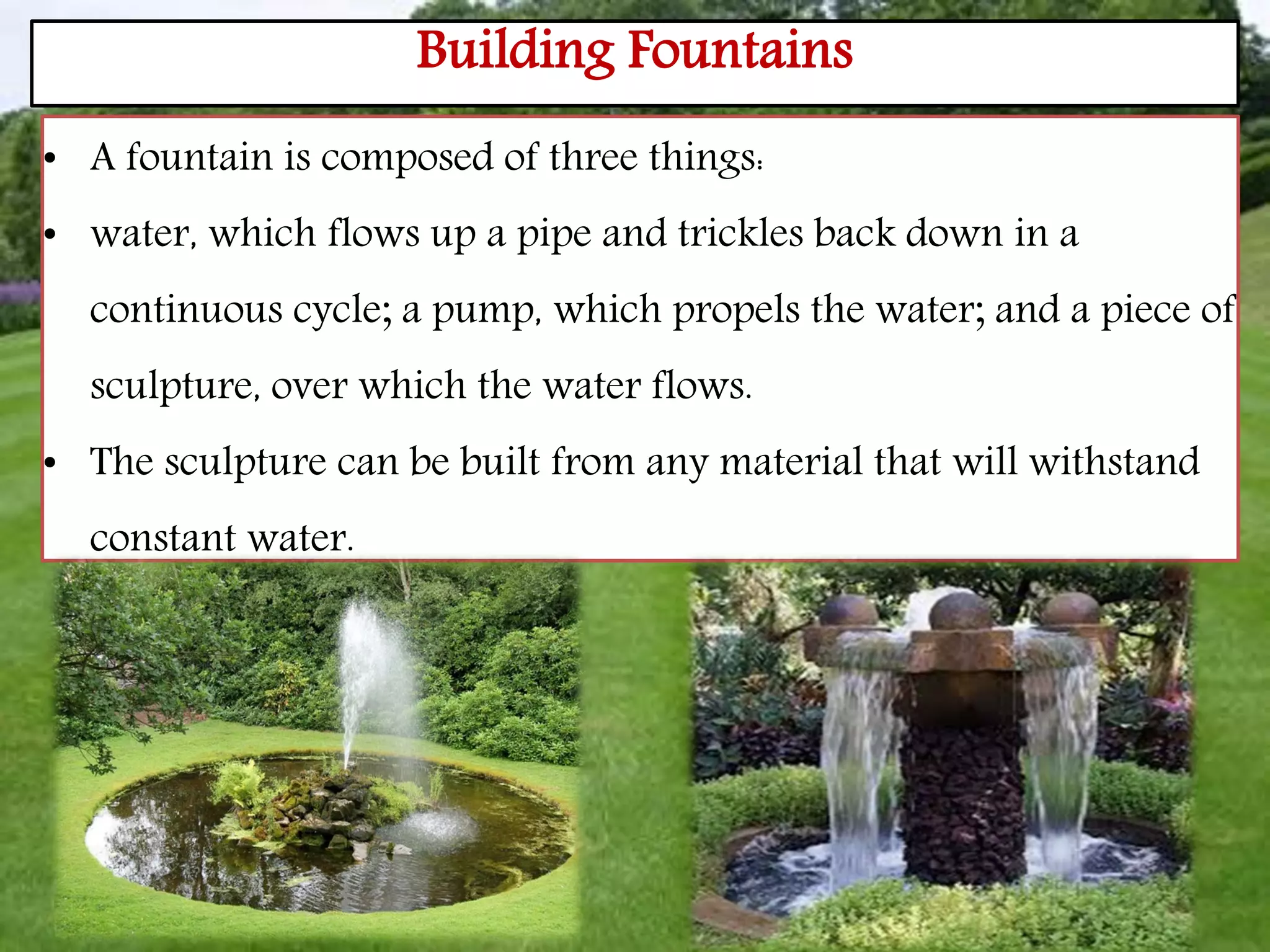
Building Fountains
• A fountain is composed of three things:
• water, which flows up a pipe and trickles back down in a
continuous cycle; a pump, which propels the water; and a piece of
sculpture, over which the water flows.
• The sculpture can be built from any material that will withstand
constant water.
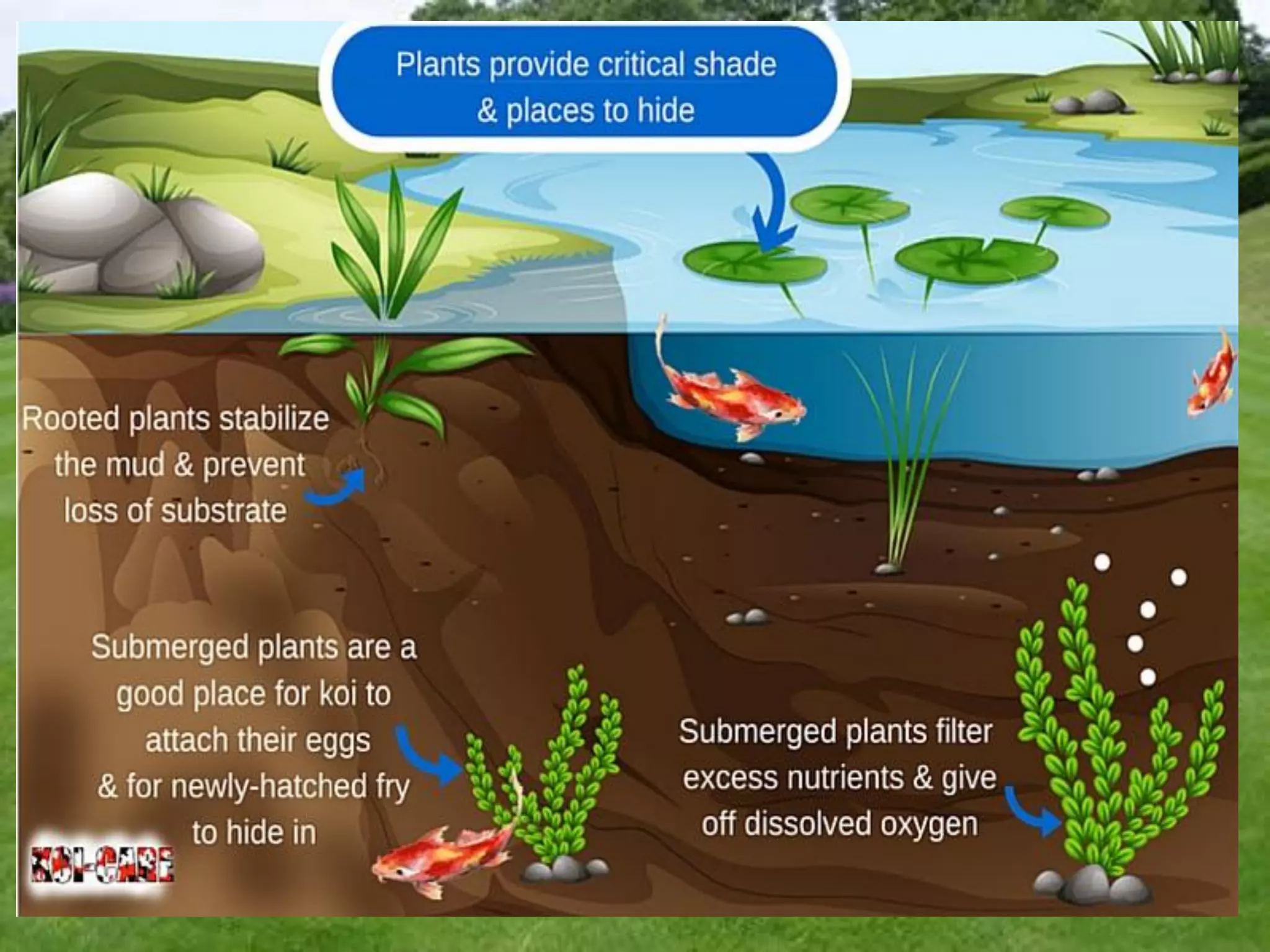
Aquatic flora
• Water garden plants are divided into Three main categories: submerged,
marginal, and floating.
• Submerged plants are those that live almost completely under the water,
sometimes with leaves or flowers that grow to the surface such as with the water
lily.
• These plants are placed in a pond or container usually 1–2 ft (0.30–0.61 m)
below the water surface.
• Some of these plants are called oxygenators because they create oxygen for the
fish that live in a pond. Examples of submerged plants are:
– Water lily (Hardy and Tropical)
– Hornwort (Ceratophyllum demersum)
• Marginal plants are those that live with their roots under the water but the restof
the plant above the surface.
• These are usually placed so that the top of the pot is at or barely below thewater
level. Examples of these are:
– Iris or Flag (Iris spp.)
– Water-crowfoot (Ranunculus fluitans)
– Bulrush (Scirpus lacustris)
– Cattail (Typha latifolia)
– Taro (Colocasia esculenta)
– Arrowhead (Sagittaria latifolia)
– Lotus (Nelumbo spp.)
– Pickerelweed (Pontederia cordata)
• Floating plants are those that are not anchored to the soil at all, but arefree-floating
on the surface.
• In water gardening, these are often used as a provider of shade to reducealgae
growth in a pond.
• These are often extremely fast growing/multiplying. Examples of these are:
– Mosquito ferns (Azolla spp.)
– Water-spangle (Salvinia spp.)
– Water-clover (Marsilea vestita)
– Water Lettuce (Pistia stratiotes)
– Water Hyacinth (Eichhornia crassipes)
• Some areas of the United States do not allow certain of these plants to be sold or
kept, as they have become invasive species in warmer areas of the country, such
as Florida and California.
A)Surface flowering Aquatics
• Nelumbo lutea-American lotus
• Nelumbo nucifera-Indian lotus
• Nymphaea sp-Water lily
B) Oxygenators
• The submerged oxygenating plants are vital in any pool, as
they maintain hygiene and balance.
• Elodea canadensis
• Vallisneria spiralis
C) Floating plants
• The speciality of the plants in this group is that no anchorage in
soil is needed for survival
• Eichhornia crassipes
• Lemna gibba
ADDITION OF FISH AND SNAILS
• First, do not open the bags immediately upon receiving the fish.
• Simply put the bags in the pond or quarantine tank and let
them float for at least 30 minutes so that the temperature of
the water in the bag can slowly adjust to that of the pond
water.
• Make sure that the water is dechlorinated and check the
water’s pH, ammonia and nitrite levels
• A good rule of thumb is to use 1-2 inches of fish for every
square foot of water surface
• Snails help to dispose of algae, fish waste and other decaying
matter.
Care and maintenance
• Aquatic plants need very little care.
• However some species grow very vigorously and need
trimming to avoid over-crowding and smothering of weaker
species.
• Sometimes the water of the ponds becomes green, popularly
known as ‘Blanket of weed’ covers the surface and side walls of
the pool.
• This is overcome by adding 1kg potassium permanganate (or)
120g copper sulphate to every 24,000 litres of water.
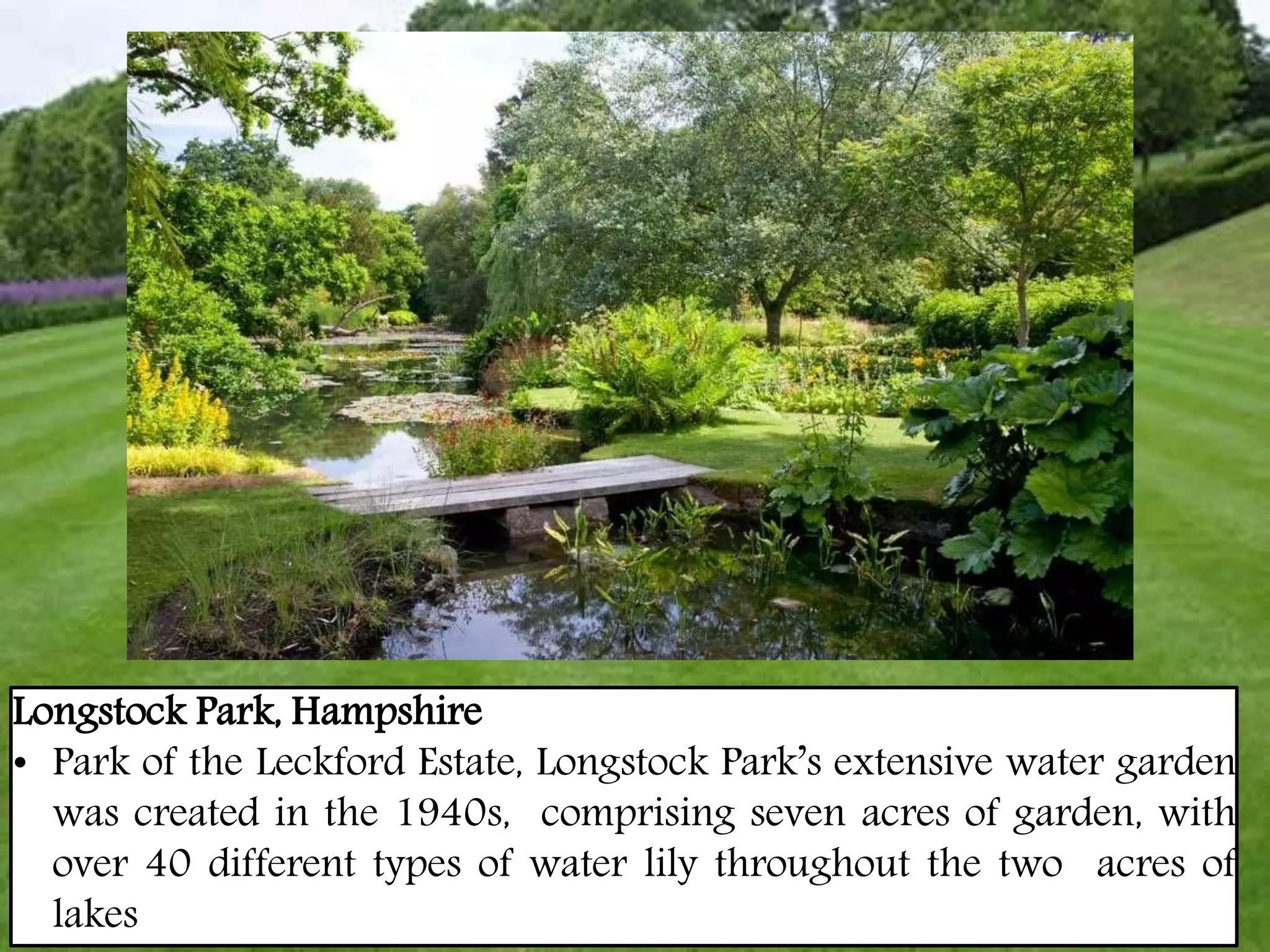
Longstock Park, Hampshire
• Park of the Leckford Estate, Longstock Park’s extensive water garden
was created in the 1940s, comprising seven acres of garden, with
over 40 different types of water lily throughout the two acres of
lakes
• Longstock Park, Hampshire
• Park of the Leckford Estate, Longstock Park’s extensive water garden
was created in the 1940s, comprising seven acres of garden, with
over 40 different types of water lily throughout the two acres of
lakes
Methods of lawn making, concepts of rock and water garden

Methods of lawn making, concepts of rock and water garden

  • 1.
    1 Methods of lawnmaking, concepts of rock and water garden Lecture No. 4
  • 2.
    LAWN • It isthe basic feature for home ground development • In home garden • improves the appearance of the house, • enhances the beauty, • Increase conveniences 2 • Lawn is beautiful green ground cover with perennial grass. • Also called as a natural green carpet. • A lawn is the heart of a garden.
  • 3.
    3 • Lawn alsoprovide –Perfect setting for • flower beds • A border • A shrubbery • A specimen of tree or a shrub –Besides , the lawn has spiritual value too • Lawn is source of charm and pride • reducestension of mind after adays’hardwork
  • 4.
    4 IMPORTANCE • Lawn isone of the most important features of a garden • “Without a lawn no garden is complete and beautiful as the beauty of the garden largely depends on the condition of the lawn.” • Main point of attraction of the garden. • Providesaplacefor takingsrest after theday’s hard work. • Ideal place for holding parties and different Social functions.
  • 5.
    5 Characters' of lawngrasses  It should develop quickly.  The grass must have compact growth.  It should withstand regular mowing.  It should tolerate Cold and drought.  The grass should be soft to touch and not patchy,  Should not give bad odour  Should look fresh and remain green throughout the year.
  • 6.
    SOIL … 6 • For establishmentof a good lawn fertile loamy soil is ideal. • Soil should be rich in humus content. • It should have good moisture holding capacity and at the same time it should have good drainage • Depth of soil shold be at least 25-30 cm for luxuriant growth • A slightly acidic soil having pH between 5. 0 to 6.0 is good growth of grass. – Low pH- 0.5 kg/m2 of chalk or grounded lime stone – Alkaline soil- Gypsum- 0.5 kg/m2
  • 7.
    Drainage… • Selected site-proper drainage • Grasses are shallow rooted herbs and no deep drainage is necessary, but • No water should stagnate in the root zone • Clayey soils- Drainage pipes or by putting a layer of bricks and rubbish 90cm bellow the surface • Ordinary drainage –carried out with grading and levelling 13
  • 8.
    • Rough surfaceleveling by eye estimation- prior to digging • Shifting and filling of soil done –if necessary • After rough levelling- thorough preparation of land is necessary- by digging • Digging should be done by trenching method- other wise the gardener fail to dig to the desired depth • Toensure proper depth- trench of 60cm deep and 45 cm width dug at one side of the site …Drainage.. 8
  • 9.
    • During digging-grass roots, stones etc., should be removed • Special care should be taken to remove the roots of Motha grass (Cyperus rotundus) • Digging should be done during – April –May- sterilize the soil, kill weed seeds, insects and harmful micro organisms • Soil should be turned up subsequently 2-3 times at weekly intervals, - each time clods of earth, if any are broken and roots of weeds are removed … D rainage 9
  • 10.
    Manuring and Grading •After digging is over – Soil is manured and graded • If the soil is already fertile- Don’t apply organicmanure- weed seeds • Poor soil-FYM, night soil manure, stable manure- 500kg/100 m2 • The manure is worked up to a depth of 15-20cm • Any freshly dug soil will take long time for settleing • In heavy rainfall areas- soil get settled due to pouring rain • In low rainfall areas- flooding is done to notice the depression and filled with soil and finally leveled using spirit level 16
  • 11.
  • 12.
    Botanical Name Commonname Situation Cynodon dactylon Hariyali /Arugu /Doob grass Suitable for open sunny location; drought resistant Stenotaphrum secundatum St. Augustine grass or Buffalo grass Suitable for shady situation; requires frequent watering Sporobolus tremulus Chain grass (or) Upparugu Suitable for saline soils and open sunny locations Poa annua Annual blue grass Suitable for acid soils and suitable for higher elevations Pennisetum clandestinum Kikuyu grass Grow well in acids soils, suitable for higher elevations. Zoisia japonica Japan grass Suitable for poor sandy soil; open sunny situation, slow in growth Selection of lawn grass species
  • 13.
    Botanical Name Commonname Situation Z. matrella Manila grass Suitable for open sunny situation Z. tenuifolia Korean grass or velvet grass or carpet grass Suitable for open sunny situation Cynodon sp. Bermuda grass (or) Hyderabad grass Suitable for open sunny situation, needs mowing Cynodon sp. Dwarf Bermuda Suitable for open sunny situation Festuca sp. Fescue grass Shade tolerant, survive on inferior soils Paspalum vaginatum Paspalum grass Suitable for open sunny situation Selection of lawn grass species
  • 14.
  • 15.
    Look for theIdentifying Parts :
  • 17.
  • 18.
    Folded Rolled Boat -Shaped Pointed Vernation Leaf Tip
  • 19.
  • 20.
    Long / Clawlike Short/ Stubby Auricle Absent
  • 21.
  • 22.
  • 23.
  • 24.
  • 25.
     Surface soiland sub – soil should be retain moisture  Adequate drainage must be provided.  The ground should be perfectly levelled and smooth.  Ploughing is required to loosen the soil.  Digging up to 35-45 cm depth is very important.  The soil should be exposed to the sun for 15 to 20 days.  Undesirable material like roots of the weeds, hard stones, rocks, etc. is removed.  The soil should be flooded with water several times to encourage the growth of weeds  About 5-7 cm depth of cowdung manure, activated sludge or any other organic manure along with lime, is to be added to the soil.  Final weeding and watering should be given after application of the manure.  Soil preparation
  • 26.
    26 PLANTING OF GRASS •Planting of grass can be done at anytime of the year. • But in the tropical country like India it is better to start the work of planting the grass in the beginning of rainy season, because grass thus planted will get quicker growth and better establishment..
  • 27.
    27 KOREAN GRASS  Thisgrass is native of Japan and Korea.  It has recently been introduced in India  Korean grass has velvety growth besides having more tolerance to cold.  This grass is highly suitable for making lawn in small areas and home gardens.
  • 28.
    28 DOOB OR BERMUDAGRASS  It is used very commonly for making lawn due to its faster growth, hardiness, less water requirements.  This grass makes excellent turf.  it can be grown on any type of soil.
  • 29.
    29 1. Seed sowing 2.Dibbling 3. Turfing 4. Bricking 5. Turf plastering 6. Planting on polythene sheet Method of planting Grasses
  • 30.
    1. SEED SOWING Before sowing of seeds divide the entire plot.  It should be 200 -300sq meter.  500 g of seed will be required for 200 sq metre area.  The entire amount of seeds should be mixed with double the quantity of fine soil.  Then the soil should be raked over in two directions so as to mix the seeds uniformly with the soil.  Then the ground should be rolled..  Then watering must be done. 78
  • 31.
    31  The seedswill germinate within 3-5 weeks.  After few weeks when the grass attains the height of about 4-5 cm the first cutting should be done and then the surface is rolled.  The grass on the lawn should never be allowed to grow more than 5 cm. 1. SEED SOWING
  • 32.
  • 33.
    33 2. DIBBLING • Itis cheapest and slowest method of lawn making but it is the most common method. • A small bunch of grass along with roots and little stem is taken. • Planting is done at a spacing of 7-9 cm apart both row to row and plant to plant, preferably when the soil is slightly moist. • The roots spread and grow underground in the course of 3-4 months making a fairly compact lawn.
  • 34.
    34 3. TURFING • Itis also called sod method quickest method of forming a lawn. • Small pieces of well prepared lawn or turf are cut into square or rectangular shape preferably. • Turf is a piece of earth with compact grass on it. • Selected small piece of grass should be cut uniformly thick selected from a place free from weeds and grasses along with soil are placed on prepared ground side by side closely • Slightly beat down flat into position. • Any cavity or interspaces found should be filled with fine soil. • It is the most costly way of making a lawn.
  • 35.
  • 36.
  • 37.
    37 4. BRICKING • Itis done to replace few unhealthy patches in a well maintained lawn. • In this methods pieces of lawn along with soil in the shape of bricks are planted and watered immediately.
  • 38.
    38 • Grass rootswith little stem of 4-5 cm long pieces are mixed with garden soil, fresh cow dung water and roots i e., rhizomes or stolons of doob grass. • Spread this paste evenly over prepared field during raining season. • It is then covered by 2 cm soil and watered regularly. 5. Turf Plastering method
  • 39.
    39 6. PLANTING ONPOLYTHENE SHEET • In this method lawn is grown on thick polyethylene (800 gauge thickness) • First cut the polyethylene into suitable pieces of desired dimension. • Spread a mixture of soil (3-4 cm thick) over the polyethylene sheets & grow grass on it. • It can be rolled and taken when temporary effect is to be created.
  • 40.
  • 41.
    Introduction: • Rock garden- Chief landscape elements • Mimics the mountains • Easiest to build up & maintain. Alpine / Rock plants: • Grow high up in mountains & comes up well in extreme conditions even freezing point. • Normally drought tolerant cacti & succulents also grown under tropical & sub tropical conditions.
  • 42.
    Alphine garden • Theseplants are found on mountain tops and tend to be dwarfed with showy blooms. • They grow on a medium consisting of sand, organic matter and gravel. • These plants are used to cool climates. • They include ferns, as well as many kinds of begonias, peperomias, and other plants
  • 44.
    Rock Garden • Arock garden, also known as a rockery or an alpine garden, is a type of garden that features extensive use of rocks or stones, along with plants native to rocky or alpine environments. • The usual form of a rock garden is a pile of rocks, large and small, esthetically arranged, and with small gaps between, where the plants will be rooted. • Some rock gardens incorporate bonsai
  • 45.
    Soil for rockgarden • It is always better to select plants that grow in the soil available instead of changing the soil to suit the plant. • As such, rock garden plants do not require heavy soil. • Chips of crushed rock, coarse sand, perlite or crushed limestone or chrushed oyster shells can be used to improve the soil texture in rock gardens. • Leaf mold, peat moss, compost and organic material can also be used. • Use soil that has been fertilized and light in texture. • This soil will facilitate water drainage.
  • 46.
    Conditions to beconsidered • Lay out must be simple • Rocks native to the area will look natural • Large rocks with irregular shapes breaks monotony • The rock is soft and porous, allowing moisture to seep through, and some determined roots will be able to make their way through the rock. • Limestone perform better & solid rocks not suitable • Limestone usually has depressions in it that can be filled with dirt for planting mosses and lichens. Plants: • Wide species is available ( perennials, bulbous, cacti, succulents, etc.,) • Plant should tolerate harsh conditions • Selection according to climate is must
  • 47.
    Key for thesuccess • Requires full sun for most of the day • Requires shade for at least 3 hours during the hottest part of the day • Little or no direct sunlight • Some or all parts of this plant may be toxic • Once established, these plants require little or no supplemental watering • These plants will tolerate some drought, but benefit from periodic watering • Needs regular weekly watering, more often in extreme heat • Keep constantly moist
  • 48.
  • 52.
    Rock Garden Care •Occasional addition of manure or compost will give them a boost. • Cutting back any leggy plants after flowering, clipping off dead stems and foliage, and dividing any plants that become root-bound or too large for its space. • Check for insects and diseases regularly. • Slugs may be present because they enjoy the shelter found among the rocks. • Periodical weeding is must
  • 60.
  • 61.
    INTRODUCTION • Planned plantingof aquatic and semi-aquatic plants in and around pool is known as water gardening”. • Water gardens or garden pools have become a popular part of landscape architecture . • The aesthetic value of water gardens is enhanced by the almost endless variety of design and planting options that make each one a unique and personal creation.
  • 64.
    STEPS TO BECONSIDERED • Try laying out possible water garden designs using a garden hose or rope • Plan where pipes , filters and water pumps etc will be located and how they will be concealed • Plan where electrical and water lines should be placed for night lighting, pumps, Fountains or water-falls and set foundations for those structures as stepping stones, walking bridge, or the base of a fountain • Plan how the water will be drained • Construct a catch basin in the deepest part of the water garden will concentrate fish during drainings and make it easy to capture them.
  • 65.
    • To protecta liner from being punctured by roots and rocks, firmly compact the dirt along the pool sides and bottom and covered it with sand or old carpet before installing the liner. • The water gardens interior may be decorated with sand , gravel or rocks. • Much of the enjoyment of owning a water garden is in designing and landscaping the pool and the surrounding area • Consider using rocks of various colors and shapes , fountains, water falls , under water lighting , islands, bridges and surrounding flower gardens. STEPS TO BE CONSIDERED
  • 66.
    Selecting a Site •The location of the water garden is critical to its ecology and maintenance. • A water garden should be situated to receive at least 6 hours of sunlight each day. • Away from tall shrubs and trees. • Locating the water garden so that it can be viewed from the house will increase your enjoyment and allow you to supervise it. • Easy access to water and electricity.
  • 67.
    Pond Styles It maybe (a) Natural (b) Artificial or Informal (c) Formal. Installing pond • While building a pond plant shelves should be included. • Most water plants stay in pots placed on a pond shelf. • Ponds need to be at least 600cm deep to allow for the water to stay cool and deep enough for water plants and fish.
  • 69.
    Pond Liner • Pondscan be constructed with concrete base or liners. • Concrete ponds- For a formal fountain with an intricate shape the best choice may be concrete. • Ponds with Liners - The average person who decides to build a pond will use either a plastic or rubber flexible liner or a preformed hard plastic liner.
  • 70.
  • 71.
    Flexible liner installation •Outline with hose • Excavate-9-12” deep and wide • Level top ledges • Install protective liner • Secure with edging – • Rock, stone or paver to the • waters edge add a great finish.
  • 73.
    Installation of pumps •A pump allows you to move water from one place to another, such as from the pond to a waterfall or through a fountain. • This action aerates the water and improves the water quality. • A pump is also necessary to operate a filter that will further clean the pond. Submersible pumps External pumps
  • 74.
    Filters • Mechanical filtersthat physically remove particles from the water. • A biological filter may take many forms but basically it is a container that holds a filter media into which water flows. • From here, water is pumped into and then back into the pond. • Several types of bacteria then live on this media and do the work of cleaning the pond water by converting one chemical into another. • This makes the water safe for fish and helps reduce the amount of algae.
  • 75.
    Skimmers • Pond skimmersare used to keep ponds cleaner and clear of debris. • Skimmers are a type of mechanical filter, which means that some sort of net, basket or screen is used to capture debris as the water passes through.
  • 76.
    WATER QUALITY • Thefirst consideration is a supply of good quality water to fill the pond • Surface water from the creek or pond is not recommended as it may contain contaminants, diseases and wild fish harms the water garden ecosystem • City water must be de-chlorinated before adding fish and ponds • Water quality factors to consider are dissolved oxygen, ammonia, nitrate, pH alkalinity, hardness, carbon-dioxide, and contaminants or pollutants
  • 77.
    Building the Waterfall •The lush, calming noise of water hitting rocks begins to drown out the sound of noisy cars, transporting you away into a more serene setting.
  • 78.
    Building Fountains • Afountain is composed of three things: • water, which flows up a pipe and trickles back down in a continuous cycle; a pump, which propels the water; and a piece of sculpture, over which the water flows. • The sculpture can be built from any material that will withstand constant water.
  • 80.
    Aquatic flora • Watergarden plants are divided into Three main categories: submerged, marginal, and floating. • Submerged plants are those that live almost completely under the water, sometimes with leaves or flowers that grow to the surface such as with the water lily. • These plants are placed in a pond or container usually 1–2 ft (0.30–0.61 m) below the water surface. • Some of these plants are called oxygenators because they create oxygen for the fish that live in a pond. Examples of submerged plants are: – Water lily (Hardy and Tropical) – Hornwort (Ceratophyllum demersum)
  • 81.
    • Marginal plantsare those that live with their roots under the water but the restof the plant above the surface. • These are usually placed so that the top of the pot is at or barely below thewater level. Examples of these are: – Iris or Flag (Iris spp.) – Water-crowfoot (Ranunculus fluitans) – Bulrush (Scirpus lacustris) – Cattail (Typha latifolia) – Taro (Colocasia esculenta) – Arrowhead (Sagittaria latifolia) – Lotus (Nelumbo spp.) – Pickerelweed (Pontederia cordata)
  • 82.
    • Floating plantsare those that are not anchored to the soil at all, but arefree-floating on the surface. • In water gardening, these are often used as a provider of shade to reducealgae growth in a pond. • These are often extremely fast growing/multiplying. Examples of these are: – Mosquito ferns (Azolla spp.) – Water-spangle (Salvinia spp.) – Water-clover (Marsilea vestita) – Water Lettuce (Pistia stratiotes) – Water Hyacinth (Eichhornia crassipes) • Some areas of the United States do not allow certain of these plants to be sold or kept, as they have become invasive species in warmer areas of the country, such as Florida and California.
  • 83.
    A)Surface flowering Aquatics •Nelumbo lutea-American lotus • Nelumbo nucifera-Indian lotus • Nymphaea sp-Water lily
  • 84.
    B) Oxygenators • Thesubmerged oxygenating plants are vital in any pool, as they maintain hygiene and balance. • Elodea canadensis • Vallisneria spiralis
  • 85.
    C) Floating plants •The speciality of the plants in this group is that no anchorage in soil is needed for survival • Eichhornia crassipes • Lemna gibba
  • 86.
    ADDITION OF FISHAND SNAILS • First, do not open the bags immediately upon receiving the fish. • Simply put the bags in the pond or quarantine tank and let them float for at least 30 minutes so that the temperature of the water in the bag can slowly adjust to that of the pond water. • Make sure that the water is dechlorinated and check the water’s pH, ammonia and nitrite levels • A good rule of thumb is to use 1-2 inches of fish for every square foot of water surface • Snails help to dispose of algae, fish waste and other decaying matter.
  • 88.
    Care and maintenance •Aquatic plants need very little care. • However some species grow very vigorously and need trimming to avoid over-crowding and smothering of weaker species. • Sometimes the water of the ponds becomes green, popularly known as ‘Blanket of weed’ covers the surface and side walls of the pool. • This is overcome by adding 1kg potassium permanganate (or) 120g copper sulphate to every 24,000 litres of water.
  • 89.
    Longstock Park, Hampshire •Park of the Leckford Estate, Longstock Park’s extensive water garden was created in the 1940s, comprising seven acres of garden, with over 40 different types of water lily throughout the two acres of lakes
  • 90.
    • Longstock Park,Hampshire • Park of the Leckford Estate, Longstock Park’s extensive water garden was created in the 1940s, comprising seven acres of garden, with over 40 different types of water lily throughout the two acres of lakes