Lawn Edition
Olathe Christian Church 2010
Healthy Yards and
        Communities
•  http://www.kansasgreenyards.org/


•  Info to maintain healthy landscapes
   and protect the environment.
Healthy Yards and
        Communities
•  Most people think that maintaining a
   nice looking yard is bad for the
   environment.

•  On the contrary, an un-healthy, un-
   managed lawn can be more harmful to
   the environment than a healthy green
   yard.
Healthy Green Lawns
•  Filter air and water.
  –  Research shows green grass removes
     pollutants from air and traps sediments
     and nutrients from entering run-off water.
     •  Dead or Damaged lawns have more soil and
        nutrient loss, polluting our surface waters.
Healthy Green Lawns
•  Cool the environment.
  –  “Heat Island Affect” in urban areas, with
     no grass
•  Healthy Landscapes can be
   maintained with little or no negative
   impact on the environment.
  –  For more info on how to maintain healthy
     yards, KSUTurf.com and
     KansasGreenYards.org
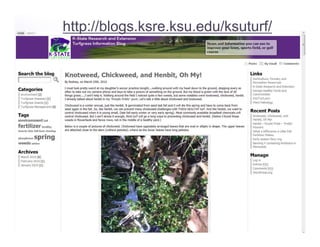
http://blogs.ksre.ksu.edu/ksuturf/
Good Lawns Include 3 Things
  1.  Start with good soil.

  2.  Picking the best species and varieties.
      – Get species and variety
        recommendations from your local
        agent and KSUTurf.com
  5.  Work
Busting Myths on Established
           Lawns
•  Today we won’t discuss
   renovation….new soil….new grasses

•  Today we will talk about the WORK
   part.
Mowing Myths
•  Always bag your clippings….they cause
   thatch.

•  Mow it really short in late fall and early
   spring.

•  Mulching tree leaves into lawn is damaging
   to the lawn.
•  Mowing short will make my yard like a golf
   course.
Mowing Myths
•  Always bag your clippings….they cause thatch.
   –  Clippings don’t cause thatch…don’t bag.
•  Mow it really short in late fall and early spring.
   –  Maybe in spring, but could cause problems.
•  Mulching tree leaves into lawn is damaging to
   the lawn.
   –  Nope they are fine.
•  Mowing short will make my yard like a golf
   course.
   –  Nope. Special grasses, special soils
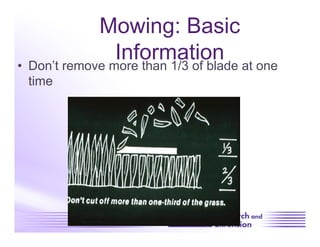
Mowing: Basic
                 Information at one
•  Don’t remove more than 1/3 of blade
 time
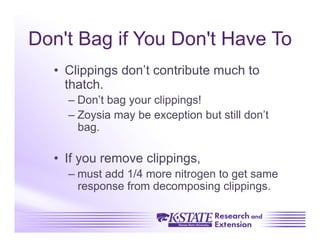
Don't Bag if You Don't Have To
  •  Clippings don’t contribute much to
     thatch.
    –  Don’t bag your clippings!
    –  Zoysia may be exception but still don’t
       bag.

  •  If you remove clippings,
    –  must add 1/4 more nitrogen to get same
       response from decomposing clippings.
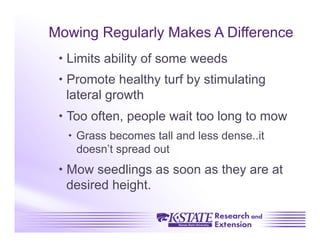
Mowing Regularly Makes A Difference
  Limits ability of some weeds
  Promote healthy turf by stimulating
   lateral growth
  Too often, people wait too long to mow
    Grass becomes tall and less dense..it
     doesn’t spread out
  Mow seedlings as soon as they are at
   desired height.
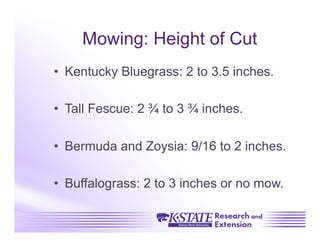
Mowing: Height of Cut
•  Kentucky Bluegrass: 2 to 3.5 inches.

•  Tall Fescue: 2 ¾ to 3 ¾ inches.

•  Bermuda and Zoysia: 9/16 to 2 inches.

•  Buffalograss: 2 to 3 inches or no mow.
FERTILITY
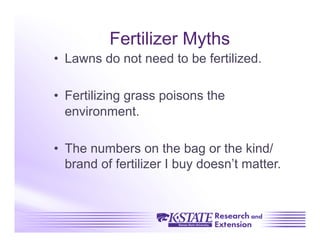
Fertilizer Myths
•  Lawns do not need to be fertilized.

•  Fertilizing grass poisons the
   environment.

•  The numbers on the bag or the kind/
   brand of fertilizer I buy doesn’t matter.
Fertilizer Myths
•  Lawns do not need to be fertilized.
  –  Almost all lawns need some fertilizer to
     maintain health.
•  Fertilizing grass poisons the
   environment.
  –  Properly fertilized lawns are healthier and
     better for the environment. Once the
     fertilizer is applied to the lawn it stays in
     the lawn.
Fertilizer Myths
•  The numbers on the bag or the kind/
   brand of fertilizer I buy doesn’t matter.
  –  The numbers are percentages of nutrients
     in the bag. Higher numbers=more
     nutrients which means you need to use
     less of that product to achieve the same
     result.
  –  Brands and kinds are formulated different.
     Garden fertilizer is not good for lawns and
     vice-versa. Coop brands vs turf brands.
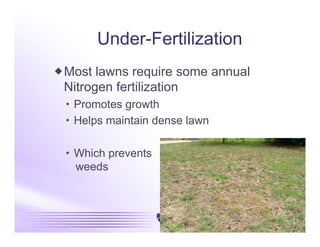
Under-Fertilization
 Most lawns require some annual
  Nitrogen fertilization
   Promotes growth
   Helps maintain dense lawn

   Which prevents
    weeds
Over-Fertilization
 Too much Nitrogen can cause over-
  stimulation.

   Resulting in lush-soft growth
   That can be more susceptible to
     Traffic Damage
     Heat Stress
     Disease
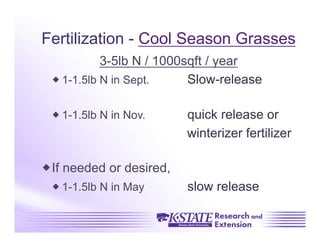
Fertilization - Cool Season Grasses
           3-5lb N / 1000sqft / year
  1-1.5lb N in Sept.     Slow-release

  1-1.5lb N in Nov.      quick release or
                          winterizer fertilizer

 If needed or desired,
  1-1.5lb N in May       slow release
Keep It Out of the Street!!!!
•  Once the fertilizer is in the lawn it
   stays in the lawn, but any on the street
   or sidewalk/driveway will wash into
   storm sewers with rain.

•  Not a major source of pollution, but do
   your part to protect the environment.
Irrigation Myths
•  The more I water the better the grass
   will perform.

•  Water in the afternoon to cool the
   lawn.
•  Water a little everyday.
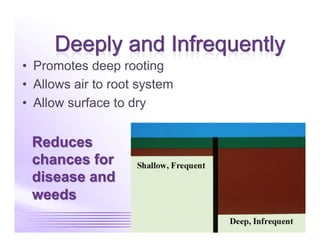
•  Promotes deep rooting
•  Allows air to root system
•  Allow surface to dry
Turf Irrigation
•  Water in early morning just before
   dawn.
  –  Less disease

  –  More Efficient
     •  Better water pressure
     •  Less wind
     •  Less evaporation
Thatch Myths
•  Thatch is bad and I don’t want to have
   any.
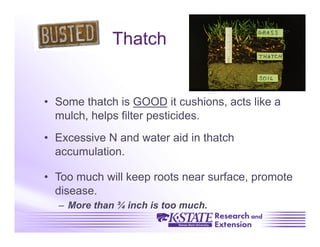
Thatch


•  Some thatch is GOOD it cushions, acts like a
   mulch, helps filter pesticides.
•  Excessive N and water aid in thatch
   accumulation.

•  Too much will keep roots near surface, promote
   disease.
  –  More than ¾ inch is too much.
Aerate for Thatch & for Healthy Grass

 Improves water and air movement into
 soil.
  Roots need air to breathe
  More Air = More Roots = Healthier Grass
 How often?
  Depends on use of lawn.
   Kids, dogs, parties, heavy soil = every
    year
   None of above, sandy soils = every 3 or
    more years.
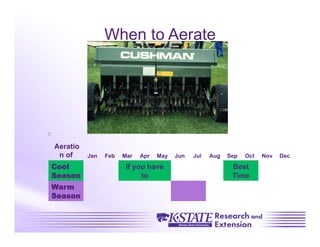
When to Aerate


Aeratio
 n of     Jan   Feb   Mar   Apr   May   Jun   Jul   Aug   Sep   Oct   Nov   Dec
Cool                   If you have                         Best
Season                      to                             Time
Warm
Season
Weed Myths
•  I had a good lawn and then the weeds
   came in and killed my yard.

•  I should always use the weed and
   feed.
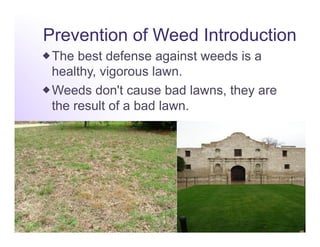
Prevention of Weed Introduction
 The best defense against weeds is a
  healthy, vigorous lawn.
 Weeds don't cause bad lawns, they are
  the result of a bad lawn.
Weed and Feed
•  Only needed if you have weeds all
   over your yard.
•  If not, then use plain fertilizer and spot
   spray your weeds.
  –  Cheaper and less potential impact to the
     environment.
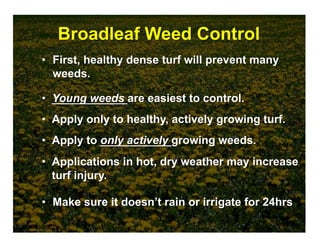
Spring Time = Time To Control
    Annual Grassy Weeds
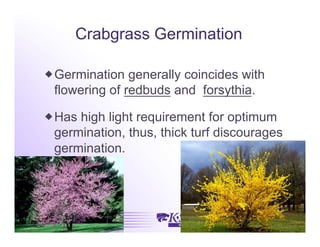
Crabgrass Germination

 Germination generally coincides with
  flowering of redbuds and forsythia.

 Has high light requirement for optimum
  germination, thus, thick turf discourages
  germination.
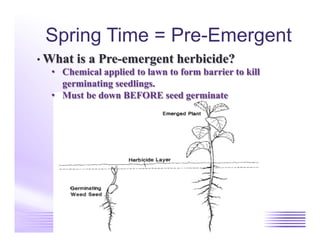
Spring Time = Pre-Emergent
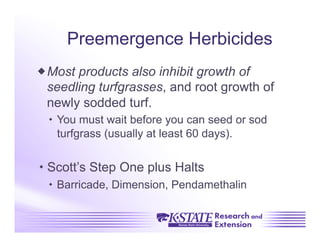
Preemergence Herbicides
 Most products also inhibit growth of
  seedling turfgrasses, and root growth of
  newly sodded turf.
    You must wait before you can seed or sod
     turfgrass (usually at least 60 days).


 Scott’s Step One plus Halts
    Barricade, Dimension, Pendamethalin
Clay Busters
•  Applying Gypsum or some special
   clay-busting, clay-loosening spray or
   chemical will loosen my clay yard and
   improve it.
Clay Busters
•  Applying Gypsum or some special
   clay-busting, clay-loosening spray or
   chemical will loosen my clay yard and
   improve it.

  –  NO! Only the addition of organic matter
     will loosen clay soils. Gypsum loosens
     salt affected clay soils, not our clay soil.
Mole Myths
•  Moles eat grubs…kill the grubs get rid
   of the moles.
  –  Nope, moles prefer to eat worms.
•  Use chewing gum, castor oil, tobacco
   to get rid of moles.
  –  Trap them. Or use poison.
  –  Talprid
Seeding Myths
•  The best time to seed a yard is in the spring.
   –  Fall is best, but seed when you have bare spots.


•  If I let my grass grow tall it will go to seed
   and seed itself.
   –  Nope.


•  All grass seed is the same.
   –  Not true, large differences in species and
      varieties.
   –  NTEP.org or KSUTurf.com
Johnson County Extension
           Office
•  Lots of paper publications on lawns,
   gardens, flowers, trees, cooking, cleaning,
   budgeting, …almost everything.
•  Soil Tests, plant, weed, insect, and disease
   ID.

•  119th and Ridgeview (NW corner)
•  www.KSRE.KSU.edu
Diseases
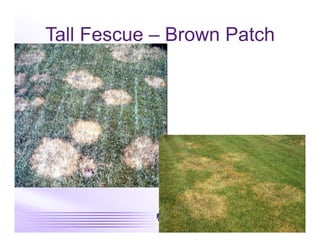
•  Tall Fescue – Brown patch
  –  Symptoms appear in late May-July
  –  Warm and humid
  –  Prefers over fertilized lawns
  –  Usually too hot and dry in Aug
Tall Fescue – Brown Patch
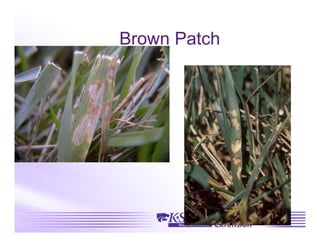
Brown Patch
Disease ID – Plant Path Lab
  •  Take a sample into your local
     extension office.
  •  Bring 3-4 inch plug with 2-3 inches of
     soil.
  •  Bring dying turf, not dead.
  •  Ziploc baggie, no wet paper towels or
     anything.
  •  Overnight mail it.
Common Postemergence Herbicides
•  2,4-D
•  Weed-B-Gone, Weed-B-Gone Max Plus Crabgrass
   Control
•  Trimec products
•  Products containing triclopyr –good for clover, ivy, violet
•  Weed Free Zone
•  Weed Stop
•  Drive – quinclorac for grassy weeds, field bindweed, Clover

•  Watch the ones that say Grass and Weed Killer
   –  They will kill your lawn too.
   –  Read the Label.

2010 Ks Lawns OCC

  • 1.
  • 2.
    Healthy Yards and Communities •  http://www.kansasgreenyards.org/ •  Info to maintain healthy landscapes and protect the environment.
  • 3.
    Healthy Yards and Communities •  Most people think that maintaining a nice looking yard is bad for the environment. •  On the contrary, an un-healthy, un- managed lawn can be more harmful to the environment than a healthy green yard.
  • 4.
    Healthy Green Lawns • Filter air and water. –  Research shows green grass removes pollutants from air and traps sediments and nutrients from entering run-off water. •  Dead or Damaged lawns have more soil and nutrient loss, polluting our surface waters.
  • 5.
    Healthy Green Lawns • Cool the environment. –  “Heat Island Affect” in urban areas, with no grass •  Healthy Landscapes can be maintained with little or no negative impact on the environment. –  For more info on how to maintain healthy yards, KSUTurf.com and KansasGreenYards.org
  • 6.
  • 7.
    Good Lawns Include3 Things 1.  Start with good soil. 2.  Picking the best species and varieties. – Get species and variety recommendations from your local agent and KSUTurf.com 5.  Work
  • 8.
    Busting Myths onEstablished Lawns •  Today we won’t discuss renovation….new soil….new grasses •  Today we will talk about the WORK part.
  • 9.
    Mowing Myths •  Alwaysbag your clippings….they cause thatch. •  Mow it really short in late fall and early spring. •  Mulching tree leaves into lawn is damaging to the lawn. •  Mowing short will make my yard like a golf course.
  • 10.
    Mowing Myths •  Alwaysbag your clippings….they cause thatch. –  Clippings don’t cause thatch…don’t bag. •  Mow it really short in late fall and early spring. –  Maybe in spring, but could cause problems. •  Mulching tree leaves into lawn is damaging to the lawn. –  Nope they are fine. •  Mowing short will make my yard like a golf course. –  Nope. Special grasses, special soils
  • 11.
    Mowing: Basic Information at one •  Don’t remove more than 1/3 of blade time
  • 12.
    Don't Bag ifYou Don't Have To •  Clippings don’t contribute much to thatch. –  Don’t bag your clippings! –  Zoysia may be exception but still don’t bag. •  If you remove clippings, –  must add 1/4 more nitrogen to get same response from decomposing clippings.
  • 13.
    Mowing Regularly MakesA Difference  Limits ability of some weeds  Promote healthy turf by stimulating lateral growth  Too often, people wait too long to mow   Grass becomes tall and less dense..it doesn’t spread out  Mow seedlings as soon as they are at desired height.
  • 14.
    Mowing: Height ofCut •  Kentucky Bluegrass: 2 to 3.5 inches. •  Tall Fescue: 2 ¾ to 3 ¾ inches. •  Bermuda and Zoysia: 9/16 to 2 inches. •  Buffalograss: 2 to 3 inches or no mow.
  • 15.
  • 16.
    Fertilizer Myths •  Lawnsdo not need to be fertilized. •  Fertilizing grass poisons the environment. •  The numbers on the bag or the kind/ brand of fertilizer I buy doesn’t matter.
  • 17.
    Fertilizer Myths •  Lawnsdo not need to be fertilized. –  Almost all lawns need some fertilizer to maintain health. •  Fertilizing grass poisons the environment. –  Properly fertilized lawns are healthier and better for the environment. Once the fertilizer is applied to the lawn it stays in the lawn.
  • 18.
    Fertilizer Myths •  Thenumbers on the bag or the kind/ brand of fertilizer I buy doesn’t matter. –  The numbers are percentages of nutrients in the bag. Higher numbers=more nutrients which means you need to use less of that product to achieve the same result. –  Brands and kinds are formulated different. Garden fertilizer is not good for lawns and vice-versa. Coop brands vs turf brands.
  • 19.
    Under-Fertilization  Most lawns requiresome annual Nitrogen fertilization   Promotes growth   Helps maintain dense lawn   Which prevents weeds
  • 20.
    Over-Fertilization  Too much Nitrogencan cause over- stimulation.   Resulting in lush-soft growth   That can be more susceptible to   Traffic Damage   Heat Stress   Disease
  • 21.
    Fertilization - CoolSeason Grasses 3-5lb N / 1000sqft / year  1-1.5lb N in Sept. Slow-release  1-1.5lb N in Nov. quick release or winterizer fertilizer  If needed or desired,  1-1.5lb N in May slow release
  • 22.
    Keep It Outof the Street!!!! •  Once the fertilizer is in the lawn it stays in the lawn, but any on the street or sidewalk/driveway will wash into storm sewers with rain. •  Not a major source of pollution, but do your part to protect the environment.
  • 23.
    Irrigation Myths •  Themore I water the better the grass will perform. •  Water in the afternoon to cool the lawn. •  Water a little everyday.
  • 24.
    •  Promotes deeprooting •  Allows air to root system •  Allow surface to dry
  • 25.
    Turf Irrigation •  Waterin early morning just before dawn. –  Less disease –  More Efficient •  Better water pressure •  Less wind •  Less evaporation
  • 26.
    Thatch Myths •  Thatchis bad and I don’t want to have any.
  • 27.
    Thatch •  Some thatchis GOOD it cushions, acts like a mulch, helps filter pesticides. •  Excessive N and water aid in thatch accumulation. •  Too much will keep roots near surface, promote disease. –  More than ¾ inch is too much.
  • 28.
    Aerate for Thatch& for Healthy Grass  Improves water and air movement into soil.  Roots need air to breathe  More Air = More Roots = Healthier Grass  How often?  Depends on use of lawn.  Kids, dogs, parties, heavy soil = every year  None of above, sandy soils = every 3 or more years.
  • 29.
    When to Aerate Aeratio n of Jan Feb Mar Apr May Jun Jul Aug Sep Oct Nov Dec Cool If you have Best Season to Time Warm Season
  • 30.
    Weed Myths •  Ihad a good lawn and then the weeds came in and killed my yard. •  I should always use the weed and feed.
  • 31.
    Prevention of WeedIntroduction  The best defense against weeds is a healthy, vigorous lawn.  Weeds don't cause bad lawns, they are the result of a bad lawn.
  • 32.
    Weed and Feed • Only needed if you have weeds all over your yard. •  If not, then use plain fertilizer and spot spray your weeds. –  Cheaper and less potential impact to the environment.
  • 33.
    Spring Time =Time To Control Annual Grassy Weeds
  • 34.
    Crabgrass Germination  Germination generallycoincides with flowering of redbuds and forsythia.  Has high light requirement for optimum germination, thus, thick turf discourages germination.
  • 35.
    Spring Time =Pre-Emergent
  • 36.
    Preemergence Herbicides  Most productsalso inhibit growth of seedling turfgrasses, and root growth of newly sodded turf.   You must wait before you can seed or sod turfgrass (usually at least 60 days).  Scott’s Step One plus Halts   Barricade, Dimension, Pendamethalin
  • 38.
    Clay Busters •  ApplyingGypsum or some special clay-busting, clay-loosening spray or chemical will loosen my clay yard and improve it.
  • 39.
    Clay Busters •  ApplyingGypsum or some special clay-busting, clay-loosening spray or chemical will loosen my clay yard and improve it. –  NO! Only the addition of organic matter will loosen clay soils. Gypsum loosens salt affected clay soils, not our clay soil.
  • 40.
    Mole Myths •  Moleseat grubs…kill the grubs get rid of the moles. –  Nope, moles prefer to eat worms. •  Use chewing gum, castor oil, tobacco to get rid of moles. –  Trap them. Or use poison. –  Talprid
  • 41.
    Seeding Myths •  Thebest time to seed a yard is in the spring. –  Fall is best, but seed when you have bare spots. •  If I let my grass grow tall it will go to seed and seed itself. –  Nope. •  All grass seed is the same. –  Not true, large differences in species and varieties. –  NTEP.org or KSUTurf.com
  • 42.
    Johnson County Extension Office •  Lots of paper publications on lawns, gardens, flowers, trees, cooking, cleaning, budgeting, …almost everything. •  Soil Tests, plant, weed, insect, and disease ID. •  119th and Ridgeview (NW corner) •  www.KSRE.KSU.edu
  • 44.
    Diseases •  Tall Fescue– Brown patch –  Symptoms appear in late May-July –  Warm and humid –  Prefers over fertilized lawns –  Usually too hot and dry in Aug
  • 45.
    Tall Fescue –Brown Patch
  • 46.
  • 47.
    Disease ID –Plant Path Lab •  Take a sample into your local extension office. •  Bring 3-4 inch plug with 2-3 inches of soil. •  Bring dying turf, not dead. •  Ziploc baggie, no wet paper towels or anything. •  Overnight mail it.
  • 48.
    Common Postemergence Herbicides • 2,4-D •  Weed-B-Gone, Weed-B-Gone Max Plus Crabgrass Control •  Trimec products •  Products containing triclopyr –good for clover, ivy, violet •  Weed Free Zone •  Weed Stop •  Drive – quinclorac for grassy weeds, field bindweed, Clover •  Watch the ones that say Grass and Weed Killer –  They will kill your lawn too. –  Read the Label.