Soils and composting for the
Master Gardener
Bart Renner, North Carolina
Cooperative Extension
March 31, 2020
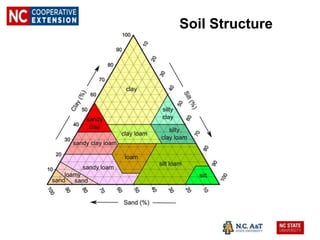
Soil Structure
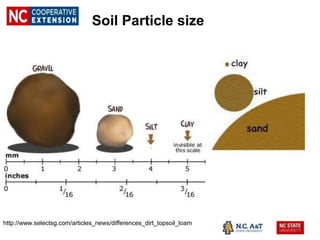
Soil Particle size
http://www.selectsg.com/articles_news/differences_dirt_topsoil_loam
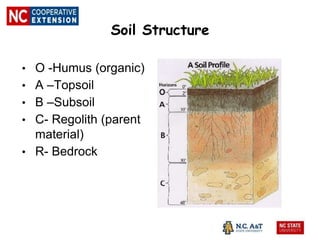
Soil Structure
• O -Humus (organic)
• A –Topsoil
• B –Subsoil
• C- Regolith (parent
material)
• R- Bedrock
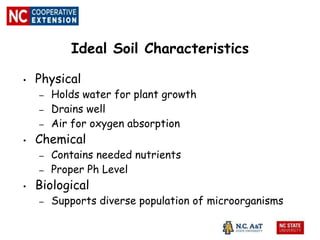
Ideal Soil Characteristics
• Physical
– Holds water for plant growth
– Drains well
– Air for oxygen absorption
• Chemical
– Contains needed nutrients
– Proper Ph Level
• Biological
– Supports diverse population of microorganisms
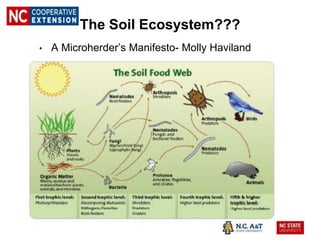
The Soil Ecosystem???
• A Microherder’s Manifesto- Molly Haviland
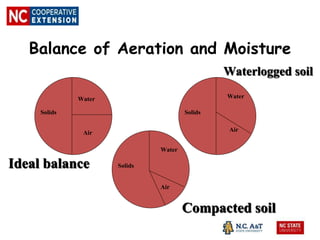
Balance of Aeration and Moisture
Solids
Water
Air
Solids
Water
Air
Solids
Water
Air
Ideal balance
Waterlogged soil
Compacted soil
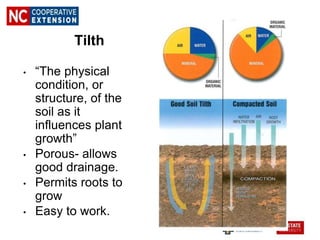
Tilth
• “The physical
condition, or
structure, of the
soil as it
influences plant
growth”
• Porous- allows
good drainage.
• Permits roots to
grow
• Easy to work.
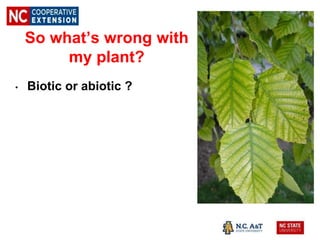
So what’s wrong with
my plant?
• Biotic or abiotic ?
How can I tell when fertilizer is
needed?
• Is Fertilizer Plant Food?
– No! – plants make their
own food by
photosynthesis
• What is fertilizer?
– Concentrated source of the
nutrients plants need to
produce their own food
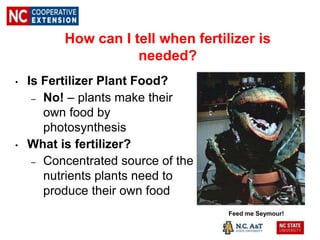
Feed me Seymour!
How Do Roots Absorb the
Nutrients in Fertilizers?
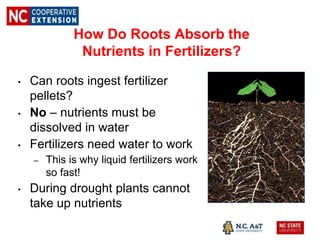
• Can roots ingest fertilizer
pellets?
• No – nutrients must be
dissolved in water
• Fertilizers need water to work
– This is why liquid fertilizers work
so fast!
• During drought plants cannot
take up nutrients
How pH affects
nutrient
availability
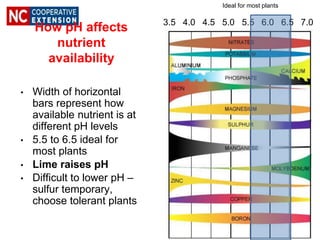
• Width of horizontal
bars represent how
available nutrient is at
different pH levels
• 5.5 to 6.5 ideal for
most plants
• Lime raises pH
• Difficult to lower pH –
sulfur temporary,
choose tolerant plants
3.5 4.0 4.5 5.0 5.5 6.0 6.5 7.0
Ideal for most plants
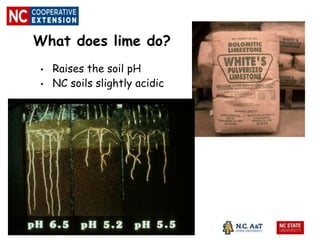
What does lime do?
• Raises the soil pH
• NC soils slightly acidic
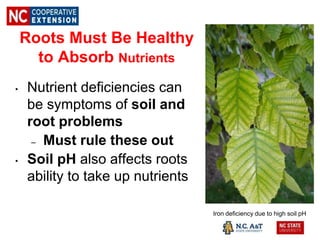
Roots Must Be Healthy
to Absorb Nutrients
• Nutrient deficiencies can
be symptoms of soil and
root problems
– Must rule these out
• Soil pH also affects roots
ability to take up nutrients
Iron deficiency due to high soil pH
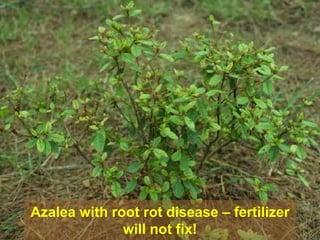
Azalea with root rot disease – fertilizer
will not fix!
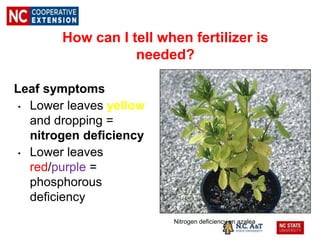
How can I tell when fertilizer is
needed?
Leaf symptoms
• Lower leaves yellow
and dropping =
nitrogen deficiency
• Lower leaves
red/purple =
phosphorous
deficiency
Nitrogen deficiency on azalea
How can I tell when fertilizer is
needed?
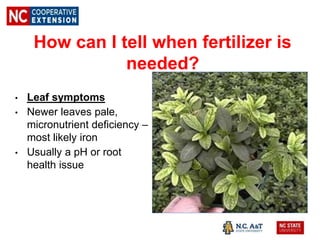
• Leaf symptoms
• Newer leaves pale,
micronutrient deficiency –
most likely iron
• Usually a pH or root
health issue
How can I tell when fertilizer is
needed?
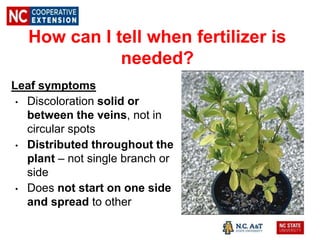
Leaf symptoms
• Discoloration solid or
between the veins, not in
circular spots
• Distributed throughout the
plant – not single branch or
side
• Does not start on one side
and spread to other side
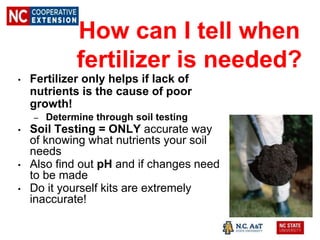
• Fertilizer only helps if lack of
nutrients is the cause of poor
growth!
– Determine through soil testing
• Soil Testing = ONLY accurate way
of knowing what nutrients your soil
needs
• Also find out pH and if changes need
to be made
• Do it yourself kits are extremely
inaccurate!
How can I tell when
fertilizer is needed?
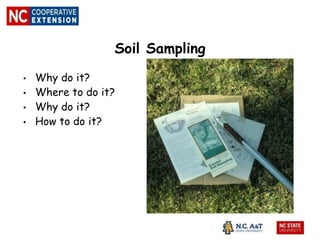
Soil Sampling
• Why do it?
• Where to do it?
• Why do it?
• How to do it?
Soil Sampling
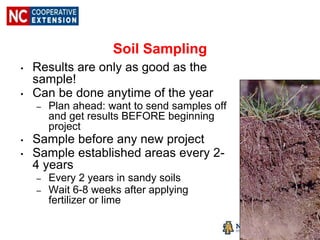
• Results are only as good as the
sample!
• Can be done anytime of the year
– Plan ahead: want to send samples off
and get results BEFORE beginning
project
• Sample before any new project
• Sample established areas every 2-
4 years
– Every 2 years in sandy soils
– Wait 6-8 weeks after applying
fertilizer or lime
How to Soil Sample
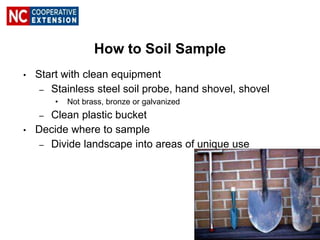
• Start with clean equipment
– Stainless steel soil probe, hand shovel, shovel
• Not brass, bronze or galvanized
– Clean plastic bucket
• Decide where to sample
– Divide landscape into areas of unique use
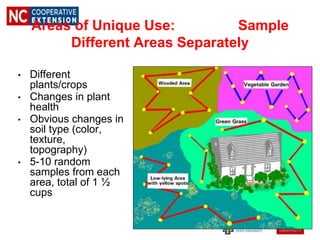
Areas of Unique Use: Sample
Different Areas Separately
• Different
plants/crops
• Changes in plant
health
• Obvious changes in
soil type (color,
texture,
topography)
• 5-10 random
samples from each
area, total of 1 ½
cups
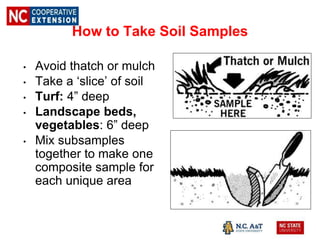
How to Take Soil Samples
• Avoid thatch or mulch
• Take a ‘slice’ of soil
• Turf: 4” deep
• Landscape beds,
vegetables: 6” deep
• Mix subsamples
together to make one
composite sample for
each unique area
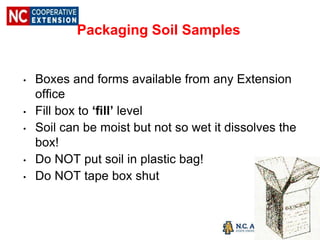
Packaging Soil Samples
• Boxes and forms available from any Extension
office
• Fill box to ‘fill’ level
• Soil can be moist but not so wet it dissolves the
box!
• Do NOT put soil in plastic bag!
• Do NOT tape box shut
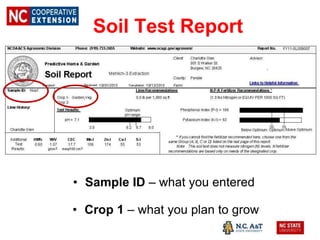
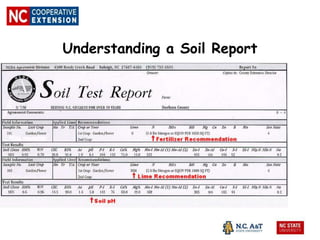
Soil Test Report
• Sample ID – what you entered
• Crop 1 – what you plan to grow
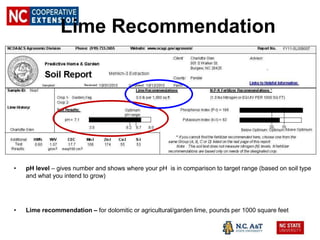
Lime Recommendation
• pH level – gives number and shows where your pH is in comparison to target range (based on soil type
and what you intend to grow)
• Lime recommendation – for dolomitic or agricultural/garden lime, pounds per 1000 square feet
Fertilizer Recommendation
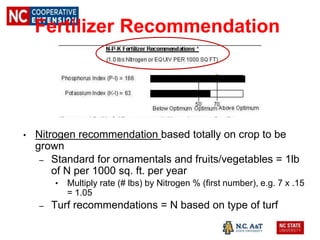
• Nitrogen recommendation based totally on crop to be
grown
– Standard for ornamentals and fruits/vegetables = 1lb
of N per 1000 sq. ft. per year
• Multiply rate (# lbs) by Nitrogen % (first number), e.g. 7 x .15
= 1.05
– Turf recommendations = N based on type of turf
Fertilizer Recommendation
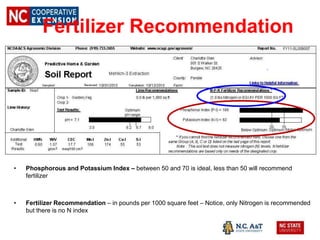
• Phosphorous and Potassium Index – between 50 and 70 is ideal, less than 50 will recommend
fertilizer
• Fertilizer Recommendation – in pounds per 1000 square feet – Notice, only Nitrogen is recommended
but there is no N index
Additional Information
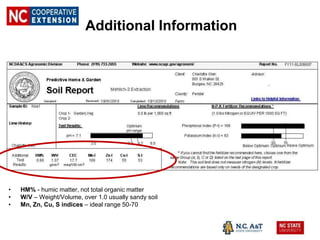
• HM% - humic matter, not total organic matter
• W/V – Weight/Volume, over 1.0 usually sandy soil
• Mn, Zn, Cu, S indices – ideal range 50-70
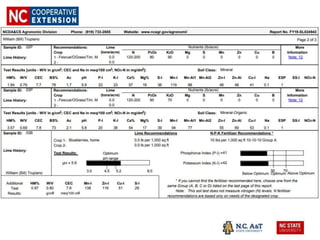
Understanding a Soil Report
Use technology to help with Math!
• Our friends in Georgia have done the hard work
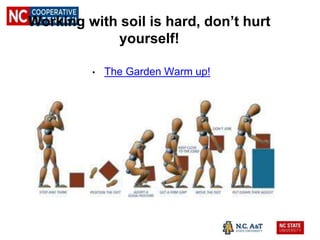
Working with soil is hard, don’t hurt
yourself!
• The Garden Warm up!

Master gardeners- soils 3 25-2019

  • 1.
    Soils and compostingfor the Master Gardener Bart Renner, North Carolina Cooperative Extension March 31, 2020
  • 2.
  • 3.
  • 4.
    Soil Structure • O-Humus (organic) • A –Topsoil • B –Subsoil • C- Regolith (parent material) • R- Bedrock
  • 5.
    Ideal Soil Characteristics •Physical – Holds water for plant growth – Drains well – Air for oxygen absorption • Chemical – Contains needed nutrients – Proper Ph Level • Biological – Supports diverse population of microorganisms
  • 6.
    The Soil Ecosystem??? •A Microherder’s Manifesto- Molly Haviland
  • 7.
    Balance of Aerationand Moisture Solids Water Air Solids Water Air Solids Water Air Ideal balance Waterlogged soil Compacted soil
  • 8.
    Tilth • “The physical condition,or structure, of the soil as it influences plant growth” • Porous- allows good drainage. • Permits roots to grow • Easy to work.
  • 9.
    So what’s wrongwith my plant? • Biotic or abiotic ?
  • 10.
    How can Itell when fertilizer is needed? • Is Fertilizer Plant Food? – No! – plants make their own food by photosynthesis • What is fertilizer? – Concentrated source of the nutrients plants need to produce their own food Feed me Seymour!
  • 11.
    How Do RootsAbsorb the Nutrients in Fertilizers? • Can roots ingest fertilizer pellets? • No – nutrients must be dissolved in water • Fertilizers need water to work – This is why liquid fertilizers work so fast! • During drought plants cannot take up nutrients
  • 12.
    How pH affects nutrient availability •Width of horizontal bars represent how available nutrient is at different pH levels • 5.5 to 6.5 ideal for most plants • Lime raises pH • Difficult to lower pH – sulfur temporary, choose tolerant plants 3.5 4.0 4.5 5.0 5.5 6.0 6.5 7.0 Ideal for most plants
  • 13.
    What does limedo? • Raises the soil pH • NC soils slightly acidic
  • 14.
    Roots Must BeHealthy to Absorb Nutrients • Nutrient deficiencies can be symptoms of soil and root problems – Must rule these out • Soil pH also affects roots ability to take up nutrients Iron deficiency due to high soil pH
  • 15.
    Azalea with rootrot disease – fertilizer will not fix!
  • 16.
    How can Itell when fertilizer is needed? Leaf symptoms • Lower leaves yellow and dropping = nitrogen deficiency • Lower leaves red/purple = phosphorous deficiency Nitrogen deficiency on azalea
  • 17.
    How can Itell when fertilizer is needed? • Leaf symptoms • Newer leaves pale, micronutrient deficiency – most likely iron • Usually a pH or root health issue
  • 18.
    How can Itell when fertilizer is needed? Leaf symptoms • Discoloration solid or between the veins, not in circular spots • Distributed throughout the plant – not single branch or side • Does not start on one side and spread to other side
  • 19.
    • Fertilizer onlyhelps if lack of nutrients is the cause of poor growth! – Determine through soil testing • Soil Testing = ONLY accurate way of knowing what nutrients your soil needs • Also find out pH and if changes need to be made • Do it yourself kits are extremely inaccurate! How can I tell when fertilizer is needed?
  • 20.
    Soil Sampling • Whydo it? • Where to do it? • Why do it? • How to do it?
  • 21.
    Soil Sampling • Resultsare only as good as the sample! • Can be done anytime of the year – Plan ahead: want to send samples off and get results BEFORE beginning project • Sample before any new project • Sample established areas every 2- 4 years – Every 2 years in sandy soils – Wait 6-8 weeks after applying fertilizer or lime
  • 22.
    How to SoilSample • Start with clean equipment – Stainless steel soil probe, hand shovel, shovel • Not brass, bronze or galvanized – Clean plastic bucket • Decide where to sample – Divide landscape into areas of unique use
  • 23.
    Areas of UniqueUse: Sample Different Areas Separately • Different plants/crops • Changes in plant health • Obvious changes in soil type (color, texture, topography) • 5-10 random samples from each area, total of 1 ½ cups
  • 24.
    How to TakeSoil Samples • Avoid thatch or mulch • Take a ‘slice’ of soil • Turf: 4” deep • Landscape beds, vegetables: 6” deep • Mix subsamples together to make one composite sample for each unique area
  • 25.
    Packaging Soil Samples •Boxes and forms available from any Extension office • Fill box to ‘fill’ level • Soil can be moist but not so wet it dissolves the box! • Do NOT put soil in plastic bag! • Do NOT tape box shut
  • 27.
    Soil Test Report •Sample ID – what you entered • Crop 1 – what you plan to grow
  • 28.
    Lime Recommendation • pHlevel – gives number and shows where your pH is in comparison to target range (based on soil type and what you intend to grow) • Lime recommendation – for dolomitic or agricultural/garden lime, pounds per 1000 square feet
  • 29.
    Fertilizer Recommendation • Nitrogenrecommendation based totally on crop to be grown – Standard for ornamentals and fruits/vegetables = 1lb of N per 1000 sq. ft. per year • Multiply rate (# lbs) by Nitrogen % (first number), e.g. 7 x .15 = 1.05 – Turf recommendations = N based on type of turf
  • 30.
    Fertilizer Recommendation • Phosphorousand Potassium Index – between 50 and 70 is ideal, less than 50 will recommend fertilizer • Fertilizer Recommendation – in pounds per 1000 square feet – Notice, only Nitrogen is recommended but there is no N index
  • 31.
    Additional Information • HM%- humic matter, not total organic matter • W/V – Weight/Volume, over 1.0 usually sandy soil • Mn, Zn, Cu, S indices – ideal range 50-70
  • 32.
  • 33.
    Use technology tohelp with Math! • Our friends in Georgia have done the hard work
  • 34.
    Working with soilis hard, don’t hurt yourself! • The Garden Warm up!

Editor's Notes

  • #5 SOM and humus are distinctly different. SOM includes all fractions of organic material in it’s multitude of stages of degradation, whereas humus is only the humic substances present at the end of the biological degradation of organic matter. SOM represents the organic constituents in the soil, including undecayed plant and animal tissues, their partial decomposition products, and the soil biomass. SOM therefore includes non-humic components such as sugars and fats etc. The Practical Value of Humic Substances As organic matter breaks down in soil, humic acids (Humic acid & Fulvic acid) are formed. To some extent they are the biological heart of natural organic matter. They are the main fraction, the biological centre, of natural humic matter.
  • #10 Need to take a systemic approach to decide if soil nutrient deficiencies are causing the problem