Spacecraft RF Communication
Day 1:
•
•
•
•

Spacecraft communications introduction
RF signal transmission
RF carrier modulation
Noise and link budgets

Day 2:
•
•
•
•

Error control coding
Telemetry systems
Analog Signal Processing
Digital Signal Processing

Day 3:
• Kalman filters
• Satellite systems
• Special topics
10/30/2013

John Reyland, PhD

Stop me
and ask!!!!
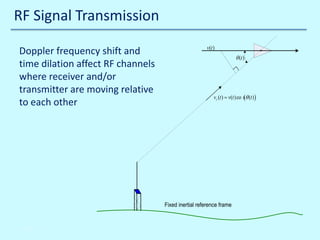
RF Signal Transmission
Doppler frequency shift and
time dilation affect RF channels
where receiver and/or
transmitter are moving relative
to each other

v(t )

θ (t )

vr (t ) = v(t ) co s(θ (t ) )

Fixed inertial reference frame

10/30/2013

.
RF Signal Transmission
Some Definitions:
c = Speed of light, 3e8 meters/second
f c = Carrier frequency (Hz)
θ (t ) = Angle between receiver’s forward velocity and
line of sight between transmitter and receiver

(t ) co s θ (t ) )
vr (t ) v=
(

Velocity of receiver relative to transmitter

f d (t ) = Doppler carrier frequency shift at receiver
Tt (t ) = Transmit symbol time
Tr (t ) = Receive symbol time

10/30/2013
RF Signal Transmission
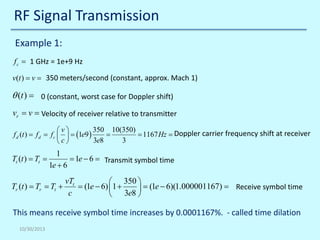
Example 1:
f c = 1 GHz = 1e+9 Hz
v(t )= v=

350 meters/second (constant, approx. Mach 1)

θ (t ) = 0 (constant, worst case for Doppler shift)
vr= v= Velocity of receiver relative to transmitter
v
= d
f d (t ) f= f c  =

c

Tt (t ) = Tt =

(1e9 )

350 10(350)
=
= 1167 Hz Doppler carrier frequency shift at receiver
=
3e8
3

1
= 1e − 6 = Transmit symbol time
1e + 6

Tr (t ) =Tr =Tt +

vTt
 350 
=(1e − 6) 1 +
 =(1e − 6)(1.000001167) = Receive symbol time
c
 3e8 

This means receive symbol time increases by 0.0001167%. - called time dilation
10/30/2013
RF Signal Transmission
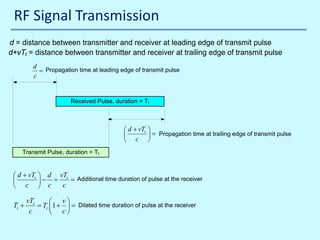
d = distance between transmitter and receiver at leading edge of transmit pulse
d+vTt = distance between transmitter and receiver at trailing edge of transmit pulse
d
= Propagation time at leading edge of transmit pulse
c

Received Pulse, duration = Tr

 d + vTt
 c



 = Propagation time at trailing edge of transmit pulse


Transmit Pulse, duration = Tt

 d + vTt
 c


Tt +

 d vTt Additional time duration of pulse at the receiver
− c = c =


vTt
 v
= Tt 1 +  = Dilated time duration of pulse at the receiver
c
 c

10/30/2013
RF Carrier Modulation
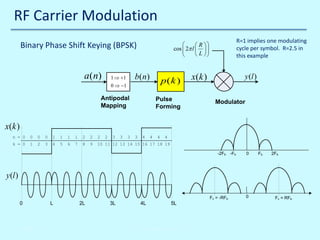
Binary Phase Shift Keying (BPSK)

a ( n)

b( n)

1 ⇒ +1
0 ⇒ −1

R=1 implies one modulating
cycle per symbol. R=2.5 in
this example


 R 
cos  2π l   
 L 


p(k )

Antipodal
Mapping

Pulse
Forming

x(k )

y (l )
Modulator

x(k )
n = 0

0

0

0

1

1

1

1

2

2

2

2

3

3

3

3

4

4

4

4

k = 0

1

2

3

4

5

6

7

8

9

10 11 12 13 14 15 16 17 18 19

-2Fb -Fb

0

Fb

2Fb

y (l )
Fc = -RFb

0

10/30/2013

L

2L

3L

4L

5L

John Reyland, PhD

0

Fc = RFb
RF Carrier Modulation

 R 
cos  2π l   
 L 


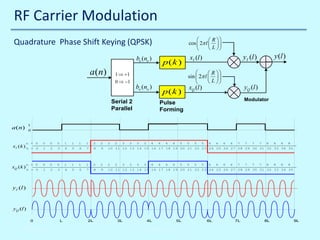
Quadrature Phase Shift Keying (QPSK)
be (ne )

a ( n)

p(k )


 R 
sin  2π l   
 L 


1 ⇒ +1
0 ⇒ −1

bo (no )
Serial 2
Parallel

p(k )

y (l )

yI (l )

xI (l )

yQ (l )

xQ (l )

Modulator

Pulse
Forming

1
0

a ( n)

n = 0

0

0

0

1

1

1

1

2

2

2

= 0

1

2

3

4

5

6

7

8

9

10 11 12 13 14 15 16 17 18 19 20 21 22 23 24 25 26 27 28 29 30 31 32 33 34 35

n = 0

0

0

0

1

1

1

1

2

2

2

= 0

1

2

3

4

5

6

7

8

9

10 11 12 13 14 15 16 17 18 19 20 21 22 23 24 25 26 27 28 29 30 31 32 33 34 35

xI ( k ) k

xQ ( k ) k

2

2

3

3

3

3

3

3

3

3

4

4

4

4

4

4

4

4

5

5

5

5

5

5

5

5

6

6

6

6

6

6

6

6

7

7

7

7

7

7

7

7

8

8

8

8

8

8

8

8

y I (l )

yQ (l )
0

10/30/2013

L

2L

3L

4L

5L

John Reyland, PhD

6L

7L

8L

9L
RF Carrier Modulation
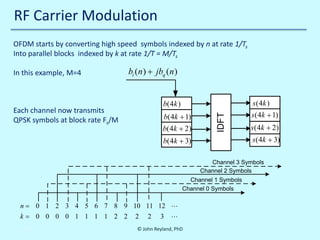
OFDM starts by converting high speed symbols indexed by n at rate 1/Ts
Into parallel blocks indexed by k at rate 1/T = M/Ts

bi ( n ) + jbq ( n )

b(4k )
b(4k + 1)

Each channel now transmits
QPSK symbols at block rate Fs/M

s(4k )
s(4k + 1)

b(4k + 2)

IDFT

In this example, M=4

s(4k + 2)
s(4k + 3)

b(4k + 3)

Channel 3 Symbols
Channel 2 Symbols
Channel 1 Symbols
Channel 0 Symbols

n = 0 1 2 3 4 5 6 7 8 9 10 11 12 
k= 0 0 0 0 1 1 1 1 2 2
10/30/2013

2

2

3



© John Reyland, PhD
RF Carrier Modulation
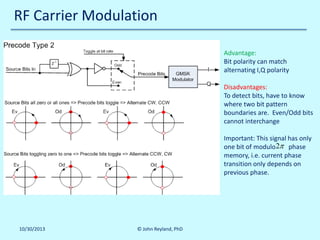
Advantage:
Bit polarity can match
alternating I,Q polarity
Disadvantages:
To detect bits, have to know
where two bit pattern
boundaries are. Even/Odd bits
cannot interchange
Important: This signal has only
one bit of modulo 2π phase
memory, i.e. current phase
transition only depends on
previous phase.

10/30/2013

© John Reyland, PhD
Noise and Link Budgets
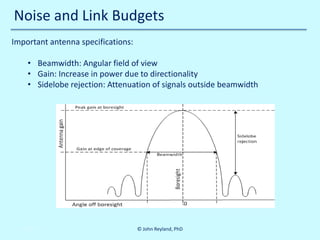
Important antenna specifications:
• Beamwidth: Angular field of view
• Gain: Increase in power due to directionality
• Sidelobe rejection: Attenuation of signals outside beamwidth

10/30/2013

© John Reyland, PhD
Error Control and Channel Coding
Time Diversity:

After receiver reassembles,
all errors can be corrected
See [R5] and [R6]

10/30/2013

© John Reyland, PhD
Error Control and Channel Coding
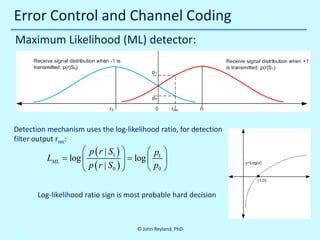
Maximum Likelihood (ML) detector:

Detection mechanism uses the log-likelihood ratio, for detection
filter output rrec:

 p ( r | S1 ) 
 p1 
= log 
LML = log  
 p (r | S ) 

0 
 p0 


Log-likelihood ratio sign is most probable hard decision

10/30/2013

© John Reyland, PhD
Error Control and Channel Coding
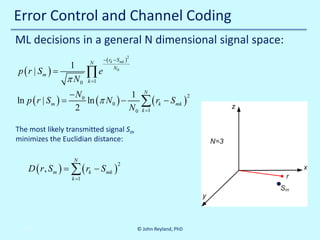
ML decisions in a general N dimensional signal space:
1
p ( r | Sm ) =
π N0

N

∏e

−( rk − Smk )

2

N0

k =1

− N0
1
ln p ( r | S=
ln (π N 0 ) −
m)
2
N0

N

∑(r
k =1

k

− S mk )

The most likely transmitted signal Sm
minimizes the Euclidian distance:

D ( r=
, Sm )

10/30/2013

N

∑ ( rk − Smk )

2

k =1

© John Reyland, PhD

2
Error Control and Channel Coding
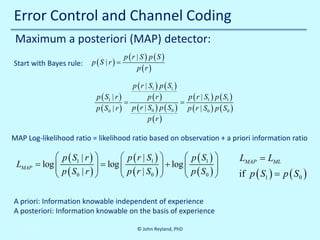
Maximum a posteriori (MAP) detector:
Start with Bayes rule:

p(S | r) =

p (r | S ) p (S )
p (r )

p ( S1 | r )
=
p ( S0 | r )

p ( r | S1 ) p ( S1 )
p (r )
p ( r | S1 ) p ( S1 )
=
p ( r | S0 ) p ( S0 ) p ( r | S0 ) p ( S0 )
p (r )

MAP Log-likelihood ratio = likelihood ratio based on observation + a priori information ratio

LMAP

 p ( S1 | r ) 
 p ( r | S1 ) 
 p ( S1 ) 
log 
= log 
 p(S | r) 

 p ( r | S )  + log  p ( S ) 



0
0 
0 





A priori: Information knowable independent of experience
A posteriori: Information knowable on the basis of experience
10/30/2013

© John Reyland, PhD

LMAP = LML

if p ( S1 ) = p ( S0 )
Error Control and Channel Coding
Concatenated coding for Voyager mission to Saturn and Uranus

Power efficiency is extremely important: Coding gain of 6dB can double the
communications range between spacecraft and earth ([C8], page 172)
Voyager telecommunications achieved 10-6 BER at EbN0 = 2.53dB, 2Mbits/sec.
What system considerations are not very important?
Bandwidth efficiency, not many other users out there.
Delay, waiting time for image reconstructions is OK
10/30/2013

© John Reyland, PhD
Error Control and Channel Coding
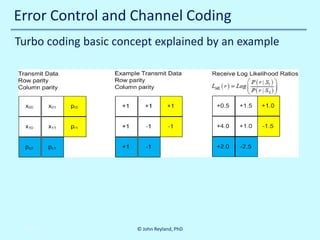
Turbo coding basic concept explained by an example

10/30/2013

© John Reyland, PhD
Error Control and Channel Coding
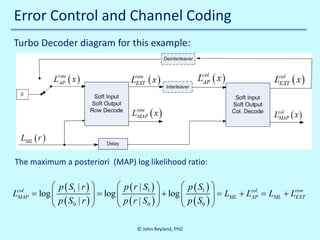
Turbo Decoder diagram for this example:

The maximum a posteriori (MAP) log likelihood ratio:
col
MAP

L

 p ( S1 | r ) 
 p ( r | S1 ) 
 p ( S1 ) 
col
row
= log 
 = log 
 + log 
 = LML + LAP = LML + LEXT
 p(S | r) 
 p (r | S ) 
 p(S ) 
0
0 
0 





10/30/2013

© John Reyland, PhD
Error Control and Channel Coding
Log likelihood ratio of modulo two addition of two soft decisions (see []):

(

L ( r0 ⊕ r1 ) L ( r0= sig nL ( r0 ) ) sig nL ( r1 ) ) min L ( r0 ) , L ( r1 )
=
)  L ( r1 )
(
(

)

This addition rule is used to combine data and parity into extrinsic information
Extrinsic means extra, or indirect, information derived from the decoding process

10/30/2013

© John Reyland, PhD
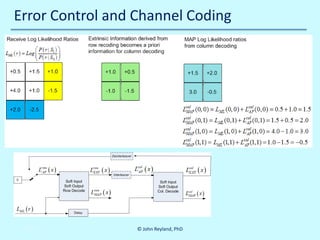
Error Control and Channel Coding

10/30/2013

© John Reyland, PhD
Error Control and Channel Coding
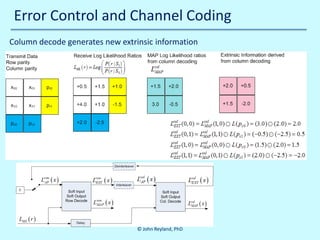
Column decode generates new extrinsic information

10/30/2013

© John Reyland, PhD
Error Control and Channel Coding
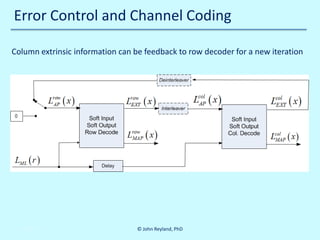
Column extrinsic information can be feedback to row decoder for a new iteration

10/30/2013

© John Reyland, PhD
Error Control and Channel Coding
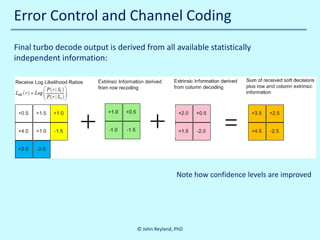
Final turbo decode output is derived from all available statistically
independent information:

Note how confidence levels are improved

10/30/2013

© John Reyland, PhD
Channel Equalization Techniques
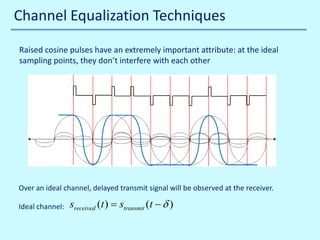
Raised cosine pulses have an extremely important attribute: at the ideal
sampling points, they don’t interfere with each other

Over an ideal channel, delayed transmit signal will be observed at the receiver.
Ideal channel:
10/30/2013

sreceived (t ) stransmit (t − δ )
=
John Reyland, PhD
Channel Equalization Techniques

A decision feedback
nonlinear adaptive
equalizer:

See [E1] and [E2]

10/30/2013

© John Reyland, PhD
Analog Signal Processing
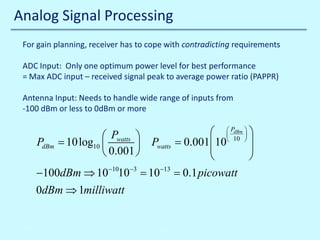
For gain planning, receiver has to cope with contradicting requirements
ADC Input: Only one optimum power level for best performance
= Max ADC input – received signal peak to average power ratio (PAPPR)
Antenna Input: Needs to handle wide range of inputs from
-100 dBm or less to 0dBm or more
dBm
  P10  


Pwatts 



PdBm 10log10 
Pwatts
= 0.001  10




 0.001 


10
0.1
−100dBm ⇒ 10−1010−3 =−13 = picowatt
0dBm ⇒ 1milliwatt

10/30/2013

© John Reyland, PhD
Analog Signal Processing
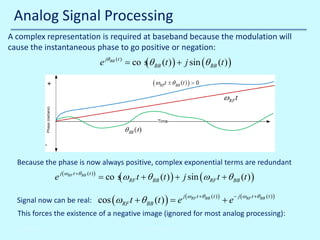
A complex representation is required at baseband because the modulation will
cause the instantaneous phase to go positive or negation:

= co s θ BB (t ) ) + j sin (θ BB (t ) )
e jθ BB (t )
(

Because the phase is now always positive, complex exponential terms are redundant

e

= co s ωRF t + θ BB (t ) ) + j sin (ωRF t + θ BB (t ) )
(

j (ωRF t +θ BB ( t ) )

Signal now can be real:

cos (ωRF t + θ BB (t= e
))

j (ωRF t +θ BB ( t ) )

+e

− j (ωRF t +θ BB ( t ) )

This forces the existence of a negative image (ignored for most analog processing):
10/30/2013

© John Reyland, PhD
Analog Signal Processing
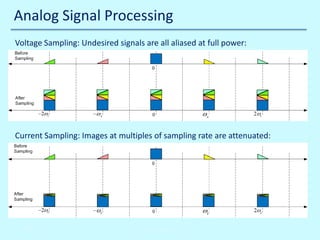
Voltage Sampling: Undesired signals are all aliased at full power:

Current Sampling: Images at multiples of sampling rate are attenuated:

10/30/2013

© John Reyland, PhD
Analog Signal Processing
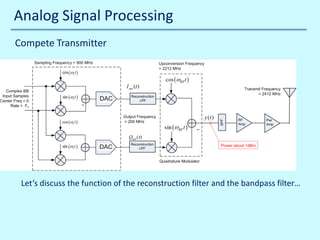
Compete Transmitter

Let’s discuss the function of the reconstruction filter and the bandpass filter…

10/30/2013

© John Reyland, PhD
Digital Signal Processing
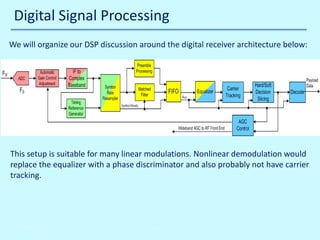
We will organize our DSP discussion around the digital receiver architecture below:

This setup is suitable for many linear modulations. Nonlinear demodulation would
replace the equalizer with a phase discriminator and also probably not have carrier
tracking.

10/30/2013

John Reyland, PhD
Digital Signal Processing

Intermediate center frequency Fif = 44.2368 MHz.
Does this mean sampling frequency Fs > 88.4736 MHz ?
No, we can bandpass sample, by making Fs = (4/3) Fif = 58.9824 MHz. This has advantages:
• Lower sample rate => smaller sample buffers and fewer FPGA timing problems
• Fif can be higher for the same sample rate, this may make frequency planning easier
Disadvantage is that noise in the range [Fs/2 Fs] is folded back into [0 Fs/2]
10/30/2013

John Reyland, PhD
Digital Signal Processing
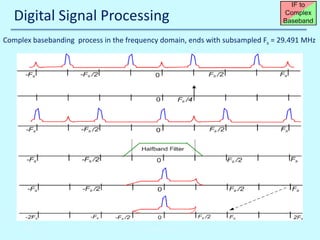
Complex basebanding process in the frequency domain, ends with subsampled Fs = 29.491 MHz

10/30/2013

John Reyland, PhD
Digital Signal Processing
Halfband Filter response

HalfBand filter Impulse Response, Order=11
0.6
0.4

Typical Matlab code:

0.2
0
-0.2

Fss = 58.9824e6;
1

2

3

4

5

6

7

8

9

10

11

Resp, dB

0
-10
-20
-30
-40

0

3.6864

7.3728

11.0592 14.7456 18.432
Frequency (MHz)

22.1184 25.8048 29.4912

0

3.6864

7.3728

11.0592 14.7456 18.432
Frequency (MHz)

22.1184 25.8048 29.4912

Resp, linear

1

0.5

0

10/30/2013

John Reyland, PhD

% Setup halfband filter for input subsampling
PassBandEdge = 1/2-1/8;
StopBandRipple = 0.1;
b=firhalfband('minorder', …
PassBandEdge, …
StopBandRipple, …
'kaiser');
% Check frequency response
[hb,wb] = freqz(b,1,2048);
plot(wb,10*log10(abs(hb)));
set(gca,'XLim',[0 pi]);
set(gca,'XTick',0:pi/8:pi);
set(gca,'XTickLabel',(0:(Fss/16):(Fss/2))/1e6);
Digital Signal Processing
DSP Circuits for IF to Complex BB process
Fs/4 Local Oscillator
Inphase Halfband Filter
I(n) + jQ(n) = [1+j0,0+j1,-1+j0,0-j1,1+j0, ...]
HI(z) = h0 + z-2h2 + z-3h3 + z-4h4 + z-6h6

Ib(n)
x(n)

Z-1

h0

Z-1

Z-1

Z-1

Z-1

Z-1

0

h2

h3

h4

0

h6
Ihb(n)
2

Qb(n)

Z-1

h0

Z-1

Z-1

Z-1

Z-1

Z-1

0

h2

h3

h4

0

h6
Qhb(n)
2

Quadrature Halfband Filter
HQ(z) = h0 + z-2h2 + z-3h3 + z-4h4 + z-6h6

10/30/2013

John Reyland, PhD
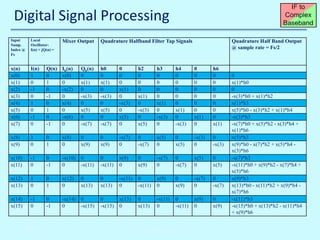
Digital Signal Processing
Input
Samp.
Index @
Fs

Local
Oscillator:
I(n) + jQ(n) =

Mixer Output

Quadrature Halfband Filter Tap Signals

x(n)
x(0)
x(1)
x(2)
x(3)
x(4)
x(5)
x(6)
x(7)

I(n)
1
0
-1
0
1
0
-1
0

Q(n)
0
1
0
-1
0
1
0
-1

Ib(n)
x(0)
0
-x(2)
0
x(4)
0
-x(6)
0

Qb(n)
0
x(1)
0
-x(3)
0
x(5)
0
-x(7)

h0
0
x(1)
0
-x(3)
0
x(5)
0
-x(7)

0
0
0
x(1)
0
-x(3)
0
x(5)
0

h2
0
0
0
x(1)
0
-x(3)
0
x(5)

h3
0
0
0
0
x(1)
0
-x(3)
0

h4
0
0
0
0
0
x(1)
0
-x(3)

0
0
0
0
0
0
0
x(1)
0

h6
0
0
0
0
0
0
0
x(1)

x(8)
x(9)

1
0

0
1

x(8)
0

0
x(9)

0
x(9)

-x(7)
0

0
-x(7)

x(5)
0

0
x(5)

-x(3)
0

0
-x(3)

x(10)
x(11)

-1
0

0
-1

-x(10)
0

0
-x(11)

0
-x(11)

x(9)
0

0
x(9)

-x(7)
0

0
-x(7)

x(5)
0

0
x(5)

x(12)
x(13)

1
0

0
1

x(12)
0

0
x(13)

0
x(13)

-x(11)
0

0
-x(11)

x(9)
0

0
x(9)

-x(7)
0

0
-x(7)

x(14)
x(15)

-1
0

0
-1

-x(14)
0

0
-x(15)

0
-x(15)

x(13)
0

0
x(13)

-x(11)
0

0
-x(11)

x(9)
0

0
x(9)

10/30/2013

John Reyland, PhD

Quadrature Half Band Output
@ sample rate = Fs/2

0
x(1)*h0
0
-x(3)*h0 + x(1)*h2
x(1)*h3
x(5)*h0 - x(3)*h2 + x(1)*h4
-x(3)*h3
-x(7)*h0 + x(5)*h2 - x(3)*h4 +
x(1)*h6
x(5)*h3
x(9)*h0 - x(7)*h2 + x(5)*h4 x(3)*h6
-x(7)*h3
-x(11)*h0 + x(9)*h2 - x(7)*h4 +
x(5)*h6
x(9)*h3
x(13)*h0 - x(11)*h2 + x(9)*h4 x(7)*h6
-x(11)*h3
-x(15)*h0 + x(13)*h2 - x(11)*h4
+ x(9)*h6
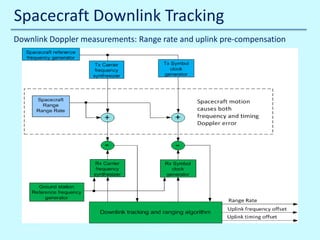
Spacecraft Downlink Tracking
Downlink Doppler measurements: Range rate and uplink pre-compensation

10/30/2013

John Reyland, PhD
Kalman Filters
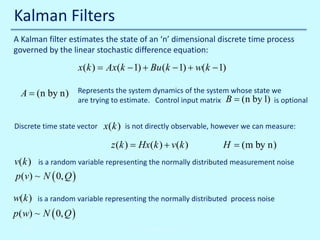
A Kalman filter estimates the state of an ‘n’ dimensional discrete time process
governed by the linear stochastic difference equation:

x(k ) Ax(k − 1) + Bu (k − 1) + w(k − 1)
=
A = (n by n)

Represents the system dynamics of the system whose state we
are trying to estimate. Control input matrix B = (n by l) is optional

Discrete time state vector

x(k )

is not directly observable, however we can measure:

= Hx(k ) + v(k )
z (k )

H = (m by n)

v(k ) is a random variable representing the normally distributed measurement noise
p (v) ~ N ( 0, Q )
w(k )

is a random variable representing the normally distributed process noise

p ( w) ~ N ( 0, Q )
10/30/2013

John Reyland, PhD
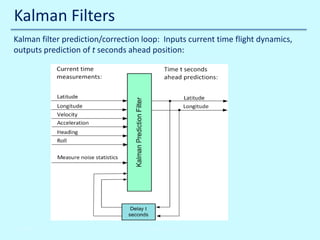
Kalman Filters
Kalman filter prediction/correction loop: Inputs current time flight dynamics,
outputs prediction of t seconds ahead position:

10/30/2013

John Reyland, PhD
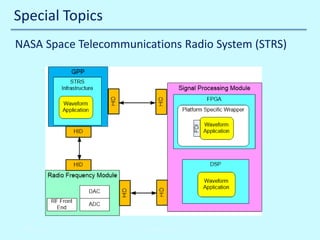
Special Topics
NASA Space Telecommunications Radio System (STRS)

10/30/2013

John Reyland, PhD
NASA STRS
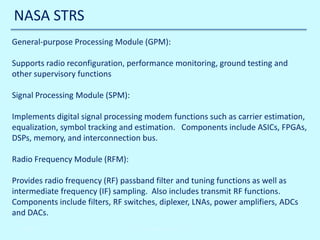
General-purpose Processing Module (GPM):
Supports radio reconfiguration, performance monitoring, ground testing and
other supervisory functions
Signal Processing Module (SPM):
Implements digital signal processing modem functions such as carrier estimation,
equalization, symbol tracking and estimation. Components include ASICs, FPGAs,
DSPs, memory, and interconnection bus.
Radio Frequency Module (RFM):
Provides radio frequency (RF) passband filter and tuning functions as well as
intermediate frequency (IF) sampling. Also includes transmit RF functions.
Components include filters, RF switches, diplexer, LNAs, power amplifiers, ADCs
and DACs.
10/30/2013

John Reyland, PhD

Spacecraft RF Communications Course Sampler

  • 1.
    Spacecraft RF Communication Day1: • • • • Spacecraft communications introduction RF signal transmission RF carrier modulation Noise and link budgets Day 2: • • • • Error control coding Telemetry systems Analog Signal Processing Digital Signal Processing Day 3: • Kalman filters • Satellite systems • Special topics 10/30/2013 John Reyland, PhD Stop me and ask!!!!
  • 2.
    RF Signal Transmission Dopplerfrequency shift and time dilation affect RF channels where receiver and/or transmitter are moving relative to each other v(t ) θ (t ) vr (t ) = v(t ) co s(θ (t ) ) Fixed inertial reference frame 10/30/2013 .
  • 3.
    RF Signal Transmission SomeDefinitions: c = Speed of light, 3e8 meters/second f c = Carrier frequency (Hz) θ (t ) = Angle between receiver’s forward velocity and line of sight between transmitter and receiver (t ) co s θ (t ) ) vr (t ) v= ( Velocity of receiver relative to transmitter f d (t ) = Doppler carrier frequency shift at receiver Tt (t ) = Transmit symbol time Tr (t ) = Receive symbol time 10/30/2013
  • 4.
    RF Signal Transmission Example1: f c = 1 GHz = 1e+9 Hz v(t )= v= 350 meters/second (constant, approx. Mach 1) θ (t ) = 0 (constant, worst case for Doppler shift) vr= v= Velocity of receiver relative to transmitter v = d f d (t ) f= f c  =  c Tt (t ) = Tt = (1e9 ) 350 10(350) = = 1167 Hz Doppler carrier frequency shift at receiver = 3e8 3 1 = 1e − 6 = Transmit symbol time 1e + 6 Tr (t ) =Tr =Tt + vTt  350  =(1e − 6) 1 +  =(1e − 6)(1.000001167) = Receive symbol time c  3e8  This means receive symbol time increases by 0.0001167%. - called time dilation 10/30/2013
  • 5.
    RF Signal Transmission d= distance between transmitter and receiver at leading edge of transmit pulse d+vTt = distance between transmitter and receiver at trailing edge of transmit pulse d = Propagation time at leading edge of transmit pulse c Received Pulse, duration = Tr  d + vTt  c    = Propagation time at trailing edge of transmit pulse  Transmit Pulse, duration = Tt  d + vTt  c  Tt +  d vTt Additional time duration of pulse at the receiver − c = c =  vTt  v = Tt 1 +  = Dilated time duration of pulse at the receiver c  c 10/30/2013
  • 6.
    RF Carrier Modulation BinaryPhase Shift Keying (BPSK) a ( n) b( n) 1 ⇒ +1 0 ⇒ −1 R=1 implies one modulating cycle per symbol. R=2.5 in this example   R  cos  2π l     L   p(k ) Antipodal Mapping Pulse Forming x(k ) y (l ) Modulator x(k ) n = 0 0 0 0 1 1 1 1 2 2 2 2 3 3 3 3 4 4 4 4 k = 0 1 2 3 4 5 6 7 8 9 10 11 12 13 14 15 16 17 18 19 -2Fb -Fb 0 Fb 2Fb y (l ) Fc = -RFb 0 10/30/2013 L 2L 3L 4L 5L John Reyland, PhD 0 Fc = RFb
  • 7.
    RF Carrier Modulation  R  cos  2π l     L   Quadrature Phase Shift Keying (QPSK) be (ne ) a ( n) p(k )   R  sin  2π l     L   1 ⇒ +1 0 ⇒ −1 bo (no ) Serial 2 Parallel p(k ) y (l ) yI (l ) xI (l ) yQ (l ) xQ (l ) Modulator Pulse Forming 1 0 a ( n) n = 0 0 0 0 1 1 1 1 2 2 2 = 0 1 2 3 4 5 6 7 8 9 10 11 12 13 14 15 16 17 18 19 20 21 22 23 24 25 26 27 28 29 30 31 32 33 34 35 n = 0 0 0 0 1 1 1 1 2 2 2 = 0 1 2 3 4 5 6 7 8 9 10 11 12 13 14 15 16 17 18 19 20 21 22 23 24 25 26 27 28 29 30 31 32 33 34 35 xI ( k ) k xQ ( k ) k 2 2 3 3 3 3 3 3 3 3 4 4 4 4 4 4 4 4 5 5 5 5 5 5 5 5 6 6 6 6 6 6 6 6 7 7 7 7 7 7 7 7 8 8 8 8 8 8 8 8 y I (l ) yQ (l ) 0 10/30/2013 L 2L 3L 4L 5L John Reyland, PhD 6L 7L 8L 9L
  • 8.
    RF Carrier Modulation OFDMstarts by converting high speed symbols indexed by n at rate 1/Ts Into parallel blocks indexed by k at rate 1/T = M/Ts bi ( n ) + jbq ( n ) b(4k ) b(4k + 1) Each channel now transmits QPSK symbols at block rate Fs/M s(4k ) s(4k + 1) b(4k + 2) IDFT In this example, M=4 s(4k + 2) s(4k + 3) b(4k + 3) Channel 3 Symbols Channel 2 Symbols Channel 1 Symbols Channel 0 Symbols n = 0 1 2 3 4 5 6 7 8 9 10 11 12  k= 0 0 0 0 1 1 1 1 2 2 10/30/2013 2 2 3  © John Reyland, PhD
  • 9.
    RF Carrier Modulation Advantage: Bitpolarity can match alternating I,Q polarity Disadvantages: To detect bits, have to know where two bit pattern boundaries are. Even/Odd bits cannot interchange Important: This signal has only one bit of modulo 2π phase memory, i.e. current phase transition only depends on previous phase. 10/30/2013 © John Reyland, PhD
  • 10.
    Noise and LinkBudgets Important antenna specifications: • Beamwidth: Angular field of view • Gain: Increase in power due to directionality • Sidelobe rejection: Attenuation of signals outside beamwidth 10/30/2013 © John Reyland, PhD
  • 11.
    Error Control andChannel Coding Time Diversity: After receiver reassembles, all errors can be corrected See [R5] and [R6] 10/30/2013 © John Reyland, PhD
  • 12.
    Error Control andChannel Coding Maximum Likelihood (ML) detector: Detection mechanism uses the log-likelihood ratio, for detection filter output rrec:  p ( r | S1 )   p1  = log  LML = log    p (r | S )   0   p0   Log-likelihood ratio sign is most probable hard decision 10/30/2013 © John Reyland, PhD
  • 13.
    Error Control andChannel Coding ML decisions in a general N dimensional signal space: 1 p ( r | Sm ) = π N0 N ∏e −( rk − Smk ) 2 N0 k =1 − N0 1 ln p ( r | S= ln (π N 0 ) − m) 2 N0 N ∑(r k =1 k − S mk ) The most likely transmitted signal Sm minimizes the Euclidian distance: D ( r= , Sm ) 10/30/2013 N ∑ ( rk − Smk ) 2 k =1 © John Reyland, PhD 2
  • 14.
    Error Control andChannel Coding Maximum a posteriori (MAP) detector: Start with Bayes rule: p(S | r) = p (r | S ) p (S ) p (r ) p ( S1 | r ) = p ( S0 | r ) p ( r | S1 ) p ( S1 ) p (r ) p ( r | S1 ) p ( S1 ) = p ( r | S0 ) p ( S0 ) p ( r | S0 ) p ( S0 ) p (r ) MAP Log-likelihood ratio = likelihood ratio based on observation + a priori information ratio LMAP  p ( S1 | r )   p ( r | S1 )   p ( S1 )  log  = log   p(S | r)    p ( r | S )  + log  p ( S )     0 0  0      A priori: Information knowable independent of experience A posteriori: Information knowable on the basis of experience 10/30/2013 © John Reyland, PhD LMAP = LML if p ( S1 ) = p ( S0 )
  • 15.
    Error Control andChannel Coding Concatenated coding for Voyager mission to Saturn and Uranus Power efficiency is extremely important: Coding gain of 6dB can double the communications range between spacecraft and earth ([C8], page 172) Voyager telecommunications achieved 10-6 BER at EbN0 = 2.53dB, 2Mbits/sec. What system considerations are not very important? Bandwidth efficiency, not many other users out there. Delay, waiting time for image reconstructions is OK 10/30/2013 © John Reyland, PhD
  • 16.
    Error Control andChannel Coding Turbo coding basic concept explained by an example 10/30/2013 © John Reyland, PhD
  • 17.
    Error Control andChannel Coding Turbo Decoder diagram for this example: The maximum a posteriori (MAP) log likelihood ratio: col MAP L  p ( S1 | r )   p ( r | S1 )   p ( S1 )  col row = log   = log   + log   = LML + LAP = LML + LEXT  p(S | r)   p (r | S )   p(S )  0 0  0      10/30/2013 © John Reyland, PhD
  • 18.
    Error Control andChannel Coding Log likelihood ratio of modulo two addition of two soft decisions (see []): ( L ( r0 ⊕ r1 ) L ( r0= sig nL ( r0 ) ) sig nL ( r1 ) ) min L ( r0 ) , L ( r1 ) = )  L ( r1 ) ( ( ) This addition rule is used to combine data and parity into extrinsic information Extrinsic means extra, or indirect, information derived from the decoding process 10/30/2013 © John Reyland, PhD
  • 19.
    Error Control andChannel Coding 10/30/2013 © John Reyland, PhD
  • 20.
    Error Control andChannel Coding Column decode generates new extrinsic information 10/30/2013 © John Reyland, PhD
  • 21.
    Error Control andChannel Coding Column extrinsic information can be feedback to row decoder for a new iteration 10/30/2013 © John Reyland, PhD
  • 22.
    Error Control andChannel Coding Final turbo decode output is derived from all available statistically independent information: Note how confidence levels are improved 10/30/2013 © John Reyland, PhD
  • 23.
    Channel Equalization Techniques Raisedcosine pulses have an extremely important attribute: at the ideal sampling points, they don’t interfere with each other Over an ideal channel, delayed transmit signal will be observed at the receiver. Ideal channel: 10/30/2013 sreceived (t ) stransmit (t − δ ) = John Reyland, PhD
  • 24.
    Channel Equalization Techniques Adecision feedback nonlinear adaptive equalizer: See [E1] and [E2] 10/30/2013 © John Reyland, PhD
  • 25.
    Analog Signal Processing Forgain planning, receiver has to cope with contradicting requirements ADC Input: Only one optimum power level for best performance = Max ADC input – received signal peak to average power ratio (PAPPR) Antenna Input: Needs to handle wide range of inputs from -100 dBm or less to 0dBm or more dBm   P10     Pwatts     PdBm 10log10  Pwatts = 0.001  10      0.001    10 0.1 −100dBm ⇒ 10−1010−3 =−13 = picowatt 0dBm ⇒ 1milliwatt 10/30/2013 © John Reyland, PhD
  • 26.
    Analog Signal Processing Acomplex representation is required at baseband because the modulation will cause the instantaneous phase to go positive or negation: = co s θ BB (t ) ) + j sin (θ BB (t ) ) e jθ BB (t ) ( Because the phase is now always positive, complex exponential terms are redundant e = co s ωRF t + θ BB (t ) ) + j sin (ωRF t + θ BB (t ) ) ( j (ωRF t +θ BB ( t ) ) Signal now can be real: cos (ωRF t + θ BB (t= e )) j (ωRF t +θ BB ( t ) ) +e − j (ωRF t +θ BB ( t ) ) This forces the existence of a negative image (ignored for most analog processing): 10/30/2013 © John Reyland, PhD
  • 27.
    Analog Signal Processing VoltageSampling: Undesired signals are all aliased at full power: Current Sampling: Images at multiples of sampling rate are attenuated: 10/30/2013 © John Reyland, PhD
  • 28.
    Analog Signal Processing CompeteTransmitter Let’s discuss the function of the reconstruction filter and the bandpass filter… 10/30/2013 © John Reyland, PhD
  • 29.
    Digital Signal Processing Wewill organize our DSP discussion around the digital receiver architecture below: This setup is suitable for many linear modulations. Nonlinear demodulation would replace the equalizer with a phase discriminator and also probably not have carrier tracking. 10/30/2013 John Reyland, PhD
  • 30.
    Digital Signal Processing Intermediatecenter frequency Fif = 44.2368 MHz. Does this mean sampling frequency Fs > 88.4736 MHz ? No, we can bandpass sample, by making Fs = (4/3) Fif = 58.9824 MHz. This has advantages: • Lower sample rate => smaller sample buffers and fewer FPGA timing problems • Fif can be higher for the same sample rate, this may make frequency planning easier Disadvantage is that noise in the range [Fs/2 Fs] is folded back into [0 Fs/2] 10/30/2013 John Reyland, PhD
  • 31.
    Digital Signal Processing Complexbasebanding process in the frequency domain, ends with subsampled Fs = 29.491 MHz 10/30/2013 John Reyland, PhD
  • 32.
    Digital Signal Processing HalfbandFilter response HalfBand filter Impulse Response, Order=11 0.6 0.4 Typical Matlab code: 0.2 0 -0.2 Fss = 58.9824e6; 1 2 3 4 5 6 7 8 9 10 11 Resp, dB 0 -10 -20 -30 -40 0 3.6864 7.3728 11.0592 14.7456 18.432 Frequency (MHz) 22.1184 25.8048 29.4912 0 3.6864 7.3728 11.0592 14.7456 18.432 Frequency (MHz) 22.1184 25.8048 29.4912 Resp, linear 1 0.5 0 10/30/2013 John Reyland, PhD % Setup halfband filter for input subsampling PassBandEdge = 1/2-1/8; StopBandRipple = 0.1; b=firhalfband('minorder', … PassBandEdge, … StopBandRipple, … 'kaiser'); % Check frequency response [hb,wb] = freqz(b,1,2048); plot(wb,10*log10(abs(hb))); set(gca,'XLim',[0 pi]); set(gca,'XTick',0:pi/8:pi); set(gca,'XTickLabel',(0:(Fss/16):(Fss/2))/1e6);
  • 33.
    Digital Signal Processing DSPCircuits for IF to Complex BB process Fs/4 Local Oscillator Inphase Halfband Filter I(n) + jQ(n) = [1+j0,0+j1,-1+j0,0-j1,1+j0, ...] HI(z) = h0 + z-2h2 + z-3h3 + z-4h4 + z-6h6 Ib(n) x(n) Z-1 h0 Z-1 Z-1 Z-1 Z-1 Z-1 0 h2 h3 h4 0 h6 Ihb(n) 2 Qb(n) Z-1 h0 Z-1 Z-1 Z-1 Z-1 Z-1 0 h2 h3 h4 0 h6 Qhb(n) 2 Quadrature Halfband Filter HQ(z) = h0 + z-2h2 + z-3h3 + z-4h4 + z-6h6 10/30/2013 John Reyland, PhD
  • 34.
    Digital Signal Processing Input Samp. Index@ Fs Local Oscillator: I(n) + jQ(n) = Mixer Output Quadrature Halfband Filter Tap Signals x(n) x(0) x(1) x(2) x(3) x(4) x(5) x(6) x(7) I(n) 1 0 -1 0 1 0 -1 0 Q(n) 0 1 0 -1 0 1 0 -1 Ib(n) x(0) 0 -x(2) 0 x(4) 0 -x(6) 0 Qb(n) 0 x(1) 0 -x(3) 0 x(5) 0 -x(7) h0 0 x(1) 0 -x(3) 0 x(5) 0 -x(7) 0 0 0 x(1) 0 -x(3) 0 x(5) 0 h2 0 0 0 x(1) 0 -x(3) 0 x(5) h3 0 0 0 0 x(1) 0 -x(3) 0 h4 0 0 0 0 0 x(1) 0 -x(3) 0 0 0 0 0 0 0 x(1) 0 h6 0 0 0 0 0 0 0 x(1) x(8) x(9) 1 0 0 1 x(8) 0 0 x(9) 0 x(9) -x(7) 0 0 -x(7) x(5) 0 0 x(5) -x(3) 0 0 -x(3) x(10) x(11) -1 0 0 -1 -x(10) 0 0 -x(11) 0 -x(11) x(9) 0 0 x(9) -x(7) 0 0 -x(7) x(5) 0 0 x(5) x(12) x(13) 1 0 0 1 x(12) 0 0 x(13) 0 x(13) -x(11) 0 0 -x(11) x(9) 0 0 x(9) -x(7) 0 0 -x(7) x(14) x(15) -1 0 0 -1 -x(14) 0 0 -x(15) 0 -x(15) x(13) 0 0 x(13) -x(11) 0 0 -x(11) x(9) 0 0 x(9) 10/30/2013 John Reyland, PhD Quadrature Half Band Output @ sample rate = Fs/2 0 x(1)*h0 0 -x(3)*h0 + x(1)*h2 x(1)*h3 x(5)*h0 - x(3)*h2 + x(1)*h4 -x(3)*h3 -x(7)*h0 + x(5)*h2 - x(3)*h4 + x(1)*h6 x(5)*h3 x(9)*h0 - x(7)*h2 + x(5)*h4 x(3)*h6 -x(7)*h3 -x(11)*h0 + x(9)*h2 - x(7)*h4 + x(5)*h6 x(9)*h3 x(13)*h0 - x(11)*h2 + x(9)*h4 x(7)*h6 -x(11)*h3 -x(15)*h0 + x(13)*h2 - x(11)*h4 + x(9)*h6
  • 35.
    Spacecraft Downlink Tracking DownlinkDoppler measurements: Range rate and uplink pre-compensation 10/30/2013 John Reyland, PhD
  • 36.
    Kalman Filters A Kalmanfilter estimates the state of an ‘n’ dimensional discrete time process governed by the linear stochastic difference equation: x(k ) Ax(k − 1) + Bu (k − 1) + w(k − 1) = A = (n by n) Represents the system dynamics of the system whose state we are trying to estimate. Control input matrix B = (n by l) is optional Discrete time state vector x(k ) is not directly observable, however we can measure: = Hx(k ) + v(k ) z (k ) H = (m by n) v(k ) is a random variable representing the normally distributed measurement noise p (v) ~ N ( 0, Q ) w(k ) is a random variable representing the normally distributed process noise p ( w) ~ N ( 0, Q ) 10/30/2013 John Reyland, PhD
  • 37.
    Kalman Filters Kalman filterprediction/correction loop: Inputs current time flight dynamics, outputs prediction of t seconds ahead position: 10/30/2013 John Reyland, PhD
  • 38.
    Special Topics NASA SpaceTelecommunications Radio System (STRS) 10/30/2013 John Reyland, PhD
  • 39.
    NASA STRS General-purpose ProcessingModule (GPM): Supports radio reconfiguration, performance monitoring, ground testing and other supervisory functions Signal Processing Module (SPM): Implements digital signal processing modem functions such as carrier estimation, equalization, symbol tracking and estimation. Components include ASICs, FPGAs, DSPs, memory, and interconnection bus. Radio Frequency Module (RFM): Provides radio frequency (RF) passband filter and tuning functions as well as intermediate frequency (IF) sampling. Also includes transmit RF functions. Components include filters, RF switches, diplexer, LNAs, power amplifiers, ADCs and DACs. 10/30/2013 John Reyland, PhD