AGENDA OVERVIEW
Chatbot Evolution
Coverschatbot taxonomy and evolution from rule-based systems to
AI-driven conversational agents.
Reference Architecture
Explores core components like NLP engines, dialogue managers,
and knowledge integration strategies.
Advanced Topics
Includes Retrieval-Augmented Generation, knowledge
orchestration, and modeling techniques for intents and context.
Deployment and Governance
Discusses deployment strategies, scalability, security, observability,
evaluation, and governance frameworks.
01/10/2026
Sample
Footer
Text
3
4.
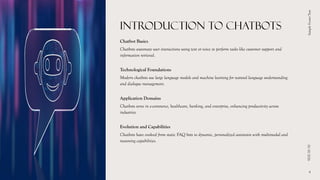
INTRODUCTION TO CHATBOTS
ChatbotBasics
Chatbots automate user interactions using text or voice to perform tasks like customer support and
information retrieval.
Technological Foundations
Modern chatbots use large language models and machine learning for natural language understanding
and dialogue management.
Application Domains
Chatbots serve in e-commerce, healthcare, banking, and enterprise, enhancing productivity across
industries.
Evolution and Capabilities
Chatbots have evolved from static FAQ bots to dynamic, personalized assistants with multimodal and
reasoning capabilities.
01/10/2026
Sample
Footer
Text
4
REFERENCE ARCHITECTURE LAYERS
Sample
Footer
Text
UserInteraction
Channels
User channels include web,
mobile, voice, and
messaging platforms,
serving as entry points for
chatbot interactions.
Orchestration
Layer
Manages routing, policies,
and guardrails to ensure
compliance and efficient
conversation flow control.
NLP and
Language Models
Handles intent
classification, entity
recognition,
summarization, and
response generation for
natural conversations.
Knowledge
Integration
Incorporates knowledge
bases, vector databases,
and RAG techniques for
accurate and context-aware
responses.
Tools and
Actions Layer
Supports function calling
and workflow execution to
complete tasks initiated by
the chatbot.
Observability and
Governance
Provides telemetry,
traceability, and prompt
monitoring to ensure
system reliability and
safety.
01/10/2026
6
7.
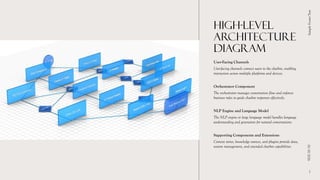
HIGH-LEVEL
ARCHITECTURE
DIAGRAM
User-Facing Channels
User-facing channelsconnect users to the chatbot, enabling
interaction across multiple platforms and devices.
Orchestrator Component
The orchestrator manages conversation flow and enforces
business rules to guide chatbot responses effectively.
NLP Engine and Language Model
The NLP engine or large language model handles language
understanding and generation for natural conversations.
Supporting Components and Extensions
Context stores, knowledge sources, and plugins provide data,
session management, and extended chatbot capabilities.
01/10/2026
Sample
Footer
Text
7
INTENT CLASSIFICATION AND
ENTITYEXTRACTION
Intent Classification Overview
Intent classification helps chatbots understand user goals and route queries accurately.
Techniques for Intent Detection
Methods include traditional SVM models and advanced transformer architectures like BERT and GPT.
Entity Extraction and NER
Entity extraction identifies key data points such as dates and names using NER and deep learning.
Natural Language Understanding Backbone
Together, intent classification and entity extraction enable accurate interpretation of user requests.
01/10/2026
Sample
Footer
Text
9
10.
CONTEXT AND DIALOGUE
MANAGEMENT
TraditionalDialogue Tracking
Frame-based slots and state machines track conversation progress using structured approaches.
Advanced Decision Models
Reinforcement learning and policy-based models enable dynamic decision-making in dialogue systems.
Memory Mechanisms in LLMs
Large language models use short-term and long-term memory to enhance dialogue coherence and
personalization.
Managing Multi-turn Dialogues
Effective context management allows chatbots to handle topic shifts and maintain user preferences
naturally.
01/10/2026
Sample
Footer
Text
10
RESPONSE GENERATION
STRATEGIES
Template-Based Methods
Template-basedstrategies ensure predictable and consistent chatbot responses using predefined patterns.
Retrieval-Based Approaches
Retrieval methods focus on factual accuracy by selecting relevant responses from a knowledge base.
Generative Models
Generative models produce dynamic and human-like responses by generating text based on input context.
Hybrid Systems and Tool Use
Hybrid chatbots combine methods and integrate tool use for real-time data retrieval and action execution.
01/10/2026
Sample
Footer
Text
12
13.
RETRIEVAL-AUGMENTED
GENERATION (RAG)
Combining Generationand Retrieval
RAG integrates large language models with retrieval to enhance factual accuracy and relevance in
responses.
Vector Databases and Embeddings
Indexing knowledge in vector databases and generating embeddings enable efficient similarity searches.
Hybrid Retrieval Techniques
Combining BM25 with dense vector search methods improves precision in retrieving relevant information.
Trustworthiness in RAG Workflows
Citation tracking and freshness policies ensure responses are trustworthy and up-to-date.
01/10/2026
Sample
Footer
Text
13
DEPLOYMENT AND
SCALABILITY
Infrastructure Patterns
Choosingserverless endpoints supports bursty workloads, while
microservices enhance modularity in chatbot deployment.
Scalability Strategies
Asynchronous I/O, token streaming, and autoscaling help
chatbots handle variable traffic efficiently.
Cost Optimization
Routing queries by complexity and monitoring conversation costs
optimize chatbot operational expenses.
01/10/2026
Sample
Footer
Text
15
16.
SECURITY, GOVERNANCE, AND
REAL-WORLDEXAMPLES
Security Measures
PII redaction, encryption, and zero-trust controls protect sensitive enterprise chatbot data against breaches
and misuse.
Safety Mechanisms
Prompt injection prevention, toxicity filters, and human-in-the-loop escalation ensure safe and responsible
chatbot interactions.
Observability and Metrics
Tracking CSAT, factuality, and turn success enables continuous evaluation for chatbot effectiveness and
improvement.
Real-world AI Examples
ChatGPT, Alexa, Microsoft Copilot, and Google Assistant demonstrate diverse enterprise AI applications
and governance practices.
01/10/2026
Sample
Footer
Text
16
#3
The agenda for this presentation covers the foundational aspects of chatbot technology and its architecture. We begin with an introduction to chatbots, their taxonomy, and evolution from rule-based systems to AI-driven conversational agents. Next, we explore the reference architecture and its core components, including NLP engines, dialogue managers, and knowledge integration strategies. The agenda also includes modeling techniques for intents, entities, and context management, followed by advanced topics such as Retrieval-Augmented Generation (RAG) and knowledge orchestration. Deployment strategies, scalability considerations, and security measures are discussed to ensure robust and compliant implementations. Observability, evaluation metrics, and governance frameworks are highlighted to maintain performance and reliability. Finally, real-world case studies and best practices provide practical insights, concluding with future trends and operational roadmaps for enterprise adoption.
#4
Chatbots are software agents designed to interact with users through text or voice interfaces, automating tasks such as information retrieval, customer support, and transactional workflows. They range from simple rule-based systems that follow predefined scripts to advanced AI-driven models leveraging large language models (LLMs) and machine learning algorithms. Modern chatbots incorporate natural language understanding (NLU) for intent recognition, entity extraction, and contextual dialogue management, enabling more human-like interactions. Their applications span multiple domains, including e-commerce, healthcare, banking, and enterprise productivity. The evolution of chatbots reflects a shift from static FAQ bots to dynamic, personalized assistants capable of reasoning, tool usage, and multimodal interactions. Understanding this progression is crucial for designing architectures that balance accuracy, scalability, and user experience.
#6
The reference architecture for AI chatbots consists of multiple layers that work cohesively to deliver intelligent conversational experiences. The first layer includes user channels such as web, mobile, voice, and messaging platforms, which serve as entry points for interactions. The orchestration layer manages routing, policies, and guardrails to ensure compliance and efficient flow control. The NLP/LLM layer handles core language tasks, including intent classification, named entity recognition (NER), summarization, and response generation. Knowledge integration is achieved through knowledge bases, vector databases, and Retrieval-Augmented Generation (RAG) techniques, enabling accurate and contextually relevant responses. The tools and actions layer supports function calling and workflow execution for task completion. Finally, observability and governance mechanisms provide telemetry, traceability, and prompt monitoring to maintain system reliability and safety.
#7
A high-level architecture diagram visually represents the interaction between key components of a chatbot system. It typically includes user-facing channels connected to an orchestrator that manages conversation flow and applies business rules. The orchestrator interfaces with an NLP engine or LLM for language understanding and generation. Supporting components such as context stores maintain session data and user profiles, while knowledge sources like databases and APIs provide factual grounding. Tools and plugins enable the chatbot to perform actions beyond text generation, such as booking appointments or retrieving real-time data. This modular design ensures scalability, flexibility, and maintainability, allowing organizations to adapt the architecture to evolving requirements and integrate emerging technologies seamlessly.
#8 Intent Classification and Entity Extraction, Context and Dialogue Management
#9
Intent classification is a fundamental task in chatbot architecture, enabling the system to understand user goals and route queries appropriately. Techniques range from traditional machine learning models like SVMs to transformer-based architectures such as BERT and GPT, which offer superior accuracy and contextual understanding. Entity extraction complements intent recognition by identifying key data points within user input, such as dates, names, or product identifiers. Named Entity Recognition (NER) models leverage pattern matching, dictionaries, and deep learning to achieve high precision. Together, these components form the backbone of natural language understanding, ensuring that chatbots can interpret user requests accurately and provide relevant responses or actions.
#10
Effective dialogue management is essential for maintaining coherent and contextually relevant conversations. Traditional approaches use frame-based slots and state machines to track conversation progress, while advanced systems employ reinforcement learning or policy-based models for dynamic decision-making. Large language models introduce memory mechanisms that differentiate between short-term context (recent turns) and long-term context (historical interactions stored in vector databases). These strategies enable chatbots to handle multi-turn dialogues, manage topic shifts, and maintain user-specific preferences, resulting in more natural and personalized interactions.
#12
Response generation in chatbots can follow multiple strategies, including template-based methods for predictable outputs, retrieval-based approaches for factual accuracy, and generative models for dynamic, human-like responses. Hybrid systems combine these techniques to balance creativity and reliability. Large language models, guided by system prompts and role definitions, generate contextually rich responses while adhering to tone and style guidelines. Incorporating tool-use capabilities allows chatbots to execute actions, retrieve real-time data, and provide precise answers, enhancing their utility in enterprise and consumer applications.
#13
RAG is a powerful technique that combines the generative capabilities of LLMs with retrieval mechanisms to ensure factual accuracy and domain relevance. It involves indexing knowledge sources in vector databases, applying chunking strategies, and generating embeddings for efficient similarity search. Hybrid retrieval methods, such as combining BM25 with dense vector search, improve precision. RAG workflows also incorporate citation tracking and freshness policies to maintain trustworthiness. This approach is particularly valuable for enterprise chatbots that require grounded responses based on proprietary data.
#14 Deployment and Scalability, Security, Governance, and Real-world Examples
#15
Deploying chatbot architectures involves selecting appropriate infrastructure patterns, such as serverless endpoints for bursty workloads or microservices for modularity. Scalability strategies include asynchronous I/O, token streaming, and autoscaling mechanisms to handle variable traffic. Cost optimization is achieved by routing queries to models based on complexity and monitoring cost per conversation. These considerations ensure that chatbot systems remain performant, cost-effective, and resilient under diverse operational conditions.
#16
Security and governance are critical for enterprise chatbot deployments. Measures include PII redaction, encryption, and zero-trust access controls to protect sensitive data. Safety mechanisms such as prompt injection prevention, toxicity filters, and human-in-the-loop escalation safeguard against misuse. Observability frameworks track metrics like CSAT, factuality, and turn success, enabling continuous evaluation. Real-world examples include OpenAI's ChatGPT, which integrates plugins and RAG for enterprise use; Amazon Alexa, optimized for voice interactions; Microsoft Copilot, leveraging organizational data for productivity; and Google Assistant, offering multimodal experiences. These case studies illustrate best practices and highlight common pitfalls, such as over-reliance on generative models without grounding or inadequate evaluation protocols.