Investigation of Wave Propagation  Using Smart Antenna for  Indoor Wireless Communication   Presented by: Sunil Kumar 0603230 EC- 4
Outline Introduction to Terms Smart Antenna. WLAN. Wave Propagation. Indoor Wireless communication Layout of the examined area. DE-ESMB used in simulation. Experimental results.
antenna with a digital signal   processing capability to transmit and receive in an adaptive and spatially   sensitive manner.   “ Smart ”  >>   digital signal processing facility  Introduction to  SMART ANTENNAS
Why   SMART ANTENNAS  ? Higher  Capacity Higher Coverage Higher bit rate Improved link quality  Spectral efficiency  Mobility
Aim  : to maximize the antenna gain in the desired direct ion to minimize the gain in directions of interferers
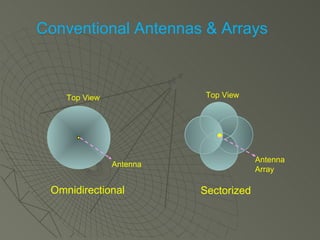
C onventional  A ntennas  & Arrays Omnidirectional Sectorized Antenna Top View Antenna Array Top View
WHY SMART ANTENNAS  ARE  SUPERIOR  TO CONVENTIONAL   ANTENNAS Switched Beam System Adaptive Array Antenna Array Desired User Interfering User Antenna Array Active Beam
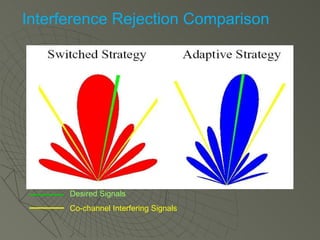
Interference Rejection Comparison Desired Signals Co-channel Interfering Signals
Conclusion Smart Antenna offer new ways to combat and exploit the spatial channel Smart Antennas reduce co-channel interference, improve BER performance and hence capacity
WLAN  /  Wi-Fi Wi-Fi  (short for “Wireless Fidelity") is the popular term for a high-frequency  wireless local area network  ( WLAN ) Uses electromagnetic radio waves to  transport   data  between  computers in a  Local Area Network  (LAN). The data to be transported is superimposed on the radio carrier  by various  modulation techniques .
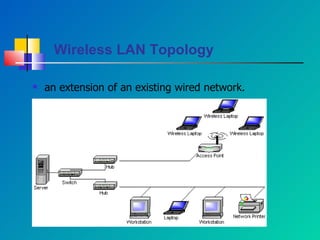
Wireless LAN Topology   an extension of an existing wired network. 
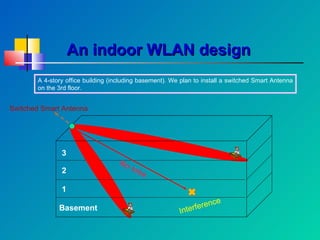
An indoor WLAN design A 4-story office building (including basement). We plan to install a switched Smart Antenna on the 3rd floor.  Switched Smart Antenna Interference 3 2 1 Basement No lobe
Benefits of Wireless Networks Mobility: Example: talking on a cordless phone vs. cord phone. Installation in Difficult-to-Wire Areas: rivers, freeways, old building Hazard materials (such as asbestos particles) when drilling. Right-of-way restrictions in some city to dig ground. Reduced Installation Time: It may take months to receive right-of-way approvals. Increased Reliability:  cable vs. cable-less Long-term savings:  never need re-cabling
•  Security: –  Wired networks can have a physically secure transmission medium. •  Access to the network: –  Wireless network is more difficult to secure. •  The transmission medium is open to anyone  within the geographical range of a transmitter: –  Data privacy is accomplished over a radio  medium using encryption & authentication. •  Encryption comes at increased cost. Challenges and Constraints
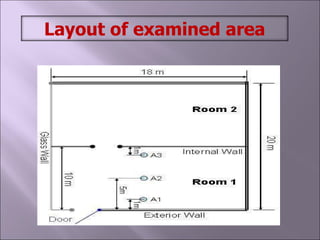
Layout of examined area
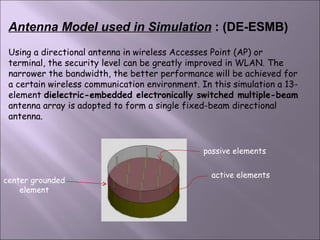
Antenna Model used in Simulation   :   (DE-ESMB) Using a directional antenna in wireless Accesses Point (AP) or terminal, the security level can be greatly improved in WLAN. The narrower the bandwidth, the better performance will be achieved for a certain wireless communication environment. In this simulation a 13-element  dielectric-embedded electronically switched multiple-beam  antenna array is adopted to form a single fixed-beam directional antenna. center grounded element active elements passive elements
 
 
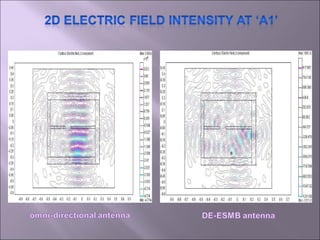
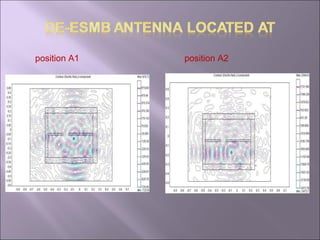
position A1 position A2
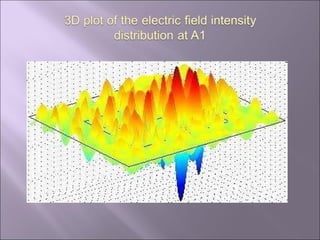
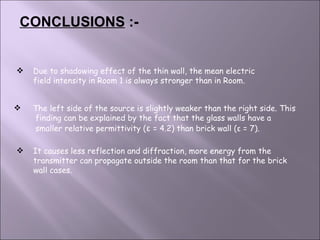
CONCLUSIONS  :- Due to shadowing effect of the thin wall, the mean electric  field intensity in Room 1 is always stronger than in Room. The left side of the source is slightly weaker than the right side. This finding can be explained by the fact that the glass walls have a  smaller relative permittivity ( ε   = 4.2) than brick wall ( ε  = 7). It causes less reflection and diffraction, more energy from the transmitter can propagate outside the room than that for the brick wall cases.

Smart Antennas

  • 1.
    Investigation of WavePropagation Using Smart Antenna for Indoor Wireless Communication Presented by: Sunil Kumar 0603230 EC- 4
  • 2.
    Outline Introduction toTerms Smart Antenna. WLAN. Wave Propagation. Indoor Wireless communication Layout of the examined area. DE-ESMB used in simulation. Experimental results.
  • 3.
    antenna with adigital signal processing capability to transmit and receive in an adaptive and spatially sensitive manner. “ Smart ” >> digital signal processing facility Introduction to SMART ANTENNAS
  • 4.
    Why SMART ANTENNAS ? Higher Capacity Higher Coverage Higher bit rate Improved link quality Spectral efficiency Mobility
  • 5.
    Aim :to maximize the antenna gain in the desired direct ion to minimize the gain in directions of interferers
  • 6.
    C onventional A ntennas & Arrays Omnidirectional Sectorized Antenna Top View Antenna Array Top View
  • 7.
    WHY SMART ANTENNAS ARE SUPERIOR TO CONVENTIONAL ANTENNAS Switched Beam System Adaptive Array Antenna Array Desired User Interfering User Antenna Array Active Beam
  • 8.
    Interference Rejection ComparisonDesired Signals Co-channel Interfering Signals
  • 9.
    Conclusion Smart Antennaoffer new ways to combat and exploit the spatial channel Smart Antennas reduce co-channel interference, improve BER performance and hence capacity
  • 10.
    WLAN / Wi-Fi Wi-Fi (short for “Wireless Fidelity") is the popular term for a high-frequency wireless local area network ( WLAN ) Uses electromagnetic radio waves to transport data between computers in a Local Area Network (LAN). The data to be transported is superimposed on the radio carrier by various modulation techniques .
  • 11.
    Wireless LAN Topology an extension of an existing wired network. 
  • 12.
    An indoor WLANdesign A 4-story office building (including basement). We plan to install a switched Smart Antenna on the 3rd floor. Switched Smart Antenna Interference 3 2 1 Basement No lobe
  • 13.
    Benefits of WirelessNetworks Mobility: Example: talking on a cordless phone vs. cord phone. Installation in Difficult-to-Wire Areas: rivers, freeways, old building Hazard materials (such as asbestos particles) when drilling. Right-of-way restrictions in some city to dig ground. Reduced Installation Time: It may take months to receive right-of-way approvals. Increased Reliability: cable vs. cable-less Long-term savings: never need re-cabling
  • 14.
    • Security:– Wired networks can have a physically secure transmission medium. • Access to the network: – Wireless network is more difficult to secure. • The transmission medium is open to anyone within the geographical range of a transmitter: – Data privacy is accomplished over a radio medium using encryption & authentication. • Encryption comes at increased cost. Challenges and Constraints
  • 15.
  • 16.
    Antenna Model usedin Simulation : (DE-ESMB) Using a directional antenna in wireless Accesses Point (AP) or terminal, the security level can be greatly improved in WLAN. The narrower the bandwidth, the better performance will be achieved for a certain wireless communication environment. In this simulation a 13-element dielectric-embedded electronically switched multiple-beam antenna array is adopted to form a single fixed-beam directional antenna. center grounded element active elements passive elements
  • 17.
  • 18.
  • 19.
  • 20.
    CONCLUSIONS :-Due to shadowing effect of the thin wall, the mean electric field intensity in Room 1 is always stronger than in Room. The left side of the source is slightly weaker than the right side. This finding can be explained by the fact that the glass walls have a smaller relative permittivity ( ε = 4.2) than brick wall ( ε = 7). It causes less reflection and diffraction, more energy from the transmitter can propagate outside the room than that for the brick wall cases.