SSUUBBMMIITTEEDD BBYY-- 
SSAAII DDEEBBAASSIISS MMOOHHAANNTTYY 
RREEGGDD NNOO--11110011221199442266 
77TTHH SSEEMM 
EETT 22
Organization 
1. Introduction. 
2. Basic principle. 
3. What is LASER Communication? 
4. Free Space Laser Communication 
5. Why Laser Communication? 
6. A Simple Laser comm. System 
6.1. Transmitter 
6.2. Modulation 
6.3. Receiver 
7. Current Application. 
8. FSO 
7.1. What is FSO? 
7.2. Advantages of FSO 
9. SUMMARY 
10. References
INTRODUCTION 
 LASER ? 
“LIGHT AMPLIFICATION BY SIMULATED 
EMMISSION OF RADIATION”
BASIC PRINCIPLE 
 ABSORPTION 
 SPONTANEOUS EMISSION 
 STIMULATED EMISSION 
 POPULATION INVERSION
What Is Laser Communication? 
“Laser communications systems are wireless 
connections through the atmosphere. They 
work similarly to fiber optic links, except the 
fact that, in lasers, beam is transmitted 
through free space. “
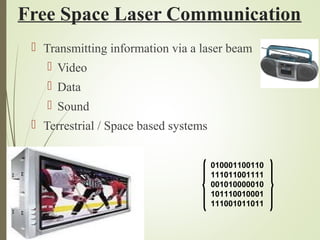
Free Space Laser Communication 
 Transmitting information via a laser beam 
 Video 
 Data 
 Sound 
 Terrestrial / Space based systems 
010001100110 
111011001111 
001010000010 
101110010001 
111001011011
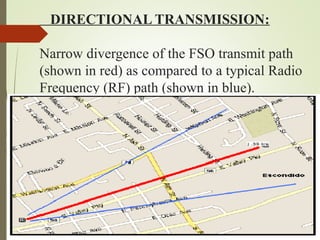
DIRECTIONAL TRANSMISSION: 
Narrow divergence of the FSO transmit path 
(shown in red) as compared to a typical Radio 
Frequency (RF) path (shown in blue).
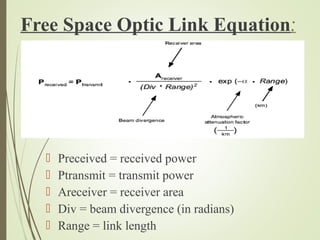
Free Space Optic Link Equation: 
 Preceived = received power 
 Ptransmit = transmit power 
 Areceiver = receiver area 
 Div = beam divergence (in radians) 
 Range = link length
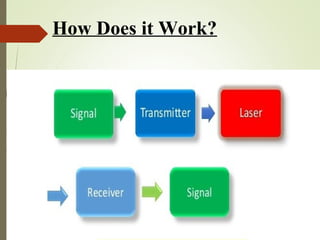
How Does it Work? 
laser
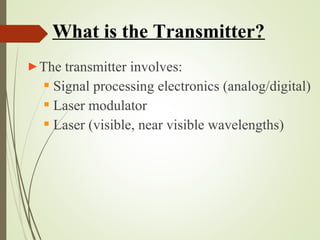
What is the Transmitter? 
►The transmitter involves: 
 Signal processing electronics (analog/digital) 
 Laser modulator 
 Laser (visible, near visible wavelengths)
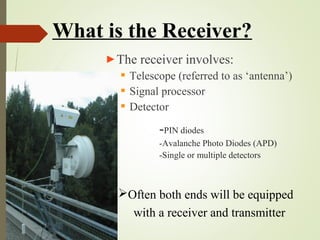
What is the Receiver? 
►The receiver involves: 
 Telescope (referred to as ‘antenna’) 
 Signal processor 
 Detector 
-PIN diodes 
-Avalanche Photo Diodes (APD) 
-Single or multiple detectors 
Often both ends will be equipped 
with a receiver and transmitter
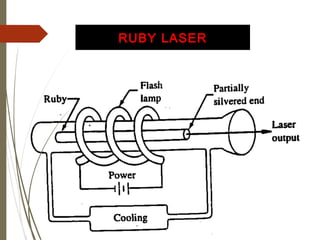
RUBY LASER
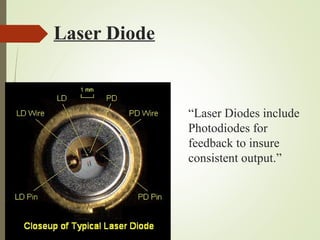
Laser Diode 
“Laser Diodes include 
Photodiodes for 
feedback to insure 
consistent output.”
Modulation 
 AM 
 Easy with gas lasers, hard with diodes 
 PWM (Pulse Width Modulation) 
 PFM (Pulsed FM) 
 Potentially the highest bandwidth (>100kHz)
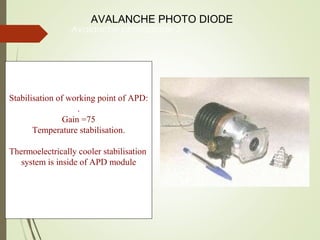
AVALANCHE PHOTO DIODE 
Avalanche photodiode-2 
Stabilisation of working point of APD: 
. 
Gain =75 
Temperature stabilisation. 
Thermoelectrically cooler stabilisation 
system is inside of APD module
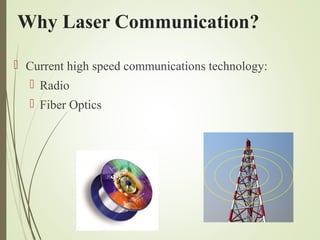
Why Laser Communication? 
 Current high speed communications technology: 
 Radio 
 Fiber Optics
Why not Fiber Optics? 
 Not always possible to lay fiber lines 
 Satellites 
 Combat zones 
 Physically / Economically not practical 
 Emergencies 
LC being incorporated into fiber optic networks 
when fiber is not practical.
Why not RF? 
 Bandwidth 
 for Laser Communication (LC) is 100 times greater than for 
RF. 
 Power 
 in LC is directed at target, so much less transmission power 
required. Also the power loss is less. 
 Size / Weight 
 LC antenna is much smaller than RF. 
 Security 
 Due to low divergence of laser beam, LC is more secure than 
RF.
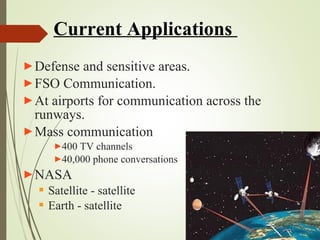
Current Applications 
►Defense and sensitive areas. 
►FSO Communication. 
►At airports for communication across the 
runways. 
►Mass communication 
►400 TV channels 
►40,000 phone conversations 
►NASA 
 Satellite - satellite 
 Earth - satellite
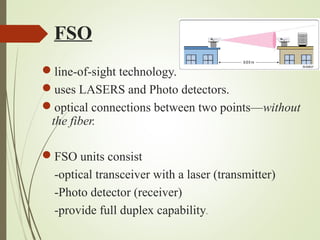
FSO 
line-of-sight technology. 
uses LASERS and Photo detectors. 
optical connections between two points—without 
the fiber. 
FSO units consist 
-optical transceiver with a laser (transmitter) 
-Photo detector (receiver) 
-provide full duplex capability.
ADVANTAGES OF FSO 
SYSTEMS 
 No licensing required. 
 Very low installation cost. 
 No sunk costs. 
 No capital overhangs. 
 Highly secure transmission possible. 
 High data rates @ 2.5 -10 Gbps.
SUMMARY 
 Basic principle of laser action discussed. 
 Laser communication system used in satellite 
communication. 
 Provide higher data rates , high security & lesser 
antenna size. 
 FSO used for lesser link length ~ 4km. 
 FSO links –designed carefully due to safety issues.
Opportunities For Student 
Involvement 
•LASER Research 
•LASER Modulation Circuitry 
•Encoding/Decoding Circuitry
Laser communication

Laser communication

  • 1.
    SSUUBBMMIITTEEDD BBYY-- SSAAIIDDEEBBAASSIISS MMOOHHAANNTTYY RREEGGDD NNOO--11110011221199442266 77TTHH SSEEMM EETT 22
  • 2.
    Organization 1. Introduction. 2. Basic principle. 3. What is LASER Communication? 4. Free Space Laser Communication 5. Why Laser Communication? 6. A Simple Laser comm. System 6.1. Transmitter 6.2. Modulation 6.3. Receiver 7. Current Application. 8. FSO 7.1. What is FSO? 7.2. Advantages of FSO 9. SUMMARY 10. References
  • 3.
    INTRODUCTION  LASER? “LIGHT AMPLIFICATION BY SIMULATED EMMISSION OF RADIATION”
  • 4.
    BASIC PRINCIPLE ABSORPTION  SPONTANEOUS EMISSION  STIMULATED EMISSION  POPULATION INVERSION
  • 5.
    What Is LaserCommunication? “Laser communications systems are wireless connections through the atmosphere. They work similarly to fiber optic links, except the fact that, in lasers, beam is transmitted through free space. “
  • 6.
    Free Space LaserCommunication  Transmitting information via a laser beam  Video  Data  Sound  Terrestrial / Space based systems 010001100110 111011001111 001010000010 101110010001 111001011011
  • 7.
    DIRECTIONAL TRANSMISSION: Narrowdivergence of the FSO transmit path (shown in red) as compared to a typical Radio Frequency (RF) path (shown in blue).
  • 8.
    Free Space OpticLink Equation:  Preceived = received power  Ptransmit = transmit power  Areceiver = receiver area  Div = beam divergence (in radians)  Range = link length
  • 9.
    How Does itWork? laser
  • 10.
    What is theTransmitter? ►The transmitter involves:  Signal processing electronics (analog/digital)  Laser modulator  Laser (visible, near visible wavelengths)
  • 11.
    What is theReceiver? ►The receiver involves:  Telescope (referred to as ‘antenna’)  Signal processor  Detector -PIN diodes -Avalanche Photo Diodes (APD) -Single or multiple detectors Often both ends will be equipped with a receiver and transmitter
  • 12.
  • 13.
    Laser Diode “LaserDiodes include Photodiodes for feedback to insure consistent output.”
  • 14.
    Modulation  AM  Easy with gas lasers, hard with diodes  PWM (Pulse Width Modulation)  PFM (Pulsed FM)  Potentially the highest bandwidth (>100kHz)
  • 15.
    AVALANCHE PHOTO DIODE Avalanche photodiode-2 Stabilisation of working point of APD: . Gain =75 Temperature stabilisation. Thermoelectrically cooler stabilisation system is inside of APD module
  • 16.
    Why Laser Communication?  Current high speed communications technology:  Radio  Fiber Optics
  • 17.
    Why not FiberOptics?  Not always possible to lay fiber lines  Satellites  Combat zones  Physically / Economically not practical  Emergencies LC being incorporated into fiber optic networks when fiber is not practical.
  • 18.
    Why not RF?  Bandwidth  for Laser Communication (LC) is 100 times greater than for RF.  Power  in LC is directed at target, so much less transmission power required. Also the power loss is less.  Size / Weight  LC antenna is much smaller than RF.  Security  Due to low divergence of laser beam, LC is more secure than RF.
  • 19.
    Current Applications ►Defenseand sensitive areas. ►FSO Communication. ►At airports for communication across the runways. ►Mass communication ►400 TV channels ►40,000 phone conversations ►NASA  Satellite - satellite  Earth - satellite
  • 20.
    FSO line-of-sight technology. uses LASERS and Photo detectors. optical connections between two points—without the fiber. FSO units consist -optical transceiver with a laser (transmitter) -Photo detector (receiver) -provide full duplex capability.
  • 21.
    ADVANTAGES OF FSO SYSTEMS  No licensing required.  Very low installation cost.  No sunk costs.  No capital overhangs.  Highly secure transmission possible.  High data rates @ 2.5 -10 Gbps.
  • 22.
    SUMMARY  Basicprinciple of laser action discussed.  Laser communication system used in satellite communication.  Provide higher data rates , high security & lesser antenna size.  FSO used for lesser link length ~ 4km.  FSO links –designed carefully due to safety issues.
  • 23.
    Opportunities For Student Involvement •LASER Research •LASER Modulation Circuitry •Encoding/Decoding Circuitry