CAUVERY INSTITUTE OF TECHNOLOGY
MANDYA
VISVESVARAYA TECHNOLOGICAL UNIVERSITY
A Technical Seminar Presentation
On
“Laser Communication System”
Under the guidance of
Prof. Anitha H C
Associate professor
Presenting by:
NIKHIL N - 4CA20EC008
Department of Electronics & Communication
Engineering
2023-2024
Contents:
• Introduction
• How does Laser Communication Work?
• Laser transmitter and receiver
• Modulation
• Filters
• Application
• Advantages
• Disadvantages
• Conclusion
• Reference
Department of ECE, CIT Mandya 2
Introduction
• Laser communications systems are wireless connections through the
atmosphere.
• They work similarly to fiber optic links, except the beam is transmitted
through free space.
• While the transmitter and receiver must require line-of-sight conditions,
they have the benefit of eliminating the need for broadcast rights and
buried cables.
Department of ECE, CIT Mandya 3
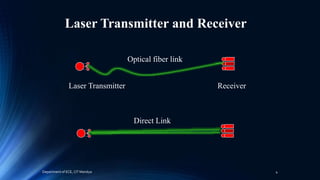
Laser Transmitter and Receiver
Laser Transmitter Receiver
Optical fiber link
Direct Link
Department of ECE, CIT Mandya 4
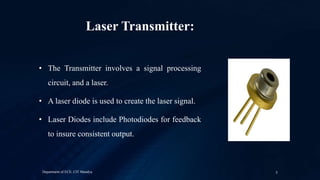
Laser Transmitter:
• The Transmitter involves a signal processing
circuit, and a laser.
• A laser diode is used to create the laser signal.
• Laser Diodes include Photodiodes for feedback
to insure consistent output.
Department of ECE, CIT Mandya 5
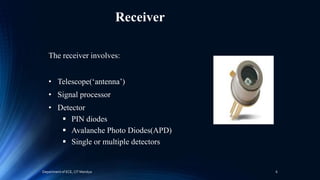
Receiver
The receiver involves:
• Telescope(‘antenna’)
• Signal processor
• Detector
 PIN diodes
 Avalanche Photo Diodes(APD)
 Single or multiple detectors
Department of ECE, CIT Mandya 6
Modulation:
• AM
Easy with gas lasers, hard with diodes
• PWM (pulse width modulation)
Used by Ramsey in their kit
• PFM(pulsed Fm)
Potentially the highest bandwidth (>100khz)
Department of ECE, CIT Mandya 7
Filters:
• Sun shade over detector
• Shade in front of lens
• Detector spectral response
• Colored filters
• Absorb 50% of available light
• Difficult to find exact frequency
Department of ECE, CIT Mandya 8
Applications:
• Transmit voice for miles line-of-sight.
• Use weak signal modes for Cloud scatter.
• Transmit video with cheap pens.
• Transmit high speed data without WEP.
• Blind flies for easy extermination.
Department of ECE, CIT Mandya 9
Advantages:
• Ease of deployment
• Can be used to power devices
• License-free long-range operation (in contrast with radio communication)
• High bit rates
• Low bit error rates
• Immunity to electromagnetic interference
• Protocol transparency
Department of ECE, CIT Mandya 10
Disadvantages:
For terrestrial applications, the principal limiting factors are:
• Beam dispersion
• Atmospheric absorption
• Rain
• Fog (10 -100 dB/km attenuation)
• Snow
• Interference from background light sources (including the Sun)
Department of ECE, CIT Mandya 11
Conclusion:
• Laser communications offers a viable alternative to RF communications for inter
satellite links and other applications where high-performance links are a
necessity.
• High data rate, small antenna size, narrow beam divergence, and a narrow field
of view are characteristics of laser communications that offer a number of
potential advantages for system design.
Department of ECE, CIT Mandya 12
References:
1. Sadiku, M. N. O., Musa, S., & Nelatury, S. R. (2021). Free space
optical communications: an overview. European scientific journal,
ESJ, 12(9), 55.
2. Prof. Atul A. Padghan | prof. Ankit P. Jaiswal" study on laser
communication: features, application, advantages" published in
international journal of trend in scientific research and development
(ijtsrd), ISSN: 2456-6470, volume-2 | issue3, April 2019
3. (2020, December 23). Laser communication space.
Https://ivypanda.Com/essays/ laser-communication-links-in-space
Department of ECE, CIT Mandya 13
Thank You
Department of ECE, CIT Mandya 14

Ppt laser 1.16.pptx for laser communication

  • 1.
    CAUVERY INSTITUTE OFTECHNOLOGY MANDYA VISVESVARAYA TECHNOLOGICAL UNIVERSITY A Technical Seminar Presentation On “Laser Communication System” Under the guidance of Prof. Anitha H C Associate professor Presenting by: NIKHIL N - 4CA20EC008 Department of Electronics & Communication Engineering 2023-2024
  • 2.
    Contents: • Introduction • Howdoes Laser Communication Work? • Laser transmitter and receiver • Modulation • Filters • Application • Advantages • Disadvantages • Conclusion • Reference Department of ECE, CIT Mandya 2
  • 3.
    Introduction • Laser communicationssystems are wireless connections through the atmosphere. • They work similarly to fiber optic links, except the beam is transmitted through free space. • While the transmitter and receiver must require line-of-sight conditions, they have the benefit of eliminating the need for broadcast rights and buried cables. Department of ECE, CIT Mandya 3
  • 4.
    Laser Transmitter andReceiver Laser Transmitter Receiver Optical fiber link Direct Link Department of ECE, CIT Mandya 4
  • 5.
    Laser Transmitter: • TheTransmitter involves a signal processing circuit, and a laser. • A laser diode is used to create the laser signal. • Laser Diodes include Photodiodes for feedback to insure consistent output. Department of ECE, CIT Mandya 5
  • 6.
    Receiver The receiver involves: •Telescope(‘antenna’) • Signal processor • Detector  PIN diodes  Avalanche Photo Diodes(APD)  Single or multiple detectors Department of ECE, CIT Mandya 6
  • 7.
    Modulation: • AM Easy withgas lasers, hard with diodes • PWM (pulse width modulation) Used by Ramsey in their kit • PFM(pulsed Fm) Potentially the highest bandwidth (>100khz) Department of ECE, CIT Mandya 7
  • 8.
    Filters: • Sun shadeover detector • Shade in front of lens • Detector spectral response • Colored filters • Absorb 50% of available light • Difficult to find exact frequency Department of ECE, CIT Mandya 8
  • 9.
    Applications: • Transmit voicefor miles line-of-sight. • Use weak signal modes for Cloud scatter. • Transmit video with cheap pens. • Transmit high speed data without WEP. • Blind flies for easy extermination. Department of ECE, CIT Mandya 9
  • 10.
    Advantages: • Ease ofdeployment • Can be used to power devices • License-free long-range operation (in contrast with radio communication) • High bit rates • Low bit error rates • Immunity to electromagnetic interference • Protocol transparency Department of ECE, CIT Mandya 10
  • 11.
    Disadvantages: For terrestrial applications,the principal limiting factors are: • Beam dispersion • Atmospheric absorption • Rain • Fog (10 -100 dB/km attenuation) • Snow • Interference from background light sources (including the Sun) Department of ECE, CIT Mandya 11
  • 12.
    Conclusion: • Laser communicationsoffers a viable alternative to RF communications for inter satellite links and other applications where high-performance links are a necessity. • High data rate, small antenna size, narrow beam divergence, and a narrow field of view are characteristics of laser communications that offer a number of potential advantages for system design. Department of ECE, CIT Mandya 12
  • 13.
    References: 1. Sadiku, M.N. O., Musa, S., & Nelatury, S. R. (2021). Free space optical communications: an overview. European scientific journal, ESJ, 12(9), 55. 2. Prof. Atul A. Padghan | prof. Ankit P. Jaiswal" study on laser communication: features, application, advantages" published in international journal of trend in scientific research and development (ijtsrd), ISSN: 2456-6470, volume-2 | issue3, April 2019 3. (2020, December 23). Laser communication space. Https://ivypanda.Com/essays/ laser-communication-links-in-space Department of ECE, CIT Mandya 13
  • 14.
    Thank You Department ofECE, CIT Mandya 14