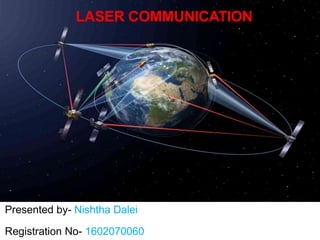
LASER COMMUNICATION
Presented by- Nishtha Dalei
Registration No- 1602070060
Content
1. Introduction
2. How does it work?
3. Laser Transmitter
4. Laser Receiver
5. Modulation
6. Optics
7. Bandpass Filter
8. Why not RF?
9. Why not Fiber Optics?
10.Applications
11.LADEE
12.Advantages
13.Disadvantages
14.Conclusion
15.Reference
Introduction
• Laser communication is a wireless connection through the atmosphere.
• Refers to transmission of modulated visible or IR beams through
atmosphere
• Working similar to fiber optic communication
• No fiber used, transmits through free space
• Transmitter and Receiver require line of sight condition.
• Carrier used for transmission is generated by laser diode
• Two parallel beams are needed for transmission and reception
• Communication over long distances, eg- between planets
How does it work ?
Signal Transmitter LASER
ReceiverSignal
• Microphone input is conditioned so that full 8 bit data range of ADC is
utilised.
• The MCU passes the signal to the UART.
• On the receiver side, the signal is read by a photo transistor.
• The UART reads these signals and generates a byte
• This byte is sent to DAC through a port and applied to the speaker.
LASER TRANSMITTER
• Transmitter involves a signal
processing circuit, and a laser light
source(He-Ne gas laser,
semiconductor laser,IR diode laser,
etc.)
• A laser diode is used to generate
the laser signal.
• Laser Diodes include Photodiodes
for feedback to insure consistent
output.
RECEIVER
• Receiver involves a Signal
Processor and Detector (Some
kind of Photodiode) that will
capture and read the incoming
laser signal.
• Detectors
• Solar cells
• Photo diode
• PMT
• CdS photoresistors
• Phototransistors
Modulation
• PAM - Output energy varies with
amplitude of the supplied
current
• PWM - Output energy varies with
pulsewidth
• PFM -Output energy varies with
pulse frequency(needs highest
BW >100KHz)
OPTICS
Conventional Glass Lens
• Double Convex lens makes
excellent receiving lens
• Different focal length for
different wavelength of light
• Increase in lens aperture
increases selectivity and light
gathering efficiency.
Fresnel Lens
• Flat with large capture area,light
weight
• Easily affordable
Bandpass Filter
• Increases the range of IR and visible
light laser.
• Heat-absorbing glass are used.
• Coloured Acetate (Red acetate passes
only red part of the visible spectrum).
Why not RF?
• Narrow Beamwidth
• For laser communication(LC), optical beam
is more focused as it propagates, due to
shorter wavelength
• As a result more,power is received by the
receiver achieving greater SNR.
• Potentially, high data rates can be achieved.
• Bandwidth
• LC has 100 times greater BW than RF
• Power
• LC is much focused at the target ,so less
transmission power required.
• Power loss is less.
• Security
secure due to low divergence
• Size of antenna
• optical antenna is much smaller than RF.
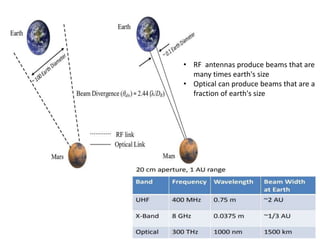
• RF antennas produce beams that are
many times earth's size
• Optical can produce beams that are a
fraction of earth's size
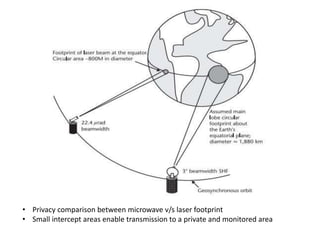
• Privacy comparison between microwave v/s laser footprint
• Small intercept areas enable transmission to a private and monitored area
Why not Fiber Optic?
• Not always possible to lay
fiber lines
– Satellite
– combat zones
– physically and economically
not practical
– Emergencies
Applications
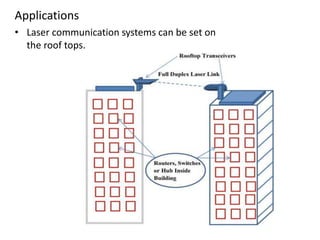
• Laser communication systems can be set on
the roof tops.
• Defence and sensitive areas
• Airport Runway
• Laser Space Communication
• Disaster scenes
• Navigation
• Ecosystem monitoring
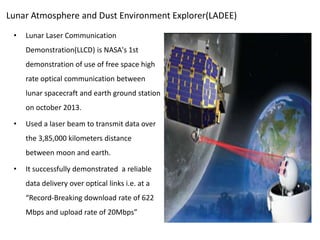
Lunar Atmosphere and Dust Environment Explorer(LADEE)
• Lunar Laser Communication
Demonstration(LLCD) is NASA's 1st
demonstration of use of free space high
rate optical communication between
lunar spacecraft and earth ground station
on october 2013.
• Used a laser beam to transmit data over
the 3,85,000 kilometers distance
between moon and earth.
• It successfully demonstrated a reliable
data delivery over optical links i.e. at a
“Record-Breaking download rate of 622
Mbps and upload rate of 20Mbps”
Advantages
• Speed more than 1GBps
• No need for broadcast rights and buried cables
• LC systems are inexpensive , small and low power.
• High bitrates
• low bit error rates
• Increased security
• License-free long range operation
• Laser space communication system designs are
lightweight, high bandwidth, low cost comm payloads.
• Optical terminals require less power than RF terminal
operating at same data rate.
• High directivity , so no interference between
transmitters.
Disadvantages
• For terrestrial applications,the limiting factors are:
• Beam dispersion
• Atmospheric attenuation
• Rain
• Fog
• Snow
• Interference from background light sources(including the Sun)
• Pollution/smog
• Optical Receiver noise
• Thermal noise
• Dark current
Conclusion
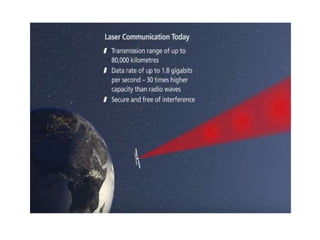
• Two way laser communication has been a goal for NASA because it
enable data transmission rates that are 10 to 1000 times higher
than traditional radio waves.
• Lasers can provide real-time data across the world.
• Intersatellite laser communication links offer an attractive
alternative to RF with virtually unlimited potential and an
unregulated spectrum.
• Astronomers could use lasers like very accurate rulers to measure
the movement of planets with very high precision
• Lasers could also be used to refine basic principles of fundamental
physics.
References
• A Laser - communications Primer-Part 1 & Part 2
• Laser Space Communication by David .G. Aviv
• https://lasercommunications.weebly.com
• https://people.ece.cornell.edu/land/courses/ece4760/FinalProjects/s2003/k
mc29/index.htm
• Introduction to Optical Communication for Satellites-KISSCaltech.edu
• Naveen, Shreyas AS, Ravi Ghael,Najashree , “Laser Communication System” ,
Department of Electronics and communication, IEEE.
• The NASA Lunar Laser Communication Demonstration-Successful High Data
Rate Laser Communications To and From Moon
• https://www.slideshare.net/asertseminar/laser-communications-33264562
• Youtube Channels-
– European Space Agency (ESA)
– German Aerospace Centre ,DLR
– KISSCaltech
– NASA's Marshall Space Flight Cente
– NASA Goddard
Laser communiction
Laser communiction

Laser communiction

  • 1.
    LASER COMMUNICATION Presented by-Nishtha Dalei Registration No- 1602070060
  • 2.
    Content 1. Introduction 2. Howdoes it work? 3. Laser Transmitter 4. Laser Receiver 5. Modulation 6. Optics 7. Bandpass Filter 8. Why not RF? 9. Why not Fiber Optics? 10.Applications 11.LADEE 12.Advantages 13.Disadvantages 14.Conclusion 15.Reference
  • 3.
    Introduction • Laser communicationis a wireless connection through the atmosphere. • Refers to transmission of modulated visible or IR beams through atmosphere • Working similar to fiber optic communication • No fiber used, transmits through free space • Transmitter and Receiver require line of sight condition. • Carrier used for transmission is generated by laser diode • Two parallel beams are needed for transmission and reception • Communication over long distances, eg- between planets
  • 4.
    How does itwork ? Signal Transmitter LASER ReceiverSignal
  • 5.
    • Microphone inputis conditioned so that full 8 bit data range of ADC is utilised. • The MCU passes the signal to the UART. • On the receiver side, the signal is read by a photo transistor. • The UART reads these signals and generates a byte • This byte is sent to DAC through a port and applied to the speaker.
  • 6.
    LASER TRANSMITTER • Transmitterinvolves a signal processing circuit, and a laser light source(He-Ne gas laser, semiconductor laser,IR diode laser, etc.) • A laser diode is used to generate the laser signal. • Laser Diodes include Photodiodes for feedback to insure consistent output.
  • 7.
    RECEIVER • Receiver involvesa Signal Processor and Detector (Some kind of Photodiode) that will capture and read the incoming laser signal. • Detectors • Solar cells • Photo diode • PMT • CdS photoresistors • Phototransistors
  • 9.
    Modulation • PAM -Output energy varies with amplitude of the supplied current • PWM - Output energy varies with pulsewidth • PFM -Output energy varies with pulse frequency(needs highest BW >100KHz)
  • 10.
    OPTICS Conventional Glass Lens •Double Convex lens makes excellent receiving lens • Different focal length for different wavelength of light • Increase in lens aperture increases selectivity and light gathering efficiency. Fresnel Lens • Flat with large capture area,light weight • Easily affordable
  • 11.
    Bandpass Filter • Increasesthe range of IR and visible light laser. • Heat-absorbing glass are used. • Coloured Acetate (Red acetate passes only red part of the visible spectrum).
  • 12.
    Why not RF? •Narrow Beamwidth • For laser communication(LC), optical beam is more focused as it propagates, due to shorter wavelength • As a result more,power is received by the receiver achieving greater SNR. • Potentially, high data rates can be achieved. • Bandwidth • LC has 100 times greater BW than RF • Power • LC is much focused at the target ,so less transmission power required. • Power loss is less. • Security secure due to low divergence • Size of antenna • optical antenna is much smaller than RF.
  • 13.
    • RF antennasproduce beams that are many times earth's size • Optical can produce beams that are a fraction of earth's size
  • 14.
    • Privacy comparisonbetween microwave v/s laser footprint • Small intercept areas enable transmission to a private and monitored area
  • 15.
    Why not FiberOptic? • Not always possible to lay fiber lines – Satellite – combat zones – physically and economically not practical – Emergencies
  • 16.
    Applications • Laser communicationsystems can be set on the roof tops.
  • 17.
    • Defence andsensitive areas • Airport Runway
  • 18.
    • Laser SpaceCommunication • Disaster scenes • Navigation • Ecosystem monitoring
  • 22.
    Lunar Atmosphere andDust Environment Explorer(LADEE) • Lunar Laser Communication Demonstration(LLCD) is NASA's 1st demonstration of use of free space high rate optical communication between lunar spacecraft and earth ground station on october 2013. • Used a laser beam to transmit data over the 3,85,000 kilometers distance between moon and earth. • It successfully demonstrated a reliable data delivery over optical links i.e. at a “Record-Breaking download rate of 622 Mbps and upload rate of 20Mbps”
  • 24.
    Advantages • Speed morethan 1GBps • No need for broadcast rights and buried cables • LC systems are inexpensive , small and low power. • High bitrates • low bit error rates • Increased security • License-free long range operation • Laser space communication system designs are lightweight, high bandwidth, low cost comm payloads. • Optical terminals require less power than RF terminal operating at same data rate. • High directivity , so no interference between transmitters.
  • 25.
    Disadvantages • For terrestrialapplications,the limiting factors are: • Beam dispersion • Atmospheric attenuation • Rain • Fog • Snow • Interference from background light sources(including the Sun) • Pollution/smog • Optical Receiver noise • Thermal noise • Dark current
  • 26.
    Conclusion • Two waylaser communication has been a goal for NASA because it enable data transmission rates that are 10 to 1000 times higher than traditional radio waves. • Lasers can provide real-time data across the world. • Intersatellite laser communication links offer an attractive alternative to RF with virtually unlimited potential and an unregulated spectrum. • Astronomers could use lasers like very accurate rulers to measure the movement of planets with very high precision • Lasers could also be used to refine basic principles of fundamental physics.
  • 27.
    References • A Laser- communications Primer-Part 1 & Part 2 • Laser Space Communication by David .G. Aviv • https://lasercommunications.weebly.com • https://people.ece.cornell.edu/land/courses/ece4760/FinalProjects/s2003/k mc29/index.htm • Introduction to Optical Communication for Satellites-KISSCaltech.edu • Naveen, Shreyas AS, Ravi Ghael,Najashree , “Laser Communication System” , Department of Electronics and communication, IEEE. • The NASA Lunar Laser Communication Demonstration-Successful High Data Rate Laser Communications To and From Moon • https://www.slideshare.net/asertseminar/laser-communications-33264562 • Youtube Channels- – European Space Agency (ESA) – German Aerospace Centre ,DLR – KISSCaltech – NASA's Marshall Space Flight Cente – NASA Goddard