B.MANIKANTA REDDY
19E11A0405
ECE-4A
Introduction
• Laser communications systems are wireless connections through the
atmosphere.
• Use Laser Beams to transmit information between two locations
• No fibers need, a wireless technology
• Communication over long distances, e.g. between planets
• Laser Communication Terminals (LCTs) transmit a laser beam and are
capable of receiving laser beams.
How does it Work ?
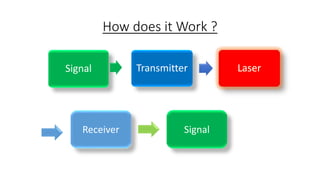
Signal Transmitter Laser
Receiver Signal
Laser Transmitter and Receiver
Laser Transmitter Receiver
Optical fiber link
Direct Link
Laser Transmitter
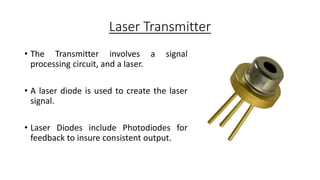
• The Transmitter involves a signal
processing circuit, and a laser.
• A laser diode is used to create the laser
signal.
• Laser Diodes include Photodiodes for
feedback to insure consistent output.
Receiver
The receiver involves:
• Telescope(‘antenna’)
• Signal processor
• Detector
 PIN diodes
 Avalanche Photo Diodes(APD)
 Single or multiple detectors
Modulation
• AM
 Easy with gas lasers, hard with diodes
• PWM
• PFM
 Potentially the highest bandwidth(>100kHz)
Gain Systems
Transmitter
 Maximum output power
 Minimum divergence
Receiver
 Maximum lens area
 Clarity
 Tight focus on detector
• Thus system is set up to
send voice data.
• A person's voice gets put
into a conditioning
circuit so that the full
eight bit range of the
analogue to digital
converter is utilized.
• Once the digital signal is
obtained by the ADC, the
MCU passes the signal to
the uart.
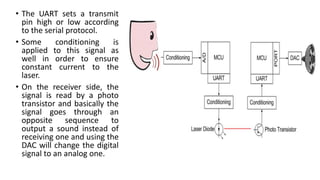
• The UART sets a transmit
pin high or low according
to the serial protocol.
• Some conditioning is
applied to this signal as
well in order to ensure
constant current to the
laser.
• On the receiver side, the
signal is read by a photo
transistor and basically the
signal goes through an
opposite sequence to
output a sound instead of
receiving one and using the
DAC will change the digital
signal to an analog one.
Applications
ISP (Internet Service Provider) Industrial Use
Applications
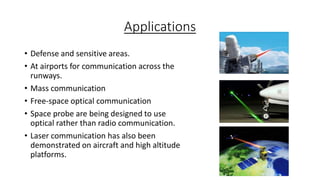
• Defense and sensitive areas.
• At airports for communication across the
runways.
• Mass communication
• Free-space optical communication
• Space probe are being designed to use
optical rather than radio communication.
• Laser communication has also been
demonstrated on aircraft and high altitude
platforms.
Lunar Atmosphere and Dust Environment Explorer
(LADEE)
• Lunar Laser Communication Demonstration
(LLCD) equipment on LADEE set a space
communication bandwidth record in
October 2013.
• Early tests using a pulsed laser beam to
transmit data over the 385,000 kilometres
(239,000 mi) between the Moon and Earth.
• Passed data at a "record-breaking download
rate of 622 megabits per second (Mbps)“
• Demonstrated an error-free data upload
rate of 20 Mbps from an Earth ground
station to LADEE in Lunar orbit.
Conclusion
• With the dramatic increase in the data handling requirements for
satellite communication services, laser
• inter satellite links offer an attractive alternative to RF with virtually
unlimited potential and an unregulated spectrum.
• The system and component technology necessary for successful inter
satellite link exists today.

laser communication pptx.pptx

  • 1.
  • 2.
    Introduction • Laser communicationssystems are wireless connections through the atmosphere. • Use Laser Beams to transmit information between two locations • No fibers need, a wireless technology • Communication over long distances, e.g. between planets • Laser Communication Terminals (LCTs) transmit a laser beam and are capable of receiving laser beams.
  • 3.
    How does itWork ? Signal Transmitter Laser Receiver Signal
  • 4.
    Laser Transmitter andReceiver Laser Transmitter Receiver Optical fiber link Direct Link
  • 5.
    Laser Transmitter • TheTransmitter involves a signal processing circuit, and a laser. • A laser diode is used to create the laser signal. • Laser Diodes include Photodiodes for feedback to insure consistent output.
  • 6.
    Receiver The receiver involves: •Telescope(‘antenna’) • Signal processor • Detector  PIN diodes  Avalanche Photo Diodes(APD)  Single or multiple detectors
  • 7.
    Modulation • AM  Easywith gas lasers, hard with diodes • PWM • PFM  Potentially the highest bandwidth(>100kHz)
  • 8.
    Gain Systems Transmitter  Maximumoutput power  Minimum divergence Receiver  Maximum lens area  Clarity  Tight focus on detector
  • 9.
    • Thus systemis set up to send voice data. • A person's voice gets put into a conditioning circuit so that the full eight bit range of the analogue to digital converter is utilized. • Once the digital signal is obtained by the ADC, the MCU passes the signal to the uart.
  • 10.
    • The UARTsets a transmit pin high or low according to the serial protocol. • Some conditioning is applied to this signal as well in order to ensure constant current to the laser. • On the receiver side, the signal is read by a photo transistor and basically the signal goes through an opposite sequence to output a sound instead of receiving one and using the DAC will change the digital signal to an analog one.
  • 11.
    Applications ISP (Internet ServiceProvider) Industrial Use
  • 12.
    Applications • Defense andsensitive areas. • At airports for communication across the runways. • Mass communication • Free-space optical communication • Space probe are being designed to use optical rather than radio communication. • Laser communication has also been demonstrated on aircraft and high altitude platforms.
  • 13.
    Lunar Atmosphere andDust Environment Explorer (LADEE) • Lunar Laser Communication Demonstration (LLCD) equipment on LADEE set a space communication bandwidth record in October 2013. • Early tests using a pulsed laser beam to transmit data over the 385,000 kilometres (239,000 mi) between the Moon and Earth. • Passed data at a "record-breaking download rate of 622 megabits per second (Mbps)“ • Demonstrated an error-free data upload rate of 20 Mbps from an Earth ground station to LADEE in Lunar orbit.
  • 14.
    Conclusion • With thedramatic increase in the data handling requirements for satellite communication services, laser • inter satellite links offer an attractive alternative to RF with virtually unlimited potential and an unregulated spectrum. • The system and component technology necessary for successful inter satellite link exists today.