Laser Communications
Contents
• Introduction
• Block Diagram
• Laser Transmitter And Receiver
• Laser Transmitter
• Receiver
• Modulation
• Gain Systems
• Filters
• Mounting System
• Pointing
• Why not Fiber Optics??
• Why not R.F??
• Advantages
• Disadvantages
• Applications
• Conclusion
• Reference
Introduction
• Laser communications systems are wireless connections through
the atmosphere.
• They work similarly to fiber optic links, except the beam is
transmitted through free space.
• While the transmitter and receiver must require line-of-sight
conditions, they have the benefit of eliminating the need for
broadcast rights and buried cables.
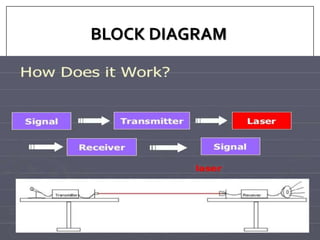
BLOCK DIAGRAM
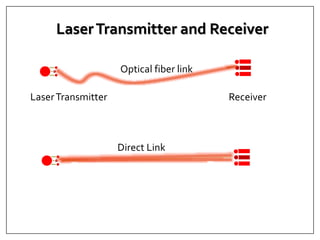
LaserTransmitter and Receiver
LaserTransmitter Receiver
Optical fiber link
Direct Link
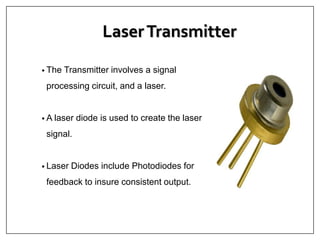
LaserTransmitter
• The Transmitter involves a signal
processing circuit, and a laser.
• A laser diode is used to create the laser
signal.
• Laser Diodes include Photodiodes for
feedback to insure consistent output.
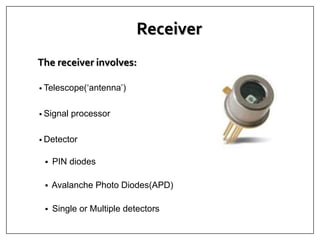
Receiver
The receiver involves:
• Telescope(‘antenna’)
• Signal processor
• Detector
 PIN diodes
 Avalanche Photo Diodes(APD)
 Single or Multiple detectors
Modulation :
• AM :
Easy with gas lasers, hard with diodes
• PWM (Pulse Width Modulation) :
Used by Ramsey in their kit
• PFM (Pulsed FM) :
Potentially the highest bandwidth (>100kHz)
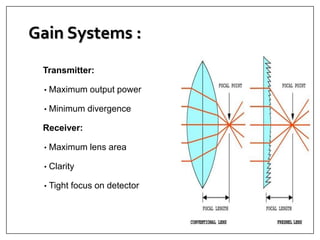
Gain Systems :
Transmitter:
• Maximum output power
• Minimum divergence
Receiver:
• Maximum lens area
• Clarity
• Tight focus on detector
Filters :
• Sun shade over detector
• Shade in front of lens
• Detector spectral response
• Colored filters
 Absorb ~50% of available light
 Difficult to find exact frequency
Mounting System :
• Mounts and stands need only be as accurate as beam
divergence.
• Good laser diodes will be 1-2mR (milli-radian)
• A 32 pitch screw at the end of a 2' mount will yield 1mR per
revolution.
• Higher thread pitches allow shorter mounts which may be more
stable (against wind, vibration, wires)
• 1mR is 1.5' of divergence every 1000', 3' at 2000 ', etc.
Pointing
• GPS and Compass
• Scopes and Binoculars
• Strobe lights, large handheld floods, headlights
• HTs to yell when laser light is seen at remote location
Why not Fiber Optics??
• Not always possible to lay fiber lines :
 Satellites
 Combat zones
 Physically/Economically not practical
 Emergencies
 Laser Communication being incorporated into fiber optic
networks when fiber is not practical.
Why not R.F??
• Bandwidth :
 For laser communication is 100times larger than R.F.
• Power :
 In LC is directed at target, so much less transmission power
 Also the power loss is less.
• Size/Weight :
 LC antenna is much smaller than R.F.
• Security :
 Due to low divergence of laser beam ,LC is more secure than R.F.
Advantages :
• Ease of deployment
• Can be used to power devices
• License-free long-range operation (in contrast with radio
communication)
• High bit rates
• Low bit error rates
• Immunity to electromagnetic interference
• Full duplex operation
• Protocol transparency
• Increased security when working with narrow beam.
Disadvantages :
For terrestrial applications, the principal limiting factors are:
• Beam dispersion
• Atmospheric absorption
• Rain
• Fog (10..~100 dB/km attenuation)
• Snow
• Scintillation
• Interference from background light sources (including the Sun)
• Shadowing
• Pointing stability in wind
• Pollution / smog
Applications :
• Laser light is used in optical fiber communications to send information
over large distances with low loss.
• Laser light is used in underwater communication networks.
• Lasers are used in space communication, radars and satellites.
Conclusion
Laser communications offers a viable alternative to RF
communications for inter satellite links and other applications
where high-performance links are a necessity.
References
• www.studymafia.org
• www.google.com
• www.wikipedia.com
Laser Communications

Laser Communications

  • 1.
  • 2.
    Contents • Introduction • BlockDiagram • Laser Transmitter And Receiver • Laser Transmitter • Receiver • Modulation • Gain Systems • Filters • Mounting System • Pointing • Why not Fiber Optics?? • Why not R.F?? • Advantages • Disadvantages • Applications • Conclusion • Reference
  • 3.
    Introduction • Laser communicationssystems are wireless connections through the atmosphere. • They work similarly to fiber optic links, except the beam is transmitted through free space. • While the transmitter and receiver must require line-of-sight conditions, they have the benefit of eliminating the need for broadcast rights and buried cables.
  • 4.
  • 5.
    LaserTransmitter and Receiver LaserTransmitterReceiver Optical fiber link Direct Link
  • 6.
    LaserTransmitter • The Transmitterinvolves a signal processing circuit, and a laser. • A laser diode is used to create the laser signal. • Laser Diodes include Photodiodes for feedback to insure consistent output.
  • 7.
    Receiver The receiver involves: •Telescope(‘antenna’) • Signal processor • Detector  PIN diodes  Avalanche Photo Diodes(APD)  Single or Multiple detectors
  • 8.
    Modulation : • AM: Easy with gas lasers, hard with diodes • PWM (Pulse Width Modulation) : Used by Ramsey in their kit • PFM (Pulsed FM) : Potentially the highest bandwidth (>100kHz)
  • 9.
    Gain Systems : Transmitter: •Maximum output power • Minimum divergence Receiver: • Maximum lens area • Clarity • Tight focus on detector
  • 10.
    Filters : • Sunshade over detector • Shade in front of lens • Detector spectral response • Colored filters  Absorb ~50% of available light  Difficult to find exact frequency
  • 11.
    Mounting System : •Mounts and stands need only be as accurate as beam divergence. • Good laser diodes will be 1-2mR (milli-radian) • A 32 pitch screw at the end of a 2' mount will yield 1mR per revolution. • Higher thread pitches allow shorter mounts which may be more stable (against wind, vibration, wires) • 1mR is 1.5' of divergence every 1000', 3' at 2000 ', etc.
  • 12.
    Pointing • GPS andCompass • Scopes and Binoculars • Strobe lights, large handheld floods, headlights • HTs to yell when laser light is seen at remote location
  • 13.
    Why not FiberOptics?? • Not always possible to lay fiber lines :  Satellites  Combat zones  Physically/Economically not practical  Emergencies  Laser Communication being incorporated into fiber optic networks when fiber is not practical.
  • 14.
    Why not R.F?? •Bandwidth :  For laser communication is 100times larger than R.F. • Power :  In LC is directed at target, so much less transmission power  Also the power loss is less. • Size/Weight :  LC antenna is much smaller than R.F. • Security :  Due to low divergence of laser beam ,LC is more secure than R.F.
  • 15.
    Advantages : • Easeof deployment • Can be used to power devices • License-free long-range operation (in contrast with radio communication) • High bit rates • Low bit error rates • Immunity to electromagnetic interference • Full duplex operation • Protocol transparency • Increased security when working with narrow beam.
  • 16.
    Disadvantages : For terrestrialapplications, the principal limiting factors are: • Beam dispersion • Atmospheric absorption • Rain • Fog (10..~100 dB/km attenuation) • Snow • Scintillation • Interference from background light sources (including the Sun) • Shadowing • Pointing stability in wind • Pollution / smog
  • 17.
    Applications : • Laserlight is used in optical fiber communications to send information over large distances with low loss. • Laser light is used in underwater communication networks. • Lasers are used in space communication, radars and satellites.
  • 18.
    Conclusion Laser communications offersa viable alternative to RF communications for inter satellite links and other applications where high-performance links are a necessity.
  • 19.