Physics rebort aboutDoppler effect
experiment and applications
Doppler effect
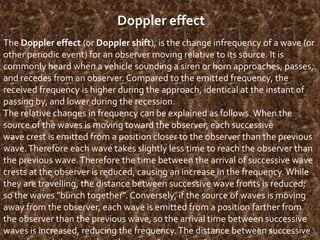
The Doppler effect (or Doppler shift), is the change infrequency of a wave (or
other periodic event) for an observer moving relative to its source. It is
commonly heard when a vehicle sounding a siren or horn approaches, passes,
and recedes from an observer. Compared to the emitted frequency, the
received frequency is higher during the approach, identical at the instant of
passing by, and lower during the recession.
The relative changes in frequency can be explained as follows. When the
source of the waves is moving toward the observer, each successive
wave crest is emitted from a position closer to the observer than the previous
wave. Therefore each wave takes slightly less time to reach the observer than
the previous wave. Therefore the time between the arrival of successive wave
crests at the observer is reduced, causing an increase in the frequency. While
they are travelling, the distance between successive wave fronts is reduced;
so the waves "bunch together". Conversely, if the source of waves is moving
away from the observer, each wave is emitted from a position farther from
the observer than the previous wave, so the arrival time between successive
waves is increased, reducing the frequency. The distance between successive
For waves that propagate in a medium, such as sound waves, the velocity of the
observer and of the source are relative to the medium in which the waves are
transmitted. The total Doppler effect may therefore result from motion of the
source, motion of the observer, or motion of the medium. Each of these effects is
analyzed separately. For waves which do not require a medium, such as light
or gravity in general relativity, only the relative difference in velocity between the
observer and the source needs to be considered
General
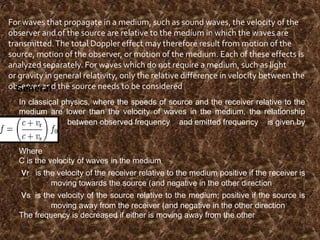
In classical physics, where the speeds of source and the receiver relative to the
medium are lower than the velocity of waves in the medium, the relationship
between observed frequency and emitted frequency is given by

Where
C is the velocity of waves in the medium

vr
vs

is the velocity of the receiver relative to the medium positive if the receiver is
moving towards the source (and negative in the other direction

is the velocity of the source relative to the medium; positive if the source is
moving away from the receiver (and negative in the other direction
The frequency is decreased if either is moving away from the other
The above formula assumes that the source is either directly
approaching or receding from the observer. If the source approaches
the observer at an angle (but still with a constant velocity), the
observed frequency that is first heard is higher than the object's
emitted frequency. Thereafter, there is amonotonic decrease in the
observed frequency as it gets closer to the observer, through equality
when it is coming from a direction perpendicular to the relative motion
(and was emitted at the point of closest approach; but when the wave
is received, the source and observer will no longer be at their closest),
and a continued monotonic decrease as it recedes from the observer.
When the observer is very close to the path of the object, the
transition from high to low frequency is very abrupt. When the
observer is far from the path of the object, the transition from high to
low frequency is gradual
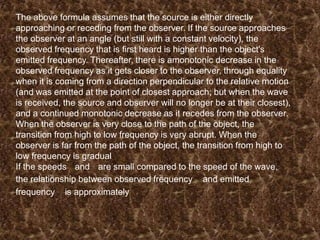
If the speeds and are small compared to the speed of the wave,
the relationship between observed frequency and emitted
frequency is approximately
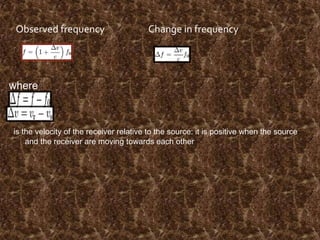
Observed frequency

Change in frequency

where

is the velocity of the receiver relative to the source: it is positive when the source
and the receiver are moving towards each other
Application
Sirens
The siren on a passing emergency vehicle will start out higher than its stationary pitch,
slide down as it passes, and continue lower than its stationary pitch as it recedes from
the observer. Astronomer John Dobson explained the effect thus
"The reason the siren slides is because it doesn't hit you
In other words, if the siren approached the observer directly, the pitch would remain
constant until the vehicle hit him, and then immediately jump to a new lower pitch.
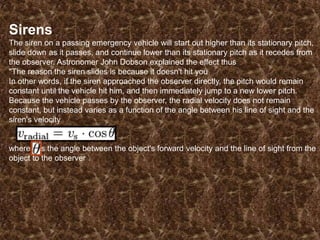
Because the vehicle passes by the observer, the radial velocity does not remain
constant, but instead varies as a function of the angle between his line of sight and the
siren's velocity

where is the angle between the object's forward velocity and the line of sight from the
object to the observer
Astronomy
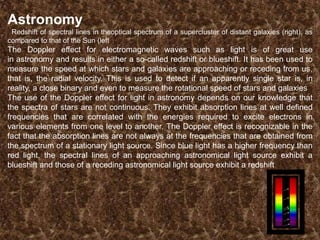
Redshift of spectral lines in theoptical spectrum of a supercluster of distant galaxies (right), as
compared to that of the Sun (left

The Doppler effect for electromagnetic waves such as light is of great use
in astronomy and results in either a so-called redshift or blueshift. It has been used to
measure the speed at which stars and galaxies are approaching or receding from us,
that is, the radial velocity. This is used to detect if an apparently single star is, in
reality, a close binary and even to measure the rotational speed of stars and galaxies
The use of the Doppler effect for light in astronomy depends on our knowledge that
the spectra of stars are not continuous. They exhibit absorption lines at well defined
frequencies that are correlated with the energies required to excite electrons in
various elements from one level to another. The Doppler effect is recognizable in the
fact that the absorption lines are not always at the frequencies that are obtained from
the spectrum of a stationary light source. Since blue light has a higher frequency than
red light, the spectral lines of an approaching astronomical light source exhibit a
blueshift and those of a receding astronomical light source exhibit a redshift
Temperature measurement
Another use of the Doppler effect, which is found mostly
in plasma physics and astronomy, is the estimation of the
temperature of a gas (or ion temperature in a plasma)
which is emitting a spectral line. Due to the thermal
motion of the emitters, the light emitted by each particle
can be slightly red- or blue-shifted, and the net effect is a
broadening of the line. This line shape is called a Doppler
profile and the width of the line is proportional to the
square root of the temperature of the emitting species,
allowing a spectral line (with the width dominated by the
Doppler broadening) to be used to infer the temperature.
Radar
Main article: Doppler radar
The Doppler effect is used in some types of radar, to measure the velocity of
detected objects. A radar beam is fired at a moving target — e.g. a motor
car, as police use radar to detect speeding motorists — as it approaches or
recedes from the radar source. Each successive radar wave has to travel
farther to reach the car, before being reflected and re-detected near the
source. As each wave has to move farther, the gap between each wave
increases, increasing the wavelength. In some situations, the radar beam is
fired at the moving car as it approaches, in which case each successive wave
travels a lesser distance, decreasing the wavelength. In either situation,
calculations from the Doppler effect accurately determine the car's velocity.
Moreover, the proximity fuze, developed during World War II, relies upon
Doppler radar to detonate explosives at the correct time, height, distance,
etc
Medical imaging and blood flow measurement
Colour flow ultrasonography (Doppler) of a carotid artery - scanner and
screen
An echocardiogram can, within certain limits, produce accurate
assessment of the direction of blood flow and the velocity of blood and
cardiac tissue at any arbitrary point using the Doppler effect. One of the
limitations is that the ultrasound beam should be as parallel to the blood
flow as possible. Velocity measurements allow assessment of cardiac
valve areas and function, any abnormal communications between the left
and right side of the heart, any leaking of blood through the valves
(valvular regurgitation), and calculation of the cardiac output. Contrastenhanced ultrasound using gas-filled microbubble contrast media can be
used to improve velocity or other flow-related medical measurements
Although "Doppler" has become synonymous with "velocity
measurement" in medical imaging, in many cases it is not the frequency
shift (Doppler shift) of the received signal that is measured, but the
phase shift when the received signal arrives). Velocity measurements of
blood flow are also used in other fields of medical ultrasonography, such
as obstetric ultrasonography and neurology. Velocity measurement of
blood flow in arteries and veins based on Doppler effect is an effective
tool for diagnosis of vascular problems like stenosis
Flow measurement
Instruments such as the laser Doppler velocimeter (LDV), and acoustic Doppler
velocimeter (ADV) have been developed to measure velocities in a fluid flow. The LDV
emits a light beam and the ADV emits an ultrasonic acoustic burst, and measure the
Doppler shift in wavelengths of reflections from particles moving with the flow. The actual
flow is computed as a function of the water velocity and phase. This technique allows nonintrusive flow measurements, at high precision and high frequency.
Underwater acoustics
In military applications the Doppler shift of a target is used to ascertain the speed of
a submarine using both passive and active sonar systems. As a submarine passes by a
passive sonobuoy, the stable frequencies undergo a Doppler shift, and the speed and range
from the sonobuoy can be calculated. If the sonar system is mounted on a moving ship or
another submarine, then the relative velocity can be calculated.
Audio
The Leslie speaker, associated with and predominantly used with the Hammond B-3 organ,
takes advantage of the Doppler Effect by using an electric motor to rotate an acoustic horn
around a loudspeaker, sending its sound in a circle. This results at the listener's ear in rapidly
fluctuating frequencies of a keyboard note.
.
Velocity profile measurement
Developed originally for velocity measurements in medical applications (blood flow),
Ultrasonic Doppler Velocimetry (UDV) can measure in real time complete velocity profile
in almost any liquids containing particles in suspension such as dust, gas bubbles,
emulsions. Flows can be pulsating, oscillating, laminar or turbulent, stationary or
transient. This technique is fully non-invasive.

Satellite communication
Fast moving satellites can have a Doppler shift of dozens of kilohertz relative to a ground
station. The speed, thus magnitude of Doppler effect, changes due to earth curvature.
Dynamic Doppler compensation, where the frequency of a signal is changed multiple
times during transmission, is used so the satellite receives a constant frequency signa

Vibration measurement
A laser Doppler vibrometer (LDV) is a non-contact method for measuring vibration. The
laser beam from the LDV is directed at the surface of interest, and the vibration amplitude
and frequency are extracted from the Doppler shift of the laser beam frequency due to the
motion of the surface
Marina fayez

Doppler effect experiment and applications

  • 1.
    Physics rebort aboutDopplereffect experiment and applications
  • 2.
    Doppler effect The Dopplereffect (or Doppler shift), is the change infrequency of a wave (or other periodic event) for an observer moving relative to its source. It is commonly heard when a vehicle sounding a siren or horn approaches, passes, and recedes from an observer. Compared to the emitted frequency, the received frequency is higher during the approach, identical at the instant of passing by, and lower during the recession. The relative changes in frequency can be explained as follows. When the source of the waves is moving toward the observer, each successive wave crest is emitted from a position closer to the observer than the previous wave. Therefore each wave takes slightly less time to reach the observer than the previous wave. Therefore the time between the arrival of successive wave crests at the observer is reduced, causing an increase in the frequency. While they are travelling, the distance between successive wave fronts is reduced; so the waves "bunch together". Conversely, if the source of waves is moving away from the observer, each wave is emitted from a position farther from the observer than the previous wave, so the arrival time between successive waves is increased, reducing the frequency. The distance between successive
  • 3.
    For waves thatpropagate in a medium, such as sound waves, the velocity of the observer and of the source are relative to the medium in which the waves are transmitted. The total Doppler effect may therefore result from motion of the source, motion of the observer, or motion of the medium. Each of these effects is analyzed separately. For waves which do not require a medium, such as light or gravity in general relativity, only the relative difference in velocity between the observer and the source needs to be considered General In classical physics, where the speeds of source and the receiver relative to the medium are lower than the velocity of waves in the medium, the relationship between observed frequency and emitted frequency is given by Where C is the velocity of waves in the medium vr vs is the velocity of the receiver relative to the medium positive if the receiver is moving towards the source (and negative in the other direction is the velocity of the source relative to the medium; positive if the source is moving away from the receiver (and negative in the other direction The frequency is decreased if either is moving away from the other
  • 4.
    The above formulaassumes that the source is either directly approaching or receding from the observer. If the source approaches the observer at an angle (but still with a constant velocity), the observed frequency that is first heard is higher than the object's emitted frequency. Thereafter, there is amonotonic decrease in the observed frequency as it gets closer to the observer, through equality when it is coming from a direction perpendicular to the relative motion (and was emitted at the point of closest approach; but when the wave is received, the source and observer will no longer be at their closest), and a continued monotonic decrease as it recedes from the observer. When the observer is very close to the path of the object, the transition from high to low frequency is very abrupt. When the observer is far from the path of the object, the transition from high to low frequency is gradual If the speeds and are small compared to the speed of the wave, the relationship between observed frequency and emitted frequency is approximately
  • 5.
    Observed frequency Change infrequency where is the velocity of the receiver relative to the source: it is positive when the source and the receiver are moving towards each other
  • 6.
  • 7.
    Sirens The siren ona passing emergency vehicle will start out higher than its stationary pitch, slide down as it passes, and continue lower than its stationary pitch as it recedes from the observer. Astronomer John Dobson explained the effect thus "The reason the siren slides is because it doesn't hit you In other words, if the siren approached the observer directly, the pitch would remain constant until the vehicle hit him, and then immediately jump to a new lower pitch. Because the vehicle passes by the observer, the radial velocity does not remain constant, but instead varies as a function of the angle between his line of sight and the siren's velocity where is the angle between the object's forward velocity and the line of sight from the object to the observer
  • 8.
    Astronomy Redshift of spectrallines in theoptical spectrum of a supercluster of distant galaxies (right), as compared to that of the Sun (left The Doppler effect for electromagnetic waves such as light is of great use in astronomy and results in either a so-called redshift or blueshift. It has been used to measure the speed at which stars and galaxies are approaching or receding from us, that is, the radial velocity. This is used to detect if an apparently single star is, in reality, a close binary and even to measure the rotational speed of stars and galaxies The use of the Doppler effect for light in astronomy depends on our knowledge that the spectra of stars are not continuous. They exhibit absorption lines at well defined frequencies that are correlated with the energies required to excite electrons in various elements from one level to another. The Doppler effect is recognizable in the fact that the absorption lines are not always at the frequencies that are obtained from the spectrum of a stationary light source. Since blue light has a higher frequency than red light, the spectral lines of an approaching astronomical light source exhibit a blueshift and those of a receding astronomical light source exhibit a redshift
  • 9.
    Temperature measurement Another useof the Doppler effect, which is found mostly in plasma physics and astronomy, is the estimation of the temperature of a gas (or ion temperature in a plasma) which is emitting a spectral line. Due to the thermal motion of the emitters, the light emitted by each particle can be slightly red- or blue-shifted, and the net effect is a broadening of the line. This line shape is called a Doppler profile and the width of the line is proportional to the square root of the temperature of the emitting species, allowing a spectral line (with the width dominated by the Doppler broadening) to be used to infer the temperature.
  • 10.
    Radar Main article: Dopplerradar The Doppler effect is used in some types of radar, to measure the velocity of detected objects. A radar beam is fired at a moving target — e.g. a motor car, as police use radar to detect speeding motorists — as it approaches or recedes from the radar source. Each successive radar wave has to travel farther to reach the car, before being reflected and re-detected near the source. As each wave has to move farther, the gap between each wave increases, increasing the wavelength. In some situations, the radar beam is fired at the moving car as it approaches, in which case each successive wave travels a lesser distance, decreasing the wavelength. In either situation, calculations from the Doppler effect accurately determine the car's velocity. Moreover, the proximity fuze, developed during World War II, relies upon Doppler radar to detonate explosives at the correct time, height, distance, etc
  • 11.
    Medical imaging andblood flow measurement Colour flow ultrasonography (Doppler) of a carotid artery - scanner and screen An echocardiogram can, within certain limits, produce accurate assessment of the direction of blood flow and the velocity of blood and cardiac tissue at any arbitrary point using the Doppler effect. One of the limitations is that the ultrasound beam should be as parallel to the blood flow as possible. Velocity measurements allow assessment of cardiac valve areas and function, any abnormal communications between the left and right side of the heart, any leaking of blood through the valves (valvular regurgitation), and calculation of the cardiac output. Contrastenhanced ultrasound using gas-filled microbubble contrast media can be used to improve velocity or other flow-related medical measurements Although "Doppler" has become synonymous with "velocity measurement" in medical imaging, in many cases it is not the frequency shift (Doppler shift) of the received signal that is measured, but the phase shift when the received signal arrives). Velocity measurements of blood flow are also used in other fields of medical ultrasonography, such as obstetric ultrasonography and neurology. Velocity measurement of blood flow in arteries and veins based on Doppler effect is an effective tool for diagnosis of vascular problems like stenosis
  • 12.
    Flow measurement Instruments suchas the laser Doppler velocimeter (LDV), and acoustic Doppler velocimeter (ADV) have been developed to measure velocities in a fluid flow. The LDV emits a light beam and the ADV emits an ultrasonic acoustic burst, and measure the Doppler shift in wavelengths of reflections from particles moving with the flow. The actual flow is computed as a function of the water velocity and phase. This technique allows nonintrusive flow measurements, at high precision and high frequency. Underwater acoustics In military applications the Doppler shift of a target is used to ascertain the speed of a submarine using both passive and active sonar systems. As a submarine passes by a passive sonobuoy, the stable frequencies undergo a Doppler shift, and the speed and range from the sonobuoy can be calculated. If the sonar system is mounted on a moving ship or another submarine, then the relative velocity can be calculated. Audio The Leslie speaker, associated with and predominantly used with the Hammond B-3 organ, takes advantage of the Doppler Effect by using an electric motor to rotate an acoustic horn around a loudspeaker, sending its sound in a circle. This results at the listener's ear in rapidly fluctuating frequencies of a keyboard note. .
  • 13.
    Velocity profile measurement Developedoriginally for velocity measurements in medical applications (blood flow), Ultrasonic Doppler Velocimetry (UDV) can measure in real time complete velocity profile in almost any liquids containing particles in suspension such as dust, gas bubbles, emulsions. Flows can be pulsating, oscillating, laminar or turbulent, stationary or transient. This technique is fully non-invasive. Satellite communication Fast moving satellites can have a Doppler shift of dozens of kilohertz relative to a ground station. The speed, thus magnitude of Doppler effect, changes due to earth curvature. Dynamic Doppler compensation, where the frequency of a signal is changed multiple times during transmission, is used so the satellite receives a constant frequency signa Vibration measurement A laser Doppler vibrometer (LDV) is a non-contact method for measuring vibration. The laser beam from the LDV is directed at the surface of interest, and the vibration amplitude and frequency are extracted from the Doppler shift of the laser beam frequency due to the motion of the surface Marina fayez