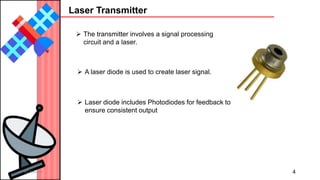
Laser communication systems transmit information via laser beams through the atmosphere over long distances such as between planets and satellites. A laser transmitter contains a signal processing circuit and laser diode that creates the laser signal. The receiver uses a telescope and signal processor with detectors like PIN diodes or avalanche photodiodes to receive the signal. Common modulation techniques for laser communication are ON-OFF keying, pulse width modulation, and pulsed frequency modulation. Laser communication provides advantages over fiber optics and microwaves for long-distance communication in space and other applications due to its high bandwidth, security, and efficiency with a narrow beam. However, laser links can be affected by atmospheric conditions and need techniques like tuning and multiple transmitters to overcome issues like