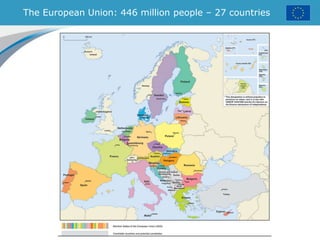
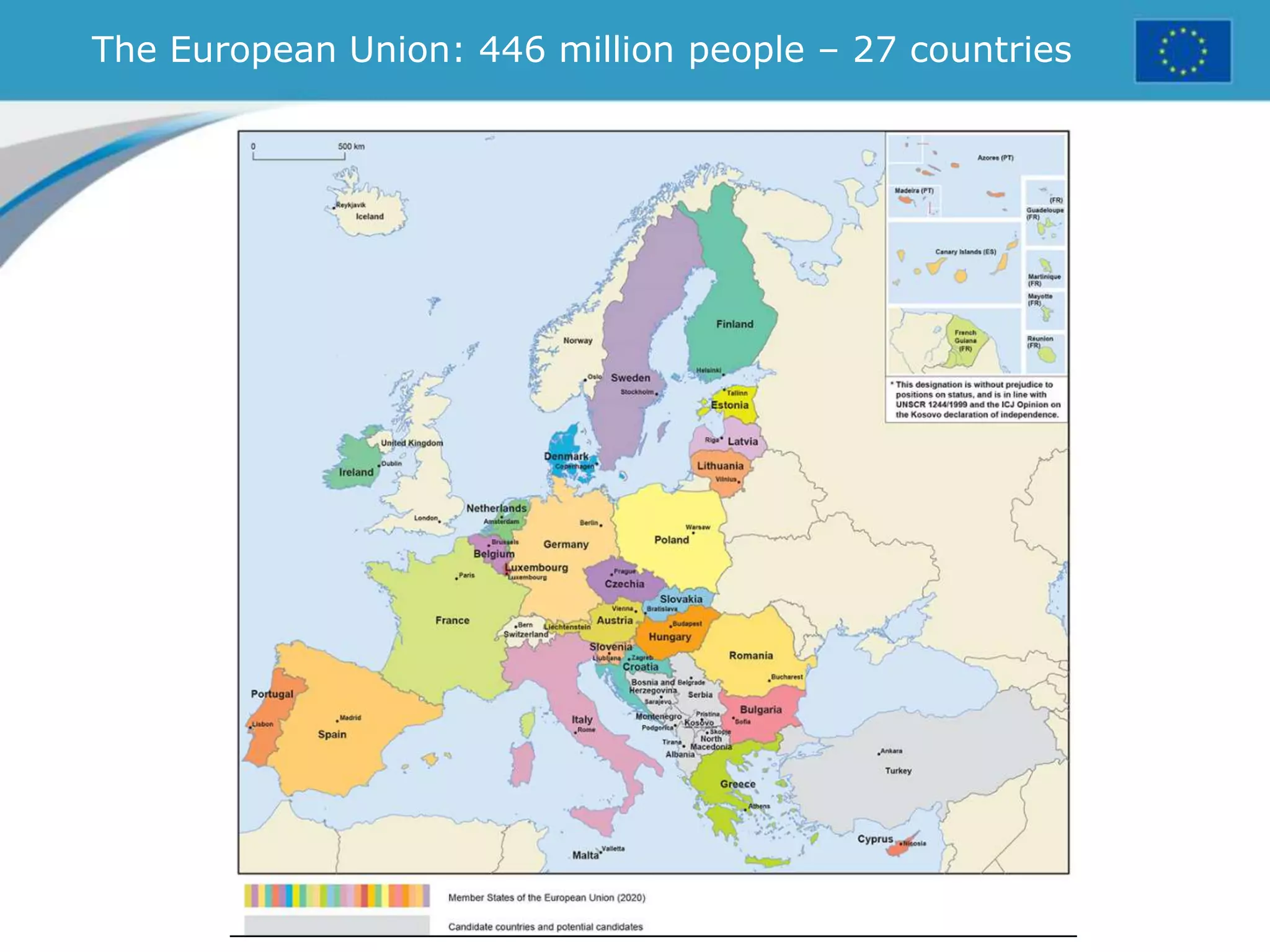
The European Union: 446 million people – 27 countries
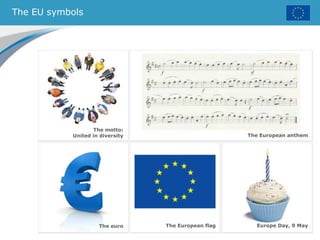
The EU symbols
The European flag
The European anthem
The euro Europe Day, 9 May
The motto:
United in diversity
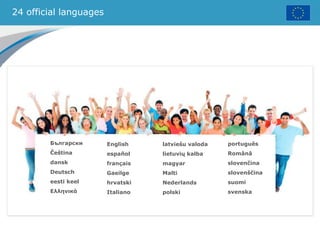
24 official languages
Български
Čeština
dansk
Deutsch
eesti keel
Ελληνικά
English
español
français
Gaeilge
hrvatski
Italiano
latviešu valoda
lietuvių kalba
magyar
Malti
Nederlands
polski
português
Română
slovenčina
slovenščina
suomi
svenska
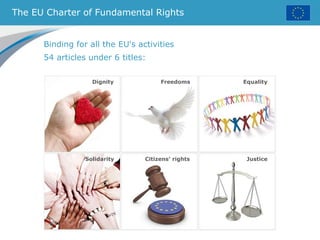
The EU Charter of Fundamental Rights
Binding for all the EU's activities
54 articles under 6 titles:
Freedoms Equality
Solidarity Citizens’ rights Justice
Dignity
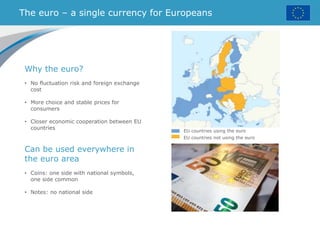
The euro – a single currency for Europeans
Why the euro?
• No fluctuation risk and foreign exchange
cost
• More choice and stable prices for
consumers
• Closer economic cooperation between EU
countries
Can be used everywhere in
the euro area
• Coins: one side with national symbols,
one side common
• Notes: no national side
EU countries using the euro
EU countries not using the euro
The single market: freedom of choice
The single market has led to:
• significant reductions in the price of many
products and services, including airfares and
phone calls
• more choice for consumers
• millions of new jobs
• more opportunities for businesses
Four freedoms of movement:
• goods
• services
• people
• capital
Free to move
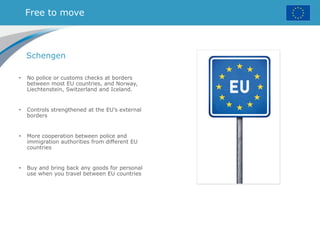
Schengen
• No police or customs checks at borders
between most EU countries, and Norway,
Liechtenstein, Switzerland and Iceland.
• Controls strengthened at the EU’s external
borders
• More cooperation between police and
immigration authorities from different EU
countries
• Buy and bring back any goods for personal
use when you travel between EU countries
Going abroad to learn or volunteer
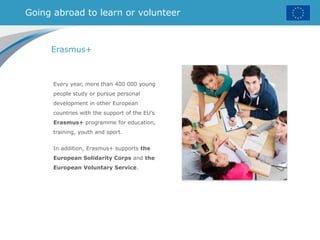
Erasmus+
Every year, more than 400 000 young
people study or pursue personal
development in other European
countries with the support of the EU’s
Erasmus+ programme for education,
training, youth and sport.
In addition, Erasmus+ supports the
European Solidarity Corps and the
European Voluntary Service.
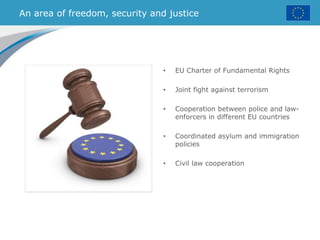
An area of freedom, security and justice
• EU Charter of Fundamental Rights
• Joint fight against terrorism
• Cooperation between police and law-
enforcers in different EU countries
• Coordinated asylum and immigration
policies
• Civil law cooperation
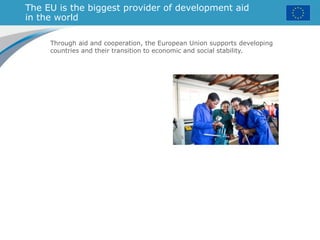
The EU is the biggest provider of development aid
in the world
Through aid and cooperation, the European Union supports developing
countries and their transition to economic and social stability.
Gender equality
Equality between women and men is a fundamental value of the EU
The EU aims to help women get the jobs they want and the same pay as men,
and help them strike a better balance between work and other areas of life:
• Employment: In 2017, the share of women in work in the EU went up to
66.6%, compared to nearly 80% of men
• Equal pay: On average, women earn 16% less than men in the EU. In
November 2017, the EU presented New Start, an Action Plan to close the
gap between what women and men are paid
• Funding: Investing in specific actions to help get women into work include
schemes to retrain and improve skills; helping women return to work after
a career break, by providing quality childcare, providing individual guidance
to women improving employers’ awareness of the challenges faced by
women
• The Economy: The gap in employment between men and women costs the
EU economy €370 billion per year. Improving gender equality could create
10.5 million jobs by 2050 and boost the EU economy by between €1.95 and
€3.15 trillion
Another major priority is to stop violence against women and girls. The EU-
funded NON.NO.NEIN campaign, encourages men and women to take a
stand on violence against women.
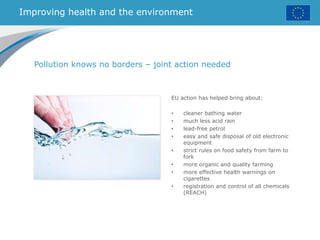
Improving health and the environment
EU action has helped bring about:
• cleaner bathing water
• much less acid rain
• lead-free petrol
• easy and safe disposal of old electronic
equipment
• strict rules on food safety from farm to
fork
• more organic and quality farming
• more effective health warnings on
cigarettes
• registration and control of all chemicals
(REACH)
Pollution knows no borders – joint action needed
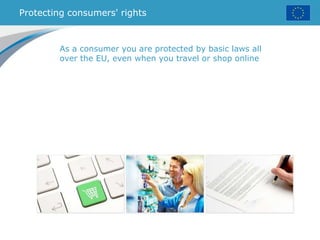
Protecting consumers' rights
As a consumer you are protected by basic laws all
over the EU, even when you travel or shop online
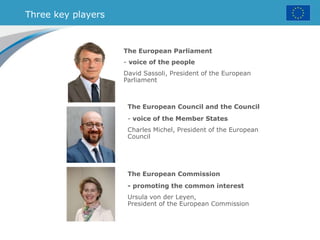
Three key players
The European Parliament
- voice of the people
David Sassoli, President of the European
Parliament
The European Council and the Council
- voice of the Member States
Charles Michel, President of the European
Council
The European Commission
- promoting the common interest
Ursula von der Leyen,
President of the European Commission
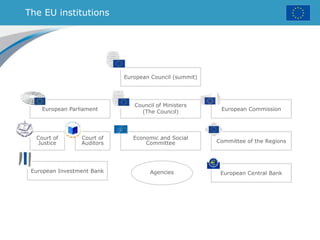
The EU institutions
European Parliament
Court of
Justice
Court of
Auditors
Economic and Social
Committee Committee of the Regions
Council of Ministers
(The Council) European Commission
European Investment Bank European Central BankAgencies
European Council (summit)
How EU laws are made
Citizens, interest groups, experts: discuss, consult
Commission: makes formal proposal
Parliament and Council of Ministers: decide jointly
National or local authorities: implement
Commission and Court of Justice: monitor implementation
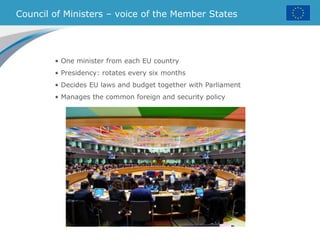
Council of Ministers – voice of the Member States
• One minister from each EU country
• Presidency: rotates every six months
• Decides EU laws and budget together with Parliament
• Manages the common foreign and security policy
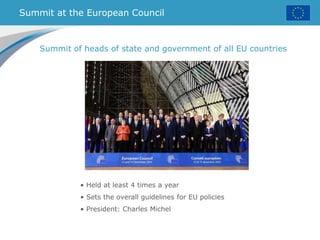
Summit at the European Council
• Held at least 4 times a year
• Sets the overall guidelines for EU policies
• President: Charles Michel
Summit of heads of state and government of all EU countries
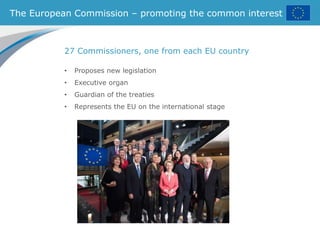
The European Commission – promoting the common interest
27 Commissioners, one from each EU country
• Proposes new legislation
• Executive organ
• Guardian of the treaties
• Represents the EU on the international stage
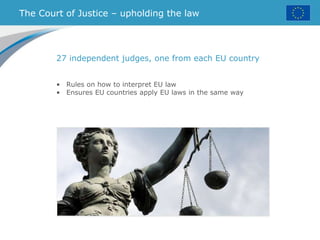
The Court of Justice – upholding the law
27 independent judges, one from each EU country
• Rules on how to interpret EU law
• Ensures EU countries apply EU laws in the same way
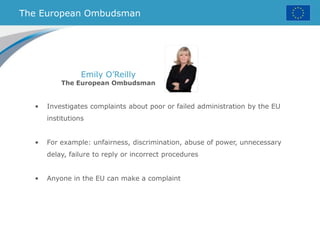
The European Ombudsman
Emily O’Reilly
The European Ombudsman
• Investigates complaints about poor or failed administration by the EU
institutions
• For example: unfairness, discrimination, abuse of power, unnecessary
delay, failure to reply or incorrect procedures
• Anyone in the EU can make a complaint
The European Court of Auditors: getting value
for your money
27 independent members
• Checks that EU funds are used properly
• Can audit any person or organisation dealing with EU funds
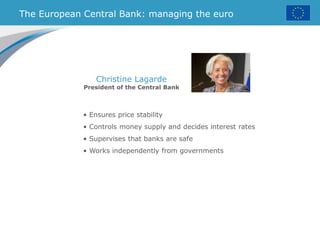
• Ensures price stability
• Controls money supply and decides interest rates
• Supervises that banks are safe
• Works independently from governments
The European Central Bank: managing the euro
Christine Lagarde
President of the Central Bank
The European Economic and Social Committee:
voice of civil society
• Represents trade unions, employers, farmers,
consumers and so on
• Advises on new EU laws and policies
• Promotes the involvement of civil society in EU matters
The Committee of the Regions: voice of local government
• Represents cities and regions
• Advises on new EU laws and policies
• Promotes the involvement of local government in EU
matters
Getting in touch with the EU
Questions about the EU? Europe Direct can help
• By phone, email or webchat
• Regional information centres
across the EU
europa.eu/europedirect

Eu in slides

  • 1.
    The European Union:446 million people – 27 countries
  • 2.
    The EU symbols TheEuropean flag The European anthem The euro Europe Day, 9 May The motto: United in diversity
  • 3.
    24 official languages Български Čeština dansk Deutsch eestikeel Ελληνικά English español français Gaeilge hrvatski Italiano latviešu valoda lietuvių kalba magyar Malti Nederlands polski português Română slovenčina slovenščina suomi svenska
  • 4.
    The EU Charterof Fundamental Rights Binding for all the EU's activities 54 articles under 6 titles: Freedoms Equality Solidarity Citizens’ rights Justice Dignity
  • 5.
    The euro –a single currency for Europeans Why the euro? • No fluctuation risk and foreign exchange cost • More choice and stable prices for consumers • Closer economic cooperation between EU countries Can be used everywhere in the euro area • Coins: one side with national symbols, one side common • Notes: no national side EU countries using the euro EU countries not using the euro
  • 6.
    The single market:freedom of choice The single market has led to: • significant reductions in the price of many products and services, including airfares and phone calls • more choice for consumers • millions of new jobs • more opportunities for businesses Four freedoms of movement: • goods • services • people • capital
  • 7.
    Free to move Schengen •No police or customs checks at borders between most EU countries, and Norway, Liechtenstein, Switzerland and Iceland. • Controls strengthened at the EU’s external borders • More cooperation between police and immigration authorities from different EU countries • Buy and bring back any goods for personal use when you travel between EU countries
  • 8.
    Going abroad tolearn or volunteer Erasmus+ Every year, more than 400 000 young people study or pursue personal development in other European countries with the support of the EU’s Erasmus+ programme for education, training, youth and sport. In addition, Erasmus+ supports the European Solidarity Corps and the European Voluntary Service.
  • 9.
    An area offreedom, security and justice • EU Charter of Fundamental Rights • Joint fight against terrorism • Cooperation between police and law- enforcers in different EU countries • Coordinated asylum and immigration policies • Civil law cooperation
  • 10.
    The EU isthe biggest provider of development aid in the world Through aid and cooperation, the European Union supports developing countries and their transition to economic and social stability.
  • 11.
    Gender equality Equality betweenwomen and men is a fundamental value of the EU The EU aims to help women get the jobs they want and the same pay as men, and help them strike a better balance between work and other areas of life: • Employment: In 2017, the share of women in work in the EU went up to 66.6%, compared to nearly 80% of men • Equal pay: On average, women earn 16% less than men in the EU. In November 2017, the EU presented New Start, an Action Plan to close the gap between what women and men are paid • Funding: Investing in specific actions to help get women into work include schemes to retrain and improve skills; helping women return to work after a career break, by providing quality childcare, providing individual guidance to women improving employers’ awareness of the challenges faced by women • The Economy: The gap in employment between men and women costs the EU economy €370 billion per year. Improving gender equality could create 10.5 million jobs by 2050 and boost the EU economy by between €1.95 and €3.15 trillion Another major priority is to stop violence against women and girls. The EU- funded NON.NO.NEIN campaign, encourages men and women to take a stand on violence against women.
  • 12.
    Improving health andthe environment EU action has helped bring about: • cleaner bathing water • much less acid rain • lead-free petrol • easy and safe disposal of old electronic equipment • strict rules on food safety from farm to fork • more organic and quality farming • more effective health warnings on cigarettes • registration and control of all chemicals (REACH) Pollution knows no borders – joint action needed
  • 13.
    Protecting consumers' rights Asa consumer you are protected by basic laws all over the EU, even when you travel or shop online
  • 14.
    Three key players TheEuropean Parliament - voice of the people David Sassoli, President of the European Parliament The European Council and the Council - voice of the Member States Charles Michel, President of the European Council The European Commission - promoting the common interest Ursula von der Leyen, President of the European Commission
  • 15.
    The EU institutions EuropeanParliament Court of Justice Court of Auditors Economic and Social Committee Committee of the Regions Council of Ministers (The Council) European Commission European Investment Bank European Central BankAgencies European Council (summit)
  • 16.
    How EU lawsare made Citizens, interest groups, experts: discuss, consult Commission: makes formal proposal Parliament and Council of Ministers: decide jointly National or local authorities: implement Commission and Court of Justice: monitor implementation
  • 17.
    Council of Ministers– voice of the Member States • One minister from each EU country • Presidency: rotates every six months • Decides EU laws and budget together with Parliament • Manages the common foreign and security policy
  • 18.
    Summit at theEuropean Council • Held at least 4 times a year • Sets the overall guidelines for EU policies • President: Charles Michel Summit of heads of state and government of all EU countries
  • 19.
    The European Commission– promoting the common interest 27 Commissioners, one from each EU country • Proposes new legislation • Executive organ • Guardian of the treaties • Represents the EU on the international stage
  • 20.
    The Court ofJustice – upholding the law 27 independent judges, one from each EU country • Rules on how to interpret EU law • Ensures EU countries apply EU laws in the same way
  • 21.
    The European Ombudsman EmilyO’Reilly The European Ombudsman • Investigates complaints about poor or failed administration by the EU institutions • For example: unfairness, discrimination, abuse of power, unnecessary delay, failure to reply or incorrect procedures • Anyone in the EU can make a complaint
  • 22.
    The European Courtof Auditors: getting value for your money 27 independent members • Checks that EU funds are used properly • Can audit any person or organisation dealing with EU funds
  • 23.
    • Ensures pricestability • Controls money supply and decides interest rates • Supervises that banks are safe • Works independently from governments The European Central Bank: managing the euro Christine Lagarde President of the Central Bank
  • 24.
    The European Economicand Social Committee: voice of civil society • Represents trade unions, employers, farmers, consumers and so on • Advises on new EU laws and policies • Promotes the involvement of civil society in EU matters
  • 25.
    The Committee ofthe Regions: voice of local government • Represents cities and regions • Advises on new EU laws and policies • Promotes the involvement of local government in EU matters
  • 26.
    Getting in touchwith the EU Questions about the EU? Europe Direct can help • By phone, email or webchat • Regional information centres across the EU europa.eu/europedirect