ASSESSMENT OF AIR QUALITY
BY: ANKITHA KUMARI MISHRA
St. GEORGE COLLEGE OF MANAGEMENT AND SCIENCE
1ST MSC 2ND SEM
MICROBIOLOGY
ASSESSMENT OF AIR QUALITY
USING AIR SAMPLER
– There are three principal methods used to quantify
microorganisms in the air.
 Impaction is the forced deposition of airborne particles
on a solid surface
 Impingement is the trapping of airborne practices in a
liquid matrix
 Filtration is the trapping of airborne particles by size
exclusion
BASED ON PRINCIPLES OF
SEDIMENTATION
– Gravity is a non-quantitative method used in which agar
medium is exposed to the environment and airborne
microorganisms are collected primarily by settling. This
method is often used because it is inexpensive and easily
performed.
BASED ON PRINCIPLES OF
IMPACTION
– The impaction method separates particles from the air by utilizing
the inertia of the particles to force their deposition onto a solid or
semi-solid surface
– The collection surface is usually an agar medium.
– The Anderson sixstage impact or sampler (Anderson Instruments
Inc., Smyra, GA) consist of six stages with decreasing nozzle
diameters, so that successive stages collect progressively smaller
particles.
– Thus the six-stage sampler measures the cultivable bioaerosol
concentrations in specific particle size ranges.
BASED ON PRINCIPLES OF
IMPINGEMENT
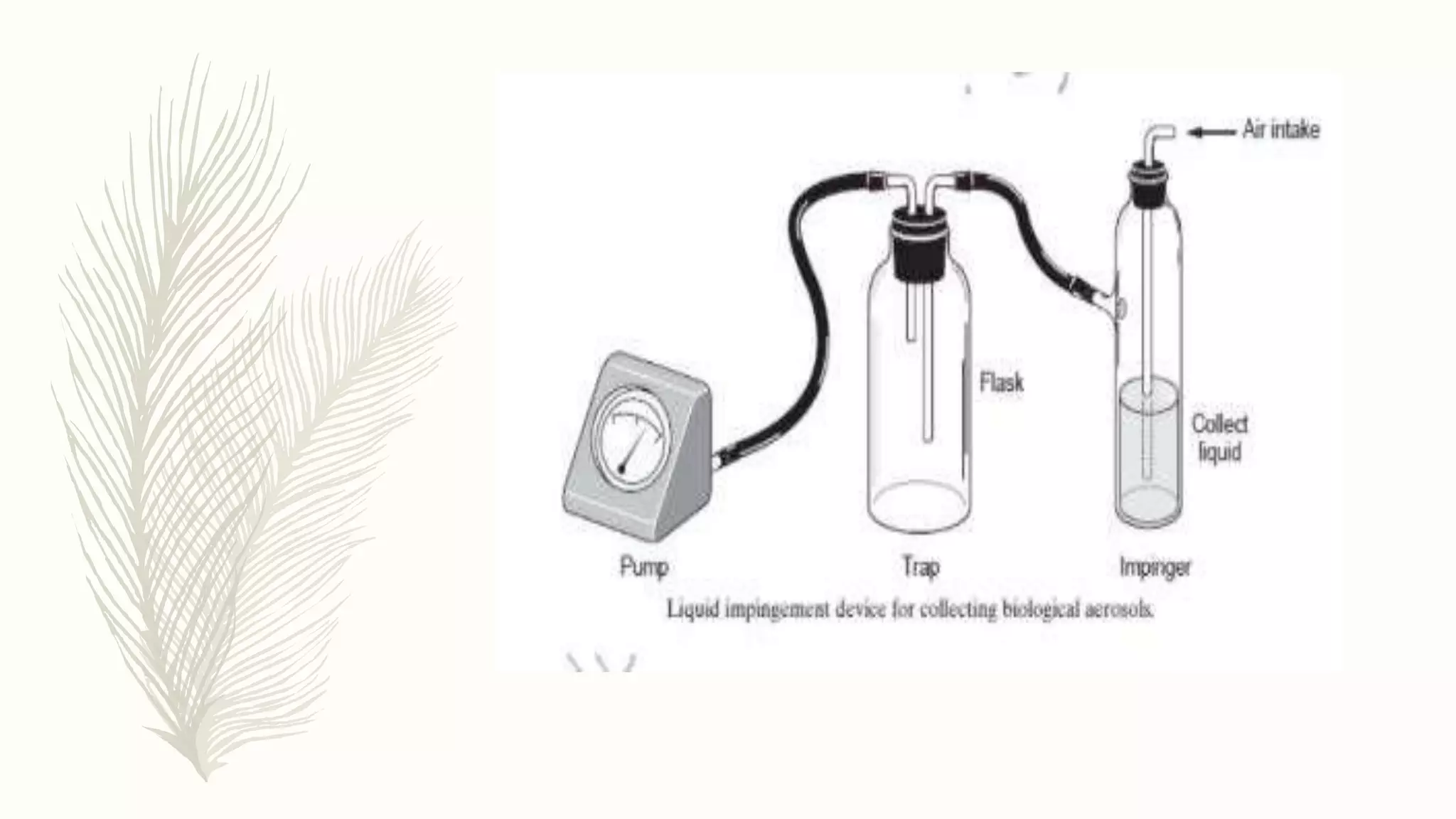
– A commonly used liquid impinger is the AGI-30 (ACE Glass, Vineland, NJ). The
AGI-30 operates by drawing air through the inlet and into a liquid.
– Any particles in the air become trapped in the liquid, which can then be
assayed for the presence of microorganisms. The AGI-30 is usually operated at a
flow rate of 12.5 liters per minutes.
– The AGI-30 is easy to use, inexpensive, portable, reliable, easily sterilized, and
has high biological sampling efficiency in comparison with many other sampling
devices. The usual collection volume is 20 ml, and the typical sampling time is
about 20 minutes.
– Longer sampling times result in too much evaporation of the liquid in the
impinger, and the inactivation or death of microorganisms in the liquid.
BASED ON PRINCIPLES OF
SUCTION AND FILTRATION
– Filtration techniques are used largely for the collection of fungi and bacterial
spores because they are desiccation resistant.
– Filters are usually held in disposable (although they may be reused) plastic filter
cassettes during bioaerosol sampling. Membrane filters used for sampling are
usually supplied as disks of 37- or 47mm diameter.
– Because the pressure drop across a filter increases with air velocity through the
filter, the use of larger filters results in a lower pressure drop for a given
volumetric flow rate.
– The use of the smaller (37-mm) filter concentrates the organisms onto a smaller
total area, thus increasing the density of particles per unit area of the filter.
– This may be helpful for direct microscopic examination of low
concentrations of organisms.
– In areas of high concentration, the organisms may have to be
eluted, diluted, and then refiltered for microscopic examination or
assay.
– For a better quantitative measure of the air volume sampled, a
limiting orifice may be placed between the cassette and the
vacuum source.
Materials
– All glass impinger AGI-30
– 1 37-mm air monitoring cassette
– 20 ml of 0.1% peptone solution
– 1 500- or 1000-ml Erlenmeyer flask
– Rubber or plastic tubing for connecting the impinger and cassette to the vacuum source
– 1 vacuum pump or vacuum source
– 1 100 ml sterile graduated cylinder
– 1 dilution blank with 0.1% peptone or phosphate buffered saline
– 2 1-ml pipettes
– 1 10-ml pipette
– 4 sterile 0.45m pore, 47-mm diameter membrane filters
– 1 filter unit
– 2 sterile 37mm 0.45mm pore filters
– Vacuum pump or other source
– Forceps
– Gas burner
– Pipette bulb
– Vortex mixer
– 4 nutrient agar (NA)1 or trypticase soy agar (TSA)1 plates
– 4 Sabouraud dextrose agar (SDA)1 plates.
Air Sampling by Impingement
– 1. Set up the AGI-30 all glass impinger as shown (Figure 23-2).
– 2. Add 20ml of 0.1% peptone to the reservoir followed by 0.1ml of anti-foam.
– 3. Add 0.1 ml of anti-foam agent.
– 4. Turn the vacuum source on for 10 minutes.
– 5. With a 1-ml pipette remove 0.5 ml of fluid from the reservoir and place 0.1 ml each on one agar
plate of either NA or TSA and spread plate the samples. Place another 0.1 ml on a plate of
Sabouraud dextrose agar for detection of fungi.
– 6. With a 10 ml pipette remove 6 ml of liquid from the reservoir and pass 5 ml through a 0.45mm
membrane filter. Place the filter on an NA or TSA plate. Repeat the procedure, but place the
membrane filter on Sabouraud dextrose agar.
– 7. Incubate the NA or TSA plates at 35°C for 24–48 hours.
– 8. Incubate the SDA for 2 to 7 days.
Air Sampling by Filtration
– 9. Connect the air-sampling cassette to the vacuum source.
– 10. Turn on the vacuum source for 10 minutes.
– 11. Remove the membrane filter from the cassette with a pair of
flamed forceps. And place on either a plate of NA or TSA.
– 12. Repeat the same procedure placing the membrane filter on
plate of SDA.
– 13. Incubate the plates as described under impingement.
– Second Period
– Materials incubated plates from the previous Period 1
– Examine the agar plates and count the umber of bacteria (NA or TSA) and fungi
(SDA) colonies.
Calculations
– Calculate the number of bacteria and fungi per cubic meter.
– The AGI-30 limiting orifice at the end of the glass tube, which is submerged into
the collection liquid, limits the amount of air passing through the liquid to 12.5
liters per minute.
– The concentration of microorganisms is usually reported as numbers per cubic
meter of air, which is calculated as follows.
THANK YOU

Assessment of air quality

  • 1.
    ASSESSMENT OF AIRQUALITY BY: ANKITHA KUMARI MISHRA St. GEORGE COLLEGE OF MANAGEMENT AND SCIENCE 1ST MSC 2ND SEM MICROBIOLOGY
  • 2.
    ASSESSMENT OF AIRQUALITY USING AIR SAMPLER – There are three principal methods used to quantify microorganisms in the air.  Impaction is the forced deposition of airborne particles on a solid surface  Impingement is the trapping of airborne practices in a liquid matrix  Filtration is the trapping of airborne particles by size exclusion
  • 3.
    BASED ON PRINCIPLESOF SEDIMENTATION – Gravity is a non-quantitative method used in which agar medium is exposed to the environment and airborne microorganisms are collected primarily by settling. This method is often used because it is inexpensive and easily performed.
  • 4.
    BASED ON PRINCIPLESOF IMPACTION – The impaction method separates particles from the air by utilizing the inertia of the particles to force their deposition onto a solid or semi-solid surface – The collection surface is usually an agar medium. – The Anderson sixstage impact or sampler (Anderson Instruments Inc., Smyra, GA) consist of six stages with decreasing nozzle diameters, so that successive stages collect progressively smaller particles. – Thus the six-stage sampler measures the cultivable bioaerosol concentrations in specific particle size ranges.
  • 5.
    BASED ON PRINCIPLESOF IMPINGEMENT – A commonly used liquid impinger is the AGI-30 (ACE Glass, Vineland, NJ). The AGI-30 operates by drawing air through the inlet and into a liquid. – Any particles in the air become trapped in the liquid, which can then be assayed for the presence of microorganisms. The AGI-30 is usually operated at a flow rate of 12.5 liters per minutes. – The AGI-30 is easy to use, inexpensive, portable, reliable, easily sterilized, and has high biological sampling efficiency in comparison with many other sampling devices. The usual collection volume is 20 ml, and the typical sampling time is about 20 minutes. – Longer sampling times result in too much evaporation of the liquid in the impinger, and the inactivation or death of microorganisms in the liquid.
  • 7.
    BASED ON PRINCIPLESOF SUCTION AND FILTRATION – Filtration techniques are used largely for the collection of fungi and bacterial spores because they are desiccation resistant. – Filters are usually held in disposable (although they may be reused) plastic filter cassettes during bioaerosol sampling. Membrane filters used for sampling are usually supplied as disks of 37- or 47mm diameter. – Because the pressure drop across a filter increases with air velocity through the filter, the use of larger filters results in a lower pressure drop for a given volumetric flow rate. – The use of the smaller (37-mm) filter concentrates the organisms onto a smaller total area, thus increasing the density of particles per unit area of the filter.
  • 8.
    – This maybe helpful for direct microscopic examination of low concentrations of organisms. – In areas of high concentration, the organisms may have to be eluted, diluted, and then refiltered for microscopic examination or assay. – For a better quantitative measure of the air volume sampled, a limiting orifice may be placed between the cassette and the vacuum source.
  • 10.
    Materials – All glassimpinger AGI-30 – 1 37-mm air monitoring cassette – 20 ml of 0.1% peptone solution – 1 500- or 1000-ml Erlenmeyer flask – Rubber or plastic tubing for connecting the impinger and cassette to the vacuum source – 1 vacuum pump or vacuum source – 1 100 ml sterile graduated cylinder – 1 dilution blank with 0.1% peptone or phosphate buffered saline – 2 1-ml pipettes – 1 10-ml pipette – 4 sterile 0.45m pore, 47-mm diameter membrane filters
  • 11.
    – 1 filterunit – 2 sterile 37mm 0.45mm pore filters – Vacuum pump or other source – Forceps – Gas burner – Pipette bulb – Vortex mixer – 4 nutrient agar (NA)1 or trypticase soy agar (TSA)1 plates – 4 Sabouraud dextrose agar (SDA)1 plates.
  • 12.
    Air Sampling byImpingement – 1. Set up the AGI-30 all glass impinger as shown (Figure 23-2). – 2. Add 20ml of 0.1% peptone to the reservoir followed by 0.1ml of anti-foam. – 3. Add 0.1 ml of anti-foam agent. – 4. Turn the vacuum source on for 10 minutes. – 5. With a 1-ml pipette remove 0.5 ml of fluid from the reservoir and place 0.1 ml each on one agar plate of either NA or TSA and spread plate the samples. Place another 0.1 ml on a plate of Sabouraud dextrose agar for detection of fungi. – 6. With a 10 ml pipette remove 6 ml of liquid from the reservoir and pass 5 ml through a 0.45mm membrane filter. Place the filter on an NA or TSA plate. Repeat the procedure, but place the membrane filter on Sabouraud dextrose agar. – 7. Incubate the NA or TSA plates at 35°C for 24–48 hours. – 8. Incubate the SDA for 2 to 7 days.
  • 13.
    Air Sampling byFiltration – 9. Connect the air-sampling cassette to the vacuum source. – 10. Turn on the vacuum source for 10 minutes. – 11. Remove the membrane filter from the cassette with a pair of flamed forceps. And place on either a plate of NA or TSA. – 12. Repeat the same procedure placing the membrane filter on plate of SDA. – 13. Incubate the plates as described under impingement.
  • 14.
    – Second Period –Materials incubated plates from the previous Period 1 – Examine the agar plates and count the umber of bacteria (NA or TSA) and fungi (SDA) colonies.
  • 15.
    Calculations – Calculate thenumber of bacteria and fungi per cubic meter. – The AGI-30 limiting orifice at the end of the glass tube, which is submerged into the collection liquid, limits the amount of air passing through the liquid to 12.5 liters per minute. – The concentration of microorganisms is usually reported as numbers per cubic meter of air, which is calculated as follows.
  • 17.