VIVEKANANDA ARTS AND SCIENCE COLLEGE FOR
WOMEN
SANKAGIRI
Department of
Microbiology
Topic: Quantification of soil
microflora
SUBJECT INCHARGE:
Dr.R. Dineshkumar,
Assistant professor,
Department of
Microbiology,
VIAAS, Sankagiri.
SUBMITTED BY:
P.Bhuvaneshwari,
II-M.Sc.
Microbiology,
VIAAS, SANKAGIRI.
Subject: Soil and Environmental
Microbiology
QUANTIFICATION OF SOIL
MICROFLORA
CONTENT
• INTRODUCTION
• DEFINITION
• PRINCIPLE
• TYPES OF METHODS
• PARAMETERS MEASURED
• APPLICATION
DEFINE OF SOIL MICROFLORA :
The community of microorganisms living in soil, including bacteria, fungi,
protozoa, and viruses.
DEFINE OF QUANTIFICATION :
The process of measuring the amount or number of something, in this case, soil
microflora.
Quantification of soil microflora refers to the measurement of the number and
diversity of microorganisms present in soil. Here are some common methods used.
INTRODUCTION OF QUANTIFICATION OF SOIL MICROFLORA:
Quantification of soil microflora involves measuring the number and diversity of
microorganisms present in soil.
This can be achieved through various methods, including:
1. Cultivation-based methods: These methods involve growing microorganisms
on agar plates or in broth.
2. Molecular biology-based methods: These methods involve analyzing DNA or
RNA extracted from soil samples.
3. Biochemical methods: These methods involve measuring enzyme activities or
substrate utilization
PRINCIPLE:
METHODS:
1. Direct Microscope method
2. Most Probable number (MPN) method
3. DNA based method
4. Biochemical method
5. Fatty acid analysis
6. Plate count method
7. Phospholipds fatty acid
PLATE COUNT METHOD:
Soil dilution:
Serial dilutions of soil sample.
Agar plates:
Spread diluted soil on agar Plates
Incubation:
Incubate plates at optimal temperature
Colony counting:
Count visible colonies
Calculation:
Calculate colony-forming units (CFU) per gram of soil
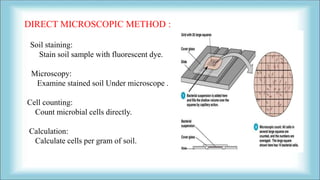
Soil staining:
Stain soil sample with fluorescent dye.
Microscopy:
Examine stained soil Under microscope .
Cell counting:
Count microbial cells directly.
Calculation:
Calculate cells per gram of soil.
DIRECT MICROSCOPIC METHOD :
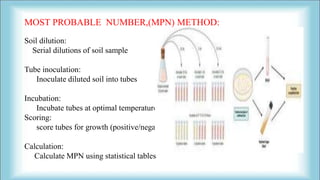
Soil dilution:
Serial dilutions of soil sample
Tube inoculation:
Inoculate diluted soil into tubes
Incubation:
Incubate tubes at optimal temperature
Scoring:
score tubes for growth (positive/negative)
Calculation:
Calculate MPN using statistical tables
MOST PROBABLE NUMBER,(MPN) METHOD:
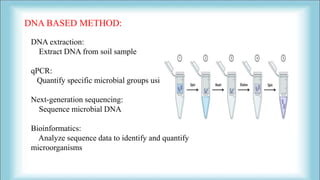
DNA extraction:
Extract DNA from soil sample
qPCR:
Quantify specific microbial groups using qPCR.
Next-generation sequencing:
Sequence microbial DNA
Bioinformatics:
Analyze sequence data to identify and quantify
microorganisms
DNA BASED METHOD:
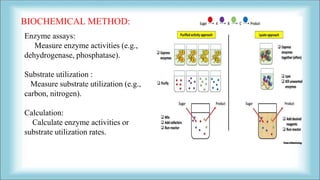
Enzyme assays:
Measure enzyme activities (e.g.,
dehydrogenase, phosphatase).
Substrate utilization :
Measure substrate utilization (e.g.,
carbon, nitrogen).
Calculation:
Calculate enzyme activities or
substrate utilization rates.
BIOCHEMICAL METHOD:
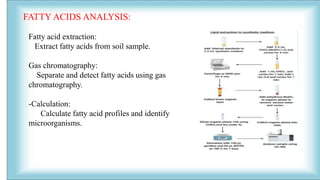
Fatty acid extraction:
Extract fatty acids from soil sample.
Gas chromatography:
Separate and detect fatty acids using gas
chromatography.
-Calculation:
Calculate fatty acid profiles and identify
microorganisms.
FATTY ACIDS ANALYSIS:
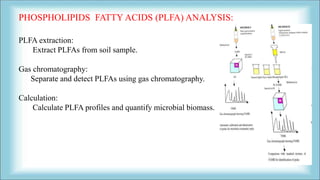
PLFA extraction:
Extract PLFAs from soil sample.
Gas chromatography:
Separate and detect PLFAs using gas chromatography.
Calculation:
Calculate PLFA profiles and quantify microbial biomass.
PHOSPHOLIPIDS FATTY ACIDS (PLFA) ANALYSIS:
1. Abundance: Total number of microorganisms (CFU,
cells, DNA copies).
2. Diversity: Variety of microbial species present
(Shannon index, Simpson index).
3. Community Structure: Relative abundance of different
species (PLFA profiles, fatty acid profiles).
4. Functional Diversity: Variety of microbial functions and
processes (enzyme activities, substrate utilization).
5. Biomass: Total mass of microorganisms (PLFA, fatty
acid analysis).
PARAMETERS MASURED:
1. Soil Health Assessment: Evaluate soil health and
fertility
2. Nutrient Cycling: Understand microbial populations
involved in nutrient cycling
3. Decomposition: Quantify microorganisms involved in
decomposition processes
4. Plant-Microbe Interactions: Understand microbial
populations involved in plant-microbe interactions
5. Environmental Monitoring: Monitor environmental
impacts and climate change
APPLICATION :
• Sampling Variability: Soil sampling can be variable, affecting accuracy
• Methodological Limitations: Each method has limitations and biases
• Data Interpretation: Requires expertise to interpret data accurately
• Soil Heterogeneity: Soil is heterogeneous, making it challenging to
representatively sample
• Microbial Complexity: Soil microflora is complex, making it challenging
to fully characterize
LIMITATION:
quantification of soil microbes-1-1.pptx

quantification of soil microbes-1-1.pptx

  • 1.
    VIVEKANANDA ARTS ANDSCIENCE COLLEGE FOR WOMEN SANKAGIRI Department of Microbiology Topic: Quantification of soil microflora SUBJECT INCHARGE: Dr.R. Dineshkumar, Assistant professor, Department of Microbiology, VIAAS, Sankagiri. SUBMITTED BY: P.Bhuvaneshwari, II-M.Sc. Microbiology, VIAAS, SANKAGIRI. Subject: Soil and Environmental Microbiology
  • 2.
  • 3.
    CONTENT • INTRODUCTION • DEFINITION •PRINCIPLE • TYPES OF METHODS • PARAMETERS MEASURED • APPLICATION
  • 4.
    DEFINE OF SOILMICROFLORA : The community of microorganisms living in soil, including bacteria, fungi, protozoa, and viruses. DEFINE OF QUANTIFICATION : The process of measuring the amount or number of something, in this case, soil microflora. Quantification of soil microflora refers to the measurement of the number and diversity of microorganisms present in soil. Here are some common methods used. INTRODUCTION OF QUANTIFICATION OF SOIL MICROFLORA:
  • 5.
    Quantification of soilmicroflora involves measuring the number and diversity of microorganisms present in soil. This can be achieved through various methods, including: 1. Cultivation-based methods: These methods involve growing microorganisms on agar plates or in broth. 2. Molecular biology-based methods: These methods involve analyzing DNA or RNA extracted from soil samples. 3. Biochemical methods: These methods involve measuring enzyme activities or substrate utilization PRINCIPLE:
  • 6.
    METHODS: 1. Direct Microscopemethod 2. Most Probable number (MPN) method 3. DNA based method 4. Biochemical method 5. Fatty acid analysis 6. Plate count method 7. Phospholipds fatty acid
  • 7.
    PLATE COUNT METHOD: Soildilution: Serial dilutions of soil sample. Agar plates: Spread diluted soil on agar Plates Incubation: Incubate plates at optimal temperature Colony counting: Count visible colonies Calculation: Calculate colony-forming units (CFU) per gram of soil
  • 8.
    Soil staining: Stain soilsample with fluorescent dye. Microscopy: Examine stained soil Under microscope . Cell counting: Count microbial cells directly. Calculation: Calculate cells per gram of soil. DIRECT MICROSCOPIC METHOD :
  • 9.
    Soil dilution: Serial dilutionsof soil sample Tube inoculation: Inoculate diluted soil into tubes Incubation: Incubate tubes at optimal temperature Scoring: score tubes for growth (positive/negative) Calculation: Calculate MPN using statistical tables MOST PROBABLE NUMBER,(MPN) METHOD:
  • 10.
    DNA extraction: Extract DNAfrom soil sample qPCR: Quantify specific microbial groups using qPCR. Next-generation sequencing: Sequence microbial DNA Bioinformatics: Analyze sequence data to identify and quantify microorganisms DNA BASED METHOD:
  • 11.
    Enzyme assays: Measure enzymeactivities (e.g., dehydrogenase, phosphatase). Substrate utilization : Measure substrate utilization (e.g., carbon, nitrogen). Calculation: Calculate enzyme activities or substrate utilization rates. BIOCHEMICAL METHOD:
  • 12.
    Fatty acid extraction: Extractfatty acids from soil sample. Gas chromatography: Separate and detect fatty acids using gas chromatography. -Calculation: Calculate fatty acid profiles and identify microorganisms. FATTY ACIDS ANALYSIS:
  • 13.
    PLFA extraction: Extract PLFAsfrom soil sample. Gas chromatography: Separate and detect PLFAs using gas chromatography. Calculation: Calculate PLFA profiles and quantify microbial biomass. PHOSPHOLIPIDS FATTY ACIDS (PLFA) ANALYSIS:
  • 14.
    1. Abundance: Totalnumber of microorganisms (CFU, cells, DNA copies). 2. Diversity: Variety of microbial species present (Shannon index, Simpson index). 3. Community Structure: Relative abundance of different species (PLFA profiles, fatty acid profiles). 4. Functional Diversity: Variety of microbial functions and processes (enzyme activities, substrate utilization). 5. Biomass: Total mass of microorganisms (PLFA, fatty acid analysis). PARAMETERS MASURED:
  • 15.
    1. Soil HealthAssessment: Evaluate soil health and fertility 2. Nutrient Cycling: Understand microbial populations involved in nutrient cycling 3. Decomposition: Quantify microorganisms involved in decomposition processes 4. Plant-Microbe Interactions: Understand microbial populations involved in plant-microbe interactions 5. Environmental Monitoring: Monitor environmental impacts and climate change APPLICATION :
  • 16.
    • Sampling Variability:Soil sampling can be variable, affecting accuracy • Methodological Limitations: Each method has limitations and biases • Data Interpretation: Requires expertise to interpret data accurately • Soil Heterogeneity: Soil is heterogeneous, making it challenging to representatively sample • Microbial Complexity: Soil microflora is complex, making it challenging to fully characterize LIMITATION: