CHLOROPHYCEAE
Dr. Sanjay Kumar Garg
Department of Plant science
M.J.P. Rohilkhand University
Bareilly (U.P.)
CHLOROPHYCEAE
• Fritsch (1935) - Chlorophyceae
• Chloros- Green
• Alexopoulus & Bold (1967) - 425 Genra
-6500 Species
More than 20000 species
Chlorophyceae (Grass Green algae)
• Chloroplasts have pyrenoids
• Reserve food material is starch
• Starch grains are usually aggregated
around the pyrenoids
• Main pigments are Chlorophyll a,
Chlorophyll b, Carotenoids and
Xanthophylls
• Flagella, if present, are of equal length,
whiplash type and inserted at the
anterior end
ORDER
1) Volvocales
2) Chlorococcales
3) Ulotrichales
4) Cladophorales
5) Chaetophorales
6) Oedogoniales
7) Conjugales
8) Siphonales
9) Charales
HABITATS
• Fresh water, brakish water,salty water terrestrial
• Siphonales and Ulvales – Marin water
• Oedogoniales and Conjugales – Fresh water
• Volvocales,Cladophorales and Chaetophorales
-Sea as well as fresh water
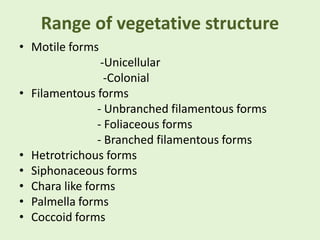
Range of vegetative structure
• Motile forms
-Unicellular
-Colonial
• Filamentous forms
- Unbranched filamentous forms
- Foliaceous forms
- Branched filamentous forms
• Hetrotrichous forms
• Siphonaceous forms
• Chara like forms
• Palmella forms
• Coccoid forms
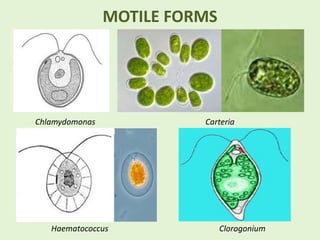
MOTILE FORMS
Chlamydomonas Carteria
Haematococcus Clorogonium
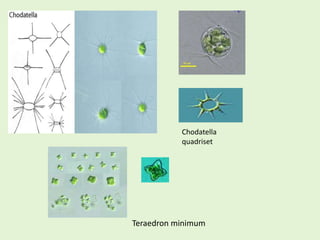
Teraedron minimum
Chodatella
quadriset
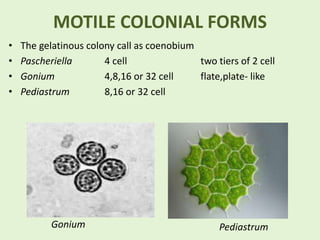
MOTILE COLONIAL FORMS
• The gelatinous colony call as coenobium
• Pascheriella 4 cell two tiers of 2 cell
• Gonium 4,8,16 or 32 cell flate,plate- like
• Pediastrum 8,16 or 32 cell
PediastrumGonium
Motile colonial Forms
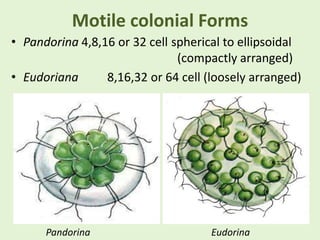
• Pandorina 4,8,16 or 32 cell spherical to ellipsoidal
(compactly arranged)
• Eudoriana 8,16,32 or 64 cell (loosely arranged)
Pandorina Eudorina
Motile colonial Forms
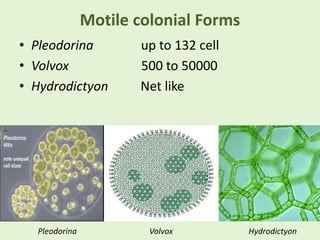
• Pleodorina up to 132 cell
• Volvox 500 to 50000
• Hydrodictyon Net like
Pleodorina Volvox Hydrodictyon
UNICELLULAR SEDENTARY FORMS
• Desmids – various diversity in shape
(specialised cells).
• Uninucleate, two semicells, complicated and
distinct wall.Cosmarium, Closterium
• Charasiosiphon
Cosmarium Closterium
Characiosiphon
Filamentous forms
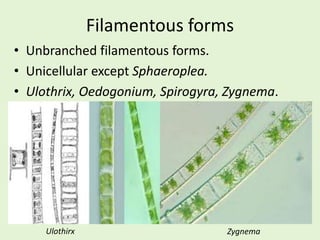
• Unbranched filamentous forms.
• Unicellular except Sphaeroplea.
• Ulothrix, Oedogonium, Spirogyra, Zygnema.
Ulothirx Zygnema
Oedogonium
Spirogyra Sphaeroplea (Multinucleat)
Foliaceous forms
• Formation of septa more than one plane.
• Flattened leaf like expansion. Prasiola and Ulva
Prasiola Ulva
Enteromorpha
Branched Filamentous Forms
• Lateral outgrowth of one or many cells.
• Branches may undergo further branching just as
main axis (Cladophora, Pithophora) (Branching
more in aerial portion).
Cladophora Pithophora
Branched Filamentous Forms
• Rhizoclonium, Basicladia (branching only basal
portion).
BasicladiaRhizoclonium
Rhizoclonium
HETEROTRICHOUS FORMS
• Prostrate branching – Prostrate system
• Erect branching – Erect system
• Order – Chaetophorales
BRANCHING PATTERN
• Stigeoclonium & Fritschiella – Both system well
developed
• Coleochaete & Aphanochaete – Prostrate system well
developed, erect reduced to few hair.
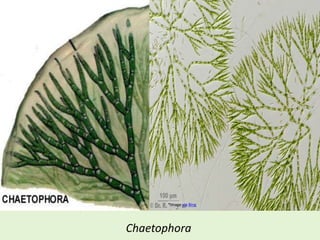
• Chaetophora – Erect system more develop.
• Draparnaldia – Prostrate system completely
suppresed.
Stigeoclonium Fritschiella
Coleochaete Aphanochaete
Chaetophora
*Image via Bing
Draparnaldia
SIPHONACEOUS FORMS
• Coenocytic, with large central vacuole
• Simplest form Protosiphon – (green, minute,
aerial vesicular portion and colourless,
rhizoidal portion )
Siphnocladus
*
te
Siphonocladus – vasicular aerial portion – septa
*Image via Bing
Caulerpa (large siphonaceous) – coenocytic – Branched creeping
rhizome and erect assimilatory shoots of various shape
*
Codium – Thallus cylindrical, richly branched threads and peripheral
cortex of large club shaped utricles disposed radially.
Vaucheria – Felt like mosses.
CHARA LIKE FORM
• Main axis exhibits unlimited power of growth
• Nodes and internodes.
• From each node arises lateral branches of limited growth
• Chara ,Nitella
PALMELLA FORMS
• Tempory stage in life cycle.
• Dominate in Tetrasporaceae, Palmellaceae (motile phase
– only in reproduction).
• Gelatinous colony (Chlamydomonas without flagella).
• Colony may definite or amorphous.
• Round (Sphaerocystes), Pear shaped (Apiocystis)
Branched cylindrical (Palmodictyon).
SchizochlamysTetraspora cylendrica & Schizochlamys.
Pseudocilia present.
Expended with sieve perforation
(Tetrasporidium)
COCCOID FORMS
• Sedentary life.
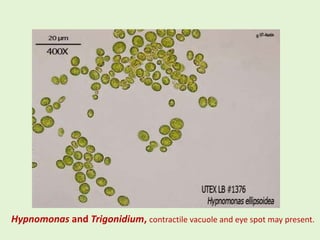
• Simplest Chlorococcus and Chlorella (Chlamydomonas
structure without contractile. Vacuole and eye spot).
• Chloroplast of various shape.
• Coenobium of various shape.
Chlorococcus Chlorella
Hypnomonas and Trigonidium, contractile vacuole and eye spot may present.
Scenedesmus– cells (2, 4 or 8) – arranged in single row

Chorophyceae,Chlorophyta