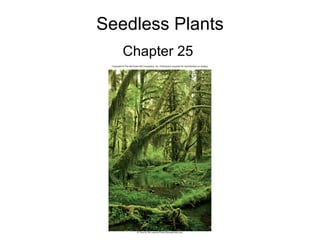
Seedless Plants
Chapter 25
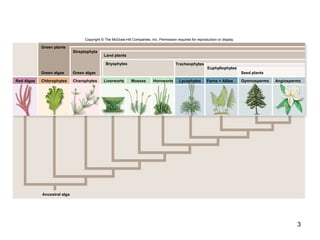
Origin of Land Plants
• All green algae and the land plants shared
a common ancestor a little over 1 BYA
– Kingdom Viridiplantae
– Not all photoautotrophs are plants
• Red and brown algae are photoautotrophs but not
classified as plants
• A single species of freshwater green algae
gave rise to the entire terrestrial plant
lineage
2
3
Copyright © The McGraw-Hill Companies, Inc. Permission required for reproduction or display.
Ancestral alga
Chlorophytes Charophytes Liverworts HornwortsMosses Lycophytes Gymnosperms Angiosperms
Seed plants
Euphyllophytes
Bryophytes
Land plants
Streptophyta
Green plants
Green algaeGreen algae
Red Algae
Tracheophytes
Ferns + Allies
Focus on Land Plants
•Adaptations to terrestrial life
– Protection from desiccation (“drying out”)
• all land plants have at least some adaptations for
this!
– Alternation of generations
• all land plants have this lifecycle!
– Vascular tissue allows plants to grow taller
• Xylem and phloem to conduct water and food
• Only “vascular” plants have this!
4
5
Copyright © The McGraw-Hill Companies, Inc. Permission required for reproduction or display.
Spore
Spore
n
n
nn
Spore mother
cell
2n
Sporangia
Sporophyte
(2n)
2n
2n Zygote
Embryo
Egg
Sperm
MEIOSIS
MITOSIS
FERTILIZATION
n
2n
Gametophyte
(n)
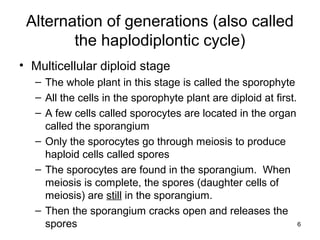
Alternation of generations (also called
the haplodiplontic cycle)
• Multicellular diploid stage
– The whole plant in this stage is called the sporophyte
– All the cells in the sporophyte plant are diploid at first.
– A few cells called sporocytes are located in the organ
called the sporangium
– Only the sporocytes go through meiosis to produce
haploid cells called spores
– The sporocytes are found in the sporangium. When
meiosis is complete, the spores (daughter cells of
meiosis) are still in the sporangium.
– Then the sporangium cracks open and releases the
spores 6
7
Copyright © The McGraw-Hill Companies, Inc. Permission required for reproduction or display.
© Edward S. Ross
Sporophyte
Gametophyte
Copyright © The McGraw-Hill Companies, Inc. Permission required for reproduction or display.
n
2n
2n
2n
1n
1n
Sperm
Sporangium
Antheridia
Egg
Archegonia
Gametophytes
Spores
Rhizoids
Female
Male
Zygote
MITOSIS
FERTILIZATION
Mature
sporophyte
Developing
sporophyte in
archegonium
Parent
gametophyte
MITOSIS
M
IEIO
SIS
Germinating
spores
Notice that the words “leaf,”
stem,” and “root” are not
used with bryophytes
• Multicellular haploid stage
– The plant in this stage is called the gametophyte
– When a haploid spore is released from the sporangium, it
lands on moist soil and germinates (ie it divides by
mitosis) until the whole gametophyte is grown
– A few cells in the organ called the gametangium go
through a “special” mitosis to form gametes.
– Sperm will leave their gametangium and swim to the eggs
in the female gametangium
– Gametes fuse to form diploid zygote
– Zygotes grows by mitosis into the next sporophyte plant
8
Alternation of generations (also called
the haplodiplontic cycle)
9
Copyright © The McGraw-Hill Companies, Inc. Permission required for reproduction or display.
© Edward S. Ross
Sporophyte
Gametophyte
Copyright © The McGraw-Hill Companies, Inc. Permission required for reproduction or display.
n
2n
2n
2n
1n
1n
Sperm
Sporangium
Antheridia
Egg
Archegonia
Gametophytes
Spores
Rhizoids
Female
Male
Zygote
MITOSIS
FERTILIZATION
Mature
sporophyte
Developing
sporophyte in
archegonium
Parent
gametophyte
MITOSIS
M
IEIO
SIS
Germinating
spores
Notice that the words “leaf,”
stem,” and “root” are not
used with bryophytes
Bryophytes – seedless
nontracheophytes
• Closest living descendants
of the first land plants
• Called “nontracheophytes”
because they lack tracheids
– (often called “nonvascular,”
but that’s not exactly
accurate)
• Symbiotic relationships
between fungi and plants
are important for absorption
10
Copyright © The McGraw-Hill Companies, Inc. Permission required for reproduction or display.
Charophytes
Liverworts
Mosses
Hornworts
Tracheophytes
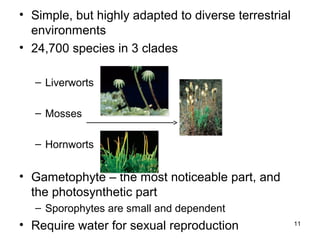
• Simple, but highly adapted to diverse terrestrial
environments
• 24,700 species in 3 clades
– Liverworts
– Mosses
– Hornworts
• Gametophyte – the most noticeable part, and
the photosynthetic part
– Sporophytes are small and dependent
• Require water for sexual reproduction 11
Tracheophyte Plants
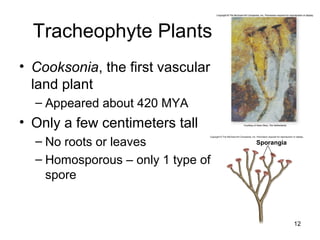
• Cooksonia, the first vascular
land plant
– Appeared about 420 MYA
• Only a few centimeters tall
– No roots or leaves
– Homosporous – only 1 type of
spore
12
Sporangia
Copyright © The McGraw-Hill Companies, Inc. Permission required for reproduction or display.
Vascular tissues
• Xylem
– Consists of dead cells called tracheids that form a
tube
– Conducts water and dissolved minerals upward from
the roots
• Phloem
– Consists of living cells
– Conducts sucrose and hormones throughout the plant
• Vascular tissues develop in sporophyte but not
gametophyte, so gametophyte is smaller
13
Tracheophytes
• Vascular plants include seven extant phyla
grouped in three clades
1. Lycophytes (club mosses)
2. Pterophytes (ferns, whisk ferns, and horsetails)
3. Seed plants
• Gametophyte has been reduced in size relative
to the sporophyte during the evolution of
tracheophytes
14
15
• 40 million years between appearance of
vascular tissue and true leaves
– Stems, then roots
• Provide transport and support
– Then leaves
• Increase surface area for photosynthesis
• Seeds - didn’t evolve until Mesozoic Era
– Highly resistant to desiccation
– Contain an embryo plus a food supply
– Lycophytes and pterophytes do not have seeds
16
17
Copyright © The McGraw-Hill Companies, Inc. Permission required for reproduction or display.
Ancestral alga
Chlorophytes Charophytes Liverworts HornwortsMosses Lycophytes Gymnosperms Angiosperms
Chlorophyll a and b
Plasmodesmata
Cuticle
Antheridia and archegonia
Multicellular embryo
Stomata
Euphylls
Seeds
Flowers
Fruits
Dominant sporophyte
Stems, roots, leaves
Ferns + Allies
Vascular tissue
Bryophytes are
seedless
nontracheophytes
Club mosses and ferns are
seedless tracheophytes
Antheridia are the male gametangia; archegonia are the female gametangia
Lycophytes – misnamed “club moss”
18
Pterophytes
•Whisk ferns
•Horsetails
•Ferns (see next slide)
Seedless Tracheophytes
Ferns
• Most abundant group of
seedless vascular plants
– About 11,000 species
• Coal formed from forests
300 mya
• The larger sporophyte
and much smaller
gametophyte are both
photosynthetic
19
20
Copyright © The McGraw-Hill Companies, Inc. Permission required for reproduction or display.
MEIOSIS
n
2n
Archegonium
Archegonium
Antheridium
Antheridium
Egg
Sperm
Embryo
1n
Gametophyte
Rhizome
Sporangium
Spores
Rhizoids
Gametophyte
MITOSIS
Underside
of leaf frond
Mature
sporangium
Sorus (cluster
of sporangia)
Adult
sporophyte
Mature
frond
Leaf of young
sporophyte
MITOSIS
Zygote
2n
FERTILIZATION
Fern reproduction
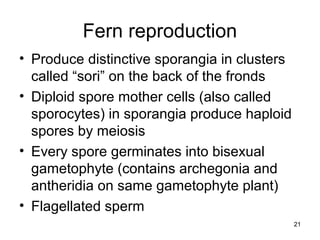
• Produce distinctive sporangia in clusters
called “sori” on the back of the fronds
• Diploid spore mother cells (also called
sporocytes) in sporangia produce haploid
spores by meiosis
• Every spore germinates into bisexual
gametophyte (contains archegonia and
antheridia on same gametophyte plant)
• Flagellated sperm
21

Chapter 25

  • 1.
  • 2.
    Origin of LandPlants • All green algae and the land plants shared a common ancestor a little over 1 BYA – Kingdom Viridiplantae – Not all photoautotrophs are plants • Red and brown algae are photoautotrophs but not classified as plants • A single species of freshwater green algae gave rise to the entire terrestrial plant lineage 2
  • 3.
    3 Copyright © TheMcGraw-Hill Companies, Inc. Permission required for reproduction or display. Ancestral alga Chlorophytes Charophytes Liverworts HornwortsMosses Lycophytes Gymnosperms Angiosperms Seed plants Euphyllophytes Bryophytes Land plants Streptophyta Green plants Green algaeGreen algae Red Algae Tracheophytes Ferns + Allies
  • 4.
    Focus on LandPlants •Adaptations to terrestrial life – Protection from desiccation (“drying out”) • all land plants have at least some adaptations for this! – Alternation of generations • all land plants have this lifecycle! – Vascular tissue allows plants to grow taller • Xylem and phloem to conduct water and food • Only “vascular” plants have this! 4
  • 5.
    5 Copyright © TheMcGraw-Hill Companies, Inc. Permission required for reproduction or display. Spore Spore n n nn Spore mother cell 2n Sporangia Sporophyte (2n) 2n 2n Zygote Embryo Egg Sperm MEIOSIS MITOSIS FERTILIZATION n 2n Gametophyte (n)
  • 6.
    Alternation of generations(also called the haplodiplontic cycle) • Multicellular diploid stage – The whole plant in this stage is called the sporophyte – All the cells in the sporophyte plant are diploid at first. – A few cells called sporocytes are located in the organ called the sporangium – Only the sporocytes go through meiosis to produce haploid cells called spores – The sporocytes are found in the sporangium. When meiosis is complete, the spores (daughter cells of meiosis) are still in the sporangium. – Then the sporangium cracks open and releases the spores 6
  • 7.
    7 Copyright © TheMcGraw-Hill Companies, Inc. Permission required for reproduction or display. © Edward S. Ross Sporophyte Gametophyte Copyright © The McGraw-Hill Companies, Inc. Permission required for reproduction or display. n 2n 2n 2n 1n 1n Sperm Sporangium Antheridia Egg Archegonia Gametophytes Spores Rhizoids Female Male Zygote MITOSIS FERTILIZATION Mature sporophyte Developing sporophyte in archegonium Parent gametophyte MITOSIS M IEIO SIS Germinating spores Notice that the words “leaf,” stem,” and “root” are not used with bryophytes
  • 8.
    • Multicellular haploidstage – The plant in this stage is called the gametophyte – When a haploid spore is released from the sporangium, it lands on moist soil and germinates (ie it divides by mitosis) until the whole gametophyte is grown – A few cells in the organ called the gametangium go through a “special” mitosis to form gametes. – Sperm will leave their gametangium and swim to the eggs in the female gametangium – Gametes fuse to form diploid zygote – Zygotes grows by mitosis into the next sporophyte plant 8 Alternation of generations (also called the haplodiplontic cycle)
  • 9.
    9 Copyright © TheMcGraw-Hill Companies, Inc. Permission required for reproduction or display. © Edward S. Ross Sporophyte Gametophyte Copyright © The McGraw-Hill Companies, Inc. Permission required for reproduction or display. n 2n 2n 2n 1n 1n Sperm Sporangium Antheridia Egg Archegonia Gametophytes Spores Rhizoids Female Male Zygote MITOSIS FERTILIZATION Mature sporophyte Developing sporophyte in archegonium Parent gametophyte MITOSIS M IEIO SIS Germinating spores Notice that the words “leaf,” stem,” and “root” are not used with bryophytes
  • 10.
    Bryophytes – seedless nontracheophytes •Closest living descendants of the first land plants • Called “nontracheophytes” because they lack tracheids – (often called “nonvascular,” but that’s not exactly accurate) • Symbiotic relationships between fungi and plants are important for absorption 10 Copyright © The McGraw-Hill Companies, Inc. Permission required for reproduction or display. Charophytes Liverworts Mosses Hornworts Tracheophytes
  • 11.
    • Simple, buthighly adapted to diverse terrestrial environments • 24,700 species in 3 clades – Liverworts – Mosses – Hornworts • Gametophyte – the most noticeable part, and the photosynthetic part – Sporophytes are small and dependent • Require water for sexual reproduction 11
  • 12.
    Tracheophyte Plants • Cooksonia,the first vascular land plant – Appeared about 420 MYA • Only a few centimeters tall – No roots or leaves – Homosporous – only 1 type of spore 12 Sporangia Copyright © The McGraw-Hill Companies, Inc. Permission required for reproduction or display.
  • 13.
    Vascular tissues • Xylem –Consists of dead cells called tracheids that form a tube – Conducts water and dissolved minerals upward from the roots • Phloem – Consists of living cells – Conducts sucrose and hormones throughout the plant • Vascular tissues develop in sporophyte but not gametophyte, so gametophyte is smaller 13
  • 14.
    Tracheophytes • Vascular plantsinclude seven extant phyla grouped in three clades 1. Lycophytes (club mosses) 2. Pterophytes (ferns, whisk ferns, and horsetails) 3. Seed plants • Gametophyte has been reduced in size relative to the sporophyte during the evolution of tracheophytes 14
  • 15.
  • 16.
    • 40 millionyears between appearance of vascular tissue and true leaves – Stems, then roots • Provide transport and support – Then leaves • Increase surface area for photosynthesis • Seeds - didn’t evolve until Mesozoic Era – Highly resistant to desiccation – Contain an embryo plus a food supply – Lycophytes and pterophytes do not have seeds 16
  • 17.
    17 Copyright © TheMcGraw-Hill Companies, Inc. Permission required for reproduction or display. Ancestral alga Chlorophytes Charophytes Liverworts HornwortsMosses Lycophytes Gymnosperms Angiosperms Chlorophyll a and b Plasmodesmata Cuticle Antheridia and archegonia Multicellular embryo Stomata Euphylls Seeds Flowers Fruits Dominant sporophyte Stems, roots, leaves Ferns + Allies Vascular tissue Bryophytes are seedless nontracheophytes Club mosses and ferns are seedless tracheophytes Antheridia are the male gametangia; archegonia are the female gametangia
  • 18.
    Lycophytes – misnamed“club moss” 18 Pterophytes •Whisk ferns •Horsetails •Ferns (see next slide) Seedless Tracheophytes
  • 19.
    Ferns • Most abundantgroup of seedless vascular plants – About 11,000 species • Coal formed from forests 300 mya • The larger sporophyte and much smaller gametophyte are both photosynthetic 19
  • 20.
    20 Copyright © TheMcGraw-Hill Companies, Inc. Permission required for reproduction or display. MEIOSIS n 2n Archegonium Archegonium Antheridium Antheridium Egg Sperm Embryo 1n Gametophyte Rhizome Sporangium Spores Rhizoids Gametophyte MITOSIS Underside of leaf frond Mature sporangium Sorus (cluster of sporangia) Adult sporophyte Mature frond Leaf of young sporophyte MITOSIS Zygote 2n FERTILIZATION
  • 21.
    Fern reproduction • Producedistinctive sporangia in clusters called “sori” on the back of the fronds • Diploid spore mother cells (also called sporocytes) in sporangia produce haploid spores by meiosis • Every spore germinates into bisexual gametophyte (contains archegonia and antheridia on same gametophyte plant) • Flagellated sperm 21