Giant chromosomes
Introduction
• There are chromosomes which are
extremely large compared to normal
chromosomes. Such chromosomes, called
giant chromosomes occur in some animal
cells.
• Giant chromosome are very long & thick
(200 times) during metaphase.
• Some cells at certain particular stage of
their life cycle contain large nuclei with
giant or large sized chromosomes.
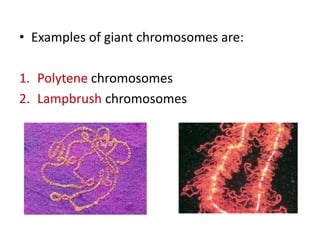
• Examples of giant chromosomes are:
1. Polytene chromosomes
2. Lampbrush chromosomes
LAMPBRUSH CHROMOSOMES
• First discovered by Ruckert in 1892.
• Occur in oocytes of vertebrates as well as in some
invertebrates.
• Found in those cells which produce a lot of RNA and
their cytoplasmic and nuclear volume increases.
• Their detailed structure have been studied during the
diplotene stage of meiotic division.
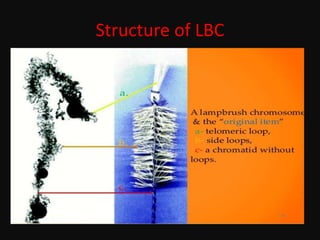
• During diplotene stage, certain chromosomes Stretch
out large loops of DNA, causing the chromosomes to
resemble a lamp brush.
• They are visible under the light microscope.
Structure of LBC
Transcription of LBC
• Transcription occurs either along the whole loop
or at a parts of a loop.
• At the beginning of meiosis, when DNA
replication is complete, the homologous pairs lie
immediately next to each other & form
characteristic structures composed of 4
chromatids.
• Lampbrush chromosomes are distinguished by an
especially high rate of RNA transcription
Functions of LBC
• Lamp brush chromosomes are involved in the
synthesis of RNA & proteins.
• Each locus codes for RNA.
• The loop is supposed to synthesis at a high
rate because of repetitive gene sequence.
• There are also reports that the LBC help in the
formation of yolk material in the egg.
POLYTENE CHROMOSOME
• First discovered by E.G Balbiani , in squash of
salivary cells of Chironomous.
• Polytene chromosomes are found in dipteran
flies: the best understood are those of Drosophila
and Chironomus
• They also occur in rectal epithelium & Malphigian
tubules.
• They are many times larger than the normal
chromosomes reaching a length of 200µm and
are visible even under a compound microscope.
• According to an estimate, the polytene
chromosomes have 1000 times more DNA than
the normal somatic chromosomes.
Morphology
• Contain 5 long & 1 short arm radiating from a central
point called chromocentre, formed by the fusion of
centromeres all the 8 chromosomes found in the cell.
• The short arm represents the fused IV chromosome &
the longest represents the fused sex chromosome.
• About 80% of the DNA is located in bands, & about
15% in interbands.
• In Drosophila, 5000 bands have been found in the 4
chromosomes of salivary gland cells.
• Bands have a high DNA content & absorb U.V light
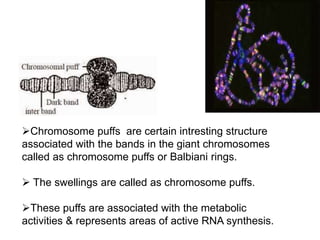
Chromosome puffs are certain intresting structure
associated with the bands in the giant chromosomes
called as chromosome puffs or Balbiani rings.
 The swellings are called as chromosome puffs.
These puffs are associated with the metabolic
activities & represents areas of active RNA synthesis.
Functions of Polytene
chromosomes
• Increasing the volume of the cells' nuclei and
causing cell expansion.
• Metabolic advantage as multiple copies of genes
permits a high level of gene expression.
• In Drosophila melanogaster, the chromosomes
undergo many rounds of endoreduplication, to
produce large amounts of glue before pupation.
• There is tandem duplication of various polytene
bands located near the centromere of the X
chromosome which results in the Bar phenotype
of kidney-shaped eyes.
Giant chromosomes

Giant chromosomes

  • 1.
  • 2.
    Introduction • There arechromosomes which are extremely large compared to normal chromosomes. Such chromosomes, called giant chromosomes occur in some animal cells. • Giant chromosome are very long & thick (200 times) during metaphase. • Some cells at certain particular stage of their life cycle contain large nuclei with giant or large sized chromosomes.
  • 3.
    • Examples ofgiant chromosomes are: 1. Polytene chromosomes 2. Lampbrush chromosomes
  • 4.
    LAMPBRUSH CHROMOSOMES • Firstdiscovered by Ruckert in 1892. • Occur in oocytes of vertebrates as well as in some invertebrates. • Found in those cells which produce a lot of RNA and their cytoplasmic and nuclear volume increases. • Their detailed structure have been studied during the diplotene stage of meiotic division. • During diplotene stage, certain chromosomes Stretch out large loops of DNA, causing the chromosomes to resemble a lamp brush. • They are visible under the light microscope.
  • 5.
  • 6.
    Transcription of LBC •Transcription occurs either along the whole loop or at a parts of a loop. • At the beginning of meiosis, when DNA replication is complete, the homologous pairs lie immediately next to each other & form characteristic structures composed of 4 chromatids. • Lampbrush chromosomes are distinguished by an especially high rate of RNA transcription
  • 7.
    Functions of LBC •Lamp brush chromosomes are involved in the synthesis of RNA & proteins. • Each locus codes for RNA. • The loop is supposed to synthesis at a high rate because of repetitive gene sequence. • There are also reports that the LBC help in the formation of yolk material in the egg.
  • 8.
    POLYTENE CHROMOSOME • Firstdiscovered by E.G Balbiani , in squash of salivary cells of Chironomous. • Polytene chromosomes are found in dipteran flies: the best understood are those of Drosophila and Chironomus • They also occur in rectal epithelium & Malphigian tubules. • They are many times larger than the normal chromosomes reaching a length of 200µm and are visible even under a compound microscope. • According to an estimate, the polytene chromosomes have 1000 times more DNA than the normal somatic chromosomes.
  • 9.
    Morphology • Contain 5long & 1 short arm radiating from a central point called chromocentre, formed by the fusion of centromeres all the 8 chromosomes found in the cell. • The short arm represents the fused IV chromosome & the longest represents the fused sex chromosome. • About 80% of the DNA is located in bands, & about 15% in interbands. • In Drosophila, 5000 bands have been found in the 4 chromosomes of salivary gland cells. • Bands have a high DNA content & absorb U.V light
  • 10.
    Chromosome puffs arecertain intresting structure associated with the bands in the giant chromosomes called as chromosome puffs or Balbiani rings.  The swellings are called as chromosome puffs. These puffs are associated with the metabolic activities & represents areas of active RNA synthesis.
  • 11.
    Functions of Polytene chromosomes •Increasing the volume of the cells' nuclei and causing cell expansion. • Metabolic advantage as multiple copies of genes permits a high level of gene expression. • In Drosophila melanogaster, the chromosomes undergo many rounds of endoreduplication, to produce large amounts of glue before pupation. • There is tandem duplication of various polytene bands located near the centromere of the X chromosome which results in the Bar phenotype of kidney-shaped eyes.