
Section 1.6
              Limits involving Infinity

                  V63.0121.002.2010Su, Calculus I

                          New York University


                           May 20, 2010


Announcements

   Office Hours: MR 5:00–5:45, TW 7:50–8:30, CIWW 102 (here)
   Quiz 1 Thursday on 1.1–1.4
Announcements


           Office Hours: MR
           5:00–5:45, TW 7:50–8:30,
           CIWW 102 (here)
           Quiz 1 Thursday on 1.1–1.4


V63.0121.002.2010Su, Calculus I (NYU)   Section 1.6 Limits involving Infinity   May 20, 2010   2 / 37
Objectives


           “Intuit” limits involving
           infinity by eyeballing the
           expression.
           Show limits involving infinity
           by algebraic manipulation
           and conceptual argument.


V63.0121.002.2010Su, Calculus I (NYU)   Section 1.6 Limits involving Infinity   May 20, 2010   3 / 37
Recall the definition of limit


 Definition
 We write
                                               lim f (x) = L
                                              x→a

 and say

                      “the limit of f (x), as x approaches a, equals L”

 if we can make the values of f (x) arbitrarily close to L (as close to L as we
 like) by taking x to be sufficiently close to a (on either side of a) but not
 equal to a.


V63.0121.002.2010Su, Calculus I (NYU)   Section 1.6 Limits involving Infinity   May 20, 2010   4 / 37
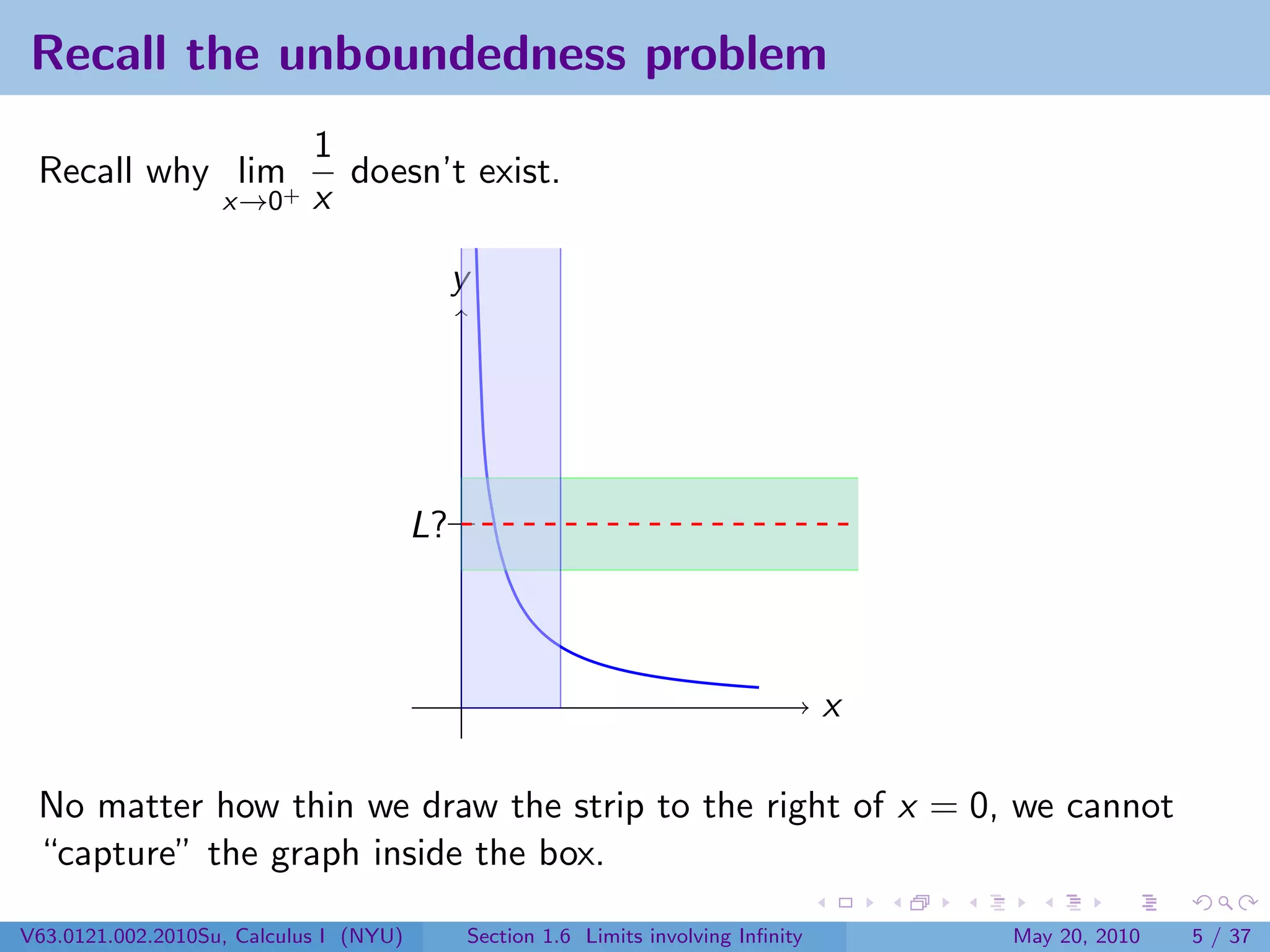
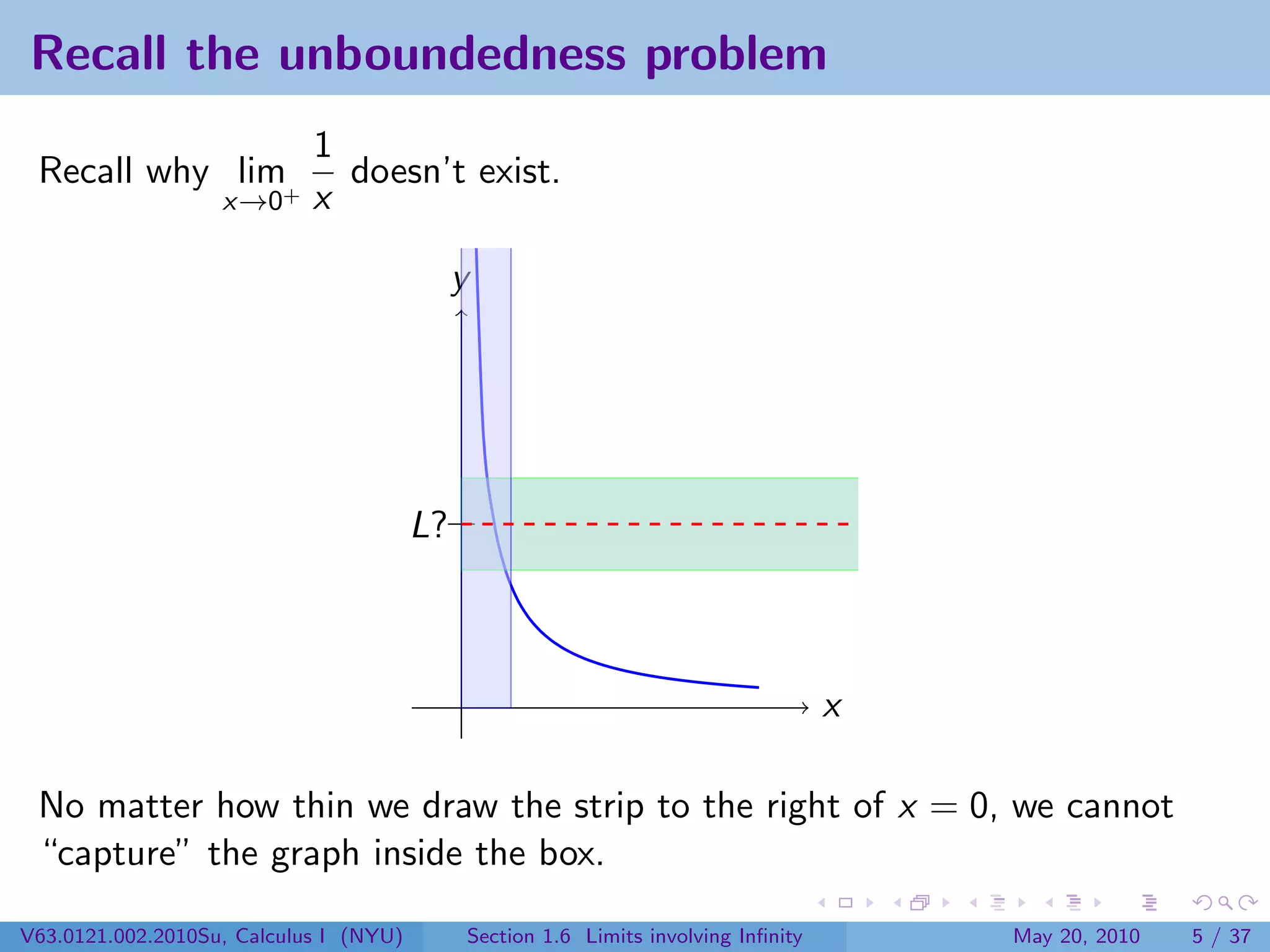
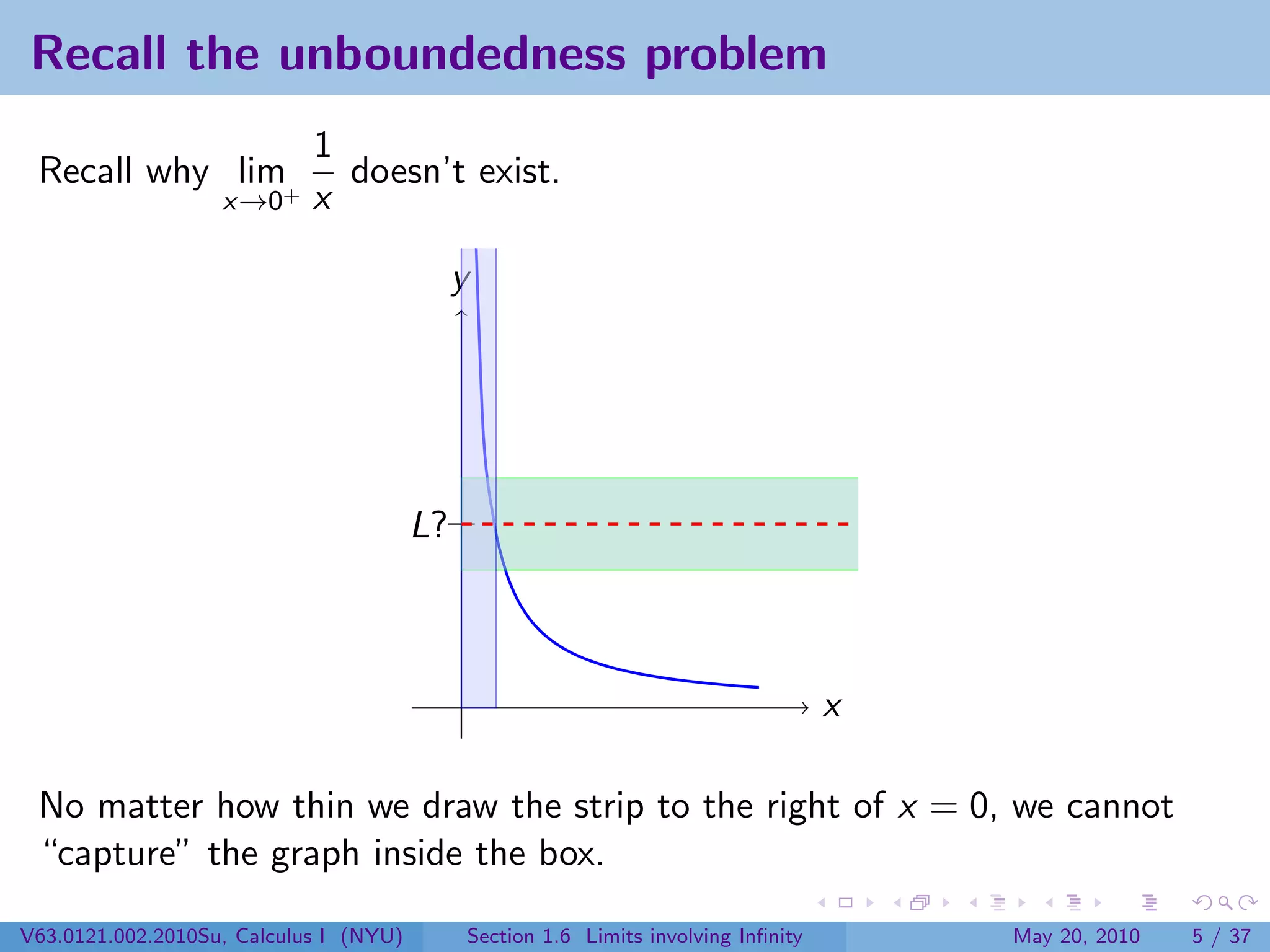
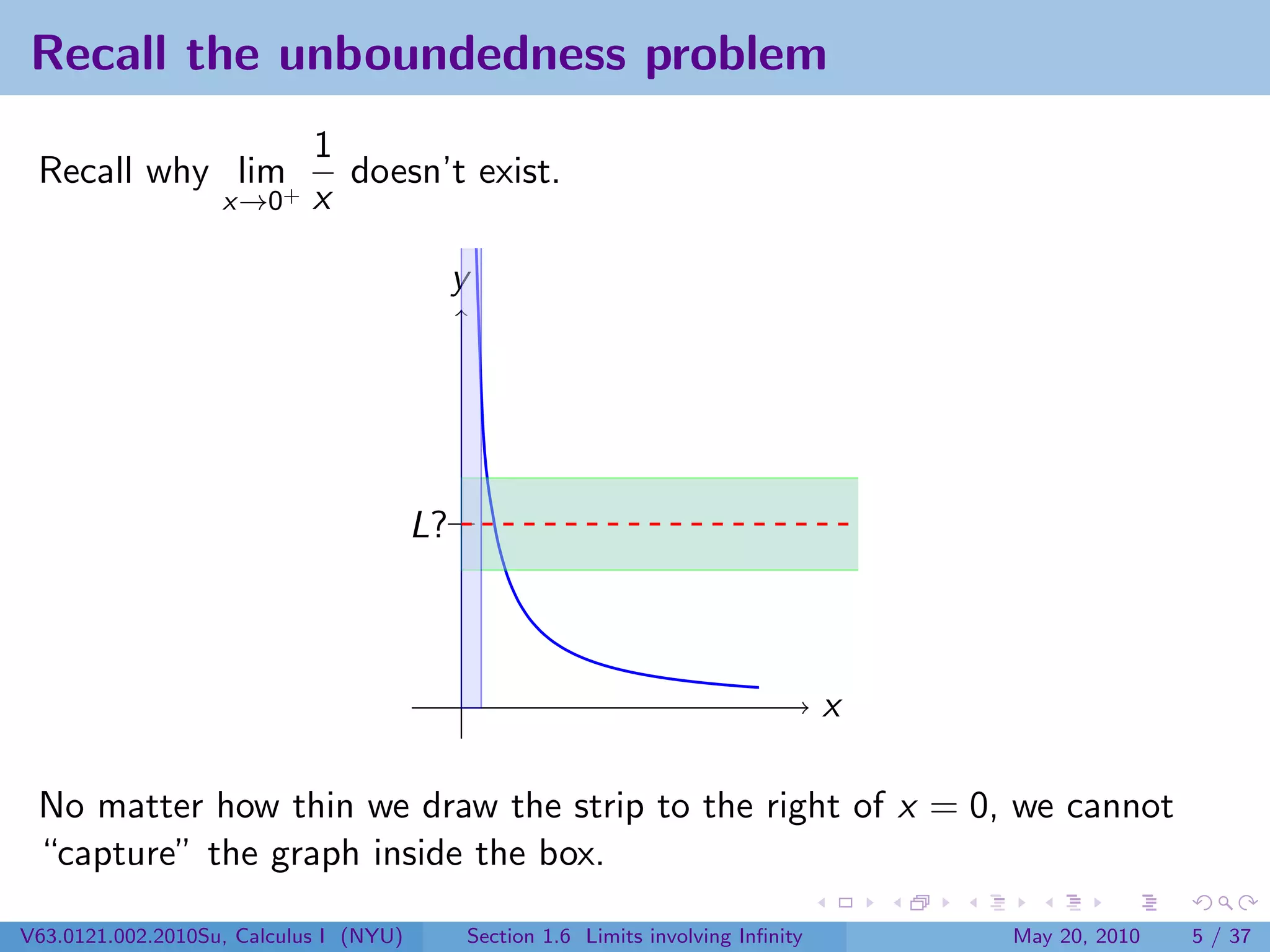
Recall the unboundedness problem
                            1
 Recall why lim+              doesn’t exist.
                   x→0      x

                                             y


                                        L?


                                                                                    x

 No matter how thin we draw the strip to the right of x = 0, we cannot
 “capture” the graph inside the box.

V63.0121.002.2010Su, Calculus I (NYU)        Section 1.6 Limits involving Infinity       May 20, 2010   5 / 37
Recall the unboundedness problem
                            1
 Recall why lim+              doesn’t exist.
                   x→0      x

                                             y


                                        L?


                                                                                    x

 No matter how thin we draw the strip to the right of x = 0, we cannot
 “capture” the graph inside the box.

V63.0121.002.2010Su, Calculus I (NYU)        Section 1.6 Limits involving Infinity       May 20, 2010   5 / 37
Recall the unboundedness problem
                            1
 Recall why lim+              doesn’t exist.
                   x→0      x

                                             y


                                        L?


                                                                                    x

 No matter how thin we draw the strip to the right of x = 0, we cannot
 “capture” the graph inside the box.

V63.0121.002.2010Su, Calculus I (NYU)        Section 1.6 Limits involving Infinity       May 20, 2010   5 / 37
Recall the unboundedness problem
                            1
 Recall why lim+              doesn’t exist.
                   x→0      x

                                             y


                                        L?


                                                                                    x

 No matter how thin we draw the strip to the right of x = 0, we cannot
 “capture” the graph inside the box.

V63.0121.002.2010Su, Calculus I (NYU)        Section 1.6 Limits involving Infinity       May 20, 2010   5 / 37
Outline


 Infinite Limits
    Vertical Asymptotes
    Infinite Limits we Know
    Limit “Laws” with Infinite Limits
    Indeterminate Limit forms


 Limits at ∞
    Algebraic rates of growth
    Rationalizing to get a limit


V63.0121.002.2010Su, Calculus I (NYU)   Section 1.6 Limits involving Infinity   May 20, 2010   6 / 37
Infinite Limits


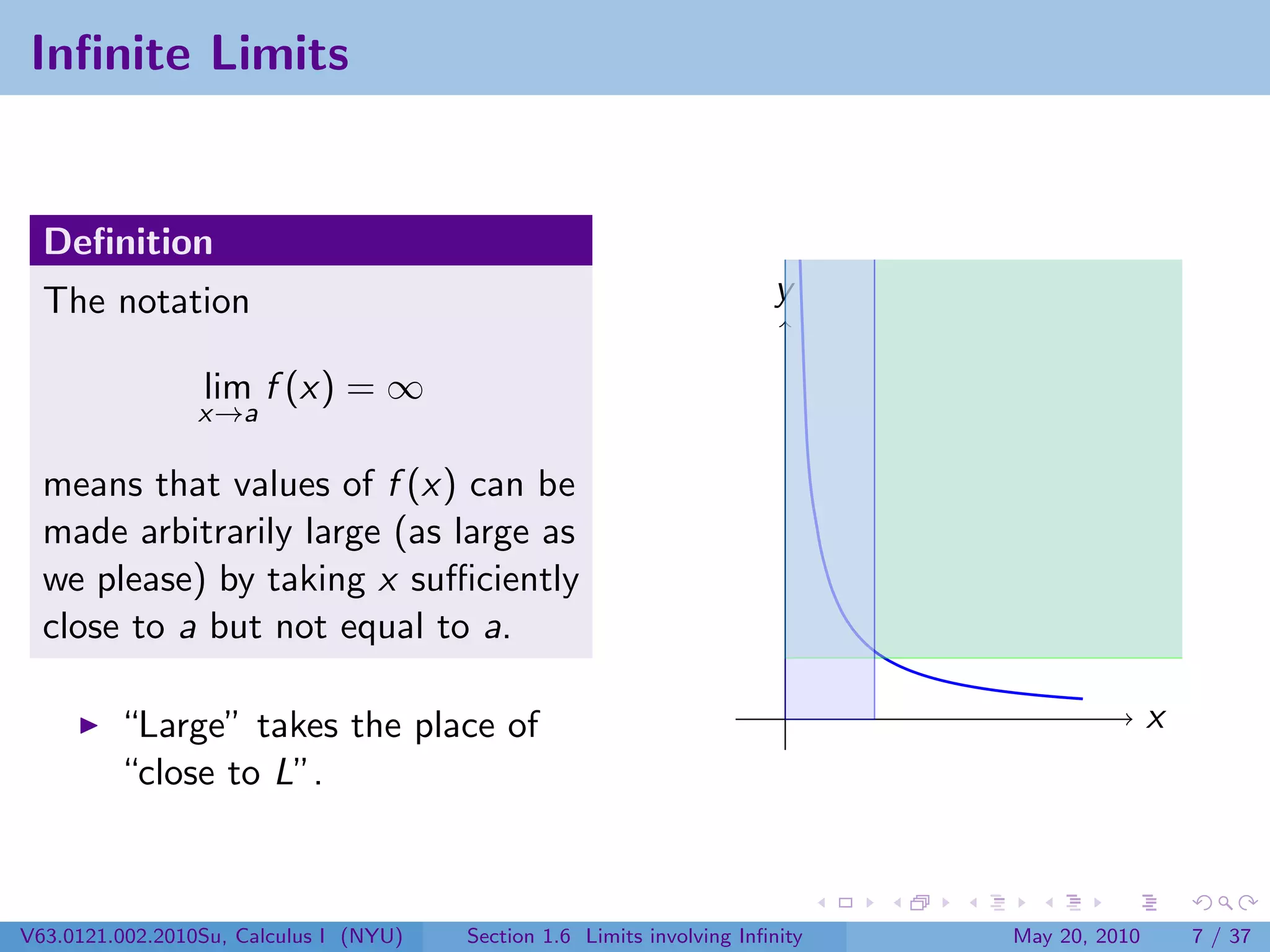
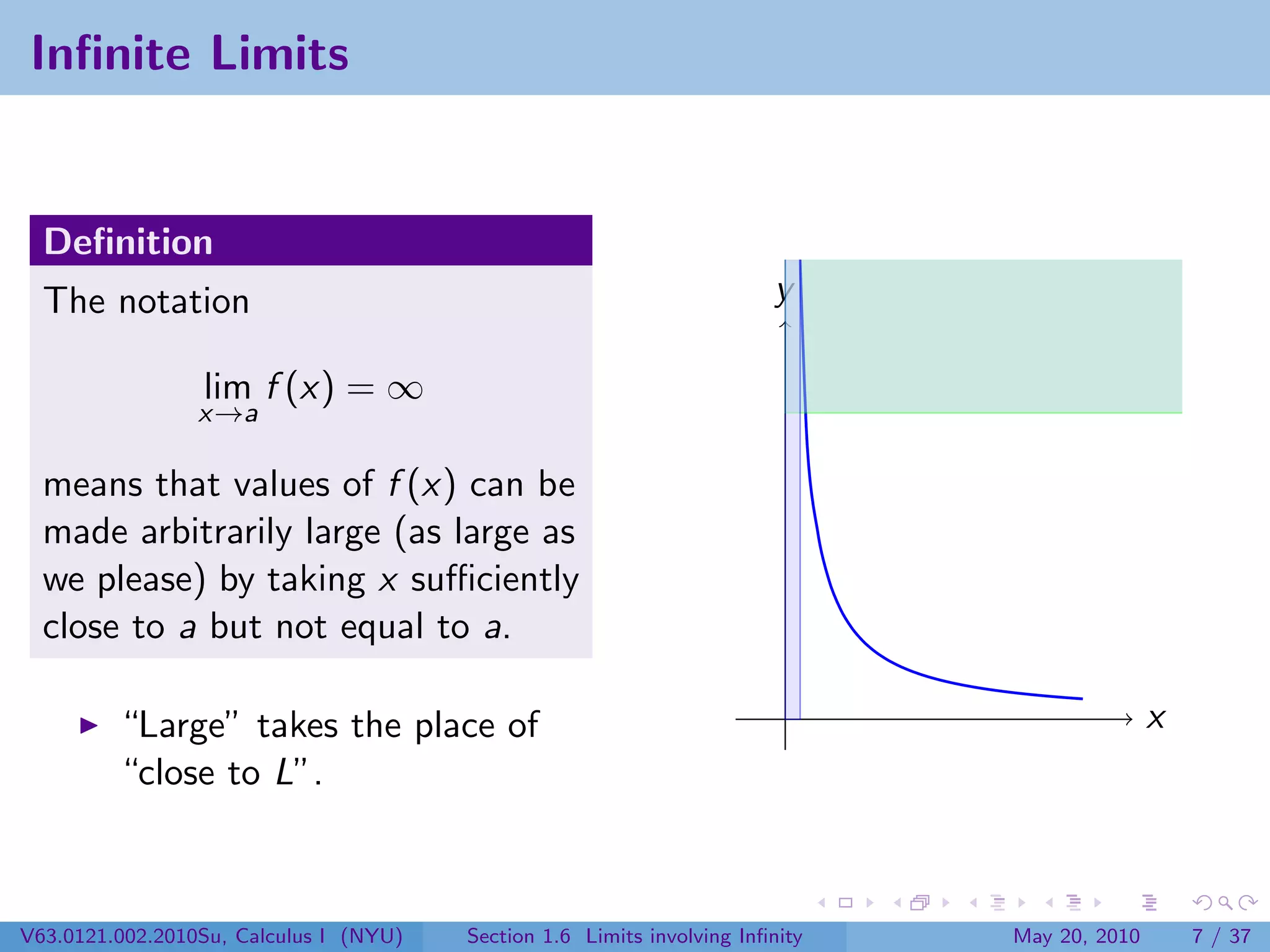
  Definition
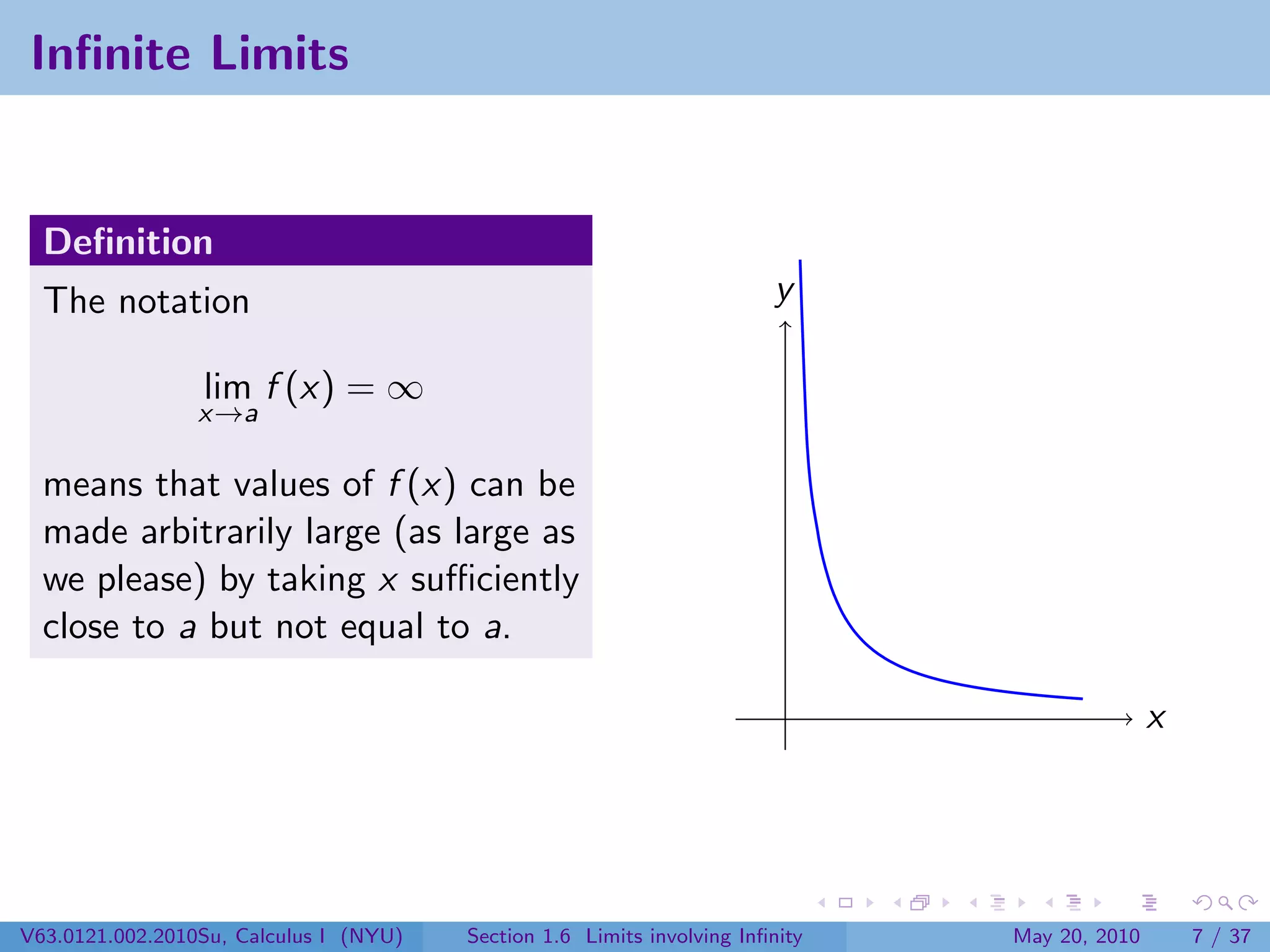
  The notation                                                          y

                 lim f (x) = ∞
                 x→a

  means that values of f (x) can be
  made arbitrarily large (as large as
  we please) by taking x sufficiently
  close to a but not equal to a.

                                                                                              x


V63.0121.002.2010Su, Calculus I (NYU)   Section 1.6 Limits involving Infinity   May 20, 2010       7 / 37
Infinite Limits


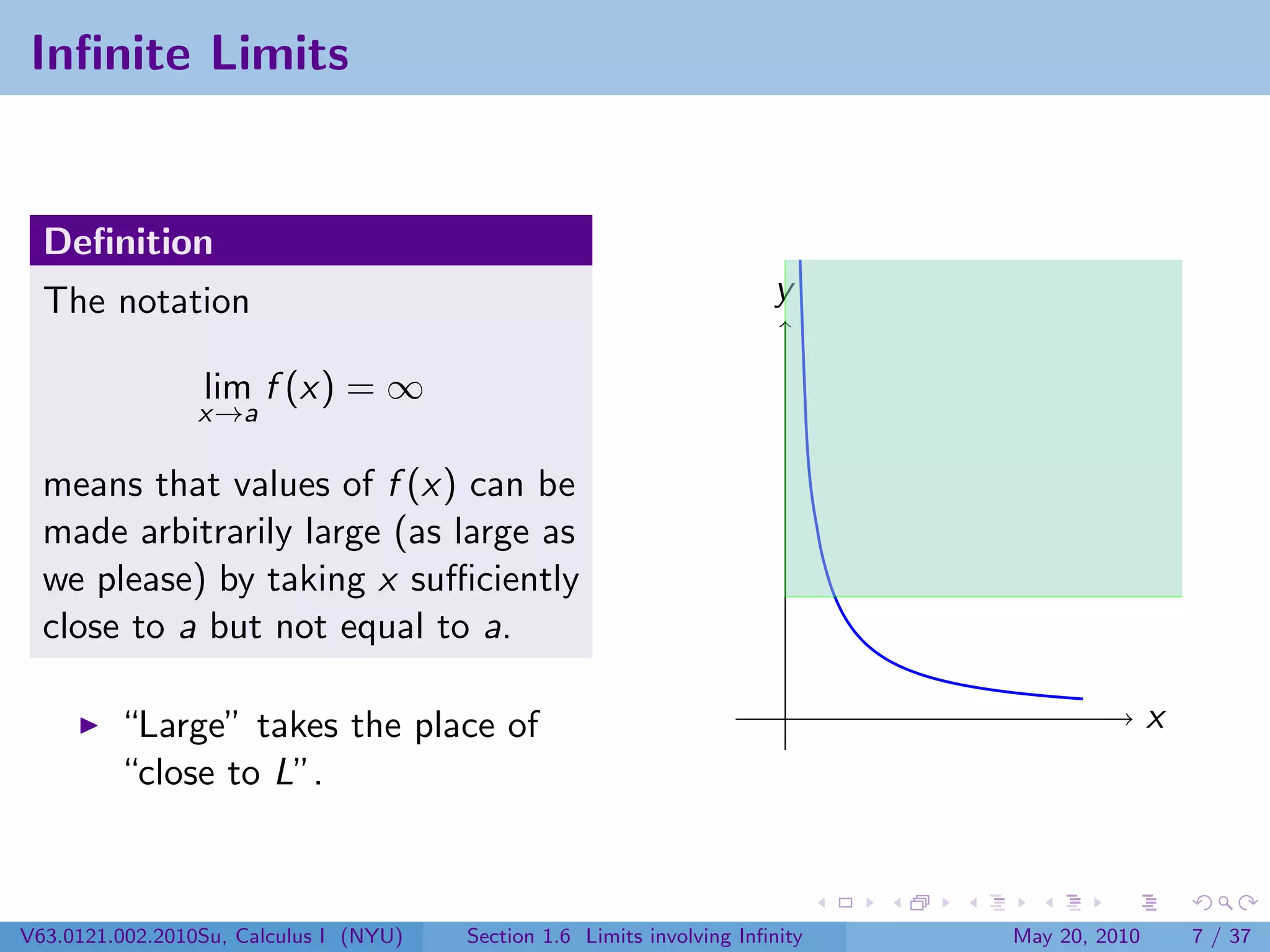
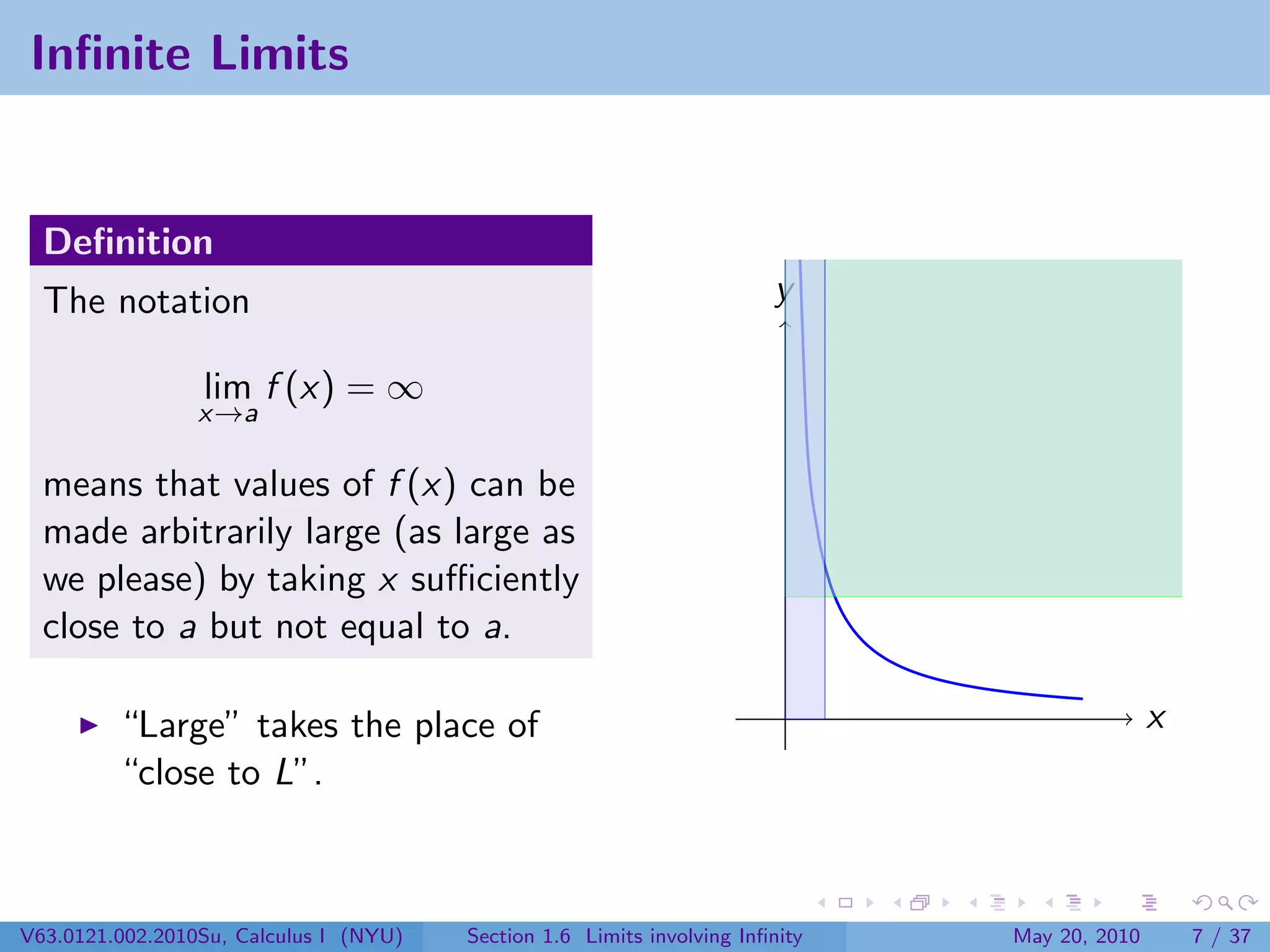
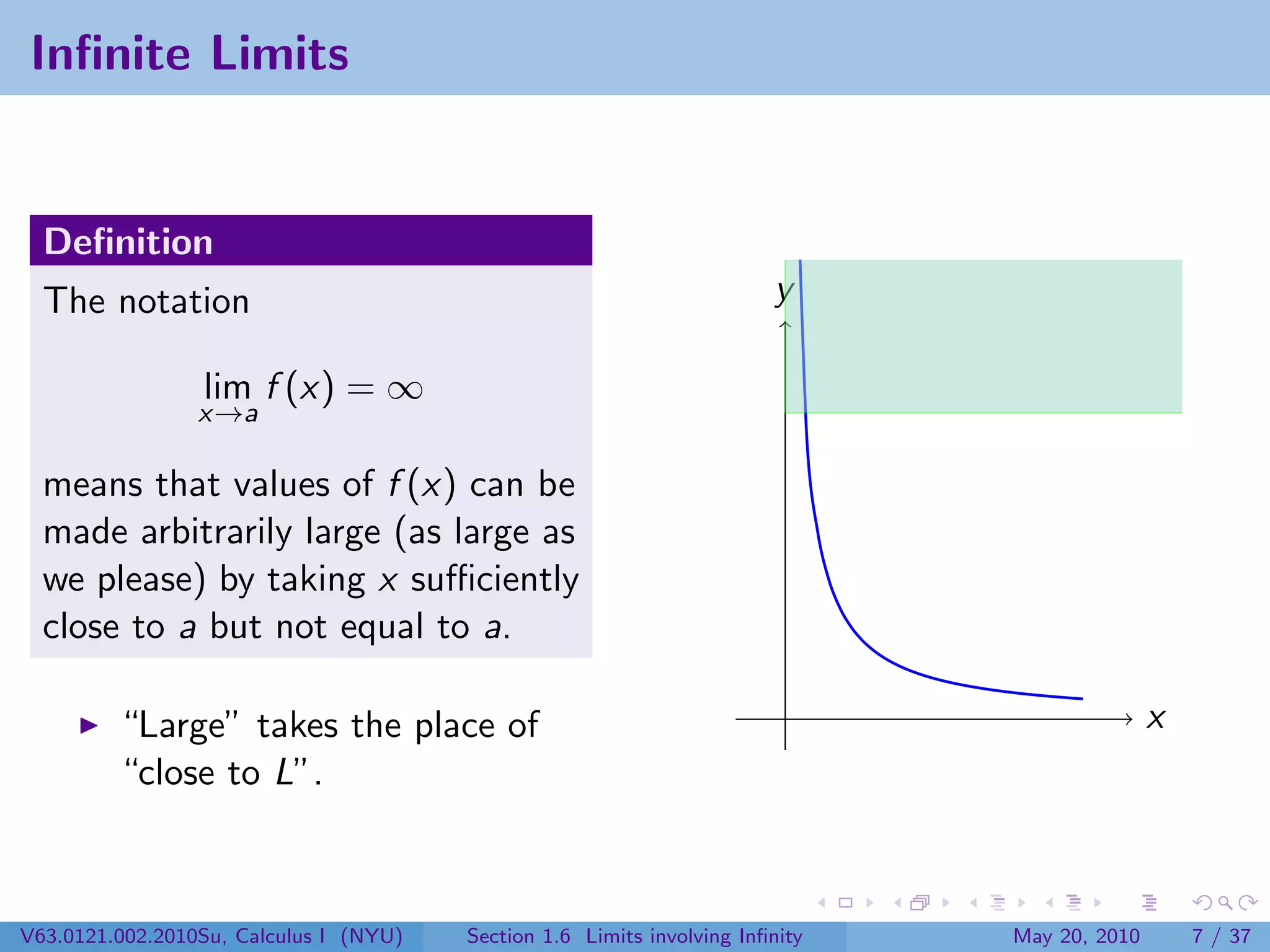
  Definition
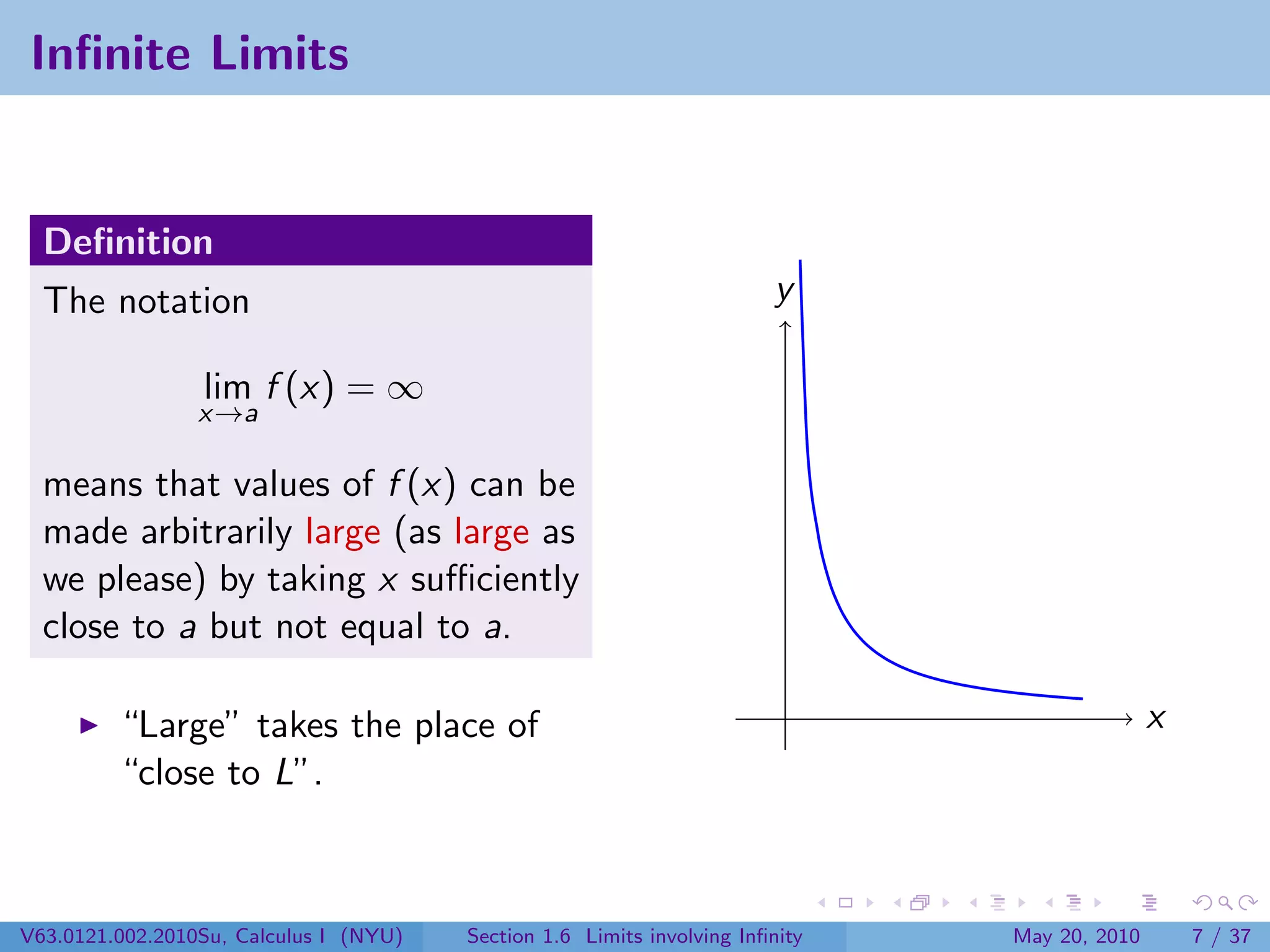
  The notation                                                          y

                 lim f (x) = ∞
                 x→a

  means that values of f (x) can be
  made arbitrarily large (as large as
  we please) by taking x sufficiently
  close to a but not equal to a.

         “Large” takes the place of                                                           x
         “close to L”.


V63.0121.002.2010Su, Calculus I (NYU)   Section 1.6 Limits involving Infinity   May 20, 2010       7 / 37
Infinite Limits


  Definition
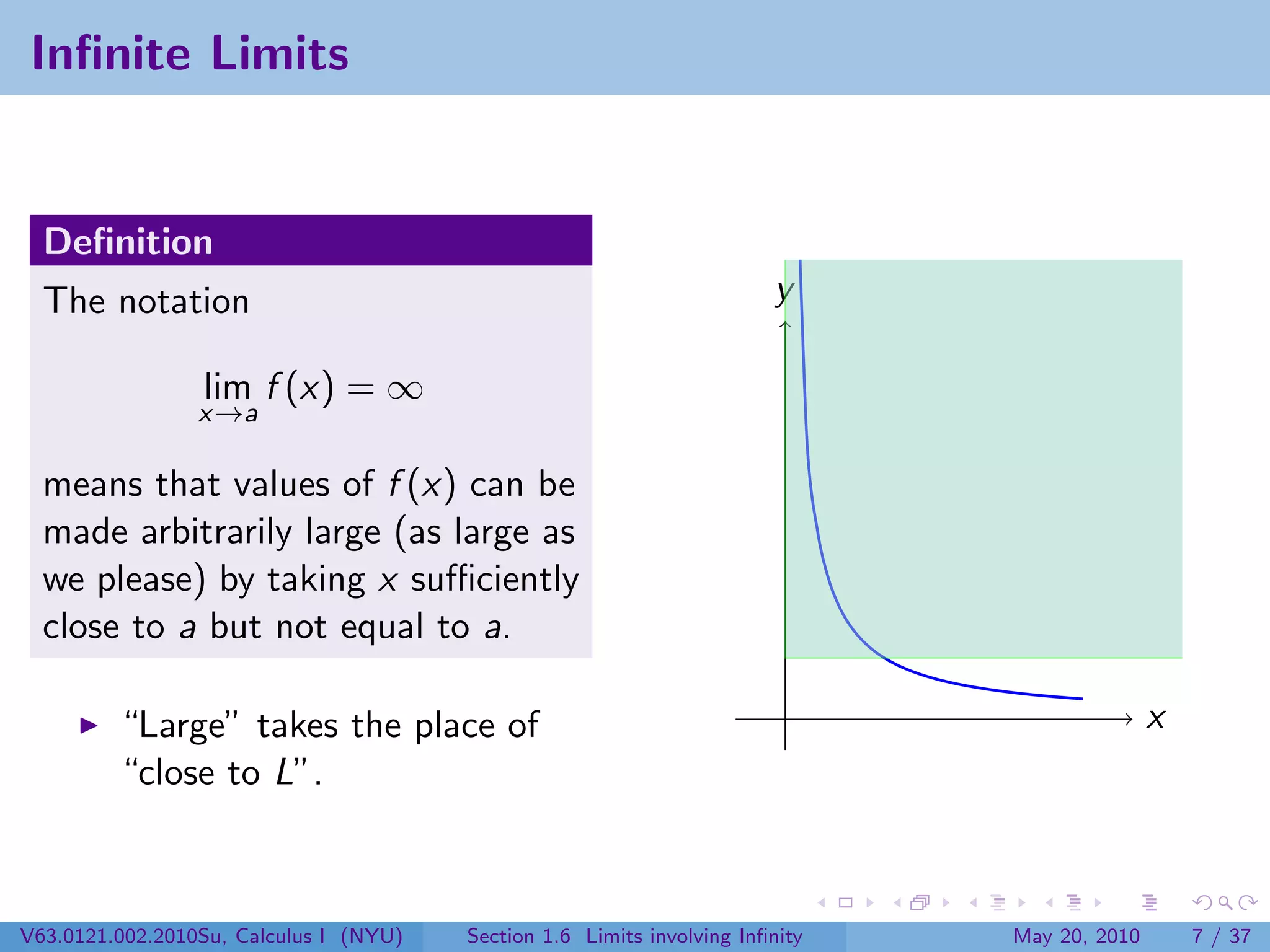
  The notation                                                          y

                 lim f (x) = ∞
                 x→a

  means that values of f (x) can be
  made arbitrarily large (as large as
  we please) by taking x sufficiently
  close to a but not equal to a.

         “Large” takes the place of                                                           x
         “close to L”.


V63.0121.002.2010Su, Calculus I (NYU)   Section 1.6 Limits involving Infinity   May 20, 2010       7 / 37
Infinite Limits


  Definition
  The notation                                                          y

                 lim f (x) = ∞
                 x→a

  means that values of f (x) can be
  made arbitrarily large (as large as
  we please) by taking x sufficiently
  close to a but not equal to a.

         “Large” takes the place of                                                           x
         “close to L”.


V63.0121.002.2010Su, Calculus I (NYU)   Section 1.6 Limits involving Infinity   May 20, 2010       7 / 37
Infinite Limits


  Definition
  The notation                                                          y

                 lim f (x) = ∞
                 x→a

  means that values of f (x) can be
  made arbitrarily large (as large as
  we please) by taking x sufficiently
  close to a but not equal to a.

         “Large” takes the place of                                                           x
         “close to L”.


V63.0121.002.2010Su, Calculus I (NYU)   Section 1.6 Limits involving Infinity   May 20, 2010       7 / 37
Infinite Limits


  Definition
  The notation                                                          y

                 lim f (x) = ∞
                 x→a

  means that values of f (x) can be
  made arbitrarily large (as large as
  we please) by taking x sufficiently
  close to a but not equal to a.

         “Large” takes the place of                                                           x
         “close to L”.


V63.0121.002.2010Su, Calculus I (NYU)   Section 1.6 Limits involving Infinity   May 20, 2010       7 / 37
Infinite Limits


  Definition
  The notation                                                          y

                 lim f (x) = ∞
                 x→a

  means that values of f (x) can be
  made arbitrarily large (as large as
  we please) by taking x sufficiently
  close to a but not equal to a.

         “Large” takes the place of                                                           x
         “close to L”.


V63.0121.002.2010Su, Calculus I (NYU)   Section 1.6 Limits involving Infinity   May 20, 2010       7 / 37
Infinite Limits


  Definition
  The notation                                                          y

                 lim f (x) = ∞
                 x→a

  means that values of f (x) can be
  made arbitrarily large (as large as
  we please) by taking x sufficiently
  close to a but not equal to a.

         “Large” takes the place of                                                           x
         “close to L”.


V63.0121.002.2010Su, Calculus I (NYU)   Section 1.6 Limits involving Infinity   May 20, 2010       7 / 37
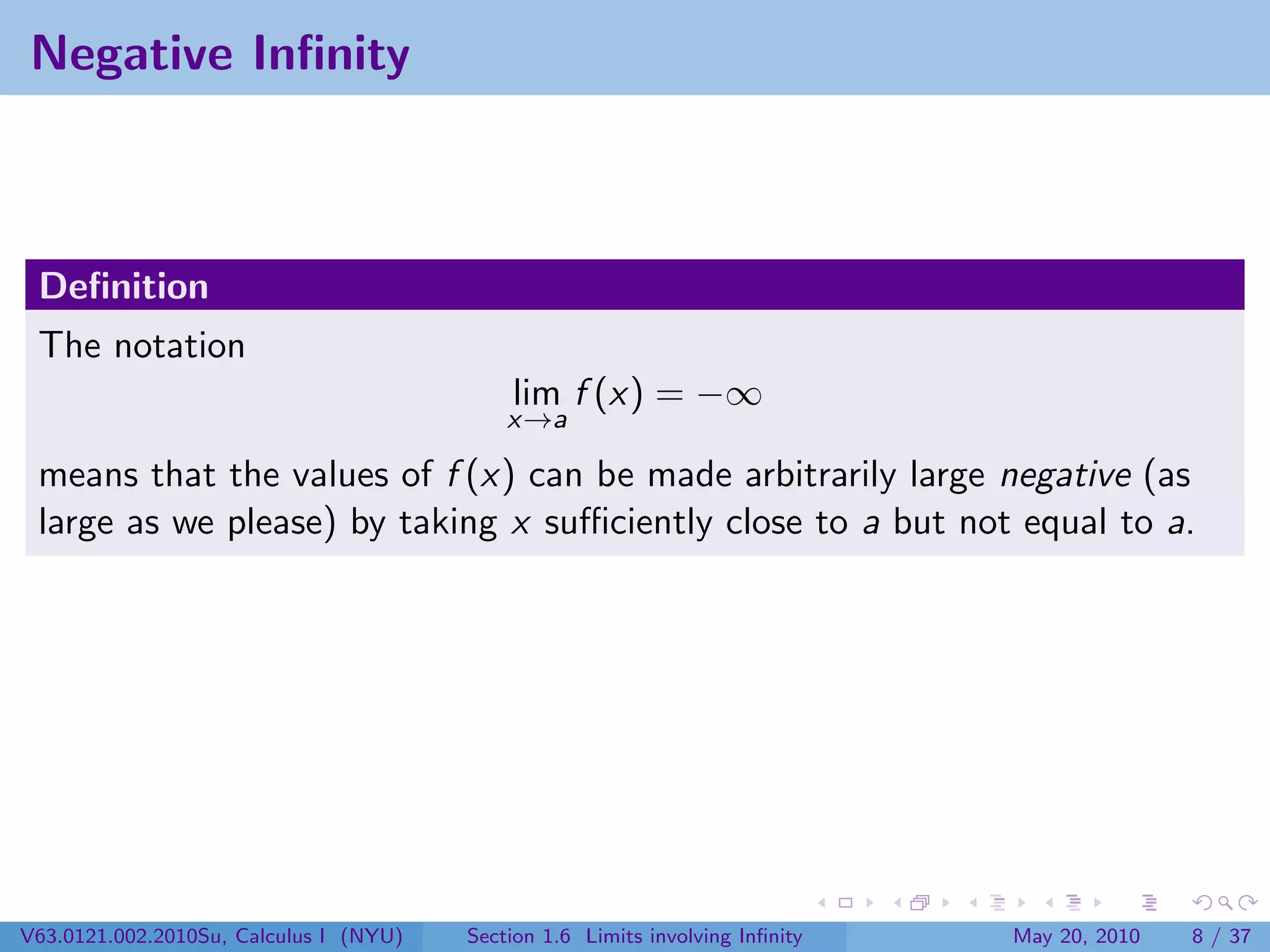
Negative Infinity


 Definition
 The notation
                                            lim f (x) = −∞
                                            x→a

 means that the values of f (x) can be made arbitrarily large negative (as
 large as we please) by taking x sufficiently close to a but not equal to a.


V63.0121.002.2010Su, Calculus I (NYU)   Section 1.6 Limits involving Infinity   May 20, 2010   8 / 37
Negative Infinity


 Definition
 The notation
                                            lim f (x) = −∞
                                            x→a

 means that the values of f (x) can be made arbitrarily large negative (as
 large as we please) by taking x sufficiently close to a but not equal to a.

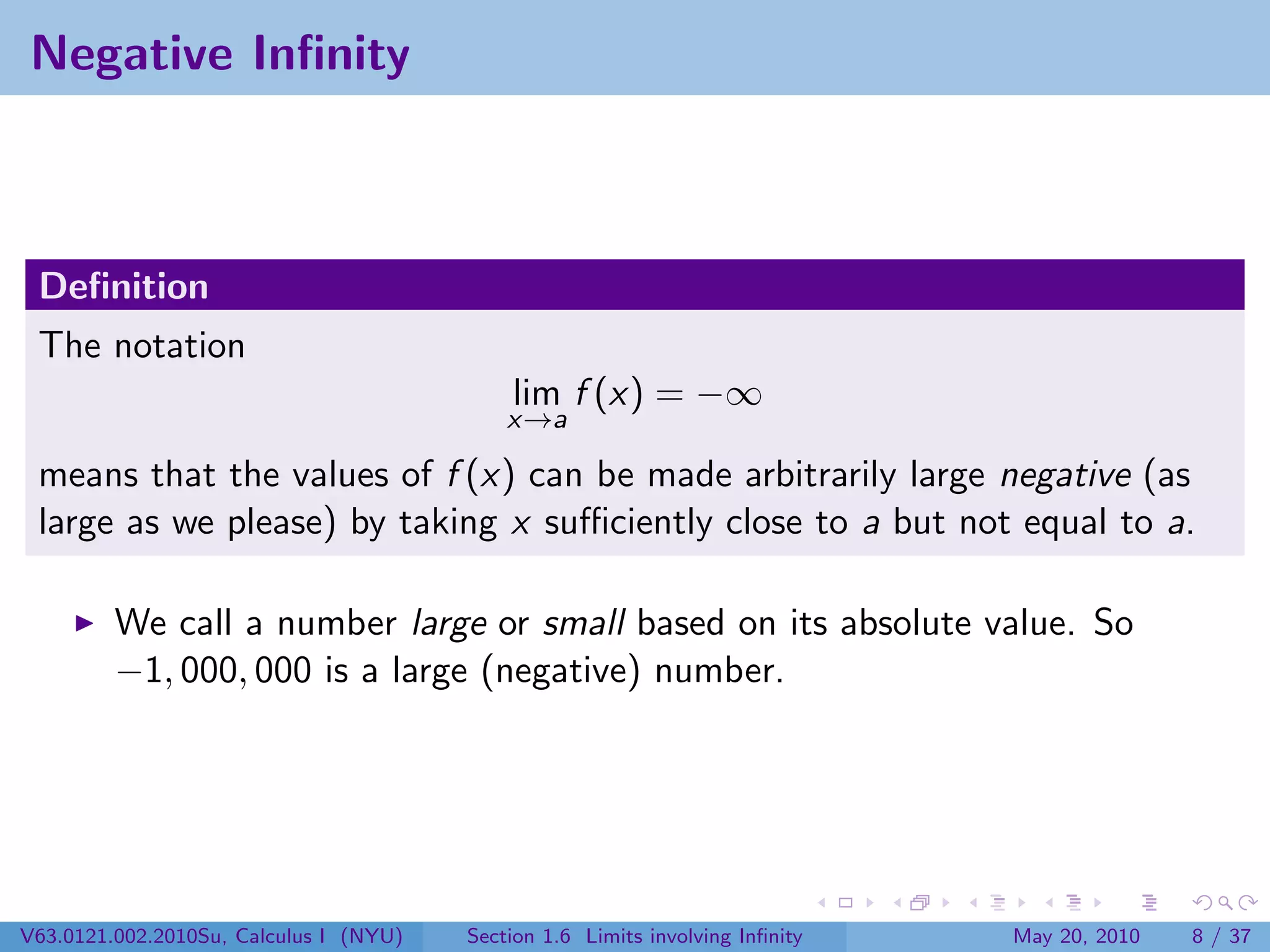
         We call a number large or small based on its absolute value. So
         −1, 000, 000 is a large (negative) number.


V63.0121.002.2010Su, Calculus I (NYU)   Section 1.6 Limits involving Infinity   May 20, 2010   8 / 37
Vertical Asymptotes


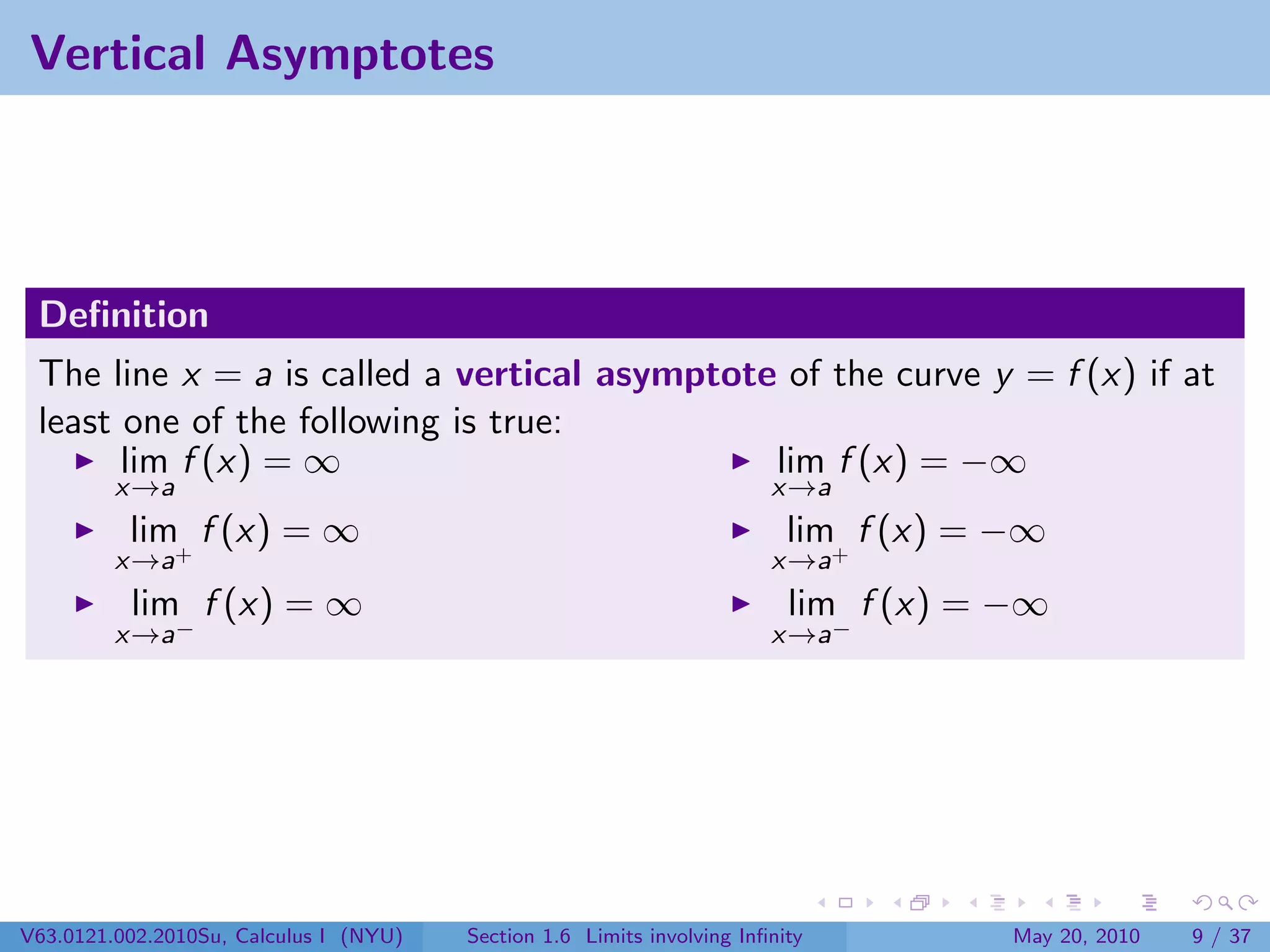
 Definition
 The line x = a is called a vertical asymptote of the curve y = f (x) if at
 least one of the following is true:
       lim f (x) = ∞                          lim f (x) = −∞
         x→a                                                            x→a
          lim+ f (x) = ∞                                                  lim f (x) = −∞
         x→a                                                            x→a+
          lim f (x) = ∞                                                   lim f (x) = −∞
         x→a−                                                           x→a−


V63.0121.002.2010Su, Calculus I (NYU)   Section 1.6 Limits involving Infinity          May 20, 2010   9 / 37
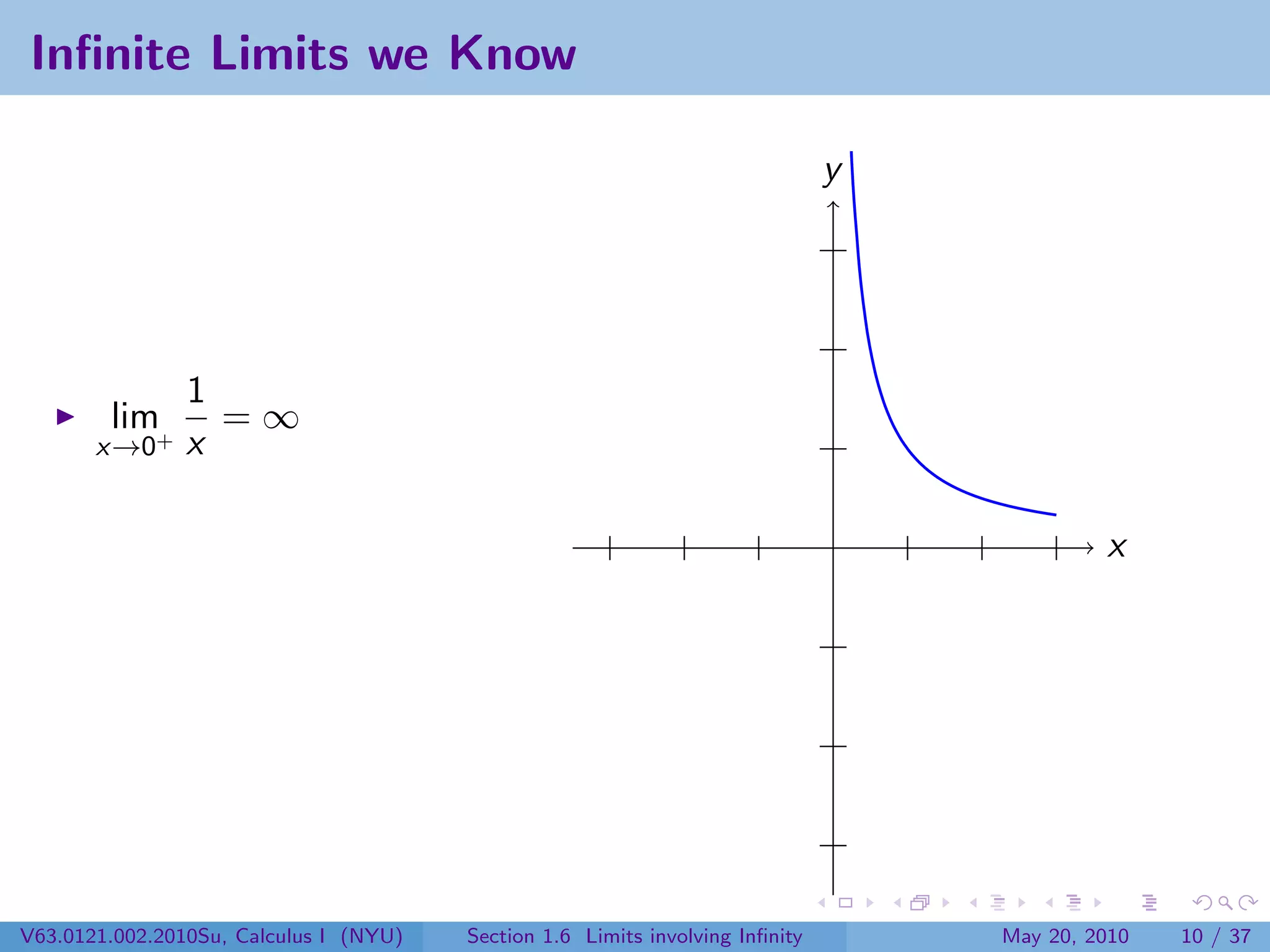
Infinite Limits we Know

                                                                               y


               1
        lim+     =∞
       x→0     x

                                                                                            x


V63.0121.002.2010Su, Calculus I (NYU)   Section 1.6 Limits involving Infinity       May 20, 2010   10 / 37
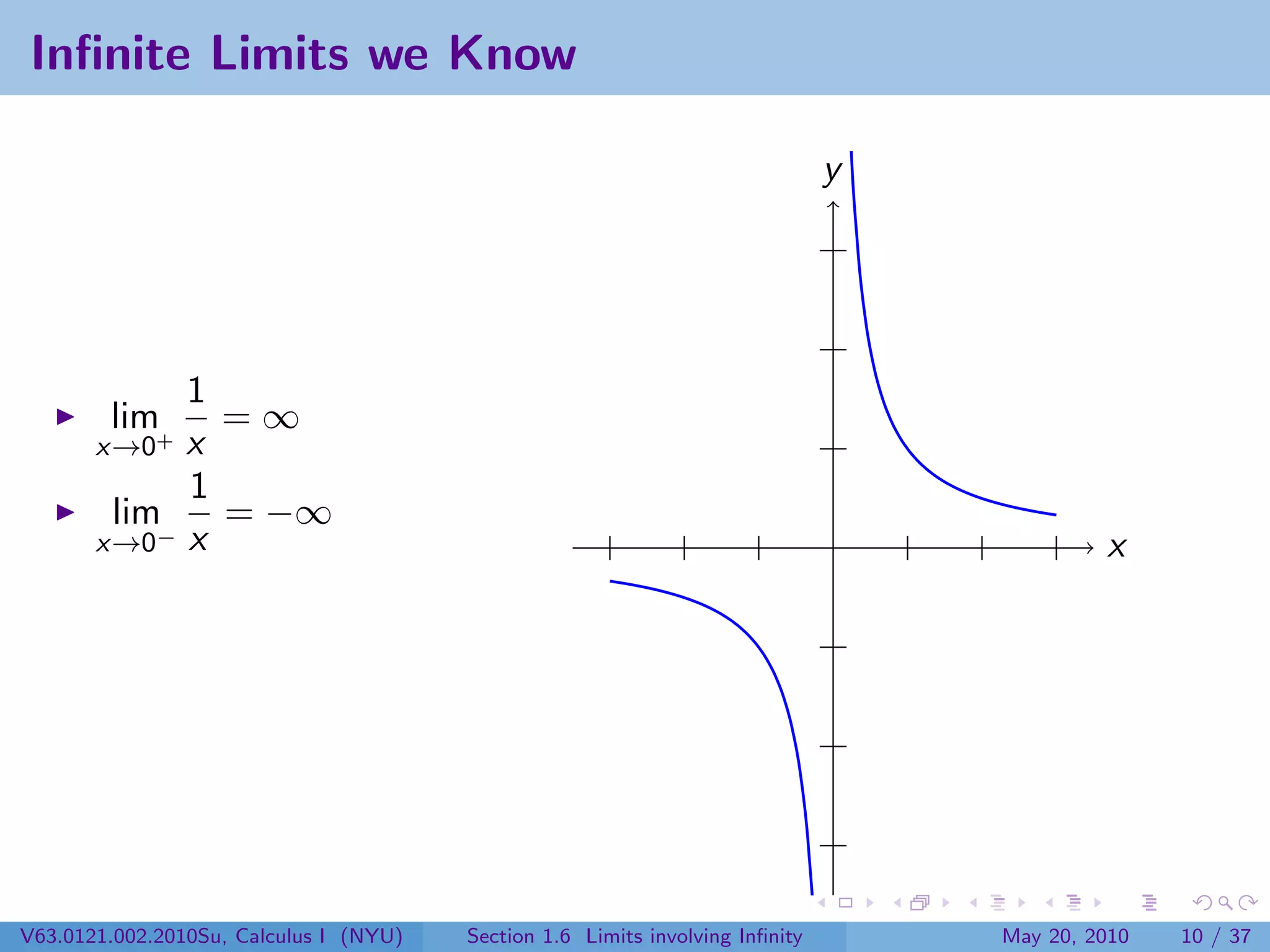
Infinite Limits we Know

                                                                               y


             1
        lim+   =∞
       x→0 x
             1
        lim    = −∞
           − x
       x→0                                                                                  x


V63.0121.002.2010Su, Calculus I (NYU)   Section 1.6 Limits involving Infinity       May 20, 2010   10 / 37
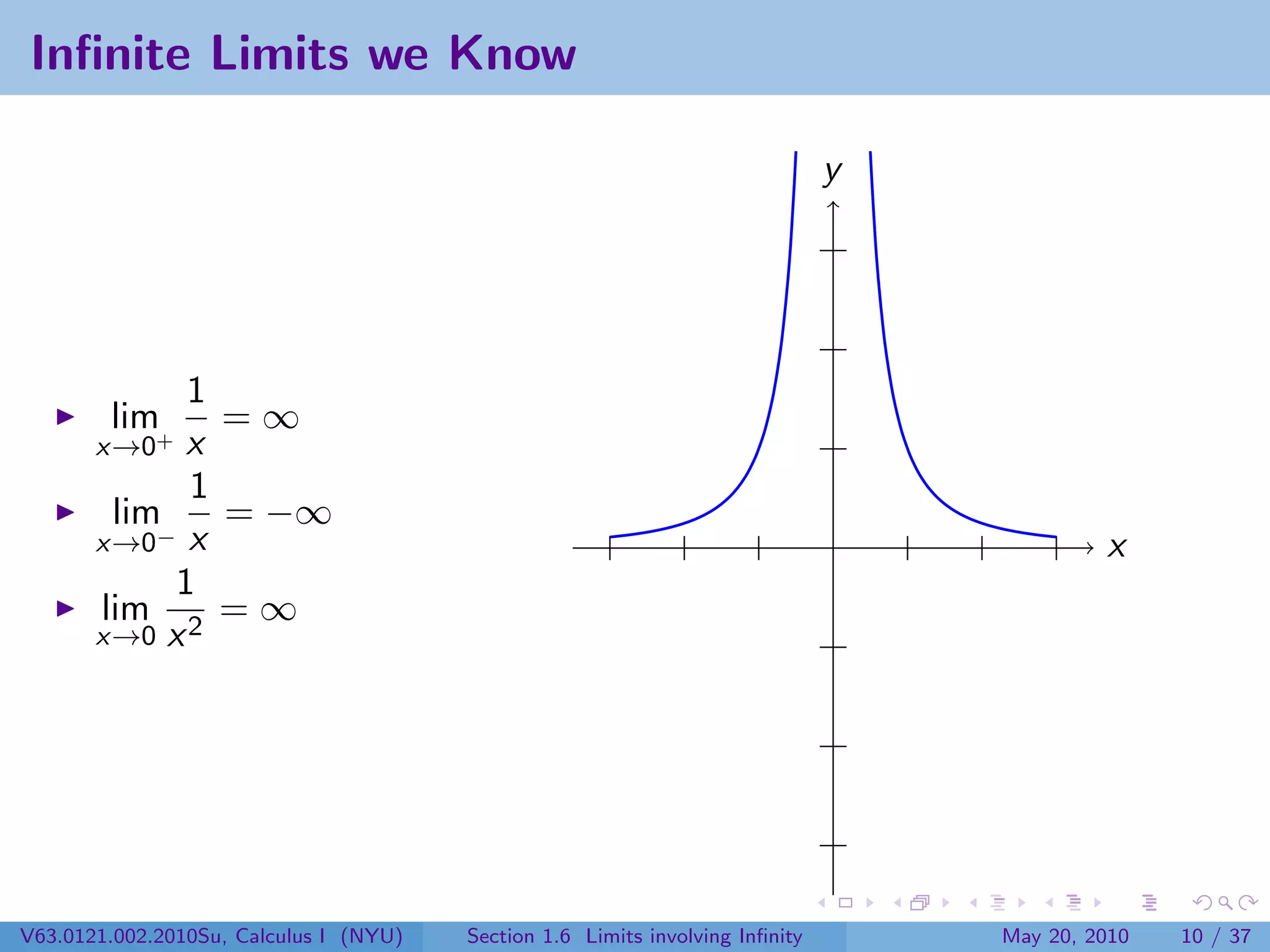
Infinite Limits we Know

                                                                               y


             1
        lim+   =∞
       x→0 x
             1
        lim    = −∞
           − x
       x→0                                                                                  x
            1
       lim 2 = ∞
       x→0 x


V63.0121.002.2010Su, Calculus I (NYU)   Section 1.6 Limits involving Infinity       May 20, 2010   10 / 37
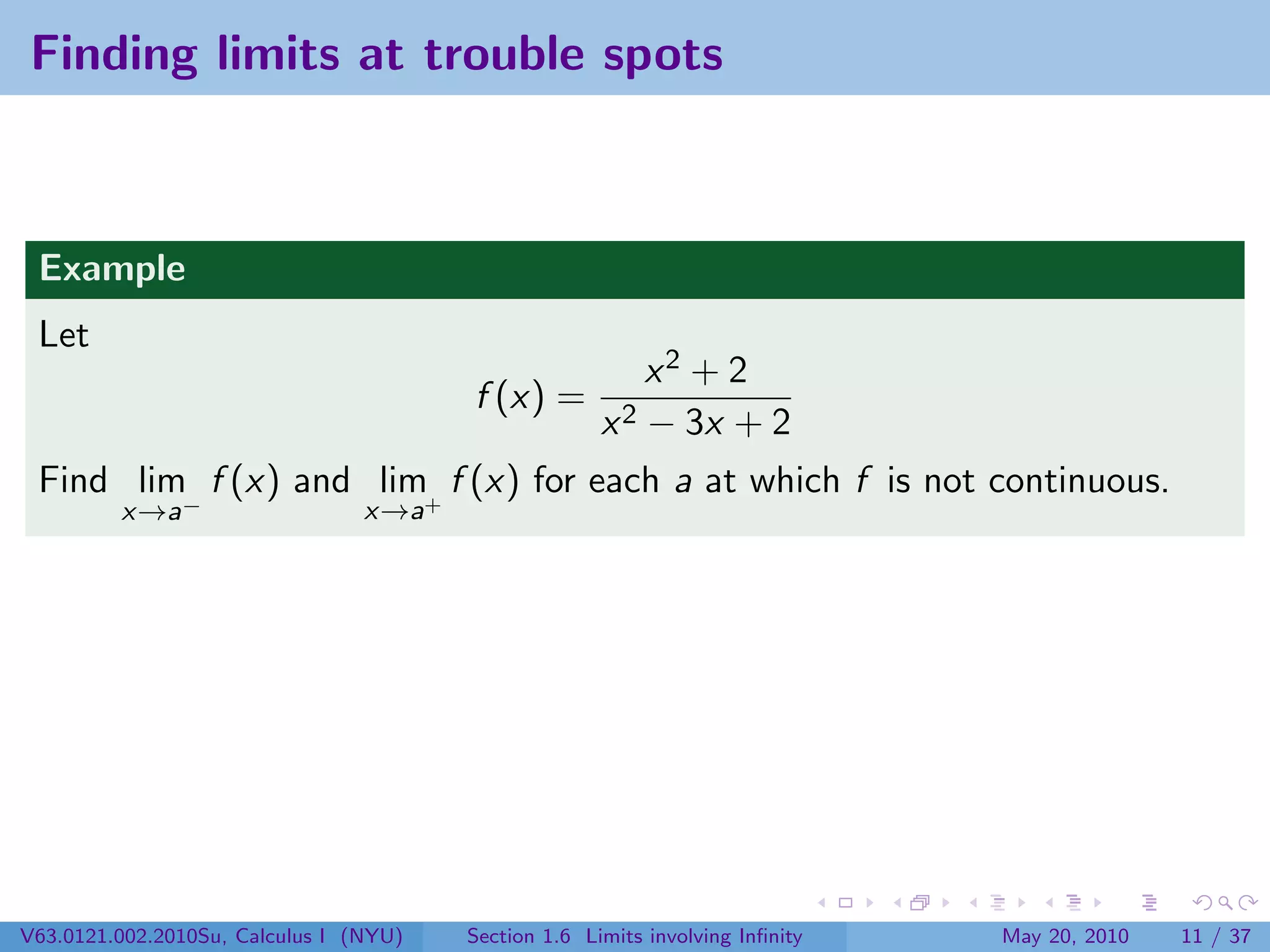
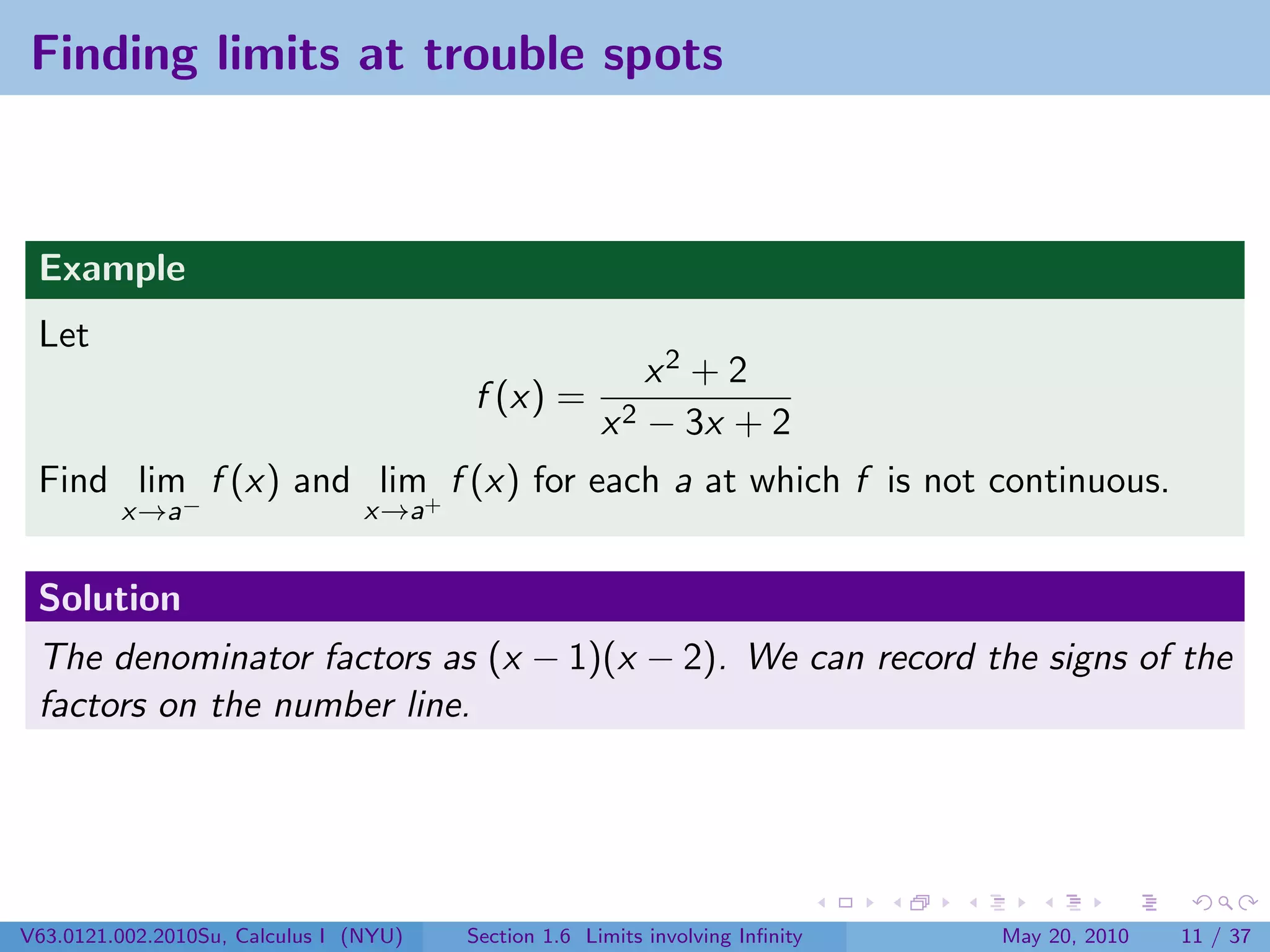
Finding limits at trouble spots


 Example
 Let
                                                          x2 + 2
                                        f (x) =
                                                      x 2 − 3x + 2
 Find lim f (x) and lim+ f (x) for each a at which f is not continuous.
         x→a−                    x→a


V63.0121.002.2010Su, Calculus I (NYU)   Section 1.6 Limits involving Infinity   May 20, 2010   11 / 37
Finding limits at trouble spots


 Example
 Let
                                                          x2 + 2
                                        f (x) =
                                                      x 2 − 3x + 2
 Find lim f (x) and lim+ f (x) for each a at which f is not continuous.
         x→a−                    x→a


 Solution
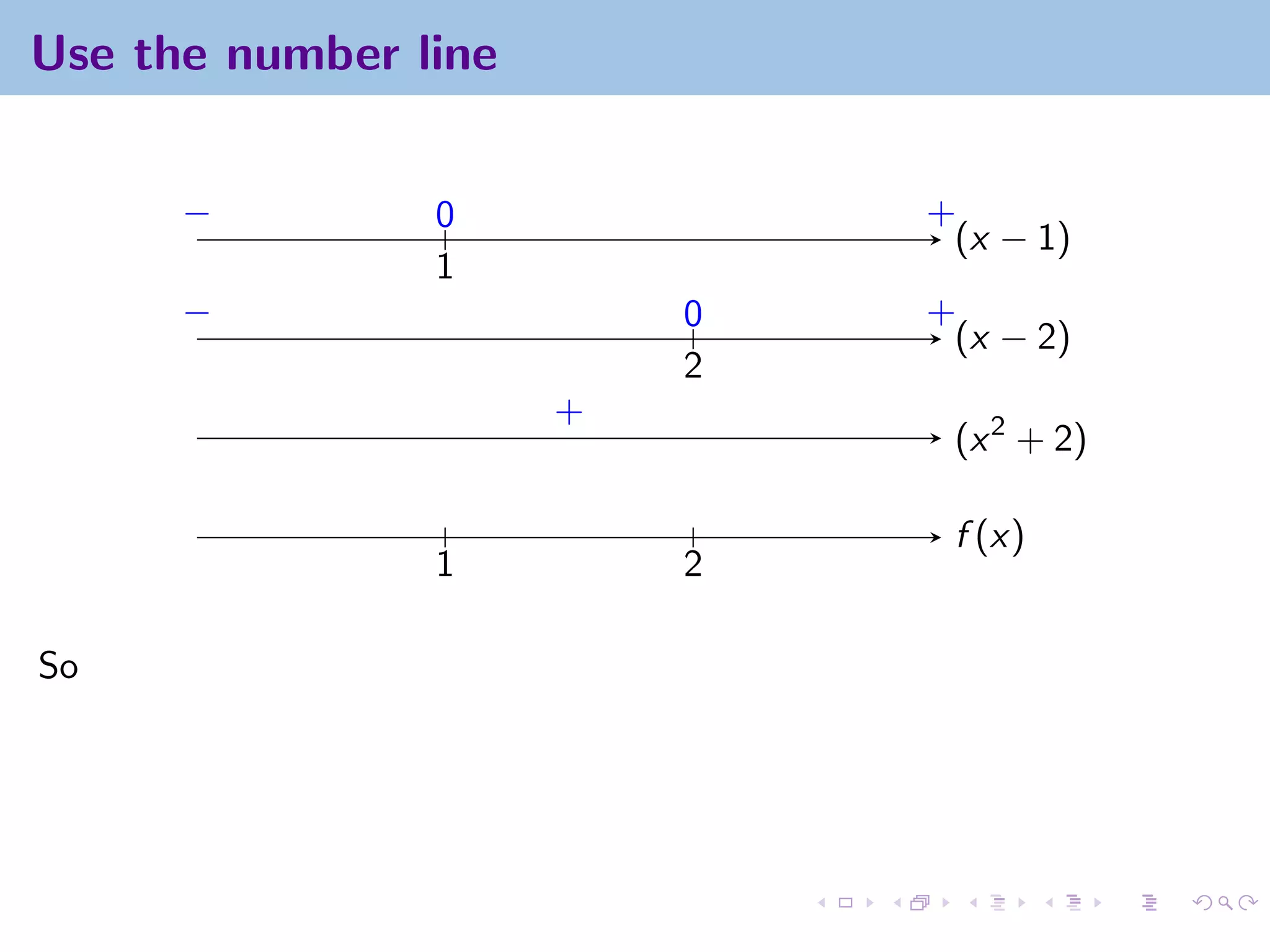
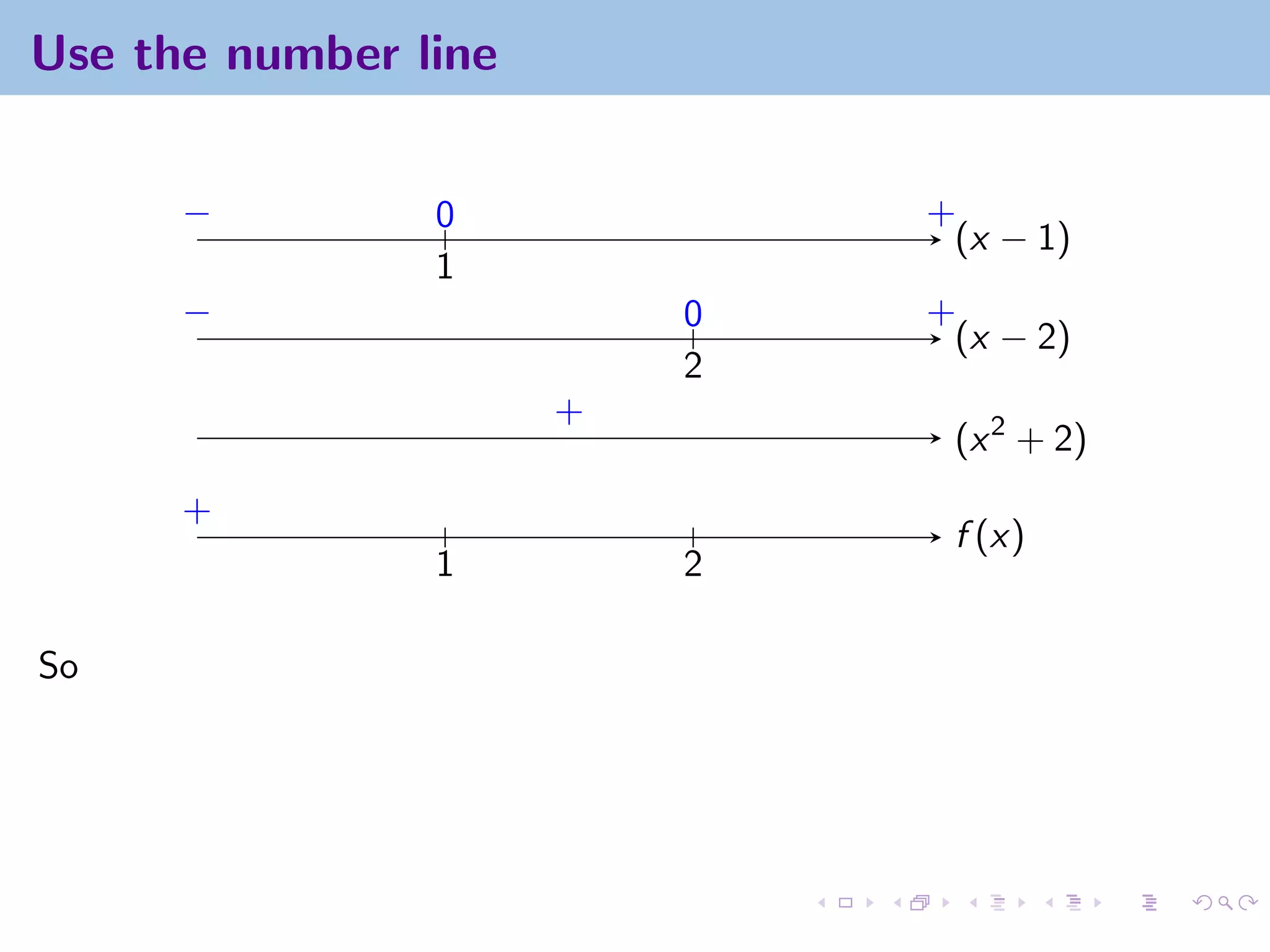
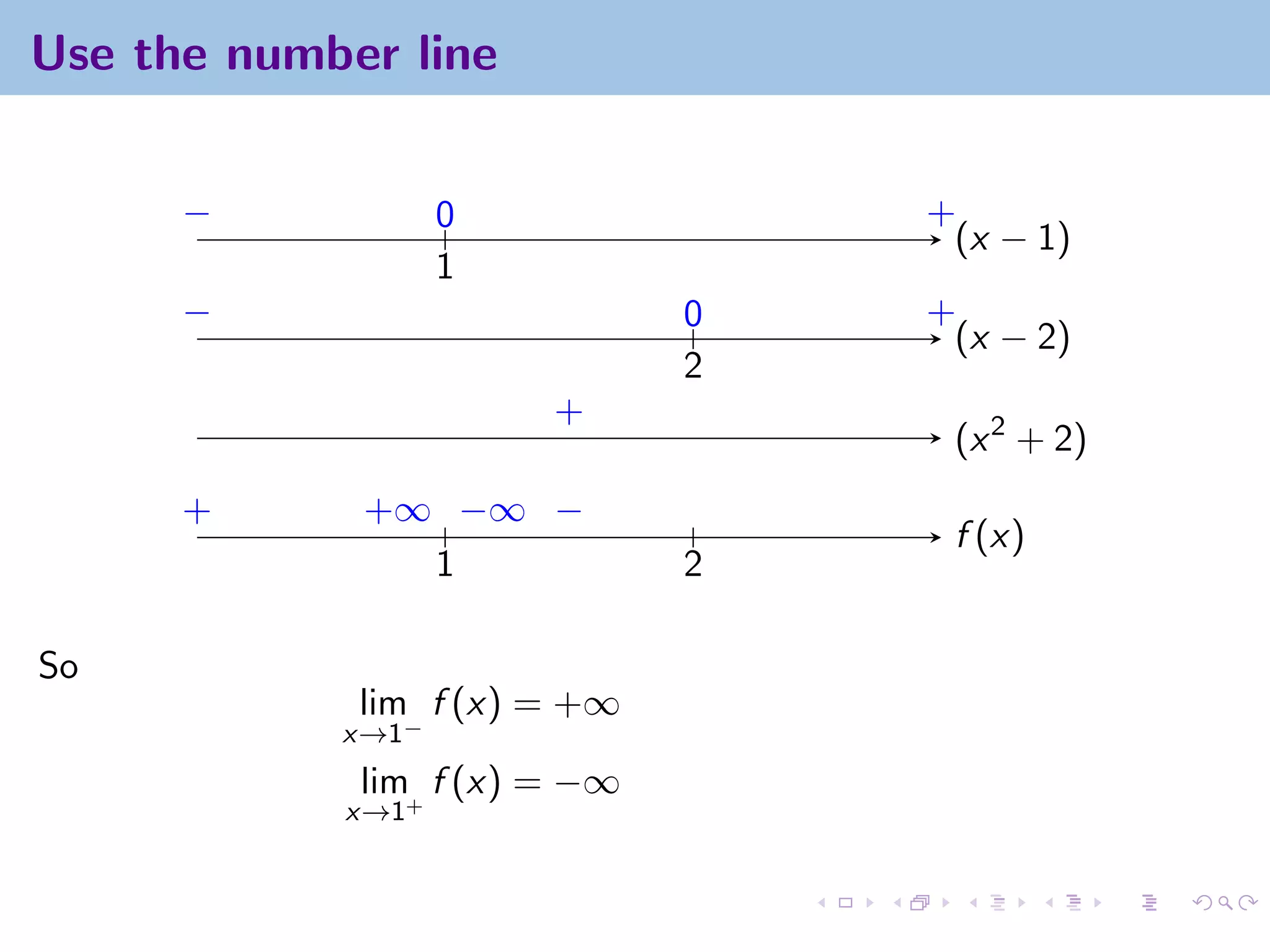
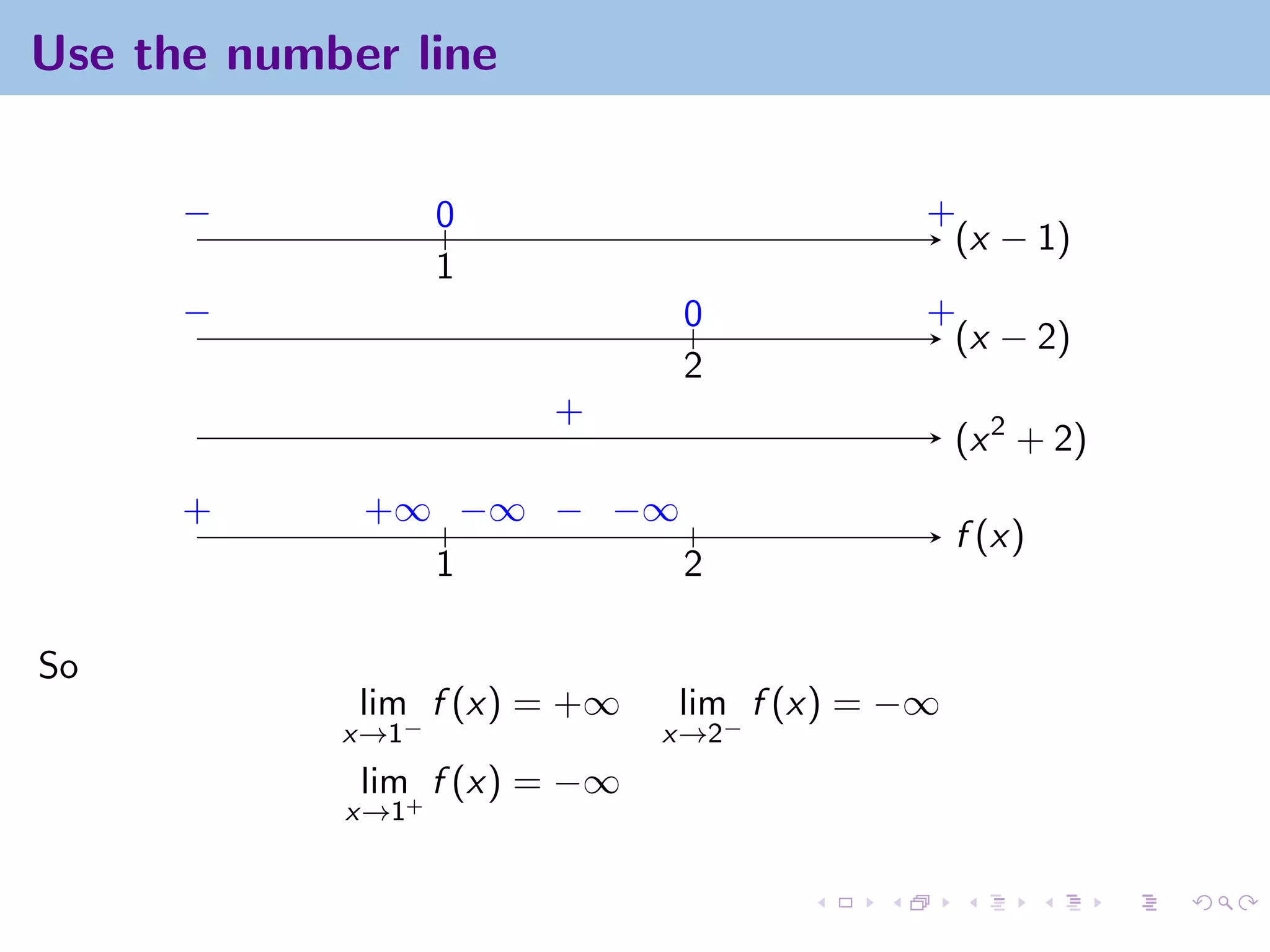
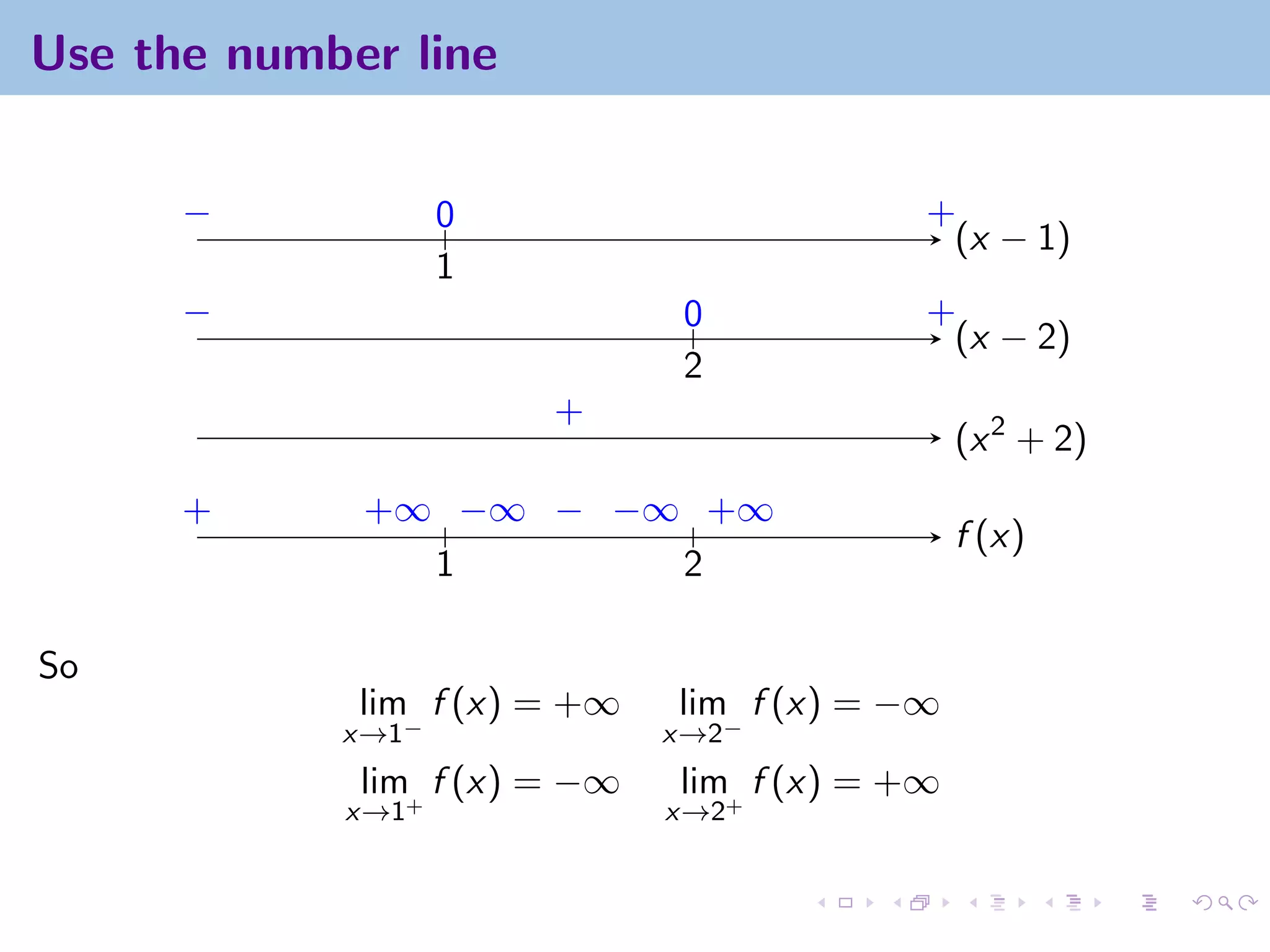
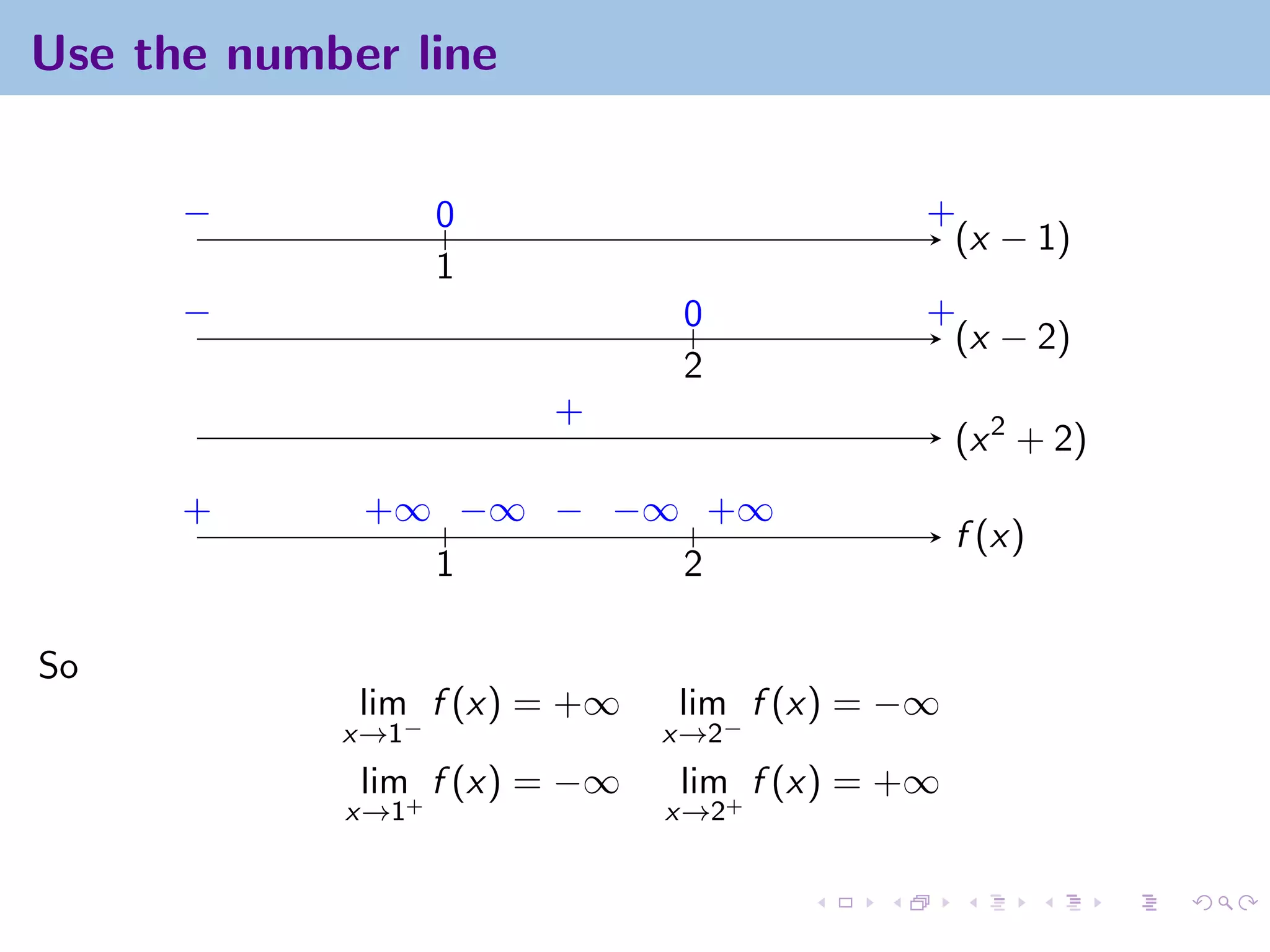
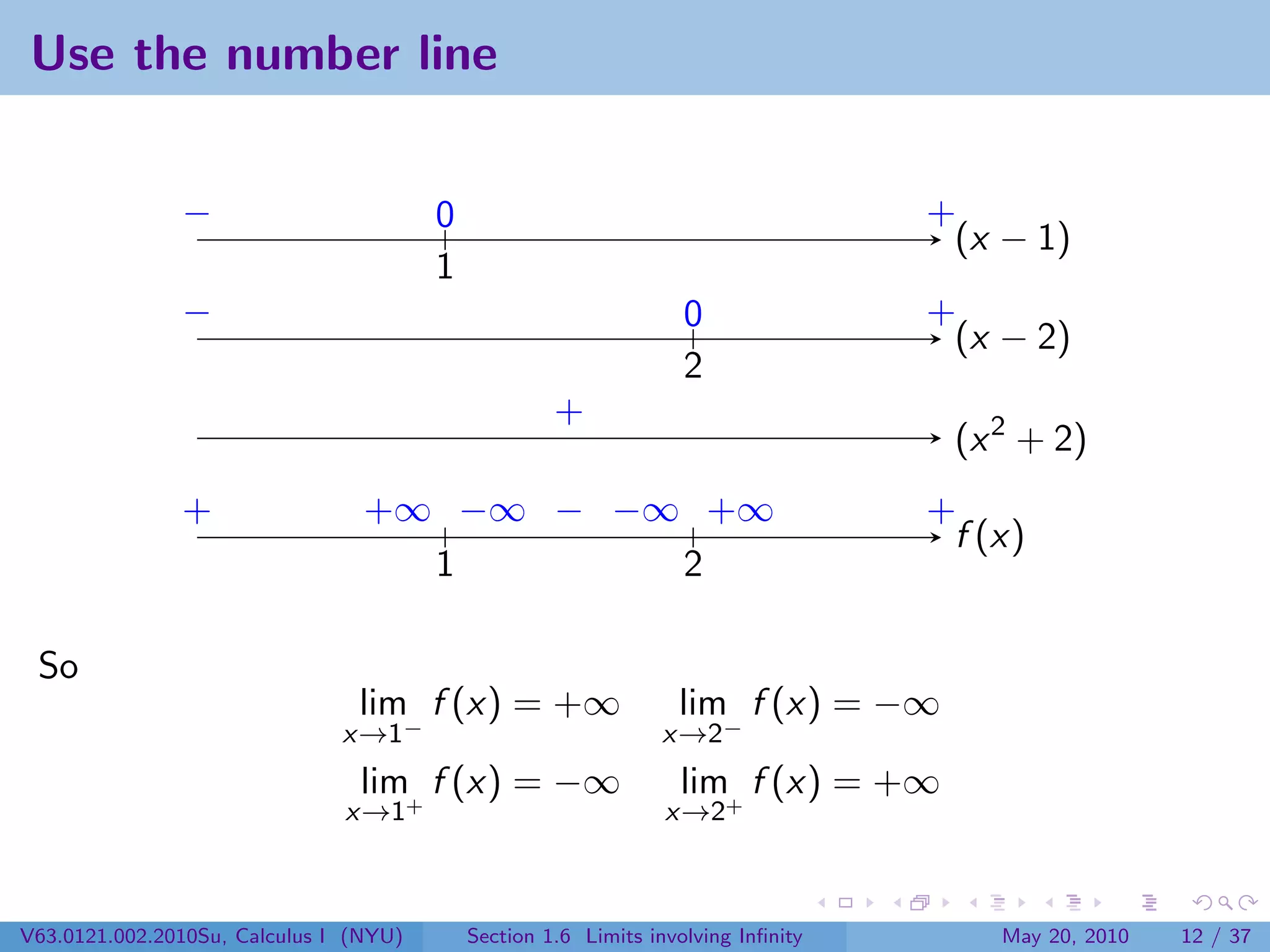
 The denominator factors as (x − 1)(x − 2). We can record the signs of the
 factors on the number line.


V63.0121.002.2010Su, Calculus I (NYU)   Section 1.6 Limits involving Infinity   May 20, 2010   11 / 37
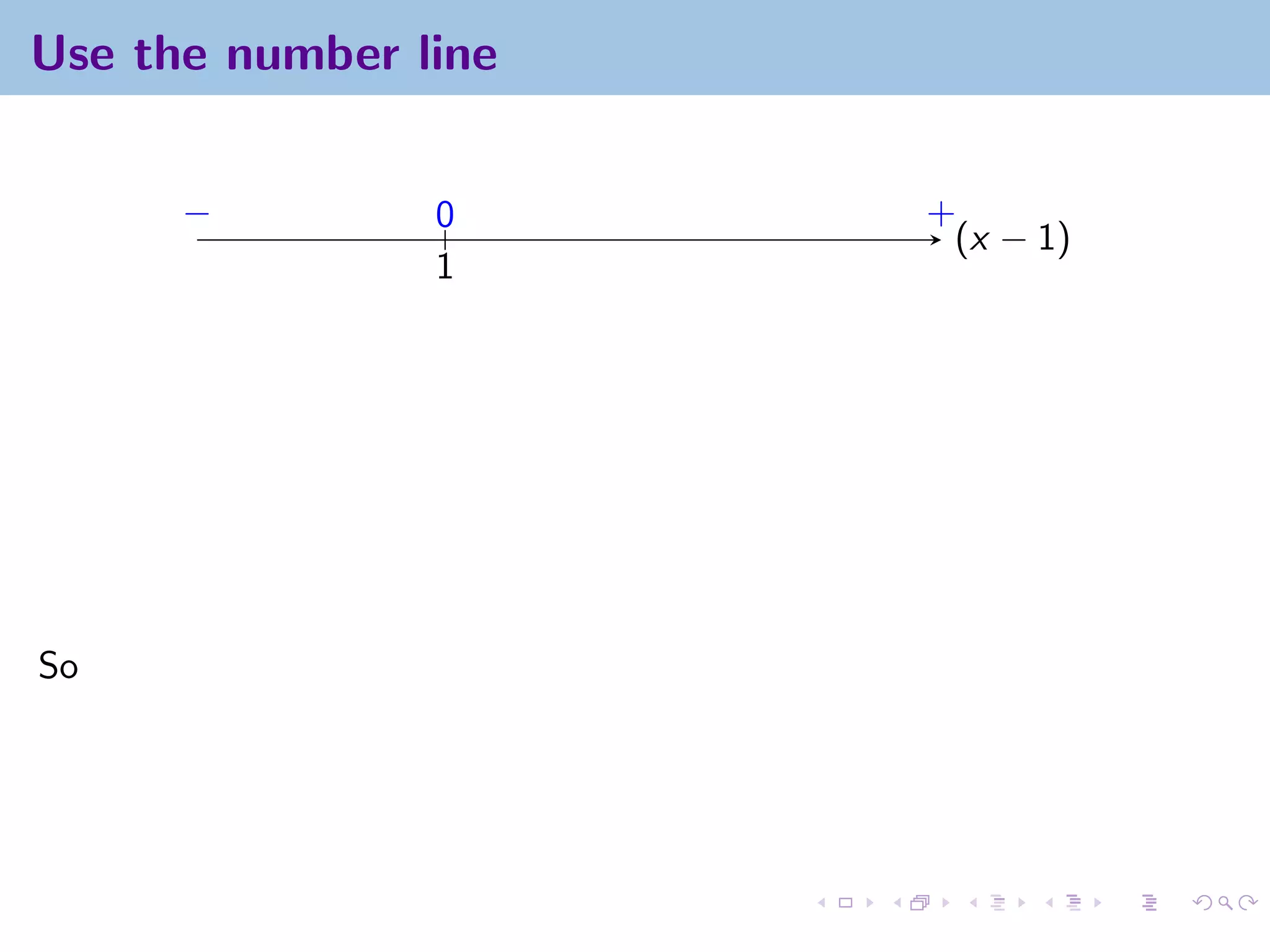
Use the number line


      −         0     +
                       (x − 1)
                1


So
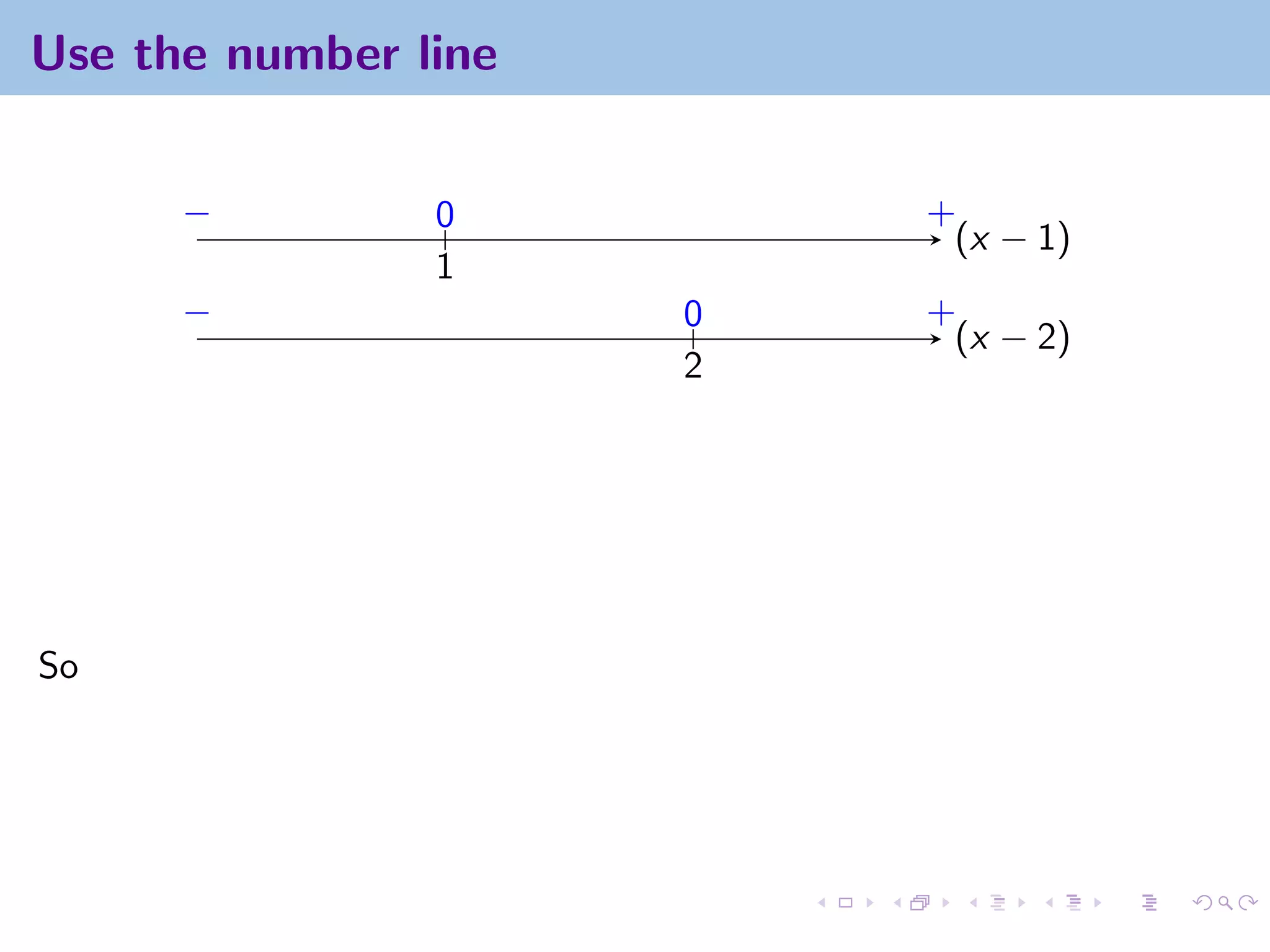
Use the number line


      −         0         +
                           (x − 1)
                1
      −               0   +
                           (x − 2)
                      2


So
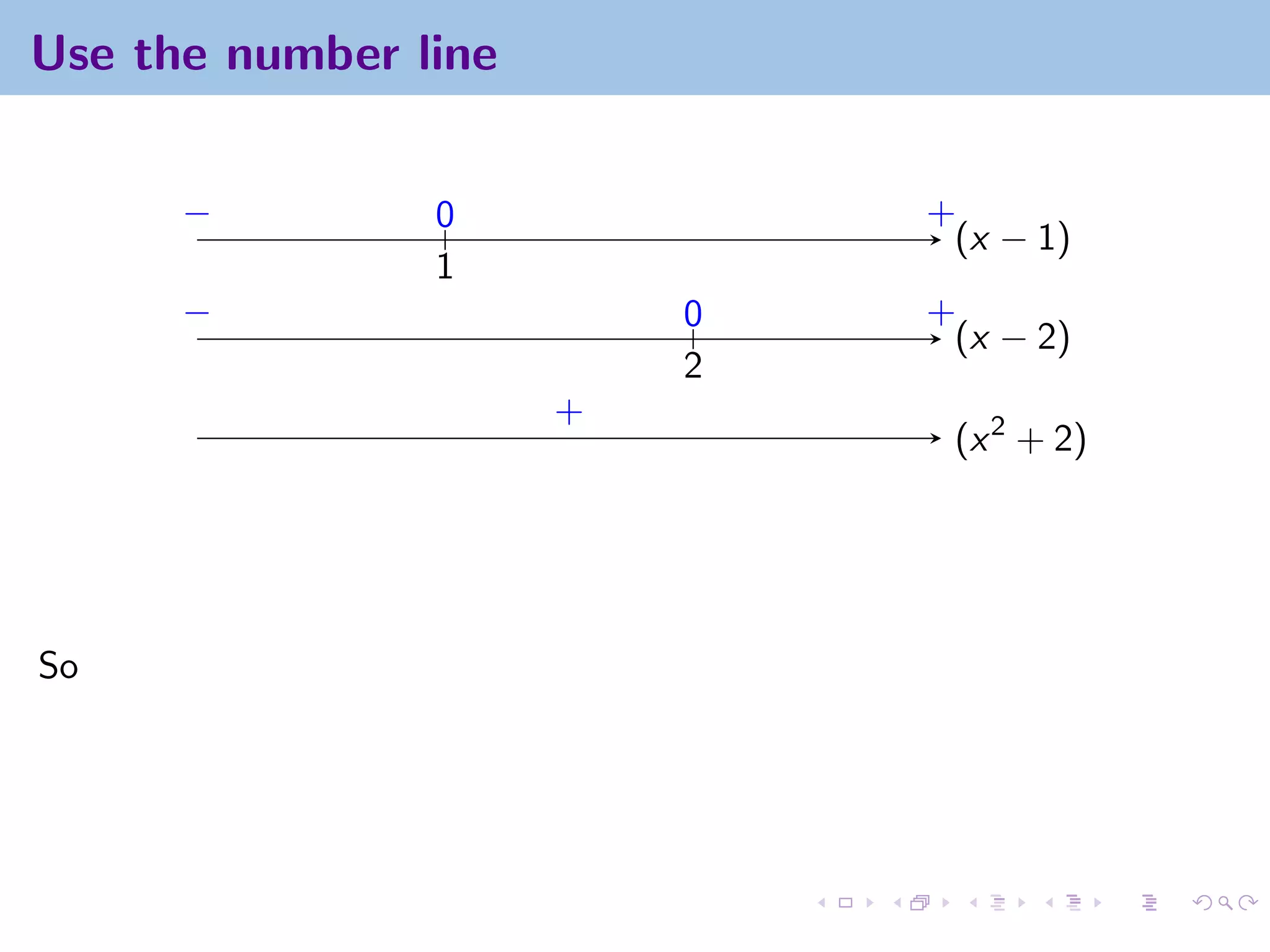
Use the number line


      −         0             +
                               (x − 1)
                1
      −                   0   +
                               (x − 2)
                          2
                      +
                               (x 2 + 2)


So
Use the number line


      −         0             +
                               (x − 1)
                1
      −                   0   +
                               (x − 2)
                          2
                      +
                               (x 2 + 2)

                               f (x)
                1         2

So
Use the number line


      −         0             +
                               (x − 1)
                1
      −                   0   +
                               (x − 2)
                          2
                      +
                               (x 2 + 2)
      +
                               f (x)
                1         2

So
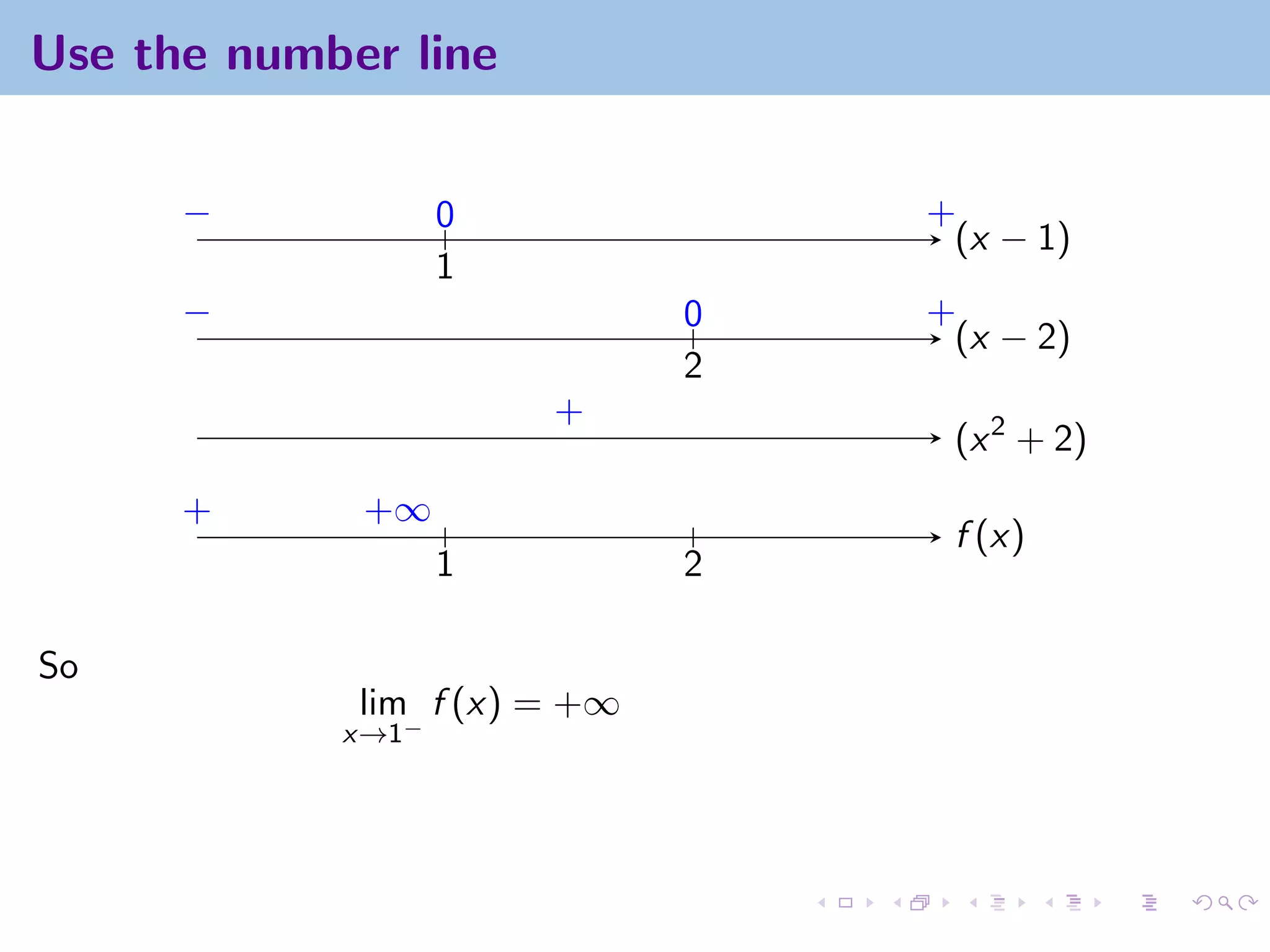
Use the number line


      −            0              +
                                   (x − 1)
                   1
      −                       0   +
                                   (x − 2)
                              2
                       +
                                   (x 2 + 2)
      +      +∞
                                   f (x)
                   1          2

So
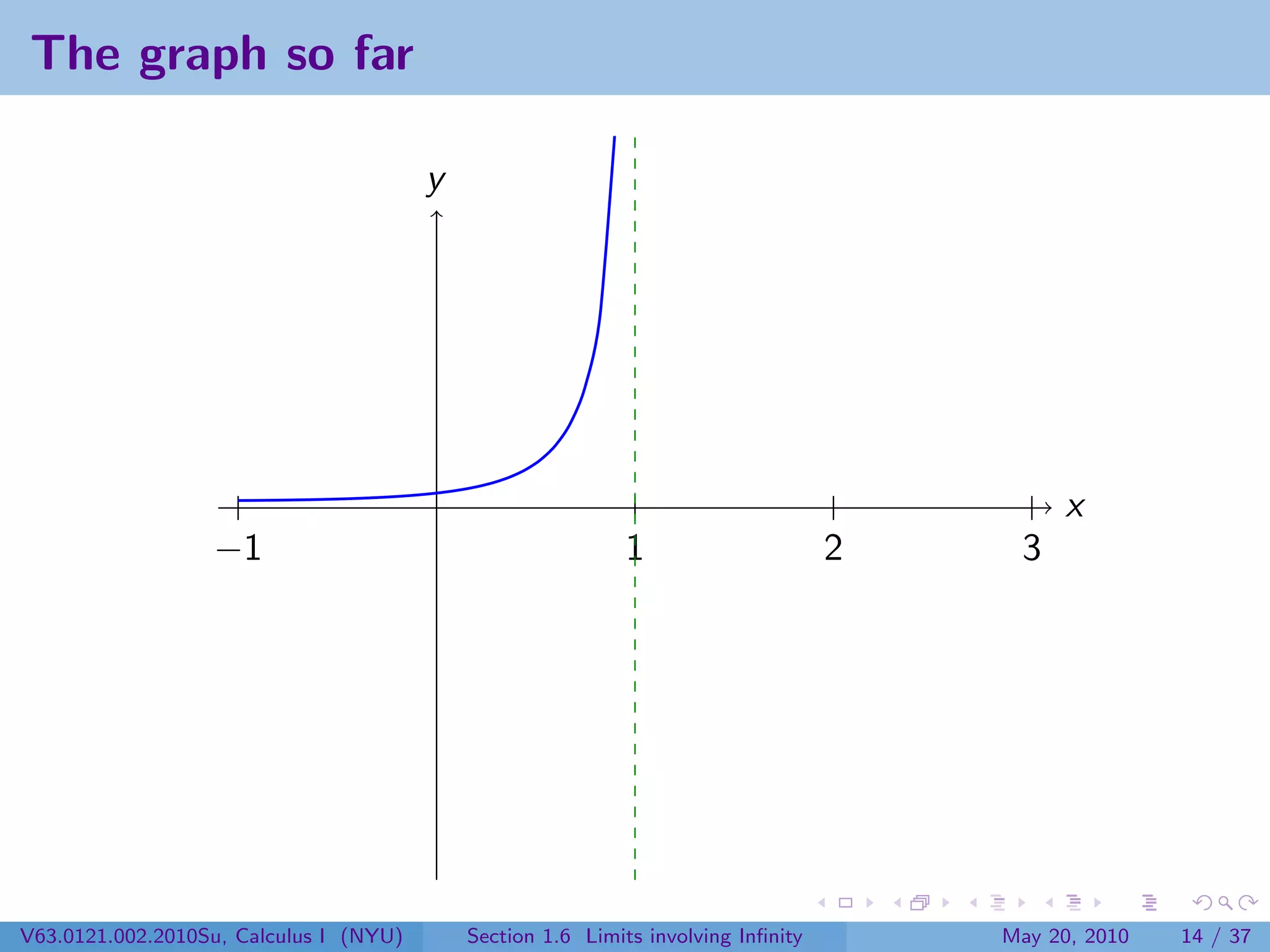
             lim f (x) = +∞
            x→1−
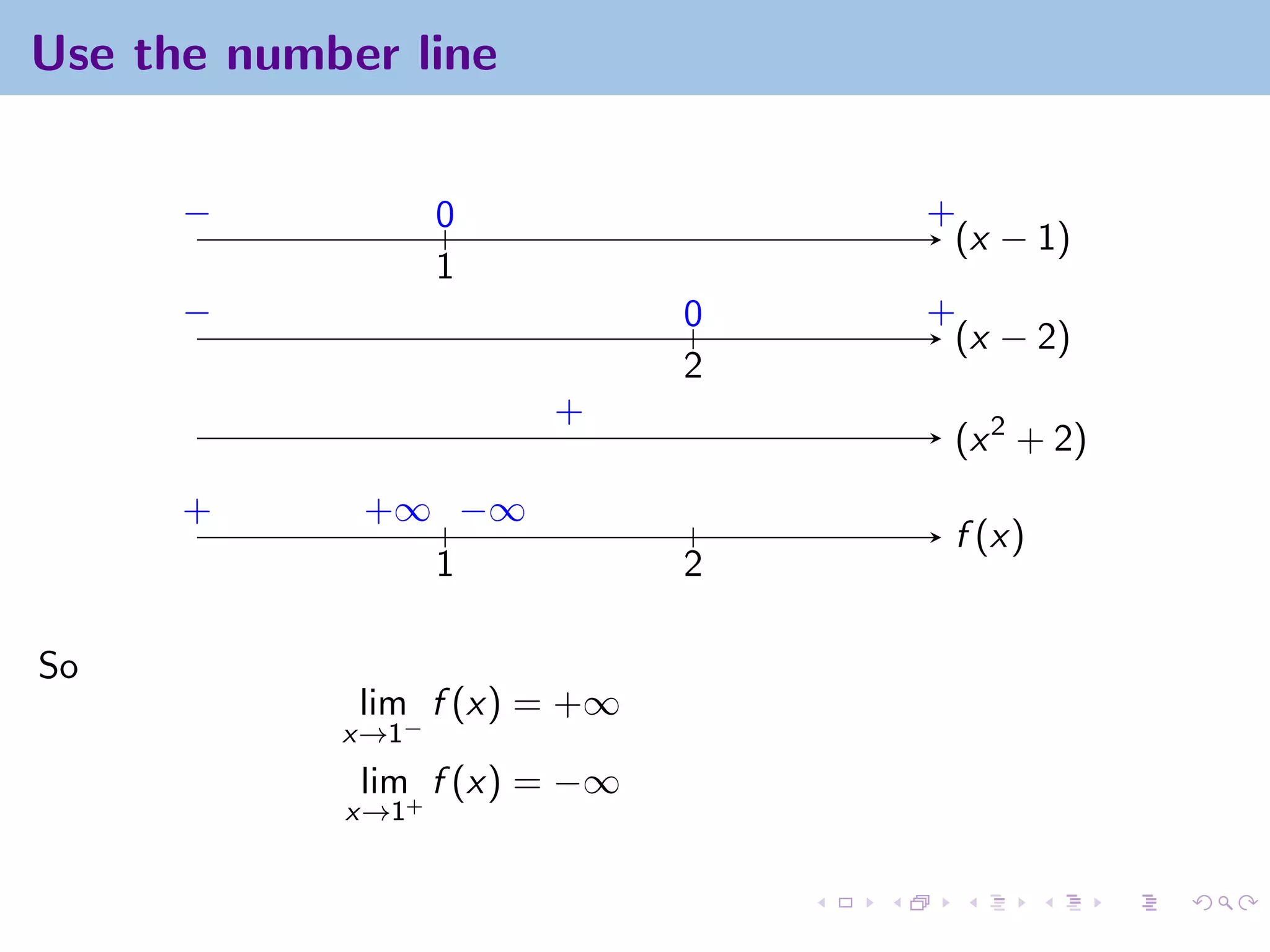
Use the number line


      −            0              +
                                   (x − 1)
                   1
      −                       0   +
                                   (x − 2)
                              2
                       +
                                   (x 2 + 2)
      +      +∞ −∞
                                   f (x)
               1              2

So
             lim f (x) = +∞
            x→1−
             lim f (x) = −∞
            x→1+
Use the number line


      −            0              +
                                   (x − 1)
                   1
      −                       0   +
                                   (x − 2)
                              2
                       +
                                   (x 2 + 2)
      +      +∞ −∞ −
                                   f (x)
               1              2

So
             lim f (x) = +∞
            x→1−
             lim f (x) = −∞
            x→1+
Use the number line


      −            0                       +
                                            (x − 1)
                   1
      −                        0           +
                                            (x − 2)
                               2
                       +
                                               (x 2 + 2)
      +      +∞ −∞ − −∞
                                               f (x)
               1        2

So
             lim f (x) = +∞   lim f (x) = −∞
            x→1−              x→2−
             lim f (x) = −∞
            x→1+
Use the number line


      −            0                       +
                                            (x − 1)
                   1
      −                        0           +
                                            (x − 2)
                               2
                       +
                                               (x 2 + 2)
      +      +∞ −∞ − −∞ +∞
                                               f (x)
               1       2

So
             lim f (x) = +∞   lim f (x) = −∞
            x→1−              x→2−
             lim f (x) = −∞   lim f (x) = +∞
            x→1+              x→2+
Use the number line


      −            0                       +
                                            (x − 1)
                   1
      −                        0           +
                                            (x − 2)
                               2
                       +
                                               (x 2 + 2)
      +      +∞ −∞ − −∞ +∞
                                               f (x)
               1       2

So
             lim f (x) = +∞   lim f (x) = −∞
            x→1−              x→2−
             lim f (x) = −∞   lim f (x) = +∞
            x→1+              x→2+
Use the number line


               −                        0                                          +
                                                                                    (x − 1)
                                        1
               −                                                   0               +
                                                                                    (x − 2)
                                                                   2
                                                     +
                                                                                    (x 2 + 2)
               +                 +∞ −∞ − −∞ +∞                                     +
                                                                                    f (x)
                                   1       2

 So
                                lim f (x) = +∞                    lim f (x) = −∞
                               x→1−                             x→2−
                                lim f (x) = −∞                    lim f (x) = +∞
                               x→1+                              x→2+


V63.0121.002.2010Su, Calculus I (NYU)       Section 1.6 Limits involving Infinity       May 20, 2010   12 / 37
In English, now


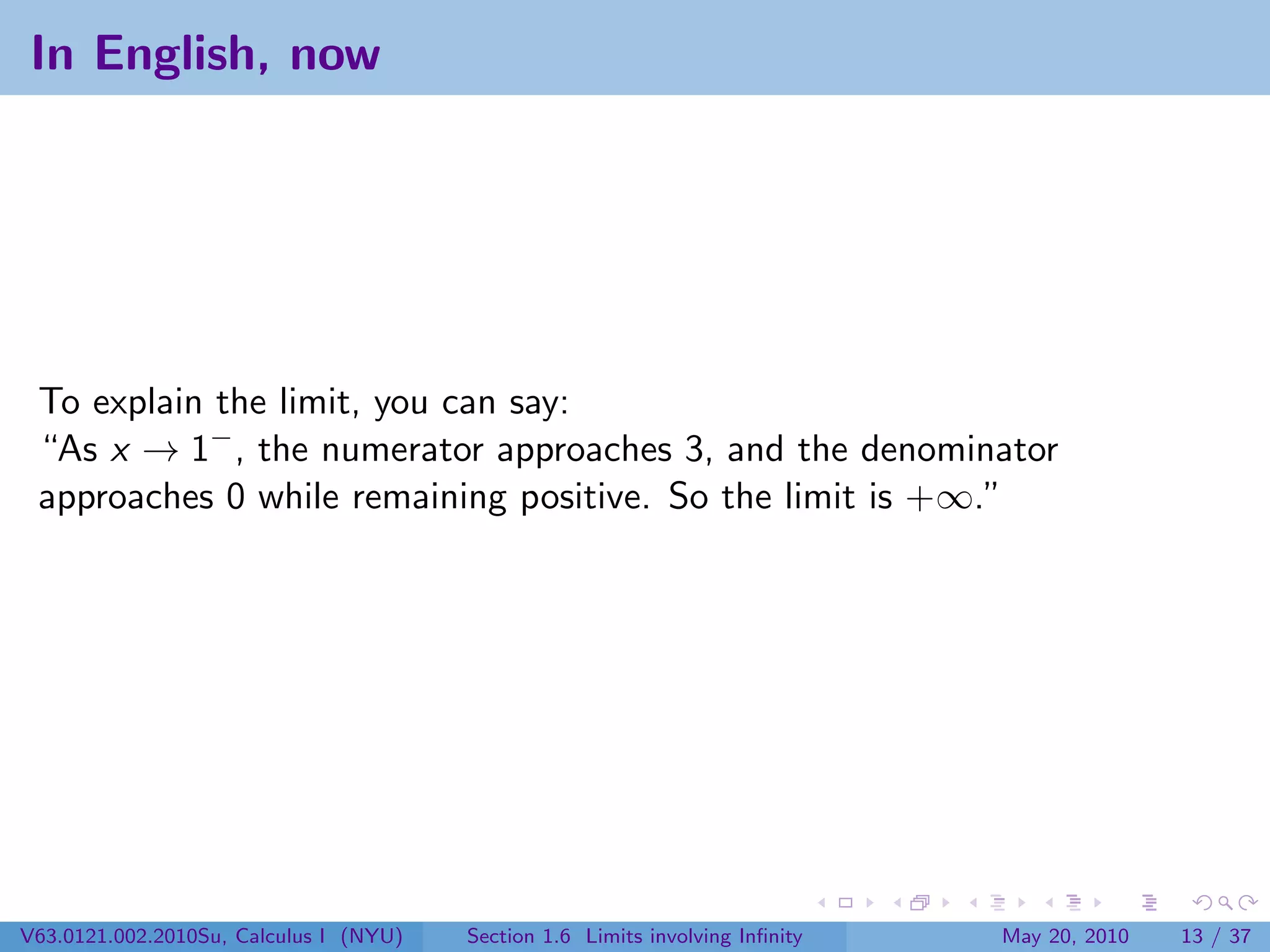
 To explain the limit, you can say:
 “As x → 1− , the numerator approaches 3, and the denominator
 approaches 0 while remaining positive. So the limit is +∞.”


V63.0121.002.2010Su, Calculus I (NYU)   Section 1.6 Limits involving Infinity   May 20, 2010   13 / 37
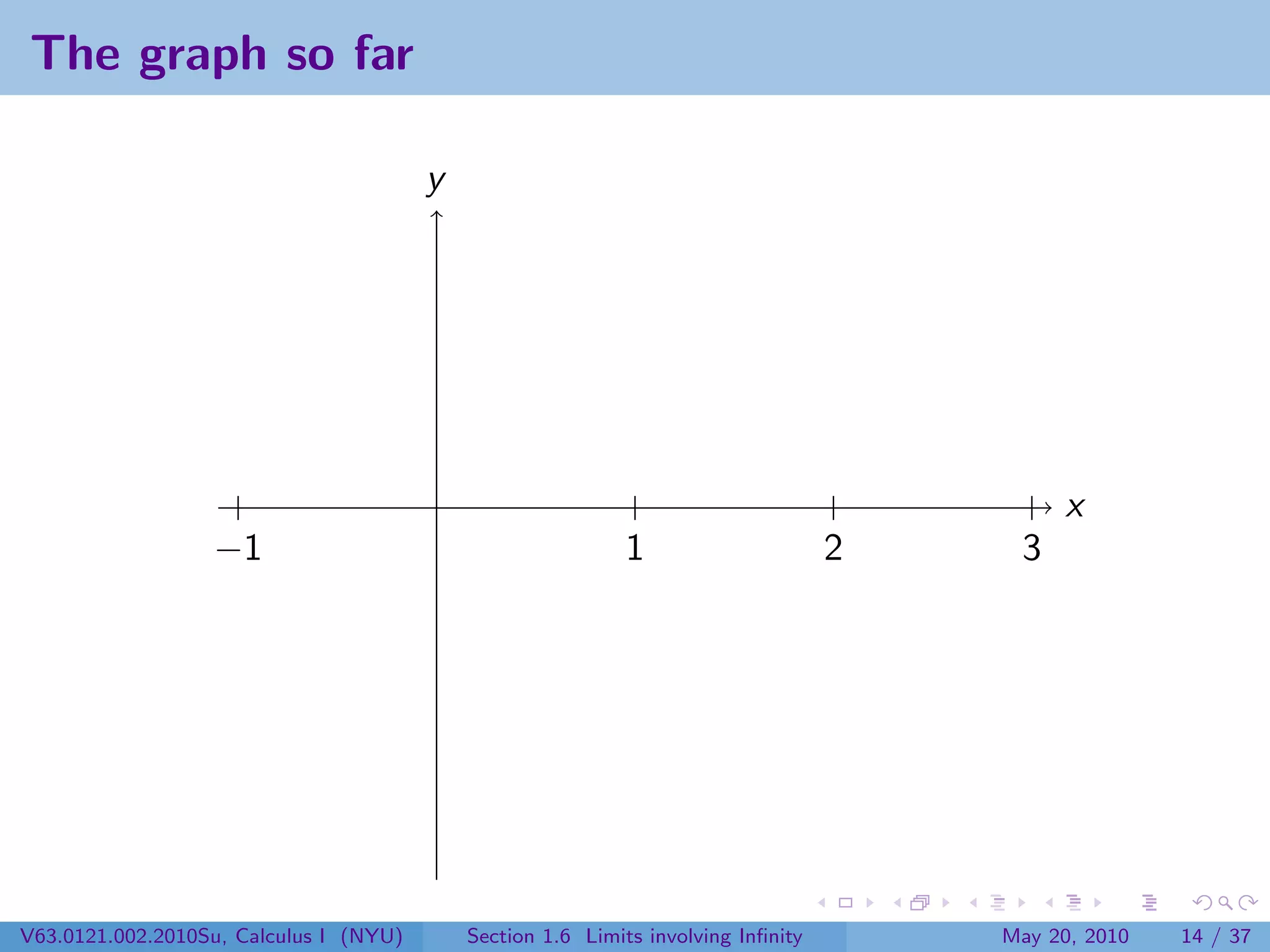
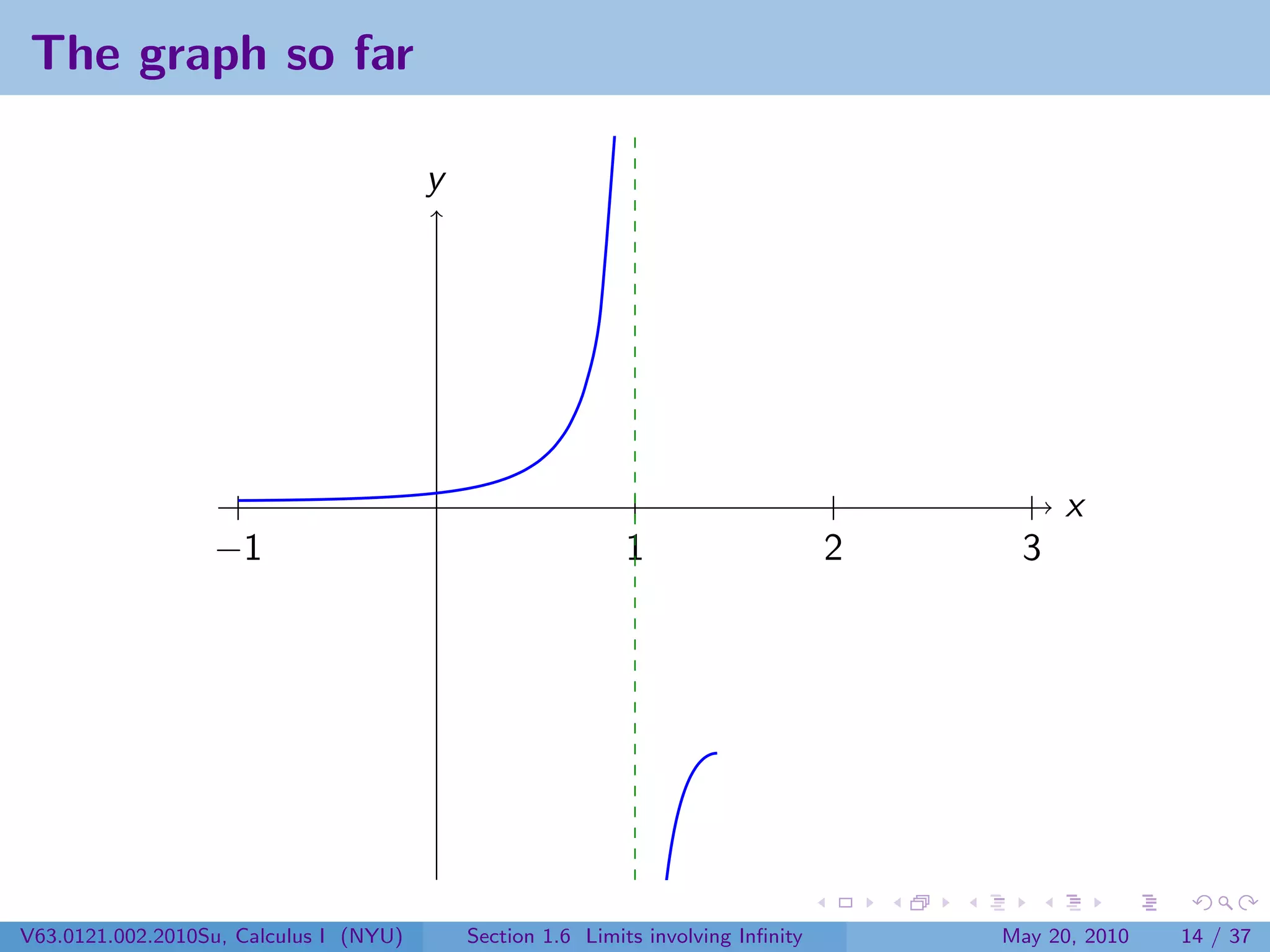
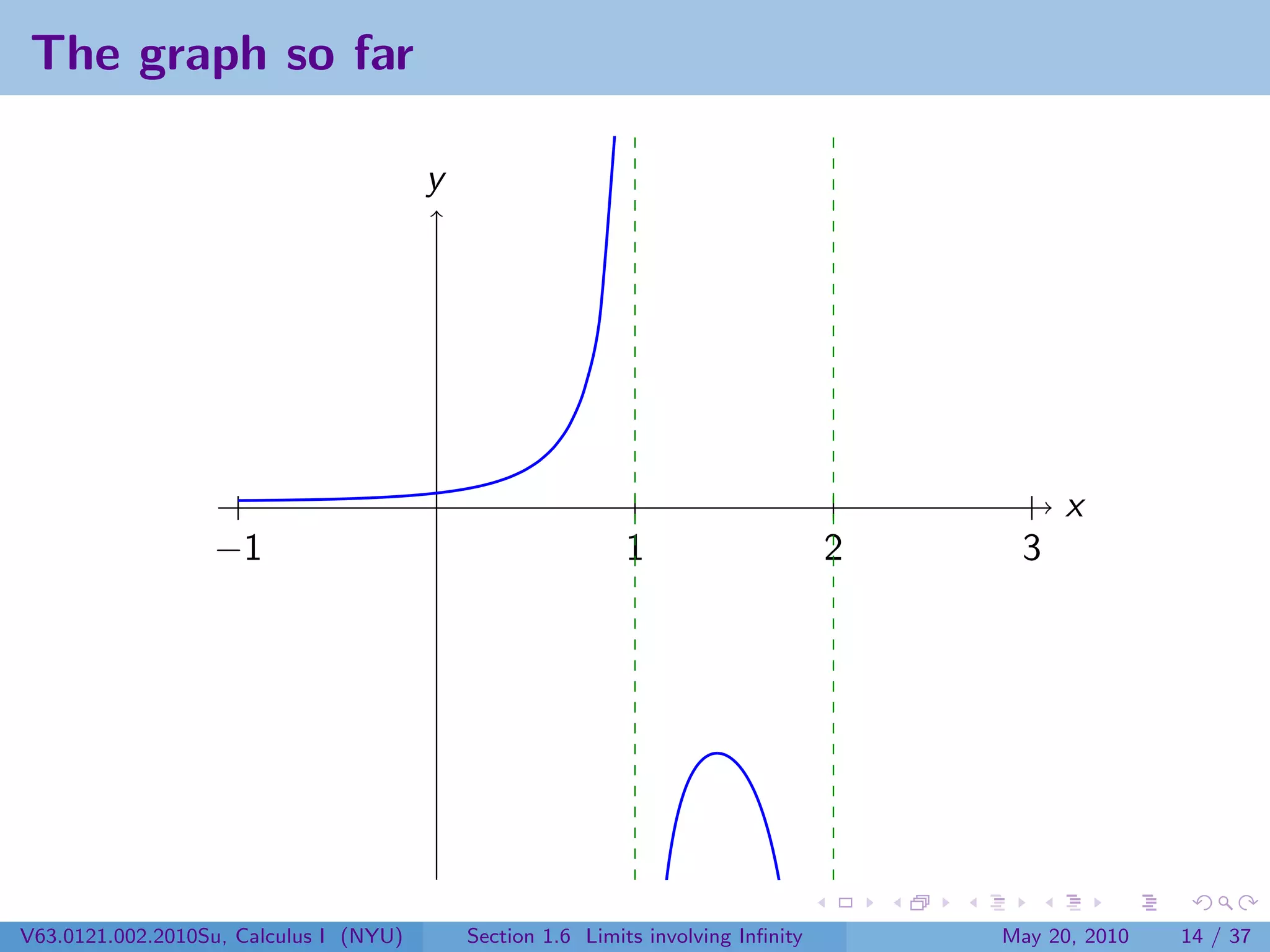
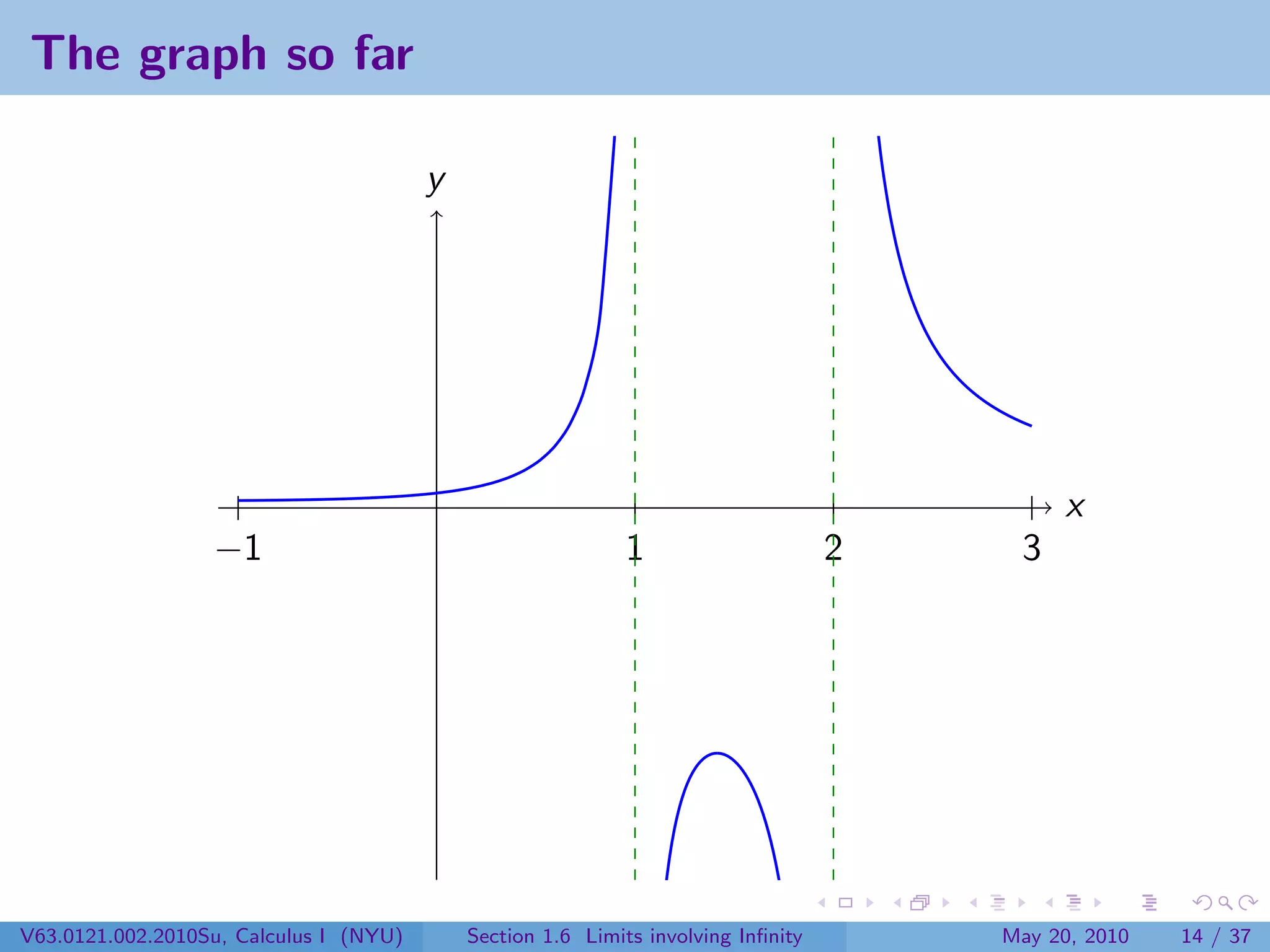
The graph so far

                                        y


                                                                                            x
                  −1                                        1                      2    3


V63.0121.002.2010Su, Calculus I (NYU)       Section 1.6 Limits involving Infinity       May 20, 2010   14 / 37
The graph so far

                                        y


                                                                                            x
                  −1                                        1                      2    3


V63.0121.002.2010Su, Calculus I (NYU)       Section 1.6 Limits involving Infinity       May 20, 2010   14 / 37
The graph so far

                                        y


                                                                                            x
                  −1                                        1                      2    3


V63.0121.002.2010Su, Calculus I (NYU)       Section 1.6 Limits involving Infinity       May 20, 2010   14 / 37
The graph so far

                                        y


                                                                                            x
                  −1                                        1                      2    3


V63.0121.002.2010Su, Calculus I (NYU)       Section 1.6 Limits involving Infinity       May 20, 2010   14 / 37
The graph so far

                                        y


                                                                                            x
                  −1                                        1                      2    3


V63.0121.002.2010Su, Calculus I (NYU)       Section 1.6 Limits involving Infinity       May 20, 2010   14 / 37
Limit Laws (?) with infinite limits


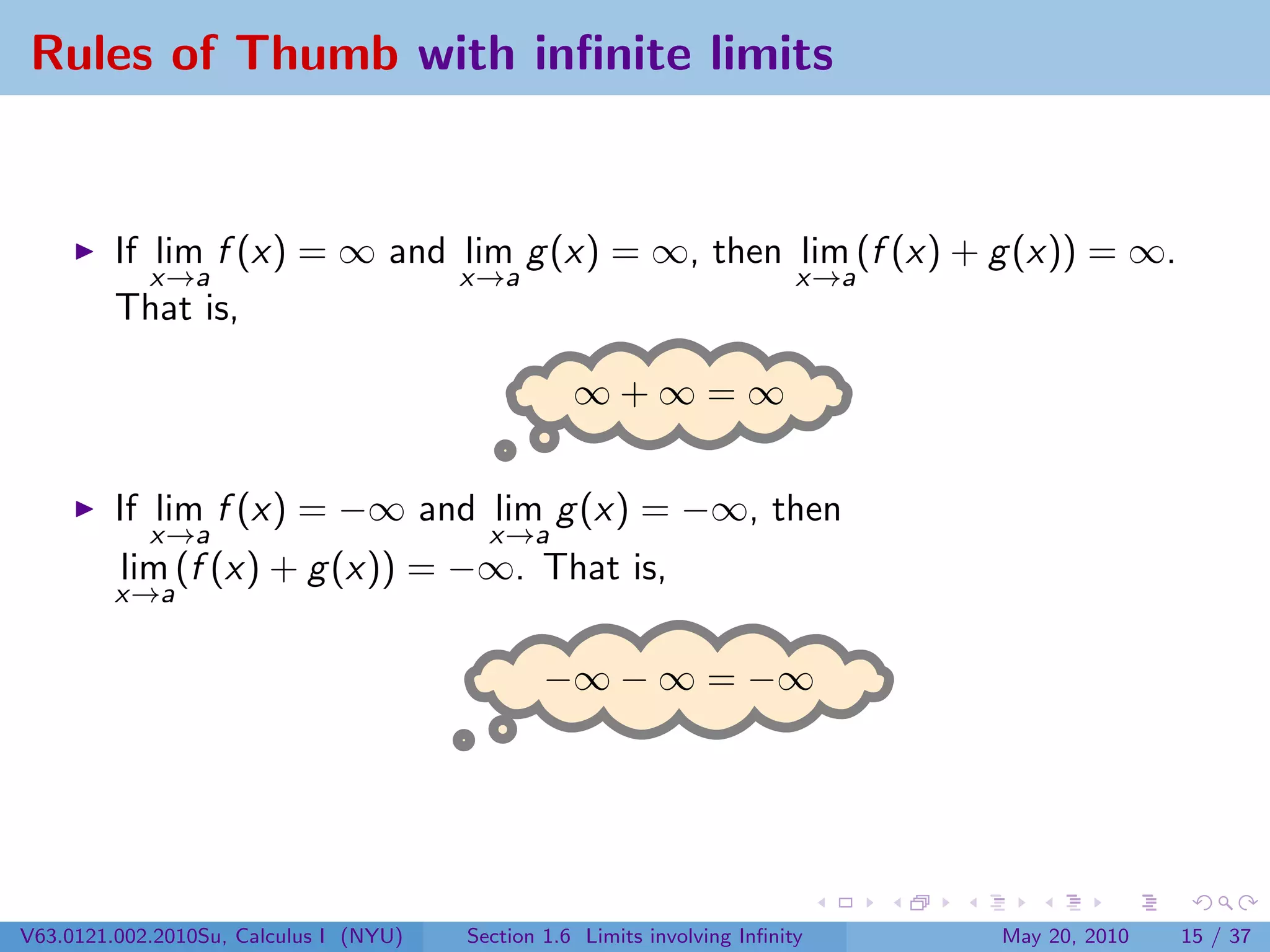
         If lim f (x) = ∞ and lim g (x) = ∞, then lim (f (x) + g (x)) = ∞.
            x→a               x→a                 x→a
         That is,

                                                   ∞+∞=∞


         If lim f (x) = −∞ and lim g (x) = −∞, then
            x→a                           x→a
         lim (f (x) + g (x)) = −∞. That is,
         x→a


                                                −∞ − ∞ = −∞


V63.0121.002.2010Su, Calculus I (NYU)   Section 1.6 Limits involving Infinity   May 20, 2010   15 / 37
Rules of Thumb with infinite limits


         If lim f (x) = ∞ and lim g (x) = ∞, then lim (f (x) + g (x)) = ∞.
            x→a               x→a                 x→a
         That is,

                                                   ∞+∞=∞


         If lim f (x) = −∞ and lim g (x) = −∞, then
            x→a                           x→a
         lim (f (x) + g (x)) = −∞. That is,
         x→a


                                                −∞ − ∞ = −∞


V63.0121.002.2010Su, Calculus I (NYU)   Section 1.6 Limits involving Infinity   May 20, 2010   15 / 37
Rules of Thumb with infinite limits


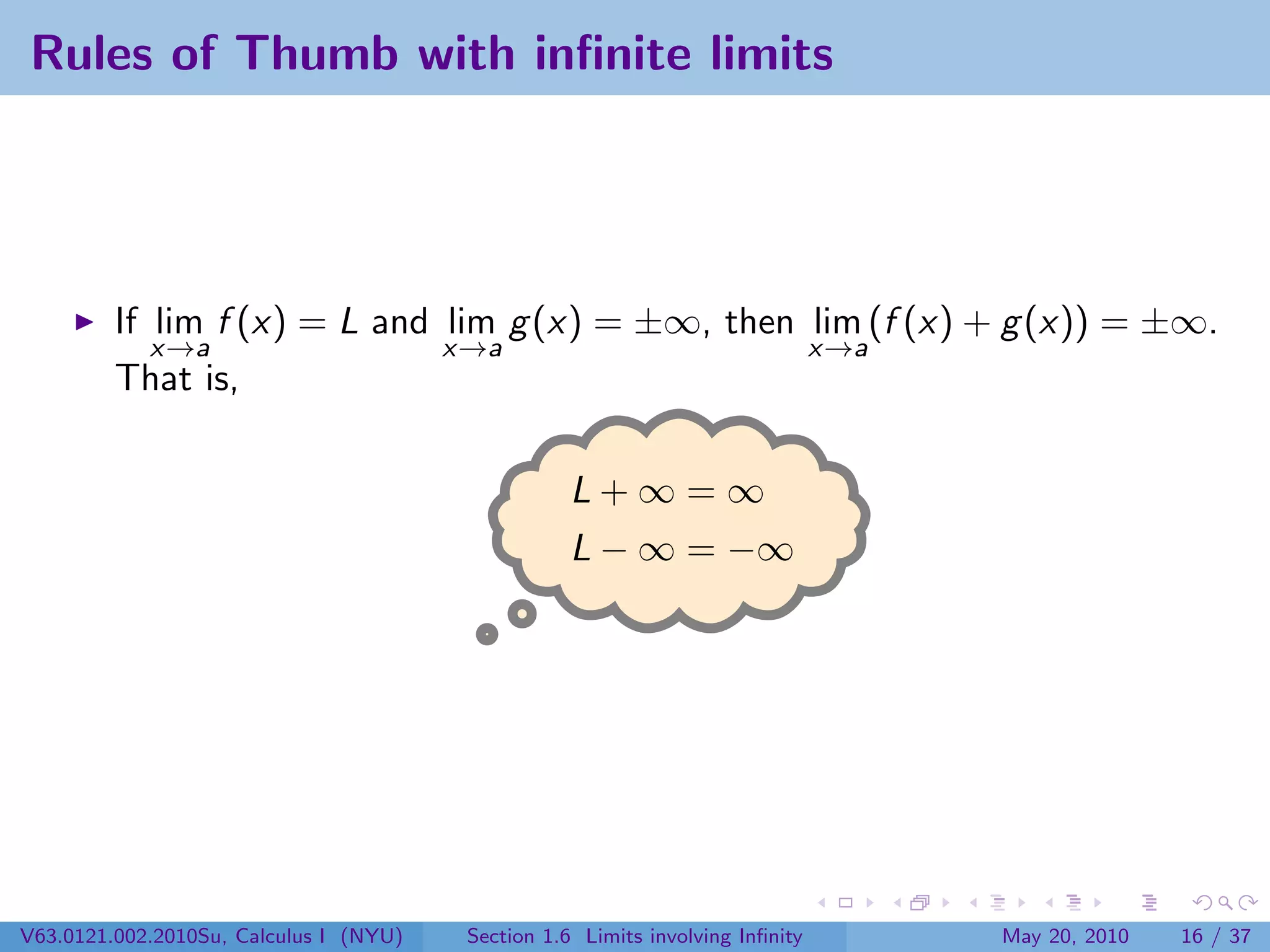
         If lim f (x) = L and lim g (x) = ±∞, then lim (f (x) + g (x)) = ±∞.
            x→a               x→a                  x→a
         That is,

                                                   L+∞=∞
                                                   L − ∞ = −∞


V63.0121.002.2010Su, Calculus I (NYU)   Section 1.6 Limits involving Infinity   May 20, 2010   16 / 37
Rules of Thumb with infinite limits
Kids, don’t try this at home!


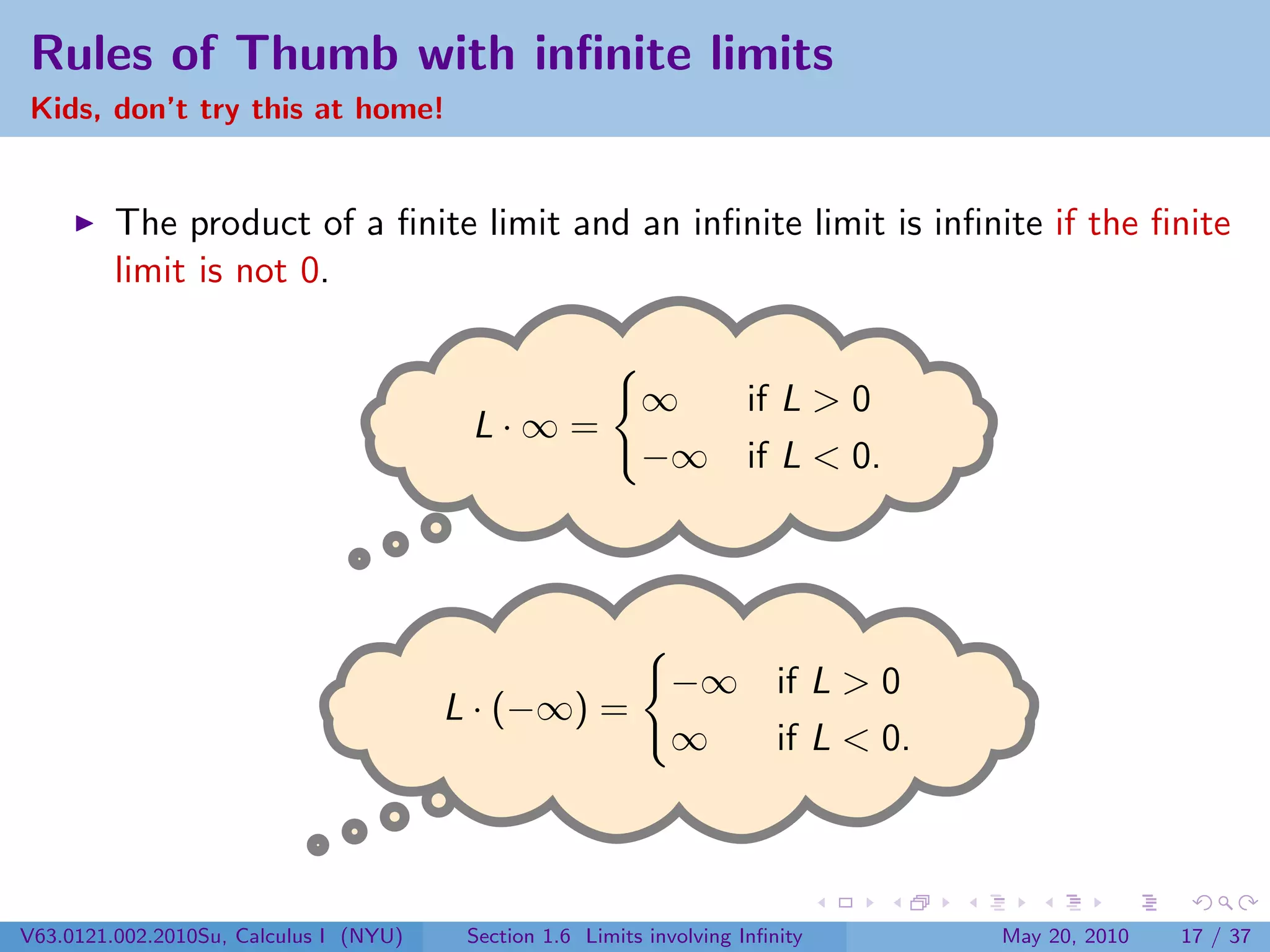
         The product of a finite limit and an infinite limit is infinite if the finite
         limit is not 0.


                                                           ∞  if L > 0
                                         L·∞=
                                                           −∞ if L < 0.


                                                              −∞ if L > 0
                                        L · (−∞) =
                                                              ∞  if L < 0.


V63.0121.002.2010Su, Calculus I (NYU)    Section 1.6 Limits involving Infinity   May 20, 2010   17 / 37
Multiplying infinite limits
Kids, don’t try this at home!


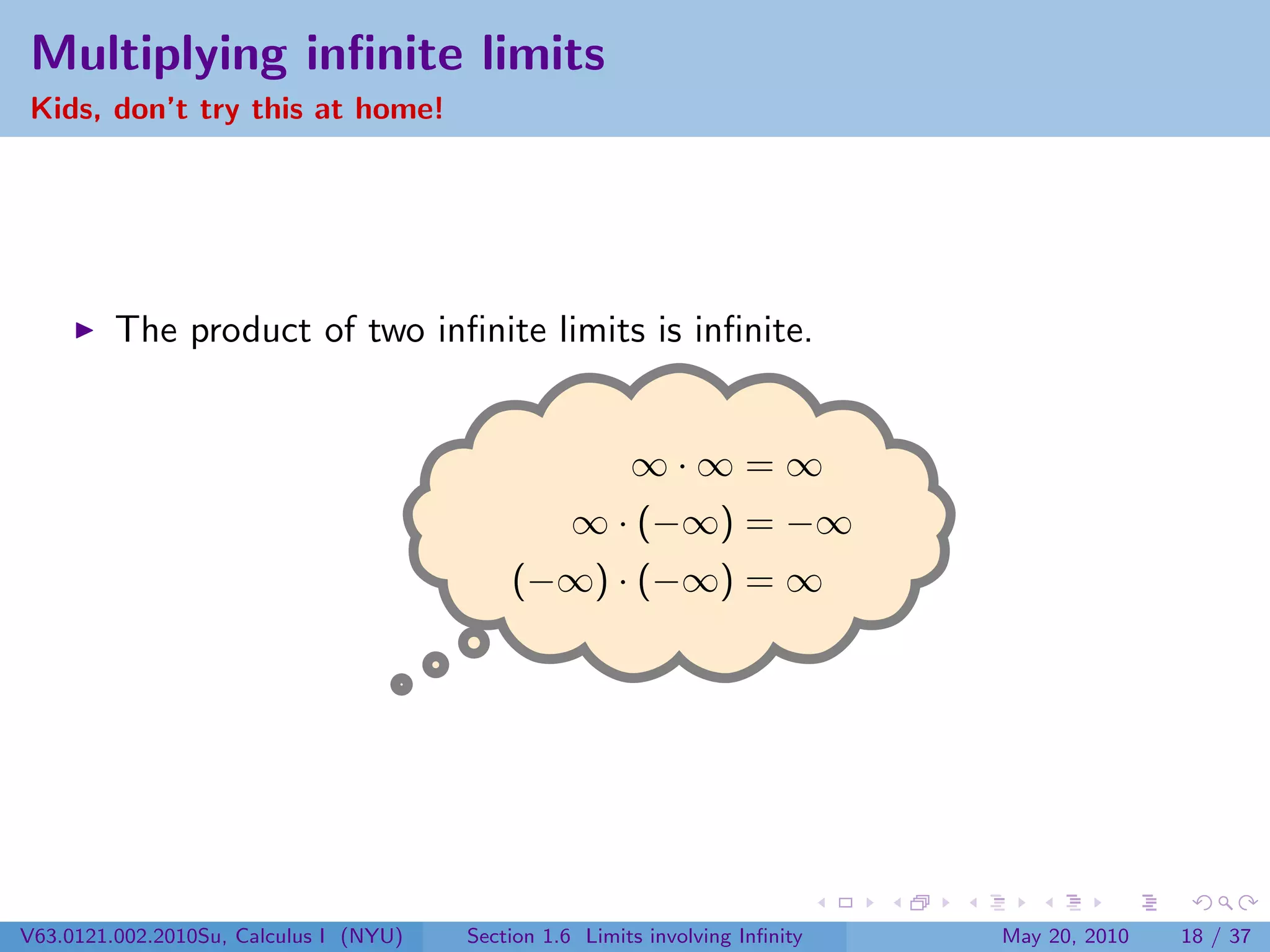
         The product of two infinite limits is infinite.


                                                         ∞·∞=∞
                                                   ∞ · (−∞) = −∞
                                            (−∞) · (−∞) = ∞


V63.0121.002.2010Su, Calculus I (NYU)   Section 1.6 Limits involving Infinity   May 20, 2010   18 / 37
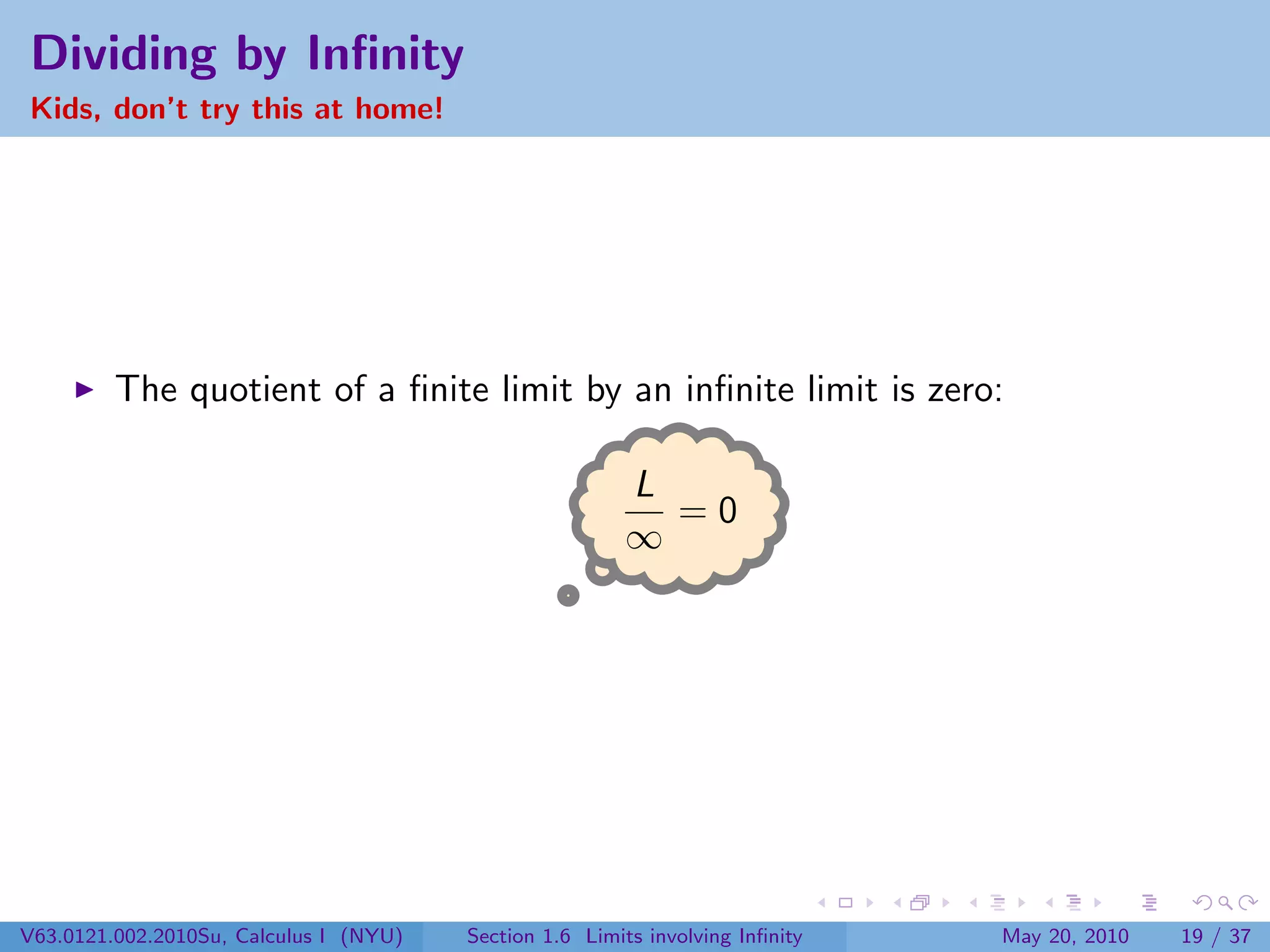
Dividing by Infinity
Kids, don’t try this at home!


         The quotient of a finite limit by an infinite limit is zero:

                                                        L
                                                          =0
                                                        ∞


V63.0121.002.2010Su, Calculus I (NYU)   Section 1.6 Limits involving Infinity   May 20, 2010   19 / 37
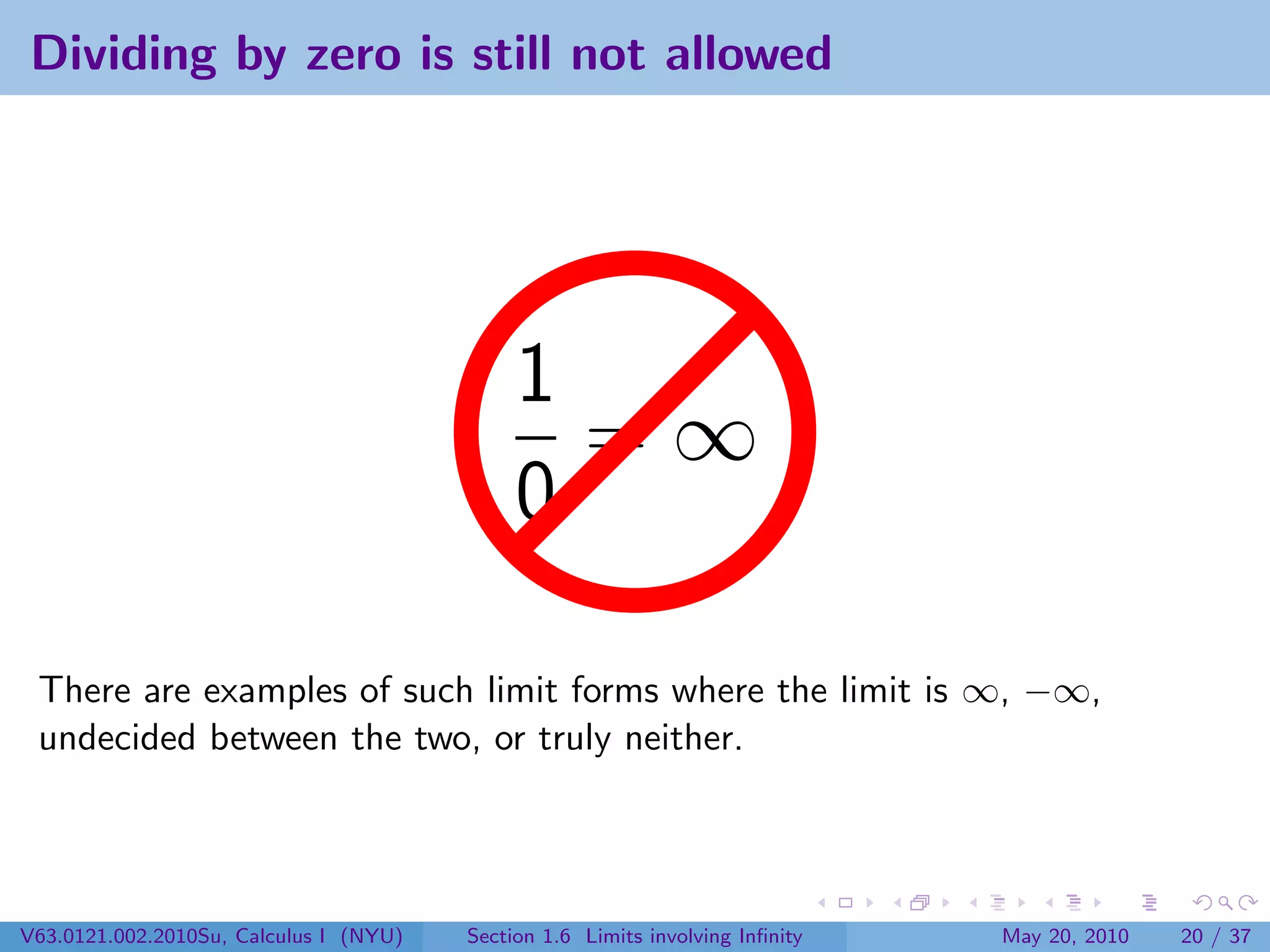
Dividing by zero is still not allowed


                                             1
                                               =∞
                                             0

 There are examples of such limit forms where the limit is ∞, −∞,
 undecided between the two, or truly neither.


V63.0121.002.2010Su, Calculus I (NYU)   Section 1.6 Limits involving Infinity   May 20, 2010   20 / 37
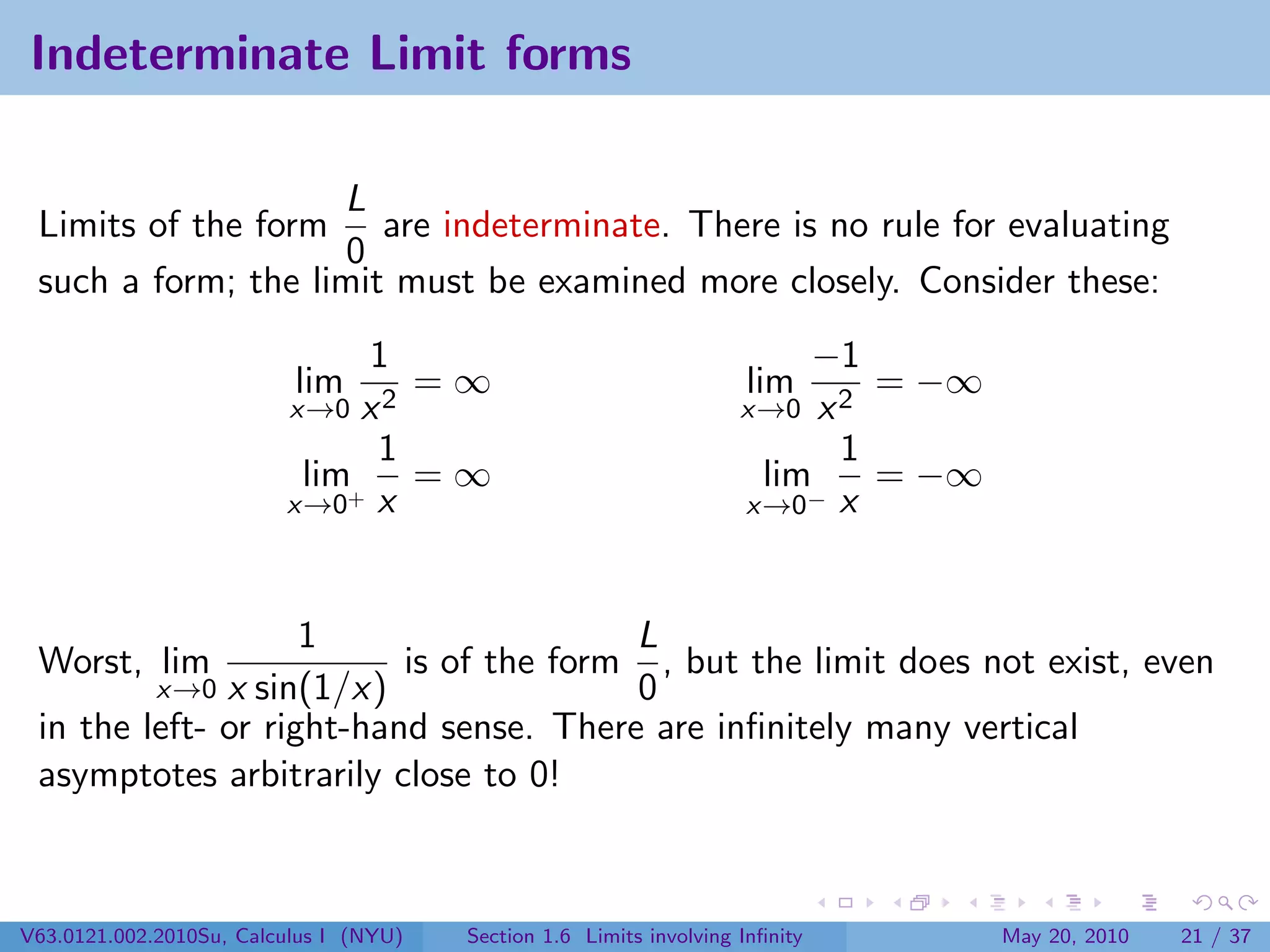
Indeterminate Limit forms

                    L
 Limits of the form are indeterminate. There is no rule for evaluating
                    0
 such a form; the limit must be examined more closely. Consider these:
                              1                                          −1
                          lim    =∞                                  lim     = −∞
                         x→0  x2                                     x→0  x2
                               1                                           1
                          lim+ = ∞                                    lim    = −∞
                         x→0 x                                       x→0− x


                    1                   L
 Worst, lim               is of the form , but the limit does not exist, even
              x sin(1/x)
             x→0                        0
 in the left- or right-hand sense. There are infinitely many vertical
 asymptotes arbitrarily close to 0!


V63.0121.002.2010Su, Calculus I (NYU)   Section 1.6 Limits involving Infinity        May 20, 2010   21 / 37
Indeterminate Limit forms


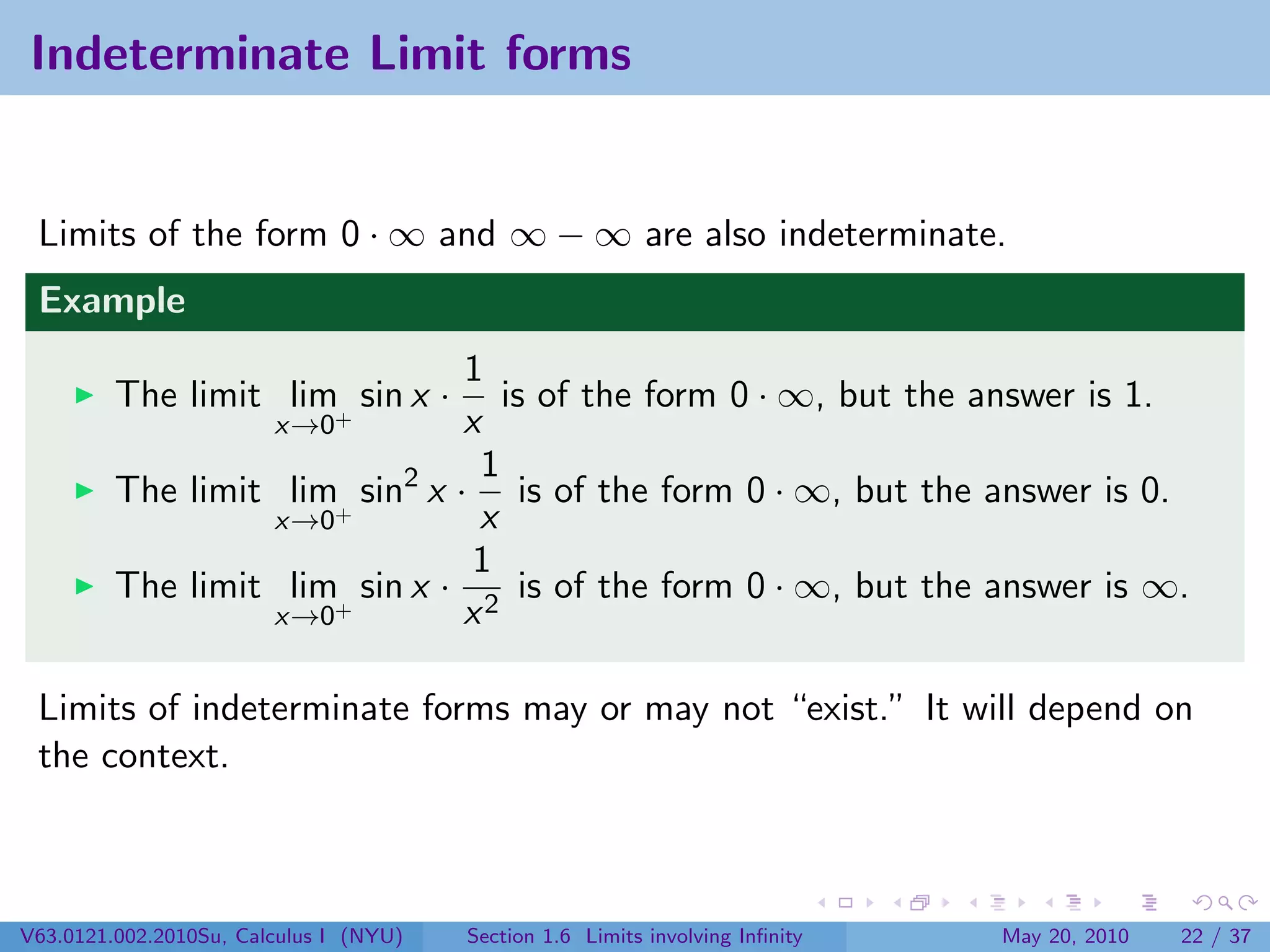
 Limits of the form 0 · ∞ and ∞ − ∞ are also indeterminate.
 Example
                                1
         The limit lim+ sin x ·    is of the form 0 · ∞, but the answer is 1.
                        x→0     x
                                 1
         The limit lim+ sin2 x · is of the form 0 · ∞, but the answer is 0.
                  x→0            x
                                 1
         The limit lim+ sin x · 2 is of the form 0 · ∞, but the answer is ∞.
                  x→0           x

 Limits of indeterminate forms may or may not “exist.” It will depend on
 the context.


V63.0121.002.2010Su, Calculus I (NYU)   Section 1.6 Limits involving Infinity   May 20, 2010   22 / 37
Indeterminate forms are like Tug Of War


 Which side wins depends on which side is stronger.

V63.0121.002.2010Su, Calculus I (NYU)   Section 1.6 Limits involving Infinity   May 20, 2010   23 / 37
Outline


 Infinite Limits
    Vertical Asymptotes
    Infinite Limits we Know
    Limit “Laws” with Infinite Limits
    Indeterminate Limit forms


 Limits at ∞
    Algebraic rates of growth
    Rationalizing to get a limit


V63.0121.002.2010Su, Calculus I (NYU)   Section 1.6 Limits involving Infinity   May 20, 2010   24 / 37
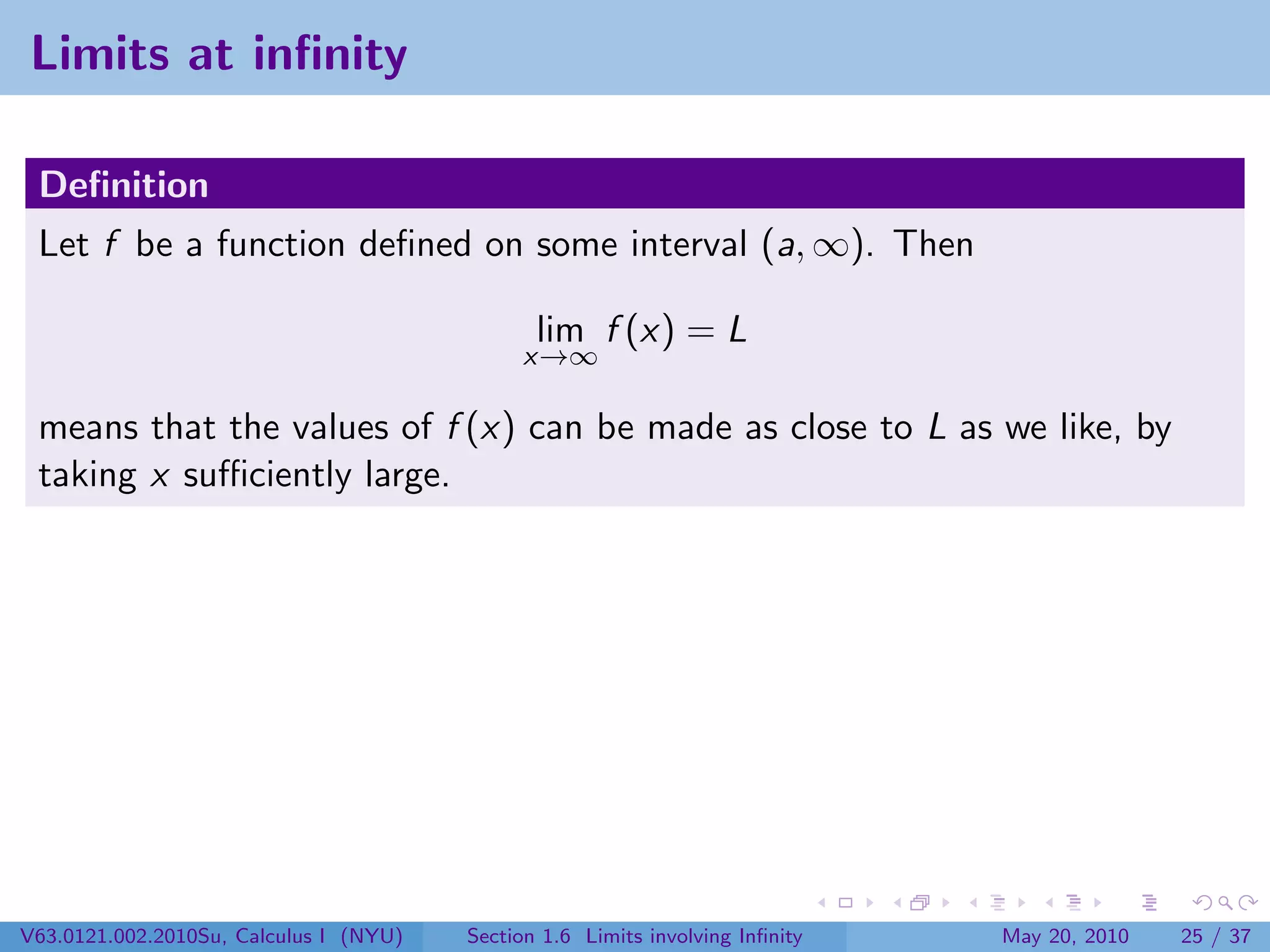
Limits at infinity

 Definition
 Let f be a function defined on some interval (a, ∞). Then

                                               lim f (x) = L
                                             x→∞

 means that the values of f (x) can be made as close to L as we like, by
 taking x sufficiently large.


V63.0121.002.2010Su, Calculus I (NYU)   Section 1.6 Limits involving Infinity   May 20, 2010   25 / 37
Limits at infinity

 Definition
 Let f be a function defined on some interval (a, ∞). Then

                                               lim f (x) = L
                                             x→∞

 means that the values of f (x) can be made as close to L as we like, by
 taking x sufficiently large.

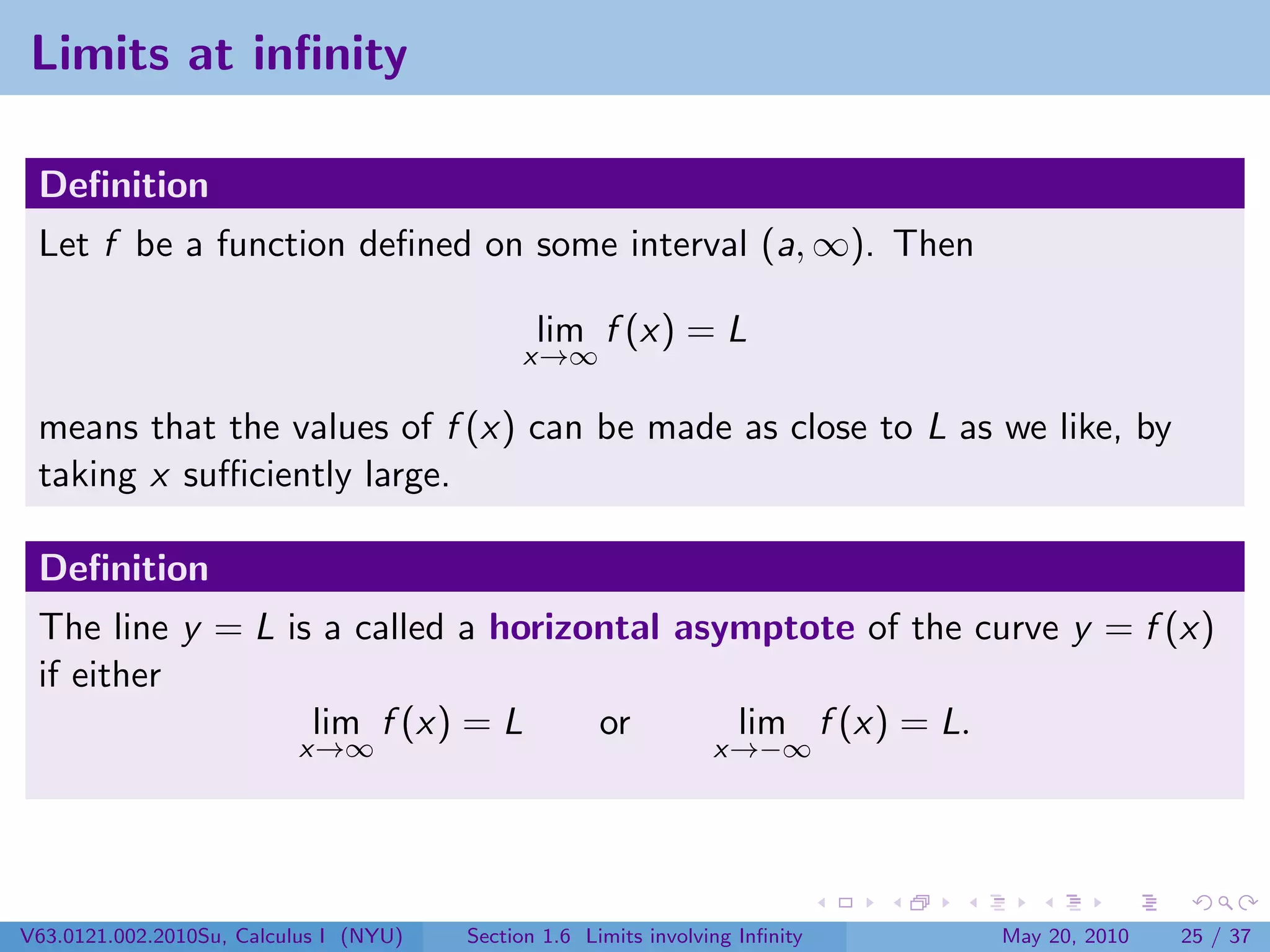
 Definition
 The line y = L is a called a horizontal asymptote of the curve y = f (x)
 if either
                  lim f (x) = L     or      lim f (x) = L.
                          x→∞                                     x→−∞


V63.0121.002.2010Su, Calculus I (NYU)   Section 1.6 Limits involving Infinity   May 20, 2010   25 / 37
Limits at infinity

 Definition
 Let f be a function defined on some interval (a, ∞). Then

                                               lim f (x) = L
                                             x→∞

 means that the values of f (x) can be made as close to L as we like, by
 taking x sufficiently large.

 Definition
 The line y = L is a called a horizontal asymptote of the curve y = f (x)
 if either
                  lim f (x) = L     or      lim f (x) = L.
                          x→∞                                     x→−∞


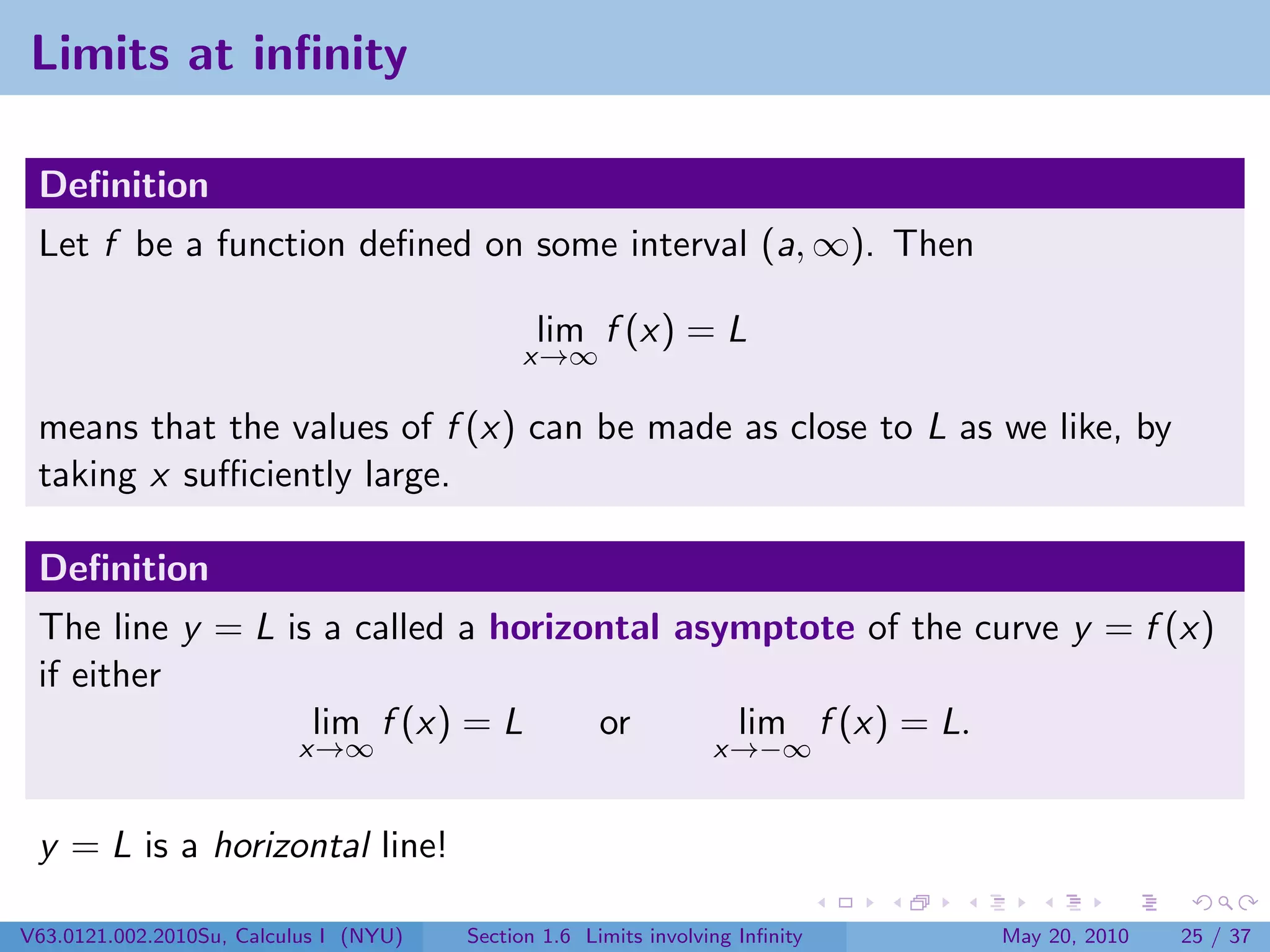
 y = L is a horizontal line!

V63.0121.002.2010Su, Calculus I (NYU)   Section 1.6 Limits involving Infinity   May 20, 2010   25 / 37
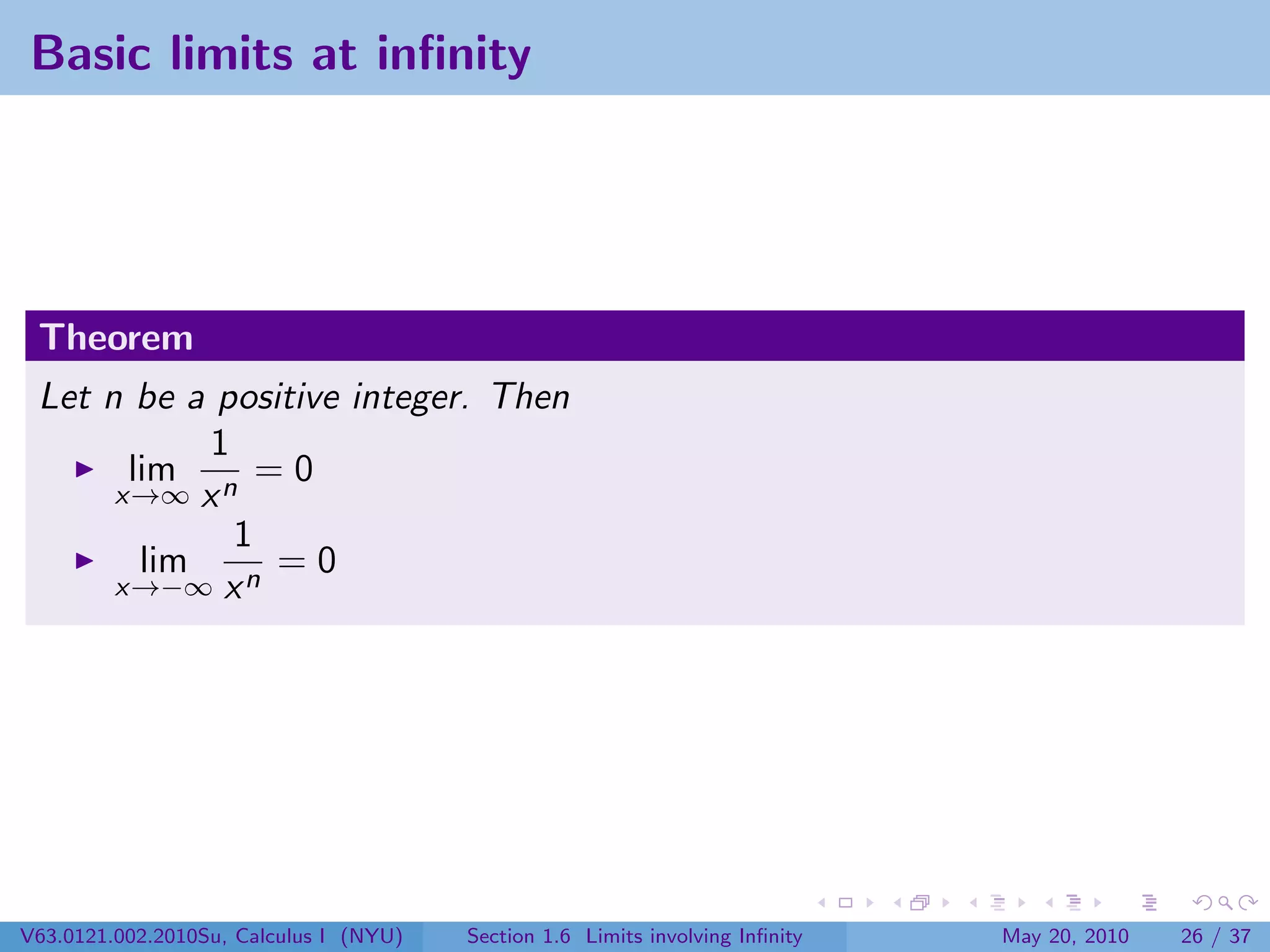
Basic limits at infinity


 Theorem
 Let n be a positive integer. Then
            1
       lim      =0
      x→∞ x n
              1
        lim      =0
      x→−∞ x n


V63.0121.002.2010Su, Calculus I (NYU)   Section 1.6 Limits involving Infinity   May 20, 2010   26 / 37
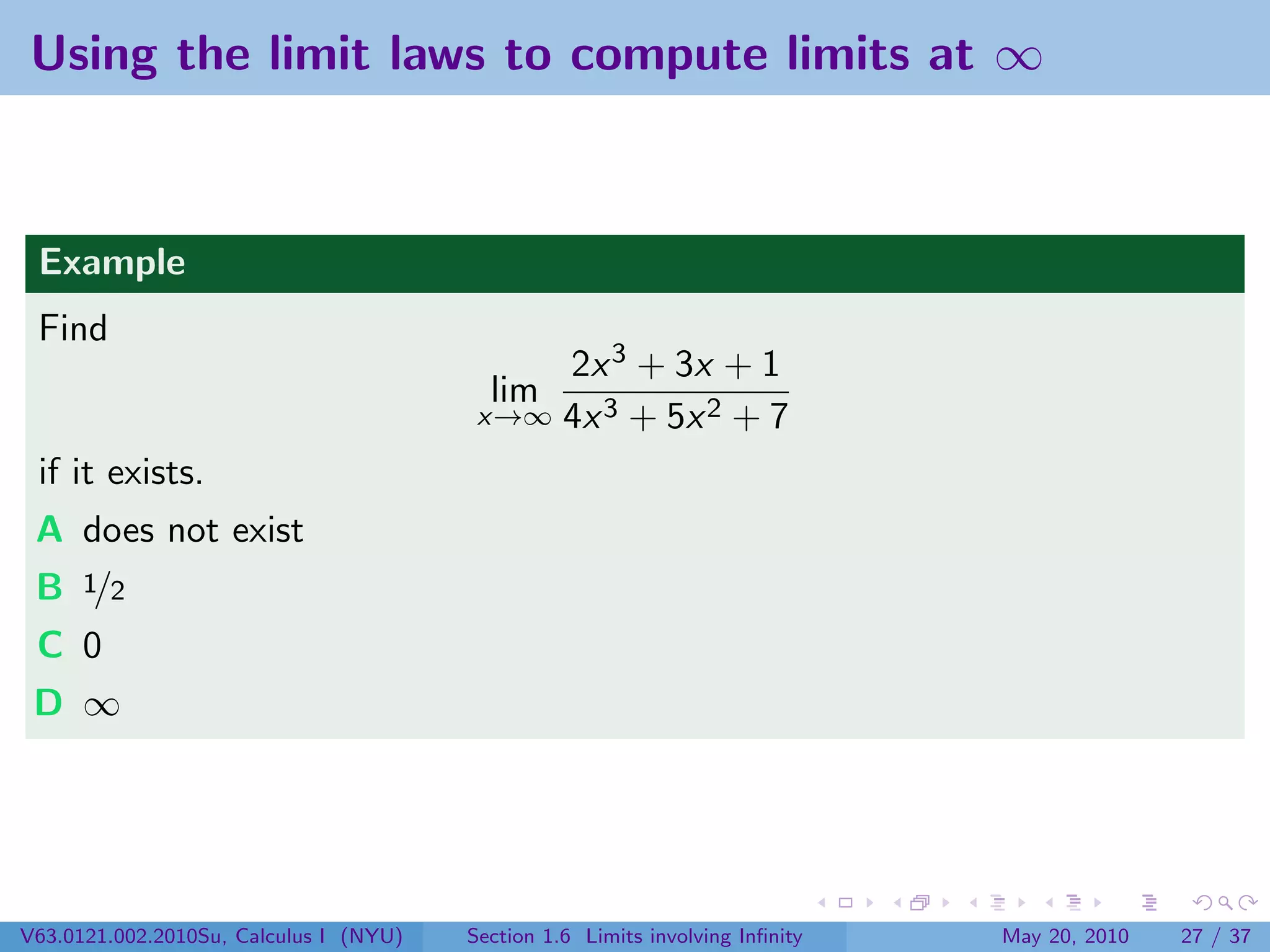
Using the limit laws to compute limits at ∞


 Example
 Find
                                             2x 3 + 3x + 1
                                          lim
                                         x→∞ 4x 3 + 5x 2 + 7

 if it exists.
 A does not exist
 B 1/2
 C 0
 D ∞


V63.0121.002.2010Su, Calculus I (NYU)   Section 1.6 Limits involving Infinity   May 20, 2010   27 / 37
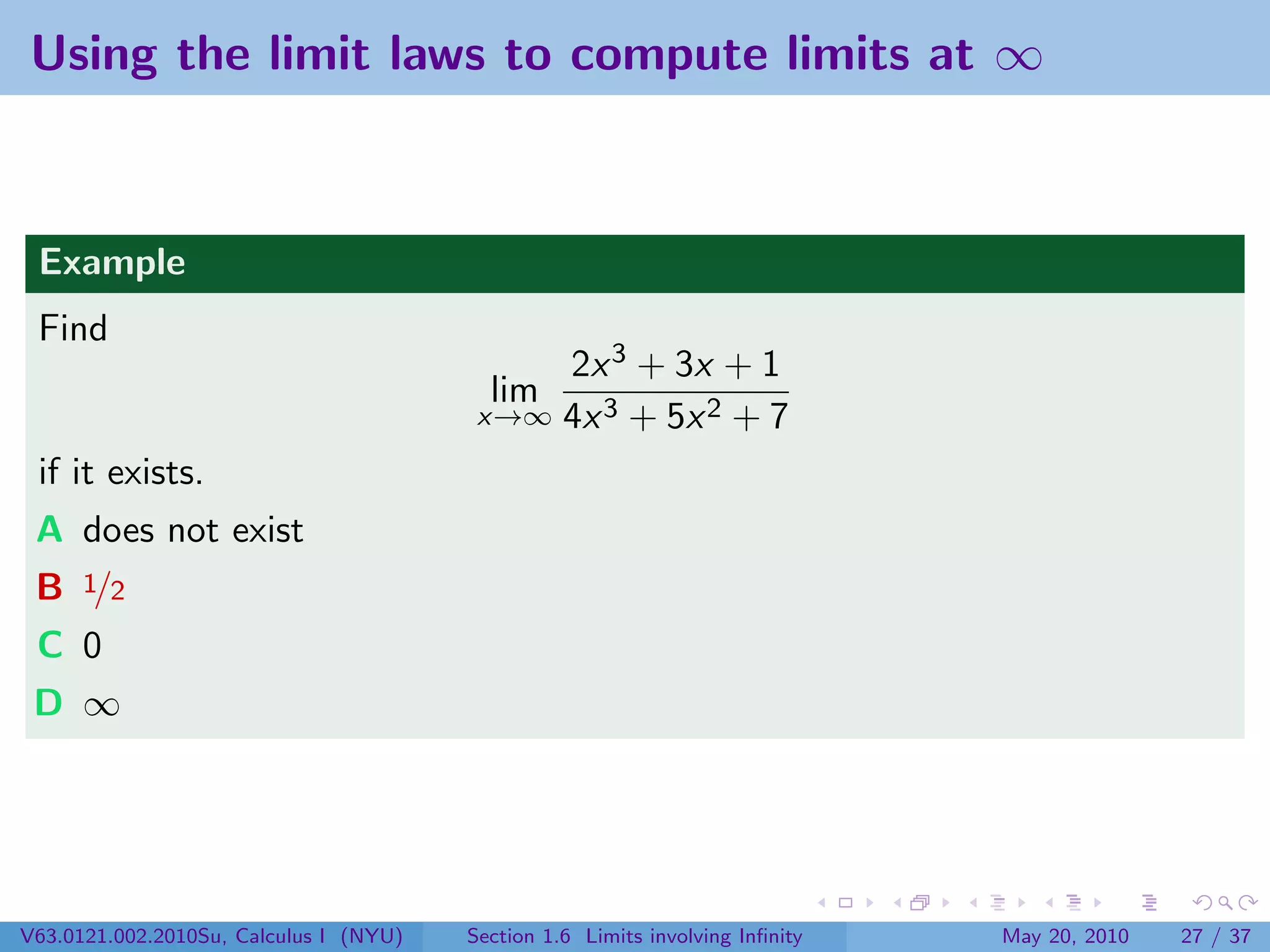
Using the limit laws to compute limits at ∞


 Example
 Find
                                             2x 3 + 3x + 1
                                          lim
                                         x→∞ 4x 3 + 5x 2 + 7

 if it exists.
 A does not exist
 B 1/2
 C 0
 D ∞


V63.0121.002.2010Su, Calculus I (NYU)   Section 1.6 Limits involving Infinity   May 20, 2010   27 / 37
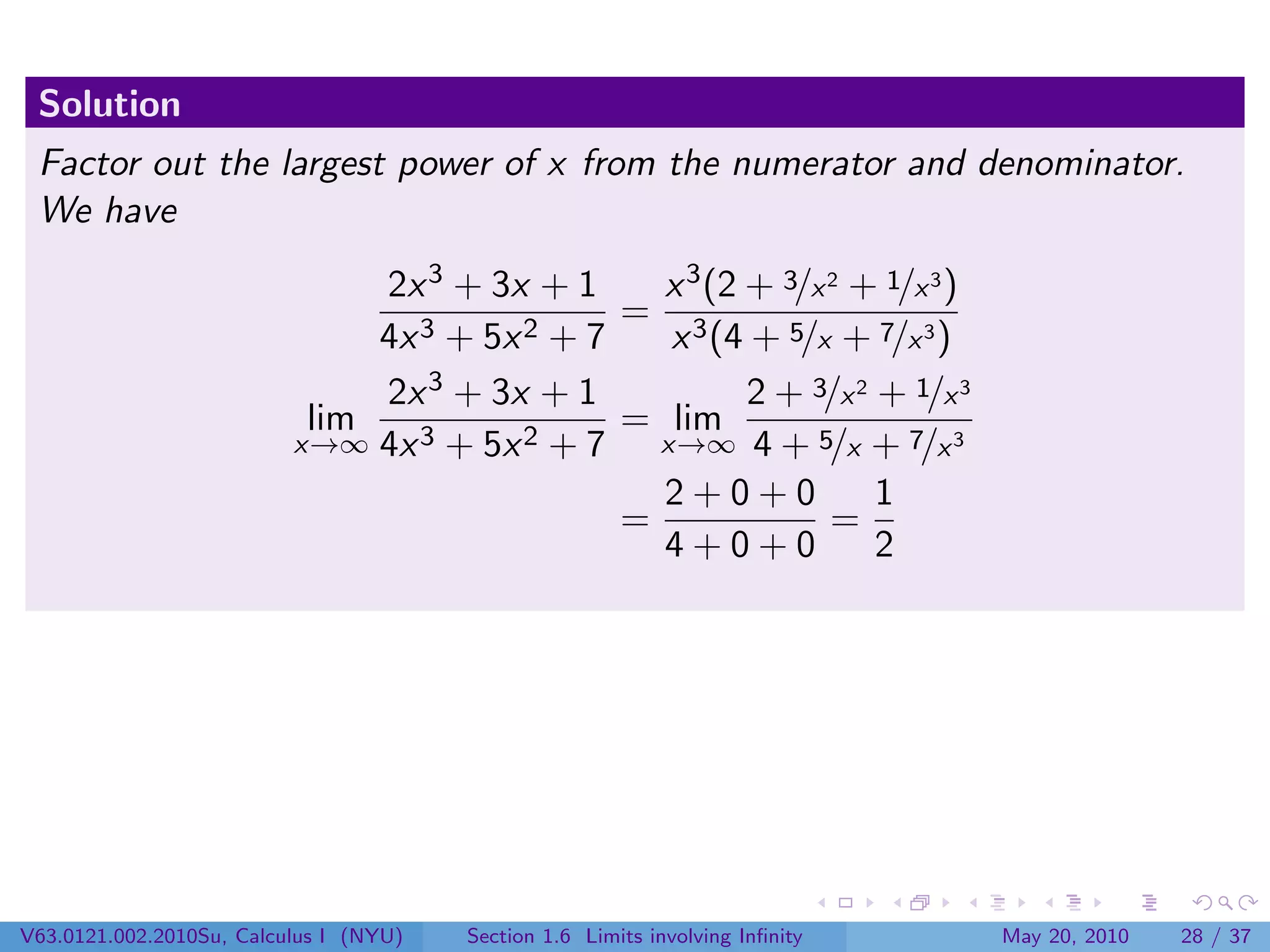
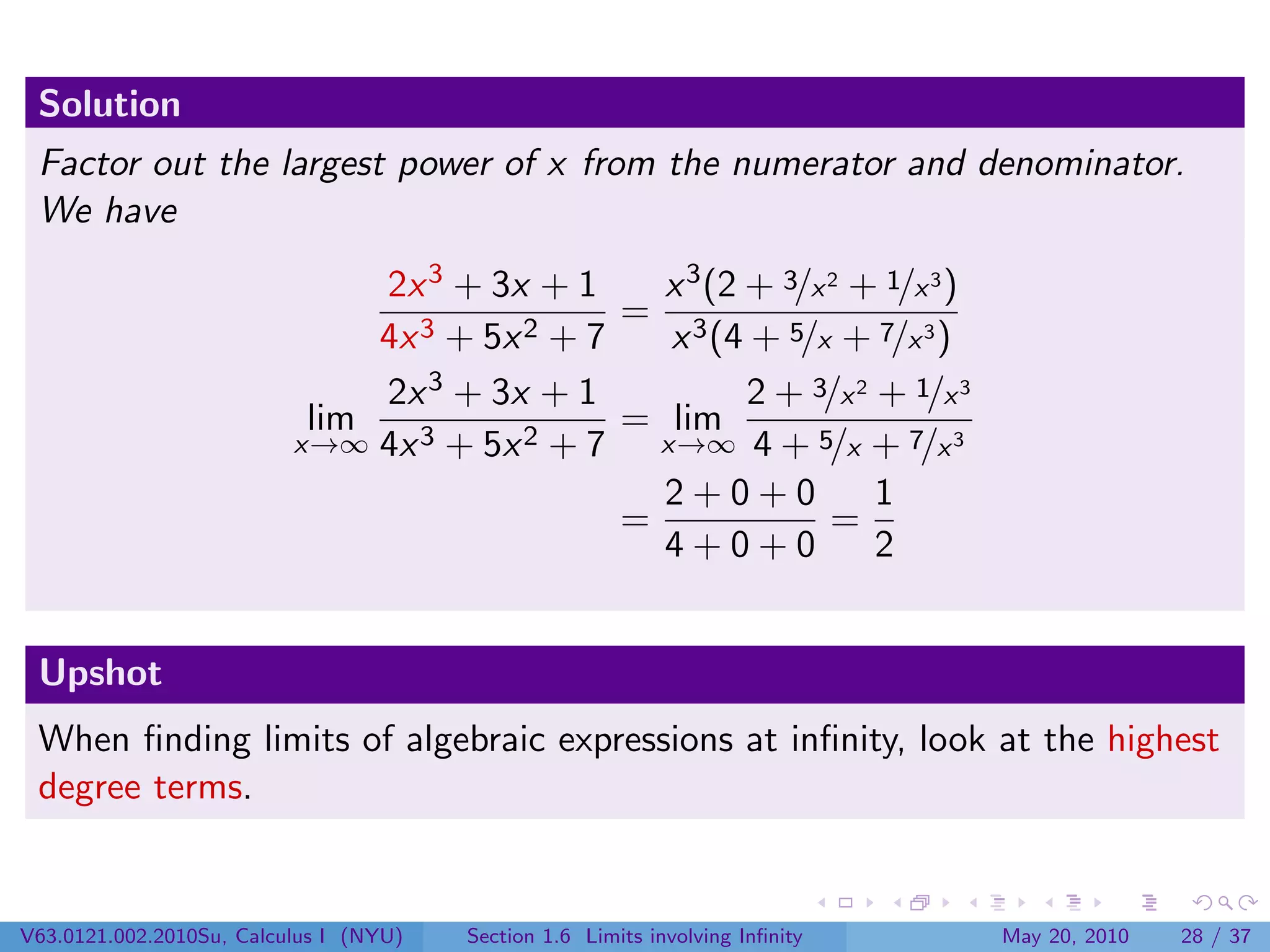
Solution
 Factor out the largest power of x from the numerator and denominator.
 We have
                               2x 3 + 3x + 1     x 3 (2 + 3/x 2 + 1/x 3 )
                                               = 3
                               4x 3 + 5x 2 + 7    x (4 + 5/x + 7/x 3 )
                               2x  3 + 3x + 1           2 + 3/x 2 + 1/x 3
                           lim    3 + 5x 2 + 7
                                               = lim
                          x→∞ 4x                 x→∞ 4 + 5/x + 7/x 3
                                                 2+0+0            1
                                               =              =
                                                 4+0+0            2


V63.0121.002.2010Su, Calculus I (NYU)   Section 1.6 Limits involving Infinity   May 20, 2010   28 / 37
Solution
 Factor out the largest power of x from the numerator and denominator.
 We have
                               2x 3 + 3x + 1     x 3 (2 + 3/x 2 + 1/x 3 )
                                               = 3
                               4x 3 + 5x 2 + 7    x (4 + 5/x + 7/x 3 )
                               2x  3 + 3x + 1           2 + 3/x 2 + 1/x 3
                           lim    3 + 5x 2 + 7
                                               = lim
                          x→∞ 4x                 x→∞ 4 + 5/x + 7/x 3
                                                 2+0+0            1
                                               =              =
                                                 4+0+0            2


 Upshot
 When finding limits of algebraic expressions at infinity, look at the highest
 degree terms.


V63.0121.002.2010Su, Calculus I (NYU)   Section 1.6 Limits involving Infinity   May 20, 2010   28 / 37
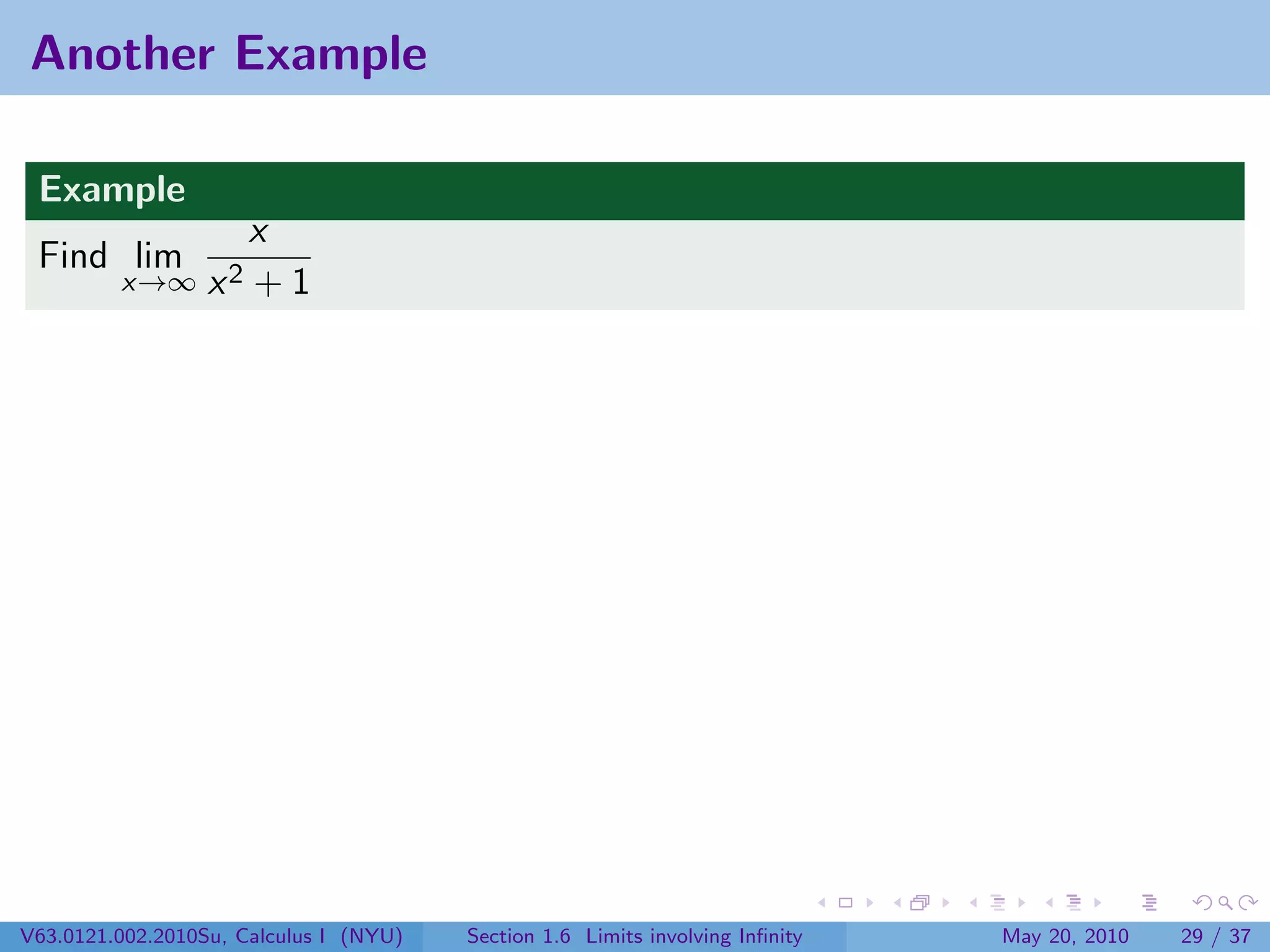
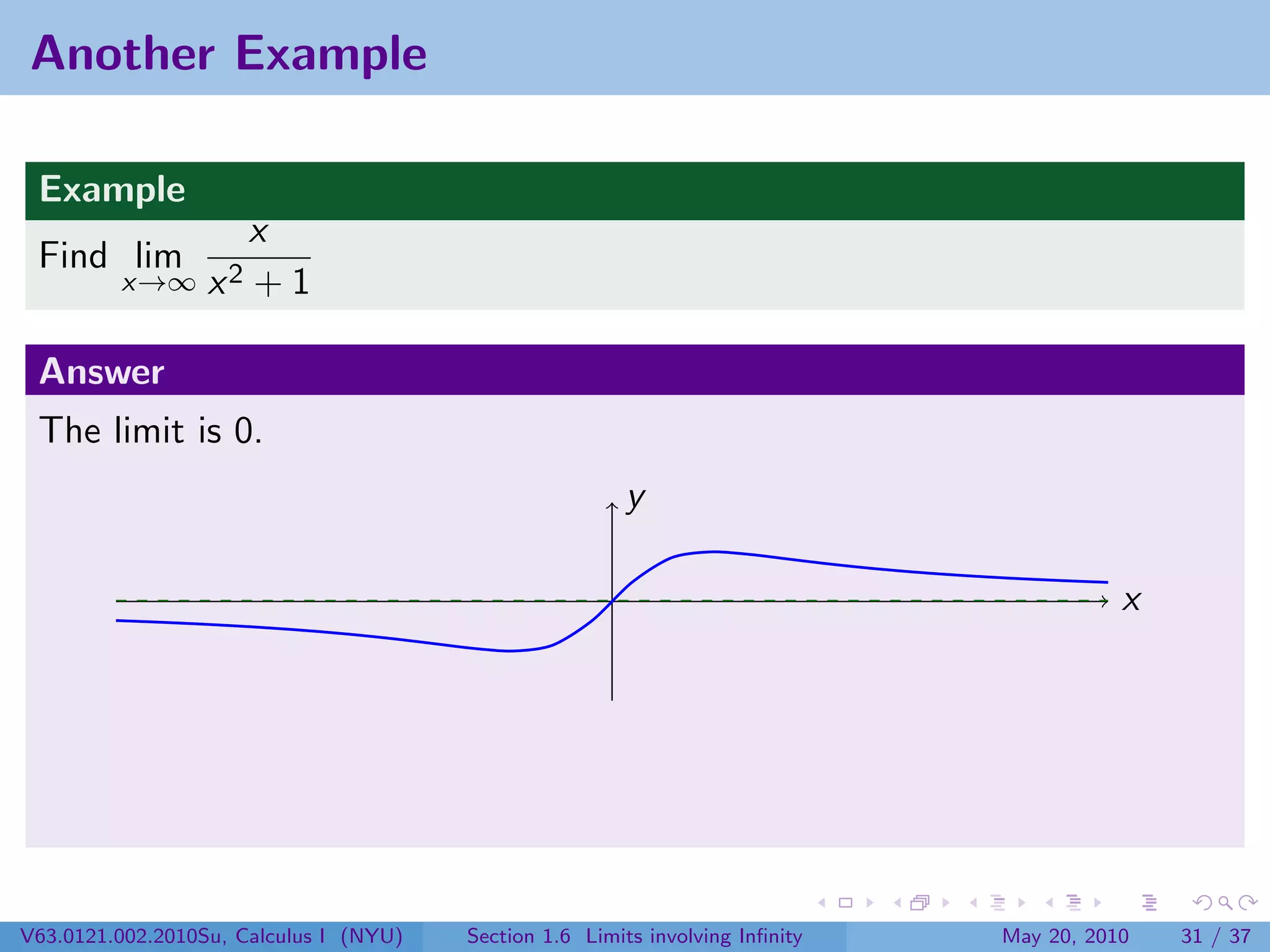
Another Example

 Example
                     x
 Find lim
         x→∞      x2 + 1


V63.0121.002.2010Su, Calculus I (NYU)   Section 1.6 Limits involving Infinity   May 20, 2010   29 / 37
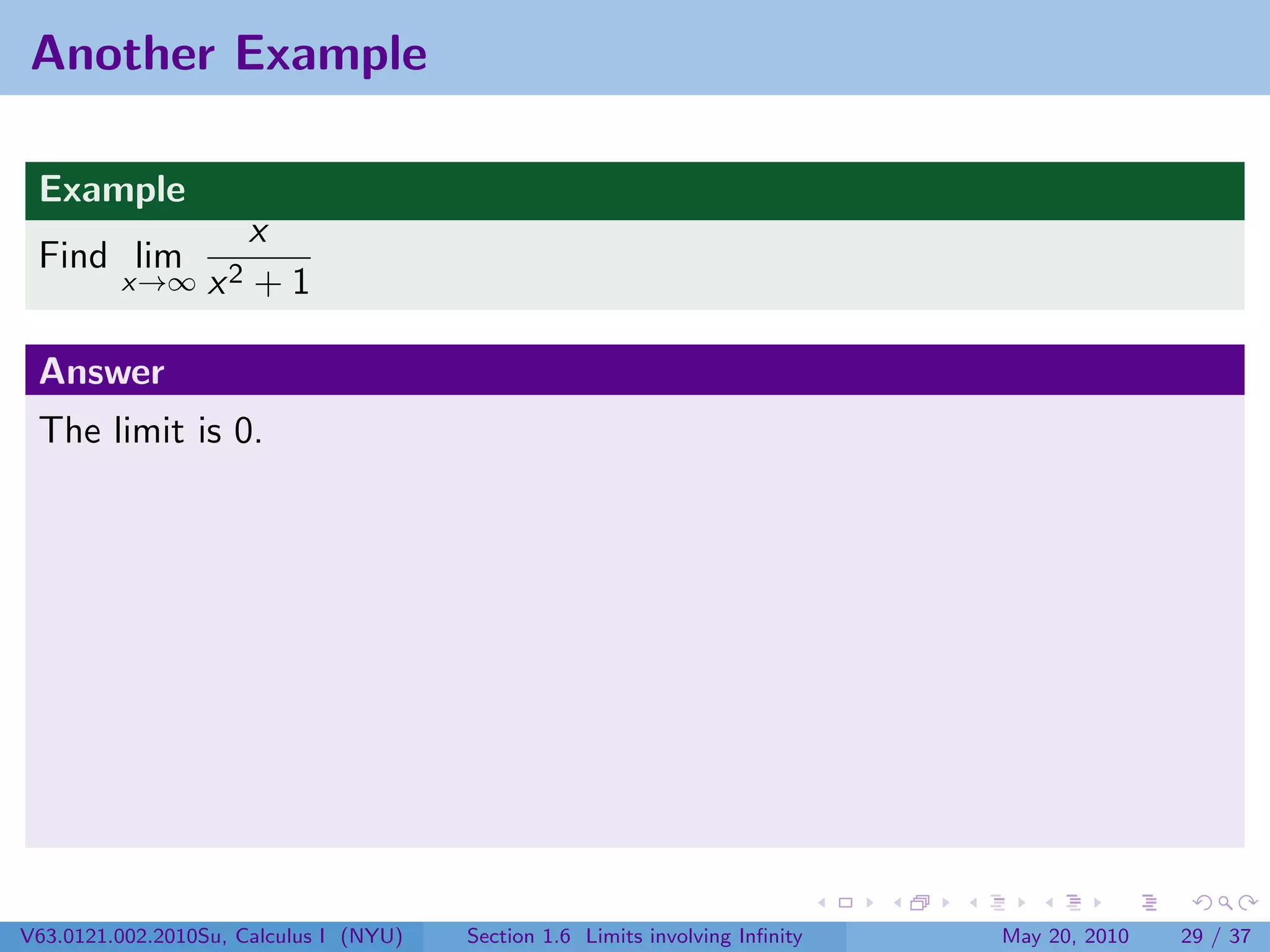
Another Example

 Example
                     x
 Find lim
         x→∞      x2 + 1

 Answer
 The limit is 0.


V63.0121.002.2010Su, Calculus I (NYU)   Section 1.6 Limits involving Infinity   May 20, 2010   29 / 37
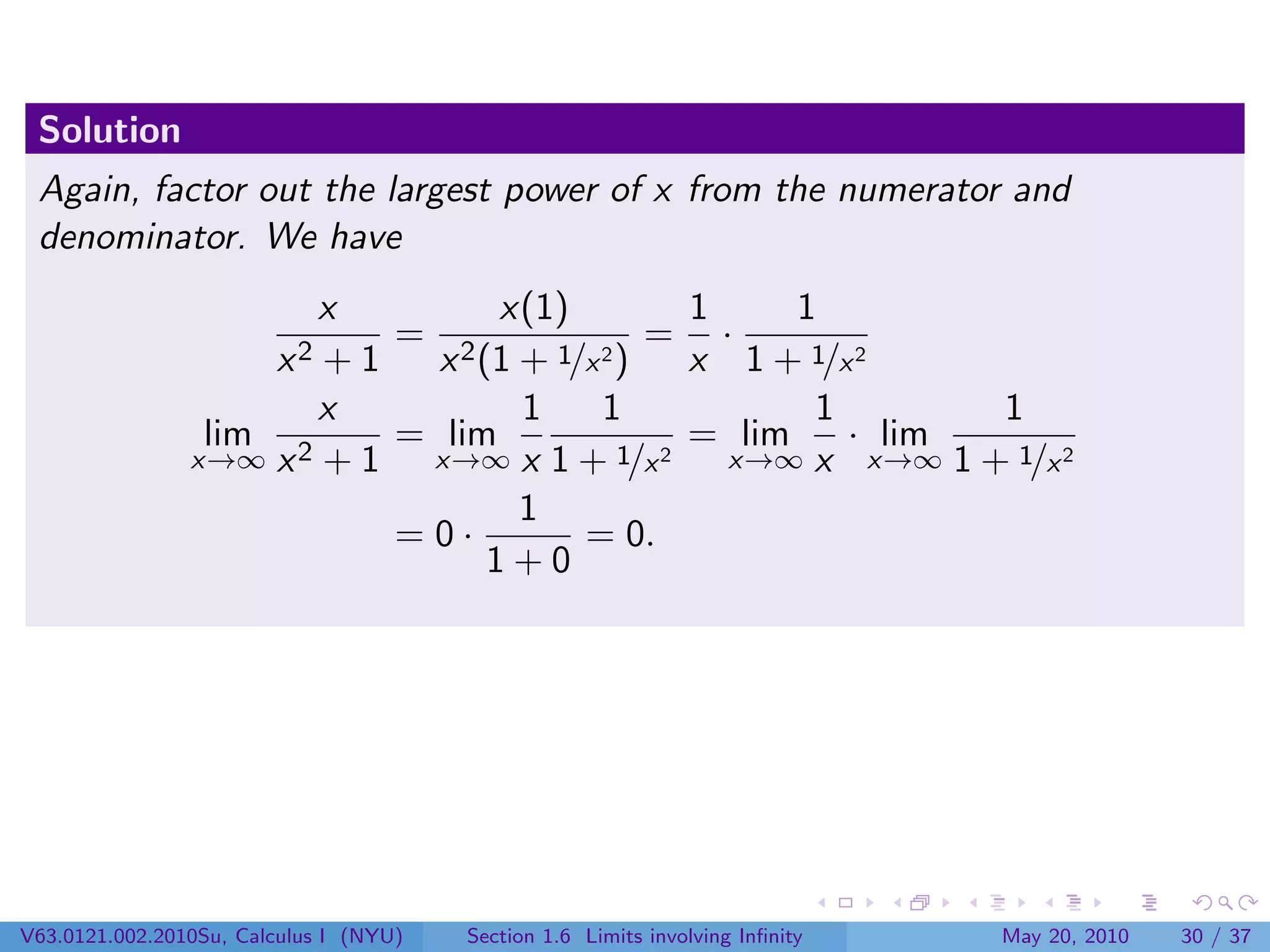
Solution
 Again, factor out the largest power of x from the numerator and
 denominator. We have
                       x        x(1)         1     1
                          = 2             = ·
                        x2
                       +1   x (1 + 1/x 2)    x 1 + 1/x 2
                       x         1     1            1       1
                 lim 2    = lim              = lim    · lim
                x→∞ x + 1  x→∞ x 1 + 1/x   2   x→∞ x x→∞ 1 + 1/x 2
                                 1
                          =0·        = 0.
                               1+0


V63.0121.002.2010Su, Calculus I (NYU)   Section 1.6 Limits involving Infinity   May 20, 2010   30 / 37
Another Example

 Example
                     x
 Find lim
         x→∞      x2 + 1

 Answer
 The limit is 0.
                                                        y

                                                                                          x


V63.0121.002.2010Su, Calculus I (NYU)   Section 1.6 Limits involving Infinity   May 20, 2010   31 / 37
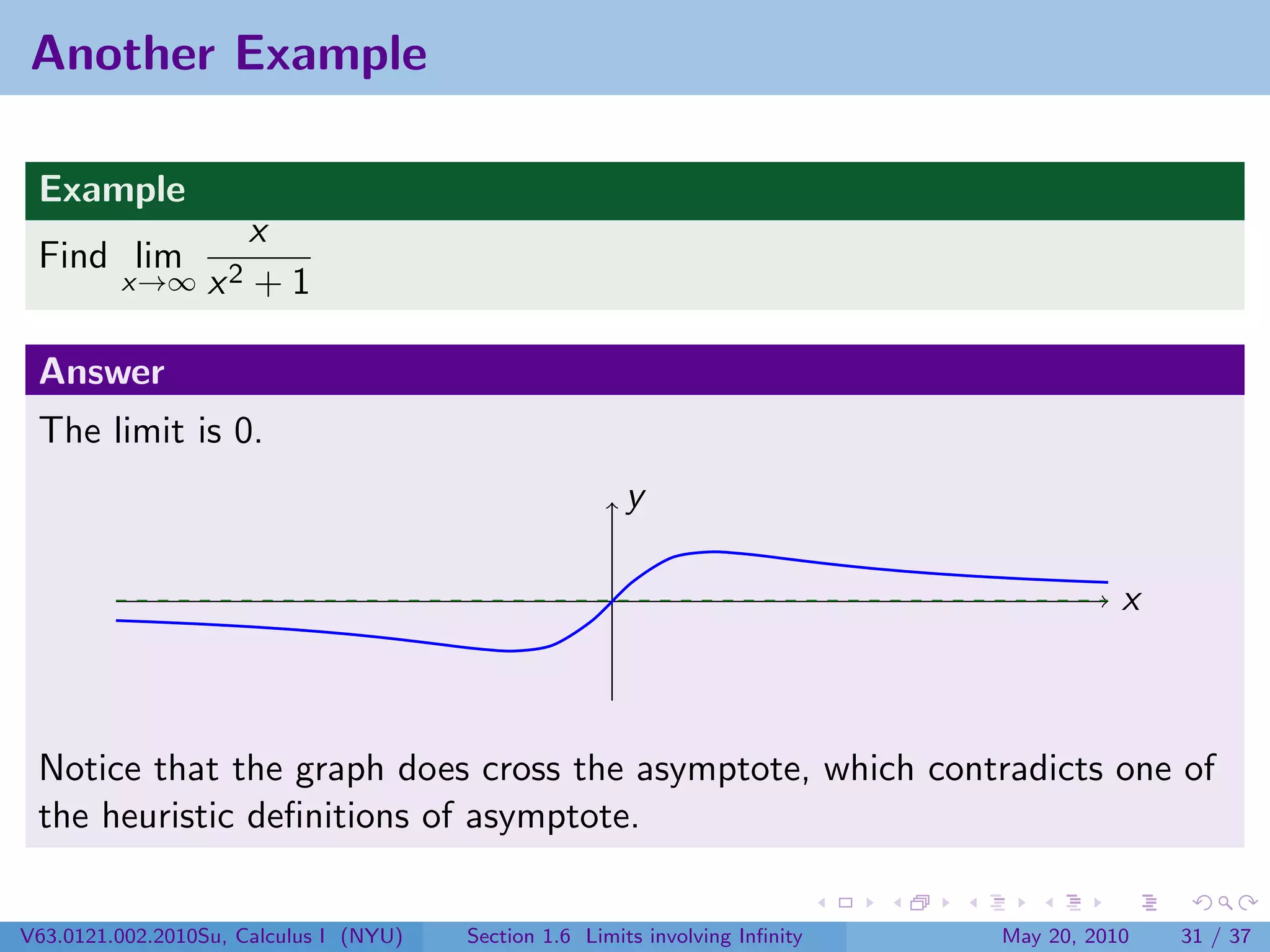
Another Example

 Example
                     x
 Find lim
         x→∞      x2 + 1

 Answer
 The limit is 0.
                                                        y

                                                                                          x


 Notice that the graph does cross the asymptote, which contradicts one of
 the heuristic definitions of asymptote.


V63.0121.002.2010Su, Calculus I (NYU)   Section 1.6 Limits involving Infinity   May 20, 2010   31 / 37
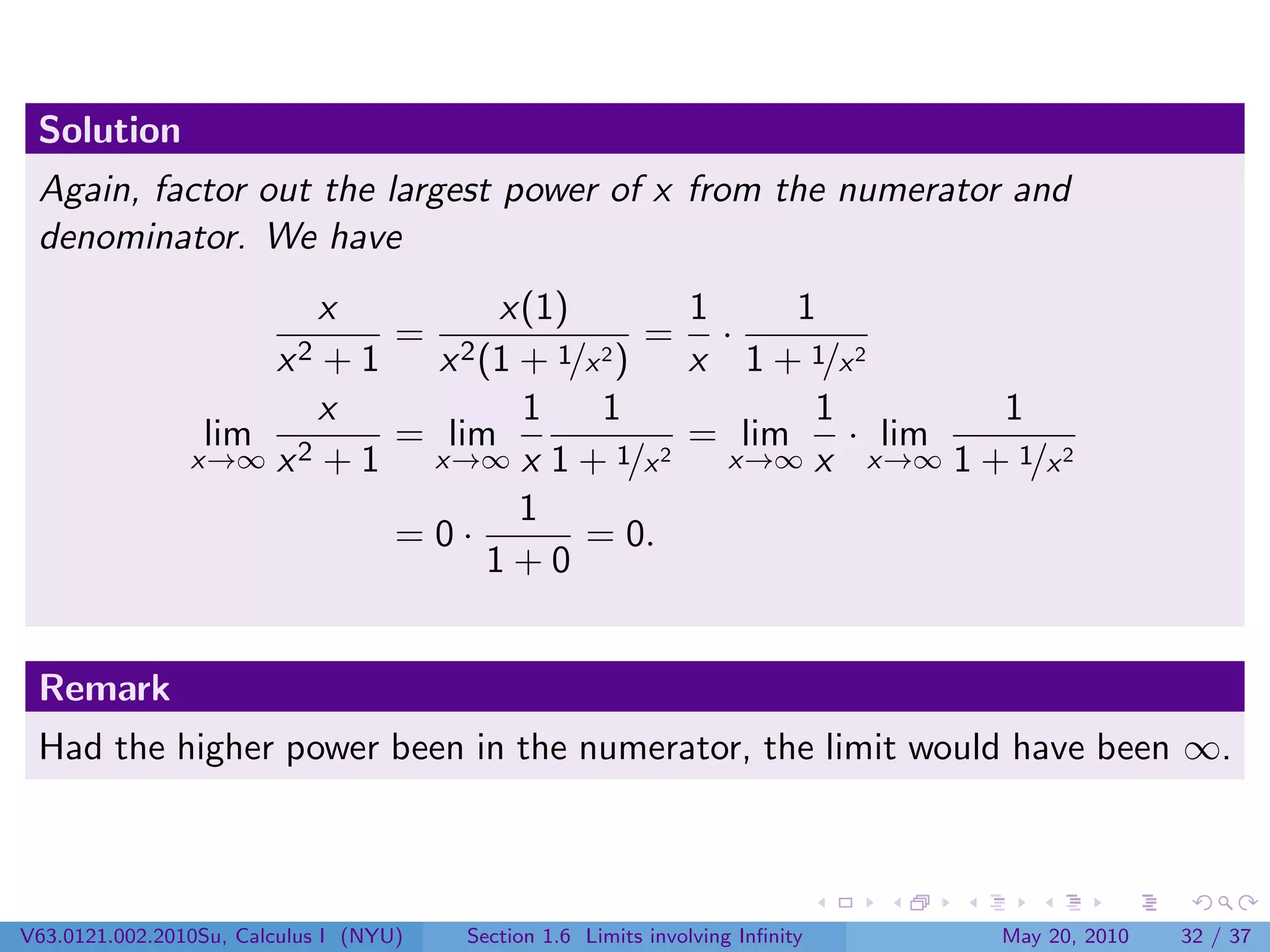
Solution
 Again, factor out the largest power of x from the numerator and
 denominator. We have
                       x        x(1)         1     1
                          = 2             = ·
                        x2
                       +1   x (1 + 1/x 2)    x 1 + 1/x 2
                       x         1     1            1       1
                 lim 2    = lim              = lim    · lim
                x→∞ x + 1  x→∞ x 1 + 1/x   2   x→∞ x x→∞ 1 + 1/x 2
                                 1
                          =0·        = 0.
                               1+0


 Remark
 Had the higher power been in the numerator, the limit would have been ∞.


V63.0121.002.2010Su, Calculus I (NYU)   Section 1.6 Limits involving Infinity   May 20, 2010   32 / 37
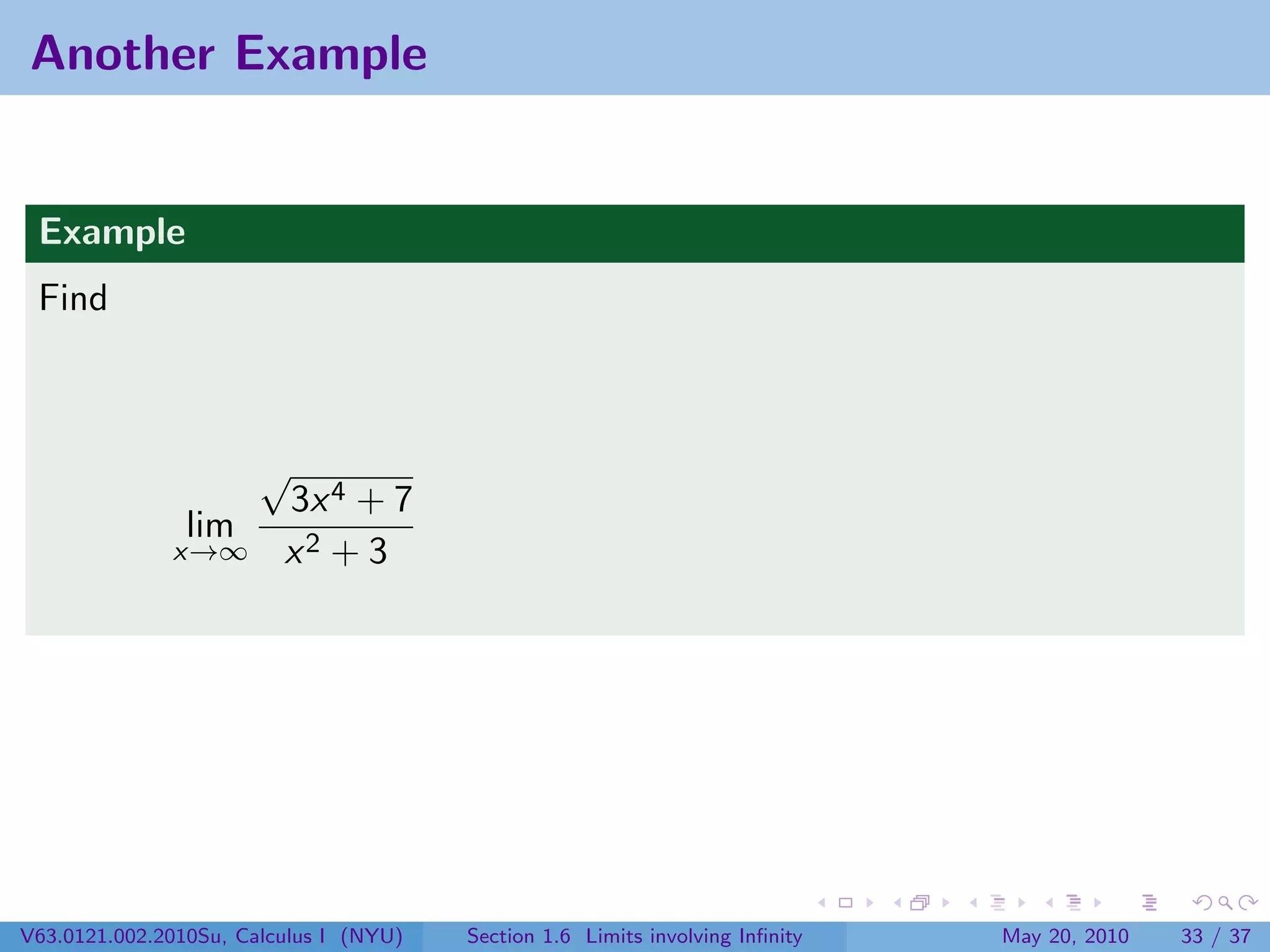
Another Example


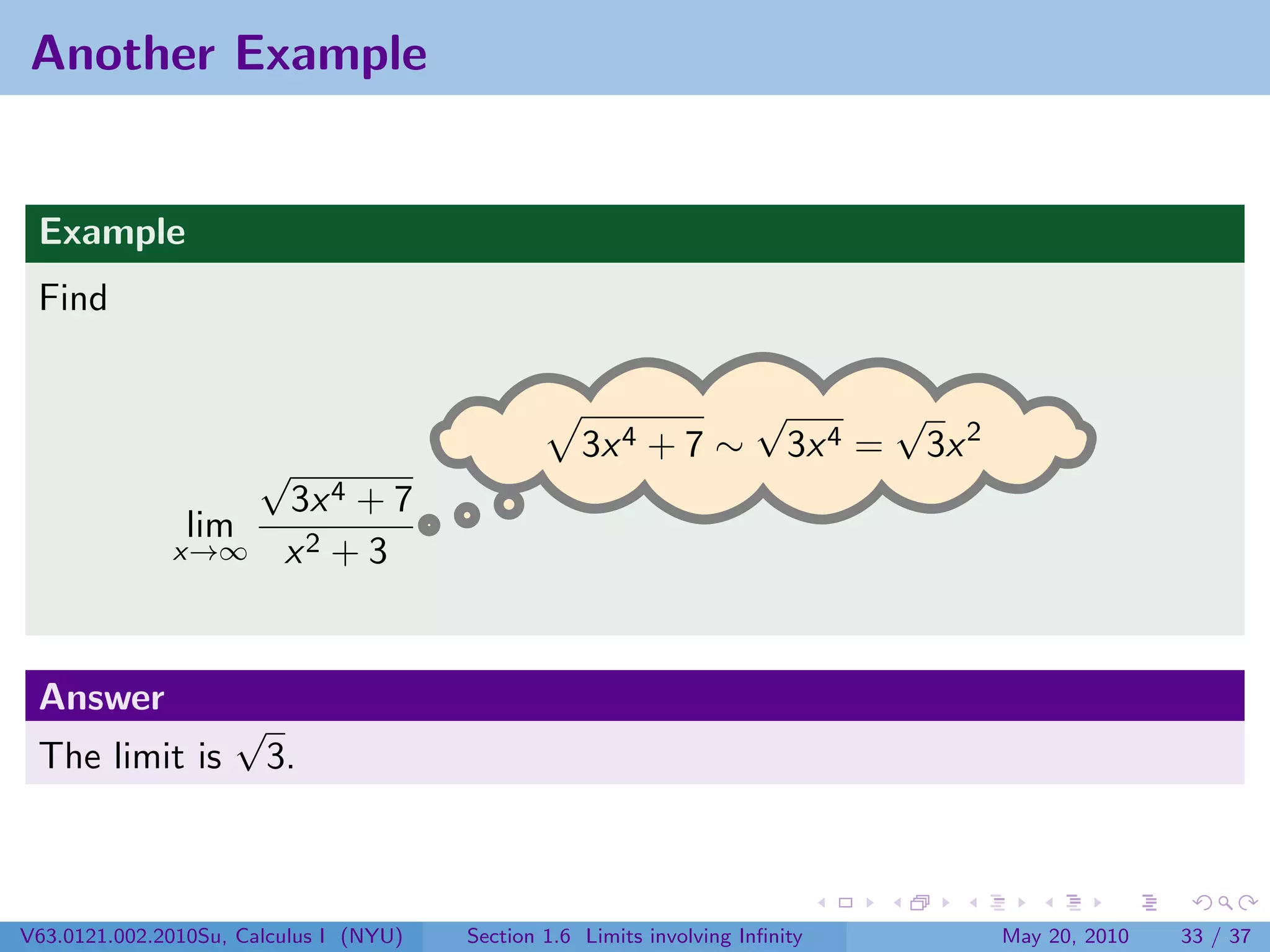
 Example
 Find


                       √
                         3x 4 + 7
                lim
              x→∞        x2 + 3


V63.0121.002.2010Su, Calculus I (NYU)   Section 1.6 Limits involving Infinity   May 20, 2010   33 / 37
Another Example


 Example
 Find

                                                                      √            √
                                                    3x 4 + 7 ∼            3x 4 =       3x 2
                       √
                         3x 4 + 7
                lim
              x→∞        x2 + 3


 Answer
                    √
 The limit is           3.


V63.0121.002.2010Su, Calculus I (NYU)   Section 1.6 Limits involving Infinity                  May 20, 2010   33 / 37
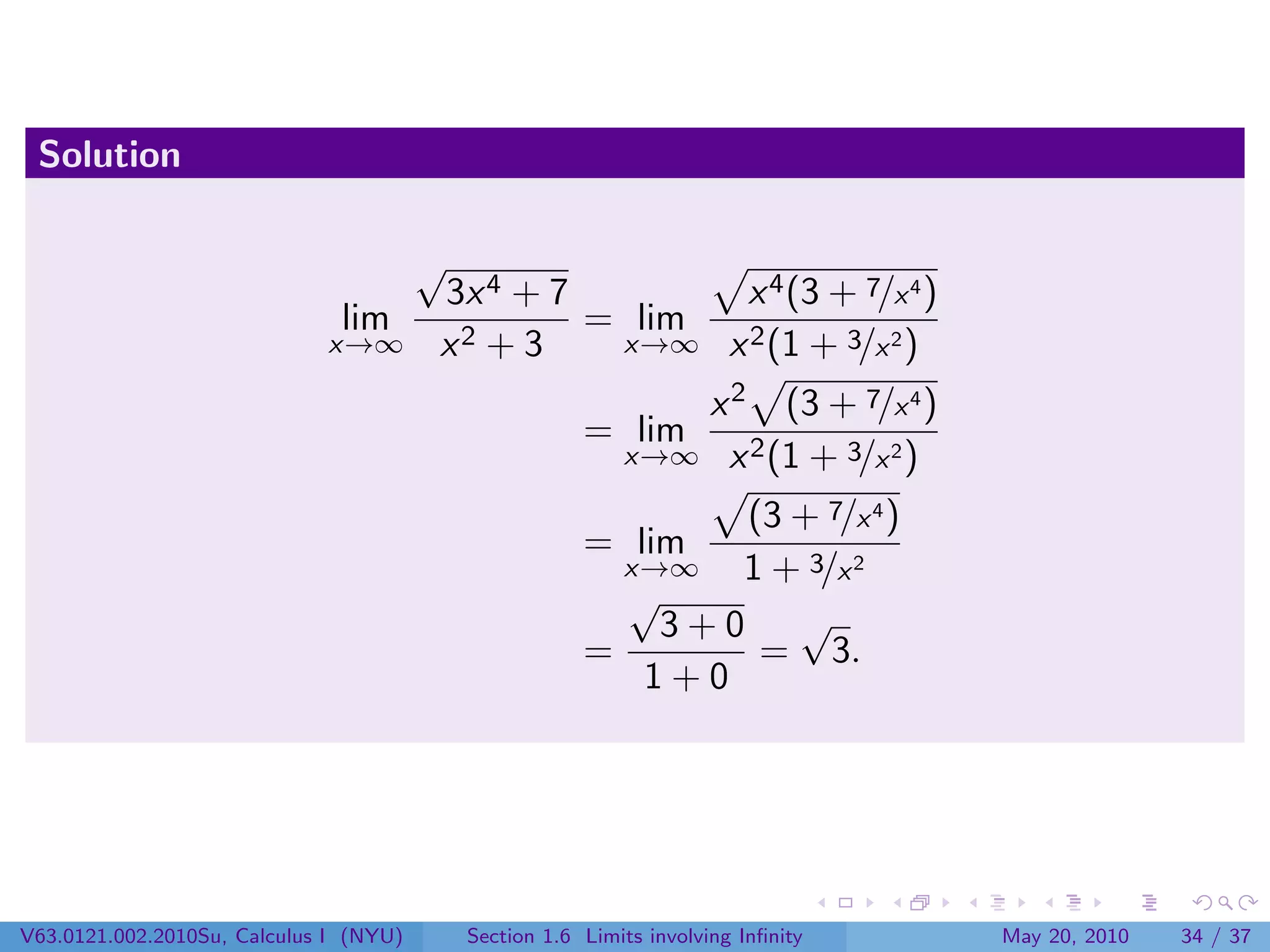
Solution

                                        √
                                        3x 4 + 7       x 4 (3 + 7/x 4 )
                               lim               = lim
                             x→∞        x2 + 3    x→∞ x 2 (1 + 3/x 2 )

                                                               x 2 (3 + 7/x 4 )
                                                        = lim
                                                            x→∞ x 2 (1 + 3/x 2 )

                                                               (3 + 7/x 4 )
                                                        = lim
                                                          x→∞  1 + 3/x 2
                                                          √
                                                            3+0 √
                                                        =       = 3.
                                                           1+0


V63.0121.002.2010Su, Calculus I (NYU)       Section 1.6 Limits involving Infinity   May 20, 2010   34 / 37
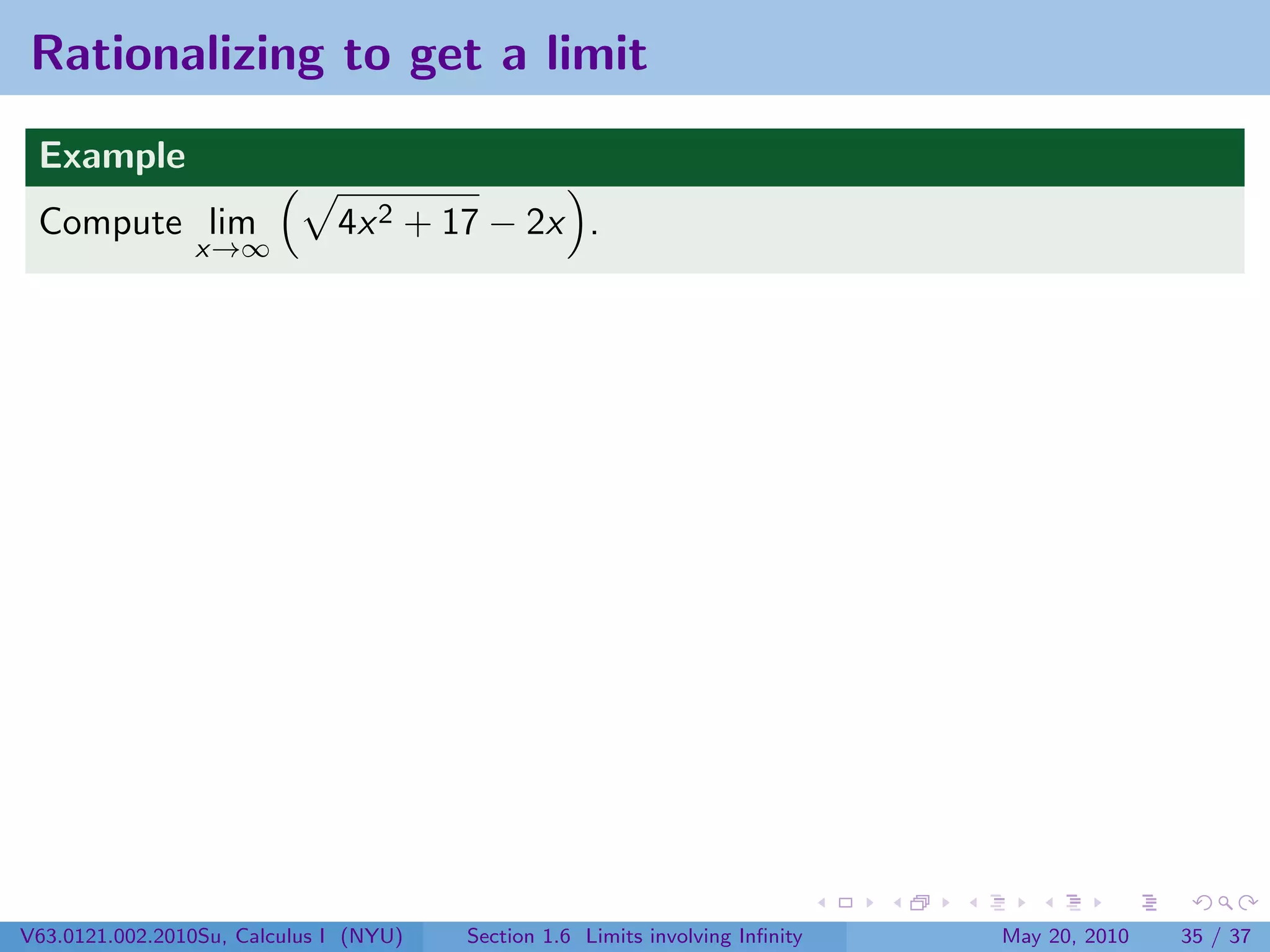
Rationalizing to get a limit
 Example
 Compute lim                  4x 2 + 17 − 2x .
                x→∞


V63.0121.002.2010Su, Calculus I (NYU)   Section 1.6 Limits involving Infinity   May 20, 2010   35 / 37
Rationalizing to get a limit
 Example
 Compute lim                  4x 2 + 17 − 2x .
                x→∞


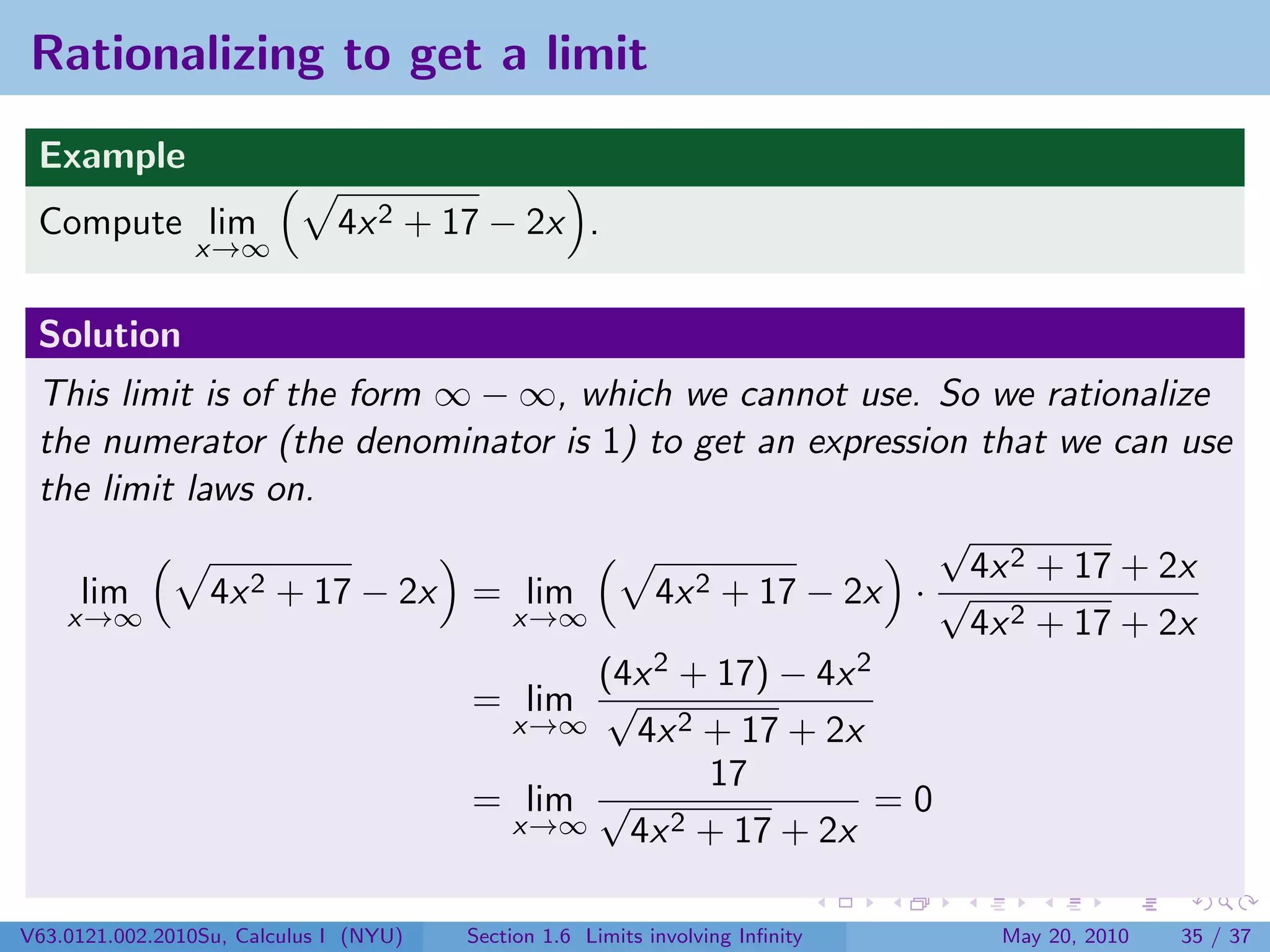
 Solution
 This limit is of the form ∞ − ∞, which we cannot use. So we rationalize
 the numerator (the denominator is 1) to get an expression that we can use
 the limit laws on.
                                                         √
                                                           4x 2 + 17 + 2x
    lim      4x 2 + 17 − 2x = lim      4x 2 + 17 − 2x · √
   x→∞                        x→∞                          4x 2 + 17 + 2x
                                   (4x 2 + 17) − 4x 2
                            = lim √
                              x→∞    4x 2 + 17 + 2x
                                           17
                            = lim √                   =0
                              x→∞    4x 2 + 17 + 2x


V63.0121.002.2010Su, Calculus I (NYU)   Section 1.6 Limits involving Infinity   May 20, 2010   35 / 37
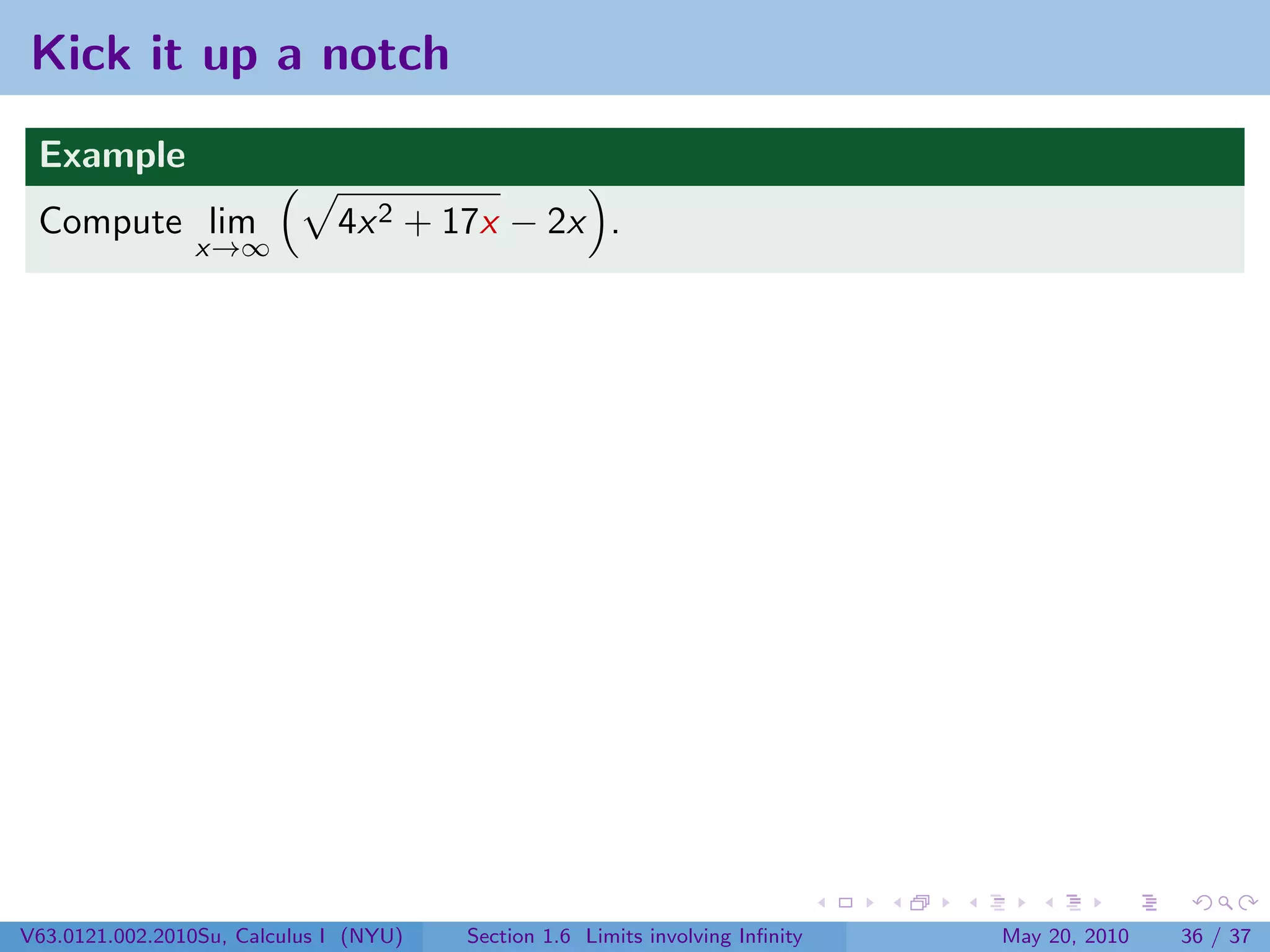
Kick it up a notch
 Example
 Compute lim                  4x 2 + 17x − 2x .
                x→∞


V63.0121.002.2010Su, Calculus I (NYU)   Section 1.6 Limits involving Infinity   May 20, 2010   36 / 37
Kick it up a notch
 Example
 Compute lim                  4x 2 + 17x − 2x .
                x→∞


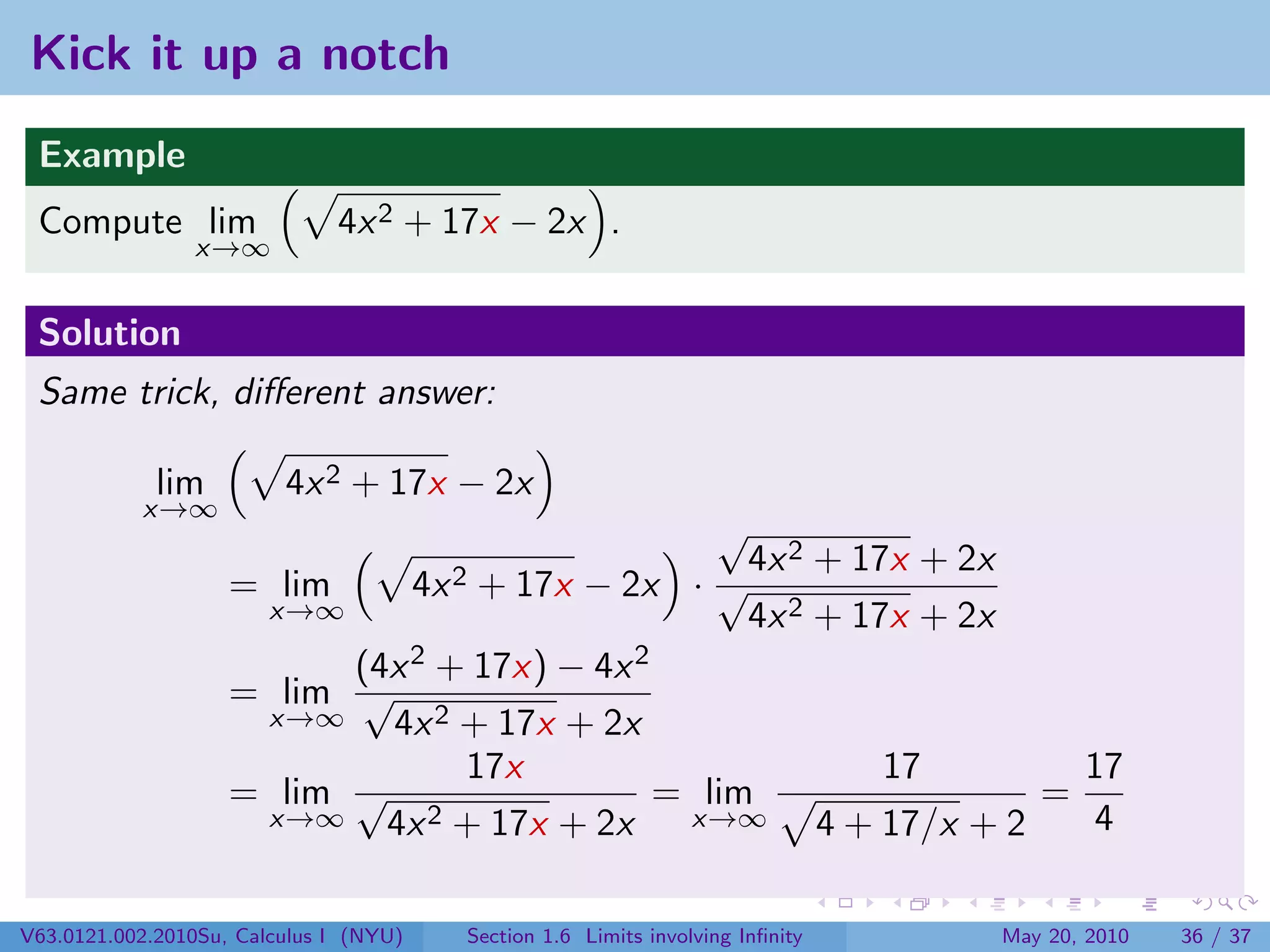
 Solution
 Same trick, different answer:

             lim         4x 2 + 17x − 2x
           x→∞
                                                 √
                                                   4x 2 + 17x + 2x
                    = lim               4x 2
                                  + 17x − 2x · √
                     x→∞                           4x 2 + 17x + 2x
                          (4x 2 + 17x) − 4x 2
                    = lim √
                     x→∞    4x 2 + 17x + 2x
                                 17x                        17         17
                    = lim √                   = lim                  =
                     x→∞    4x 2 + 17x + 2x    x→∞      4 + 17/x + 2   4

V63.0121.002.2010Su, Calculus I (NYU)          Section 1.6 Limits involving Infinity   May 20, 2010   36 / 37
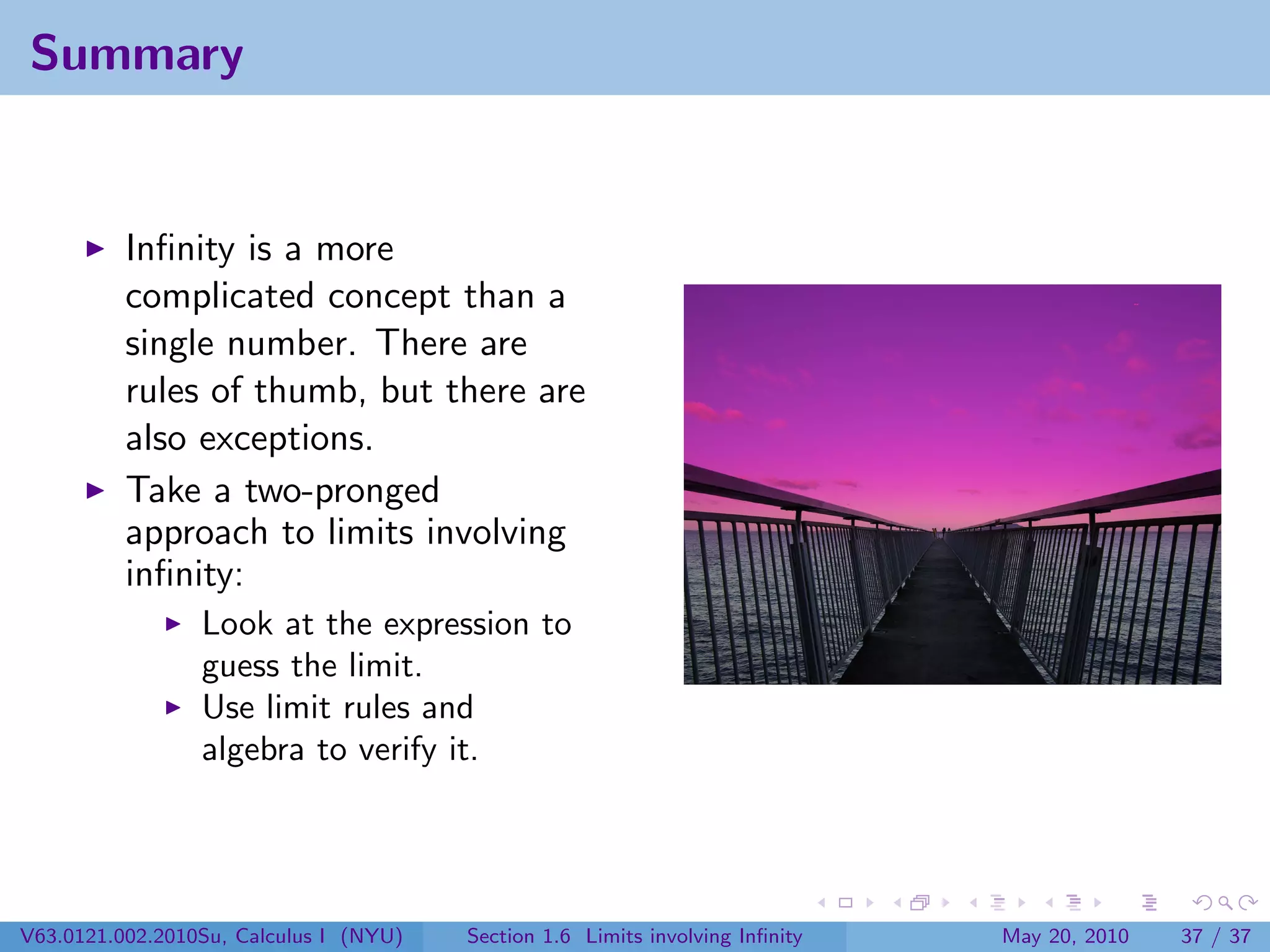
Summary


          Infinity is a more
          complicated concept than a
          single number. There are
          rules of thumb, but there are
          also exceptions.
          Take a two-pronged
          approach to limits involving
          infinity:
                 Look at the expression to
                 guess the limit.
                 Use limit rules and
                 algebra to verify it.


V63.0121.002.2010Su, Calculus I (NYU)   Section 1.6 Limits involving Infinity   May 20, 2010   37 / 37

Lesson 5: Limits Involving Infinity

  • 1.
    Section 1.6 Limits involving Infinity V63.0121.002.2010Su, Calculus I New York University May 20, 2010 Announcements Office Hours: MR 5:00–5:45, TW 7:50–8:30, CIWW 102 (here) Quiz 1 Thursday on 1.1–1.4
  • 2.
    Announcements Office Hours: MR 5:00–5:45, TW 7:50–8:30, CIWW 102 (here) Quiz 1 Thursday on 1.1–1.4 V63.0121.002.2010Su, Calculus I (NYU) Section 1.6 Limits involving Infinity May 20, 2010 2 / 37
  • 3.
    Objectives “Intuit” limits involving infinity by eyeballing the expression. Show limits involving infinity by algebraic manipulation and conceptual argument. V63.0121.002.2010Su, Calculus I (NYU) Section 1.6 Limits involving Infinity May 20, 2010 3 / 37
  • 4.
    Recall the definitionof limit Definition We write lim f (x) = L x→a and say “the limit of f (x), as x approaches a, equals L” if we can make the values of f (x) arbitrarily close to L (as close to L as we like) by taking x to be sufficiently close to a (on either side of a) but not equal to a. V63.0121.002.2010Su, Calculus I (NYU) Section 1.6 Limits involving Infinity May 20, 2010 4 / 37
  • 5.
    Recall the unboundednessproblem 1 Recall why lim+ doesn’t exist. x→0 x y L? x No matter how thin we draw the strip to the right of x = 0, we cannot “capture” the graph inside the box. V63.0121.002.2010Su, Calculus I (NYU) Section 1.6 Limits involving Infinity May 20, 2010 5 / 37
  • 6.
    Recall the unboundednessproblem 1 Recall why lim+ doesn’t exist. x→0 x y L? x No matter how thin we draw the strip to the right of x = 0, we cannot “capture” the graph inside the box. V63.0121.002.2010Su, Calculus I (NYU) Section 1.6 Limits involving Infinity May 20, 2010 5 / 37
  • 7.
    Recall the unboundednessproblem 1 Recall why lim+ doesn’t exist. x→0 x y L? x No matter how thin we draw the strip to the right of x = 0, we cannot “capture” the graph inside the box. V63.0121.002.2010Su, Calculus I (NYU) Section 1.6 Limits involving Infinity May 20, 2010 5 / 37
  • 8.
    Recall the unboundednessproblem 1 Recall why lim+ doesn’t exist. x→0 x y L? x No matter how thin we draw the strip to the right of x = 0, we cannot “capture” the graph inside the box. V63.0121.002.2010Su, Calculus I (NYU) Section 1.6 Limits involving Infinity May 20, 2010 5 / 37
  • 9.
    Outline Infinite Limits Vertical Asymptotes Infinite Limits we Know Limit “Laws” with Infinite Limits Indeterminate Limit forms Limits at ∞ Algebraic rates of growth Rationalizing to get a limit V63.0121.002.2010Su, Calculus I (NYU) Section 1.6 Limits involving Infinity May 20, 2010 6 / 37
  • 10.
    Infinite Limits Definition The notation y lim f (x) = ∞ x→a means that values of f (x) can be made arbitrarily large (as large as we please) by taking x sufficiently close to a but not equal to a. x V63.0121.002.2010Su, Calculus I (NYU) Section 1.6 Limits involving Infinity May 20, 2010 7 / 37
  • 11.
    Infinite Limits Definition The notation y lim f (x) = ∞ x→a means that values of f (x) can be made arbitrarily large (as large as we please) by taking x sufficiently close to a but not equal to a. “Large” takes the place of x “close to L”. V63.0121.002.2010Su, Calculus I (NYU) Section 1.6 Limits involving Infinity May 20, 2010 7 / 37
  • 12.
    Infinite Limits Definition The notation y lim f (x) = ∞ x→a means that values of f (x) can be made arbitrarily large (as large as we please) by taking x sufficiently close to a but not equal to a. “Large” takes the place of x “close to L”. V63.0121.002.2010Su, Calculus I (NYU) Section 1.6 Limits involving Infinity May 20, 2010 7 / 37
  • 13.
    Infinite Limits Definition The notation y lim f (x) = ∞ x→a means that values of f (x) can be made arbitrarily large (as large as we please) by taking x sufficiently close to a but not equal to a. “Large” takes the place of x “close to L”. V63.0121.002.2010Su, Calculus I (NYU) Section 1.6 Limits involving Infinity May 20, 2010 7 / 37
  • 14.
    Infinite Limits Definition The notation y lim f (x) = ∞ x→a means that values of f (x) can be made arbitrarily large (as large as we please) by taking x sufficiently close to a but not equal to a. “Large” takes the place of x “close to L”. V63.0121.002.2010Su, Calculus I (NYU) Section 1.6 Limits involving Infinity May 20, 2010 7 / 37
  • 15.
    Infinite Limits Definition The notation y lim f (x) = ∞ x→a means that values of f (x) can be made arbitrarily large (as large as we please) by taking x sufficiently close to a but not equal to a. “Large” takes the place of x “close to L”. V63.0121.002.2010Su, Calculus I (NYU) Section 1.6 Limits involving Infinity May 20, 2010 7 / 37
  • 16.
    Infinite Limits Definition The notation y lim f (x) = ∞ x→a means that values of f (x) can be made arbitrarily large (as large as we please) by taking x sufficiently close to a but not equal to a. “Large” takes the place of x “close to L”. V63.0121.002.2010Su, Calculus I (NYU) Section 1.6 Limits involving Infinity May 20, 2010 7 / 37
  • 17.
    Infinite Limits Definition The notation y lim f (x) = ∞ x→a means that values of f (x) can be made arbitrarily large (as large as we please) by taking x sufficiently close to a but not equal to a. “Large” takes the place of x “close to L”. V63.0121.002.2010Su, Calculus I (NYU) Section 1.6 Limits involving Infinity May 20, 2010 7 / 37
  • 18.
    Negative Infinity Definition The notation lim f (x) = −∞ x→a means that the values of f (x) can be made arbitrarily large negative (as large as we please) by taking x sufficiently close to a but not equal to a. V63.0121.002.2010Su, Calculus I (NYU) Section 1.6 Limits involving Infinity May 20, 2010 8 / 37
  • 19.
    Negative Infinity Definition The notation lim f (x) = −∞ x→a means that the values of f (x) can be made arbitrarily large negative (as large as we please) by taking x sufficiently close to a but not equal to a. We call a number large or small based on its absolute value. So −1, 000, 000 is a large (negative) number. V63.0121.002.2010Su, Calculus I (NYU) Section 1.6 Limits involving Infinity May 20, 2010 8 / 37
  • 20.
    Vertical Asymptotes Definition The line x = a is called a vertical asymptote of the curve y = f (x) if at least one of the following is true: lim f (x) = ∞ lim f (x) = −∞ x→a x→a lim+ f (x) = ∞ lim f (x) = −∞ x→a x→a+ lim f (x) = ∞ lim f (x) = −∞ x→a− x→a− V63.0121.002.2010Su, Calculus I (NYU) Section 1.6 Limits involving Infinity May 20, 2010 9 / 37
  • 21.
    Infinite Limits weKnow y 1 lim+ =∞ x→0 x x V63.0121.002.2010Su, Calculus I (NYU) Section 1.6 Limits involving Infinity May 20, 2010 10 / 37
  • 22.
    Infinite Limits weKnow y 1 lim+ =∞ x→0 x 1 lim = −∞ − x x→0 x V63.0121.002.2010Su, Calculus I (NYU) Section 1.6 Limits involving Infinity May 20, 2010 10 / 37
  • 23.
    Infinite Limits weKnow y 1 lim+ =∞ x→0 x 1 lim = −∞ − x x→0 x 1 lim 2 = ∞ x→0 x V63.0121.002.2010Su, Calculus I (NYU) Section 1.6 Limits involving Infinity May 20, 2010 10 / 37
  • 24.
    Finding limits attrouble spots Example Let x2 + 2 f (x) = x 2 − 3x + 2 Find lim f (x) and lim+ f (x) for each a at which f is not continuous. x→a− x→a V63.0121.002.2010Su, Calculus I (NYU) Section 1.6 Limits involving Infinity May 20, 2010 11 / 37
  • 25.
    Finding limits attrouble spots Example Let x2 + 2 f (x) = x 2 − 3x + 2 Find lim f (x) and lim+ f (x) for each a at which f is not continuous. x→a− x→a Solution The denominator factors as (x − 1)(x − 2). We can record the signs of the factors on the number line. V63.0121.002.2010Su, Calculus I (NYU) Section 1.6 Limits involving Infinity May 20, 2010 11 / 37
  • 26.
    Use the numberline − 0 + (x − 1) 1 So
  • 27.
    Use the numberline − 0 + (x − 1) 1 − 0 + (x − 2) 2 So
  • 28.
    Use the numberline − 0 + (x − 1) 1 − 0 + (x − 2) 2 + (x 2 + 2) So
  • 29.
    Use the numberline − 0 + (x − 1) 1 − 0 + (x − 2) 2 + (x 2 + 2) f (x) 1 2 So
  • 30.
    Use the numberline − 0 + (x − 1) 1 − 0 + (x − 2) 2 + (x 2 + 2) + f (x) 1 2 So
  • 31.
    Use the numberline − 0 + (x − 1) 1 − 0 + (x − 2) 2 + (x 2 + 2) + +∞ f (x) 1 2 So lim f (x) = +∞ x→1−
  • 32.
    Use the numberline − 0 + (x − 1) 1 − 0 + (x − 2) 2 + (x 2 + 2) + +∞ −∞ f (x) 1 2 So lim f (x) = +∞ x→1− lim f (x) = −∞ x→1+
  • 33.
    Use the numberline − 0 + (x − 1) 1 − 0 + (x − 2) 2 + (x 2 + 2) + +∞ −∞ − f (x) 1 2 So lim f (x) = +∞ x→1− lim f (x) = −∞ x→1+
  • 34.
    Use the numberline − 0 + (x − 1) 1 − 0 + (x − 2) 2 + (x 2 + 2) + +∞ −∞ − −∞ f (x) 1 2 So lim f (x) = +∞ lim f (x) = −∞ x→1− x→2− lim f (x) = −∞ x→1+
  • 35.
    Use the numberline − 0 + (x − 1) 1 − 0 + (x − 2) 2 + (x 2 + 2) + +∞ −∞ − −∞ +∞ f (x) 1 2 So lim f (x) = +∞ lim f (x) = −∞ x→1− x→2− lim f (x) = −∞ lim f (x) = +∞ x→1+ x→2+
  • 36.
    Use the numberline − 0 + (x − 1) 1 − 0 + (x − 2) 2 + (x 2 + 2) + +∞ −∞ − −∞ +∞ f (x) 1 2 So lim f (x) = +∞ lim f (x) = −∞ x→1− x→2− lim f (x) = −∞ lim f (x) = +∞ x→1+ x→2+
  • 37.
    Use the numberline − 0 + (x − 1) 1 − 0 + (x − 2) 2 + (x 2 + 2) + +∞ −∞ − −∞ +∞ + f (x) 1 2 So lim f (x) = +∞ lim f (x) = −∞ x→1− x→2− lim f (x) = −∞ lim f (x) = +∞ x→1+ x→2+ V63.0121.002.2010Su, Calculus I (NYU) Section 1.6 Limits involving Infinity May 20, 2010 12 / 37
  • 38.
    In English, now To explain the limit, you can say: “As x → 1− , the numerator approaches 3, and the denominator approaches 0 while remaining positive. So the limit is +∞.” V63.0121.002.2010Su, Calculus I (NYU) Section 1.6 Limits involving Infinity May 20, 2010 13 / 37
  • 39.
    The graph sofar y x −1 1 2 3 V63.0121.002.2010Su, Calculus I (NYU) Section 1.6 Limits involving Infinity May 20, 2010 14 / 37
  • 40.
    The graph sofar y x −1 1 2 3 V63.0121.002.2010Su, Calculus I (NYU) Section 1.6 Limits involving Infinity May 20, 2010 14 / 37
  • 41.
    The graph sofar y x −1 1 2 3 V63.0121.002.2010Su, Calculus I (NYU) Section 1.6 Limits involving Infinity May 20, 2010 14 / 37
  • 42.
    The graph sofar y x −1 1 2 3 V63.0121.002.2010Su, Calculus I (NYU) Section 1.6 Limits involving Infinity May 20, 2010 14 / 37
  • 43.
    The graph sofar y x −1 1 2 3 V63.0121.002.2010Su, Calculus I (NYU) Section 1.6 Limits involving Infinity May 20, 2010 14 / 37
  • 44.
    Limit Laws (?)with infinite limits If lim f (x) = ∞ and lim g (x) = ∞, then lim (f (x) + g (x)) = ∞. x→a x→a x→a That is, ∞+∞=∞ If lim f (x) = −∞ and lim g (x) = −∞, then x→a x→a lim (f (x) + g (x)) = −∞. That is, x→a −∞ − ∞ = −∞ V63.0121.002.2010Su, Calculus I (NYU) Section 1.6 Limits involving Infinity May 20, 2010 15 / 37
  • 45.
    Rules of Thumbwith infinite limits If lim f (x) = ∞ and lim g (x) = ∞, then lim (f (x) + g (x)) = ∞. x→a x→a x→a That is, ∞+∞=∞ If lim f (x) = −∞ and lim g (x) = −∞, then x→a x→a lim (f (x) + g (x)) = −∞. That is, x→a −∞ − ∞ = −∞ V63.0121.002.2010Su, Calculus I (NYU) Section 1.6 Limits involving Infinity May 20, 2010 15 / 37
  • 46.
    Rules of Thumbwith infinite limits If lim f (x) = L and lim g (x) = ±∞, then lim (f (x) + g (x)) = ±∞. x→a x→a x→a That is, L+∞=∞ L − ∞ = −∞ V63.0121.002.2010Su, Calculus I (NYU) Section 1.6 Limits involving Infinity May 20, 2010 16 / 37
  • 47.
    Rules of Thumbwith infinite limits Kids, don’t try this at home! The product of a finite limit and an infinite limit is infinite if the finite limit is not 0. ∞ if L > 0 L·∞= −∞ if L < 0. −∞ if L > 0 L · (−∞) = ∞ if L < 0. V63.0121.002.2010Su, Calculus I (NYU) Section 1.6 Limits involving Infinity May 20, 2010 17 / 37
  • 48.
    Multiplying infinite limits Kids,don’t try this at home! The product of two infinite limits is infinite. ∞·∞=∞ ∞ · (−∞) = −∞ (−∞) · (−∞) = ∞ V63.0121.002.2010Su, Calculus I (NYU) Section 1.6 Limits involving Infinity May 20, 2010 18 / 37
  • 49.
    Dividing by Infinity Kids,don’t try this at home! The quotient of a finite limit by an infinite limit is zero: L =0 ∞ V63.0121.002.2010Su, Calculus I (NYU) Section 1.6 Limits involving Infinity May 20, 2010 19 / 37
  • 50.
    Dividing by zerois still not allowed 1 =∞ 0 There are examples of such limit forms where the limit is ∞, −∞, undecided between the two, or truly neither. V63.0121.002.2010Su, Calculus I (NYU) Section 1.6 Limits involving Infinity May 20, 2010 20 / 37
  • 51.
    Indeterminate Limit forms L Limits of the form are indeterminate. There is no rule for evaluating 0 such a form; the limit must be examined more closely. Consider these: 1 −1 lim =∞ lim = −∞ x→0 x2 x→0 x2 1 1 lim+ = ∞ lim = −∞ x→0 x x→0− x 1 L Worst, lim is of the form , but the limit does not exist, even x sin(1/x) x→0 0 in the left- or right-hand sense. There are infinitely many vertical asymptotes arbitrarily close to 0! V63.0121.002.2010Su, Calculus I (NYU) Section 1.6 Limits involving Infinity May 20, 2010 21 / 37
  • 52.
    Indeterminate Limit forms Limits of the form 0 · ∞ and ∞ − ∞ are also indeterminate. Example 1 The limit lim+ sin x · is of the form 0 · ∞, but the answer is 1. x→0 x 1 The limit lim+ sin2 x · is of the form 0 · ∞, but the answer is 0. x→0 x 1 The limit lim+ sin x · 2 is of the form 0 · ∞, but the answer is ∞. x→0 x Limits of indeterminate forms may or may not “exist.” It will depend on the context. V63.0121.002.2010Su, Calculus I (NYU) Section 1.6 Limits involving Infinity May 20, 2010 22 / 37
  • 53.
    Indeterminate forms arelike Tug Of War Which side wins depends on which side is stronger. V63.0121.002.2010Su, Calculus I (NYU) Section 1.6 Limits involving Infinity May 20, 2010 23 / 37
  • 54.
    Outline Infinite Limits Vertical Asymptotes Infinite Limits we Know Limit “Laws” with Infinite Limits Indeterminate Limit forms Limits at ∞ Algebraic rates of growth Rationalizing to get a limit V63.0121.002.2010Su, Calculus I (NYU) Section 1.6 Limits involving Infinity May 20, 2010 24 / 37
  • 55.
    Limits at infinity Definition Let f be a function defined on some interval (a, ∞). Then lim f (x) = L x→∞ means that the values of f (x) can be made as close to L as we like, by taking x sufficiently large. V63.0121.002.2010Su, Calculus I (NYU) Section 1.6 Limits involving Infinity May 20, 2010 25 / 37
  • 56.
    Limits at infinity Definition Let f be a function defined on some interval (a, ∞). Then lim f (x) = L x→∞ means that the values of f (x) can be made as close to L as we like, by taking x sufficiently large. Definition The line y = L is a called a horizontal asymptote of the curve y = f (x) if either lim f (x) = L or lim f (x) = L. x→∞ x→−∞ V63.0121.002.2010Su, Calculus I (NYU) Section 1.6 Limits involving Infinity May 20, 2010 25 / 37
  • 57.
    Limits at infinity Definition Let f be a function defined on some interval (a, ∞). Then lim f (x) = L x→∞ means that the values of f (x) can be made as close to L as we like, by taking x sufficiently large. Definition The line y = L is a called a horizontal asymptote of the curve y = f (x) if either lim f (x) = L or lim f (x) = L. x→∞ x→−∞ y = L is a horizontal line! V63.0121.002.2010Su, Calculus I (NYU) Section 1.6 Limits involving Infinity May 20, 2010 25 / 37
  • 58.
    Basic limits atinfinity Theorem Let n be a positive integer. Then 1 lim =0 x→∞ x n 1 lim =0 x→−∞ x n V63.0121.002.2010Su, Calculus I (NYU) Section 1.6 Limits involving Infinity May 20, 2010 26 / 37
  • 59.
    Using the limitlaws to compute limits at ∞ Example Find 2x 3 + 3x + 1 lim x→∞ 4x 3 + 5x 2 + 7 if it exists. A does not exist B 1/2 C 0 D ∞ V63.0121.002.2010Su, Calculus I (NYU) Section 1.6 Limits involving Infinity May 20, 2010 27 / 37
  • 60.
    Using the limitlaws to compute limits at ∞ Example Find 2x 3 + 3x + 1 lim x→∞ 4x 3 + 5x 2 + 7 if it exists. A does not exist B 1/2 C 0 D ∞ V63.0121.002.2010Su, Calculus I (NYU) Section 1.6 Limits involving Infinity May 20, 2010 27 / 37
  • 61.
    Solution Factor outthe largest power of x from the numerator and denominator. We have 2x 3 + 3x + 1 x 3 (2 + 3/x 2 + 1/x 3 ) = 3 4x 3 + 5x 2 + 7 x (4 + 5/x + 7/x 3 ) 2x 3 + 3x + 1 2 + 3/x 2 + 1/x 3 lim 3 + 5x 2 + 7 = lim x→∞ 4x x→∞ 4 + 5/x + 7/x 3 2+0+0 1 = = 4+0+0 2 V63.0121.002.2010Su, Calculus I (NYU) Section 1.6 Limits involving Infinity May 20, 2010 28 / 37
  • 62.
    Solution Factor outthe largest power of x from the numerator and denominator. We have 2x 3 + 3x + 1 x 3 (2 + 3/x 2 + 1/x 3 ) = 3 4x 3 + 5x 2 + 7 x (4 + 5/x + 7/x 3 ) 2x 3 + 3x + 1 2 + 3/x 2 + 1/x 3 lim 3 + 5x 2 + 7 = lim x→∞ 4x x→∞ 4 + 5/x + 7/x 3 2+0+0 1 = = 4+0+0 2 Upshot When finding limits of algebraic expressions at infinity, look at the highest degree terms. V63.0121.002.2010Su, Calculus I (NYU) Section 1.6 Limits involving Infinity May 20, 2010 28 / 37
  • 63.
    Another Example Example x Find lim x→∞ x2 + 1 V63.0121.002.2010Su, Calculus I (NYU) Section 1.6 Limits involving Infinity May 20, 2010 29 / 37
  • 64.
    Another Example Example x Find lim x→∞ x2 + 1 Answer The limit is 0. V63.0121.002.2010Su, Calculus I (NYU) Section 1.6 Limits involving Infinity May 20, 2010 29 / 37
  • 65.
    Solution Again, factorout the largest power of x from the numerator and denominator. We have x x(1) 1 1 = 2 = · x2 +1 x (1 + 1/x 2) x 1 + 1/x 2 x 1 1 1 1 lim 2 = lim = lim · lim x→∞ x + 1 x→∞ x 1 + 1/x 2 x→∞ x x→∞ 1 + 1/x 2 1 =0· = 0. 1+0 V63.0121.002.2010Su, Calculus I (NYU) Section 1.6 Limits involving Infinity May 20, 2010 30 / 37
  • 66.
    Another Example Example x Find lim x→∞ x2 + 1 Answer The limit is 0. y x V63.0121.002.2010Su, Calculus I (NYU) Section 1.6 Limits involving Infinity May 20, 2010 31 / 37
  • 67.
    Another Example Example x Find lim x→∞ x2 + 1 Answer The limit is 0. y x Notice that the graph does cross the asymptote, which contradicts one of the heuristic definitions of asymptote. V63.0121.002.2010Su, Calculus I (NYU) Section 1.6 Limits involving Infinity May 20, 2010 31 / 37
  • 68.
    Solution Again, factorout the largest power of x from the numerator and denominator. We have x x(1) 1 1 = 2 = · x2 +1 x (1 + 1/x 2) x 1 + 1/x 2 x 1 1 1 1 lim 2 = lim = lim · lim x→∞ x + 1 x→∞ x 1 + 1/x 2 x→∞ x x→∞ 1 + 1/x 2 1 =0· = 0. 1+0 Remark Had the higher power been in the numerator, the limit would have been ∞. V63.0121.002.2010Su, Calculus I (NYU) Section 1.6 Limits involving Infinity May 20, 2010 32 / 37
  • 69.
    Another Example Example Find √ 3x 4 + 7 lim x→∞ x2 + 3 V63.0121.002.2010Su, Calculus I (NYU) Section 1.6 Limits involving Infinity May 20, 2010 33 / 37
  • 70.
    Another Example Example Find √ √ 3x 4 + 7 ∼ 3x 4 = 3x 2 √ 3x 4 + 7 lim x→∞ x2 + 3 Answer √ The limit is 3. V63.0121.002.2010Su, Calculus I (NYU) Section 1.6 Limits involving Infinity May 20, 2010 33 / 37
  • 71.
    Solution √ 3x 4 + 7 x 4 (3 + 7/x 4 ) lim = lim x→∞ x2 + 3 x→∞ x 2 (1 + 3/x 2 ) x 2 (3 + 7/x 4 ) = lim x→∞ x 2 (1 + 3/x 2 ) (3 + 7/x 4 ) = lim x→∞ 1 + 3/x 2 √ 3+0 √ = = 3. 1+0 V63.0121.002.2010Su, Calculus I (NYU) Section 1.6 Limits involving Infinity May 20, 2010 34 / 37
  • 72.
    Rationalizing to geta limit Example Compute lim 4x 2 + 17 − 2x . x→∞ V63.0121.002.2010Su, Calculus I (NYU) Section 1.6 Limits involving Infinity May 20, 2010 35 / 37
  • 73.
    Rationalizing to geta limit Example Compute lim 4x 2 + 17 − 2x . x→∞ Solution This limit is of the form ∞ − ∞, which we cannot use. So we rationalize the numerator (the denominator is 1) to get an expression that we can use the limit laws on. √ 4x 2 + 17 + 2x lim 4x 2 + 17 − 2x = lim 4x 2 + 17 − 2x · √ x→∞ x→∞ 4x 2 + 17 + 2x (4x 2 + 17) − 4x 2 = lim √ x→∞ 4x 2 + 17 + 2x 17 = lim √ =0 x→∞ 4x 2 + 17 + 2x V63.0121.002.2010Su, Calculus I (NYU) Section 1.6 Limits involving Infinity May 20, 2010 35 / 37
  • 74.
    Kick it upa notch Example Compute lim 4x 2 + 17x − 2x . x→∞ V63.0121.002.2010Su, Calculus I (NYU) Section 1.6 Limits involving Infinity May 20, 2010 36 / 37
  • 75.
    Kick it upa notch Example Compute lim 4x 2 + 17x − 2x . x→∞ Solution Same trick, different answer: lim 4x 2 + 17x − 2x x→∞ √ 4x 2 + 17x + 2x = lim 4x 2 + 17x − 2x · √ x→∞ 4x 2 + 17x + 2x (4x 2 + 17x) − 4x 2 = lim √ x→∞ 4x 2 + 17x + 2x 17x 17 17 = lim √ = lim = x→∞ 4x 2 + 17x + 2x x→∞ 4 + 17/x + 2 4 V63.0121.002.2010Su, Calculus I (NYU) Section 1.6 Limits involving Infinity May 20, 2010 36 / 37
  • 76.
    Summary Infinity is a more complicated concept than a single number. There are rules of thumb, but there are also exceptions. Take a two-pronged approach to limits involving infinity: Look at the expression to guess the limit. Use limit rules and algebra to verify it. V63.0121.002.2010Su, Calculus I (NYU) Section 1.6 Limits involving Infinity May 20, 2010 37 / 37