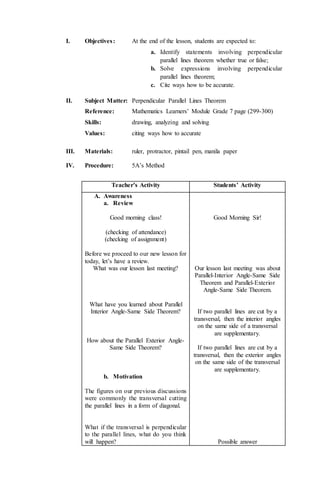
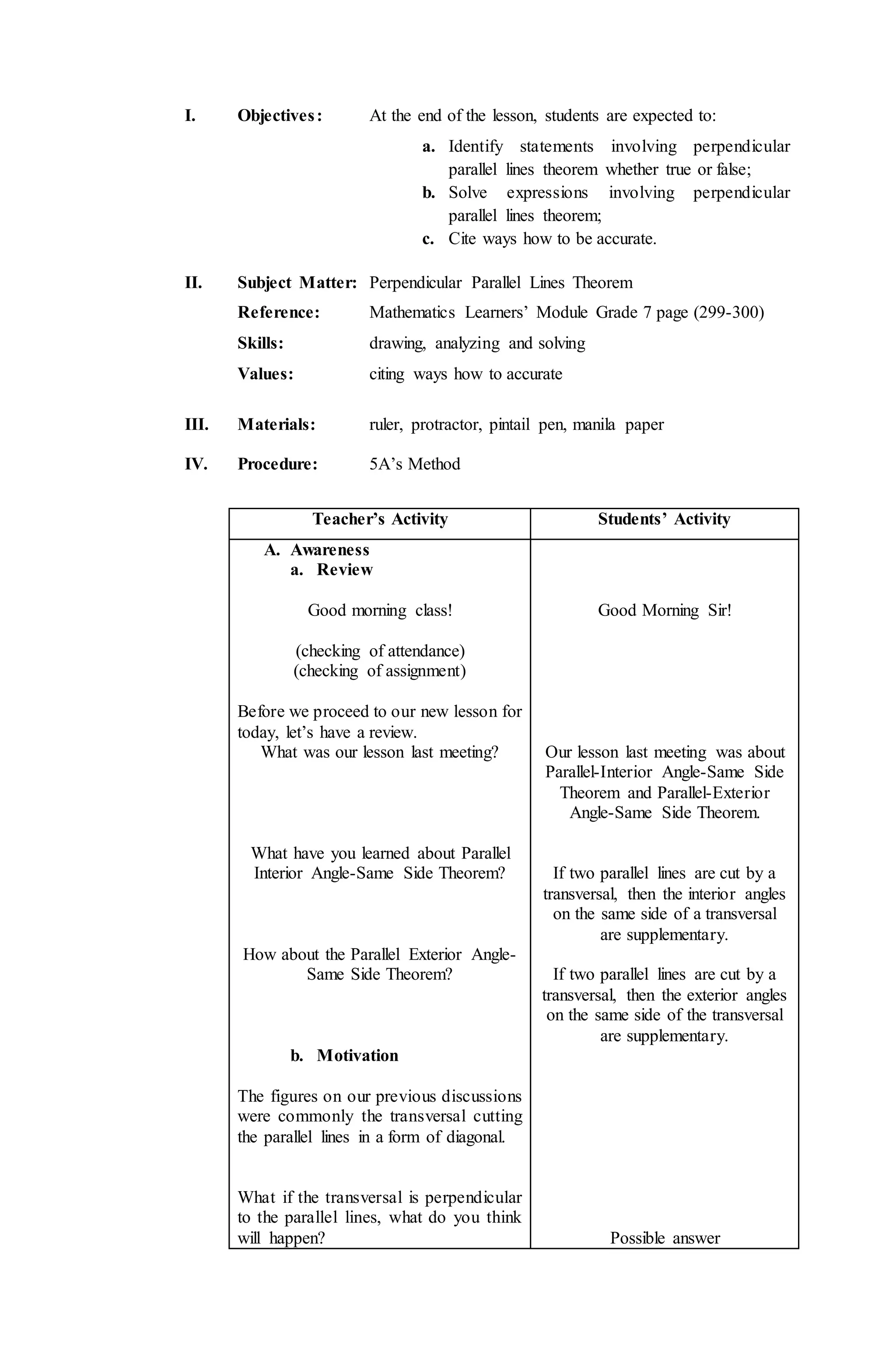
I. Objectives: At the end of the lesson, students are expected to:
a. Identify statements involving perpendicular
parallel lines theorem whether true or false;
b. Solve expressions involving perpendicular
parallel lines theorem;
c. Cite ways how to be accurate.
II. Subject Matter: Perpendicular Parallel Lines Theorem
Reference: Mathematics Learners’ Module Grade 7 page (299-300)
Skills: drawing, analyzing and solving
Values: citing ways how to accurate
III. Materials: ruler, protractor, pintail pen, manila paper
IV. Procedure: 5A’s Method
Teacher’s Activity Students’ Activity
A. Awareness
a. Review
Good morning class!
(checking of attendance)
(checking of assignment)
Before we proceed to our new lesson for
today, let’s have a review.
What was our lesson last meeting?
What have you learned about Parallel
Interior Angle-Same Side Theorem?
How about the Parallel Exterior Angle-
Same Side Theorem?
b. Motivation
The figures on our previous discussions
were commonly the transversal cutting
the parallel lines in a form of diagonal.
What if the transversal is perpendicular
to the parallel lines, what do you think
will happen?
Good Morning Sir!
Our lesson last meeting was about
Parallel-Interior Angle-Same Side
Theorem and Parallel-Exterior
Angle-Same Side Theorem.
If two parallel lines are cut by a
transversal, then the interior angles
on the same side of a transversal
are supplementary.
If two parallel lines are cut by a
transversal, then the exterior angles
on the same side of the transversal
are supplementary.
Possible answer
Do you know about a certain theorem
when the transversal is perpendicular to
the parallel lines?
c. Presentation
So be with me this morning class as I
discuss to you the Perpendicular
Parallel Lines Theorem
d. Statement of the Aim
*identify statements whether true Or
false
*solve expressions
*cite way how to be accurate
B. Activity
I’ll group you into 4; all you have to do
is to perform these procedures for 5
minutes.
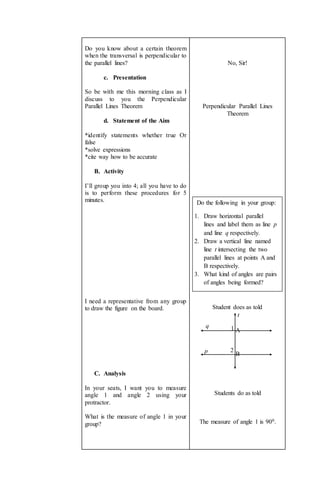
I need a representative from any group
to draw the figure on the board.
C. Analysis
In your seats, I want you to measure
angle 1 and angle 2 using your
protractor.
What is the measure of angle 1 in your
group?
No, Sir!
Perpendicular Parallel Lines
Theorem
Student does as told
Students do as told
The measure of angle 1 is 900.
Do the following in your group:
1. Draw horizontal parallel
lines and label them as line p
and line q respectively.
2. Draw a vertical line named
line t intersecting the two
parallel lines at points A and
B respectively.
3. What kind of angles are pairs
of angles being formed?
1
B
A
2p
q
t
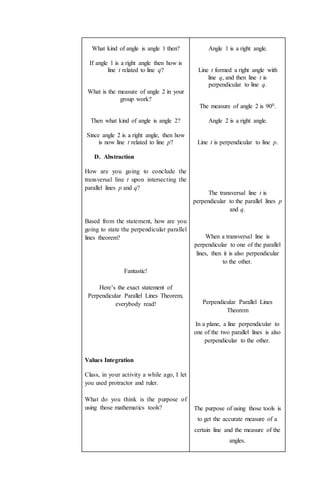
What kind of angle is angle 1 then?
If angle 1 is a right angle then how is
line t related to line q?
What is the measure of angle 2 in your
group work?
Then what kind of angle is angle 2?
Since angle 2 is a right angle, then how
is now line t related to line p?
D. Abstraction
How are you going to conclude the
transversal line t upon intersecting the
parallel lines p and q?
Based from the statement, how are you
going to state the perpendicular parallel
lines theorem?
Fantastic!
Here’s the exact statement of
Perpendicular Parallel Lines Theorem,
everybody read!
Values Integration
Class, in your activity a while ago, I let
you used protractor and ruler.
What do you think is the purpose of
using those mathematics tools?
Angle 1 is a right angle.
Line t formed a right angle with
line q, and then line t is
perpendicular to line q.
The measure of angle 2 is 900.
Angle 2 is a right angle.
Line t is perpendicular to line p.
The transversal line t is
perpendicular to the parallel lines p
and q.
When a transversal line is
perpendicular to one of the parallel
lines, then it is also perpendicular
to the other.
Perpendicular Parallel Lines
Theorem
In a plane, a line perpendicular to
one of the two parallel lines is also
perpendicular to the other.
The purpose of using those tools is
to get the accurate measure of a
certain line and the measure of the
angles.
In our real life situation class, how can
you be an accurate in terms of the things
that you and day?
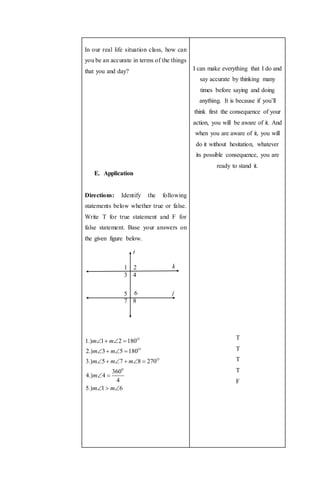
E. Application
Directions: Identify the following
statements below whether true or false.
Write T for true statement and F for
false statement. Base your answers on
the given figure below.
0
1.) 1 2 180
2.) 3 5 180
3.) 5 7 8 270
360
4.) 4
4
5.) 1 6
O
O
O
m m
m m
m m m
m
m m
   
   
     
 
  
I can make everything that I do and
say accurate by thinking many
times before saying and doing
anything. It is because if you’ll
think first the consequence of your
action, you will be aware of it. And
when you are aware of it, you will
do it without hesitation, whatever
its possible consequence, you are
ready to stand it.
T
T
T
T
F
1 2
3 4
5 6
7 8
t
k
j
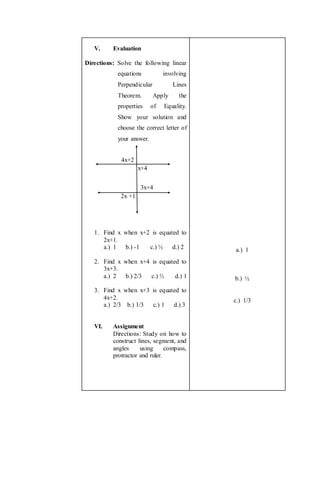
V. Evaluation
Directions: Solve the following linear
equations involving
Perpendicular Lines
Theorem. Apply the
properties of Equality.
Show your solution and
choose the correct letter of
your answer.
1. Find x when x+2 is equated to
2x+1.
a.) 1 b.) -1 c.) ½ d.) 2
2. Find x when x+4 is equated to
3x+3.
a.) 2 b.) 2/3 c.) ½ d.) 1
3. Find x when x+3 is equated to
4x+2.
a.) 2/3 b.) 1/3 c.) 1 d.) 3
VI. Assignment
Directions: Study on how to
construct lines, segment, and
angles using compass,
protractor and ruler.
a.) 1
b.) ½
c.) 1/3
4x+2
x+4
3x+4
2x +1

Perpendicular parallel lines theorem lesson plan using 5 as method

  • 1.
    I. Objectives: Atthe end of the lesson, students are expected to: a. Identify statements involving perpendicular parallel lines theorem whether true or false; b. Solve expressions involving perpendicular parallel lines theorem; c. Cite ways how to be accurate. II. Subject Matter: Perpendicular Parallel Lines Theorem Reference: Mathematics Learners’ Module Grade 7 page (299-300) Skills: drawing, analyzing and solving Values: citing ways how to accurate III. Materials: ruler, protractor, pintail pen, manila paper IV. Procedure: 5A’s Method Teacher’s Activity Students’ Activity A. Awareness a. Review Good morning class! (checking of attendance) (checking of assignment) Before we proceed to our new lesson for today, let’s have a review. What was our lesson last meeting? What have you learned about Parallel Interior Angle-Same Side Theorem? How about the Parallel Exterior Angle- Same Side Theorem? b. Motivation The figures on our previous discussions were commonly the transversal cutting the parallel lines in a form of diagonal. What if the transversal is perpendicular to the parallel lines, what do you think will happen? Good Morning Sir! Our lesson last meeting was about Parallel-Interior Angle-Same Side Theorem and Parallel-Exterior Angle-Same Side Theorem. If two parallel lines are cut by a transversal, then the interior angles on the same side of a transversal are supplementary. If two parallel lines are cut by a transversal, then the exterior angles on the same side of the transversal are supplementary. Possible answer
  • 2.
    Do you knowabout a certain theorem when the transversal is perpendicular to the parallel lines? c. Presentation So be with me this morning class as I discuss to you the Perpendicular Parallel Lines Theorem d. Statement of the Aim *identify statements whether true Or false *solve expressions *cite way how to be accurate B. Activity I’ll group you into 4; all you have to do is to perform these procedures for 5 minutes. I need a representative from any group to draw the figure on the board. C. Analysis In your seats, I want you to measure angle 1 and angle 2 using your protractor. What is the measure of angle 1 in your group? No, Sir! Perpendicular Parallel Lines Theorem Student does as told Students do as told The measure of angle 1 is 900. Do the following in your group: 1. Draw horizontal parallel lines and label them as line p and line q respectively. 2. Draw a vertical line named line t intersecting the two parallel lines at points A and B respectively. 3. What kind of angles are pairs of angles being formed? 1 B A 2p q t
  • 3.
    What kind ofangle is angle 1 then? If angle 1 is a right angle then how is line t related to line q? What is the measure of angle 2 in your group work? Then what kind of angle is angle 2? Since angle 2 is a right angle, then how is now line t related to line p? D. Abstraction How are you going to conclude the transversal line t upon intersecting the parallel lines p and q? Based from the statement, how are you going to state the perpendicular parallel lines theorem? Fantastic! Here’s the exact statement of Perpendicular Parallel Lines Theorem, everybody read! Values Integration Class, in your activity a while ago, I let you used protractor and ruler. What do you think is the purpose of using those mathematics tools? Angle 1 is a right angle. Line t formed a right angle with line q, and then line t is perpendicular to line q. The measure of angle 2 is 900. Angle 2 is a right angle. Line t is perpendicular to line p. The transversal line t is perpendicular to the parallel lines p and q. When a transversal line is perpendicular to one of the parallel lines, then it is also perpendicular to the other. Perpendicular Parallel Lines Theorem In a plane, a line perpendicular to one of the two parallel lines is also perpendicular to the other. The purpose of using those tools is to get the accurate measure of a certain line and the measure of the angles.
  • 4.
    In our reallife situation class, how can you be an accurate in terms of the things that you and day? E. Application Directions: Identify the following statements below whether true or false. Write T for true statement and F for false statement. Base your answers on the given figure below. 0 1.) 1 2 180 2.) 3 5 180 3.) 5 7 8 270 360 4.) 4 4 5.) 1 6 O O O m m m m m m m m m m                    I can make everything that I do and say accurate by thinking many times before saying and doing anything. It is because if you’ll think first the consequence of your action, you will be aware of it. And when you are aware of it, you will do it without hesitation, whatever its possible consequence, you are ready to stand it. T T T T F 1 2 3 4 5 6 7 8 t k j
  • 5.
    V. Evaluation Directions: Solvethe following linear equations involving Perpendicular Lines Theorem. Apply the properties of Equality. Show your solution and choose the correct letter of your answer. 1. Find x when x+2 is equated to 2x+1. a.) 1 b.) -1 c.) ½ d.) 2 2. Find x when x+4 is equated to 3x+3. a.) 2 b.) 2/3 c.) ½ d.) 1 3. Find x when x+3 is equated to 4x+2. a.) 2/3 b.) 1/3 c.) 1 d.) 3 VI. Assignment Directions: Study on how to construct lines, segment, and angles using compass, protractor and ruler. a.) 1 b.) ½ c.) 1/3 4x+2 x+4 3x+4 2x +1