Downloaded 150 times

![One day an Indian gentleman, a snake charmer, arrived in
England by plane. He was coming from Bombay with two
pieces of luggage. The big of them contained a snake. A
man and a little boy was watching him in the customs
area. The man said to the little boy: ‘Go and speak with
this gentleman’. When the little boy was speaking with the
traveller, the thief took the big suitcase and went out
quickly. When the victim saw that he cried ‘Help me! Help
me! A thief! A thief!’ The policeman was in this corner
whistle but it was too late. The two thieves escape with the
big suitcase, took their car and went in the traffic. They
passed near a zoo and stop in a forest. There they had a
big surprise. The basket contain a big snake.
[French native speaker]](https://image.slidesharecdn.com/l2-140429131833-phpapp02/85/L2-error-analysis-6-320.jpg)
![One day an Indian gentleman, a snake charmer, arrived in
England by plane. He was coming from Bombay with two
pieces of luggage. The bigger of them contained a snake. A
man and a little boy were watching him in the customs area.
The man said to the little boy: ‘Go and speak with this
gentleman’. When the little boy was speaking with the
traveller, the thief took the big suitcase and went out quickly.
When the victim saw that he cried ‘Help me! Help me! A
thief! A thief!’ The policeman, who was in this corner,
whistled but it was too late. The two thieves escaped with
the big suitcase, took their car and went into the traffic. They
passed near a zoo and stoped in a forest. There they had a
big surprise. The basket contain a big snake.
[French native speaker]](https://image.slidesharecdn.com/l2-140429131833-phpapp02/85/L2-error-analysis-7-320.jpg)
![Contrastive analysis
Learning is a cumulative process. The more knowledge
and skills an individual acquires, the more likely it
becomes that his new learning will be shaped by his past
experiences and activities. An adult rarely, if ever, learns
anything completely new; however, unfamiliar the task
that confronts him, the information and habits he has built
up in the past will be his point of departure. Thus transfer
of training from old to new situations is part and parcel of
most, if not all, learning. In this sense the study of transfer
is coextensive with the investigation of learning.
[Postman 1971]](https://image.slidesharecdn.com/l2-140429131833-phpapp02/85/L2-error-analysis-9-320.jpg)
![Since even languages as closely related as German and
English differ significantly in the form, meaning and
distribution of their grammatical structures, and since the
learner tends to transfer the habits of his native language
structure to the foreign language, we have here the major
source of difficulty or ease in learning the structure of a
foreign language. Those structures that are similar will be
easy to learn because they will be transferred and may
function satisfactorily in the foreign language. Those
structures that are different will be difficult because when
transferred they will not function satisfactorily in the foreign
language and will therefore have to be changed.
[Lado 1957]](https://image.slidesharecdn.com/l2-140429131833-phpapp02/85/L2-error-analysis-11-320.jpg)
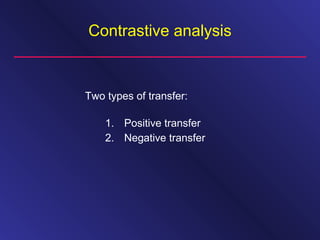
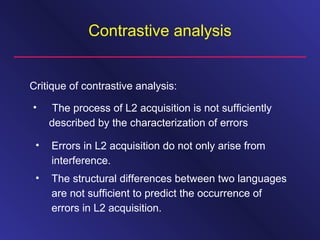
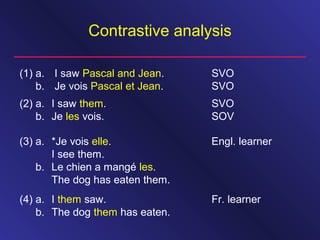
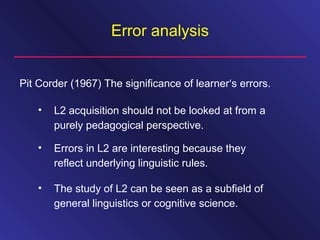
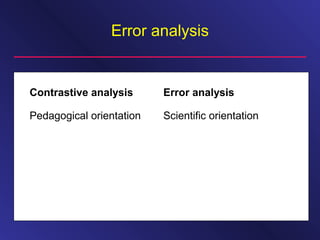
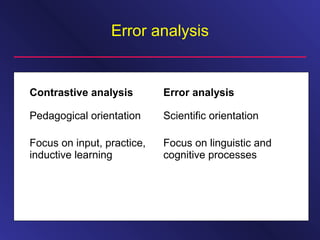
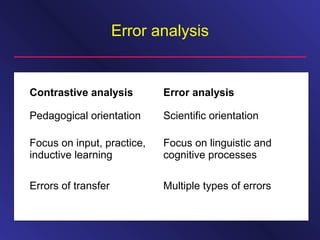
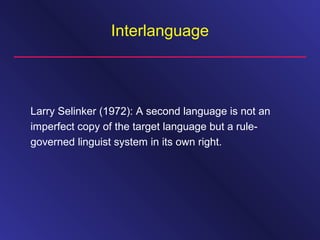
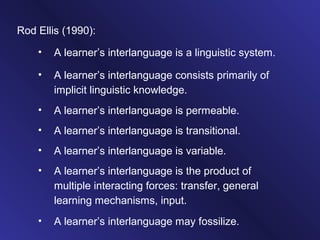
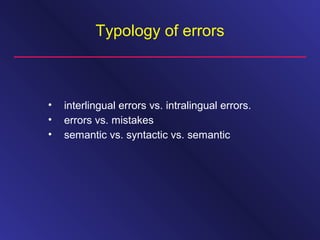
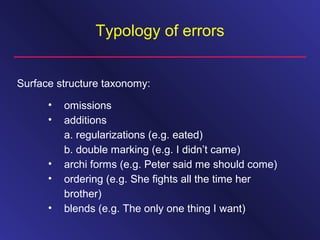

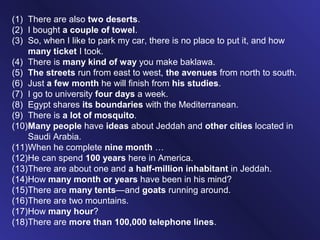
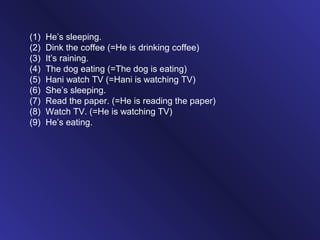
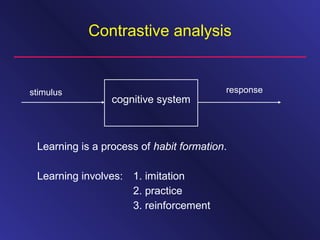
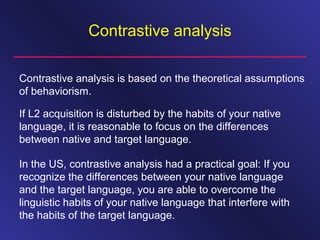
Contrastive analysis and error analysis are approaches to understanding second language acquisition. Contrastive analysis focuses on differences between a learner's first language and the target language, believing errors stem from transferring habits from the first language. Error analysis takes a more scientific view, seeing language acquisition as a cognitive process and errors as natural reflections of developing linguistic rules. Interlanguage theory posits learners develop their own internal language system, not an imperfect copy of the target language. Various taxonomies classify types of errors learners make.


