ENGLISH AS
AN INTERNATIONAL OR
 A GLOBAL LANGUAGE
INTRODUCTION

    Language is the primary medium of human social interaction,
and interaction is the means through which social relations are
constructed and maintained. It is a vital commodity in a globalized
world (Block and Cameron, 2002).

     It means that every people needs and uses language as a means
to communicate to each other. People need language to express their
needs in many aspects of life. So, as the community of the world,
people need language to be used as a means of global
communication. In this sense, our group will present the topic about
English as an International/ a Global language.

     This paper will focuses on discussing the following questions:
What is international or global language? Why do we need
international or global language? Why English becomes an
international or a global language? What are the implications of
English as an International or a Global Language in English
Language Teaching?
What is International
                          or Global Language?
        Smith (1976) as cited by Sandra Lee McKay defines an
international language as the language which is used by people of
different nations to communicate with one another.
        David Crystal, 2003 in “English as a Global Language”,
gives some ideas on what a global language is. He stated that a
language achieves a genuinely global status when it develops a
special role that is recognized in every country. Such a role will be
most evident in countries where large numbers of the people speak
the language as a mother tongue. He also stated that to achieve a
global status, a language has to be taken up by other countries
around the world. They must decide to give it a special place within
their communities, even though they may have few (or no) mother-
tongue speakers.
There are two main ways in which a language can
             be made the official language of a country


• Firstly, it is used as a medium       • Secondly, a language can
  of communication in such                be made a priority in a
  domains as government, the              country’s foreign-language
  law courts, the media, and the          teaching, even though this
  educational system. To get on
  in these societies, it is essential     language has no official
  to master the official language         status. It becomes the
  as early in life as possible.           language which children
  Such a language is often                are most likely to be
  described as a “second                  taught when they arrive in
  language”, because it is seen           school. (Crystal, 2003)
  as a complement to a person’s
  mother tongue or first
  language.
Why do we need an International
                      or a Global Language?
There are some reasons such as:
• According to Crystal (2003), thousands of years ago, translation
  played a central role in human interaction. For example, when
  ambassadors met on the International stage there would be
  interpreters present. In this way, misunderstanding will appear
  because of so many languages used in the community.
• As global community, people around the world will always keep in
  contact in international forums for political, economical,
  educational, and many other international affairs, and even in
  private businesses.
• Another example is that when communities begin to trade with each
  other, they communicate by adopting a simplified language, known
  as pidgin, which combines elements of their different languages.
Why do we need an International
                or a Global Language? (Continued)
• United Nation (UN in 1945) and many International bodies such as
  World bank (1945), UNESCO and UNICEF (1946), WHO (1948),
  etc. were established. Around 190 countries take part in UN bodies
  and will be represented in single meeting places.
       These reasons determine that every people in this world need a
  language which can be used globally or internationally as medium
  of communication to enable them to communicate and understand
  each other easily. The need for a global language is particularly
  appreciated by the international academic and business
  communities, and it is here that the adoption of a single lingua
  franca or common language is most in evidence, both in lecture-
  rooms and board rooms, as well as in thousands of individual
  contacts being made daily all over the globe.
Map of English spread
to become an International/ a Global Language
Why English becomes
an International/ a Global Language
1. Old English (450-1100 AD)
       The invading Germanic tribes spoke similar
languages, which in Britain developed into what we
now call Old English. Old English did not sound or
look like English today. Native English speakers now
would have great difficulty understanding Old
English. Nevertheless, about half of the most
commonly used words in Modern English have Old
English roots. The words be, strong and water, for
example, derive from Old English. Old English was
spoken until around 1100.
2. Middle English (1100-1500)
       In 1066, William the Conqueror the Duke of
Normandy (part of modern France), invaded and
conquered England. The new conquerors (called the
Normans) brought with them a kind of French, which
became the language of the Royal Court, and the ruling
and business classes. For a period there was a kind of
linguistic class division, where the lower classes spoke
English and the upper classes spoke French. In the 14th
century English became dominant in Britain again, but
with many French words added. This language is called
Middle English. It was the language of the great poet
Chaucer (c1340-1400), but it would still be difficult for
native English speakers to understand today.
3. Modern English
 Early Modern English (1500-1800)
        Towards the end of Middle English, a sudden and
distinct change in pronunciation (the Great Vowel Shift)
started, with vowels being pronounced shorter and shorter.
From the 16th century the British had contact with many
peoples from around the world.
This, and the Renaissance of Classical learning, meant that
many new words and phrases entered the language. The
invention of printing also meant that there was now a
common language in print. Books became cheaper and
more people learned to read. Printing also brought
standardization to English. Spelling and grammar became
fixed, and the dialect of London, where most publishing
houses were, became the standard. In 1604 the first English
dictionary was published.
3. Modern English
 Late Modern English (1800-Present)
      The main difference between Early Modern
English and Late Modern English is vocabulary. Late
Modern English has many more words, arising from
two principal factors: firstly, the Industrial Revolution
and technology created a need for new words;
secondly, the British Empire at its height covered one
quarter of the earth's surface, and the English
language adopted foreign words from many countries.
The reason why a language becomes a Global or an International
Language is not only deals with how many people speak it, but more deals
with who those speakers are. A language has traditionally become an
International language for one chief reason: “the power of its people” in
many aspects (especially economical, technological, political, and military
power).
         From the time the US entered the First World War in 1917 right
through to the present, the US has been one of the major military powers in
the world. The economic and military has forced the traders and soldiers
had to learn English to do their job properly. Because industry, exploration
and military demands needed and contributed to learning, so, a lot of
scientific discourse carried out primarily in English. The combination of
industry, trade, war, and learning all of which use English has put English
in its position as the world’s pre-eminent language (Bauer, 2002).
Similarly, Crystal as cited by McKay also concluded the
primary reason for the spread of English becoming an international
language that:
“in the seventeenth and eighteenth centuries English was the language
of the leading colonial nation – (Britain). In the eighteenth and the
nineteenth centuries it was the language of the leader of the industrial
revolution – also in Britain. In the late-nineteenth century and the
early twentieth century it was the language of the leading economic
power – the (USA). As a result, when new technologies brought new
linguistic opportunities, English emerged as a first-rank language in
industries which affected all aspects of society – the press, advertising,
broadcasting, motion pictures, sound recording, transport and
communication (Crystal 1997:110-11 in McKay, 2002:16).
VARIETIES OF ENGLISH AND STANDARD ENGLISH


Kachru’s concentric circles of English

              Expanding


               Outer


               Inner
Example of English Varieties in Singapore


                                         Used for wider communication
          Standard                       and official purposes
           English

          Standard                        Used for primary education and
          Singapore                       local news
            English

           Singlish                           Used with family and friends


E.g. “She kena sabo by them.”                “She was sabotaged by them.”
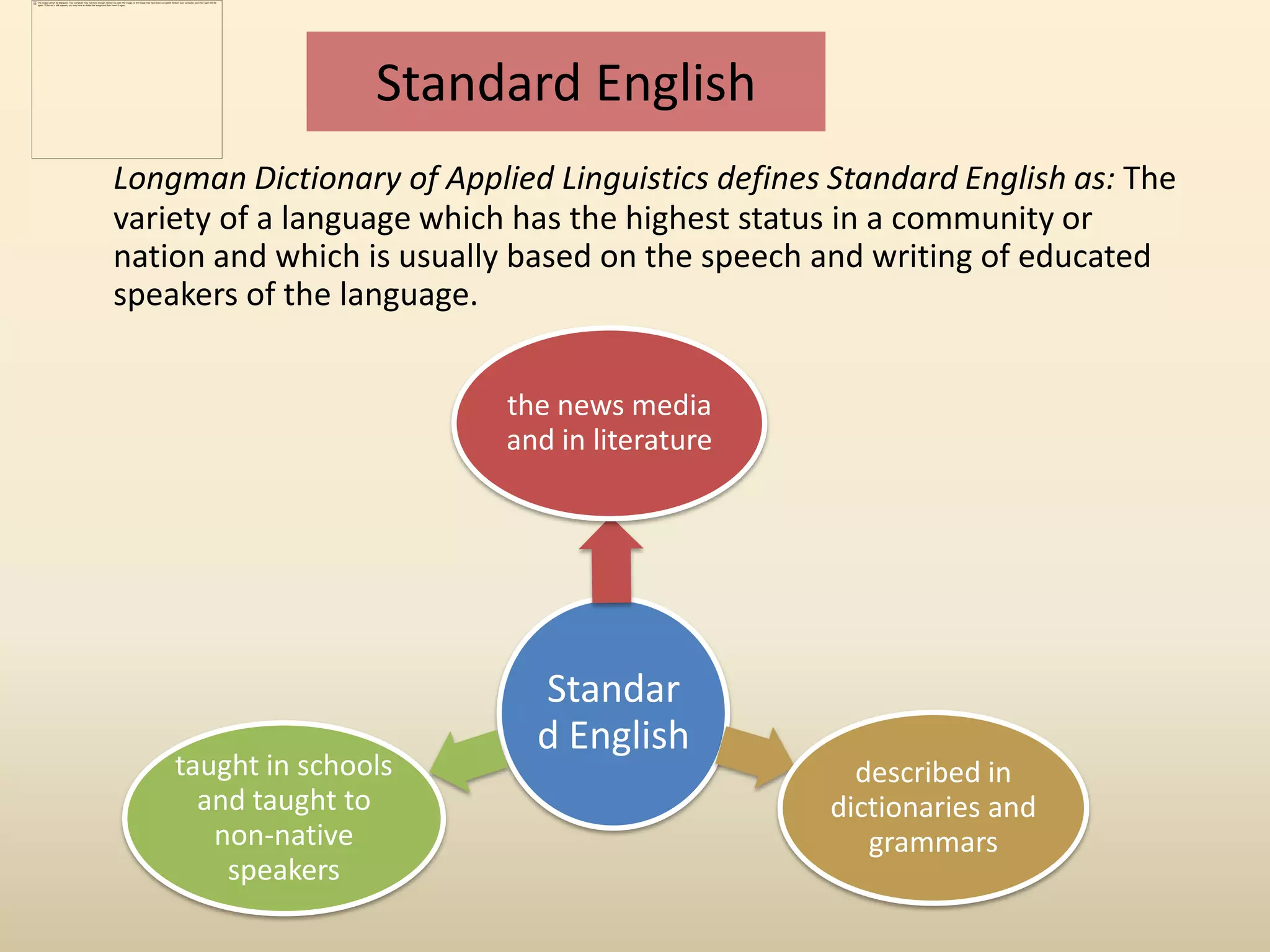
Standard English
Longman Dictionary of Applied Linguistics defines Standard English as: The
variety of a language which has the highest status in a community or
nation and which is usually based on the speech and writing of educated
speakers of the language.


                           the news media
                           and in literature


                             Standar
                             d English
    taught in schools                              described in
      and taught to                              dictionaries and
       non-native                                   grammars
        speakers
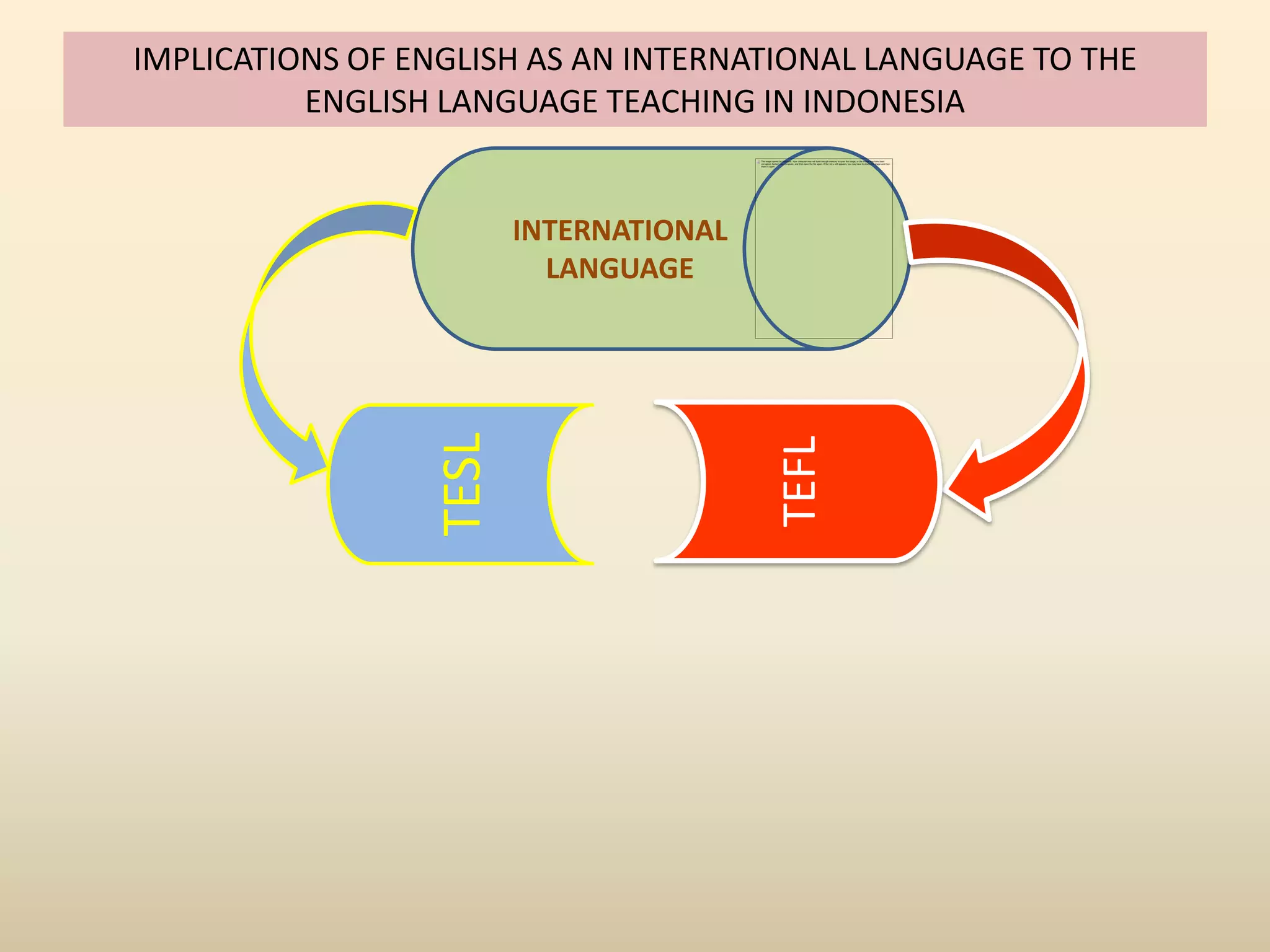
IMPLICATIONS OF ENGLISH AS AN INTERNATIONAL LANGUAGE TO THE
          ENGLISH LANGUAGE TEACHING IN INDONESIA


                        INTERNATIONAL
                          LANGUAGE


                 TESL


                                        TEFL
TEFLIN
                      4 Major
                       Skills


Listening   Reading         Speaking   Writing
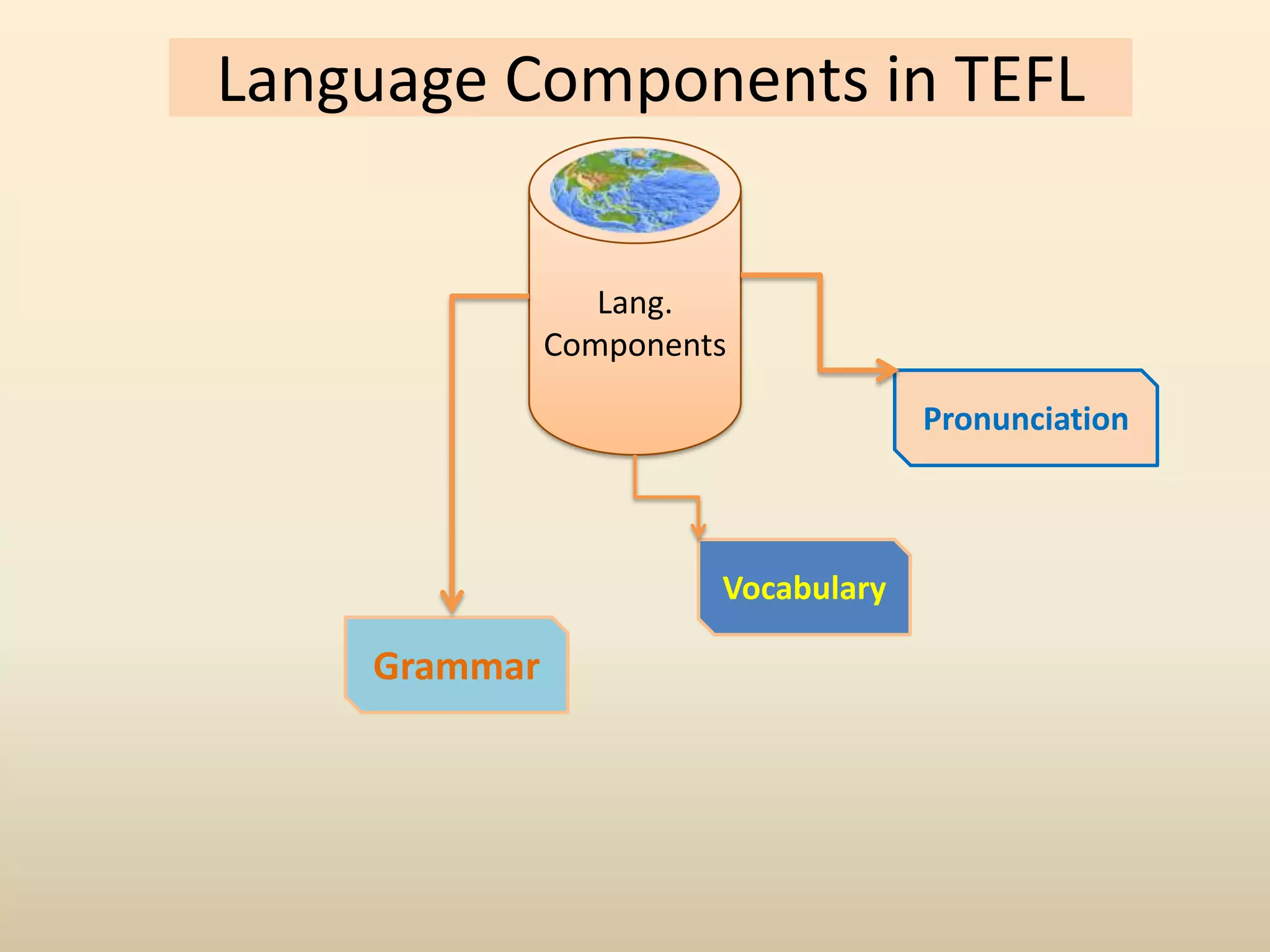
Language Components in TEFL


                 Lang.
              Components

                                    Pronunciation


                       Vocabulary

    Grammar
CONCLUSION
      Language is very important in our life as means of
  communication. As a global community, we really need a
  language which can be used as a means of global
  communication. In this case, English has become an
  international or a global language. So, every people in
  this world should be able to communicate in English in
  order to participate in global affairs.
      In teaching English as an international language,
  there are many theories, methodologies, and techniques
  that can be applied. However, as teachers, we should
  realize that there is no one best method for all contexts.
  So, it needs teacher’s sense of plausibility to select the
  appropriate methods, techniques, and materials that
  reflect local culture and meet student’s needs to develop
  language proficiency.
Thank You

English as a global language

  • 1.
    ENGLISH AS AN INTERNATIONALOR A GLOBAL LANGUAGE
  • 2.
    INTRODUCTION Language is the primary medium of human social interaction, and interaction is the means through which social relations are constructed and maintained. It is a vital commodity in a globalized world (Block and Cameron, 2002). It means that every people needs and uses language as a means to communicate to each other. People need language to express their needs in many aspects of life. So, as the community of the world, people need language to be used as a means of global communication. In this sense, our group will present the topic about English as an International/ a Global language. This paper will focuses on discussing the following questions: What is international or global language? Why do we need international or global language? Why English becomes an international or a global language? What are the implications of English as an International or a Global Language in English Language Teaching?
  • 3.
    What is International or Global Language? Smith (1976) as cited by Sandra Lee McKay defines an international language as the language which is used by people of different nations to communicate with one another. David Crystal, 2003 in “English as a Global Language”, gives some ideas on what a global language is. He stated that a language achieves a genuinely global status when it develops a special role that is recognized in every country. Such a role will be most evident in countries where large numbers of the people speak the language as a mother tongue. He also stated that to achieve a global status, a language has to be taken up by other countries around the world. They must decide to give it a special place within their communities, even though they may have few (or no) mother- tongue speakers.
  • 4.
    There are twomain ways in which a language can be made the official language of a country • Firstly, it is used as a medium • Secondly, a language can of communication in such be made a priority in a domains as government, the country’s foreign-language law courts, the media, and the teaching, even though this educational system. To get on in these societies, it is essential language has no official to master the official language status. It becomes the as early in life as possible. language which children Such a language is often are most likely to be described as a “second taught when they arrive in language”, because it is seen school. (Crystal, 2003) as a complement to a person’s mother tongue or first language.
  • 5.
    Why do weneed an International or a Global Language? There are some reasons such as: • According to Crystal (2003), thousands of years ago, translation played a central role in human interaction. For example, when ambassadors met on the International stage there would be interpreters present. In this way, misunderstanding will appear because of so many languages used in the community. • As global community, people around the world will always keep in contact in international forums for political, economical, educational, and many other international affairs, and even in private businesses. • Another example is that when communities begin to trade with each other, they communicate by adopting a simplified language, known as pidgin, which combines elements of their different languages.
  • 6.
    Why do weneed an International or a Global Language? (Continued) • United Nation (UN in 1945) and many International bodies such as World bank (1945), UNESCO and UNICEF (1946), WHO (1948), etc. were established. Around 190 countries take part in UN bodies and will be represented in single meeting places. These reasons determine that every people in this world need a language which can be used globally or internationally as medium of communication to enable them to communicate and understand each other easily. The need for a global language is particularly appreciated by the international academic and business communities, and it is here that the adoption of a single lingua franca or common language is most in evidence, both in lecture- rooms and board rooms, as well as in thousands of individual contacts being made daily all over the globe.
  • 7.
    Map of Englishspread to become an International/ a Global Language
  • 8.
    Why English becomes anInternational/ a Global Language
  • 9.
    1. Old English(450-1100 AD) The invading Germanic tribes spoke similar languages, which in Britain developed into what we now call Old English. Old English did not sound or look like English today. Native English speakers now would have great difficulty understanding Old English. Nevertheless, about half of the most commonly used words in Modern English have Old English roots. The words be, strong and water, for example, derive from Old English. Old English was spoken until around 1100.
  • 10.
    2. Middle English(1100-1500) In 1066, William the Conqueror the Duke of Normandy (part of modern France), invaded and conquered England. The new conquerors (called the Normans) brought with them a kind of French, which became the language of the Royal Court, and the ruling and business classes. For a period there was a kind of linguistic class division, where the lower classes spoke English and the upper classes spoke French. In the 14th century English became dominant in Britain again, but with many French words added. This language is called Middle English. It was the language of the great poet Chaucer (c1340-1400), but it would still be difficult for native English speakers to understand today.
  • 11.
    3. Modern English Early Modern English (1500-1800) Towards the end of Middle English, a sudden and distinct change in pronunciation (the Great Vowel Shift) started, with vowels being pronounced shorter and shorter. From the 16th century the British had contact with many peoples from around the world. This, and the Renaissance of Classical learning, meant that many new words and phrases entered the language. The invention of printing also meant that there was now a common language in print. Books became cheaper and more people learned to read. Printing also brought standardization to English. Spelling and grammar became fixed, and the dialect of London, where most publishing houses were, became the standard. In 1604 the first English dictionary was published.
  • 12.
    3. Modern English Late Modern English (1800-Present) The main difference between Early Modern English and Late Modern English is vocabulary. Late Modern English has many more words, arising from two principal factors: firstly, the Industrial Revolution and technology created a need for new words; secondly, the British Empire at its height covered one quarter of the earth's surface, and the English language adopted foreign words from many countries.
  • 14.
    The reason whya language becomes a Global or an International Language is not only deals with how many people speak it, but more deals with who those speakers are. A language has traditionally become an International language for one chief reason: “the power of its people” in many aspects (especially economical, technological, political, and military power). From the time the US entered the First World War in 1917 right through to the present, the US has been one of the major military powers in the world. The economic and military has forced the traders and soldiers had to learn English to do their job properly. Because industry, exploration and military demands needed and contributed to learning, so, a lot of scientific discourse carried out primarily in English. The combination of industry, trade, war, and learning all of which use English has put English in its position as the world’s pre-eminent language (Bauer, 2002).
  • 15.
    Similarly, Crystal ascited by McKay also concluded the primary reason for the spread of English becoming an international language that: “in the seventeenth and eighteenth centuries English was the language of the leading colonial nation – (Britain). In the eighteenth and the nineteenth centuries it was the language of the leader of the industrial revolution – also in Britain. In the late-nineteenth century and the early twentieth century it was the language of the leading economic power – the (USA). As a result, when new technologies brought new linguistic opportunities, English emerged as a first-rank language in industries which affected all aspects of society – the press, advertising, broadcasting, motion pictures, sound recording, transport and communication (Crystal 1997:110-11 in McKay, 2002:16).
  • 16.
    VARIETIES OF ENGLISHAND STANDARD ENGLISH Kachru’s concentric circles of English Expanding Outer Inner
  • 17.
    Example of EnglishVarieties in Singapore Used for wider communication Standard and official purposes English Standard Used for primary education and Singapore local news English Singlish Used with family and friends E.g. “She kena sabo by them.” “She was sabotaged by them.”
  • 18.
    Standard English Longman Dictionaryof Applied Linguistics defines Standard English as: The variety of a language which has the highest status in a community or nation and which is usually based on the speech and writing of educated speakers of the language. the news media and in literature Standar d English taught in schools described in and taught to dictionaries and non-native grammars speakers
  • 19.
    IMPLICATIONS OF ENGLISHAS AN INTERNATIONAL LANGUAGE TO THE ENGLISH LANGUAGE TEACHING IN INDONESIA INTERNATIONAL LANGUAGE TESL TEFL
  • 20.
    TEFLIN 4 Major Skills Listening Reading Speaking Writing
  • 21.
    Language Components inTEFL Lang. Components Pronunciation Vocabulary Grammar
  • 22.
    CONCLUSION  Language is very important in our life as means of communication. As a global community, we really need a language which can be used as a means of global communication. In this case, English has become an international or a global language. So, every people in this world should be able to communicate in English in order to participate in global affairs.  In teaching English as an international language, there are many theories, methodologies, and techniques that can be applied. However, as teachers, we should realize that there is no one best method for all contexts. So, it needs teacher’s sense of plausibility to select the appropriate methods, techniques, and materials that reflect local culture and meet student’s needs to develop language proficiency.
  • 23.