Methods of Fossilization
Kimberly Kelton
Haynes Wildcat Library
Library Standards
 Standard 1: Inquire, think critically, and gain
knowledge
 Indicator 1.1.4: Find, evaluate, and select appropriate
sources to answer questions.
 Standard 2: Draw conclusions, make informed
decisions, apply knowledge to new situations, and
create new knowledge.
 Indicator 2.1.4: Use technology and other information
tools to analyze and organize information.
Tennessee Science
Standards
 GLE 0507.Inq.2: Use appropriate tools and
techniques to gather, organize, analyze, and
interpret data.
 GLE 0507.Inq.5: Communicate scientific
understanding using descriptions, explanations,
and models.
I can…
 Choose appropriate print and
technology resources to…
 Research a given topic, and…
 Analyze and organize that
information.
Pre Assessment
1. Fossils in Rocks
2. Fossils in Amber
3. Petrifaction
4. Fossils in Asphalt
5. Frozen Fossils
A. Temperatures in this type of fossilization
slow down decay. Preservation is almost
perfect.
B. This is the process in which minerals
replace an organism’s tissues. Is often
associated with petrified wood.
C. Originally from trees, often insect fossils
are discovered in this substance.
D. This substance wells up from the ground
and forms thick, sticky pools. Many fossils
have been found in this type of substance
in California.
E. A fossil formed by this process was
quickly buried in sediment after its death,
and the hard parts of the animal were
preserved as the sediment slowly turned
into rock.
The Task
 You will create a step book about the 5 ways that a
fossil can form in nature.
 On the inside of each flap, you will identify and
describe one method of fossilization.
 With each method you find, you must cite your
resource in MLA format.
Word of Advice: Explore the resources in Blackboard.
Resources
 Types of resources provided:
 An encyclopedia article from Rosen Digital.
 Access to the Limitless Libraries Database.
 Your Science book.
 Several Library books
 Mrs. Smith and I will hand out a guide to citing
your resources for this document.
Encyclopedia Article
 Must use this article. If needed, the username is
haynes and the password is school.
 The article page may or may not have the correct
citation information you will need to cite your
sources. You must check it against your guide sheet.
 Must work with a partner if using an iPad and
independantly if at a desktop.
Internet Resources
 Understanding Geologic Time.
 Click on the link in Blackboard. Explore the site and
take the test. This will take at least 20 minutes.
 After you have taken the test, follow the directions
to submit your score on Blackboard.
Print Resources
 Around the classroom, there are several tables with
a variety of non-fiction books about this topic.
 Make sure you cite your source!
Textbook Resources
 There are several copies of the Science textbook
located at various tables in the library.
 Remember, only one of your resources may come
from the textbook.
Small Group Work
 With your partner, work to gather and organize the
following information:
 Name the 5 ways in which a fossil can form. For
each term:
 Write at least one good sentence that defines the term.
 Draw a small picture illustrating a fossil that has been
created from this manner of fossilization.
 Cite your resource using MLA format.
After you have found the
information…
 You may work on the cover of your research piece.
Draw a picture that represents what you have been
studying about. Make it as colorful and creative as
you can.
 If you do not finish this part in class, take it home
and finish it for homework tonight.
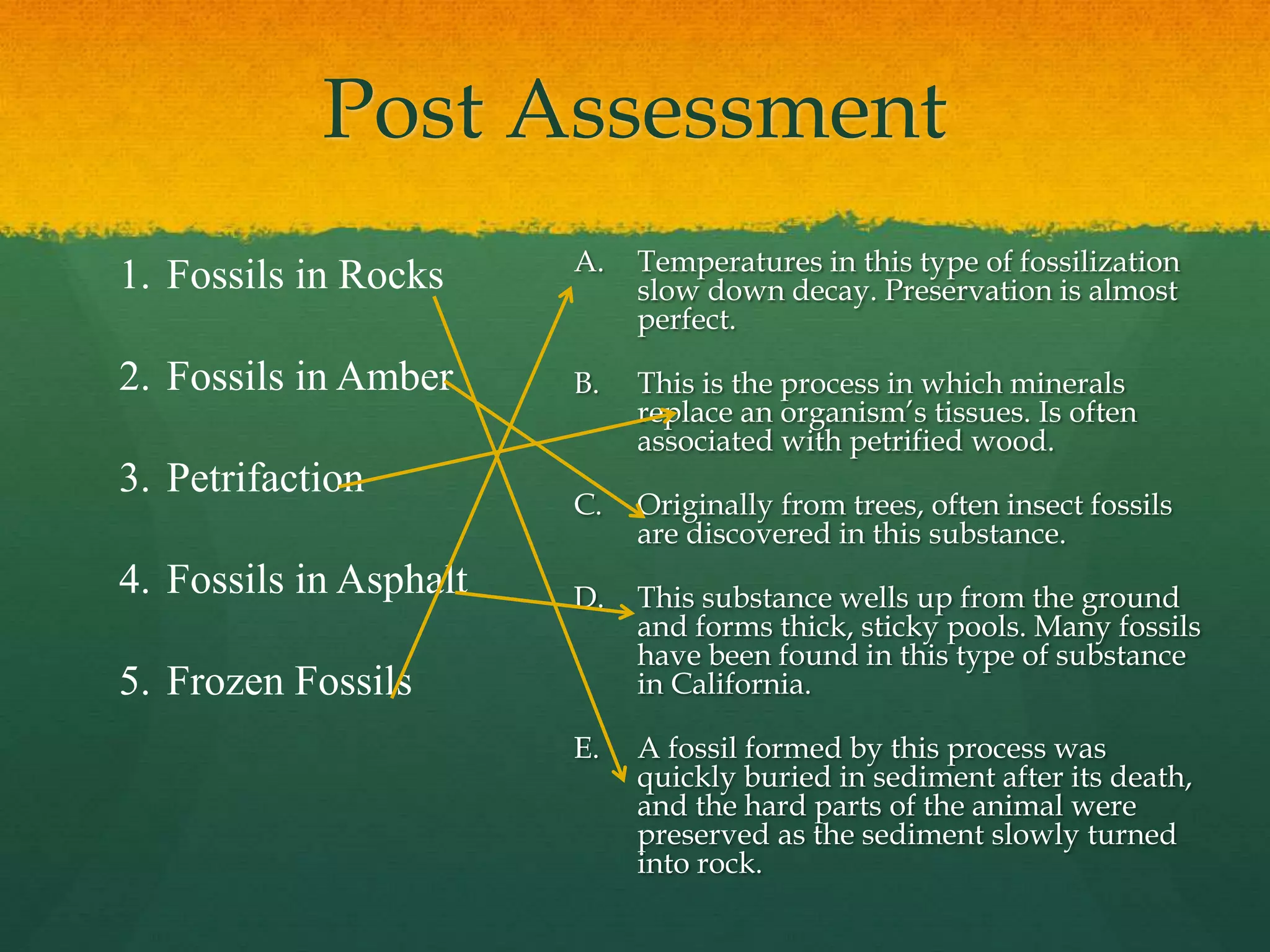
Post Assessment
1. Fossils in Rocks
2. Fossils in Amber
3. Petrifaction
4. Fossils in Asphalt
5. Frozen Fossils
A. Temperatures in this type of fossilization
slow down decay. Preservation is almost
perfect.
B. This is the process in which minerals
replace an organism’s tissues. Is often
associated with petrified wood.
C. Originally from trees, often insect fossils
are discovered in this substance.
D. This substance wells up from the ground
and forms thick, sticky pools. Many fossils
have been found in this type of substance
in California.
E. A fossil formed by this process was
quickly buried in sediment after its death,
and the hard parts of the animal were
preserved as the sediment slowly turned
into rock.
Thank You!

Fossils presentation-Kelton

  • 1.
    Methods of Fossilization KimberlyKelton Haynes Wildcat Library
  • 2.
    Library Standards  Standard1: Inquire, think critically, and gain knowledge  Indicator 1.1.4: Find, evaluate, and select appropriate sources to answer questions.  Standard 2: Draw conclusions, make informed decisions, apply knowledge to new situations, and create new knowledge.  Indicator 2.1.4: Use technology and other information tools to analyze and organize information.
  • 3.
    Tennessee Science Standards  GLE0507.Inq.2: Use appropriate tools and techniques to gather, organize, analyze, and interpret data.  GLE 0507.Inq.5: Communicate scientific understanding using descriptions, explanations, and models.
  • 4.
    I can…  Chooseappropriate print and technology resources to…  Research a given topic, and…  Analyze and organize that information.
  • 5.
    Pre Assessment 1. Fossilsin Rocks 2. Fossils in Amber 3. Petrifaction 4. Fossils in Asphalt 5. Frozen Fossils A. Temperatures in this type of fossilization slow down decay. Preservation is almost perfect. B. This is the process in which minerals replace an organism’s tissues. Is often associated with petrified wood. C. Originally from trees, often insect fossils are discovered in this substance. D. This substance wells up from the ground and forms thick, sticky pools. Many fossils have been found in this type of substance in California. E. A fossil formed by this process was quickly buried in sediment after its death, and the hard parts of the animal were preserved as the sediment slowly turned into rock.
  • 6.
    The Task  Youwill create a step book about the 5 ways that a fossil can form in nature.  On the inside of each flap, you will identify and describe one method of fossilization.  With each method you find, you must cite your resource in MLA format. Word of Advice: Explore the resources in Blackboard.
  • 7.
    Resources  Types ofresources provided:  An encyclopedia article from Rosen Digital.  Access to the Limitless Libraries Database.  Your Science book.  Several Library books  Mrs. Smith and I will hand out a guide to citing your resources for this document.
  • 8.
    Encyclopedia Article  Mustuse this article. If needed, the username is haynes and the password is school.  The article page may or may not have the correct citation information you will need to cite your sources. You must check it against your guide sheet.  Must work with a partner if using an iPad and independantly if at a desktop.
  • 9.
    Internet Resources  UnderstandingGeologic Time.  Click on the link in Blackboard. Explore the site and take the test. This will take at least 20 minutes.  After you have taken the test, follow the directions to submit your score on Blackboard.
  • 10.
    Print Resources  Aroundthe classroom, there are several tables with a variety of non-fiction books about this topic.  Make sure you cite your source!
  • 11.
    Textbook Resources  Thereare several copies of the Science textbook located at various tables in the library.  Remember, only one of your resources may come from the textbook.
  • 12.
    Small Group Work With your partner, work to gather and organize the following information:  Name the 5 ways in which a fossil can form. For each term:  Write at least one good sentence that defines the term.  Draw a small picture illustrating a fossil that has been created from this manner of fossilization.  Cite your resource using MLA format.
  • 13.
    After you havefound the information…  You may work on the cover of your research piece. Draw a picture that represents what you have been studying about. Make it as colorful and creative as you can.  If you do not finish this part in class, take it home and finish it for homework tonight.
  • 14.
    Post Assessment 1. Fossilsin Rocks 2. Fossils in Amber 3. Petrifaction 4. Fossils in Asphalt 5. Frozen Fossils A. Temperatures in this type of fossilization slow down decay. Preservation is almost perfect. B. This is the process in which minerals replace an organism’s tissues. Is often associated with petrified wood. C. Originally from trees, often insect fossils are discovered in this substance. D. This substance wells up from the ground and forms thick, sticky pools. Many fossils have been found in this type of substance in California. E. A fossil formed by this process was quickly buried in sediment after its death, and the hard parts of the animal were preserved as the sediment slowly turned into rock.
  • 15.