Contrastive analysis


                Damaris Escobar
    June 2012
WHAT IS IT?...

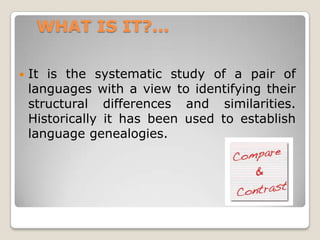
   It is the systematic study of a pair of
    languages with a view to identifying their
    structural differences and similarities.
    Historically it has been used to establish
    language genealogies.
Contrastive Analysis and Second
Language Acquisition


   Contrastive Analysis was used extensively in the field of Second
    Language Acquisition (SLA) in the 1960s and early 1970s, as a
    method of explaining why some features of a Target Language were
    more difficult to acquire than others. According to the behaviorist
    theories prevailing at the time, language learning was a question of
    habit formation, and this could be reinforced or impeded by existing
    habits. Therefore, the difficulty in mastering certain structures in a
    second language (L2) depended on the difference between the
    learners' mother language (L1) and the language they were trying to
    learn.
History
   The theoretical foundations for what became known as the
    Contrastive     Analysis     Hypothesis    were    formulated      in   Lado's
    Linguistics Across Cultures (1957). In this book, Lado claimed
    that "those elements which are similar to [the learner's] native
    language will be simple for him, and those elements that are
    different    will   be    difficult".   While   this   was   not    a   novel
    suggestion, Lado was the first to provide a comprehensive
    theoretical treatment and to suggest a systematic set of technical
    procedures for the contrastive study of languages. This involved
    describing          the        languages          (using        structuralist
    linguistics), comparing them and predicting learning difficulties.
History
   During the 1960s, there was a widespread enthusiasm with this
    technique, manifested in the contrastive descriptions of several
    European languages, many of which were sponsored by the
    Center of Applied Linguistics in Washington, DC. It was expected
    that once the areas of potential difficulty had been mapped out
    through Contrastive Analysis, it would be possible to design
    language courses more efficiently. Contrastive Analysis, along
    with Behaviorism and Structuralism exerted a profound effect on
    SLA curriculum design and language teacher education, and
    provided the theoretical pillars of Audio-Lingual Method.
Criticism
   In its strongest formulation, the Contrastive
    Analysis Hypothesis claimed that all the errors
    made in learning the L2 could be attributed to
    'interference' by the L1. However, this claim
    could not be sustained by empirical evidence that
    was accumulated in the mid- and late 1970s.
Criticism
   It was soon pointed out that many errors predicted
    by   Contrastive       Analysis     were     inexplicably     not
    observed        in   learners'     language.     Even        more
    confusingly, some uniform errors were made by
    learners irrespective of their L1. It thus became clear
    that Contrastive Analysis could not predict all learning
    difficulties,    but    was      certainly   useful     in    the
    retrospective explanation of errors.
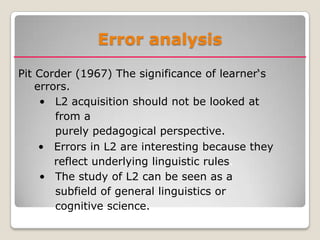
Error analysis

Pit Corder (1967) The significance of learner‘s
    errors.
     • L2 acquisition should not be looked at
        from a
        purely pedagogical perspective.
     • Errors in L2 are interesting because they
        reflect underlying linguistic rules.
     • The study of L2 can be seen as a
        subfield of general linguistics or
        cognitive science.
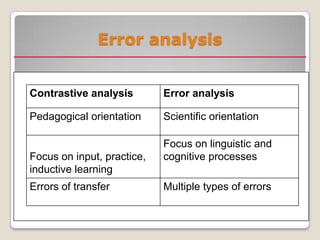
Error analysis


Contrastive analysis        Error analysis

Pedagogical orientation     Scientific orientation

                            Focus on linguistic and
Focus on input, practice,   cognitive processes
inductive learning
Errors of transfer          Multiple types of errors
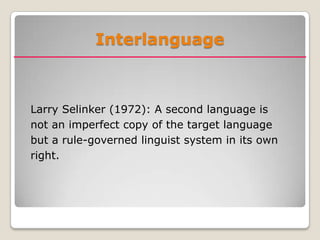
Interlanguage


Larry Selinker (1972): A second language is
not an imperfect copy of the target language
but a rule-governed linguist system in its own
right.
Rod Ellis
  (1990):
  •           A learner’s interlanguage is a linguistic system.
          •     A learner’s interlanguage consists primarily of
                implicit linguistic knowledge.

   •          A learner’s interlanguage is permeable.
      •        A learner’s interlanguage is transitional.

  •           A learner’s interlanguage is variable.

      • A learner’s interlanguage is the product of
      multiple interacting forces: transfer, general learning
         mechanisms, input.
      •        A learner’s interlanguage may fossilize.
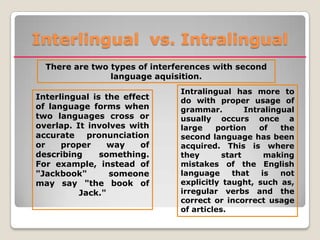
Interlingual vs. Intralingual
  There are two types of interferences with second
                language aquisition.
                               Intralingual has more to
Interlingual is the effect     do with proper usage of
of language forms when         grammar.         Intralingual
two languages cross or         usually occurs once a
overlap. It involves with      large    portion     of   the
accurate    pronunciation      second language has been
or    proper     way    of     acquired. This is where
describing     something.      they       start      making
For example, instead of        mistakes of the English
"Jackbook"       someone       language      that   is   not
may say "the book of           explicitly taught, such as,
          Jack."               irregular verbs and the
                               correct or incorrect usage
                               of articles.
Contrastive analysis

Contrastive analysis

  • 1.
    Contrastive analysis Damaris Escobar June 2012
  • 2.
    WHAT IS IT?...  It is the systematic study of a pair of languages with a view to identifying their structural differences and similarities. Historically it has been used to establish language genealogies.
  • 3.
    Contrastive Analysis andSecond Language Acquisition  Contrastive Analysis was used extensively in the field of Second Language Acquisition (SLA) in the 1960s and early 1970s, as a method of explaining why some features of a Target Language were more difficult to acquire than others. According to the behaviorist theories prevailing at the time, language learning was a question of habit formation, and this could be reinforced or impeded by existing habits. Therefore, the difficulty in mastering certain structures in a second language (L2) depended on the difference between the learners' mother language (L1) and the language they were trying to learn.
  • 4.
    History  The theoretical foundations for what became known as the Contrastive Analysis Hypothesis were formulated in Lado's Linguistics Across Cultures (1957). In this book, Lado claimed that "those elements which are similar to [the learner's] native language will be simple for him, and those elements that are different will be difficult". While this was not a novel suggestion, Lado was the first to provide a comprehensive theoretical treatment and to suggest a systematic set of technical procedures for the contrastive study of languages. This involved describing the languages (using structuralist linguistics), comparing them and predicting learning difficulties.
  • 5.
    History  During the 1960s, there was a widespread enthusiasm with this technique, manifested in the contrastive descriptions of several European languages, many of which were sponsored by the Center of Applied Linguistics in Washington, DC. It was expected that once the areas of potential difficulty had been mapped out through Contrastive Analysis, it would be possible to design language courses more efficiently. Contrastive Analysis, along with Behaviorism and Structuralism exerted a profound effect on SLA curriculum design and language teacher education, and provided the theoretical pillars of Audio-Lingual Method.
  • 6.
    Criticism  In its strongest formulation, the Contrastive Analysis Hypothesis claimed that all the errors made in learning the L2 could be attributed to 'interference' by the L1. However, this claim could not be sustained by empirical evidence that was accumulated in the mid- and late 1970s.
  • 7.
    Criticism  It was soon pointed out that many errors predicted by Contrastive Analysis were inexplicably not observed in learners' language. Even more confusingly, some uniform errors were made by learners irrespective of their L1. It thus became clear that Contrastive Analysis could not predict all learning difficulties, but was certainly useful in the retrospective explanation of errors.
  • 8.
    Error analysis Pit Corder(1967) The significance of learner‘s errors. • L2 acquisition should not be looked at from a purely pedagogical perspective. • Errors in L2 are interesting because they reflect underlying linguistic rules. • The study of L2 can be seen as a subfield of general linguistics or cognitive science.
  • 9.
    Error analysis Contrastive analysis Error analysis Pedagogical orientation Scientific orientation Focus on linguistic and Focus on input, practice, cognitive processes inductive learning Errors of transfer Multiple types of errors
  • 10.
    Interlanguage Larry Selinker (1972):A second language is not an imperfect copy of the target language but a rule-governed linguist system in its own right.
  • 11.
    Rod Ellis (1990): • A learner’s interlanguage is a linguistic system. • A learner’s interlanguage consists primarily of implicit linguistic knowledge. • A learner’s interlanguage is permeable. • A learner’s interlanguage is transitional. • A learner’s interlanguage is variable. • A learner’s interlanguage is the product of multiple interacting forces: transfer, general learning mechanisms, input. • A learner’s interlanguage may fossilize.
  • 12.
    Interlingual vs. Intralingual There are two types of interferences with second language aquisition. Intralingual has more to Interlingual is the effect do with proper usage of of language forms when grammar. Intralingual two languages cross or usually occurs once a overlap. It involves with large portion of the accurate pronunciation second language has been or proper way of acquired. This is where describing something. they start making For example, instead of mistakes of the English "Jackbook" someone language that is not may say "the book of explicitly taught, such as, Jack." irregular verbs and the correct or incorrect usage of articles.