Chapter 12
Group 12:
 Moulsem Chormvirak 66559
 Rop Socheata 79394
 Poch Marozet 62150
 Yin Chanvutha 60684
Lim Kannitha
1
2
* Introduction
1.Linguistics and native-language teaching
1.1.Pedagogical grammar
1.2. A role for linguistics in first-language instruction
2. Linguistics and second-language teaching
2.1. The rise and fall of audiolingualism
2.2. Krashen and the natural approach
2.3. A new role of grammar
2.4. A role for linguistics in second-language instruction
* Conclusion
3
*
In the chapter we examine some of the classroom
application. The chapter is divided into two parts. The
first is addressed to teacher of English of student whose
native language is English, and the second is addressed to
teachers of English as a second or foreign language.
4
1.1. Pedagogical grammar
*Pedagogical grammar is grammatical analysis
and instruction and learning something about
language structures. It is useful in teaching and
learning.
5
In 1875, (Reed and Kellogg’s book higher lesson
in English appeared) introduced a system of
sentence diagramming to prove a formal language
instruction tool. Reed and kellogg’s diagrams,
sometime call stick or line diagram are a rough and
simplified form of phrase structure grammar which
in the way represented the argument or modifier.
6
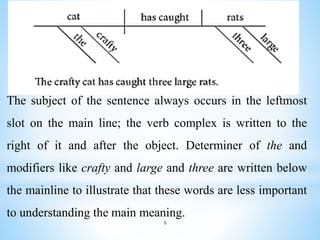
The subject of the sentence always occurs in the leftmost
slot on the main line; the verb complex is written to the
right of it and after the object. Determiner of the and
modifiers like crafty and large and three are written below
the mainline to illustrate that these words are less important
to understanding the main meaning.
7
8
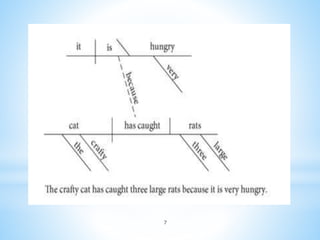
*The crafty cat has caught three large rats :
independent clause because we can understand it
when it stands alone.
* Because it is very hungry : Dependent clause
because we don’t understand when it stands alone.
*The logic of the dotted-line connection between the
two clause is that the “because-clause “is adverbial
(that answer the adverbial question why?) and it
modify to the verb of the main clause.
9
Language is a human attribute and its nature is as
deserving of attention as anything in the traditional
life science.
*Modification of nouns
When a lexical noun is pressed into service as a
modifier of another noun, it is immediately precedes
the noun that it modifies.
10
Modifiers seem to follow a certain ordering pattern.
Ordering of modifier.
Quantity E.g.: four, a few, several
Value/Opinion : delicious, beautiful
Size : tall, tiny, huge
Temperature : hot, cold
Age : old, new, 14-year-old
Shape : square, round
Color : red, purple, green
Origin : Swedish, Victorian
Material : glass, silver, wooden
Ex: A wonderful old Italian clock.
[Opinion – age – origin]
:an old, lovely, black, large, painted box.
11
*Product approach mode of teaching: writers use
different ways of writing draft or ignore the process
from introduction to conclusion. They use the
effective styles for their writing.
*Process approach of teaching: emphasize a multiple
drafting process, with conceptual development placed
first, then organize or reorganize of these ideas into
parts to make them as fully comprehensible to the
reader as possible, after that followed it again into
third draft editing. The last step is having attention to
grammar, style, punctuation, and spelling.
12
Sentence-combining technique provides students with
a simple sentence then encourages them to develop it in
semi-creative way.
1. Given sentence and cue : A garbage dump is behind
the restaurant.
*Transformed sentence : There is a garbage dump
behind the restaurant.
(add demonstrative “There” to show the place.)
2. Given sentence and cues: Some telephones are
nearby.
*Transformed sentence : Aren’t there some telephones
nearby?
13
(Use Tag question [negative form ] he/she knows the
answer but he/she wants to confirm it again by tag
question)
3. Given sentence and cue : It would be impossible
to ignore the fact that something caused a great deal
of controversy. Simmons published the experiment.
*Transformed sentence : It would be impossible
to ignore the fact that Simmon’s publication of the
experiment caused a great deal of controversy.
( Join sentences together in order to make it
meaning full. )
14
Dialect is the language used by the people of a specific
area, class, district or any other group of people. The term
dialect involves the spelling, sounds, grammar and
pronunciation used by a particular group of people and it
distinguishes them from other people around them.
Definition of Dialect tend to fall into three categories
1. One sentence of dialect has often interchangeable
with idiolect, which is the language of an individual
speaker, including those ways of speaking that the
speaker finds acceptable. E.g. Being working on a project
at the moment, she was unwilling to be disturbed.
15
2. Dialect is used by linguists to refer to
 A set of lexical items
 A set of rules, which together generate possible
sentences that are acceptable to native speakers.
3. Dialect is its more popular everyday sense and it is
seen to be deviations from some standard language. Ex:
Australia “ barbie” is a “barbecue”.
For examples of dialectal differences include American
English subway, contrasting with British English
underground; and corn, which means “maize” in the
United States, Canada, and Australia, “wheat” in
England, and “oats” in Scotland.
16
• The teaching of second languages has never followed a
single, lockstep course of development with one set of
operating principle.
• The course of development will appear strikingly similar
to what we have seen for native-languages instruction. But
the goals of teaching foreign languages are far different
from the traditional goals of native-language instruction
and prescriptive grammar.
17
 An influential early attempt to make language teaching
respectable by it to theory of psychology and, ipso facto,
to scientific linguistics was the Audio-Lingual Method
(ALM).
 its goal is to get the students to mimic (follow) to native
speech as closely as possible and to treat deviations from
the standard rather as case of mislearned habits.
 The ALM way involved seemingly endless mechanical
drills which placed heavy emphasis on correct
pronunciation.
 For the students, the goal was to ensure accurate
production through mimicry and analogy.
18
 For teacher, in contrast, it was considered quite
important to know the relevant facts of both target
(taught) language and the students’ native language,
especially their phonology. The teacher would able to
identify potential problem areas and adjust lesson plans.
 It is well known that after a certain age, learning a new
language is quite difficult; A student who begins study
of a second language after puberty will only rarely
come to exhibit the skill of native speaker of that
language.
19
 In the early 1970s, studies of the production of
grammatical morphemes in populations of second
language learner led many to the belief that there was
something like an invariant natural order of
acquisition of grammatical structure in second
language which was Brown (1973) to hold for learner
of first language.
 Later in the 1970s Stephen Krashen made use of this
data to elaborate a view of acquisition which he called
the “Monitor Model”.
20
* Language teachers often feel frustrated to find students
who are perfectly capable of scoring high on written tests
of structure say multiple choice tests which instruct a
student to choose the proper form of a verb in a given
sentence but who in their actual spontaneous spoken
language consistently exhibit a failure to produce these
forms.
*A frequent case in point is the third person singular “s”
ending in English : The dog runs, not the dog run. The
correct form is taught at an early stage in most ESL
syllabi, yet highly proficient nonnative speaker of English
continue to utter the ungrammatical form after years of
study , even though they can select the proper form when
given time and the opportunity to focus correctness.
21
This phenomenon said Krashen is due to the fact
there are differences between learning and acquisition.
*Acquisition is an unconscious process similar or
identical to the way in which children pick up a
mother tongue and is identified with the discrete
mental faculty assumed in generative grammar to
constitute the locus of linguistic ability .
* Learning conscious knowledge of a second language,
knowing the rules being aware of them, and being
able to talk about them.
22
* Krashen has claimed that if grammar could play a
significant role it is difficult in the average classroom
of second language learners to find all students at
exactly the same stage of grammatical development,
so that spending much time on drills would mean a
scattershot teaching syllabus in which some students
are bored by the elementary nature of the material.
*And majority of students though grammar is not
interesting, so Krashen and his college Tracy Terrell
created Natural Approach to second language. This
approach is creating a classroom found in successful
second language acquisition by naturalistic principle
and on create the environment in which students aren’t
anxiety and therefore open to acquiring the second
language.
23
*The natural approach is based on the principles of
naturalistic language learning in young children.
*It is emphasizes on exposure on input (listen).
*It is not emphasizes on grammar, but it is emphasizes
communication.
*The Native language should not be used in the classroom.
*Vocabulary should be exposed or seen to the student.
Example: Picture with the word below.
*Activities should be developed in the classroom.
• The receiving of second language is claimed to constitute
or make a theory. It means when we learn second
language, we need to learn theory.
Ex: Present simple is use for habit, general truth and
repeated action.
• The complexity of theory is always impressive. The
reaction also arose. When something was created, there is
someone support and someone does not support.
24
25
• In English morphemes, grammar structure are
internalize in a particular, invariant order. It means all
grammar structure can make us understand how to
write sentence in order correctly. Ex: S + V + Obj.
• It was never make clear of what a structure was
supposed to be.
*Ex: “I depend on you” or “I depend at you”.
• So how teachers call attention to their students If the
grammar is so complex and difficult like this?
• It is possible that teachers can call attention of their
students to the problem of grammar structure by providing
specific example of those structure. Ex: Present simple
tense. I get up in the morning at 6 o’clock.
• There is no evidence that author views about
consciousness-raising about right or wrong in
communication. Ex: Tomorrow I go home you.
• We always fail to language. We do not know all the root
of the language.
26
27
*The confrontation of teacher of English in the first day of
teaching is to deal with norm of students.
*It means students have different norm based on their own
country and nature, so teacher need to understand and be
careful of this point.
*If teacher uses wrong teaching to the norm of student, it will
cause students not happy to study with.
*Ex: There are few muslim students in the class, and teacher
uses example with eating pork and dog meat.
28
*For product errors, it cannot draw students’ attention.
*It means when teachers always make errors in teaching or
speaking, students will not interest in the topic anymore.
*Sometimes teachers do not think every errors in student’s
interlanguage, so the term of using linguistic competence at
any stage short of native-speaker competence.
*It means that for student’s interlanguage, teachers seldom to
care of their speaking or using of language, so the ability of
using linguistic is low. Teacher let the students speak in the
wrong way.
Ex: I angry.
29
*It become a habit. So They use Second language in wrong
way.
*Any ways, the errors may be the kind of development
change if teachers and students learn from these errors.
*Teachers also need to know about structure of native
language of second language students because all of
students have no the same structure, and the high number
of errors will appear to involve negative transfer
30
*It means when there are error increase, the transfer in
negative or wrong way will also appear, so teachers need to
involve and try to understand student’s different structure.
Ex: Who did you see last night?
Who do you see last night?
Grammar is also the important part of school program in
second language that involve in reading and writing.
 It means in reading and writing, students need to
practice. When students practice again and again, they
will understand well the grammar in writing and reading,
and it can make student investigate the specific sub area
of their reading and writing.
31
*Ex: Teacher will give one topic about “the effect of
deforestation on the earth’s atmosphere”. This topic will
make student think and discuss of real-world issue in
classroom. At that time grammar will also arise in
discussion and writing too.
*Ex: Teacher needs to give students to focus on the role of
folk object in culture and that each student needs to bring
one object and explain.
Student will find the reason to use several type of relative
pronoun in their speaking.
32
*
33
Q &A

Linguistic : Slide chapter-12

  • 1.
    Chapter 12 Group 12: Moulsem Chormvirak 66559  Rop Socheata 79394  Poch Marozet 62150  Yin Chanvutha 60684 Lim Kannitha 1
  • 2.
    2 * Introduction 1.Linguistics andnative-language teaching 1.1.Pedagogical grammar 1.2. A role for linguistics in first-language instruction 2. Linguistics and second-language teaching 2.1. The rise and fall of audiolingualism 2.2. Krashen and the natural approach 2.3. A new role of grammar 2.4. A role for linguistics in second-language instruction * Conclusion
  • 3.
    3 * In the chapterwe examine some of the classroom application. The chapter is divided into two parts. The first is addressed to teacher of English of student whose native language is English, and the second is addressed to teachers of English as a second or foreign language.
  • 4.
    4 1.1. Pedagogical grammar *Pedagogicalgrammar is grammatical analysis and instruction and learning something about language structures. It is useful in teaching and learning.
  • 5.
    5 In 1875, (Reedand Kellogg’s book higher lesson in English appeared) introduced a system of sentence diagramming to prove a formal language instruction tool. Reed and kellogg’s diagrams, sometime call stick or line diagram are a rough and simplified form of phrase structure grammar which in the way represented the argument or modifier.
  • 6.
    6 The subject ofthe sentence always occurs in the leftmost slot on the main line; the verb complex is written to the right of it and after the object. Determiner of the and modifiers like crafty and large and three are written below the mainline to illustrate that these words are less important to understanding the main meaning.
  • 7.
  • 8.
    8 *The crafty cathas caught three large rats : independent clause because we can understand it when it stands alone. * Because it is very hungry : Dependent clause because we don’t understand when it stands alone. *The logic of the dotted-line connection between the two clause is that the “because-clause “is adverbial (that answer the adverbial question why?) and it modify to the verb of the main clause.
  • 9.
    9 Language is ahuman attribute and its nature is as deserving of attention as anything in the traditional life science. *Modification of nouns When a lexical noun is pressed into service as a modifier of another noun, it is immediately precedes the noun that it modifies.
  • 10.
    10 Modifiers seem tofollow a certain ordering pattern. Ordering of modifier. Quantity E.g.: four, a few, several Value/Opinion : delicious, beautiful Size : tall, tiny, huge Temperature : hot, cold Age : old, new, 14-year-old Shape : square, round Color : red, purple, green Origin : Swedish, Victorian Material : glass, silver, wooden Ex: A wonderful old Italian clock. [Opinion – age – origin] :an old, lovely, black, large, painted box.
  • 11.
    11 *Product approach modeof teaching: writers use different ways of writing draft or ignore the process from introduction to conclusion. They use the effective styles for their writing. *Process approach of teaching: emphasize a multiple drafting process, with conceptual development placed first, then organize or reorganize of these ideas into parts to make them as fully comprehensible to the reader as possible, after that followed it again into third draft editing. The last step is having attention to grammar, style, punctuation, and spelling.
  • 12.
    12 Sentence-combining technique providesstudents with a simple sentence then encourages them to develop it in semi-creative way. 1. Given sentence and cue : A garbage dump is behind the restaurant. *Transformed sentence : There is a garbage dump behind the restaurant. (add demonstrative “There” to show the place.) 2. Given sentence and cues: Some telephones are nearby. *Transformed sentence : Aren’t there some telephones nearby?
  • 13.
    13 (Use Tag question[negative form ] he/she knows the answer but he/she wants to confirm it again by tag question) 3. Given sentence and cue : It would be impossible to ignore the fact that something caused a great deal of controversy. Simmons published the experiment. *Transformed sentence : It would be impossible to ignore the fact that Simmon’s publication of the experiment caused a great deal of controversy. ( Join sentences together in order to make it meaning full. )
  • 14.
    14 Dialect is thelanguage used by the people of a specific area, class, district or any other group of people. The term dialect involves the spelling, sounds, grammar and pronunciation used by a particular group of people and it distinguishes them from other people around them. Definition of Dialect tend to fall into three categories 1. One sentence of dialect has often interchangeable with idiolect, which is the language of an individual speaker, including those ways of speaking that the speaker finds acceptable. E.g. Being working on a project at the moment, she was unwilling to be disturbed.
  • 15.
    15 2. Dialect isused by linguists to refer to  A set of lexical items  A set of rules, which together generate possible sentences that are acceptable to native speakers. 3. Dialect is its more popular everyday sense and it is seen to be deviations from some standard language. Ex: Australia “ barbie” is a “barbecue”. For examples of dialectal differences include American English subway, contrasting with British English underground; and corn, which means “maize” in the United States, Canada, and Australia, “wheat” in England, and “oats” in Scotland.
  • 16.
    16 • The teachingof second languages has never followed a single, lockstep course of development with one set of operating principle. • The course of development will appear strikingly similar to what we have seen for native-languages instruction. But the goals of teaching foreign languages are far different from the traditional goals of native-language instruction and prescriptive grammar.
  • 17.
    17  An influentialearly attempt to make language teaching respectable by it to theory of psychology and, ipso facto, to scientific linguistics was the Audio-Lingual Method (ALM).  its goal is to get the students to mimic (follow) to native speech as closely as possible and to treat deviations from the standard rather as case of mislearned habits.  The ALM way involved seemingly endless mechanical drills which placed heavy emphasis on correct pronunciation.  For the students, the goal was to ensure accurate production through mimicry and analogy.
  • 18.
    18  For teacher,in contrast, it was considered quite important to know the relevant facts of both target (taught) language and the students’ native language, especially their phonology. The teacher would able to identify potential problem areas and adjust lesson plans.  It is well known that after a certain age, learning a new language is quite difficult; A student who begins study of a second language after puberty will only rarely come to exhibit the skill of native speaker of that language.
  • 19.
    19  In theearly 1970s, studies of the production of grammatical morphemes in populations of second language learner led many to the belief that there was something like an invariant natural order of acquisition of grammatical structure in second language which was Brown (1973) to hold for learner of first language.  Later in the 1970s Stephen Krashen made use of this data to elaborate a view of acquisition which he called the “Monitor Model”.
  • 20.
    20 * Language teachersoften feel frustrated to find students who are perfectly capable of scoring high on written tests of structure say multiple choice tests which instruct a student to choose the proper form of a verb in a given sentence but who in their actual spontaneous spoken language consistently exhibit a failure to produce these forms. *A frequent case in point is the third person singular “s” ending in English : The dog runs, not the dog run. The correct form is taught at an early stage in most ESL syllabi, yet highly proficient nonnative speaker of English continue to utter the ungrammatical form after years of study , even though they can select the proper form when given time and the opportunity to focus correctness.
  • 21.
    21 This phenomenon saidKrashen is due to the fact there are differences between learning and acquisition. *Acquisition is an unconscious process similar or identical to the way in which children pick up a mother tongue and is identified with the discrete mental faculty assumed in generative grammar to constitute the locus of linguistic ability . * Learning conscious knowledge of a second language, knowing the rules being aware of them, and being able to talk about them.
  • 22.
    22 * Krashen hasclaimed that if grammar could play a significant role it is difficult in the average classroom of second language learners to find all students at exactly the same stage of grammatical development, so that spending much time on drills would mean a scattershot teaching syllabus in which some students are bored by the elementary nature of the material. *And majority of students though grammar is not interesting, so Krashen and his college Tracy Terrell created Natural Approach to second language. This approach is creating a classroom found in successful second language acquisition by naturalistic principle and on create the environment in which students aren’t anxiety and therefore open to acquiring the second language.
  • 23.
    23 *The natural approachis based on the principles of naturalistic language learning in young children. *It is emphasizes on exposure on input (listen). *It is not emphasizes on grammar, but it is emphasizes communication. *The Native language should not be used in the classroom. *Vocabulary should be exposed or seen to the student. Example: Picture with the word below. *Activities should be developed in the classroom.
  • 24.
    • The receivingof second language is claimed to constitute or make a theory. It means when we learn second language, we need to learn theory. Ex: Present simple is use for habit, general truth and repeated action. • The complexity of theory is always impressive. The reaction also arose. When something was created, there is someone support and someone does not support. 24
  • 25.
    25 • In Englishmorphemes, grammar structure are internalize in a particular, invariant order. It means all grammar structure can make us understand how to write sentence in order correctly. Ex: S + V + Obj. • It was never make clear of what a structure was supposed to be. *Ex: “I depend on you” or “I depend at you”.
  • 26.
    • So howteachers call attention to their students If the grammar is so complex and difficult like this? • It is possible that teachers can call attention of their students to the problem of grammar structure by providing specific example of those structure. Ex: Present simple tense. I get up in the morning at 6 o’clock. • There is no evidence that author views about consciousness-raising about right or wrong in communication. Ex: Tomorrow I go home you. • We always fail to language. We do not know all the root of the language. 26
  • 27.
    27 *The confrontation ofteacher of English in the first day of teaching is to deal with norm of students. *It means students have different norm based on their own country and nature, so teacher need to understand and be careful of this point. *If teacher uses wrong teaching to the norm of student, it will cause students not happy to study with. *Ex: There are few muslim students in the class, and teacher uses example with eating pork and dog meat.
  • 28.
    28 *For product errors,it cannot draw students’ attention. *It means when teachers always make errors in teaching or speaking, students will not interest in the topic anymore. *Sometimes teachers do not think every errors in student’s interlanguage, so the term of using linguistic competence at any stage short of native-speaker competence. *It means that for student’s interlanguage, teachers seldom to care of their speaking or using of language, so the ability of using linguistic is low. Teacher let the students speak in the wrong way. Ex: I angry.
  • 29.
    29 *It become ahabit. So They use Second language in wrong way. *Any ways, the errors may be the kind of development change if teachers and students learn from these errors. *Teachers also need to know about structure of native language of second language students because all of students have no the same structure, and the high number of errors will appear to involve negative transfer
  • 30.
    30 *It means whenthere are error increase, the transfer in negative or wrong way will also appear, so teachers need to involve and try to understand student’s different structure. Ex: Who did you see last night? Who do you see last night? Grammar is also the important part of school program in second language that involve in reading and writing.  It means in reading and writing, students need to practice. When students practice again and again, they will understand well the grammar in writing and reading, and it can make student investigate the specific sub area of their reading and writing.
  • 31.
    31 *Ex: Teacher willgive one topic about “the effect of deforestation on the earth’s atmosphere”. This topic will make student think and discuss of real-world issue in classroom. At that time grammar will also arise in discussion and writing too. *Ex: Teacher needs to give students to focus on the role of folk object in culture and that each student needs to bring one object and explain. Student will find the reason to use several type of relative pronoun in their speaking.
  • 32.
  • 33.