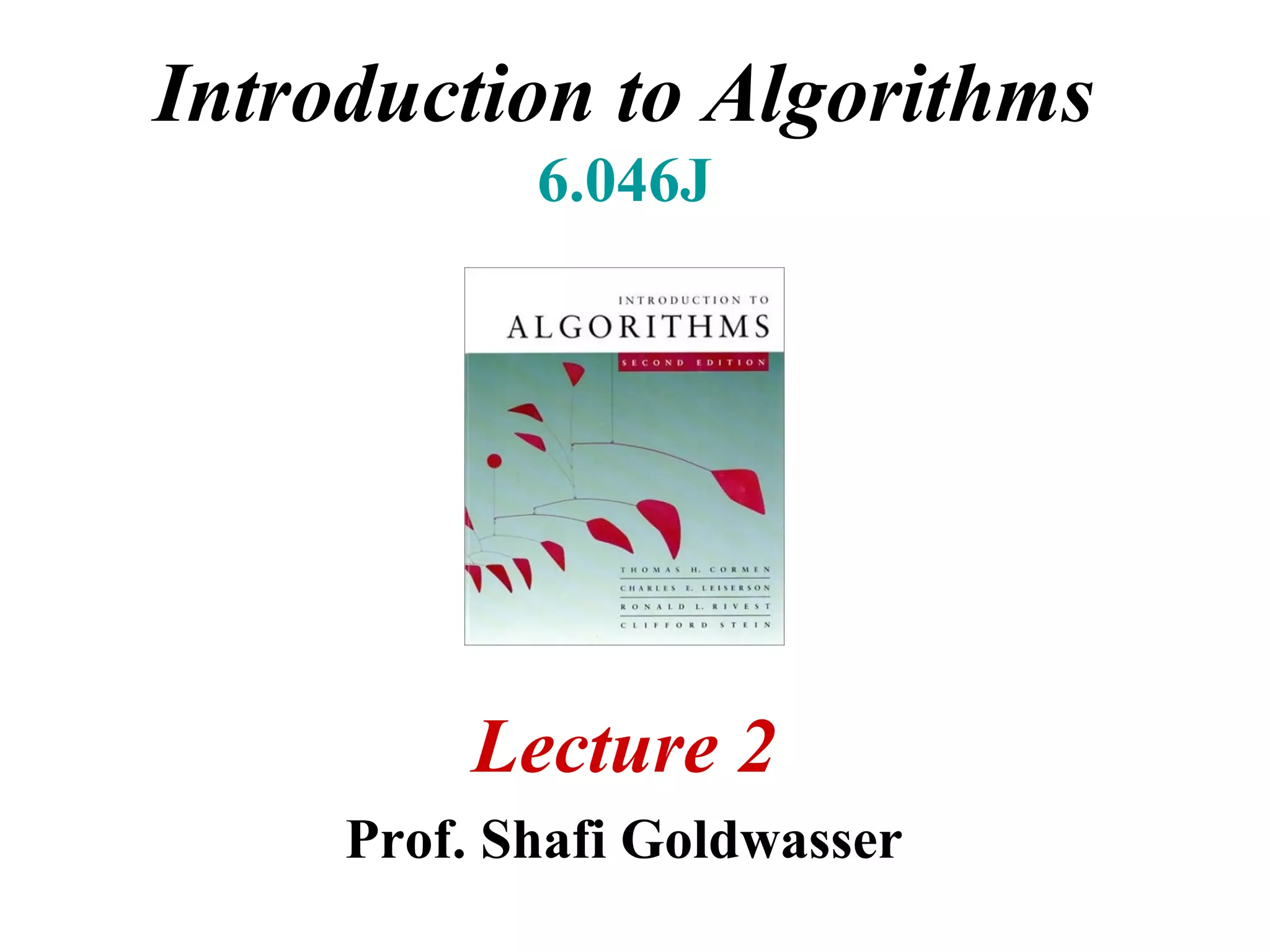
Introduction to Algorithms
6.046J
Lecture 2
Prof. Shafi Goldwasser
L2.2
Solving recurrences
• The analysis of integer multiplication
from Lecture 1 required us to solve a
recurrence.
• Recurrences are a major tool for
analysis of algorithms
• Today: Learn a few methods.
• Lecture 3: Divide and Conquer
algorithms which are analyzable by
recurrences.
L2.3
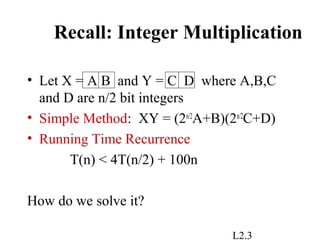
Recall: Integer Multiplication
• Let X = A B and Y = C D where A,B,C
and D are n/2 bit integers
• Simple Method: XY = (2n/2
A+B)(2n/2
C+D)
• Running Time Recurrence
T(n) < 4T(n/2) + 100n
How do we solve it?
L2.4
Substitution method
1. Guess the form of the solution.
2. Verify by induction.
3. Solve for constants.
The most general method:
Example: T(n) = 4T(n/2) + 100n
• [Assume that T(1) = Θ(1).]
• Guess O(n3
) . (Prove O and Ω separately.)
• Assume that T(k) ≤ ck3
for k < n .
• Prove T(n) ≤ cn3
by induction.
L2.5
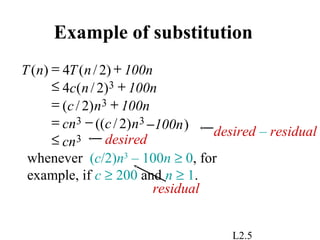
Example of substitution
desired – residual
whenever (c/2)n3
– 100n ≥ 0, for
example, if c ≥ 200 and n ≥ 1.
desired
residual
3
33
3
3
))2/((
)2/(
)2/(4
)2/(4)(
cn
100nnccn
100nnc
100nnc
100nnTnT
≤
−−=
+=
+≤
+=
L2.6
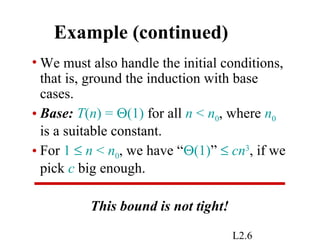
Example (continued)
• We must also handle the initial conditions,
that is, ground the induction with base
cases.
• Base: T(n) = Θ(1) for all n < n0, where n0
is a suitable constant.
• For 1 ≤ n < n0, we have “Θ(1)” ≤ cn3
, if we
pick c big enough.
This bound is not tight!
L2.7
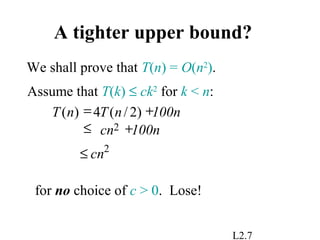
A tighter upper bound?
We shall prove that T(n) = O(n2
).
Assume that T(k) ≤ ck2
for k < n:
for no choice of c > 0. Lose!
)2/(4)(
2 100ncn
100nnTnT
+≤
+=
2
cn≤
L2.8
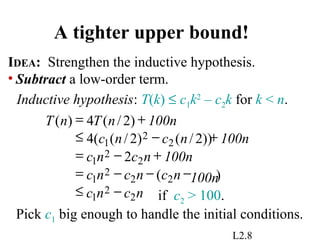
A tighter upper bound!
IDEA: Strengthen the inductive hypothesis.
• Subtract a low-order term.
Inductive hypothesis: T(k) ≤ c1k2
– c2k for k < n.
if c2 > 100.
Pick c1 big enough to handle the initial conditions.
)(
2
))2/()2/((4
)2/(4)(
2
2
1
22
2
1
2
2
1
2
2
1
ncnc
100nncncnc
100nncnc
100nncnc
100nnTnT
−≤
−−−=
+−=
+−≤
+=
L2.9
Recursion-tree method
• A recursion tree models the costs (time) of a
recursive execution of an algorithm.
• The recursion tree method is good for
generating guesses for the substitution
method.
• The recursion-tree method can be unreliable,
just like any method that uses ellipses (…).
• The recursion-tree method promotes intuition,
however.
L2.10
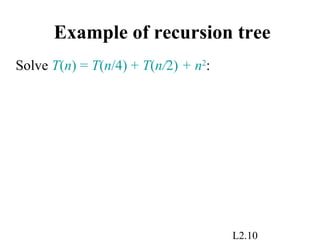
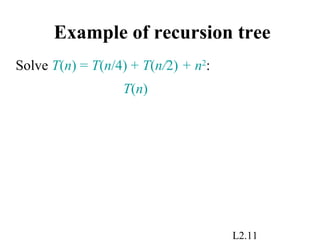
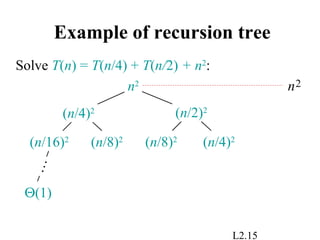
Example of recursion tree
Solve T(n) = T(n/4) + T(n/2) + n2
:
L2.11
Example of recursion tree
T(n)
Solve T(n) = T(n/4) + T(n/2) + n2
:
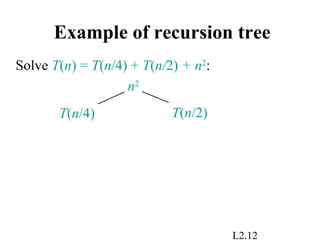
L2.12
Example of recursion tree
T(n/4) T(n/2)
n2
Solve T(n) = T(n/4) + T(n/2) + n2
:
L2.13
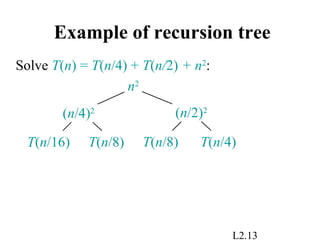
Example of recursion tree
Solve T(n) = T(n/4) + T(n/2) + n2
:
n2
(n/4)2 (n/2)2
T(n/16) T(n/8) T(n/8) T(n/4)
L2.14
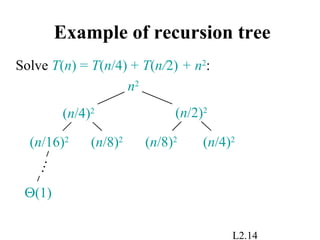
Example of recursion tree
(n/16)2
(n/8)2
(n/8)2
(n/4)2
(n/4)2 (n/2)2
Θ(1)
…
Solve T(n) = T(n/4) + T(n/2) + n2
:
n2
L2.15
Example of recursion tree
Solve T(n) = T(n/4) + T(n/2) + n2
:
(n/16)2
(n/8)2
(n/8)2
(n/4)2
(n/4)2 (n/2)2
Θ(1)
…
2nn2
L2.16
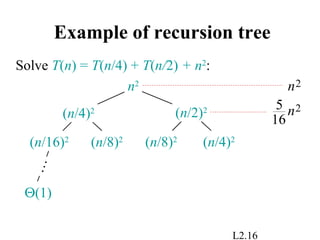
Example of recursion tree
Solve T(n) = T(n/4) + T(n/2) + n2
:
(n/16)2
(n/8)2
(n/8)2
(n/4)2
(n/4)2 (n/2)2
Θ(1)
…
2
16
5 n
2nn2
L2.17
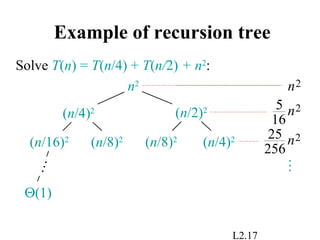
Example of recursion tree
Solve T(n) = T(n/4) + T(n/2) + n2
:
(n/16)2
(n/8)2
(n/8)2
(n/4)2
(n/4)2
Θ(1)
…
2
16
5 n
2n
2
256
25 n
n2
(n/2)2
…
L2.18
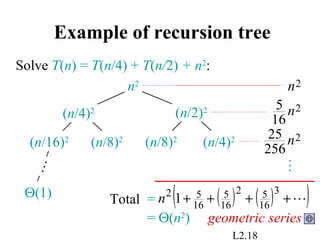
Example of recursion tree
Solve T(n) = T(n/4) + T(n/2) + n2
:
(n/16)2
(n/8)2
(n/8)2
(n/4)2
(n/4)2
Θ(1)
…
2
16
5 n
2n
2
256
25 n
( ) ( )( )1
3
16
52
16
5
16
52
++++n
…
Total =
= Θ(n2
)
n2
(n/2)2
geometric series
L2.19
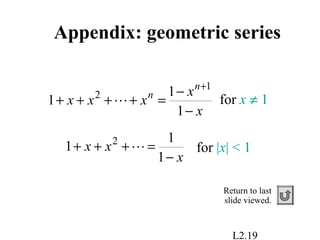
Appendix: geometric series
1
1
1 2
x
xx
−
=+++  for |x| < 1
1
1
1
1
2
x
x
xxx
n
n
−
−
=++++
+
 for x ≠ 1
Return to last
slide viewed.
L2.20
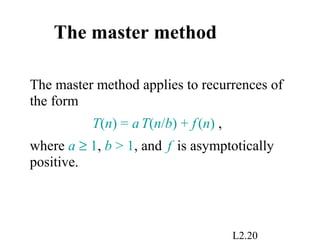
The master method
The master method applies to recurrences of
the form
T(n) = aT(n/b) + f(n) ,
where a ≥ 1, b > 1, and f is asymptotically
positive.
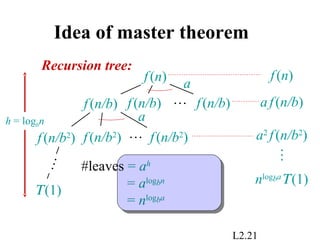
L2.21
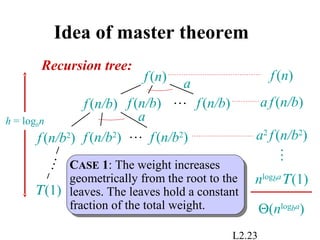
f(n/b)
Idea of master theorem
f(n/b) f(n/b)
Τ(1)
…
Recursion tree:
…
f(n) a
f(n/b2
)f(n/b2
) f(n/b2
)…
ah = logbn
f(n)
af(n/b)
a2
f(n/b2
)
…
#leaves = ah
= alogbn
= nlogba
nlogba
Τ(1)
L2.22
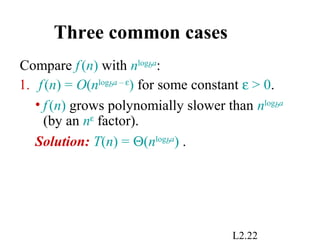
Three common cases
Compare f(n) with nlogba
:
1. f(n) = O(nlogba – ε
) for some constant ε > 0.
• f(n) grows polynomially slower than nlogba
(by an nε
factor).
Solution: T(n) = Θ(nlogba
) .
L2.23
f(n/b)
Idea of master theorem
f(n/b) f(n/b)
Τ(1)
…
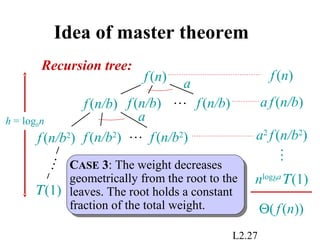
Recursion tree:
…
f(n) a
f(n/b2
)f(n/b2
) f(n/b2
)…
ah = logbn
f(n)
af(n/b)
a2
f(n/b2
)
…
nlogba
Τ(1)
CASE 1: The weight increases
geometrically from the root to the
leaves. The leaves hold a constant
fraction of the total weight.
CASE 1: The weight increases
geometrically from the root to the
leaves. The leaves hold a constant
fraction of the total weight. Θ(nlogba
)
L2.24
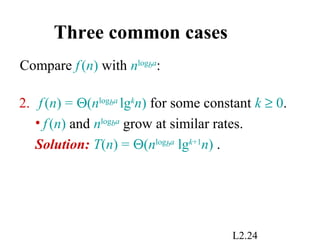
Three common cases
Compare f(n) with nlogba
:
2. f(n) = Θ(nlogba
lgk
n) for some constant k ≥ 0.
• f(n) and nlogba
grow at similar rates.
Solution: T(n) = Θ(nlogba
lgk+1
n) .
L2.25
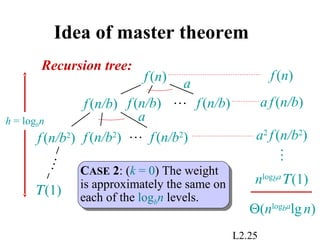
f(n/b)
Idea of master theorem
f(n/b) f(n/b)
Τ(1)
…
Recursion tree:
…
f(n) a
f(n/b2
)f(n/b2
) f(n/b2
)…
ah = logbn
f(n)
af(n/b)
a2
f(n/b2
)
…
nlogba
Τ(1)CASE 2: (k = 0) The weight
is approximately the same on
each of the logbn levels.
CASE 2: (k = 0) The weight
is approximately the same on
each of the logbn levels.
Θ(nlogba
lgn)
L2.26
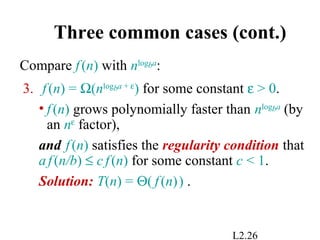
Three common cases (cont.)
Compare f(n) with nlogba
:
3. f(n) = Ω(nlogba + ε
) for some constant ε > 0.
• f(n) grows polynomially faster than nlogba
(by
an nε
factor),
and f(n) satisfies the regularity condition that
af(n/b) ≤ c f(n) for some constant c < 1.
Solution: T(n) = Θ( f(n)) .
L2.27
f(n/b)
Idea of master theorem
f(n/b) f(n/b)
Τ(1)
…
Recursion tree:
…
f(n) a
f(n/b2
)f(n/b2
) f(n/b2
)…
ah = logbn
f(n)
af(n/b)
a2
f(n/b2
)
…
nlogba
Τ(1)
CASE 3: The weight decreases
geometrically from the root to the
leaves. The root holds a constant
fraction of the total weight.
CASE 3: The weight decreases
geometrically from the root to the
leaves. The root holds a constant
fraction of the total weight. Θ(f(n))
L2.28
Examples
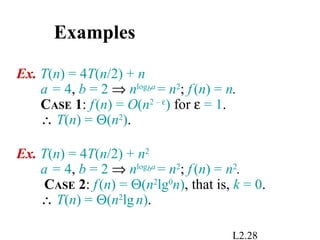
Ex. T(n) = 4T(n/2) + n
a = 4, b = 2 ⇒ nlogba
= n2
; f(n) = n.
CASE 1: f(n) = O(n2 – ε
) for ε = 1.
∴ T(n) = Θ(n2
).
Ex. T(n) = 4T(n/2) + n2
a = 4, b = 2 ⇒ nlogba
= n2
; f(n) = n2
.
CASE 2: f(n) = Θ(n2
lg0
n), that is, k = 0.
∴ T(n) = Θ(n2
lgn).
L2.29
Examples
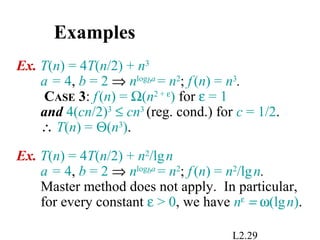
Ex. T(n) = 4T(n/2) + n3
a = 4, b = 2 ⇒ nlogba
= n2
; f(n) = n3
.
CASE 3: f(n) = Ω(n2 + ε
) for ε = 1
and 4(cn/2)3
≤ cn3
(reg. cond.) for c = 1/2.
∴ T(n) = Θ(n3
).
Ex. T(n) = 4T(n/2) + n2
/lgn
a = 4, b = 2 ⇒ nlogba
= n2
; f(n) = n2
/lgn.
Master method does not apply. In particular,
for every constant ε > 0, we have nε
= ω(lgn).
L2.30
Conclusion
• Next time: applying the master method.
• For proof of master theorem, goto section

L2

  • 1.
  • 2.
    L2.2 Solving recurrences • Theanalysis of integer multiplication from Lecture 1 required us to solve a recurrence. • Recurrences are a major tool for analysis of algorithms • Today: Learn a few methods. • Lecture 3: Divide and Conquer algorithms which are analyzable by recurrences.
  • 3.
    L2.3 Recall: Integer Multiplication •Let X = A B and Y = C D where A,B,C and D are n/2 bit integers • Simple Method: XY = (2n/2 A+B)(2n/2 C+D) • Running Time Recurrence T(n) < 4T(n/2) + 100n How do we solve it?
  • 4.
    L2.4 Substitution method 1. Guessthe form of the solution. 2. Verify by induction. 3. Solve for constants. The most general method: Example: T(n) = 4T(n/2) + 100n • [Assume that T(1) = Θ(1).] • Guess O(n3 ) . (Prove O and Ω separately.) • Assume that T(k) ≤ ck3 for k < n . • Prove T(n) ≤ cn3 by induction.
  • 5.
    L2.5 Example of substitution desired– residual whenever (c/2)n3 – 100n ≥ 0, for example, if c ≥ 200 and n ≥ 1. desired residual 3 33 3 3 ))2/(( )2/( )2/(4 )2/(4)( cn 100nnccn 100nnc 100nnc 100nnTnT ≤ −−= += +≤ +=
  • 6.
    L2.6 Example (continued) • Wemust also handle the initial conditions, that is, ground the induction with base cases. • Base: T(n) = Θ(1) for all n < n0, where n0 is a suitable constant. • For 1 ≤ n < n0, we have “Θ(1)” ≤ cn3 , if we pick c big enough. This bound is not tight!
  • 7.
    L2.7 A tighter upperbound? We shall prove that T(n) = O(n2 ). Assume that T(k) ≤ ck2 for k < n: for no choice of c > 0. Lose! )2/(4)( 2 100ncn 100nnTnT +≤ += 2 cn≤
  • 8.
    L2.8 A tighter upperbound! IDEA: Strengthen the inductive hypothesis. • Subtract a low-order term. Inductive hypothesis: T(k) ≤ c1k2 – c2k for k < n. if c2 > 100. Pick c1 big enough to handle the initial conditions. )( 2 ))2/()2/((4 )2/(4)( 2 2 1 22 2 1 2 2 1 2 2 1 ncnc 100nncncnc 100nncnc 100nncnc 100nnTnT −≤ −−−= +−= +−≤ +=
  • 9.
    L2.9 Recursion-tree method • Arecursion tree models the costs (time) of a recursive execution of an algorithm. • The recursion tree method is good for generating guesses for the substitution method. • The recursion-tree method can be unreliable, just like any method that uses ellipses (…). • The recursion-tree method promotes intuition, however.
  • 10.
    L2.10 Example of recursiontree Solve T(n) = T(n/4) + T(n/2) + n2 :
  • 11.
    L2.11 Example of recursiontree T(n) Solve T(n) = T(n/4) + T(n/2) + n2 :
  • 12.
    L2.12 Example of recursiontree T(n/4) T(n/2) n2 Solve T(n) = T(n/4) + T(n/2) + n2 :
  • 13.
    L2.13 Example of recursiontree Solve T(n) = T(n/4) + T(n/2) + n2 : n2 (n/4)2 (n/2)2 T(n/16) T(n/8) T(n/8) T(n/4)
  • 14.
    L2.14 Example of recursiontree (n/16)2 (n/8)2 (n/8)2 (n/4)2 (n/4)2 (n/2)2 Θ(1) … Solve T(n) = T(n/4) + T(n/2) + n2 : n2
  • 15.
    L2.15 Example of recursiontree Solve T(n) = T(n/4) + T(n/2) + n2 : (n/16)2 (n/8)2 (n/8)2 (n/4)2 (n/4)2 (n/2)2 Θ(1) … 2nn2
  • 16.
    L2.16 Example of recursiontree Solve T(n) = T(n/4) + T(n/2) + n2 : (n/16)2 (n/8)2 (n/8)2 (n/4)2 (n/4)2 (n/2)2 Θ(1) … 2 16 5 n 2nn2
  • 17.
    L2.17 Example of recursiontree Solve T(n) = T(n/4) + T(n/2) + n2 : (n/16)2 (n/8)2 (n/8)2 (n/4)2 (n/4)2 Θ(1) … 2 16 5 n 2n 2 256 25 n n2 (n/2)2 …
  • 18.
    L2.18 Example of recursiontree Solve T(n) = T(n/4) + T(n/2) + n2 : (n/16)2 (n/8)2 (n/8)2 (n/4)2 (n/4)2 Θ(1) … 2 16 5 n 2n 2 256 25 n ( ) ( )( )1 3 16 52 16 5 16 52 ++++n … Total = = Θ(n2 ) n2 (n/2)2 geometric series
  • 19.
    L2.19 Appendix: geometric series 1 1 12 x xx − =+++  for |x| < 1 1 1 1 1 2 x x xxx n n − − =++++ +  for x ≠ 1 Return to last slide viewed.
  • 20.
    L2.20 The master method Themaster method applies to recurrences of the form T(n) = aT(n/b) + f(n) , where a ≥ 1, b > 1, and f is asymptotically positive.
  • 21.
    L2.21 f(n/b) Idea of mastertheorem f(n/b) f(n/b) Τ(1) … Recursion tree: … f(n) a f(n/b2 )f(n/b2 ) f(n/b2 )… ah = logbn f(n) af(n/b) a2 f(n/b2 ) … #leaves = ah = alogbn = nlogba nlogba Τ(1)
  • 22.
    L2.22 Three common cases Comparef(n) with nlogba : 1. f(n) = O(nlogba – ε ) for some constant ε > 0. • f(n) grows polynomially slower than nlogba (by an nε factor). Solution: T(n) = Θ(nlogba ) .
  • 23.
    L2.23 f(n/b) Idea of mastertheorem f(n/b) f(n/b) Τ(1) … Recursion tree: … f(n) a f(n/b2 )f(n/b2 ) f(n/b2 )… ah = logbn f(n) af(n/b) a2 f(n/b2 ) … nlogba Τ(1) CASE 1: The weight increases geometrically from the root to the leaves. The leaves hold a constant fraction of the total weight. CASE 1: The weight increases geometrically from the root to the leaves. The leaves hold a constant fraction of the total weight. Θ(nlogba )
  • 24.
    L2.24 Three common cases Comparef(n) with nlogba : 2. f(n) = Θ(nlogba lgk n) for some constant k ≥ 0. • f(n) and nlogba grow at similar rates. Solution: T(n) = Θ(nlogba lgk+1 n) .
  • 25.
    L2.25 f(n/b) Idea of mastertheorem f(n/b) f(n/b) Τ(1) … Recursion tree: … f(n) a f(n/b2 )f(n/b2 ) f(n/b2 )… ah = logbn f(n) af(n/b) a2 f(n/b2 ) … nlogba Τ(1)CASE 2: (k = 0) The weight is approximately the same on each of the logbn levels. CASE 2: (k = 0) The weight is approximately the same on each of the logbn levels. Θ(nlogba lgn)
  • 26.
    L2.26 Three common cases(cont.) Compare f(n) with nlogba : 3. f(n) = Ω(nlogba + ε ) for some constant ε > 0. • f(n) grows polynomially faster than nlogba (by an nε factor), and f(n) satisfies the regularity condition that af(n/b) ≤ c f(n) for some constant c < 1. Solution: T(n) = Θ( f(n)) .
  • 27.
    L2.27 f(n/b) Idea of mastertheorem f(n/b) f(n/b) Τ(1) … Recursion tree: … f(n) a f(n/b2 )f(n/b2 ) f(n/b2 )… ah = logbn f(n) af(n/b) a2 f(n/b2 ) … nlogba Τ(1) CASE 3: The weight decreases geometrically from the root to the leaves. The root holds a constant fraction of the total weight. CASE 3: The weight decreases geometrically from the root to the leaves. The root holds a constant fraction of the total weight. Θ(f(n))
  • 28.
    L2.28 Examples Ex. T(n) =4T(n/2) + n a = 4, b = 2 ⇒ nlogba = n2 ; f(n) = n. CASE 1: f(n) = O(n2 – ε ) for ε = 1. ∴ T(n) = Θ(n2 ). Ex. T(n) = 4T(n/2) + n2 a = 4, b = 2 ⇒ nlogba = n2 ; f(n) = n2 . CASE 2: f(n) = Θ(n2 lg0 n), that is, k = 0. ∴ T(n) = Θ(n2 lgn).
  • 29.
    L2.29 Examples Ex. T(n) =4T(n/2) + n3 a = 4, b = 2 ⇒ nlogba = n2 ; f(n) = n3 . CASE 3: f(n) = Ω(n2 + ε ) for ε = 1 and 4(cn/2)3 ≤ cn3 (reg. cond.) for c = 1/2. ∴ T(n) = Θ(n3 ). Ex. T(n) = 4T(n/2) + n2 /lgn a = 4, b = 2 ⇒ nlogba = n2 ; f(n) = n2 /lgn. Master method does not apply. In particular, for every constant ε > 0, we have nε = ω(lgn).
  • 30.
    L2.30 Conclusion • Next time:applying the master method. • For proof of master theorem, goto section