1
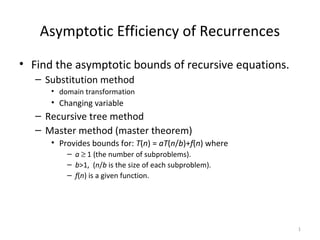
Asymptotic Efficiency of Recurrences
• Find the asymptotic bounds of recursive equations.
– Substitution method
• domain transformation
• Changing variable
– Recursive tree method
– Master method (master theorem)
• Provides bounds for: T(n) = aT(n/b)+f(n) where
– a ≥ 1 (the number of subproblems).
– b>1, (n/b is the size of each subproblem).
– f(n) is a given function.
2
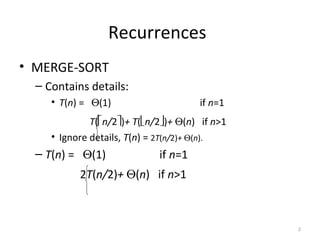
Recurrences
• MERGE-SORT
– Contains details:
• T(n) = Θ(1) if n=1
T(n/2)+ T(n/2)+ Θ(n) if n>1
• Ignore details, T(n) = 2T(n/2)+ Θ(n).
– T(n) = Θ(1) if n=1
2T(n/2)+ Θ(n) if n>1
3
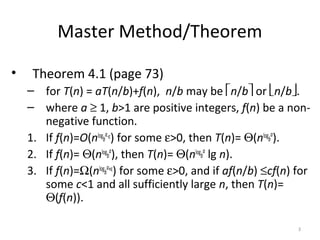
Master Method/Theorem
• Theorem 4.1 (page 73)
– for T(n) = aT(n/b)+f(n), n/b may be n/b or n/b.
– where a ≥ 1, b>1 are positive integers, f(n) be a non-
negative function.
1. If f(n)=O(nlogb
a-ε) for some ε>0, then T(n)= Θ(nlogb
a
).
2. If f(n)= Θ(nlogb
a
), then T(n)= Θ(nlogb
a
lg n).
3. If f(n)=Ω(nlogb
a+ε) for some ε>0, and if af(n/b) ≤cf(n) for
some c<1 and all sufficiently large n, then T(n)=
Θ(f(n)).
4
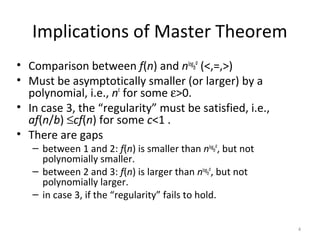
Implications of Master Theorem
• Comparison between f(n) and nlogb
a
(<,=,>)
• Must be asymptotically smaller (or larger) by a
polynomial, i.e., nε
for some ε>0.
• In case 3, the “regularity” must be satisfied, i.e.,
af(n/b) ≤cf(n) for some c<1 .
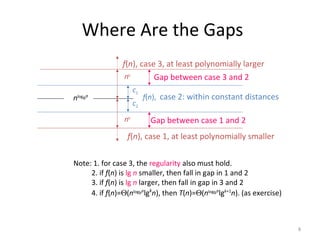
• There are gaps
– between 1 and 2: f(n) is smaller than nlogb
a
, but not
polynomially smaller.
– between 2 and 3: f(n) is larger than nlogb
a
, but not
polynomially larger.
– in case 3, if the “regularity” fails to hold.
5
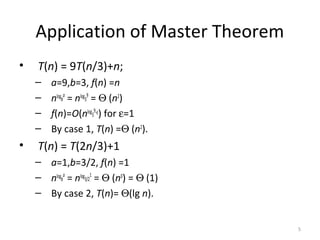
Application of Master Theorem
• T(n) = 9T(n/3)+n;
– a=9,b=3, f(n) =n
– nlogb
a
= nlog3
9
= Θ (n2
)
– f(n)=O(nlog3
9-ε) for ε=1
– By case 1, T(n) =Θ (n2
).
• T(n) = T(2n/3)+1
– a=1,b=3/2, f(n) =1
– nlogb
a
= nlog3/2
1
= Θ (n0
) = Θ (1)
– By case 2, T(n)= Θ(lg n).
6
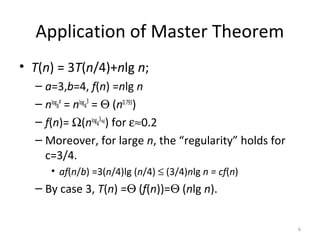
Application of Master Theorem
• T(n) = 3T(n/4)+nlg n;
– a=3,b=4, f(n) =nlg n
– nlogb
a
= nlog4
3
= Θ (n0.793
)
– f(n)= Ω(nlog4
3+ε) for ε≈0.2
– Moreover, for large n, the “regularity” holds for
c=3/4.
• af(n/b) =3(n/4)lg (n/4) ≤ (3/4)nlg n = cf(n)
– By case 3, T(n) =Θ (f(n))=Θ (nlg n).
7
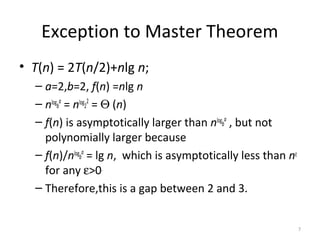
Exception to Master Theorem
• T(n) = 2T(n/2)+nlg n;
– a=2,b=2, f(n) =nlg n
– nlogb
a
= nlog2
2
= Θ (n)
– f(n) is asymptotically larger than nlogb
a
, but not
polynomially larger because
– f(n)/nlogb
a
= lg n, which is asymptotically less than nε
for any ε>0.
– Therefore,this is a gap between 2 and 3.
8
Where Are the Gaps
nlogba f(n), case 2: within constant distances
c1
c2
nε
f(n), case 1, at least polynomially smaller
Gap between case 1 and 2
nε
Gap between case 3 and 2
f(n), case 3, at least polynomially larger
Note: 1. for case 3, the regularity also must hold.
2. if f(n) is lg n smaller, then fall in gap in 1 and 2
3. if f(n) is lg n larger, then fall in gap in 3 and 2
4. if f(n)=Θ(nlogba
lgk
n), then T(n)=Θ(nlogba
lgk+1
n). (as exercise)
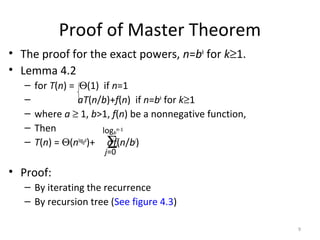
9
Proof of Master Theorem
• The proof for the exact powers, n=bk
for k≥1.
• Lemma 4.2
– for T(n) = Θ(1) if n=1
– aT(n/b)+f(n) if n=bk
for k≥1
– where a ≥ 1, b>1, f(n) be a nonnegative function,
– Then
– T(n) = Θ(nlogba
)+ aj
f(n/bj
)
• Proof:
– By iterating the recurrence
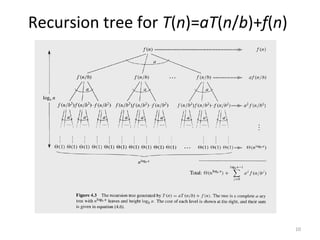
– By recursion tree (See figure 4.3)
∑
j=0
logb
n-1
10
Recursion tree for T(n)=aT(n/b)+f(n)
11
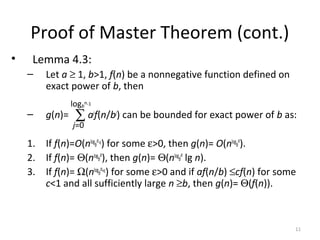
Proof of Master Theorem (cont.)
• Lemma 4.3:
– Let a ≥ 1, b>1, f(n) be a nonnegative function defined on
exact power of b, then
– g(n)= aj
f(n/bj
) can be bounded for exact power of b as:
1. If f(n)=O(nlogb
a-ε) for some ε>0, then g(n)= O(nlogb
a
).
2. If f(n)= Θ(nlogb
a
), then g(n)= Θ(nlogb
a
lg n).
3. If f(n)= Ω(nlogb
a+ε) for some ε>0 and if af(n/b) ≤cf(n) for some
c<1 and all sufficiently large n ≥b, then g(n)= Θ(f(n)).
∑
j=0
logb
n-1
12
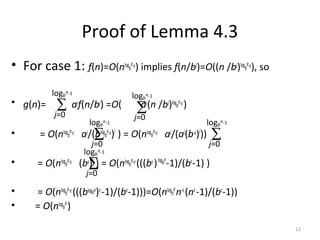
Proof of Lemma 4.3
• For case 1: f(n)=O(nlogb
a-ε) implies f(n/bj
)=O((n /bj
)logb
a-ε), so
• g(n)= aj
f(n/bj
) =O( aj
(n /bj
)logb
a-ε)
• = O(nlogb
a-ε aj
/(blogb
a-ε)j
) = O(nlogb
a-ε aj
/(aj
(b-ε)j
))
• = O(nlogb
a-ε (bε)j
) = O(nlogb
a-ε(((bε)logbn
-1)/(bε
-1) )
• = O(nlogb
a-ε(((blogbn
)ε
-1)/(bε
-1)))=O(nlogb
a
n-ε
(nε
-1)/(bε
-1))
• = O(nlogb
a
)
∑
j=0
logb
n-1
∑
j=0
logb
n-1
∑
j=0
logb
n-1
∑
j=0
logb
n-1
∑
j=0
logb
n-1
13
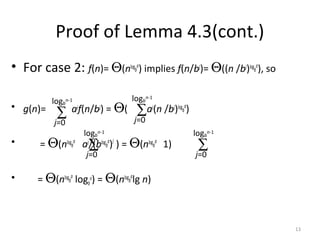
Proof of Lemma 4.3(cont.)
• For case 2: f(n)= Θ(nlogb
a
) implies f(n/bj
)= Θ((n /bj
)logb
a
), so
• g(n)= aj
f(n/bj
) = Θ( aj
(n /bj
)logb
a
)
• = Θ(nlogb
a
aj
/(blogb
a
)j
) = Θ(nlogb
a
1)
• = Θ(nlogb
a
logb
n) = Θ(nlogb
a
lg n)
∑
j=0
logb
n-1
∑
j=0
logb
n-1
∑
j=0
logb
n-1
∑
j=0
logb
n-1
14
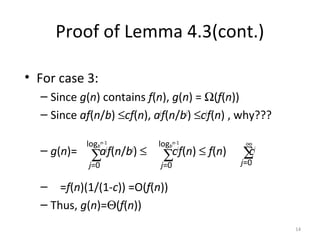
Proof of Lemma 4.3(cont.)
• For case 3:
– Since g(n) contains f(n), g(n) = Ω(f(n))
– Since af(n/b) ≤cf(n), aj
f(n/bj
) ≤cj
f(n) , why???
– g(n)= aj
f(n/bj
) ≤ cj
f(n) ≤ f(n) cj
– =f(n)(1/(1-c)) =O(f(n))
– Thus, g(n)=Θ(f(n))
∑
j=0
logb
n-1
∑
j=0
logb
n-1
∑
j=0
∞
15
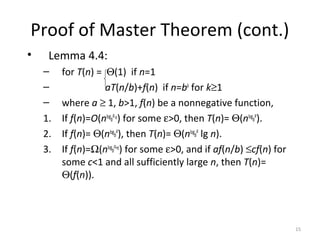
Proof of Master Theorem (cont.)
• Lemma 4.4:
– for T(n) = Θ(1) if n=1
– aT(n/b)+f(n) if n=bk
for k≥1
– where a ≥ 1, b>1, f(n) be a nonnegative function,
1. If f(n)=O(nlogb
a-ε) for some ε>0, then T(n)= Θ(nlogb
a
).
2. If f(n)= Θ(nlogb
a
), then T(n)= Θ(nlogb
a
lg n).
3. If f(n)=Ω(nlogb
a+ε) for some ε>0, and if af(n/b) ≤cf(n) for
some c<1 and all sufficiently large n, then T(n)=
Θ(f(n)).
16
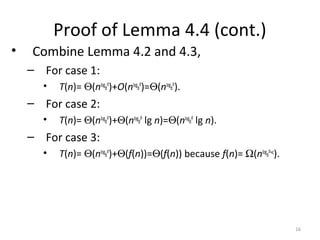
Proof of Lemma 4.4 (cont.)
• Combine Lemma 4.2 and 4.3,
– For case 1:
• T(n)= Θ(nlogb
a
)+O(nlogb
a
)=Θ(nlogb
a
).
– For case 2:
• T(n)= Θ(nlogb
a
)+Θ(nlogb
a
lg n)=Θ(nlogb
a
lg n).
– For case 3:
• T(n)= Θ(nlogb
a
)+Θ(f(n))=Θ(f(n)) because f(n)= Ω(nlogb
a+ε).
17
Floors and Ceilings
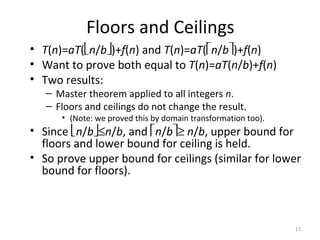
• T(n)=aT(n/b)+f(n) and T(n)=aT(n/b)+f(n)
• Want to prove both equal to T(n)=aT(n/b)+f(n)
• Two results:
– Master theorem applied to all integers n.
– Floors and ceilings do not change the result.
• (Note: we proved this by domain transformation too).
• Since n/b≤n/b, and n/b≥ n/b, upper bound for
floors and lower bound for ceiling is held.
• So prove upper bound for ceilings (similar for lower
bound for floors).
18
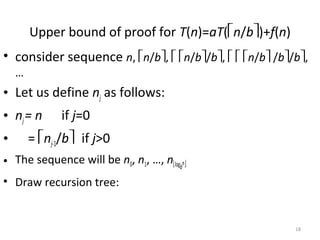
Upper bound of proof for T(n)=aT(n/b)+f(n)
• consider sequence n, n/b,  n/b/b,   n/b /b/b,
…
• Let us define nj as follows:
• nj= n if j=0
• = nj-1/b if j>0
• The sequence will be n0, n1, …, nlogb
n
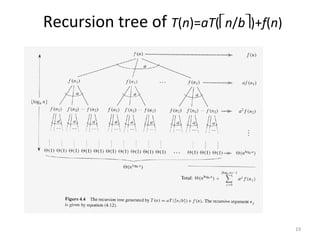
• Draw recursion tree:
19
Recursion tree of T(n)=aT(n/b)+f(n)
20
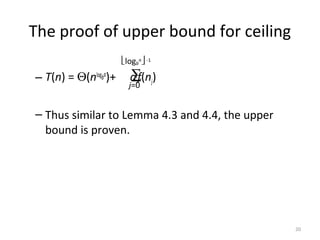
The proof of upper bound for ceiling
– T(n) = Θ(nlogba
)+ aj
f(nj)
– Thus similar to Lemma 4.3 and 4.4, the upper
bound is proven.
∑
j=0
logb
n -1
21
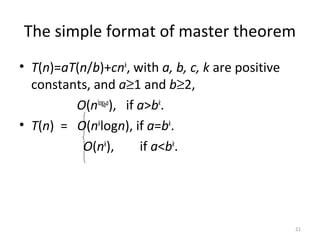
The simple format of master theorem
• T(n)=aT(n/b)+cnk
, with a, b, c, k are positive
constants, and a≥1 and b≥2,
O(nlogba
), if a>bk
.
• T(n) = O(nk
logn), if a=bk
.
O(nk
), if a<bk
.
22
Summary
Recurrences and their bounds
– Substitution
– Recursion tree
– Master theorem.
– Proof of subtleties
– Recurrences that Master theorem does not
apply to.

Master method theorem

  • 1.
    1 Asymptotic Efficiency ofRecurrences • Find the asymptotic bounds of recursive equations. – Substitution method • domain transformation • Changing variable – Recursive tree method – Master method (master theorem) • Provides bounds for: T(n) = aT(n/b)+f(n) where – a ≥ 1 (the number of subproblems). – b>1, (n/b is the size of each subproblem). – f(n) is a given function.
  • 2.
    2 Recurrences • MERGE-SORT – Containsdetails: • T(n) = Θ(1) if n=1 T(n/2)+ T(n/2)+ Θ(n) if n>1 • Ignore details, T(n) = 2T(n/2)+ Θ(n). – T(n) = Θ(1) if n=1 2T(n/2)+ Θ(n) if n>1
  • 3.
    3 Master Method/Theorem • Theorem4.1 (page 73) – for T(n) = aT(n/b)+f(n), n/b may be n/b or n/b. – where a ≥ 1, b>1 are positive integers, f(n) be a non- negative function. 1. If f(n)=O(nlogb a-ε) for some ε>0, then T(n)= Θ(nlogb a ). 2. If f(n)= Θ(nlogb a ), then T(n)= Θ(nlogb a lg n). 3. If f(n)=Ω(nlogb a+ε) for some ε>0, and if af(n/b) ≤cf(n) for some c<1 and all sufficiently large n, then T(n)= Θ(f(n)).
  • 4.
    4 Implications of MasterTheorem • Comparison between f(n) and nlogb a (<,=,>) • Must be asymptotically smaller (or larger) by a polynomial, i.e., nε for some ε>0. • In case 3, the “regularity” must be satisfied, i.e., af(n/b) ≤cf(n) for some c<1 . • There are gaps – between 1 and 2: f(n) is smaller than nlogb a , but not polynomially smaller. – between 2 and 3: f(n) is larger than nlogb a , but not polynomially larger. – in case 3, if the “regularity” fails to hold.
  • 5.
    5 Application of MasterTheorem • T(n) = 9T(n/3)+n; – a=9,b=3, f(n) =n – nlogb a = nlog3 9 = Θ (n2 ) – f(n)=O(nlog3 9-ε) for ε=1 – By case 1, T(n) =Θ (n2 ). • T(n) = T(2n/3)+1 – a=1,b=3/2, f(n) =1 – nlogb a = nlog3/2 1 = Θ (n0 ) = Θ (1) – By case 2, T(n)= Θ(lg n).
  • 6.
    6 Application of MasterTheorem • T(n) = 3T(n/4)+nlg n; – a=3,b=4, f(n) =nlg n – nlogb a = nlog4 3 = Θ (n0.793 ) – f(n)= Ω(nlog4 3+ε) for ε≈0.2 – Moreover, for large n, the “regularity” holds for c=3/4. • af(n/b) =3(n/4)lg (n/4) ≤ (3/4)nlg n = cf(n) – By case 3, T(n) =Θ (f(n))=Θ (nlg n).
  • 7.
    7 Exception to MasterTheorem • T(n) = 2T(n/2)+nlg n; – a=2,b=2, f(n) =nlg n – nlogb a = nlog2 2 = Θ (n) – f(n) is asymptotically larger than nlogb a , but not polynomially larger because – f(n)/nlogb a = lg n, which is asymptotically less than nε for any ε>0. – Therefore,this is a gap between 2 and 3.
  • 8.
    8 Where Are theGaps nlogba f(n), case 2: within constant distances c1 c2 nε f(n), case 1, at least polynomially smaller Gap between case 1 and 2 nε Gap between case 3 and 2 f(n), case 3, at least polynomially larger Note: 1. for case 3, the regularity also must hold. 2. if f(n) is lg n smaller, then fall in gap in 1 and 2 3. if f(n) is lg n larger, then fall in gap in 3 and 2 4. if f(n)=Θ(nlogba lgk n), then T(n)=Θ(nlogba lgk+1 n). (as exercise)
  • 9.
    9 Proof of MasterTheorem • The proof for the exact powers, n=bk for k≥1. • Lemma 4.2 – for T(n) = Θ(1) if n=1 – aT(n/b)+f(n) if n=bk for k≥1 – where a ≥ 1, b>1, f(n) be a nonnegative function, – Then – T(n) = Θ(nlogba )+ aj f(n/bj ) • Proof: – By iterating the recurrence – By recursion tree (See figure 4.3) ∑ j=0 logb n-1
  • 10.
    10 Recursion tree forT(n)=aT(n/b)+f(n)
  • 11.
    11 Proof of MasterTheorem (cont.) • Lemma 4.3: – Let a ≥ 1, b>1, f(n) be a nonnegative function defined on exact power of b, then – g(n)= aj f(n/bj ) can be bounded for exact power of b as: 1. If f(n)=O(nlogb a-ε) for some ε>0, then g(n)= O(nlogb a ). 2. If f(n)= Θ(nlogb a ), then g(n)= Θ(nlogb a lg n). 3. If f(n)= Ω(nlogb a+ε) for some ε>0 and if af(n/b) ≤cf(n) for some c<1 and all sufficiently large n ≥b, then g(n)= Θ(f(n)). ∑ j=0 logb n-1
  • 12.
    12 Proof of Lemma4.3 • For case 1: f(n)=O(nlogb a-ε) implies f(n/bj )=O((n /bj )logb a-ε), so • g(n)= aj f(n/bj ) =O( aj (n /bj )logb a-ε) • = O(nlogb a-ε aj /(blogb a-ε)j ) = O(nlogb a-ε aj /(aj (b-ε)j )) • = O(nlogb a-ε (bε)j ) = O(nlogb a-ε(((bε)logbn -1)/(bε -1) ) • = O(nlogb a-ε(((blogbn )ε -1)/(bε -1)))=O(nlogb a n-ε (nε -1)/(bε -1)) • = O(nlogb a ) ∑ j=0 logb n-1 ∑ j=0 logb n-1 ∑ j=0 logb n-1 ∑ j=0 logb n-1 ∑ j=0 logb n-1
  • 13.
    13 Proof of Lemma4.3(cont.) • For case 2: f(n)= Θ(nlogb a ) implies f(n/bj )= Θ((n /bj )logb a ), so • g(n)= aj f(n/bj ) = Θ( aj (n /bj )logb a ) • = Θ(nlogb a aj /(blogb a )j ) = Θ(nlogb a 1) • = Θ(nlogb a logb n) = Θ(nlogb a lg n) ∑ j=0 logb n-1 ∑ j=0 logb n-1 ∑ j=0 logb n-1 ∑ j=0 logb n-1
  • 14.
    14 Proof of Lemma4.3(cont.) • For case 3: – Since g(n) contains f(n), g(n) = Ω(f(n)) – Since af(n/b) ≤cf(n), aj f(n/bj ) ≤cj f(n) , why??? – g(n)= aj f(n/bj ) ≤ cj f(n) ≤ f(n) cj – =f(n)(1/(1-c)) =O(f(n)) – Thus, g(n)=Θ(f(n)) ∑ j=0 logb n-1 ∑ j=0 logb n-1 ∑ j=0 ∞
  • 15.
    15 Proof of MasterTheorem (cont.) • Lemma 4.4: – for T(n) = Θ(1) if n=1 – aT(n/b)+f(n) if n=bk for k≥1 – where a ≥ 1, b>1, f(n) be a nonnegative function, 1. If f(n)=O(nlogb a-ε) for some ε>0, then T(n)= Θ(nlogb a ). 2. If f(n)= Θ(nlogb a ), then T(n)= Θ(nlogb a lg n). 3. If f(n)=Ω(nlogb a+ε) for some ε>0, and if af(n/b) ≤cf(n) for some c<1 and all sufficiently large n, then T(n)= Θ(f(n)).
  • 16.
    16 Proof of Lemma4.4 (cont.) • Combine Lemma 4.2 and 4.3, – For case 1: • T(n)= Θ(nlogb a )+O(nlogb a )=Θ(nlogb a ). – For case 2: • T(n)= Θ(nlogb a )+Θ(nlogb a lg n)=Θ(nlogb a lg n). – For case 3: • T(n)= Θ(nlogb a )+Θ(f(n))=Θ(f(n)) because f(n)= Ω(nlogb a+ε).
  • 17.
    17 Floors and Ceilings •T(n)=aT(n/b)+f(n) and T(n)=aT(n/b)+f(n) • Want to prove both equal to T(n)=aT(n/b)+f(n) • Two results: – Master theorem applied to all integers n. – Floors and ceilings do not change the result. • (Note: we proved this by domain transformation too). • Since n/b≤n/b, and n/b≥ n/b, upper bound for floors and lower bound for ceiling is held. • So prove upper bound for ceilings (similar for lower bound for floors).
  • 18.
    18 Upper bound ofproof for T(n)=aT(n/b)+f(n) • consider sequence n, n/b,  n/b/b,   n/b /b/b, … • Let us define nj as follows: • nj= n if j=0 • = nj-1/b if j>0 • The sequence will be n0, n1, …, nlogb n • Draw recursion tree:
  • 19.
    19 Recursion tree ofT(n)=aT(n/b)+f(n)
  • 20.
    20 The proof ofupper bound for ceiling – T(n) = Θ(nlogba )+ aj f(nj) – Thus similar to Lemma 4.3 and 4.4, the upper bound is proven. ∑ j=0 logb n -1
  • 21.
    21 The simple formatof master theorem • T(n)=aT(n/b)+cnk , with a, b, c, k are positive constants, and a≥1 and b≥2, O(nlogba ), if a>bk . • T(n) = O(nk logn), if a=bk . O(nk ), if a<bk .
  • 22.
    22 Summary Recurrences and theirbounds – Substitution – Recursion tree – Master theorem. – Proof of subtleties – Recurrences that Master theorem does not apply to.