Courtesy: Costas/Ullman 1
Regular Expressions
2
RE’s: Introduction
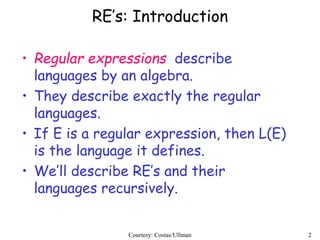
• Regular expressions describe
languages by an algebra.
• They describe exactly the regular
languages.
• If E is a regular expression, then L(E)
is the language it defines.
• We’ll describe RE’s and their
languages recursively.
Courtesy: Costas/Ullman
3
Operations on Languages
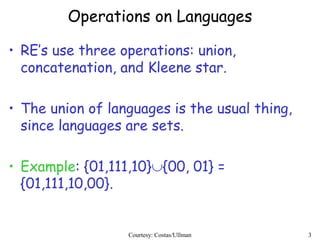
• RE’s use three operations: union,
concatenation, and Kleene star.
• The union of languages is the usual thing,
since languages are sets.
• Example: {01,111,10}{00, 01} =
{01,111,10,00}.
Courtesy: Costas/Ullman
4
Concatenation
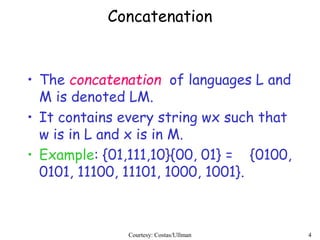
• The concatenation of languages L and
M is denoted LM.
• It contains every string wx such that
w is in L and x is in M.
• Example: {01,111,10}{00, 01} = {0100,
0101, 11100, 11101, 1000, 1001}.
Courtesy: Costas/Ullman
5
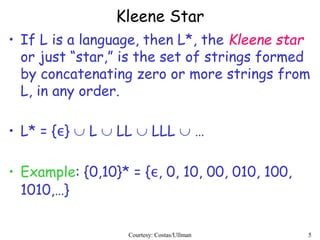
Kleene Star
• If L is a language, then L*, the Kleene star
or just “star,” is the set of strings formed
by concatenating zero or more strings from
L, in any order.
• L* = {ε}  L  LL  LLL  …
• Example: {0,10}* = {ε, 0, 10, 00, 010, 100,
1010,…}
Courtesy: Costas/Ullman
6
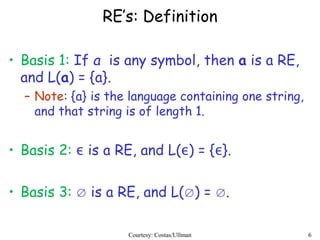
RE’s: Definition
• Basis 1: If a is any symbol, then a is a RE,
and L(a) = {a}.
– Note: {a} is the language containing one string,
and that string is of length 1.
• Basis 2: ε is a RE, and L(ε) = {ε}.
• Basis 3: ∅ is a RE, and L(∅) = ∅.
Courtesy: Costas/Ullman
7
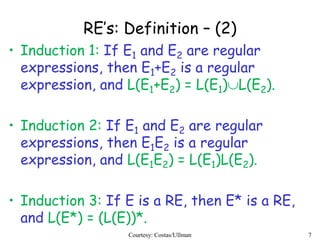
RE’s: Definition – (2)
• Induction 1: If E1 and E2 are regular
expressions, then E1+E2 is a regular
expression, and L(E1+E2) = L(E1)L(E2).
• Induction 2: If E1 and E2 are regular
expressions, then E1E2 is a regular
expression, and L(E1E2) = L(E1)L(E2).
• Induction 3: If E is a RE, then E* is a RE,
and L(E*) = (L(E))*.
Courtesy: Costas/Ullman
Courtesy: Costas/Ullman 8
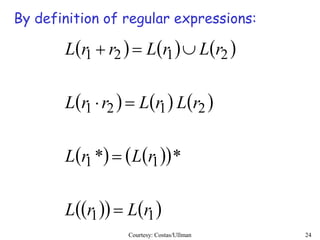
Definition (continued)
For regular expressions and1r 2r
     2121 rLrLrrL 
     2121 rLrLrrL 
    ** 11 rLrL 
    11 rLrL 
9
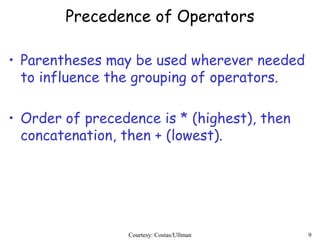
Precedence of Operators
• Parentheses may be used wherever needed
to influence the grouping of operators.
• Order of precedence is * (highest), then
concatenation, then + (lowest).
Courtesy: Costas/Ullman
Courtesy: Costas/Ullman 10
Example
Regular expression:   *aba 
  *abaL      *aLbaL 
   *aLbaL 
       *aLbLaL 
       *aba 
  ,...,,,, aaaaaaba 
 ,...,,,...,,, baababaaaaaa
Courtesy: Costas/Ullman 11
Example
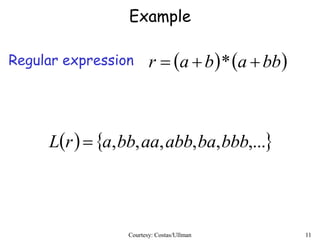
Regular expression    bbabar  *
   ,...,,,,, bbbbaabbaabbarL 
Courtesy: Costas/Ullman 12
Example
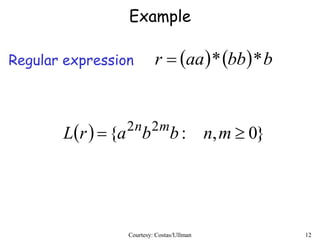
Regular expression     bbbaar **
  }0,:{ 22
 mnbbarL mn
Courtesy: Costas/Ullman 13
Example
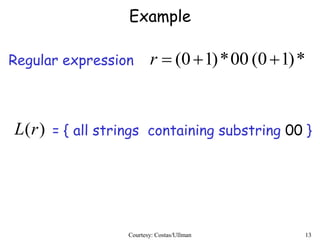
Regular expression *)10(00*)10( r
)(rL = { all strings containing substring 00 }
Courtesy: Costas/Ullman 14
Example
Regular expression )0(*)011( r
)(rL = { all strings without substring 00 }
Courtesy: Costas/Ullman 15
Equivalent Regular Expressions
Definition:
Regular expressions and
are equivalent if
1r 2r
)()( 21 rLrL 
Courtesy: Costas/Ullman 16
Example
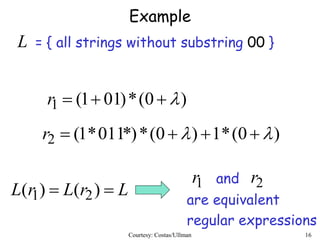
L = { all strings without substring 00 }
)0(*)011(1 r
)0(*1)0(**)011*1(2  r
LrLrL  )()( 21
1r 2rand
are equivalent
regular expressions
Courtesy: Costas/Ullman 17
Regular Expressions
and
Regular Languages
Courtesy: Costas/Ullman 18
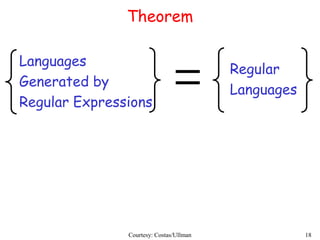
Theorem
Languages
Generated by
Regular Expressions
Regular
Languages
Courtesy: Costas/Ullman 19
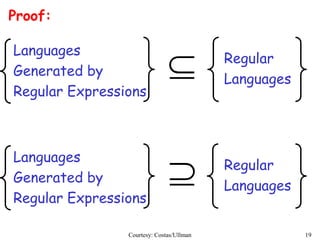
Languages
Generated by
Regular Expressions
Regular
Languages

Languages
Generated by
Regular Expressions
Regular
Languages

Proof:
Courtesy: Costas/Ullman 20
Proof - Part 1
r
)(rL
For any regular expression
the language is regular
Languages
Generated by
Regular Expressions
Regular
Languages

Proof by induction on the size of r
Courtesy: Costas/Ullman 21
Induction Basis
Primitive Regular Expressions: ,,
Corresponding
NFAs
)()( 1  LML
)(}{)( 2  LML 
)(}{)( 3 aLaML 
regular
languages
a
Courtesy: Costas/Ullman 22
Inductive Hypothesis
Suppose
that for regular expressions and ,
and are regular languages
1r 2r
)( 1rL )( 2rL
Courtesy: Costas/Ullman 23
Inductive Step
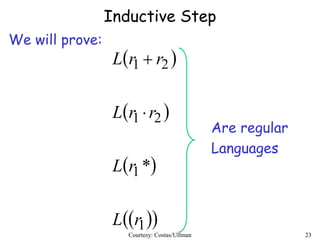
We will prove:
 
 
 
  1
1
21
21
*
rL
rL
rrL
rrL


Are regular
Languages
Courtesy: Costas/Ullman 24
By definition of regular expressions:
     
     
    
    11
11
2121
2121
**
rLrL
rLrL
rLrLrrL
rLrLrrL




Courtesy: Costas/Ullman 25
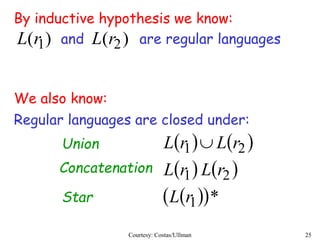
)( 1rL )( 2rL
By inductive hypothesis we know:
and are regular languages
Regular languages are closed under:
   
   
  *1
21
21
rL
rLrL
rLrL Union
Concatenation
Star
We also know:
Courtesy: Costas/Ullman 26
Therefore:
     
     
    ** 11
2121
2121
rLrL
rLrLrrL
rLrLrrL



Are regular
languages
)())(( 11 rLrL  is trivially a regular language
(by induction hypothesis)
End of Proof-Part 1
Courtesy: Costas/Ullman 27
Using the regular closure of operations,
we can construct recursively the NFA
that accepts
M
)()( rLML 
Example: 21 rrr 
)()( 11 rLML 
)()( 22 rLML 
)()( rLML 


Courtesy: Costas/Ullman 28
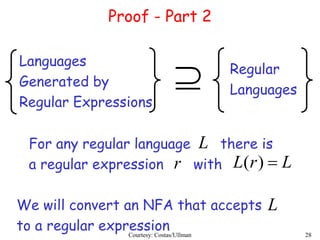
For any regular language there is
a regular expression with
Proof - Part 2
Languages
Generated by
Regular Expressions
Regular
Languages

L
r LrL )(
We will convert an NFA that accepts
to a regular expression
L
Courtesy: Costas/Ullman 29
Since is regular, there is a
NFA that accepts it
L
M
LML )(
Take it with a single accept state
Courtesy: Costas/Ullman 30
From construct the equivalent
Generalized Transition Graph
in which transition labels are regular expressions
M
Example:
a
ba,
c
M
a
ba 
c
Corresponding
Generalized transition graph
Courtesy: Costas/Ullman 31
Another Example:
ba 
a
b
b
0q 1q 2q
ba,
a
b
b
0q 1q 2q
b
bTransition labels
are regular
expressions
Courtesy: Costas/Ullman 32
Reducing the states:
ba 
a
b
b
0q 1q 2q
b
0q 2q
babb*
)(* babb 
Transition labels
are regular
expressions
Courtesy: Costas/Ullman 33
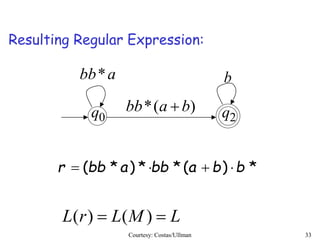
Resulting Regular Expression:
0q 2q
babb*
)(* babb 
*)(**)*( bbabbabbr 
LMLrL  )()(
Courtesy: Costas/Ullman 34
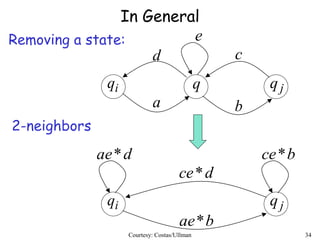
In General
Removing a state:
iq q jq
a b
cd
e
iq jq
dae* bce*
dce*
bae*
2-neighbors
Courtesy: Costas/Ullman 35
iq jq
dae* bce*
dce*
bae*
iq q jq
a b
cd
e
kq
f g
kq
fge*
dge*
fae*
bge*
fce*
This can be generalized
to arbitrary number
of neighbors to q
3-neighbors
Courtesy: Costas/Ullman 36
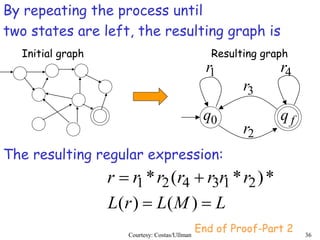
0q fq
1r
2r
3r
4r
*)*(* 213421 rrrrrrr 
LMLrL  )()(
The resulting regular expression:
By repeating the process until
two states are left, the resulting graph is
Initial graph Resulting graph
End of Proof-Part 2
Courtesy: Costas/Ullman 37
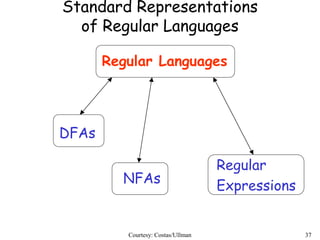
Standard Representations
of Regular Languages
Regular Languages
DFAs
NFAs
Regular
Expressions
Courtesy: Costas/Ullman 38
When we say: We are given
a Regular Language
We mean:
L
Language is in a standard
representation
L
(DFA, NFA, or Regular Expression)

Regular expressions

  • 1.
  • 2.
    2 RE’s: Introduction • Regularexpressions describe languages by an algebra. • They describe exactly the regular languages. • If E is a regular expression, then L(E) is the language it defines. • We’ll describe RE’s and their languages recursively. Courtesy: Costas/Ullman
  • 3.
    3 Operations on Languages •RE’s use three operations: union, concatenation, and Kleene star. • The union of languages is the usual thing, since languages are sets. • Example: {01,111,10}{00, 01} = {01,111,10,00}. Courtesy: Costas/Ullman
  • 4.
    4 Concatenation • The concatenationof languages L and M is denoted LM. • It contains every string wx such that w is in L and x is in M. • Example: {01,111,10}{00, 01} = {0100, 0101, 11100, 11101, 1000, 1001}. Courtesy: Costas/Ullman
  • 5.
    5 Kleene Star • IfL is a language, then L*, the Kleene star or just “star,” is the set of strings formed by concatenating zero or more strings from L, in any order. • L* = {ε}  L  LL  LLL  … • Example: {0,10}* = {ε, 0, 10, 00, 010, 100, 1010,…} Courtesy: Costas/Ullman
  • 6.
    6 RE’s: Definition • Basis1: If a is any symbol, then a is a RE, and L(a) = {a}. – Note: {a} is the language containing one string, and that string is of length 1. • Basis 2: ε is a RE, and L(ε) = {ε}. • Basis 3: ∅ is a RE, and L(∅) = ∅. Courtesy: Costas/Ullman
  • 7.
    7 RE’s: Definition –(2) • Induction 1: If E1 and E2 are regular expressions, then E1+E2 is a regular expression, and L(E1+E2) = L(E1)L(E2). • Induction 2: If E1 and E2 are regular expressions, then E1E2 is a regular expression, and L(E1E2) = L(E1)L(E2). • Induction 3: If E is a RE, then E* is a RE, and L(E*) = (L(E))*. Courtesy: Costas/Ullman
  • 8.
    Courtesy: Costas/Ullman 8 Definition(continued) For regular expressions and1r 2r      2121 rLrLrrL       2121 rLrLrrL      ** 11 rLrL      11 rLrL 
  • 9.
    9 Precedence of Operators •Parentheses may be used wherever needed to influence the grouping of operators. • Order of precedence is * (highest), then concatenation, then + (lowest). Courtesy: Costas/Ullman
  • 10.
    Courtesy: Costas/Ullman 10 Example Regularexpression:   *aba    *abaL      *aLbaL     *aLbaL         *aLbLaL         *aba    ,...,,,, aaaaaaba   ,...,,,...,,, baababaaaaaa
  • 11.
    Courtesy: Costas/Ullman 11 Example Regularexpression    bbabar  *    ,...,,,,, bbbbaabbaabbarL 
  • 12.
    Courtesy: Costas/Ullman 12 Example Regularexpression     bbbaar **   }0,:{ 22  mnbbarL mn
  • 13.
    Courtesy: Costas/Ullman 13 Example Regularexpression *)10(00*)10( r )(rL = { all strings containing substring 00 }
  • 14.
    Courtesy: Costas/Ullman 14 Example Regularexpression )0(*)011( r )(rL = { all strings without substring 00 }
  • 15.
    Courtesy: Costas/Ullman 15 EquivalentRegular Expressions Definition: Regular expressions and are equivalent if 1r 2r )()( 21 rLrL 
  • 16.
    Courtesy: Costas/Ullman 16 Example L= { all strings without substring 00 } )0(*)011(1 r )0(*1)0(**)011*1(2  r LrLrL  )()( 21 1r 2rand are equivalent regular expressions
  • 17.
    Courtesy: Costas/Ullman 17 RegularExpressions and Regular Languages
  • 18.
    Courtesy: Costas/Ullman 18 Theorem Languages Generatedby Regular Expressions Regular Languages
  • 19.
    Courtesy: Costas/Ullman 19 Languages Generatedby Regular Expressions Regular Languages  Languages Generated by Regular Expressions Regular Languages  Proof:
  • 20.
    Courtesy: Costas/Ullman 20 Proof- Part 1 r )(rL For any regular expression the language is regular Languages Generated by Regular Expressions Regular Languages  Proof by induction on the size of r
  • 21.
    Courtesy: Costas/Ullman 21 InductionBasis Primitive Regular Expressions: ,, Corresponding NFAs )()( 1  LML )(}{)( 2  LML  )(}{)( 3 aLaML  regular languages a
  • 22.
    Courtesy: Costas/Ullman 22 InductiveHypothesis Suppose that for regular expressions and , and are regular languages 1r 2r )( 1rL )( 2rL
  • 23.
    Courtesy: Costas/Ullman 23 InductiveStep We will prove:         1 1 21 21 * rL rL rrL rrL   Are regular Languages
  • 24.
    Courtesy: Costas/Ullman 24 Bydefinition of regular expressions:                      11 11 2121 2121 ** rLrL rLrL rLrLrrL rLrLrrL    
  • 25.
    Courtesy: Costas/Ullman 25 )(1rL )( 2rL By inductive hypothesis we know: and are regular languages Regular languages are closed under:           *1 21 21 rL rLrL rLrL Union Concatenation Star We also know:
  • 26.
    Courtesy: Costas/Ullman 26 Therefore:                ** 11 2121 2121 rLrL rLrLrrL rLrLrrL    Are regular languages )())(( 11 rLrL  is trivially a regular language (by induction hypothesis) End of Proof-Part 1
  • 27.
    Courtesy: Costas/Ullman 27 Usingthe regular closure of operations, we can construct recursively the NFA that accepts M )()( rLML  Example: 21 rrr  )()( 11 rLML  )()( 22 rLML  )()( rLML   
  • 28.
    Courtesy: Costas/Ullman 28 Forany regular language there is a regular expression with Proof - Part 2 Languages Generated by Regular Expressions Regular Languages  L r LrL )( We will convert an NFA that accepts to a regular expression L
  • 29.
    Courtesy: Costas/Ullman 29 Sinceis regular, there is a NFA that accepts it L M LML )( Take it with a single accept state
  • 30.
    Courtesy: Costas/Ullman 30 Fromconstruct the equivalent Generalized Transition Graph in which transition labels are regular expressions M Example: a ba, c M a ba  c Corresponding Generalized transition graph
  • 31.
    Courtesy: Costas/Ullman 31 AnotherExample: ba  a b b 0q 1q 2q ba, a b b 0q 1q 2q b bTransition labels are regular expressions
  • 32.
    Courtesy: Costas/Ullman 32 Reducingthe states: ba  a b b 0q 1q 2q b 0q 2q babb* )(* babb  Transition labels are regular expressions
  • 33.
    Courtesy: Costas/Ullman 33 ResultingRegular Expression: 0q 2q babb* )(* babb  *)(**)*( bbabbabbr  LMLrL  )()(
  • 34.
    Courtesy: Costas/Ullman 34 InGeneral Removing a state: iq q jq a b cd e iq jq dae* bce* dce* bae* 2-neighbors
  • 35.
    Courtesy: Costas/Ullman 35 iqjq dae* bce* dce* bae* iq q jq a b cd e kq f g kq fge* dge* fae* bge* fce* This can be generalized to arbitrary number of neighbors to q 3-neighbors
  • 36.
    Courtesy: Costas/Ullman 36 0qfq 1r 2r 3r 4r *)*(* 213421 rrrrrrr  LMLrL  )()( The resulting regular expression: By repeating the process until two states are left, the resulting graph is Initial graph Resulting graph End of Proof-Part 2
  • 37.
    Courtesy: Costas/Ullman 37 StandardRepresentations of Regular Languages Regular Languages DFAs NFAs Regular Expressions
  • 38.
    Courtesy: Costas/Ullman 38 Whenwe say: We are given a Regular Language We mean: L Language is in a standard representation L (DFA, NFA, or Regular Expression)