 An algorithm is a sequence of unambiguous
instructions used for solving a problem, which
can be implemented (as a program) on a
computer
 Algorithms are used to convert our problem solution
into step by step statements. These statements can be
converted into computer programming instructions
which forms a program. This program is executed by
computer to produce solution. Here, program takes
required data as input, processes data according to the
program instructions and finally produces result as
shown in the following picture.
 Input - Every algorithm must take zero or more number
of input values from external.
 Output - Every algorithm must produce an output as
result.
 Definiteness - Every statement/instruction in an
algorithm must be clear and unambiguous (only one
interpretation)
 Finiteness - For all different cases, the algorithm must
produce result within a finite number of steps.
 Effectiveness - Every instruction must be basic enough
to be carried out and it also must be feasible.
 Problem Statement : Find the largest number in the
given list of numbers?

Input : A list of positive integer numbers. (List must
contain at least one number).

Output : The largest number in the given list of
positive integer numbers.
 Consider the given list of numbers as 'L' (input), and
the largest number as 'max' (Output).
 Step 1: Define a variable 'max' and initialize
with '0'.
 Step 2: Compare first number (say 'x') in the list
'L' with 'max', if 'x' is larger than 'max', set 'max'
to 'x'.
 Step 3: Repeat step 2 for all numbers in the list
'L'.
 Step 4: Display the value of 'max' as a result.
 int findMax(L)
 {
 int max = 0,i;
 for(i=0; i < listSize; i++)
 {
 if(L[i] > max) max = L[i];
 }
 return max;
 }
 If we want to go from city "A" to city "B", there can be
many ways of doing this. We can go by flight, by bus, by
train and also by bicycle. Depending on the availability
and convenience, we choose the one which suits us.
Similarly, in computer science there are multiple
algorithms to solve a problem. When we have more than
one algorithm to solve a problem, we need to select the
best one. Performance analysis helps us to select the
best algorithm from multiple algorithms to solve a
problem.
 Whether that algorithm is providing the exact solution
for the problem?
 Whether it is easy to understand?
 Whether it is easy to implement?
 How much space (memory) it requires to solve the
problem?
 How much time it takes to solve the problem? Etc.,
 When we want to analyse an algorithm, we consider
only the space and time required by that particular
algorithm and we ignore all remaining elements.
 Performance analysis of an algorithm is the process
of calculating space required by that algorithm and
time required by that algorithm.
 When we design an algorithm to solve a problem, it
needs some computer memory to complete its
execution. For any algorithm, memory is required for
the following purposes...
 Memory required to store program instructions
 Memory required to store constant values
 Memory required to store variable values
 And for few other things
 Total amount of computer memory
required by an algorithm to complete its
execution is called as space complexity of
that algorithm
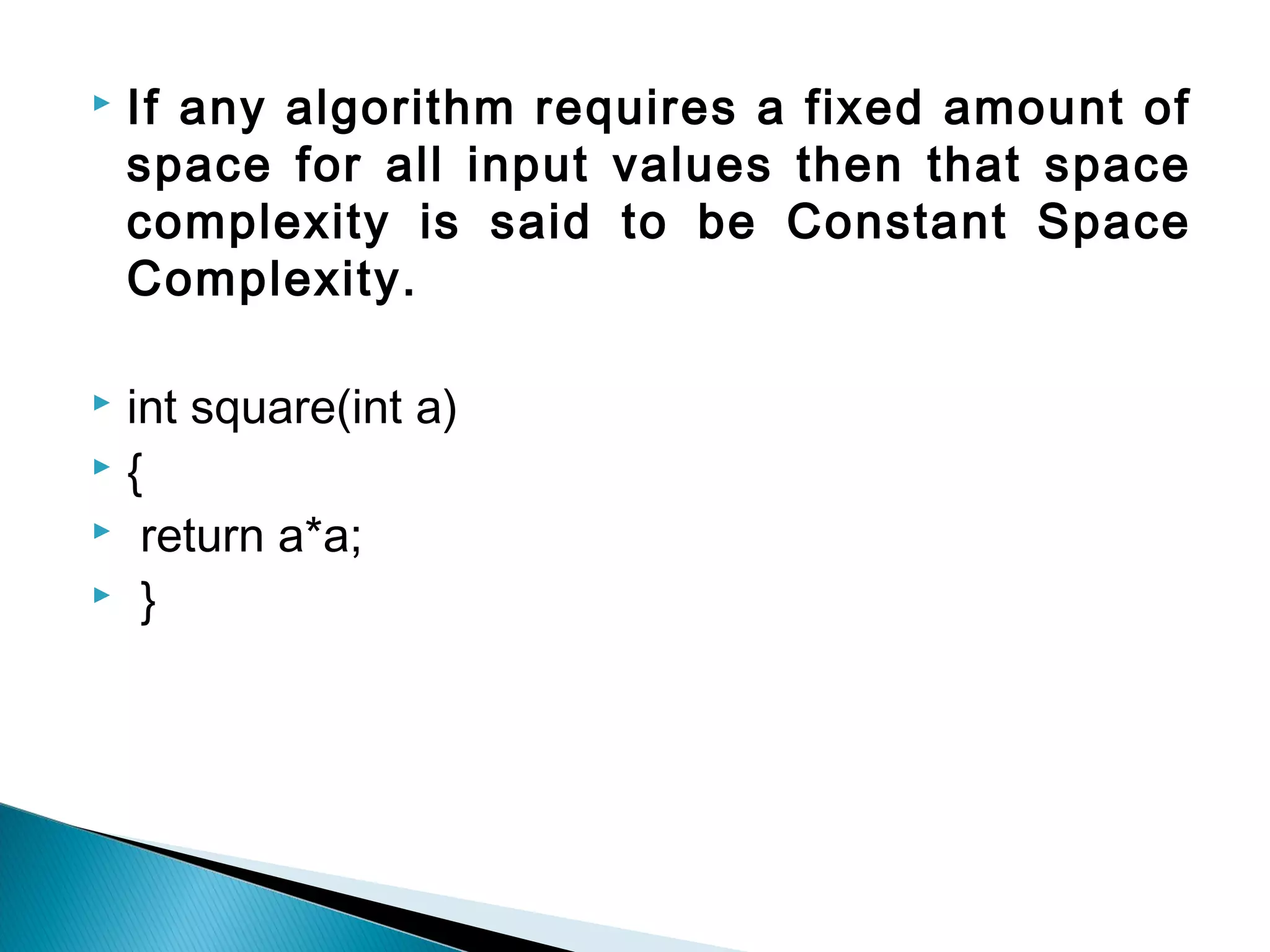
 If any algorithm requires a fixed amount of
space for all input values then that space
complexity is said to be Constant Space
Complexity.
 int square(int a)
 {
 return a*a;
 }
 If the amount of space required by an
algorithm is increased with the increase of
input value, then that space complexity is
said to be Linear Space Complexity.
 int sum(int A[], int n)
 {
 int sum = 0, i;
 for(i = 0; i < n; i++)
 sum = sum + A[i];
 return sum;
 }
 The time complexity of an algorithm is the
total amount of time required by an
algorithm to complete its execution.
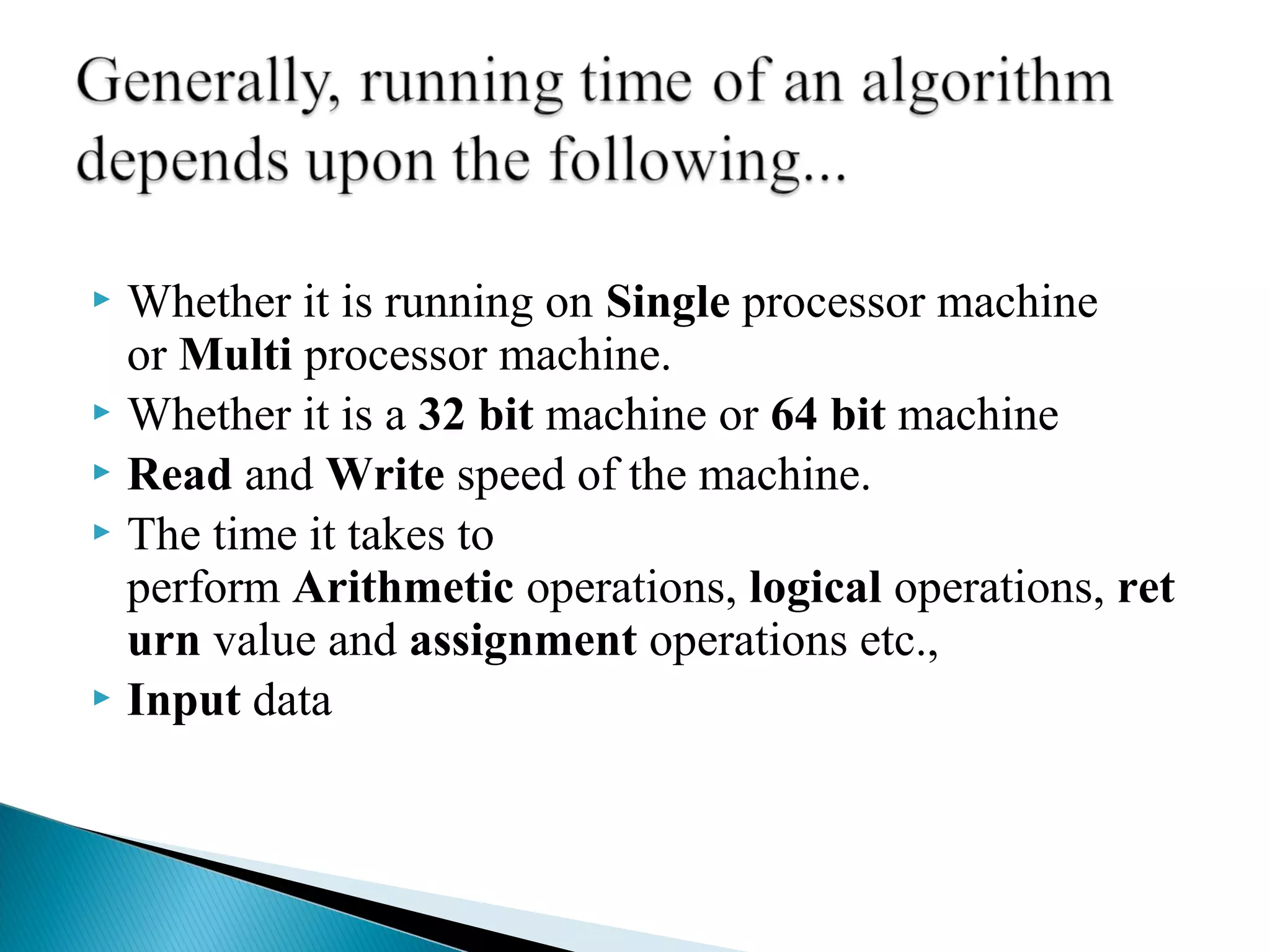
 Whether it is running on Single processor machine
or Multi processor machine.
 Whether it is a 32 bit machine or 64 bit machine
 Read and Write speed of the machine.
 The time it takes to
perform Arithmetic operations, logical operations, ret
urn value and assignment operations etc.,
 Input data
 When we calculate time complexity of an algorithm,
we consider only input data and ignore the remaining
things, as they are machine dependent. We check only,
how our program is behaving for the different input
values to perform all the operations like Arithmetic,
Logical, Return value and Assignment etc.,
 To calculate time complexity of an
algorithm, we need to define a model
machine. Let us assume a machine with
following configuration...
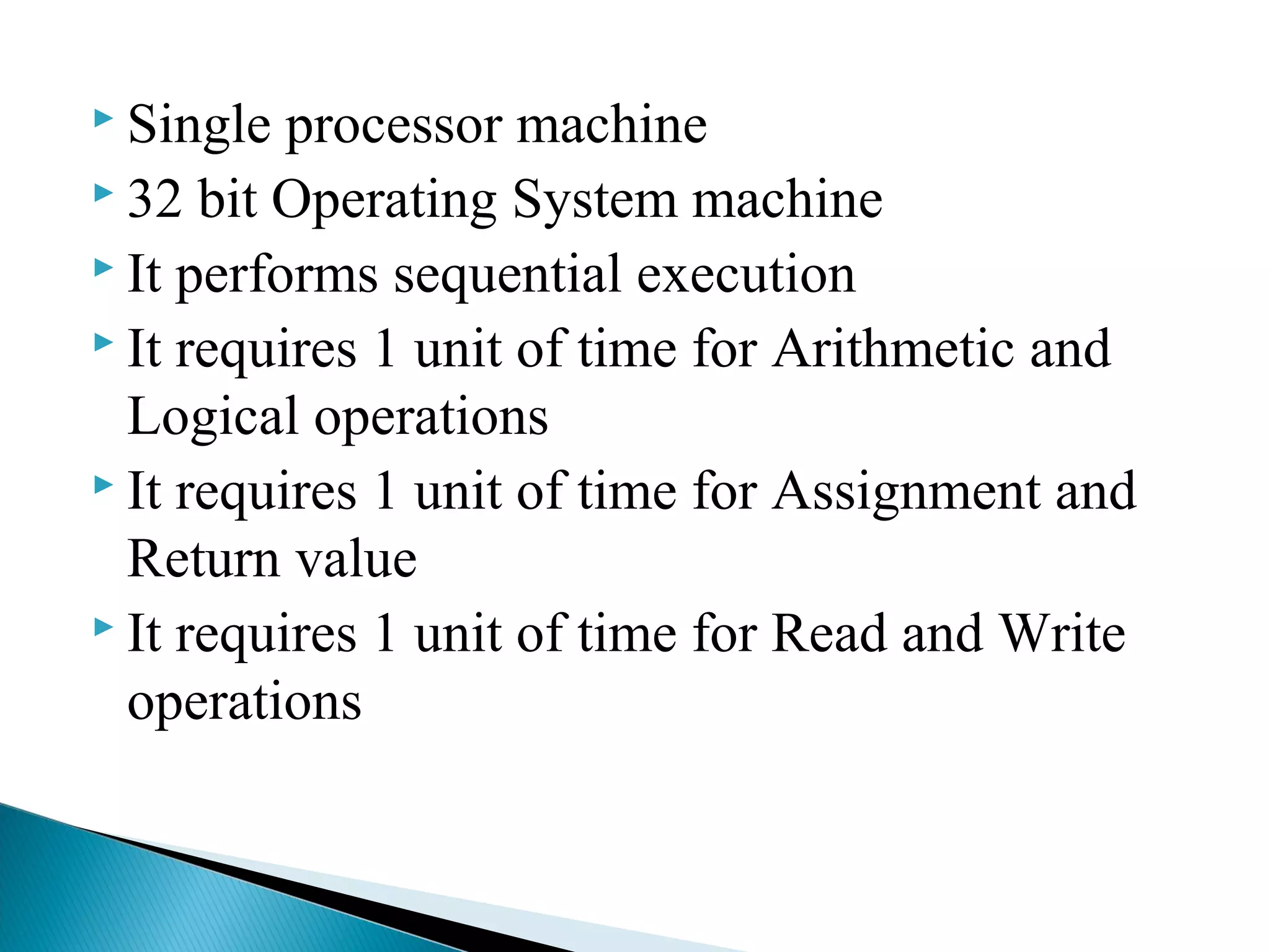
 Single processor machine
 32 bit Operating System machine
 It performs sequential execution
 It requires 1 unit of time for Arithmetic and
Logical operations
 It requires 1 unit of time for Assignment and
Return value
 It requires 1 unit of time for Read and Write
operations
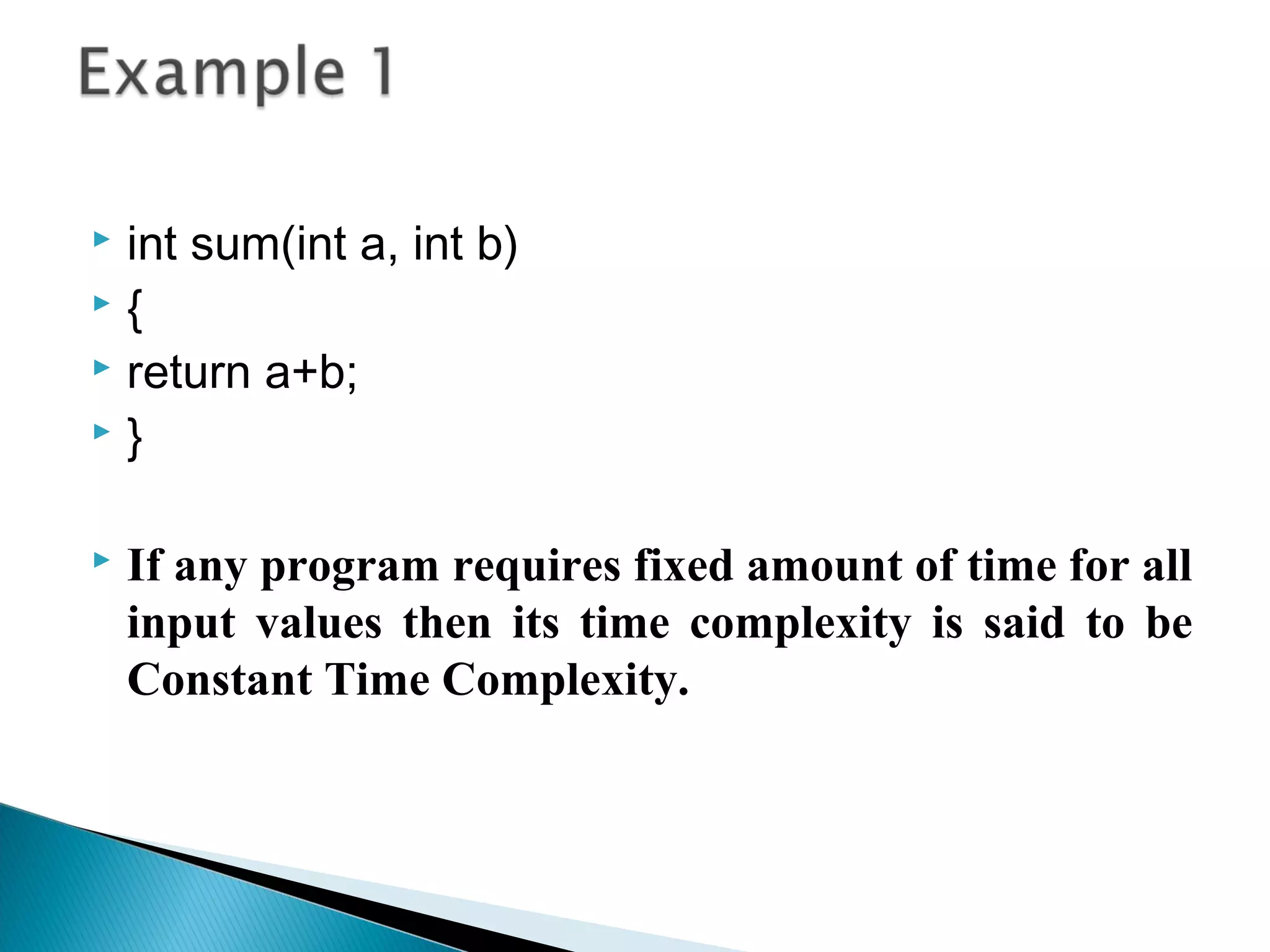
 int sum(int a, int b)
 {
 return a+b;
 }
 If any program requires fixed amount of time for all
input values then its time complexity is said to be
Constant Time Complexity.
 int sum(int A[], int n)
 {
 int sum = 0, i;
 for(i = 0; i < n; i++)
 sum = sum + A[i];
 return sum;
 }
 If the amount of time required by an algorithm is
increased with the increase of input value then that
time complexity is said to be Linear Time
Complexity
 An algorithm is said to run in logarithmic time if its
time execution is proportional to the logarithm of the
input size. Example:
 binary search
 An algorithm is said to run in logarithmic time if its
time execution is proportional to the square of the input
size. Examples:
 bubble sort, selection sort, insertion sort
 Asymptotic notation of an algorithm is a
mathematical representation of its complexity
 For example, consider the following time complexities
of two algorithms...
 Algorihtm 1 : 5n2
+ 2n + 1
 Algorihtm 2 : 10n2
+ 8n + 3
 In asymptotic notation, when we want to
represent the complexity of an algorithm, we
use only the most significant terms in the
complexity of that algorithm and ignore least
significant terms in the complexity of that
algorithm (Here complexity may be Space
Complexity or Time Complexity).
 Majorly, we use THREE types of Asymptotic
Notations and those are as follows...
 Big - Oh (O)
 Big - Omega (Ω)
 Big - Theta (Θ)
 Big - Oh notation is used to define the upper bound of an
algorithm in terms of Time Complexity.
That means Big - Oh notation always indicates the
maximum time required by an algorithm for all input
values. That means Big - Oh notation describes the worst
case of an algorithm time complexity.
Big - Oh Notation can be defined as follows...
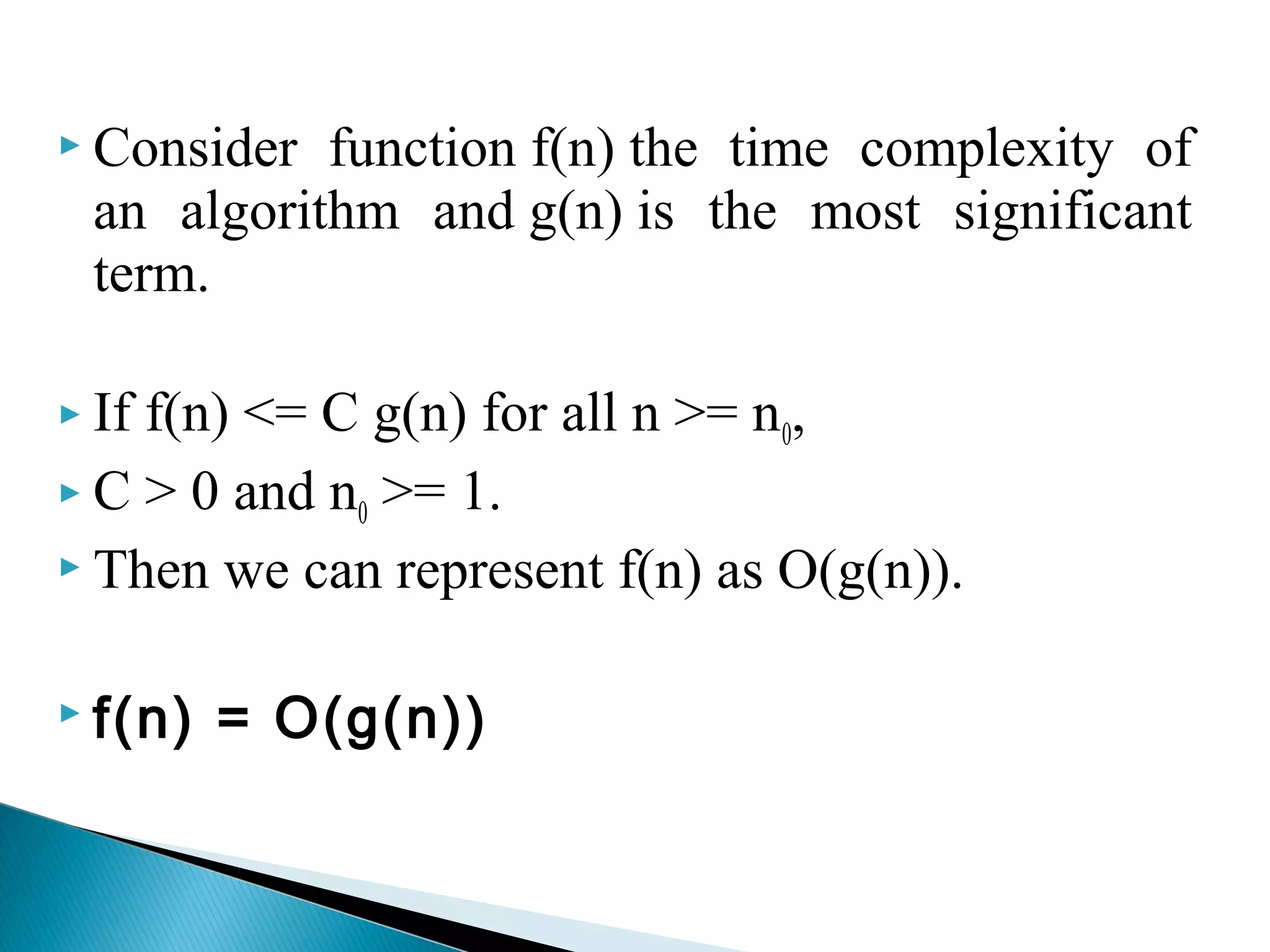
 Consider function f(n) the time complexity of
an algorithm and g(n) is the most significant
term.
 If f(n) <= C g(n) for all n >= n0,
 C > 0 and n0 >= 1.
 Then we can represent f(n) as O(g(n)).
 f(n) = O(g(n))
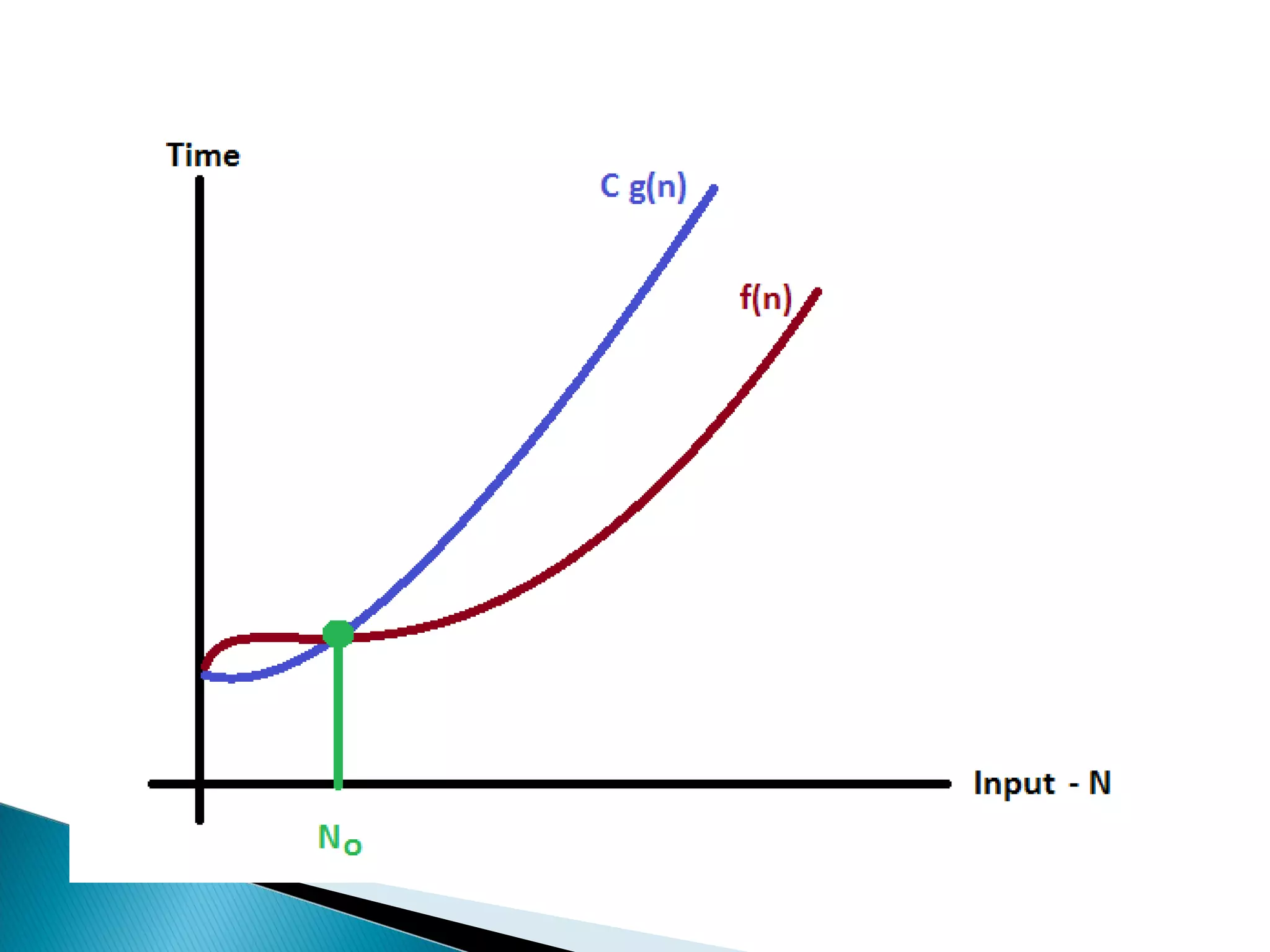
 Consider the following graph drawn for the
values of f(n) and C g(n) for input (n) value on
X-Axis and time required is on Y-Axis
 In above graph after a particular input value n0,
always C g(n) is greater than f(n) which
indicates the algorithm's upper bound.
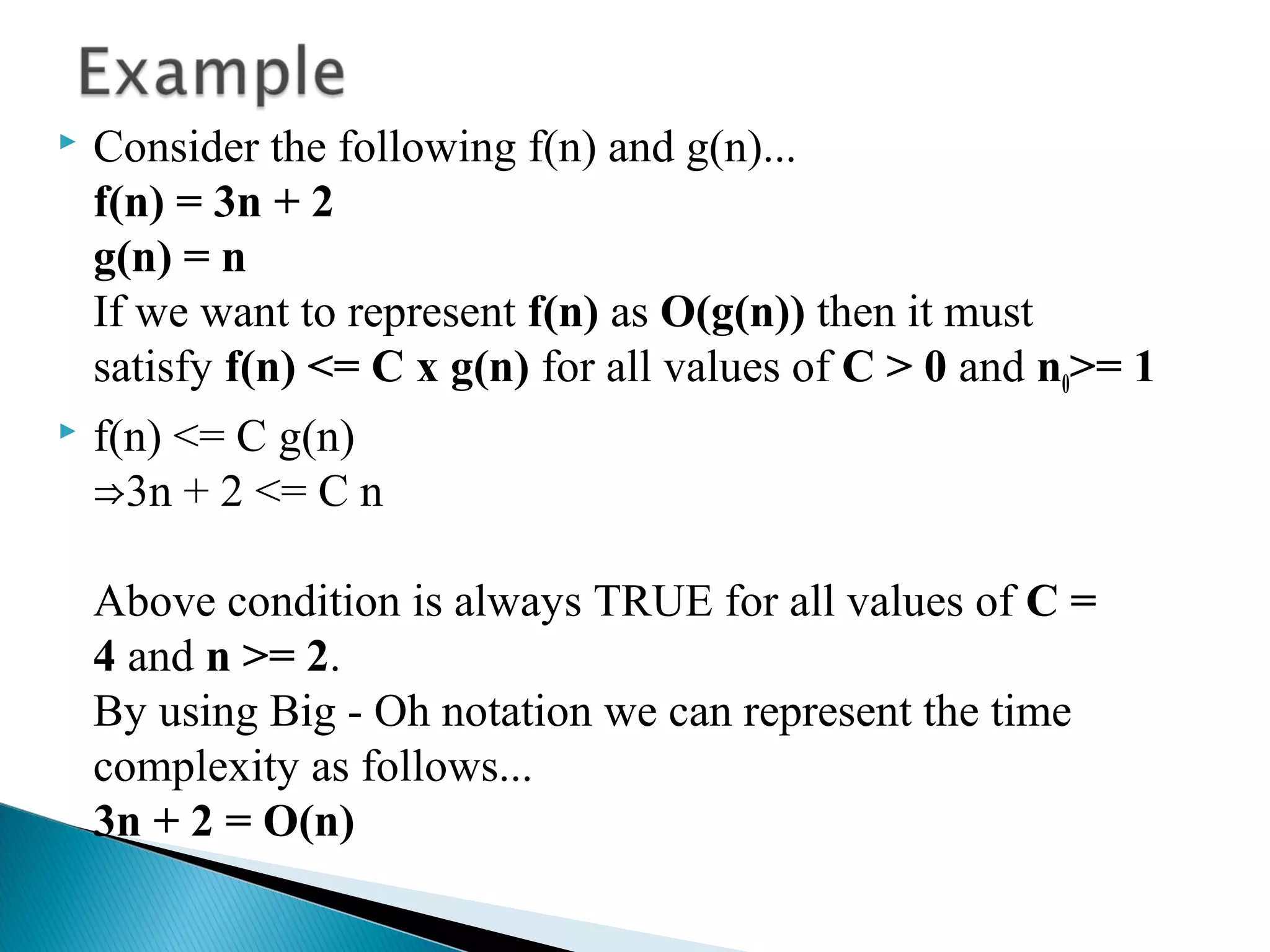
 Consider the following f(n) and g(n)...
f(n) = 3n + 2
g(n) = n
If we want to represent f(n) as O(g(n)) then it must
satisfy f(n) <= C x g(n) for all values of C > 0 and n0>= 1
 f(n) <= C g(n)
3n + 2 <= C n⇒
Above condition is always TRUE for all values of C =
4 and n >= 2.
By using Big - Oh notation we can represent the time
complexity as follows...
3n + 2 = O(n)
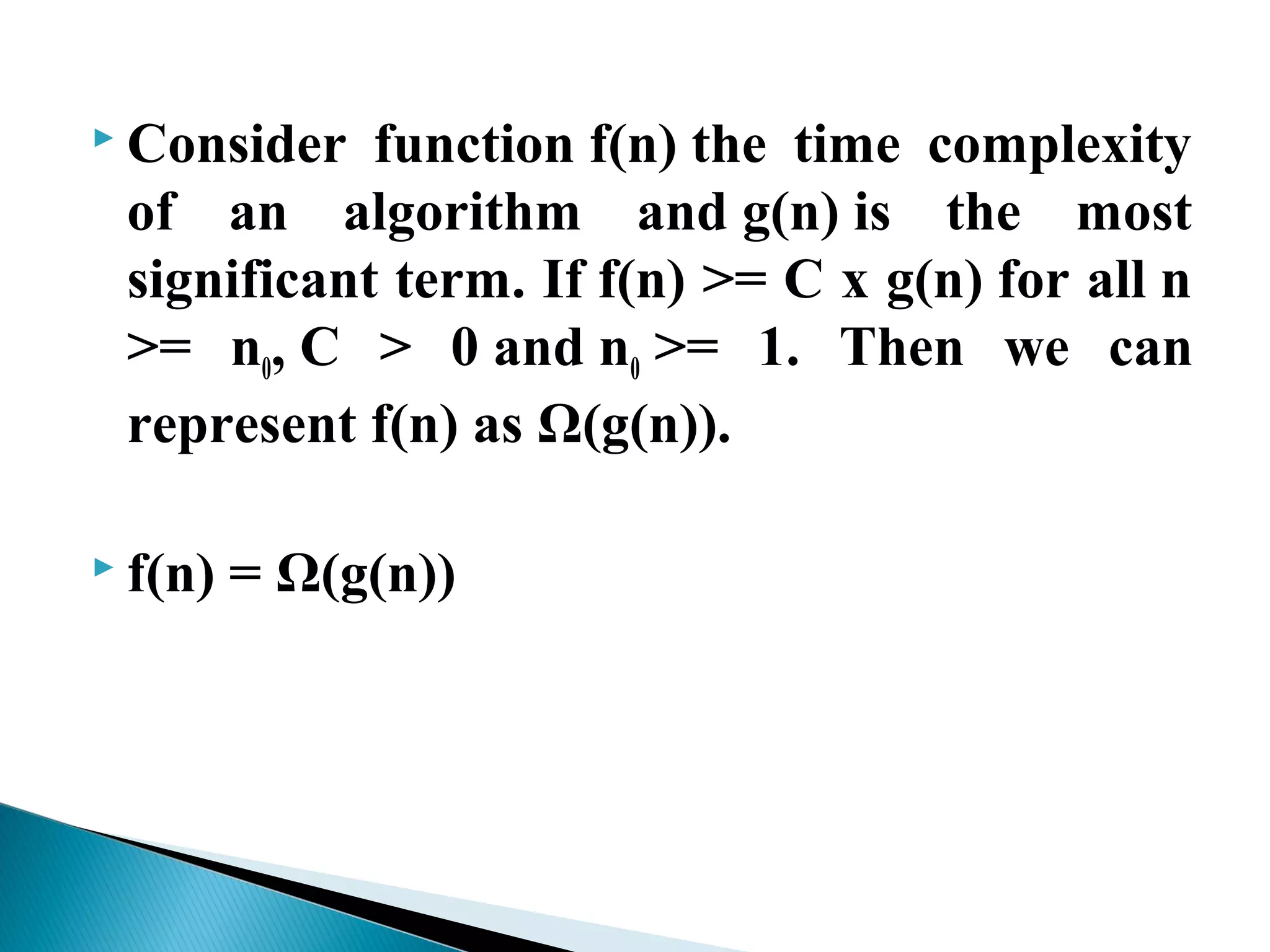
 Big - Omega notation is used to define the lower
bound of an algorithm in terms of Time Complexity.
That means Big - Omega notation always indicates the
minimum time required by an algorithm for all input
values. That means Big - Omega notation describes the
best case of an algorithm time complexity.
Big - Omega Notation can be defined as follows...
 Consider function f(n) the time complexity
of an algorithm and g(n) is the most
significant term. If f(n) >= C x g(n) for all n
>= n0, C > 0 and n0 >= 1. Then we can
represent f(n) as Ω(g(n)).
 f(n) = Ω(g(n))
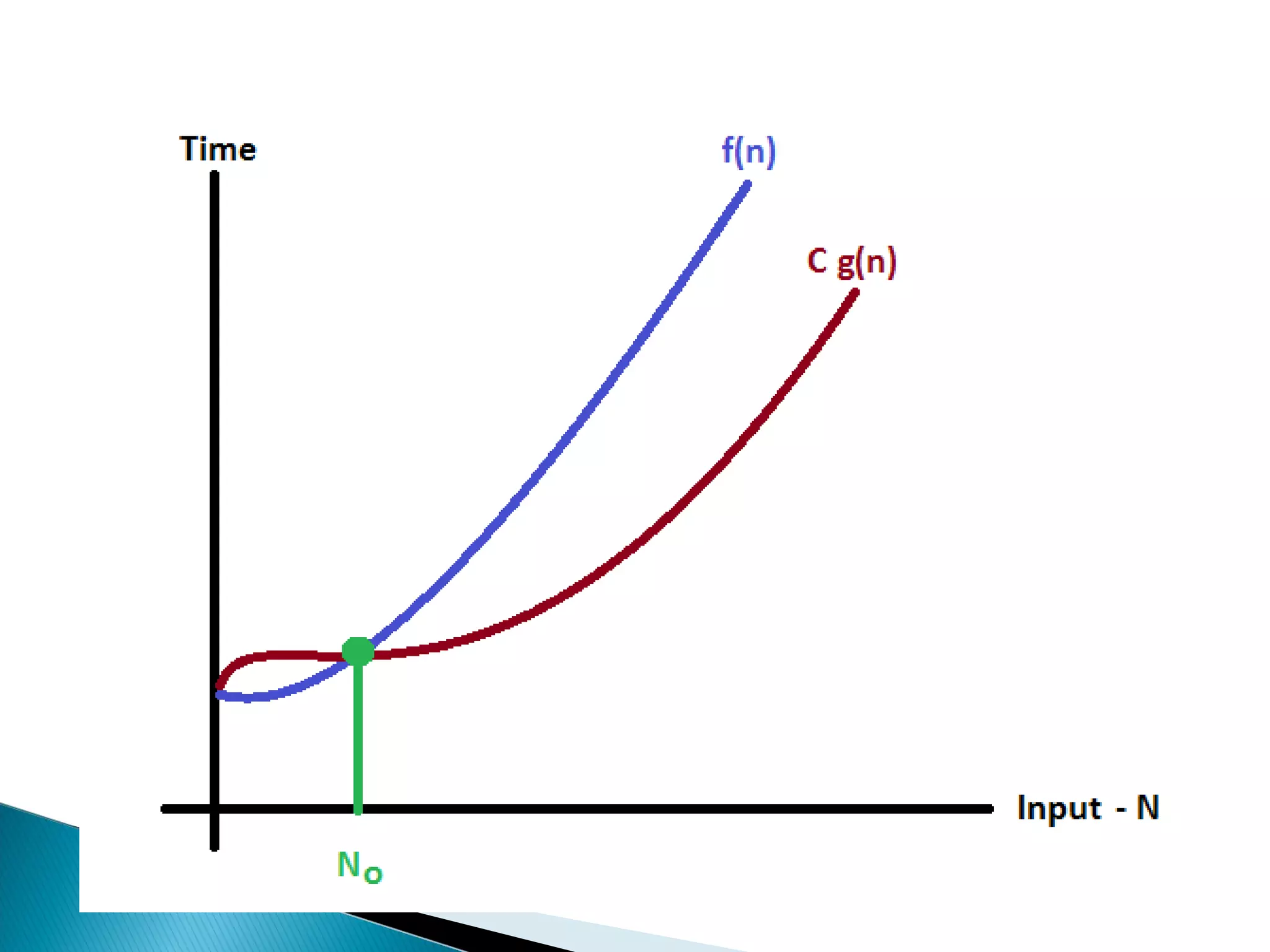
 Consider the following graph drawn for the values of
f(n) and C g(n) for input (n) value on X-Axis and time
required is on Y-Axis
 In above graph after a particular input value n0, always
C x g(n) is less than f(n) which indicates the
algorithm's lower bound.
 Consider the following f(n) and g(n)...
f(n) = 3n + 2
g(n) = n
If we want to represent f(n) as Ω(g(n)) then it must
satisfy f(n) >= C g(n) for all values of C >
0 and n0>= 1
 Big - Theta notation is used to define the average
bound of an algorithm in terms of Time Complexity.
That means Big - Theta notation always indicates the
average time required by an algorithm for all input
values. That means Big - Theta notation describes the
average case of an algorithm time complexity.
Big - Theta Notation can be defined as follows...
 Consider function f(n) the time complexity of an
algorithm and g(n) is the most significant term.
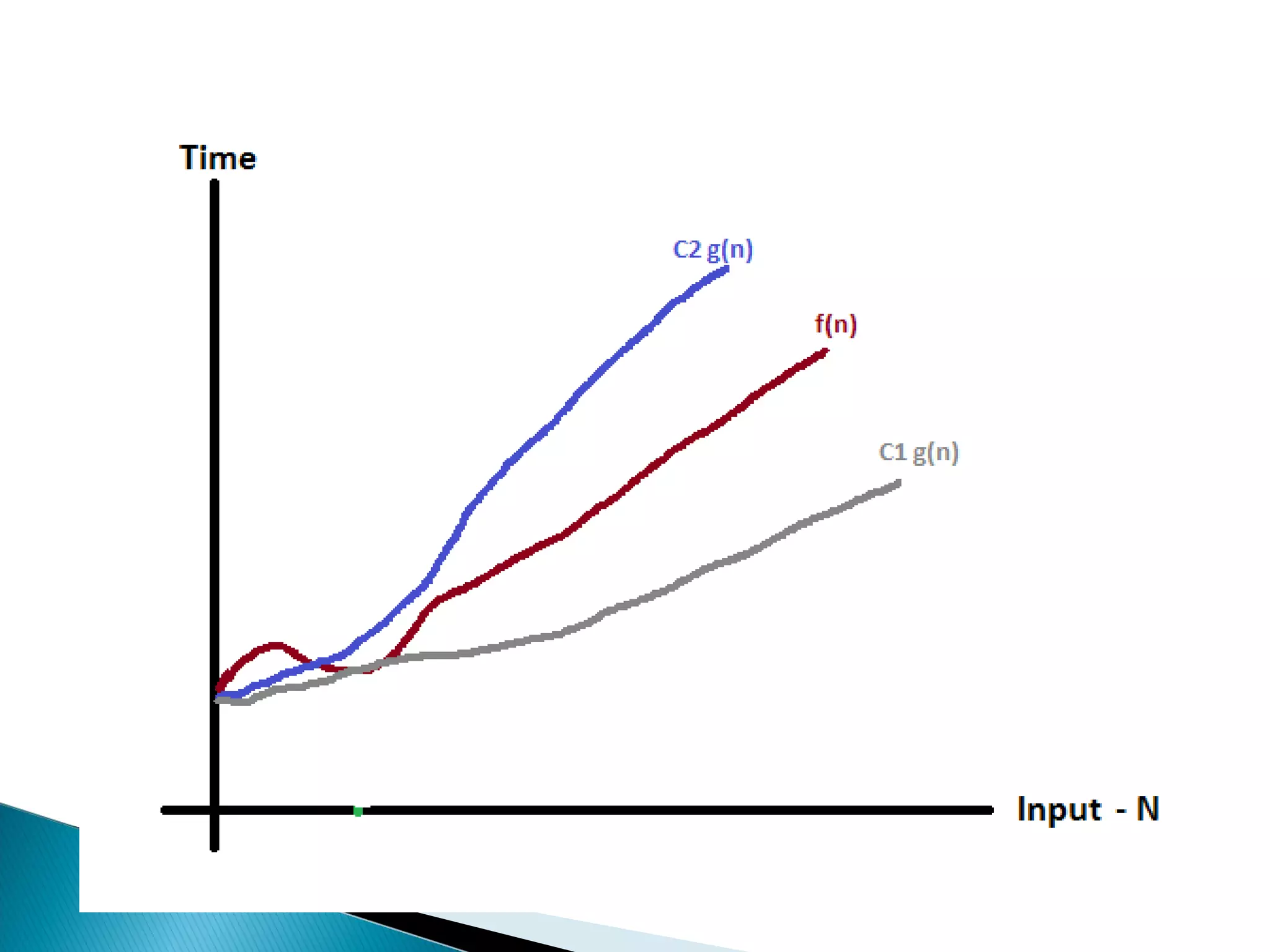
If C1 g(n) <= f(n) >= C2 g(n) for all n >= n0, C1, C2 >
0 and n0 >= 1. Then we can
represent f(n) as Θ(g(n)).
 Consider the following f(n) and g(n)...
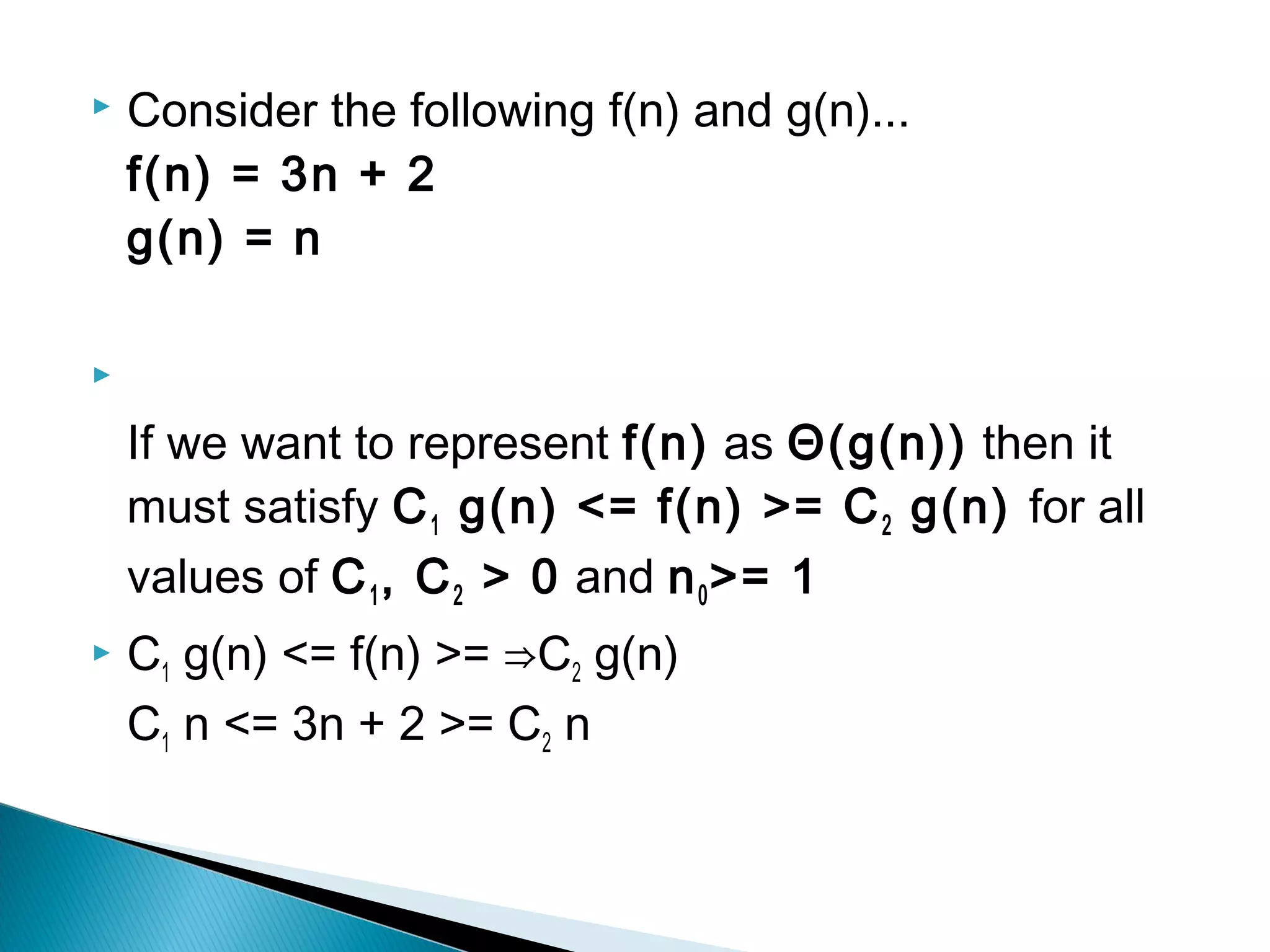
f(n) = 3n + 2
g(n) = n

If we want to represent f(n) as Θ(g(n)) then it
must satisfy C1 g(n) <= f(n) >= C2 g(n) for all
values of C1, C2 > 0 and n0>= 1
 C1 g(n) <= f(n) >= ⇒C2 g(n)
C1 n <= 3n + 2 >= C2 n
Thank you

Asymptotic Notation

  • 2.
     An algorithmis a sequence of unambiguous instructions used for solving a problem, which can be implemented (as a program) on a computer
  • 3.
     Algorithms areused to convert our problem solution into step by step statements. These statements can be converted into computer programming instructions which forms a program. This program is executed by computer to produce solution. Here, program takes required data as input, processes data according to the program instructions and finally produces result as shown in the following picture.
  • 4.
     Input -Every algorithm must take zero or more number of input values from external.  Output - Every algorithm must produce an output as result.  Definiteness - Every statement/instruction in an algorithm must be clear and unambiguous (only one interpretation)  Finiteness - For all different cases, the algorithm must produce result within a finite number of steps.  Effectiveness - Every instruction must be basic enough to be carried out and it also must be feasible.
  • 5.
     Problem Statement: Find the largest number in the given list of numbers?  Input : A list of positive integer numbers. (List must contain at least one number).  Output : The largest number in the given list of positive integer numbers.  Consider the given list of numbers as 'L' (input), and the largest number as 'max' (Output).
  • 6.
     Step 1:Define a variable 'max' and initialize with '0'.  Step 2: Compare first number (say 'x') in the list 'L' with 'max', if 'x' is larger than 'max', set 'max' to 'x'.  Step 3: Repeat step 2 for all numbers in the list 'L'.  Step 4: Display the value of 'max' as a result.
  • 7.
     int findMax(L) {  int max = 0,i;  for(i=0; i < listSize; i++)  {  if(L[i] > max) max = L[i];  }  return max;  }
  • 8.
     If wewant to go from city "A" to city "B", there can be many ways of doing this. We can go by flight, by bus, by train and also by bicycle. Depending on the availability and convenience, we choose the one which suits us. Similarly, in computer science there are multiple algorithms to solve a problem. When we have more than one algorithm to solve a problem, we need to select the best one. Performance analysis helps us to select the best algorithm from multiple algorithms to solve a problem.
  • 9.
     Whether thatalgorithm is providing the exact solution for the problem?  Whether it is easy to understand?  Whether it is easy to implement?  How much space (memory) it requires to solve the problem?  How much time it takes to solve the problem? Etc.,
  • 10.
     When wewant to analyse an algorithm, we consider only the space and time required by that particular algorithm and we ignore all remaining elements.  Performance analysis of an algorithm is the process of calculating space required by that algorithm and time required by that algorithm.
  • 11.
     When wedesign an algorithm to solve a problem, it needs some computer memory to complete its execution. For any algorithm, memory is required for the following purposes...  Memory required to store program instructions  Memory required to store constant values  Memory required to store variable values  And for few other things
  • 12.
     Total amountof computer memory required by an algorithm to complete its execution is called as space complexity of that algorithm
  • 13.
     If anyalgorithm requires a fixed amount of space for all input values then that space complexity is said to be Constant Space Complexity.  int square(int a)  {  return a*a;  }
  • 14.
     If theamount of space required by an algorithm is increased with the increase of input value, then that space complexity is said to be Linear Space Complexity.  int sum(int A[], int n)  {  int sum = 0, i;  for(i = 0; i < n; i++)  sum = sum + A[i];  return sum;  }
  • 15.
     The timecomplexity of an algorithm is the total amount of time required by an algorithm to complete its execution.
  • 16.
     Whether itis running on Single processor machine or Multi processor machine.  Whether it is a 32 bit machine or 64 bit machine  Read and Write speed of the machine.  The time it takes to perform Arithmetic operations, logical operations, ret urn value and assignment operations etc.,  Input data
  • 17.
     When wecalculate time complexity of an algorithm, we consider only input data and ignore the remaining things, as they are machine dependent. We check only, how our program is behaving for the different input values to perform all the operations like Arithmetic, Logical, Return value and Assignment etc.,
  • 18.
     To calculatetime complexity of an algorithm, we need to define a model machine. Let us assume a machine with following configuration...
  • 19.
     Single processormachine  32 bit Operating System machine  It performs sequential execution  It requires 1 unit of time for Arithmetic and Logical operations  It requires 1 unit of time for Assignment and Return value  It requires 1 unit of time for Read and Write operations
  • 20.
     int sum(inta, int b)  {  return a+b;  }  If any program requires fixed amount of time for all input values then its time complexity is said to be Constant Time Complexity.
  • 21.
     int sum(intA[], int n)  {  int sum = 0, i;  for(i = 0; i < n; i++)  sum = sum + A[i];  return sum;  }  If the amount of time required by an algorithm is increased with the increase of input value then that time complexity is said to be Linear Time Complexity
  • 22.
     An algorithmis said to run in logarithmic time if its time execution is proportional to the logarithm of the input size. Example:  binary search
  • 23.
     An algorithmis said to run in logarithmic time if its time execution is proportional to the square of the input size. Examples:  bubble sort, selection sort, insertion sort
  • 24.
     Asymptotic notationof an algorithm is a mathematical representation of its complexity
  • 25.
     For example,consider the following time complexities of two algorithms...  Algorihtm 1 : 5n2 + 2n + 1  Algorihtm 2 : 10n2 + 8n + 3
  • 26.
     In asymptoticnotation, when we want to represent the complexity of an algorithm, we use only the most significant terms in the complexity of that algorithm and ignore least significant terms in the complexity of that algorithm (Here complexity may be Space Complexity or Time Complexity).
  • 27.
     Majorly, weuse THREE types of Asymptotic Notations and those are as follows...  Big - Oh (O)  Big - Omega (Ω)  Big - Theta (Θ)
  • 28.
     Big -Oh notation is used to define the upper bound of an algorithm in terms of Time Complexity. That means Big - Oh notation always indicates the maximum time required by an algorithm for all input values. That means Big - Oh notation describes the worst case of an algorithm time complexity. Big - Oh Notation can be defined as follows...
  • 29.
     Consider functionf(n) the time complexity of an algorithm and g(n) is the most significant term.  If f(n) <= C g(n) for all n >= n0,  C > 0 and n0 >= 1.  Then we can represent f(n) as O(g(n)).  f(n) = O(g(n))
  • 30.
     Consider thefollowing graph drawn for the values of f(n) and C g(n) for input (n) value on X-Axis and time required is on Y-Axis
  • 32.
     In abovegraph after a particular input value n0, always C g(n) is greater than f(n) which indicates the algorithm's upper bound.
  • 33.
     Consider thefollowing f(n) and g(n)... f(n) = 3n + 2 g(n) = n If we want to represent f(n) as O(g(n)) then it must satisfy f(n) <= C x g(n) for all values of C > 0 and n0>= 1  f(n) <= C g(n) 3n + 2 <= C n⇒ Above condition is always TRUE for all values of C = 4 and n >= 2. By using Big - Oh notation we can represent the time complexity as follows... 3n + 2 = O(n)
  • 34.
     Big -Omega notation is used to define the lower bound of an algorithm in terms of Time Complexity. That means Big - Omega notation always indicates the minimum time required by an algorithm for all input values. That means Big - Omega notation describes the best case of an algorithm time complexity. Big - Omega Notation can be defined as follows...
  • 35.
     Consider functionf(n) the time complexity of an algorithm and g(n) is the most significant term. If f(n) >= C x g(n) for all n >= n0, C > 0 and n0 >= 1. Then we can represent f(n) as Ω(g(n)).  f(n) = Ω(g(n))
  • 36.
     Consider thefollowing graph drawn for the values of f(n) and C g(n) for input (n) value on X-Axis and time required is on Y-Axis
  • 38.
     In abovegraph after a particular input value n0, always C x g(n) is less than f(n) which indicates the algorithm's lower bound.
  • 39.
     Consider thefollowing f(n) and g(n)... f(n) = 3n + 2 g(n) = n If we want to represent f(n) as Ω(g(n)) then it must satisfy f(n) >= C g(n) for all values of C > 0 and n0>= 1
  • 40.
     Big -Theta notation is used to define the average bound of an algorithm in terms of Time Complexity. That means Big - Theta notation always indicates the average time required by an algorithm for all input values. That means Big - Theta notation describes the average case of an algorithm time complexity. Big - Theta Notation can be defined as follows...
  • 41.
     Consider functionf(n) the time complexity of an algorithm and g(n) is the most significant term. If C1 g(n) <= f(n) >= C2 g(n) for all n >= n0, C1, C2 > 0 and n0 >= 1. Then we can represent f(n) as Θ(g(n)).
  • 43.
     Consider thefollowing f(n) and g(n)... f(n) = 3n + 2 g(n) = n  If we want to represent f(n) as Θ(g(n)) then it must satisfy C1 g(n) <= f(n) >= C2 g(n) for all values of C1, C2 > 0 and n0>= 1  C1 g(n) <= f(n) >= ⇒C2 g(n) C1 n <= 3n + 2 >= C2 n
  • 44.