Recurrence Relations
• Connection to recursive algorithms
• Techniques for solving them
Recursion and Mathematical
Induction
In both, we have general and boundary conditions:
The general conditions break the problem into smaller
and smaller pieces.
The initial or boundary condition terminate the
recursion.
Both take a Divide and Conquer approach to solving
mathematical problems.
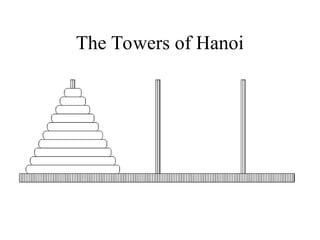
The Towers of Hanoi
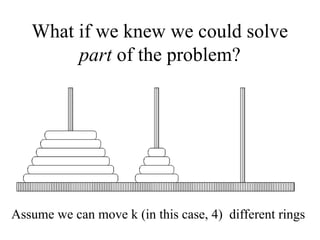
What if we knew we could solve
part of the problem?
Assume we can move k (in this case, 4) different rings
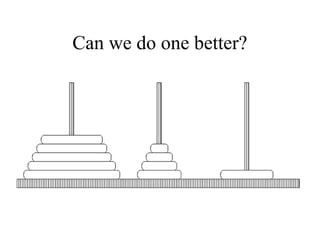
Can we do one better?
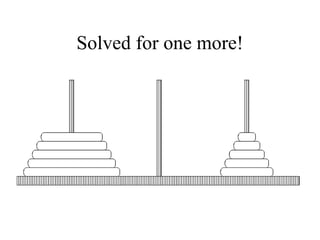
Solved for one more!
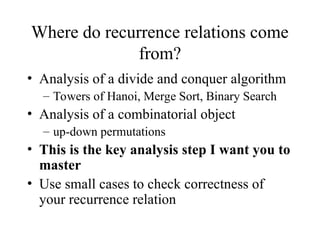
Where do recurrence relations come
from?
• Analysis of a divide and conquer algorithm
– Towers of Hanoi, Merge Sort, Binary Search
• Analysis of a combinatorial object
– up-down permutations
• This is the key analysis step I want you to
master
• Use small cases to check correctness of
your recurrence relation
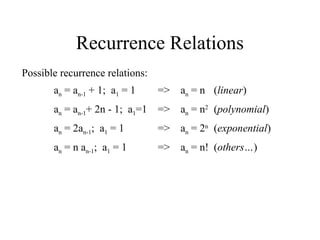
Recurrence Relations
Possible recurrence relations:
an = an-1 + 1; a1 = 1 => an = n (linear)
an = an-1+ 2n - 1; a1=1 => an = n2
(polynomial)
an = 2an-1; a1 = 1 => an = 2n
(exponential)
an = n an-1; a1 = 1 => an = n! (others…)
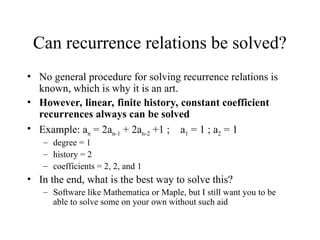
Can recurrence relations be solved?
• No general procedure for solving recurrence relations is
known, which is why it is an art.
• However, linear, finite history, constant coefficient
recurrences always can be solved
• Example: an = 2an-1 + 2an-2 +1 ; a1 = 1 ; a2 = 1
– degree = 1
– history = 2
– coefficients = 2, 2, and 1
• In the end, what is the best way to solve this?
– Software like Mathematica or Maple, but I still want you to be
able to solve some on your own without such aid
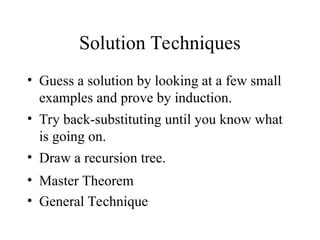
Solution Techniques
• Guess a solution by looking at a few small
examples and prove by induction.
• Try back-substituting until you know what
is going on.
• Draw a recursion tree.
• Master Theorem
• General Technique
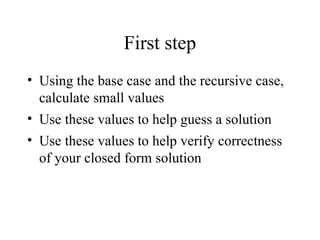
First step
• Using the base case and the recursive case,
calculate small values
• Use these values to help guess a solution
• Use these values to help verify correctness
of your closed form solution
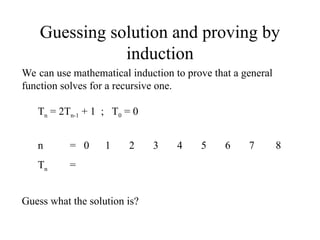
Guessing solution and proving by
induction
We can use mathematical induction to prove that a general
function solves for a recursive one.
Tn = 2Tn-1 + 1 ; T0 = 0
n = 0 1 2 3 4 5 6 7 8
Tn =
Guess what the solution is?
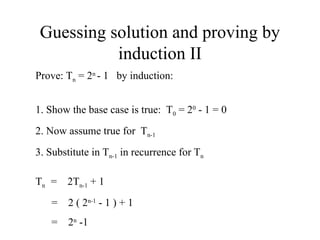
Guessing solution and proving by
induction II
Prove: Tn = 2n
- 1 by induction:
1. Show the base case is true: T0 = 20
- 1 = 0
2. Now assume true for Tn-1
3. Substitute in Tn-1 in recurrence for Tn
Tn = 2Tn-1 + 1
= 2 ( 2n-1
- 1 ) + 1
= 2n
-1
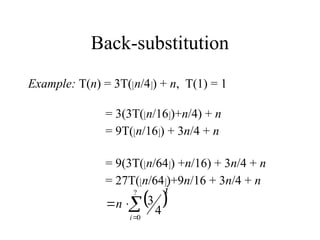
Back-substitution
Example: T(n) = 3T(n/4) + n, T(1) = 1
= 3(3T(n/16)+n/4) + n
= 9T(n/16) + 3n/4 + n
= 9(3T(n/64) +n/16) + 3n/4 + n
= 27T(n/64)+9n/16 + 3n/4 + n
 
i
n
i




?
0
4
3
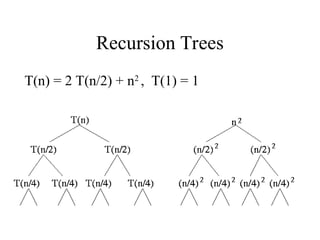
Recursion Trees
T(n) = 2 T(n/2) + n2
, T(1) = 1
Example Problem
Use induction to prove that MergeSort is an O(n log n)
algorithm.
Mergesort(array)
n = size(array)
if ( n == 1) return array
array1 = Mergesort(array[1 .. n/2])
array2 = Mergesort(array[n/2 .. n])
return Merge(array1, array2)
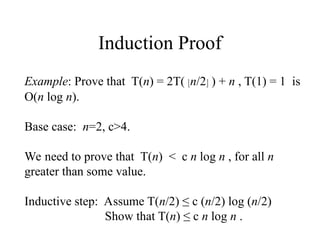
Induction Proof
Example: Prove that T(n) = 2T( n/2 ) + n , T(1) = 1 is
O(n log n).
Base case: n=2, c>4.
We need to prove that T(n) < c n log n , for all n
greater than some value.
Inductive step: Assume T(n/2) ≤ c (n/2) log (n/2)
Show that T(n) ≤ c n log n .
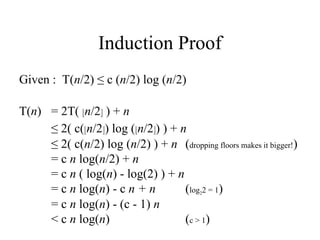
Induction Proof
Given : T(n/2) ≤ c (n/2) log (n/2)
T(n) = 2T( n/2 ) + n
≤ 2( c(n/2) log (n/2) ) + n
≤ 2( c(n/2) log (n/2) ) + n (dropping floors makes it bigger!)
= c n log(n/2) + n
= c n ( log(n) - log(2) ) + n
= c n log(n) - c n + n (log22 = 1)
= c n log(n) - (c - 1) n
< c n log(n) (c > 1)
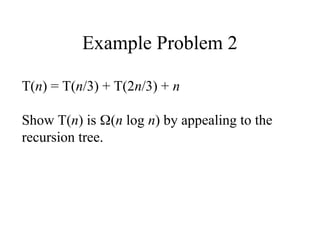
Example Problem 2
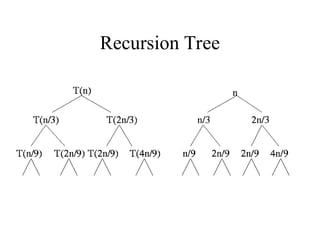
T(n) = T(n/3) + T(2n/3) + n
Show T(n) is (n log n) by appealing to the
recursion tree.
Recursion Tree
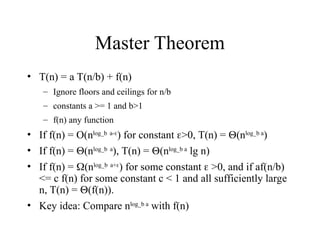
Master Theorem
• T(n) = a T(n/b) + f(n)
– Ignore floors and ceilings for n/b
– constants a >= 1 and b>1
– f(n) any function
• If f(n) = O(nlog_b a-
) for constant >0, T(n) = (nlog_b a
)
• If f(n) = (nlog_b a
), T(n) = (nlog_b a
lg n)
• If f(n) = (nlog_b a+
) for some constant  >0, and if af(n/b)
<= c f(n) for some constant c < 1 and all sufficiently large
n, T(n) = (f(n)).
• Key idea: Compare nlog_b a
with f(n)
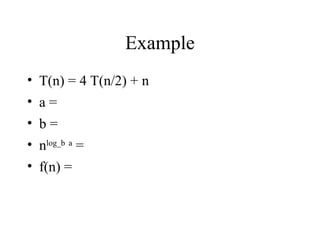
Example
• T(n) = 4 T(n/2) + n
• a =
• b =
• nlog_b a
=
• f(n) =
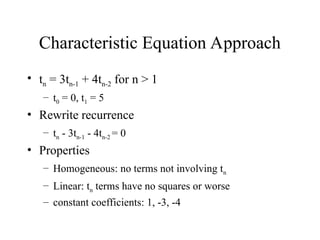
Characteristic Equation Approach
• tn = 3tn-1 + 4tn-2 for n > 1
– t0 = 0, t1 = 5
• Rewrite recurrence
– tn - 3tn-1 - 4tn-2 = 0
• Properties
– Homogeneous: no terms not involving tn
– Linear: tn terms have no squares or worse
– constant coefficients: 1, -3, -4
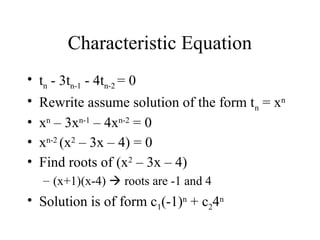
Characteristic Equation
• tn - 3tn-1 - 4tn-2 = 0
• Rewrite assume solution of the form tn = xn
• xn
– 3xn-1
– 4xn-2
= 0
• xn-2
(x2
– 3x – 4) = 0
• Find roots of (x2
– 3x – 4)
– (x+1)(x-4)  roots are -1 and 4
• Solution is of form c1(-1)n
+ c24n
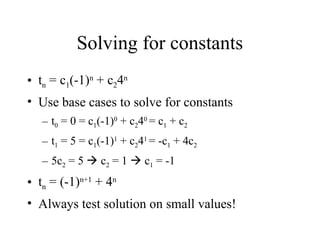
Solving for constants
• tn = c1(-1)n
+ c24n
• Use base cases to solve for constants
– t0 = 0 = c1(-1)0
+ c240
= c1 + c2
– t1 = 5 = c1(-1)1
+ c241
= -c1 + 4c2
– 5c2 = 5  c2 = 1  c1 = -1
• tn = (-1)n+1
+ 4n
• Always test solution on small values!
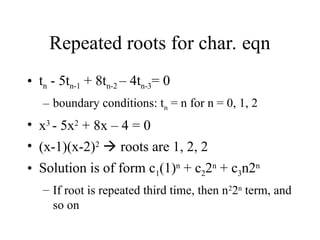
Repeated roots for char. eqn
• tn - 5tn-1 + 8tn-2 – 4tn-3= 0
– boundary conditions: tn = n for n = 0, 1, 2
• x3
- 5x2
+ 8x – 4 = 0
• (x-1)(x-2)2
 roots are 1, 2, 2
• Solution is of form c1(1)n
+ c22n
+ c3n2n
– If root is repeated third time, then n2
2n
term, and
so on
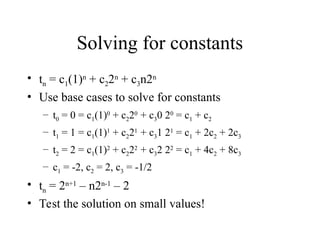
Solving for constants
• tn = c1(1)n
+ c22n
+ c3n2n
• Use base cases to solve for constants
– t0 = 0 = c1(1)0
+ c220
+ c30 20
= c1 + c2
– t1 = 1 = c1(1)1
+ c221
+ c31 21
= c1 + 2c2 + 2c3
– t2 = 2 = c1(1)2
+ c222
+ c32 22
= c1 + 4c2 + 8c3
– c1 = -2, c2 = 2, c3 = -1/2
• tn = 2n+1
– n2n-1
– 2
• Test the solution on small values!
Inhomogeneous Equation
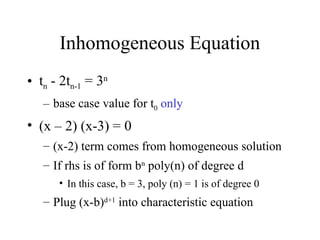
• tn - 2tn-1 = 3n
– base case value for t0 only
• (x – 2) (x-3) = 0
– (x-2) term comes from homogeneous solution
– If rhs is of form bn
poly(n) of degree d
• In this case, b = 3, poly (n) = 1 is of degree 0
– Plug (x-b)d+1
into characteristic equation
Solving for constants
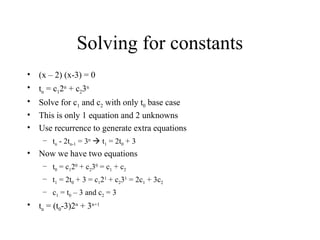
• (x – 2) (x-3) = 0
• tn = c12n
+ c23n
• Solve for c1 and c2 with only t0 base case
• This is only 1 equation and 2 unknowns
• Use recurrence to generate extra equations
– tn - 2tn-1 = 3n
 t1 = 2t0 + 3
• Now we have two equations
– t0 = c120
+ c230
= c1 + c2
– t1 = 2t0 + 3 = c121
+ c231
= 2c1 + 3c2
– c1 = t0 – 3 and c2 = 3
• tn = (t0-3)2n
+ 3n+1
Changing variable
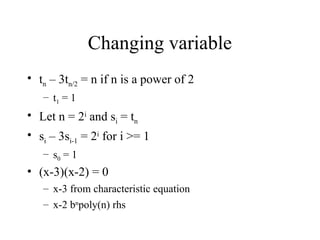
• tn – 3tn/2 = n if n is a power of 2
– t1 = 1
• Let n = 2i
and si = tn
• si – 3si-1 = 2i
for i >= 1
– s0 = 1
• (x-3)(x-2) = 0
– x-3 from characteristic equation
– x-2 bn
poly(n) rhs
Solving for constants
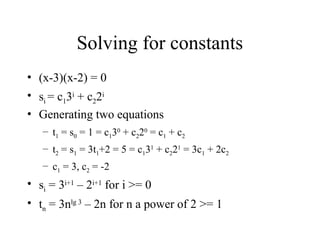
• (x-3)(x-2) = 0
• si = c13i
+ c22i
• Generating two equations
– t1 = s0 = 1 = c130
+ c220
= c1 + c2
– t2 = s1 = 3t1+2 = 5 = c131
+ c221
= 3c1 + 2c2
– c1 = 3, c2 = -2
• si = 3i+1
– 2i+1
for i >= 0
• tn = 3nlg 3
– 2n for n a power of 2 >= 1
Example: Up-down Permutations
• An up-down permutation is a permutation of the
numbers from 1 to n such that the numbers strictly
increase to n and then decrease thereafter
• Examples
– 1376542, 7654321, 3476521
• Let tn denote the number of up-down permutations
– What is recurrence relation for tn?
– What is solution?
Example: Towers of Hanoi
• Suppose we have two disks of each size.
• Let n be the number of sizes of disks
– What is recurrence relation?
– What is solution?
Example: Merge Sort
• Merge sort breaking array into 3 pieces
– What is recurrence relation?
– What is solution?
– How does this compare to breaking into 2
pieces?
recurrence relations in analysis of algorithm

  • 1.
    Recurrence Relations • Connectionto recursive algorithms • Techniques for solving them
  • 2.
    Recursion and Mathematical Induction Inboth, we have general and boundary conditions: The general conditions break the problem into smaller and smaller pieces. The initial or boundary condition terminate the recursion. Both take a Divide and Conquer approach to solving mathematical problems.
  • 3.
  • 4.
    What if weknew we could solve part of the problem? Assume we can move k (in this case, 4) different rings
  • 5.
    Can we doone better?
  • 6.
  • 7.
    Where do recurrencerelations come from? • Analysis of a divide and conquer algorithm – Towers of Hanoi, Merge Sort, Binary Search • Analysis of a combinatorial object – up-down permutations • This is the key analysis step I want you to master • Use small cases to check correctness of your recurrence relation
  • 8.
    Recurrence Relations Possible recurrencerelations: an = an-1 + 1; a1 = 1 => an = n (linear) an = an-1+ 2n - 1; a1=1 => an = n2 (polynomial) an = 2an-1; a1 = 1 => an = 2n (exponential) an = n an-1; a1 = 1 => an = n! (others…)
  • 9.
    Can recurrence relationsbe solved? • No general procedure for solving recurrence relations is known, which is why it is an art. • However, linear, finite history, constant coefficient recurrences always can be solved • Example: an = 2an-1 + 2an-2 +1 ; a1 = 1 ; a2 = 1 – degree = 1 – history = 2 – coefficients = 2, 2, and 1 • In the end, what is the best way to solve this? – Software like Mathematica or Maple, but I still want you to be able to solve some on your own without such aid
  • 10.
    Solution Techniques • Guessa solution by looking at a few small examples and prove by induction. • Try back-substituting until you know what is going on. • Draw a recursion tree. • Master Theorem • General Technique
  • 11.
    First step • Usingthe base case and the recursive case, calculate small values • Use these values to help guess a solution • Use these values to help verify correctness of your closed form solution
  • 12.
    Guessing solution andproving by induction We can use mathematical induction to prove that a general function solves for a recursive one. Tn = 2Tn-1 + 1 ; T0 = 0 n = 0 1 2 3 4 5 6 7 8 Tn = Guess what the solution is?
  • 13.
    Guessing solution andproving by induction II Prove: Tn = 2n - 1 by induction: 1. Show the base case is true: T0 = 20 - 1 = 0 2. Now assume true for Tn-1 3. Substitute in Tn-1 in recurrence for Tn Tn = 2Tn-1 + 1 = 2 ( 2n-1 - 1 ) + 1 = 2n -1
  • 14.
    Back-substitution Example: T(n) =3T(n/4) + n, T(1) = 1 = 3(3T(n/16)+n/4) + n = 9T(n/16) + 3n/4 + n = 9(3T(n/64) +n/16) + 3n/4 + n = 27T(n/64)+9n/16 + 3n/4 + n   i n i     ? 0 4 3
  • 15.
    Recursion Trees T(n) =2 T(n/2) + n2 , T(1) = 1
  • 16.
    Example Problem Use inductionto prove that MergeSort is an O(n log n) algorithm. Mergesort(array) n = size(array) if ( n == 1) return array array1 = Mergesort(array[1 .. n/2]) array2 = Mergesort(array[n/2 .. n]) return Merge(array1, array2)
  • 17.
    Induction Proof Example: Provethat T(n) = 2T( n/2 ) + n , T(1) = 1 is O(n log n). Base case: n=2, c>4. We need to prove that T(n) < c n log n , for all n greater than some value. Inductive step: Assume T(n/2) ≤ c (n/2) log (n/2) Show that T(n) ≤ c n log n .
  • 18.
    Induction Proof Given :T(n/2) ≤ c (n/2) log (n/2) T(n) = 2T( n/2 ) + n ≤ 2( c(n/2) log (n/2) ) + n ≤ 2( c(n/2) log (n/2) ) + n (dropping floors makes it bigger!) = c n log(n/2) + n = c n ( log(n) - log(2) ) + n = c n log(n) - c n + n (log22 = 1) = c n log(n) - (c - 1) n < c n log(n) (c > 1)
  • 19.
    Example Problem 2 T(n)= T(n/3) + T(2n/3) + n Show T(n) is (n log n) by appealing to the recursion tree.
  • 20.
  • 21.
    Master Theorem • T(n)= a T(n/b) + f(n) – Ignore floors and ceilings for n/b – constants a >= 1 and b>1 – f(n) any function • If f(n) = O(nlog_b a- ) for constant >0, T(n) = (nlog_b a ) • If f(n) = (nlog_b a ), T(n) = (nlog_b a lg n) • If f(n) = (nlog_b a+ ) for some constant  >0, and if af(n/b) <= c f(n) for some constant c < 1 and all sufficiently large n, T(n) = (f(n)). • Key idea: Compare nlog_b a with f(n)
  • 22.
    Example • T(n) =4 T(n/2) + n • a = • b = • nlog_b a = • f(n) =
  • 23.
    Characteristic Equation Approach •tn = 3tn-1 + 4tn-2 for n > 1 – t0 = 0, t1 = 5 • Rewrite recurrence – tn - 3tn-1 - 4tn-2 = 0 • Properties – Homogeneous: no terms not involving tn – Linear: tn terms have no squares or worse – constant coefficients: 1, -3, -4
  • 24.
    Characteristic Equation • tn- 3tn-1 - 4tn-2 = 0 • Rewrite assume solution of the form tn = xn • xn – 3xn-1 – 4xn-2 = 0 • xn-2 (x2 – 3x – 4) = 0 • Find roots of (x2 – 3x – 4) – (x+1)(x-4)  roots are -1 and 4 • Solution is of form c1(-1)n + c24n
  • 25.
    Solving for constants •tn = c1(-1)n + c24n • Use base cases to solve for constants – t0 = 0 = c1(-1)0 + c240 = c1 + c2 – t1 = 5 = c1(-1)1 + c241 = -c1 + 4c2 – 5c2 = 5  c2 = 1  c1 = -1 • tn = (-1)n+1 + 4n • Always test solution on small values!
  • 26.
    Repeated roots forchar. eqn • tn - 5tn-1 + 8tn-2 – 4tn-3= 0 – boundary conditions: tn = n for n = 0, 1, 2 • x3 - 5x2 + 8x – 4 = 0 • (x-1)(x-2)2  roots are 1, 2, 2 • Solution is of form c1(1)n + c22n + c3n2n – If root is repeated third time, then n2 2n term, and so on
  • 27.
    Solving for constants •tn = c1(1)n + c22n + c3n2n • Use base cases to solve for constants – t0 = 0 = c1(1)0 + c220 + c30 20 = c1 + c2 – t1 = 1 = c1(1)1 + c221 + c31 21 = c1 + 2c2 + 2c3 – t2 = 2 = c1(1)2 + c222 + c32 22 = c1 + 4c2 + 8c3 – c1 = -2, c2 = 2, c3 = -1/2 • tn = 2n+1 – n2n-1 – 2 • Test the solution on small values!
  • 28.
    Inhomogeneous Equation • tn- 2tn-1 = 3n – base case value for t0 only • (x – 2) (x-3) = 0 – (x-2) term comes from homogeneous solution – If rhs is of form bn poly(n) of degree d • In this case, b = 3, poly (n) = 1 is of degree 0 – Plug (x-b)d+1 into characteristic equation
  • 29.
    Solving for constants •(x – 2) (x-3) = 0 • tn = c12n + c23n • Solve for c1 and c2 with only t0 base case • This is only 1 equation and 2 unknowns • Use recurrence to generate extra equations – tn - 2tn-1 = 3n  t1 = 2t0 + 3 • Now we have two equations – t0 = c120 + c230 = c1 + c2 – t1 = 2t0 + 3 = c121 + c231 = 2c1 + 3c2 – c1 = t0 – 3 and c2 = 3 • tn = (t0-3)2n + 3n+1
  • 30.
    Changing variable • tn– 3tn/2 = n if n is a power of 2 – t1 = 1 • Let n = 2i and si = tn • si – 3si-1 = 2i for i >= 1 – s0 = 1 • (x-3)(x-2) = 0 – x-3 from characteristic equation – x-2 bn poly(n) rhs
  • 31.
    Solving for constants •(x-3)(x-2) = 0 • si = c13i + c22i • Generating two equations – t1 = s0 = 1 = c130 + c220 = c1 + c2 – t2 = s1 = 3t1+2 = 5 = c131 + c221 = 3c1 + 2c2 – c1 = 3, c2 = -2 • si = 3i+1 – 2i+1 for i >= 0 • tn = 3nlg 3 – 2n for n a power of 2 >= 1
  • 32.
    Example: Up-down Permutations •An up-down permutation is a permutation of the numbers from 1 to n such that the numbers strictly increase to n and then decrease thereafter • Examples – 1376542, 7654321, 3476521 • Let tn denote the number of up-down permutations – What is recurrence relation for tn? – What is solution?
  • 33.
    Example: Towers ofHanoi • Suppose we have two disks of each size. • Let n be the number of sizes of disks – What is recurrence relation? – What is solution?
  • 34.
    Example: Merge Sort •Merge sort breaking array into 3 pieces – What is recurrence relation? – What is solution? – How does this compare to breaking into 2 pieces?