Assembly Language forAssembly Language for
Intel-Based Computers,Intel-Based Computers,
44thth
EditionEdition
Chapter 7: Integer ArithmeticChapter 7: Integer Arithmetic
Assembly language sources (Web)
Web site Examples
Chapter OverviewChapter Overview
• Shift and Rotate Instructions
• Shift and Rotate Applications
• Multiplication and Division
Instructions
• Extended Addition and Subtraction
• ASCII and Packed Decimal
Arithmetic
22
Web site Examples
Shift and Rotate InstructionsShift and Rotate Instructions
• Logical vs Arithmetic Shifts
• SHL Instruction
• SHR Instruction
• SAL and SAR Instructions
• ROL Instruction
• ROR Instruction
• RCL and RCR Instructions
• SHLD/SHRD Instructions
Irvine, Kip R. Assembly Language for Intel-BasedIrvine, Kip R. Assembly Language for Intel-Based
Computers, 2003.Computers, 2003. 33
Web site Examples
Logical vs Arithmetic ShiftsLogical vs Arithmetic Shifts
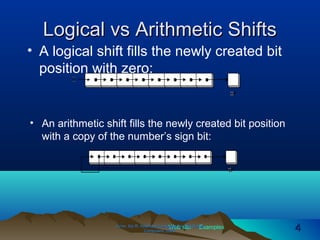
• A logical shift fills the newly created bit
position with zero:
Irvine, Kip R. Assembly Language for Intel-BasedIrvine, Kip R. Assembly Language for Intel-Based
Computers, 2003.Computers, 2003. 44
• An arithmetic shift fills the newly created bit position
with a copy of the number’s sign bit:
Web site Examples
SHL InstructionSHL Instruction
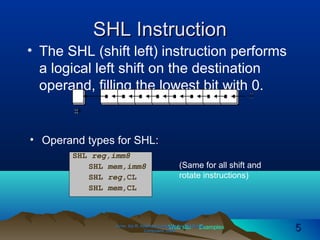
• The SHL (shift left) instruction performs
a logical left shift on the destination
operand, filling the lowest bit with 0.
Irvine, Kip R. Assembly Language for Intel-BasedIrvine, Kip R. Assembly Language for Intel-Based
Computers, 2003.Computers, 2003. 55
• Operand types for SHL:
SHL reg,imm8
SHL mem,imm8
SHL reg,CL
SHL mem,CL
(Same for all shift and
rotate instructions)
Web site Examples
Fast MultiplicationFast Multiplication
Irvine, Kip R. Assembly Language for Intel-BasedIrvine, Kip R. Assembly Language for Intel-Based
Computers, 2003.Computers, 2003. 66
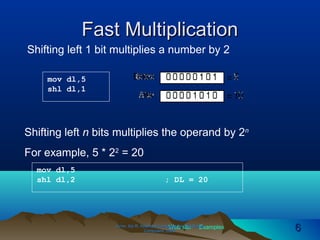
mov dl,5
shl dl,1
Shifting left 1 bit multiplies a number by 2
mov dl,5
shl dl,2 ; DL = 20
Shifting left n bits multiplies the operand by 2n
For example, 5 * 22
= 20
Web site Examples
SHR InstructionSHR Instruction
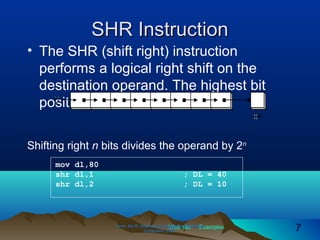
• The SHR (shift right) instruction
performs a logical right shift on the
destination operand. The highest bit
position is filled with a zero.
Irvine, Kip R. Assembly Language for Intel-BasedIrvine, Kip R. Assembly Language for Intel-Based
Computers, 2003.Computers, 2003. 77
mov dl,80
shr dl,1 ; DL = 40
shr dl,2 ; DL = 10
Shifting right n bits divides the operand by 2n
Web site Examples
SAL and SAR InstructionsSAL and SAR Instructions
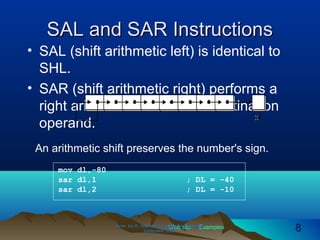
• SAL (shift arithmetic left) is identical to
SHL.
• SAR (shift arithmetic right) performs a
right arithmetic shift on the destination
operand.
Irvine, Kip R. Assembly Language for Intel-BasedIrvine, Kip R. Assembly Language for Intel-Based
Computers, 2003.Computers, 2003. 88
An arithmetic shift preserves the number's sign.
mov dl,-80
sar dl,1 ; DL = -40
sar dl,2 ; DL = -10
Web site Examples
Your turn . . .Your turn . . .
Irvine, Kip R. Assembly Language for Intel-BasedIrvine, Kip R. Assembly Language for Intel-Based
Computers, 2003.Computers, 2003. 99
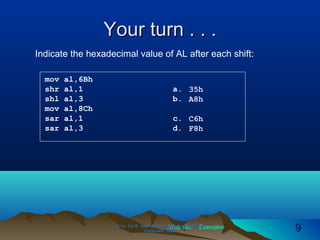
mov al,6Bh
shr al,1 a.
shl al,3 b.
mov al,8Ch
sar al,1 c.
sar al,3 d.
Indicate the hexadecimal value of AL after each shift:
35h
A8h
C6h
F8h
Web site Examples
ROL InstructionROL Instruction
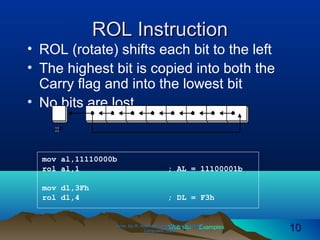
• ROL (rotate) shifts each bit to the left
• The highest bit is copied into both the
Carry flag and into the lowest bit
• No bits are lost
Irvine, Kip R. Assembly Language for Intel-BasedIrvine, Kip R. Assembly Language for Intel-Based
Computers, 2003.Computers, 2003. 1010
mov al,11110000b
rol al,1 ; AL = 11100001b
mov dl,3Fh
rol dl,4 ; DL = F3h
Web site Examples
ROR InstructionROR Instruction
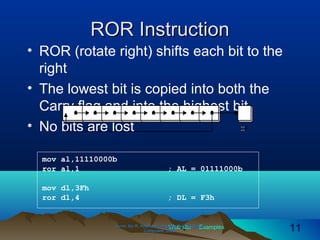
• ROR (rotate right) shifts each bit to the
right
• The lowest bit is copied into both the
Carry flag and into the highest bit
• No bits are lost
Irvine, Kip R. Assembly Language for Intel-BasedIrvine, Kip R. Assembly Language for Intel-Based
Computers, 2003.Computers, 2003. 1111
mov al,11110000b
ror al,1 ; AL = 01111000b
mov dl,3Fh
ror dl,4 ; DL = F3h
Web site Examples
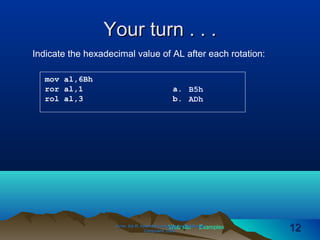
Your turn . . .Your turn . . .
Irvine, Kip R. Assembly Language for Intel-BasedIrvine, Kip R. Assembly Language for Intel-Based
Computers, 2003.Computers, 2003. 1212
mov al,6Bh
ror al,1 a.
rol al,3 b.
Indicate the hexadecimal value of AL after each rotation:
B5h
ADh
Web site Examples
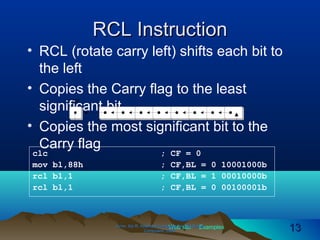
RCL InstructionRCL Instruction
• RCL (rotate carry left) shifts each bit to
the left
• Copies the Carry flag to the least
significant bit
• Copies the most significant bit to the
Carry flag
Irvine, Kip R. Assembly Language for Intel-BasedIrvine, Kip R. Assembly Language for Intel-Based
Computers, 2003.Computers, 2003. 1313
CF
clc ; CF = 0
mov bl,88h ; CF,BL = 0 10001000b
rcl bl,1 ; CF,BL = 1 00010000b
rcl bl,1 ; CF,BL = 0 00100001b
Web site Examples
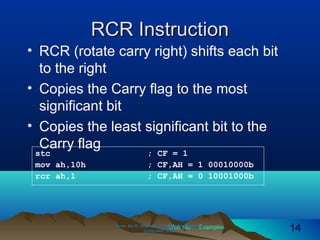
RCR InstructionRCR Instruction
• RCR (rotate carry right) shifts each bit
to the right
• Copies the Carry flag to the most
significant bit
• Copies the least significant bit to the
Carry flag
Irvine, Kip R. Assembly Language for Intel-BasedIrvine, Kip R. Assembly Language for Intel-Based
Computers, 2003.Computers, 2003. 1414
stc ; CF = 1
mov ah,10h ; CF,AH = 1 00010000b
rcr ah,1 ; CF,AH = 0 10001000b
Web site Examples
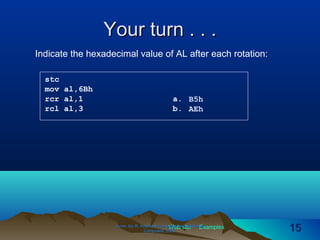
Your turn . . .Your turn . . .
Irvine, Kip R. Assembly Language for Intel-BasedIrvine, Kip R. Assembly Language for Intel-Based
Computers, 2003.Computers, 2003. 1515
stc
mov al,6Bh
rcr al,1 a.
rcl al,3 b.
Indicate the hexadecimal value of AL after each rotation:
B5h
AEh
Web site Examples
SHLD InstructionSHLD Instruction
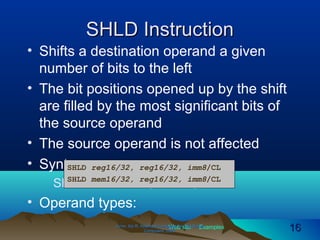
• Shifts a destination operand a given
number of bits to the left
• The bit positions opened up by the shift
are filled by the most significant bits of
the source operand
• The source operand is not affected
• Syntax:
SHLD destination, source, count
• Operand types:
Irvine, Kip R. Assembly Language for Intel-BasedIrvine, Kip R. Assembly Language for Intel-Based
Computers, 2003.Computers, 2003. 1616
SHLD reg16/32, reg16/32, imm8/CL
SHLD mem16/32, reg16/32, imm8/CL
Web site Examples
SHLD ExampleSHLD Example
Irvine, Kip R. Assembly Language for Intel-BasedIrvine, Kip R. Assembly Language for Intel-Based
Computers, 2003.Computers, 2003. 1717
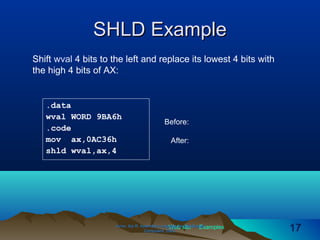
.data
wval WORD 9BA6h
.code
mov ax,0AC36h
shld wval,ax,4
Shift wval 4 bits to the left and replace its lowest 4 bits with
the high 4 bits of AX:
Before:
After:
Web site Examples
SHRD InstructionSHRD Instruction
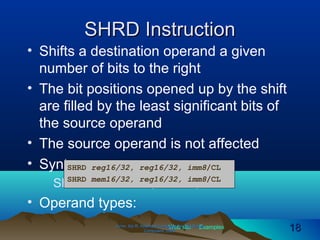
• Shifts a destination operand a given
number of bits to the right
• The bit positions opened up by the shift
are filled by the least significant bits of
the source operand
• The source operand is not affected
• Syntax:
SHRD destination, source, count
• Operand types:
Irvine, Kip R. Assembly Language for Intel-BasedIrvine, Kip R. Assembly Language for Intel-Based
Computers, 2003.Computers, 2003. 1818
SHRD reg16/32, reg16/32, imm8/CL
SHRD mem16/32, reg16/32, imm8/CL
Web site Examples
SHRD ExampleSHRD Example
Irvine, Kip R. Assembly Language for Intel-BasedIrvine, Kip R. Assembly Language for Intel-Based
Computers, 2003.Computers, 2003. 1919
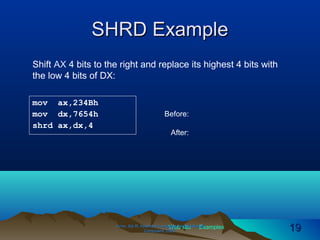
mov ax,234Bh
mov dx,7654h
shrd ax,dx,4
Shift AX 4 bits to the right and replace its highest 4 bits with
the low 4 bits of DX:
Before:
After:
Web site Examples
Your turn . . .Your turn . . .
Irvine, Kip R. Assembly Language for Intel-BasedIrvine, Kip R. Assembly Language for Intel-Based
Computers, 2003.Computers, 2003. 2020
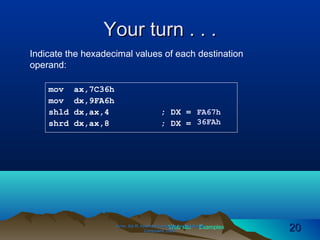
mov ax,7C36h
mov dx,9FA6h
shld dx,ax,4 ; DX =
shrd dx,ax,8 ; DX =
Indicate the hexadecimal values of each destination
operand:
FA67h
36FAh
Web site Examples
Shift and Rotate ApplicationsShift and Rotate Applications
• Shifting Multiple Doublewords
• Binary Multiplication
• Displaying Binary Bits
• Isolating a Bit String
Irvine, Kip R. Assembly Language for Intel-BasedIrvine, Kip R. Assembly Language for Intel-Based
Computers, 2003.Computers, 2003. 2121
Web site Examples
Shifting Multiple DoublewordsShifting Multiple Doublewords
• Programs sometimes need to shift all
bits within an array, as one might when
moving a bitmapped graphic image
from one screen location to another.
• The following shifts an array of 3
doublewords 1 bit to the right (view
complete source code):
Irvine, Kip R. Assembly Language for Intel-BasedIrvine, Kip R. Assembly Language for Intel-Based
Computers, 2003.Computers, 2003. 2222
.data
ArraySize = 3
array DWORD ArraySize DUP(99999999h) ; 1001 1001...
.code
mov esi,0
shr array[esi + 8],1 ; high dword
rcr array[esi + 4],1 ; middle dword, include Carry
rcr array[esi],1 ; low dword, include Carry
Web site Examples
Binary MultiplicationBinary Multiplication
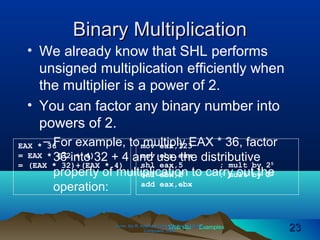
• We already know that SHL performs
unsigned multiplication efficiently when
the multiplier is a power of 2.
• You can factor any binary number into
powers of 2.
– For example, to multiply EAX * 36, factor
36 into 32 + 4 and use the distributive
property of multiplication to carry out the
operation:
Irvine, Kip R. Assembly Language for Intel-BasedIrvine, Kip R. Assembly Language for Intel-Based
Computers, 2003.Computers, 2003. 2323
EAX * 36
= EAX * (32 + 4)
= (EAX * 32)+(EAX * 4)
mov eax,123
mov ebx,eax
shl eax,5 ; mult by 25
shl ebx,2 ; mult by 22
add eax,ebx
Web site Examples
Your turn . . .Your turn . . .
Irvine, Kip R. Assembly Language for Intel-BasedIrvine, Kip R. Assembly Language for Intel-Based
Computers, 2003.Computers, 2003. 2424
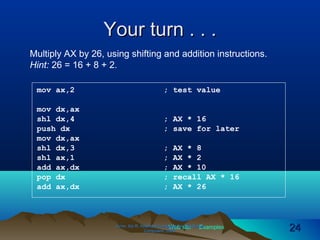
mov ax,2 ; test value
mov dx,ax
shl dx,4 ; AX * 16
push dx ; save for later
mov dx,ax
shl dx,3 ; AX * 8
shl ax,1 ; AX * 2
add ax,dx ; AX * 10
pop dx ; recall AX * 16
add ax,dx ; AX * 26
Multiply AX by 26, using shifting and addition instructions.
Hint: 26 = 16 + 8 + 2.
Web site Examples
Displaying Binary BitsDisplaying Binary Bits
Algorithm: Shift MSB into the Carry flag; If CF = 1, append a "1"
character to a string; otherwise, append a "0" character. Repeat
in a loop, 32 times.
Irvine, Kip R. Assembly Language for Intel-BasedIrvine, Kip R. Assembly Language for Intel-Based
Computers, 2003.Computers, 2003. 2525
.data
buffer BYTE 32 DUP(0),0
.code
mov ecx,32
mov esi,OFFSET buffer
L1: shl eax,1
mov BYTE PTR [esi],'0'
jnc L2
mov BYTE PTR [esi],'1'
L2: inc esi
loop L1
Web site Examples
Isolating a Bit StringIsolating a Bit String
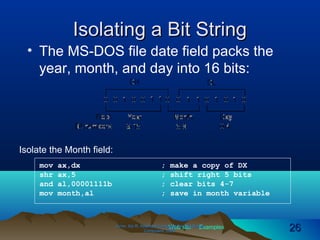
• The MS-DOS file date field packs the
year, month, and day into 16 bits:
Irvine, Kip R. Assembly Language for Intel-BasedIrvine, Kip R. Assembly Language for Intel-Based
Computers, 2003.Computers, 2003. 2626
mov ax,dx ; make a copy of DX
shr ax,5 ; shift right 5 bits
and al,00001111b ; clear bits 4-7
mov month,al ; save in month variable
Isolate the Month field:
Web site Examples
Multiplication and DivisionMultiplication and Division
InstructionsInstructions
• MUL Instruction
• IMUL Instruction
• DIV Instruction
• Signed Integer Division
• CBW, CWD, CDQ Instructions
• IDIV Instruction
• Implementing Arithmetic
Expressions
Irvine, Kip R. Assembly Language for Intel-BasedIrvine, Kip R. Assembly Language for Intel-Based
Computers, 2003.Computers, 2003. 2727
Web site Examples
MUL InstructionMUL Instruction
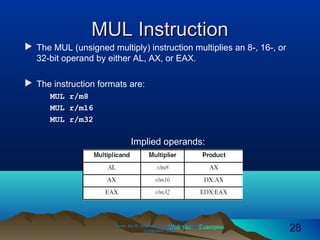
 The MUL (unsigned multiply) instruction multiplies an 8-, 16-, or
32-bit operand by either AL, AX, or EAX.
 The instruction formats are:
MUL r/m8
MUL r/m16
MUL r/m32
Irvine, Kip R. Assembly Language for Intel-BasedIrvine, Kip R. Assembly Language for Intel-Based
Computers, 2003.Computers, 2003. 2828
Implied operands:
Web site Examples
MUL ExamplesMUL Examples
Irvine, Kip R. Assembly Language for Intel-BasedIrvine, Kip R. Assembly Language for Intel-Based
Computers, 2003.Computers, 2003. 2929
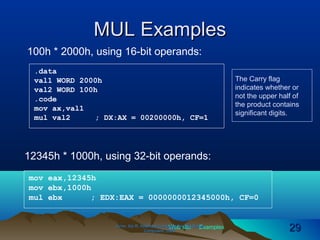
100h * 2000h, using 16-bit operands:
.data
val1 WORD 2000h
val2 WORD 100h
.code
mov ax,val1
mul val2 ; DX:AX = 00200000h, CF=1
The Carry flag
indicates whether or
not the upper half of
the product contains
significant digits.
mov eax,12345h
mov ebx,1000h
mul ebx ; EDX:EAX = 0000000012345000h, CF=0
12345h * 1000h, using 32-bit operands:
Web site Examples
Your turn . . .Your turn . . .
Irvine, Kip R. Assembly Language for Intel-BasedIrvine, Kip R. Assembly Language for Intel-Based
Computers, 2003.Computers, 2003. 3030
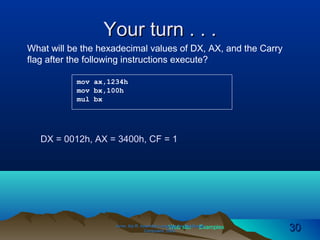
mov ax,1234h
mov bx,100h
mul bx
What will be the hexadecimal values of DX, AX, and the Carry
flag after the following instructions execute?
DX = 0012h, AX = 3400h, CF = 1
Web site Examples
Your turn . . .Your turn . . .
Irvine, Kip R. Assembly Language for Intel-BasedIrvine, Kip R. Assembly Language for Intel-Based
Computers, 2003.Computers, 2003. 3131
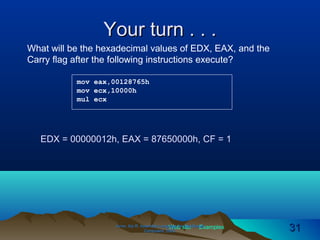
mov eax,00128765h
mov ecx,10000h
mul ecx
What will be the hexadecimal values of EDX, EAX, and the
Carry flag after the following instructions execute?
EDX = 00000012h, EAX = 87650000h, CF = 1
Web site Examples
IMUL InstructionIMUL Instruction
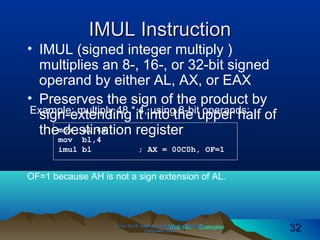
• IMUL (signed integer multiply )
multiplies an 8-, 16-, or 32-bit signed
operand by either AL, AX, or EAX
• Preserves the sign of the product by
sign-extending it into the upper half of
the destination register
Irvine, Kip R. Assembly Language for Intel-BasedIrvine, Kip R. Assembly Language for Intel-Based
Computers, 2003.Computers, 2003. 3232
Example: multiply 48 * 4, using 8-bit operands:
mov al,48
mov bl,4
imul bl ; AX = 00C0h, OF=1
OF=1 because AH is not a sign extension of AL.
Web site Examples
IMUL ExamplesIMUL Examples
Irvine, Kip R. Assembly Language for Intel-BasedIrvine, Kip R. Assembly Language for Intel-Based
Computers, 2003.Computers, 2003. 3333
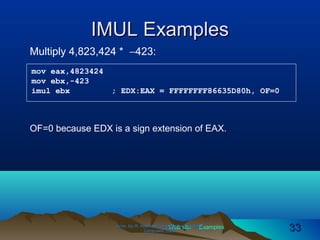
Multiply 4,823,424 * −423:
mov eax,4823424
mov ebx,-423
imul ebx ; EDX:EAX = FFFFFFFF86635D80h, OF=0
OF=0 because EDX is a sign extension of EAX.
Web site Examples
Your turn . . .Your turn . . .
Irvine, Kip R. Assembly Language for Intel-BasedIrvine, Kip R. Assembly Language for Intel-Based
Computers, 2003.Computers, 2003. 3434
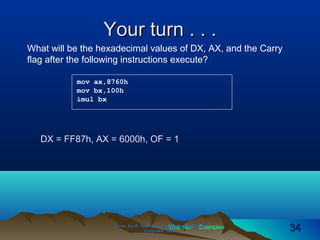
mov ax,8760h
mov bx,100h
imul bx
What will be the hexadecimal values of DX, AX, and the Carry
flag after the following instructions execute?
DX = FF87h, AX = 6000h, OF = 1
Web site Examples
DIV InstructionDIV Instruction
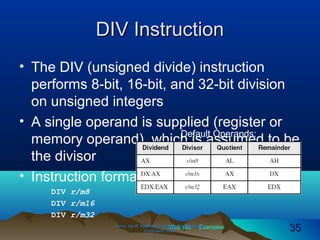
• The DIV (unsigned divide) instruction
performs 8-bit, 16-bit, and 32-bit division
on unsigned integers
• A single operand is supplied (register or
memory operand), which is assumed to be
the divisor
• Instruction formats:
DIV r/m8
DIV r/m16
DIV r/m32
Irvine, Kip R. Assembly Language for Intel-BasedIrvine, Kip R. Assembly Language for Intel-Based
Computers, 2003.Computers, 2003. 3535
Default Operands:
Web site Examples
DIV ExamplesDIV Examples
Irvine, Kip R. Assembly Language for Intel-BasedIrvine, Kip R. Assembly Language for Intel-Based
Computers, 2003.Computers, 2003. 3636
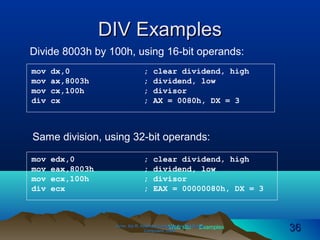
Divide 8003h by 100h, using 16-bit operands:
mov dx,0 ; clear dividend, high
mov ax,8003h ; dividend, low
mov cx,100h ; divisor
div cx ; AX = 0080h, DX = 3
Same division, using 32-bit operands:
mov edx,0 ; clear dividend, high
mov eax,8003h ; dividend, low
mov ecx,100h ; divisor
div ecx ; EAX = 00000080h, DX = 3
Web site Examples
Your turn . . .Your turn . . .
Irvine, Kip R. Assembly Language for Intel-BasedIrvine, Kip R. Assembly Language for Intel-Based
Computers, 2003.Computers, 2003. 3737
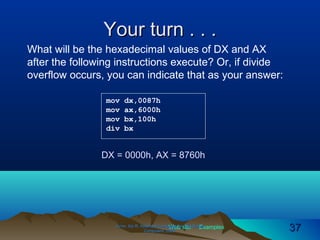
mov dx,0087h
mov ax,6000h
mov bx,100h
div bx
What will be the hexadecimal values of DX and AX
after the following instructions execute? Or, if divide
overflow occurs, you can indicate that as your answer:
DX = 0000h, AX = 8760h
Web site Examples
Your turn . . .Your turn . . .
Irvine, Kip R. Assembly Language for Intel-BasedIrvine, Kip R. Assembly Language for Intel-Based
Computers, 2003.Computers, 2003. 3838
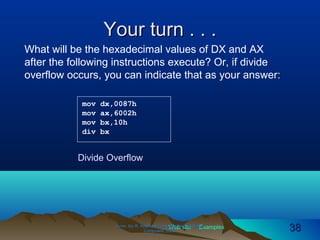
mov dx,0087h
mov ax,6002h
mov bx,10h
div bx
What will be the hexadecimal values of DX and AX
after the following instructions execute? Or, if divide
overflow occurs, you can indicate that as your answer:
Divide Overflow
Web site Examples
Signed Integer DivisionSigned Integer Division
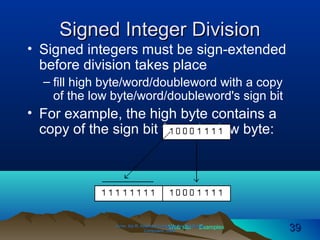
• Signed integers must be sign-extended
before division takes place
– fill high byte/word/doubleword with a copy
of the low byte/word/doubleword's sign bit
• For example, the high byte contains a
copy of the sign bit from the low byte:
Irvine, Kip R. Assembly Language for Intel-BasedIrvine, Kip R. Assembly Language for Intel-Based
Computers, 2003.Computers, 2003. 3939
Web site Examples
CBW, CWD, CDQ InstructionsCBW, CWD, CDQ Instructions
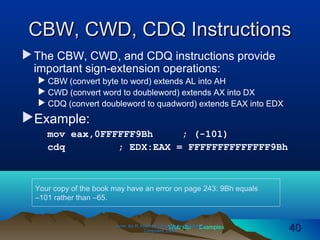
The CBW, CWD, and CDQ instructions provide
important sign-extension operations:
 CBW (convert byte to word) extends AL into AH
 CWD (convert word to doubleword) extends AX into DX
 CDQ (convert doubleword to quadword) extends EAX into EDX
Example:
mov eax,0FFFFFF9Bh ; (-101)
cdq ; EDX:EAX = FFFFFFFFFFFFFF9Bh
Irvine, Kip R. Assembly Language for Intel-BasedIrvine, Kip R. Assembly Language for Intel-Based
Computers, 2003.Computers, 2003. 4040
Your copy of the book may have an error on page 243: 9Bh equals
–101 rather than –65.
Web site Examples
IDIV InstructionIDIV Instruction
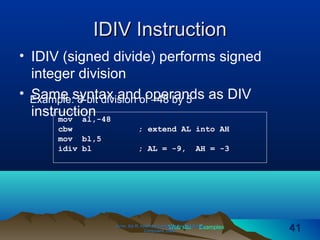
• IDIV (signed divide) performs signed
integer division
• Same syntax and operands as DIV
instruction
Irvine, Kip R. Assembly Language for Intel-BasedIrvine, Kip R. Assembly Language for Intel-Based
Computers, 2003.Computers, 2003. 4141
Example: 8-bit division of –48 by 5
mov al,-48
cbw ; extend AL into AH
mov bl,5
idiv bl ; AL = -9, AH = -3
Web site Examples
IDIV ExamplesIDIV Examples
Irvine, Kip R. Assembly Language for Intel-BasedIrvine, Kip R. Assembly Language for Intel-Based
Computers, 2003.Computers, 2003. 4242
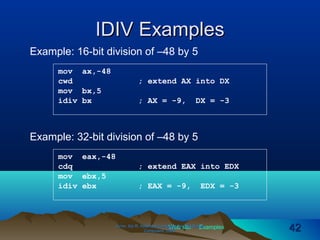
Example: 32-bit division of –48 by 5
mov eax,-48
cdq ; extend EAX into EDX
mov ebx,5
idiv ebx ; EAX = -9, EDX = -3
Example: 16-bit division of –48 by 5
mov ax,-48
cwd ; extend AX into DX
mov bx,5
idiv bx ; AX = -9, DX = -3
Web site Examples
Your turn . . .Your turn . . .
Irvine, Kip R. Assembly Language for Intel-BasedIrvine, Kip R. Assembly Language for Intel-Based
Computers, 2003.Computers, 2003. 4343
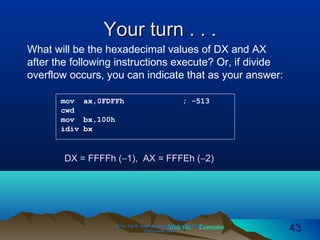
mov ax,0FDFFh ; -513
cwd
mov bx,100h
idiv bx
What will be the hexadecimal values of DX and AX
after the following instructions execute? Or, if divide
overflow occurs, you can indicate that as your answer:
DX = FFFFh (−1), AX = FFFEh (−2)
Web site Examples
Unsigned ArithmeticUnsigned Arithmetic
ExpressionsExpressions
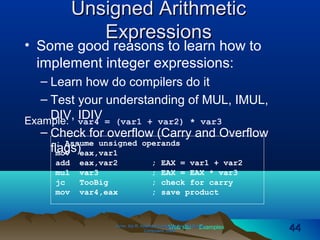
• Some good reasons to learn how to
implement integer expressions:
– Learn how do compilers do it
– Test your understanding of MUL, IMUL,
DIV, IDIV
– Check for overflow (Carry and Overflow
flags)
Irvine, Kip R. Assembly Language for Intel-BasedIrvine, Kip R. Assembly Language for Intel-Based
Computers, 2003.Computers, 2003. 4444
Example: var4 = (var1 + var2) * var3
; Assume unsigned operands
mov eax,var1
add eax,var2 ; EAX = var1 + var2
mul var3 ; EAX = EAX * var3
jc TooBig ; check for carry
mov var4,eax ; save product
Web site Examples
Signed Arithmetic ExpressionsSigned Arithmetic Expressions (1(1
of 2)of 2)
Irvine, Kip R. Assembly Language for Intel-BasedIrvine, Kip R. Assembly Language for Intel-Based
Computers, 2003.Computers, 2003. 4545
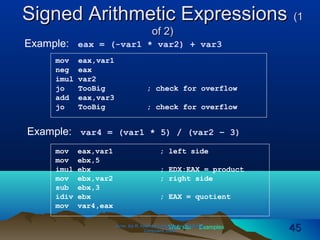
Example: eax = (-var1 * var2) + var3
mov eax,var1
neg eax
imul var2
jo TooBig ; check for overflow
add eax,var3
jo TooBig ; check for overflow
Example: var4 = (var1 * 5) / (var2 – 3)
mov eax,var1 ; left side
mov ebx,5
imul ebx ; EDX:EAX = product
mov ebx,var2 ; right side
sub ebx,3
idiv ebx ; EAX = quotient
mov var4,eax
Web site Examples
Signed Arithmetic ExpressionsSigned Arithmetic Expressions
(2 of 2)(2 of 2)
Irvine, Kip R. Assembly Language for Intel-BasedIrvine, Kip R. Assembly Language for Intel-Based
Computers, 2003.Computers, 2003. 4646
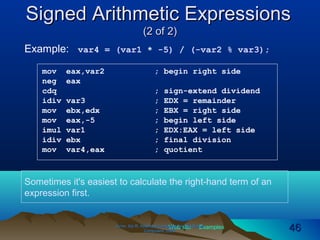
Example: var4 = (var1 * -5) / (-var2 % var3);
mov eax,var2 ; begin right side
neg eax
cdq ; sign-extend dividend
idiv var3 ; EDX = remainder
mov ebx,edx ; EBX = right side
mov eax,-5 ; begin left side
imul var1 ; EDX:EAX = left side
idiv ebx ; final division
mov var4,eax ; quotient
Sometimes it's easiest to calculate the right-hand term of an
expression first.
Web site Examples
Your turn . . .Your turn . . .
Irvine, Kip R. Assembly Language for Intel-BasedIrvine, Kip R. Assembly Language for Intel-Based
Computers, 2003.Computers, 2003. 4747
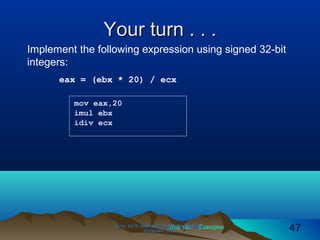
mov eax,20
imul ebx
idiv ecx
Implement the following expression using signed 32-bit
integers:
eax = (ebx * 20) / ecx
Web site Examples
Your turn . . .Your turn . . .
Irvine, Kip R. Assembly Language for Intel-BasedIrvine, Kip R. Assembly Language for Intel-Based
Computers, 2003.Computers, 2003. 4848
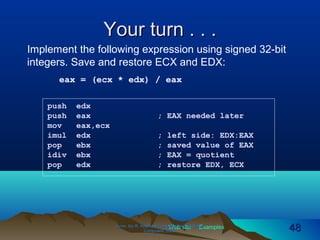
push edx
push eax ; EAX needed later
mov eax,ecx
imul edx ; left side: EDX:EAX
pop ebx ; saved value of EAX
idiv ebx ; EAX = quotient
pop edx ; restore EDX, ECX
Implement the following expression using signed 32-bit
integers. Save and restore ECX and EDX:
eax = (ecx * edx) / eax
Web site Examples
Your turn . . .Your turn . . .
Irvine, Kip R. Assembly Language for Intel-BasedIrvine, Kip R. Assembly Language for Intel-Based
Computers, 2003.Computers, 2003. 4949
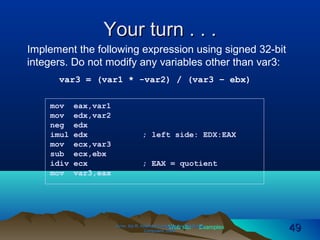
mov eax,var1
mov edx,var2
neg edx
imul edx ; left side: EDX:EAX
mov ecx,var3
sub ecx,ebx
idiv ecx ; EAX = quotient
mov var3,eax
Implement the following expression using signed 32-bit
integers. Do not modify any variables other than var3:
var3 = (var1 * -var2) / (var3 – ebx)
Web site Examples
Extended Precision ArithmeticExtended Precision Arithmetic
• ADC Instruction
• Extended Precision Addition
• SBB Instruction
• Extended Precision Subtraction
Irvine, Kip R. Assembly Language for Intel-BasedIrvine, Kip R. Assembly Language for Intel-Based
Computers, 2003.Computers, 2003. 5050
Web site Examples
Extended Precision AdditionExtended Precision Addition
• Adding two operands that are longer than
the computer's word size (32 bits).
– Virtually no limit to the size of the operands
• The arithmetic must be performed in steps
– The Carry value from each step is passed on
to the next step.
Irvine, Kip R. Assembly Language for Intel-BasedIrvine, Kip R. Assembly Language for Intel-Based
Computers, 2003.Computers, 2003. 5151
Web site Examples
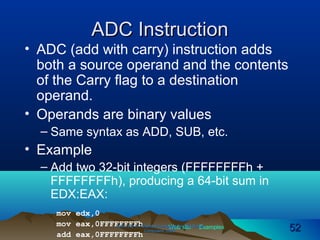
ADC InstructionADC Instruction
• ADC (add with carry) instruction adds
both a source operand and the contents
of the Carry flag to a destination
operand.
• Operands are binary values
– Same syntax as ADD, SUB, etc.
• Example
– Add two 32-bit integers (FFFFFFFFh +
FFFFFFFFh), producing a 64-bit sum in
EDX:EAX:
mov edx,0
mov eax,0FFFFFFFFh
add eax,0FFFFFFFFh
Irvine, Kip R. Assembly Language for Intel-BasedIrvine, Kip R. Assembly Language for Intel-Based
Computers, 2003.Computers, 2003. 5252
Web site Examples
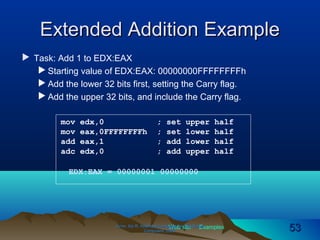
Extended Addition ExampleExtended Addition Example
 Task: Add 1 to EDX:EAX
 Starting value of EDX:EAX: 00000000FFFFFFFFh
 Add the lower 32 bits first, setting the Carry flag.
 Add the upper 32 bits, and include the Carry flag.
Irvine, Kip R. Assembly Language for Intel-BasedIrvine, Kip R. Assembly Language for Intel-Based
Computers, 2003.Computers, 2003. 5353
mov edx,0 ; set upper half
mov eax,0FFFFFFFFh ; set lower half
add eax,1 ; add lower half
adc edx,0 ; add upper half
EDX:EAX = 00000001 00000000
Web site Examples
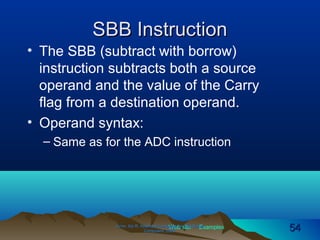
SBB InstructionSBB Instruction
• The SBB (subtract with borrow)
instruction subtracts both a source
operand and the value of the Carry
flag from a destination operand.
• Operand syntax:
– Same as for the ADC instruction
Irvine, Kip R. Assembly Language for Intel-BasedIrvine, Kip R. Assembly Language for Intel-Based
Computers, 2003.Computers, 2003. 5454
Web site Examples
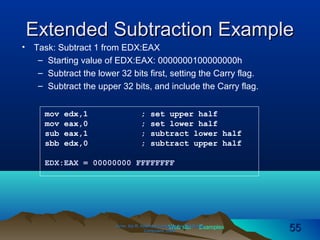
Extended Subtraction ExampleExtended Subtraction Example
• Task: Subtract 1 from EDX:EAX
– Starting value of EDX:EAX: 0000000100000000h
– Subtract the lower 32 bits first, setting the Carry flag.
– Subtract the upper 32 bits, and include the Carry flag.
Irvine, Kip R. Assembly Language for Intel-BasedIrvine, Kip R. Assembly Language for Intel-Based
Computers, 2003.Computers, 2003. 5555
mov edx,1 ; set upper half
mov eax,0 ; set lower half
sub eax,1 ; subtract lower half
sbb edx,0 ; subtract upper half
EDX:EAX = 00000000 FFFFFFFF
Web site Examples
ASCII and Packed DecimalASCII and Packed Decimal
ArithmeticArithmetic
• Binary Coded Decimal
• ASCII Decimal
• AAA Instruction
• AAS Instruction
• AAM Instruction
• AAD Instruction
• Packed Decimal Integers
• DAA Instruction
• DAS InstructionIrvine, Kip R. Assembly Language for Intel-BasedIrvine, Kip R. Assembly Language for Intel-Based
Computers, 2003.Computers, 2003. 5656
Web site Examples
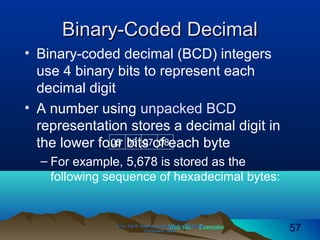
Binary-Coded DecimalBinary-Coded Decimal
• Binary-coded decimal (BCD) integers
use 4 binary bits to represent each
decimal digit
• A number using unpacked BCD
representation stores a decimal digit in
the lower four bits of each byte
– For example, 5,678 is stored as the
following sequence of hexadecimal bytes:
Irvine, Kip R. Assembly Language for Intel-BasedIrvine, Kip R. Assembly Language for Intel-Based
Computers, 2003.Computers, 2003. 5757
05 06 07 08
Web site Examples
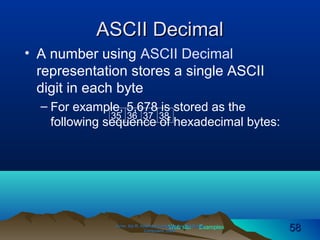
ASCII DecimalASCII Decimal
• A number using ASCII Decimal
representation stores a single ASCII
digit in each byte
– For example, 5,678 is stored as the
following sequence of hexadecimal bytes:
Irvine, Kip R. Assembly Language for Intel-BasedIrvine, Kip R. Assembly Language for Intel-Based
Computers, 2003.Computers, 2003. 5858
35 36 37 38
Web site Examples
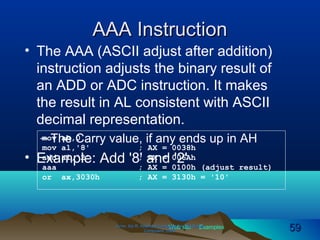
AAA InstructionAAA Instruction
• The AAA (ASCII adjust after addition)
instruction adjusts the binary result of
an ADD or ADC instruction. It makes
the result in AL consistent with ASCII
decimal representation.
– The Carry value, if any ends up in AH
• Example: Add '8' and '2'
Irvine, Kip R. Assembly Language for Intel-BasedIrvine, Kip R. Assembly Language for Intel-Based
Computers, 2003.Computers, 2003. 5959
mov ah,0
mov al,'8' ; AX = 0038h
add al,'2' ; AX = 006Ah
aaa ; AX = 0100h (adjust result)
or ax,3030h ; AX = 3130h = '10'
Web site Examples
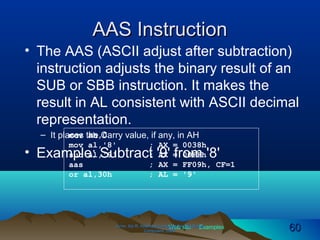
AAS InstructionAAS Instruction
• The AAS (ASCII adjust after subtraction)
instruction adjusts the binary result of an
SUB or SBB instruction. It makes the
result in AL consistent with ASCII decimal
representation.
– It places the Carry value, if any, in AH
• Example: Subtract '9' from '8'
Irvine, Kip R. Assembly Language for Intel-BasedIrvine, Kip R. Assembly Language for Intel-Based
Computers, 2003.Computers, 2003. 6060
mov ah,0
mov al,'8' ; AX = 0038h
sub al,'9' ; AX = 00FFh
aas ; AX = FF09h, CF=1
or al,30h ; AL = '9'
Web site Examples
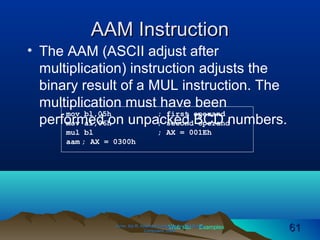
AAM InstructionAAM Instruction
• The AAM (ASCII adjust after
multiplication) instruction adjusts the
binary result of a MUL instruction. The
multiplication must have been
performed on unpacked BCD numbers.
Irvine, Kip R. Assembly Language for Intel-BasedIrvine, Kip R. Assembly Language for Intel-Based
Computers, 2003.Computers, 2003. 6161
mov bl,05h ; first operand
mov al,06h ; second operand
mul bl ; AX = 001Eh
aam ; AX = 0300h
Web site Examples
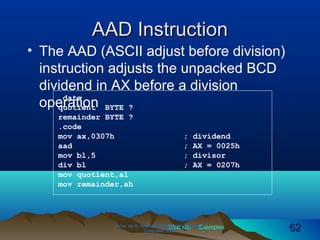
AAD InstructionAAD Instruction
• The AAD (ASCII adjust before division)
instruction adjusts the unpacked BCD
dividend in AX before a division
operation
Irvine, Kip R. Assembly Language for Intel-BasedIrvine, Kip R. Assembly Language for Intel-Based
Computers, 2003.Computers, 2003. 6262
.data
quotient BYTE ?
remainder BYTE ?
.code
mov ax,0307h ; dividend
aad ; AX = 0025h
mov bl,5 ; divisor
div bl ; AX = 0207h
mov quotient,al
mov remainder,ah
Web site Examples
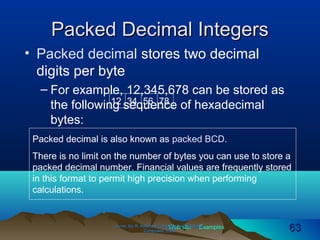
Packed Decimal IntegersPacked Decimal Integers
• Packed decimal stores two decimal
digits per byte
– For example, 12,345,678 can be stored as
the following sequence of hexadecimal
bytes:
Irvine, Kip R. Assembly Language for Intel-BasedIrvine, Kip R. Assembly Language for Intel-Based
Computers, 2003.Computers, 2003. 6363
12 34 56 78
Packed decimal is also known as packed BCD.
There is no limit on the number of bytes you can use to store a
packed decimal number. Financial values are frequently stored
in this format to permit high precision when performing
calculations.
Web site Examples
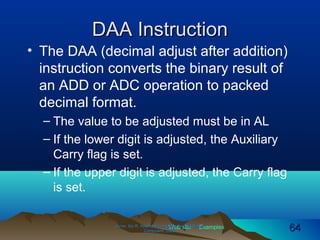
DAA InstructionDAA Instruction
• The DAA (decimal adjust after addition)
instruction converts the binary result of
an ADD or ADC operation to packed
decimal format.
– The value to be adjusted must be in AL
– If the lower digit is adjusted, the Auxiliary
Carry flag is set.
– If the upper digit is adjusted, the Carry flag
is set.
Irvine, Kip R. Assembly Language for Intel-BasedIrvine, Kip R. Assembly Language for Intel-Based
Computers, 2003.Computers, 2003. 6464
Web site Examples
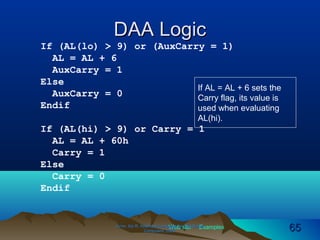
DAA LogicDAA Logic
If (AL(lo) > 9) or (AuxCarry = 1)
AL = AL + 6
AuxCarry = 1
Else
AuxCarry = 0
Endif
If (AL(hi) > 9) or Carry = 1
AL = AL + 60h
Carry = 1
Else
Carry = 0
Endif
Irvine, Kip R. Assembly Language for Intel-BasedIrvine, Kip R. Assembly Language for Intel-Based
Computers, 2003.Computers, 2003. 6565
If AL = AL + 6 sets the
Carry flag, its value is
used when evaluating
AL(hi).
Web site Examples
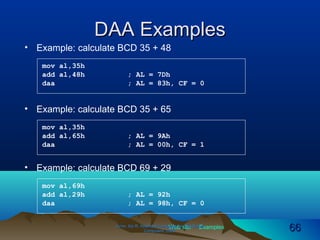
DAA ExamplesDAA Examples
• Example: calculate BCD 35 + 48
Irvine, Kip R. Assembly Language for Intel-BasedIrvine, Kip R. Assembly Language for Intel-Based
Computers, 2003.Computers, 2003. 6666
mov al,35h
add al,48h ; AL = 7Dh
daa ; AL = 83h, CF = 0
• Example: calculate BCD 35 + 65
mov al,35h
add al,65h ; AL = 9Ah
daa ; AL = 00h, CF = 1
• Example: calculate BCD 69 + 29
mov al,69h
add al,29h ; AL = 92h
daa ; AL = 98h, CF = 0
Web site Examples
Your turn . . .Your turn . . .
 A temporary malfunction in your computer's processor has
disabled the DAA instruction. Write a procedure in assembly
language that performs the same actions as DAA.
 Test your procedure using the values from the previous slide.
Irvine, Kip R. Assembly Language for Intel-BasedIrvine, Kip R. Assembly Language for Intel-Based
Computers, 2003.Computers, 2003. 6767
Web site Examples
DAS InstructionDAS Instruction
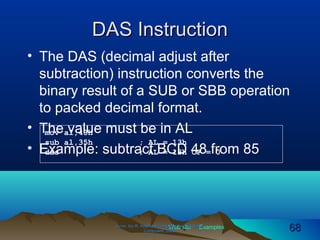
• The DAS (decimal adjust after
subtraction) instruction converts the
binary result of a SUB or SBB operation
to packed decimal format.
• The value must be in AL
• Example: subtract BCD 48 from 85
Irvine, Kip R. Assembly Language for Intel-BasedIrvine, Kip R. Assembly Language for Intel-Based
Computers, 2003.Computers, 2003. 6868
mov al,48h
sub al,35h ; AL = 13h
das ; AL = 13h CF = 0
Web site Examples
DAS LogicDAS Logic
Irvine, Kip R. Assembly Language for Intel-BasedIrvine, Kip R. Assembly Language for Intel-Based
Computers, 2003.Computers, 2003. 6969
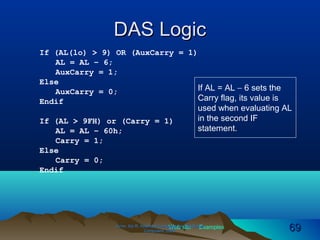
If (AL(lo) > 9) OR (AuxCarry = 1)
AL = AL − 6;
AuxCarry = 1;
Else
AuxCarry = 0;
Endif
If (AL > 9FH) or (Carry = 1)
AL = AL − 60h;
Carry = 1;
Else
Carry = 0;
Endif
If AL = AL − 6 sets the
Carry flag, its value is
used when evaluating AL
in the second IF
statement.
Web site Examples
DAS ExamplesDAS Examples (1 of 2)(1 of 2)
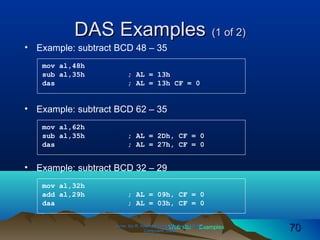
• Example: subtract BCD 48 – 35
Irvine, Kip R. Assembly Language for Intel-BasedIrvine, Kip R. Assembly Language for Intel-Based
Computers, 2003.Computers, 2003. 7070
mov al,48h
sub al,35h ; AL = 13h
das ; AL = 13h CF = 0
• Example: subtract BCD 62 – 35
mov al,62h
sub al,35h ; AL = 2Dh, CF = 0
das ; AL = 27h, CF = 0
• Example: subtract BCD 32 – 29
mov al,32h
add al,29h ; AL = 09h, CF = 0
daa ; AL = 03h, CF = 0
Web site Examples
DAS ExamplesDAS Examples (2 of 2)(2 of 2)
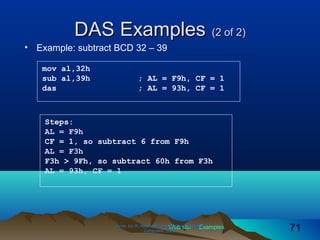
• Example: subtract BCD 32 – 39
Irvine, Kip R. Assembly Language for Intel-BasedIrvine, Kip R. Assembly Language for Intel-Based
Computers, 2003.Computers, 2003. 7171
mov al,32h
sub al,39h ; AL = F9h, CF = 1
das ; AL = 93h, CF = 1
Steps:
AL = F9h
CF = 1, so subtract 6 from F9h
AL = F3h
F3h > 9Fh, so subtract 60h from F3h
AL = 93h, CF = 1
Web site Examples
Your turn . . .Your turn . . .
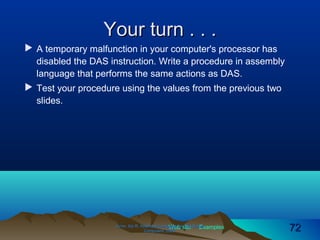
 A temporary malfunction in your computer's processor has
disabled the DAS instruction. Write a procedure in assembly
language that performs the same actions as DAS.
 Test your procedure using the values from the previous two
slides.
Irvine, Kip R. Assembly Language for Intel-BasedIrvine, Kip R. Assembly Language for Intel-Based
Computers, 2003.Computers, 2003. 7272
Web site Examples
The EndThe End
Irvine, Kip R. Assembly Language for Intel-BasedIrvine, Kip R. Assembly Language for Intel-Based
Computers, 2003.Computers, 2003. 7373
Web site ExamplesIrvine, Kip R. Assembly Language for Intel-BasedIrvine, Kip R. Assembly Language for Intel-Based
Computers, 2003.Computers, 2003. 7474
output window
syntax
code

Shift rotate

  • 1.
    Assembly Language forAssemblyLanguage for Intel-Based Computers,Intel-Based Computers, 44thth EditionEdition Chapter 7: Integer ArithmeticChapter 7: Integer Arithmetic Assembly language sources (Web)
  • 2.
    Web site Examples ChapterOverviewChapter Overview • Shift and Rotate Instructions • Shift and Rotate Applications • Multiplication and Division Instructions • Extended Addition and Subtraction • ASCII and Packed Decimal Arithmetic 22
  • 3.
    Web site Examples Shiftand Rotate InstructionsShift and Rotate Instructions • Logical vs Arithmetic Shifts • SHL Instruction • SHR Instruction • SAL and SAR Instructions • ROL Instruction • ROR Instruction • RCL and RCR Instructions • SHLD/SHRD Instructions Irvine, Kip R. Assembly Language for Intel-BasedIrvine, Kip R. Assembly Language for Intel-Based Computers, 2003.Computers, 2003. 33
  • 4.
    Web site Examples Logicalvs Arithmetic ShiftsLogical vs Arithmetic Shifts • A logical shift fills the newly created bit position with zero: Irvine, Kip R. Assembly Language for Intel-BasedIrvine, Kip R. Assembly Language for Intel-Based Computers, 2003.Computers, 2003. 44 • An arithmetic shift fills the newly created bit position with a copy of the number’s sign bit:
  • 5.
    Web site Examples SHLInstructionSHL Instruction • The SHL (shift left) instruction performs a logical left shift on the destination operand, filling the lowest bit with 0. Irvine, Kip R. Assembly Language for Intel-BasedIrvine, Kip R. Assembly Language for Intel-Based Computers, 2003.Computers, 2003. 55 • Operand types for SHL: SHL reg,imm8 SHL mem,imm8 SHL reg,CL SHL mem,CL (Same for all shift and rotate instructions)
  • 6.
    Web site Examples FastMultiplicationFast Multiplication Irvine, Kip R. Assembly Language for Intel-BasedIrvine, Kip R. Assembly Language for Intel-Based Computers, 2003.Computers, 2003. 66 mov dl,5 shl dl,1 Shifting left 1 bit multiplies a number by 2 mov dl,5 shl dl,2 ; DL = 20 Shifting left n bits multiplies the operand by 2n For example, 5 * 22 = 20
  • 7.
    Web site Examples SHRInstructionSHR Instruction • The SHR (shift right) instruction performs a logical right shift on the destination operand. The highest bit position is filled with a zero. Irvine, Kip R. Assembly Language for Intel-BasedIrvine, Kip R. Assembly Language for Intel-Based Computers, 2003.Computers, 2003. 77 mov dl,80 shr dl,1 ; DL = 40 shr dl,2 ; DL = 10 Shifting right n bits divides the operand by 2n
  • 8.
    Web site Examples SALand SAR InstructionsSAL and SAR Instructions • SAL (shift arithmetic left) is identical to SHL. • SAR (shift arithmetic right) performs a right arithmetic shift on the destination operand. Irvine, Kip R. Assembly Language for Intel-BasedIrvine, Kip R. Assembly Language for Intel-Based Computers, 2003.Computers, 2003. 88 An arithmetic shift preserves the number's sign. mov dl,-80 sar dl,1 ; DL = -40 sar dl,2 ; DL = -10
  • 9.
    Web site Examples Yourturn . . .Your turn . . . Irvine, Kip R. Assembly Language for Intel-BasedIrvine, Kip R. Assembly Language for Intel-Based Computers, 2003.Computers, 2003. 99 mov al,6Bh shr al,1 a. shl al,3 b. mov al,8Ch sar al,1 c. sar al,3 d. Indicate the hexadecimal value of AL after each shift: 35h A8h C6h F8h
  • 10.
    Web site Examples ROLInstructionROL Instruction • ROL (rotate) shifts each bit to the left • The highest bit is copied into both the Carry flag and into the lowest bit • No bits are lost Irvine, Kip R. Assembly Language for Intel-BasedIrvine, Kip R. Assembly Language for Intel-Based Computers, 2003.Computers, 2003. 1010 mov al,11110000b rol al,1 ; AL = 11100001b mov dl,3Fh rol dl,4 ; DL = F3h
  • 11.
    Web site Examples RORInstructionROR Instruction • ROR (rotate right) shifts each bit to the right • The lowest bit is copied into both the Carry flag and into the highest bit • No bits are lost Irvine, Kip R. Assembly Language for Intel-BasedIrvine, Kip R. Assembly Language for Intel-Based Computers, 2003.Computers, 2003. 1111 mov al,11110000b ror al,1 ; AL = 01111000b mov dl,3Fh ror dl,4 ; DL = F3h
  • 12.
    Web site Examples Yourturn . . .Your turn . . . Irvine, Kip R. Assembly Language for Intel-BasedIrvine, Kip R. Assembly Language for Intel-Based Computers, 2003.Computers, 2003. 1212 mov al,6Bh ror al,1 a. rol al,3 b. Indicate the hexadecimal value of AL after each rotation: B5h ADh
  • 13.
    Web site Examples RCLInstructionRCL Instruction • RCL (rotate carry left) shifts each bit to the left • Copies the Carry flag to the least significant bit • Copies the most significant bit to the Carry flag Irvine, Kip R. Assembly Language for Intel-BasedIrvine, Kip R. Assembly Language for Intel-Based Computers, 2003.Computers, 2003. 1313 CF clc ; CF = 0 mov bl,88h ; CF,BL = 0 10001000b rcl bl,1 ; CF,BL = 1 00010000b rcl bl,1 ; CF,BL = 0 00100001b
  • 14.
    Web site Examples RCRInstructionRCR Instruction • RCR (rotate carry right) shifts each bit to the right • Copies the Carry flag to the most significant bit • Copies the least significant bit to the Carry flag Irvine, Kip R. Assembly Language for Intel-BasedIrvine, Kip R. Assembly Language for Intel-Based Computers, 2003.Computers, 2003. 1414 stc ; CF = 1 mov ah,10h ; CF,AH = 1 00010000b rcr ah,1 ; CF,AH = 0 10001000b
  • 15.
    Web site Examples Yourturn . . .Your turn . . . Irvine, Kip R. Assembly Language for Intel-BasedIrvine, Kip R. Assembly Language for Intel-Based Computers, 2003.Computers, 2003. 1515 stc mov al,6Bh rcr al,1 a. rcl al,3 b. Indicate the hexadecimal value of AL after each rotation: B5h AEh
  • 16.
    Web site Examples SHLDInstructionSHLD Instruction • Shifts a destination operand a given number of bits to the left • The bit positions opened up by the shift are filled by the most significant bits of the source operand • The source operand is not affected • Syntax: SHLD destination, source, count • Operand types: Irvine, Kip R. Assembly Language for Intel-BasedIrvine, Kip R. Assembly Language for Intel-Based Computers, 2003.Computers, 2003. 1616 SHLD reg16/32, reg16/32, imm8/CL SHLD mem16/32, reg16/32, imm8/CL
  • 17.
    Web site Examples SHLDExampleSHLD Example Irvine, Kip R. Assembly Language for Intel-BasedIrvine, Kip R. Assembly Language for Intel-Based Computers, 2003.Computers, 2003. 1717 .data wval WORD 9BA6h .code mov ax,0AC36h shld wval,ax,4 Shift wval 4 bits to the left and replace its lowest 4 bits with the high 4 bits of AX: Before: After:
  • 18.
    Web site Examples SHRDInstructionSHRD Instruction • Shifts a destination operand a given number of bits to the right • The bit positions opened up by the shift are filled by the least significant bits of the source operand • The source operand is not affected • Syntax: SHRD destination, source, count • Operand types: Irvine, Kip R. Assembly Language for Intel-BasedIrvine, Kip R. Assembly Language for Intel-Based Computers, 2003.Computers, 2003. 1818 SHRD reg16/32, reg16/32, imm8/CL SHRD mem16/32, reg16/32, imm8/CL
  • 19.
    Web site Examples SHRDExampleSHRD Example Irvine, Kip R. Assembly Language for Intel-BasedIrvine, Kip R. Assembly Language for Intel-Based Computers, 2003.Computers, 2003. 1919 mov ax,234Bh mov dx,7654h shrd ax,dx,4 Shift AX 4 bits to the right and replace its highest 4 bits with the low 4 bits of DX: Before: After:
  • 20.
    Web site Examples Yourturn . . .Your turn . . . Irvine, Kip R. Assembly Language for Intel-BasedIrvine, Kip R. Assembly Language for Intel-Based Computers, 2003.Computers, 2003. 2020 mov ax,7C36h mov dx,9FA6h shld dx,ax,4 ; DX = shrd dx,ax,8 ; DX = Indicate the hexadecimal values of each destination operand: FA67h 36FAh
  • 21.
    Web site Examples Shiftand Rotate ApplicationsShift and Rotate Applications • Shifting Multiple Doublewords • Binary Multiplication • Displaying Binary Bits • Isolating a Bit String Irvine, Kip R. Assembly Language for Intel-BasedIrvine, Kip R. Assembly Language for Intel-Based Computers, 2003.Computers, 2003. 2121
  • 22.
    Web site Examples ShiftingMultiple DoublewordsShifting Multiple Doublewords • Programs sometimes need to shift all bits within an array, as one might when moving a bitmapped graphic image from one screen location to another. • The following shifts an array of 3 doublewords 1 bit to the right (view complete source code): Irvine, Kip R. Assembly Language for Intel-BasedIrvine, Kip R. Assembly Language for Intel-Based Computers, 2003.Computers, 2003. 2222 .data ArraySize = 3 array DWORD ArraySize DUP(99999999h) ; 1001 1001... .code mov esi,0 shr array[esi + 8],1 ; high dword rcr array[esi + 4],1 ; middle dword, include Carry rcr array[esi],1 ; low dword, include Carry
  • 23.
    Web site Examples BinaryMultiplicationBinary Multiplication • We already know that SHL performs unsigned multiplication efficiently when the multiplier is a power of 2. • You can factor any binary number into powers of 2. – For example, to multiply EAX * 36, factor 36 into 32 + 4 and use the distributive property of multiplication to carry out the operation: Irvine, Kip R. Assembly Language for Intel-BasedIrvine, Kip R. Assembly Language for Intel-Based Computers, 2003.Computers, 2003. 2323 EAX * 36 = EAX * (32 + 4) = (EAX * 32)+(EAX * 4) mov eax,123 mov ebx,eax shl eax,5 ; mult by 25 shl ebx,2 ; mult by 22 add eax,ebx
  • 24.
    Web site Examples Yourturn . . .Your turn . . . Irvine, Kip R. Assembly Language for Intel-BasedIrvine, Kip R. Assembly Language for Intel-Based Computers, 2003.Computers, 2003. 2424 mov ax,2 ; test value mov dx,ax shl dx,4 ; AX * 16 push dx ; save for later mov dx,ax shl dx,3 ; AX * 8 shl ax,1 ; AX * 2 add ax,dx ; AX * 10 pop dx ; recall AX * 16 add ax,dx ; AX * 26 Multiply AX by 26, using shifting and addition instructions. Hint: 26 = 16 + 8 + 2.
  • 25.
    Web site Examples DisplayingBinary BitsDisplaying Binary Bits Algorithm: Shift MSB into the Carry flag; If CF = 1, append a "1" character to a string; otherwise, append a "0" character. Repeat in a loop, 32 times. Irvine, Kip R. Assembly Language for Intel-BasedIrvine, Kip R. Assembly Language for Intel-Based Computers, 2003.Computers, 2003. 2525 .data buffer BYTE 32 DUP(0),0 .code mov ecx,32 mov esi,OFFSET buffer L1: shl eax,1 mov BYTE PTR [esi],'0' jnc L2 mov BYTE PTR [esi],'1' L2: inc esi loop L1
  • 26.
    Web site Examples Isolatinga Bit StringIsolating a Bit String • The MS-DOS file date field packs the year, month, and day into 16 bits: Irvine, Kip R. Assembly Language for Intel-BasedIrvine, Kip R. Assembly Language for Intel-Based Computers, 2003.Computers, 2003. 2626 mov ax,dx ; make a copy of DX shr ax,5 ; shift right 5 bits and al,00001111b ; clear bits 4-7 mov month,al ; save in month variable Isolate the Month field:
  • 27.
    Web site Examples Multiplicationand DivisionMultiplication and Division InstructionsInstructions • MUL Instruction • IMUL Instruction • DIV Instruction • Signed Integer Division • CBW, CWD, CDQ Instructions • IDIV Instruction • Implementing Arithmetic Expressions Irvine, Kip R. Assembly Language for Intel-BasedIrvine, Kip R. Assembly Language for Intel-Based Computers, 2003.Computers, 2003. 2727
  • 28.
    Web site Examples MULInstructionMUL Instruction  The MUL (unsigned multiply) instruction multiplies an 8-, 16-, or 32-bit operand by either AL, AX, or EAX.  The instruction formats are: MUL r/m8 MUL r/m16 MUL r/m32 Irvine, Kip R. Assembly Language for Intel-BasedIrvine, Kip R. Assembly Language for Intel-Based Computers, 2003.Computers, 2003. 2828 Implied operands:
  • 29.
    Web site Examples MULExamplesMUL Examples Irvine, Kip R. Assembly Language for Intel-BasedIrvine, Kip R. Assembly Language for Intel-Based Computers, 2003.Computers, 2003. 2929 100h * 2000h, using 16-bit operands: .data val1 WORD 2000h val2 WORD 100h .code mov ax,val1 mul val2 ; DX:AX = 00200000h, CF=1 The Carry flag indicates whether or not the upper half of the product contains significant digits. mov eax,12345h mov ebx,1000h mul ebx ; EDX:EAX = 0000000012345000h, CF=0 12345h * 1000h, using 32-bit operands:
  • 30.
    Web site Examples Yourturn . . .Your turn . . . Irvine, Kip R. Assembly Language for Intel-BasedIrvine, Kip R. Assembly Language for Intel-Based Computers, 2003.Computers, 2003. 3030 mov ax,1234h mov bx,100h mul bx What will be the hexadecimal values of DX, AX, and the Carry flag after the following instructions execute? DX = 0012h, AX = 3400h, CF = 1
  • 31.
    Web site Examples Yourturn . . .Your turn . . . Irvine, Kip R. Assembly Language for Intel-BasedIrvine, Kip R. Assembly Language for Intel-Based Computers, 2003.Computers, 2003. 3131 mov eax,00128765h mov ecx,10000h mul ecx What will be the hexadecimal values of EDX, EAX, and the Carry flag after the following instructions execute? EDX = 00000012h, EAX = 87650000h, CF = 1
  • 32.
    Web site Examples IMULInstructionIMUL Instruction • IMUL (signed integer multiply ) multiplies an 8-, 16-, or 32-bit signed operand by either AL, AX, or EAX • Preserves the sign of the product by sign-extending it into the upper half of the destination register Irvine, Kip R. Assembly Language for Intel-BasedIrvine, Kip R. Assembly Language for Intel-Based Computers, 2003.Computers, 2003. 3232 Example: multiply 48 * 4, using 8-bit operands: mov al,48 mov bl,4 imul bl ; AX = 00C0h, OF=1 OF=1 because AH is not a sign extension of AL.
  • 33.
    Web site Examples IMULExamplesIMUL Examples Irvine, Kip R. Assembly Language for Intel-BasedIrvine, Kip R. Assembly Language for Intel-Based Computers, 2003.Computers, 2003. 3333 Multiply 4,823,424 * −423: mov eax,4823424 mov ebx,-423 imul ebx ; EDX:EAX = FFFFFFFF86635D80h, OF=0 OF=0 because EDX is a sign extension of EAX.
  • 34.
    Web site Examples Yourturn . . .Your turn . . . Irvine, Kip R. Assembly Language for Intel-BasedIrvine, Kip R. Assembly Language for Intel-Based Computers, 2003.Computers, 2003. 3434 mov ax,8760h mov bx,100h imul bx What will be the hexadecimal values of DX, AX, and the Carry flag after the following instructions execute? DX = FF87h, AX = 6000h, OF = 1
  • 35.
    Web site Examples DIVInstructionDIV Instruction • The DIV (unsigned divide) instruction performs 8-bit, 16-bit, and 32-bit division on unsigned integers • A single operand is supplied (register or memory operand), which is assumed to be the divisor • Instruction formats: DIV r/m8 DIV r/m16 DIV r/m32 Irvine, Kip R. Assembly Language for Intel-BasedIrvine, Kip R. Assembly Language for Intel-Based Computers, 2003.Computers, 2003. 3535 Default Operands:
  • 36.
    Web site Examples DIVExamplesDIV Examples Irvine, Kip R. Assembly Language for Intel-BasedIrvine, Kip R. Assembly Language for Intel-Based Computers, 2003.Computers, 2003. 3636 Divide 8003h by 100h, using 16-bit operands: mov dx,0 ; clear dividend, high mov ax,8003h ; dividend, low mov cx,100h ; divisor div cx ; AX = 0080h, DX = 3 Same division, using 32-bit operands: mov edx,0 ; clear dividend, high mov eax,8003h ; dividend, low mov ecx,100h ; divisor div ecx ; EAX = 00000080h, DX = 3
  • 37.
    Web site Examples Yourturn . . .Your turn . . . Irvine, Kip R. Assembly Language for Intel-BasedIrvine, Kip R. Assembly Language for Intel-Based Computers, 2003.Computers, 2003. 3737 mov dx,0087h mov ax,6000h mov bx,100h div bx What will be the hexadecimal values of DX and AX after the following instructions execute? Or, if divide overflow occurs, you can indicate that as your answer: DX = 0000h, AX = 8760h
  • 38.
    Web site Examples Yourturn . . .Your turn . . . Irvine, Kip R. Assembly Language for Intel-BasedIrvine, Kip R. Assembly Language for Intel-Based Computers, 2003.Computers, 2003. 3838 mov dx,0087h mov ax,6002h mov bx,10h div bx What will be the hexadecimal values of DX and AX after the following instructions execute? Or, if divide overflow occurs, you can indicate that as your answer: Divide Overflow
  • 39.
    Web site Examples SignedInteger DivisionSigned Integer Division • Signed integers must be sign-extended before division takes place – fill high byte/word/doubleword with a copy of the low byte/word/doubleword's sign bit • For example, the high byte contains a copy of the sign bit from the low byte: Irvine, Kip R. Assembly Language for Intel-BasedIrvine, Kip R. Assembly Language for Intel-Based Computers, 2003.Computers, 2003. 3939
  • 40.
    Web site Examples CBW,CWD, CDQ InstructionsCBW, CWD, CDQ Instructions The CBW, CWD, and CDQ instructions provide important sign-extension operations:  CBW (convert byte to word) extends AL into AH  CWD (convert word to doubleword) extends AX into DX  CDQ (convert doubleword to quadword) extends EAX into EDX Example: mov eax,0FFFFFF9Bh ; (-101) cdq ; EDX:EAX = FFFFFFFFFFFFFF9Bh Irvine, Kip R. Assembly Language for Intel-BasedIrvine, Kip R. Assembly Language for Intel-Based Computers, 2003.Computers, 2003. 4040 Your copy of the book may have an error on page 243: 9Bh equals –101 rather than –65.
  • 41.
    Web site Examples IDIVInstructionIDIV Instruction • IDIV (signed divide) performs signed integer division • Same syntax and operands as DIV instruction Irvine, Kip R. Assembly Language for Intel-BasedIrvine, Kip R. Assembly Language for Intel-Based Computers, 2003.Computers, 2003. 4141 Example: 8-bit division of –48 by 5 mov al,-48 cbw ; extend AL into AH mov bl,5 idiv bl ; AL = -9, AH = -3
  • 42.
    Web site Examples IDIVExamplesIDIV Examples Irvine, Kip R. Assembly Language for Intel-BasedIrvine, Kip R. Assembly Language for Intel-Based Computers, 2003.Computers, 2003. 4242 Example: 32-bit division of –48 by 5 mov eax,-48 cdq ; extend EAX into EDX mov ebx,5 idiv ebx ; EAX = -9, EDX = -3 Example: 16-bit division of –48 by 5 mov ax,-48 cwd ; extend AX into DX mov bx,5 idiv bx ; AX = -9, DX = -3
  • 43.
    Web site Examples Yourturn . . .Your turn . . . Irvine, Kip R. Assembly Language for Intel-BasedIrvine, Kip R. Assembly Language for Intel-Based Computers, 2003.Computers, 2003. 4343 mov ax,0FDFFh ; -513 cwd mov bx,100h idiv bx What will be the hexadecimal values of DX and AX after the following instructions execute? Or, if divide overflow occurs, you can indicate that as your answer: DX = FFFFh (−1), AX = FFFEh (−2)
  • 44.
    Web site Examples UnsignedArithmeticUnsigned Arithmetic ExpressionsExpressions • Some good reasons to learn how to implement integer expressions: – Learn how do compilers do it – Test your understanding of MUL, IMUL, DIV, IDIV – Check for overflow (Carry and Overflow flags) Irvine, Kip R. Assembly Language for Intel-BasedIrvine, Kip R. Assembly Language for Intel-Based Computers, 2003.Computers, 2003. 4444 Example: var4 = (var1 + var2) * var3 ; Assume unsigned operands mov eax,var1 add eax,var2 ; EAX = var1 + var2 mul var3 ; EAX = EAX * var3 jc TooBig ; check for carry mov var4,eax ; save product
  • 45.
    Web site Examples SignedArithmetic ExpressionsSigned Arithmetic Expressions (1(1 of 2)of 2) Irvine, Kip R. Assembly Language for Intel-BasedIrvine, Kip R. Assembly Language for Intel-Based Computers, 2003.Computers, 2003. 4545 Example: eax = (-var1 * var2) + var3 mov eax,var1 neg eax imul var2 jo TooBig ; check for overflow add eax,var3 jo TooBig ; check for overflow Example: var4 = (var1 * 5) / (var2 – 3) mov eax,var1 ; left side mov ebx,5 imul ebx ; EDX:EAX = product mov ebx,var2 ; right side sub ebx,3 idiv ebx ; EAX = quotient mov var4,eax
  • 46.
    Web site Examples SignedArithmetic ExpressionsSigned Arithmetic Expressions (2 of 2)(2 of 2) Irvine, Kip R. Assembly Language for Intel-BasedIrvine, Kip R. Assembly Language for Intel-Based Computers, 2003.Computers, 2003. 4646 Example: var4 = (var1 * -5) / (-var2 % var3); mov eax,var2 ; begin right side neg eax cdq ; sign-extend dividend idiv var3 ; EDX = remainder mov ebx,edx ; EBX = right side mov eax,-5 ; begin left side imul var1 ; EDX:EAX = left side idiv ebx ; final division mov var4,eax ; quotient Sometimes it's easiest to calculate the right-hand term of an expression first.
  • 47.
    Web site Examples Yourturn . . .Your turn . . . Irvine, Kip R. Assembly Language for Intel-BasedIrvine, Kip R. Assembly Language for Intel-Based Computers, 2003.Computers, 2003. 4747 mov eax,20 imul ebx idiv ecx Implement the following expression using signed 32-bit integers: eax = (ebx * 20) / ecx
  • 48.
    Web site Examples Yourturn . . .Your turn . . . Irvine, Kip R. Assembly Language for Intel-BasedIrvine, Kip R. Assembly Language for Intel-Based Computers, 2003.Computers, 2003. 4848 push edx push eax ; EAX needed later mov eax,ecx imul edx ; left side: EDX:EAX pop ebx ; saved value of EAX idiv ebx ; EAX = quotient pop edx ; restore EDX, ECX Implement the following expression using signed 32-bit integers. Save and restore ECX and EDX: eax = (ecx * edx) / eax
  • 49.
    Web site Examples Yourturn . . .Your turn . . . Irvine, Kip R. Assembly Language for Intel-BasedIrvine, Kip R. Assembly Language for Intel-Based Computers, 2003.Computers, 2003. 4949 mov eax,var1 mov edx,var2 neg edx imul edx ; left side: EDX:EAX mov ecx,var3 sub ecx,ebx idiv ecx ; EAX = quotient mov var3,eax Implement the following expression using signed 32-bit integers. Do not modify any variables other than var3: var3 = (var1 * -var2) / (var3 – ebx)
  • 50.
    Web site Examples ExtendedPrecision ArithmeticExtended Precision Arithmetic • ADC Instruction • Extended Precision Addition • SBB Instruction • Extended Precision Subtraction Irvine, Kip R. Assembly Language for Intel-BasedIrvine, Kip R. Assembly Language for Intel-Based Computers, 2003.Computers, 2003. 5050
  • 51.
    Web site Examples ExtendedPrecision AdditionExtended Precision Addition • Adding two operands that are longer than the computer's word size (32 bits). – Virtually no limit to the size of the operands • The arithmetic must be performed in steps – The Carry value from each step is passed on to the next step. Irvine, Kip R. Assembly Language for Intel-BasedIrvine, Kip R. Assembly Language for Intel-Based Computers, 2003.Computers, 2003. 5151
  • 52.
    Web site Examples ADCInstructionADC Instruction • ADC (add with carry) instruction adds both a source operand and the contents of the Carry flag to a destination operand. • Operands are binary values – Same syntax as ADD, SUB, etc. • Example – Add two 32-bit integers (FFFFFFFFh + FFFFFFFFh), producing a 64-bit sum in EDX:EAX: mov edx,0 mov eax,0FFFFFFFFh add eax,0FFFFFFFFh Irvine, Kip R. Assembly Language for Intel-BasedIrvine, Kip R. Assembly Language for Intel-Based Computers, 2003.Computers, 2003. 5252
  • 53.
    Web site Examples ExtendedAddition ExampleExtended Addition Example  Task: Add 1 to EDX:EAX  Starting value of EDX:EAX: 00000000FFFFFFFFh  Add the lower 32 bits first, setting the Carry flag.  Add the upper 32 bits, and include the Carry flag. Irvine, Kip R. Assembly Language for Intel-BasedIrvine, Kip R. Assembly Language for Intel-Based Computers, 2003.Computers, 2003. 5353 mov edx,0 ; set upper half mov eax,0FFFFFFFFh ; set lower half add eax,1 ; add lower half adc edx,0 ; add upper half EDX:EAX = 00000001 00000000
  • 54.
    Web site Examples SBBInstructionSBB Instruction • The SBB (subtract with borrow) instruction subtracts both a source operand and the value of the Carry flag from a destination operand. • Operand syntax: – Same as for the ADC instruction Irvine, Kip R. Assembly Language for Intel-BasedIrvine, Kip R. Assembly Language for Intel-Based Computers, 2003.Computers, 2003. 5454
  • 55.
    Web site Examples ExtendedSubtraction ExampleExtended Subtraction Example • Task: Subtract 1 from EDX:EAX – Starting value of EDX:EAX: 0000000100000000h – Subtract the lower 32 bits first, setting the Carry flag. – Subtract the upper 32 bits, and include the Carry flag. Irvine, Kip R. Assembly Language for Intel-BasedIrvine, Kip R. Assembly Language for Intel-Based Computers, 2003.Computers, 2003. 5555 mov edx,1 ; set upper half mov eax,0 ; set lower half sub eax,1 ; subtract lower half sbb edx,0 ; subtract upper half EDX:EAX = 00000000 FFFFFFFF
  • 56.
    Web site Examples ASCIIand Packed DecimalASCII and Packed Decimal ArithmeticArithmetic • Binary Coded Decimal • ASCII Decimal • AAA Instruction • AAS Instruction • AAM Instruction • AAD Instruction • Packed Decimal Integers • DAA Instruction • DAS InstructionIrvine, Kip R. Assembly Language for Intel-BasedIrvine, Kip R. Assembly Language for Intel-Based Computers, 2003.Computers, 2003. 5656
  • 57.
    Web site Examples Binary-CodedDecimalBinary-Coded Decimal • Binary-coded decimal (BCD) integers use 4 binary bits to represent each decimal digit • A number using unpacked BCD representation stores a decimal digit in the lower four bits of each byte – For example, 5,678 is stored as the following sequence of hexadecimal bytes: Irvine, Kip R. Assembly Language for Intel-BasedIrvine, Kip R. Assembly Language for Intel-Based Computers, 2003.Computers, 2003. 5757 05 06 07 08
  • 58.
    Web site Examples ASCIIDecimalASCII Decimal • A number using ASCII Decimal representation stores a single ASCII digit in each byte – For example, 5,678 is stored as the following sequence of hexadecimal bytes: Irvine, Kip R. Assembly Language for Intel-BasedIrvine, Kip R. Assembly Language for Intel-Based Computers, 2003.Computers, 2003. 5858 35 36 37 38
  • 59.
    Web site Examples AAAInstructionAAA Instruction • The AAA (ASCII adjust after addition) instruction adjusts the binary result of an ADD or ADC instruction. It makes the result in AL consistent with ASCII decimal representation. – The Carry value, if any ends up in AH • Example: Add '8' and '2' Irvine, Kip R. Assembly Language for Intel-BasedIrvine, Kip R. Assembly Language for Intel-Based Computers, 2003.Computers, 2003. 5959 mov ah,0 mov al,'8' ; AX = 0038h add al,'2' ; AX = 006Ah aaa ; AX = 0100h (adjust result) or ax,3030h ; AX = 3130h = '10'
  • 60.
    Web site Examples AASInstructionAAS Instruction • The AAS (ASCII adjust after subtraction) instruction adjusts the binary result of an SUB or SBB instruction. It makes the result in AL consistent with ASCII decimal representation. – It places the Carry value, if any, in AH • Example: Subtract '9' from '8' Irvine, Kip R. Assembly Language for Intel-BasedIrvine, Kip R. Assembly Language for Intel-Based Computers, 2003.Computers, 2003. 6060 mov ah,0 mov al,'8' ; AX = 0038h sub al,'9' ; AX = 00FFh aas ; AX = FF09h, CF=1 or al,30h ; AL = '9'
  • 61.
    Web site Examples AAMInstructionAAM Instruction • The AAM (ASCII adjust after multiplication) instruction adjusts the binary result of a MUL instruction. The multiplication must have been performed on unpacked BCD numbers. Irvine, Kip R. Assembly Language for Intel-BasedIrvine, Kip R. Assembly Language for Intel-Based Computers, 2003.Computers, 2003. 6161 mov bl,05h ; first operand mov al,06h ; second operand mul bl ; AX = 001Eh aam ; AX = 0300h
  • 62.
    Web site Examples AADInstructionAAD Instruction • The AAD (ASCII adjust before division) instruction adjusts the unpacked BCD dividend in AX before a division operation Irvine, Kip R. Assembly Language for Intel-BasedIrvine, Kip R. Assembly Language for Intel-Based Computers, 2003.Computers, 2003. 6262 .data quotient BYTE ? remainder BYTE ? .code mov ax,0307h ; dividend aad ; AX = 0025h mov bl,5 ; divisor div bl ; AX = 0207h mov quotient,al mov remainder,ah
  • 63.
    Web site Examples PackedDecimal IntegersPacked Decimal Integers • Packed decimal stores two decimal digits per byte – For example, 12,345,678 can be stored as the following sequence of hexadecimal bytes: Irvine, Kip R. Assembly Language for Intel-BasedIrvine, Kip R. Assembly Language for Intel-Based Computers, 2003.Computers, 2003. 6363 12 34 56 78 Packed decimal is also known as packed BCD. There is no limit on the number of bytes you can use to store a packed decimal number. Financial values are frequently stored in this format to permit high precision when performing calculations.
  • 64.
    Web site Examples DAAInstructionDAA Instruction • The DAA (decimal adjust after addition) instruction converts the binary result of an ADD or ADC operation to packed decimal format. – The value to be adjusted must be in AL – If the lower digit is adjusted, the Auxiliary Carry flag is set. – If the upper digit is adjusted, the Carry flag is set. Irvine, Kip R. Assembly Language for Intel-BasedIrvine, Kip R. Assembly Language for Intel-Based Computers, 2003.Computers, 2003. 6464
  • 65.
    Web site Examples DAALogicDAA Logic If (AL(lo) > 9) or (AuxCarry = 1) AL = AL + 6 AuxCarry = 1 Else AuxCarry = 0 Endif If (AL(hi) > 9) or Carry = 1 AL = AL + 60h Carry = 1 Else Carry = 0 Endif Irvine, Kip R. Assembly Language for Intel-BasedIrvine, Kip R. Assembly Language for Intel-Based Computers, 2003.Computers, 2003. 6565 If AL = AL + 6 sets the Carry flag, its value is used when evaluating AL(hi).
  • 66.
    Web site Examples DAAExamplesDAA Examples • Example: calculate BCD 35 + 48 Irvine, Kip R. Assembly Language for Intel-BasedIrvine, Kip R. Assembly Language for Intel-Based Computers, 2003.Computers, 2003. 6666 mov al,35h add al,48h ; AL = 7Dh daa ; AL = 83h, CF = 0 • Example: calculate BCD 35 + 65 mov al,35h add al,65h ; AL = 9Ah daa ; AL = 00h, CF = 1 • Example: calculate BCD 69 + 29 mov al,69h add al,29h ; AL = 92h daa ; AL = 98h, CF = 0
  • 67.
    Web site Examples Yourturn . . .Your turn . . .  A temporary malfunction in your computer's processor has disabled the DAA instruction. Write a procedure in assembly language that performs the same actions as DAA.  Test your procedure using the values from the previous slide. Irvine, Kip R. Assembly Language for Intel-BasedIrvine, Kip R. Assembly Language for Intel-Based Computers, 2003.Computers, 2003. 6767
  • 68.
    Web site Examples DASInstructionDAS Instruction • The DAS (decimal adjust after subtraction) instruction converts the binary result of a SUB or SBB operation to packed decimal format. • The value must be in AL • Example: subtract BCD 48 from 85 Irvine, Kip R. Assembly Language for Intel-BasedIrvine, Kip R. Assembly Language for Intel-Based Computers, 2003.Computers, 2003. 6868 mov al,48h sub al,35h ; AL = 13h das ; AL = 13h CF = 0
  • 69.
    Web site Examples DASLogicDAS Logic Irvine, Kip R. Assembly Language for Intel-BasedIrvine, Kip R. Assembly Language for Intel-Based Computers, 2003.Computers, 2003. 6969 If (AL(lo) > 9) OR (AuxCarry = 1) AL = AL − 6; AuxCarry = 1; Else AuxCarry = 0; Endif If (AL > 9FH) or (Carry = 1) AL = AL − 60h; Carry = 1; Else Carry = 0; Endif If AL = AL − 6 sets the Carry flag, its value is used when evaluating AL in the second IF statement.
  • 70.
    Web site Examples DASExamplesDAS Examples (1 of 2)(1 of 2) • Example: subtract BCD 48 – 35 Irvine, Kip R. Assembly Language for Intel-BasedIrvine, Kip R. Assembly Language for Intel-Based Computers, 2003.Computers, 2003. 7070 mov al,48h sub al,35h ; AL = 13h das ; AL = 13h CF = 0 • Example: subtract BCD 62 – 35 mov al,62h sub al,35h ; AL = 2Dh, CF = 0 das ; AL = 27h, CF = 0 • Example: subtract BCD 32 – 29 mov al,32h add al,29h ; AL = 09h, CF = 0 daa ; AL = 03h, CF = 0
  • 71.
    Web site Examples DASExamplesDAS Examples (2 of 2)(2 of 2) • Example: subtract BCD 32 – 39 Irvine, Kip R. Assembly Language for Intel-BasedIrvine, Kip R. Assembly Language for Intel-Based Computers, 2003.Computers, 2003. 7171 mov al,32h sub al,39h ; AL = F9h, CF = 1 das ; AL = 93h, CF = 1 Steps: AL = F9h CF = 1, so subtract 6 from F9h AL = F3h F3h > 9Fh, so subtract 60h from F3h AL = 93h, CF = 1
  • 72.
    Web site Examples Yourturn . . .Your turn . . .  A temporary malfunction in your computer's processor has disabled the DAS instruction. Write a procedure in assembly language that performs the same actions as DAS.  Test your procedure using the values from the previous two slides. Irvine, Kip R. Assembly Language for Intel-BasedIrvine, Kip R. Assembly Language for Intel-Based Computers, 2003.Computers, 2003. 7272
  • 73.
    Web site Examples TheEndThe End Irvine, Kip R. Assembly Language for Intel-BasedIrvine, Kip R. Assembly Language for Intel-Based Computers, 2003.Computers, 2003. 7373
  • 74.
    Web site ExamplesIrvine,Kip R. Assembly Language for Intel-BasedIrvine, Kip R. Assembly Language for Intel-Based Computers, 2003.Computers, 2003. 7474 output window syntax code