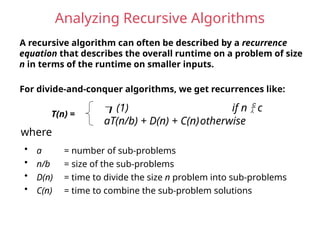
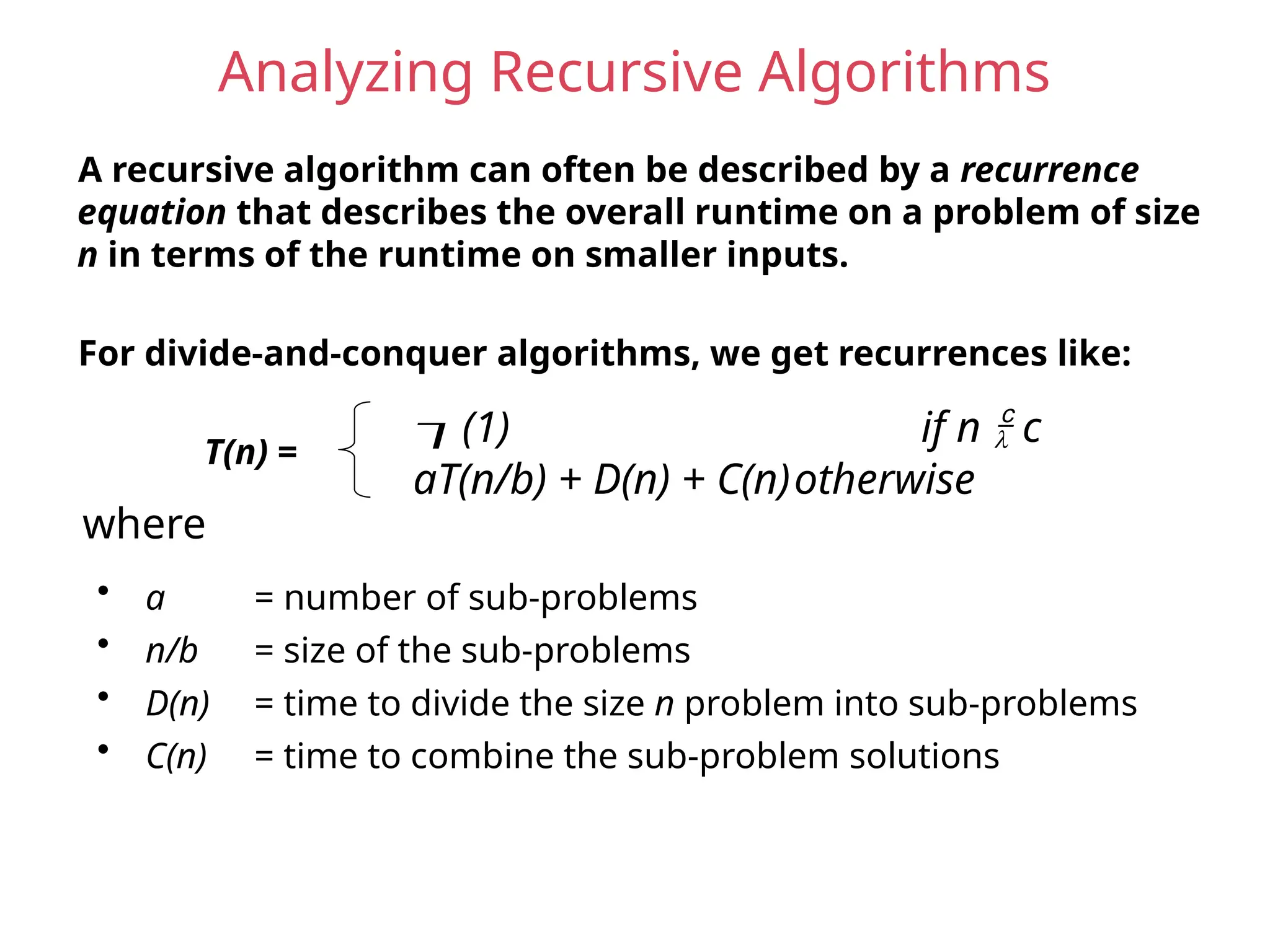
Analyzing Recursive Algorithms
Arecursive algorithm can often be described by a recurrence
equation that describes the overall runtime on a problem of size
n in terms of the runtime on smaller inputs.
For divide-and-conquer algorithms, we get recurrences like:
T(n) =
(1) if n c
aT(n/b) + D(n) + C(n)otherwise
• a = number of sub-problems
• n/b = size of the sub-problems
• D(n) = time to divide the size n problem into sub-problems
• C(n) = time to combine the sub-problem solutions
where
2.
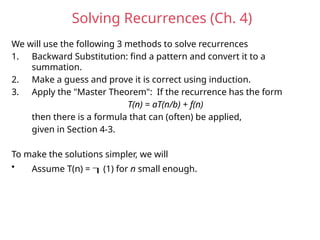
Solving Recurrences (Ch.4)
We will use the following 3 methods to solve recurrences
1. Backward Substitution: find a pattern and convert it to a
summation.
2. Make a guess and prove it is correct using induction.
3. Apply the "Master Theorem": If the recurrence has the form
T(n) = aT(n/b) + f(n)
then there is a formula that can (often) be applied,
given in Section 4-3.
To make the solutions simpler, we will
• Assume T(n) = (1) for n small enough.
3.
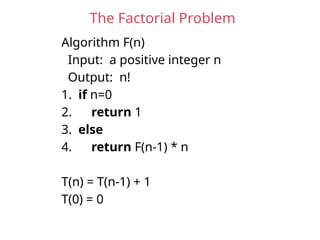
The Factorial Problem
AlgorithmF(n)
Input: a positive integer n
Output: n!
1. if n=0
2. return 1
3. else
4. return F(n-1) * n
T(n) = T(n-1) + 1
T(0) = 0
4.
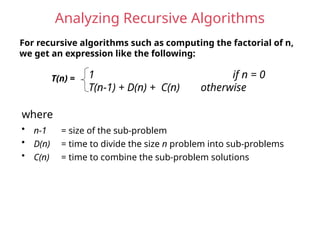
Analyzing Recursive Algorithms
Forrecursive algorithms such as computing the factorial of n,
we get an expression like the following:
T(n) = 1 if n = 0
T(n-1) + D(n) + C(n) otherwise
• n-1 = size of the sub-problem
• D(n) = time to divide the size n problem into sub-problems
• C(n) = time to combine the sub-problem solutions
where
5.
Solving recurrence forn!
Algorithm F(n)
Input: a positive integer n
Output: n!
1. if n=0
2. return 1
3. else
4. return F(n-1) * n
T(n) = T(n-1) + 1
T(0) = 0
We can solve this recurrence (ie, find an expression of the running
time that is not given in terms of itself) using backward substitution.
T(n) = T(n-1) + 1 subst T(n-1) = T(n-2) + 1
= [T(n-2) + 1] + 1 = T(n-2) + 2
subst T(n-2) = T(n-3) + 1
=[T(n-3) + 1] + 2 = T(n-3) + 3…
…
=T(n-i)+i = … = T(n-n)+n = 0 + n
Therefore, this algorithm has linear running
time.
6.
Solving Recurrences: BackwardSubstitution
Example: T(n) = 2T(n/2) + n (look familiar?)
T(n) = 2T(n/2) + n
= 2[2T(n/4) + n/2] + nexpand T(n/2)
= 4T(n/4) + n + n simplify
= 4[2T(n/8) + n/4] + n + n expand T(n/4)
= 8T(n/8) + n + n + n simplify…notice a pattern?
= . . . . . .
= 2lgn
T(n/2lgn
) + . . . + n + n + n after lgn iterations
= c2lgn
+ nlgn
= cn + nlgn 2lgn
= nlg2
= n
= (nlgn)
7.
Solving Recurrences: BackwardSubstitution
Example: T(n) = 4T(n/2) + n
T(n) = 4T(n/2) + n
= 4[4T(n/4) + n/2] + n expand T(n/2)
= 16T(n/4) + 2n + n simplify 16 = 42
= 16[4T(n/8) + n/4] + 2n + n expand T(n/4)
= 64T(n/8) + 4n + 2n + n simplify 64 = 43
= . . . . . .
= 4lgn
T(n/2lgn
) + . . . + 4n + 2n + n after lgn iterations
= c4lgn
+ n convert to summation
= cnlg4
+ n (2lgn
- 1) 4lgn
= nlg4
= n2
= cn2
+ n(n - 1) 2lgn
= nlg2
= n
= (n
2
)
Binary Search (non-recursive)
AlgorithmBinarySearch(A[1…n], k)
Input: a sorted array A of n comparable items and search key k
Output: Index of array’s element that is equal to k or -1 if k not
found
1. l = 1; r =n
2. while l r
≤
3. m = (l + r)/2
4. if k = A[m] return m
5. else if k < A[m] r = m – 1
6. else l = m + 1
7. return -1
What is the running time of this algorithm for an input of size n?
Are there best- and worst-case input instances?
10.
Binary Search (recursive)
AlgorithmBinarySearchRec(A[1…n], k, l, r)
Input: a sorted array A of n comparable items, search key k,
leftmost
and rightmost index positions in A
Output: Index of array’s element that is equal to k or -1 if k not
found
1. if (l > r) return -1
2. else
3. m = (l + r)/2
4. if k = A[m] return m
5. else if k < A[m] return BinarySearchRec(A, k, l, m-1)
6. else return BinarySearchRec(A, k, m+1, r)
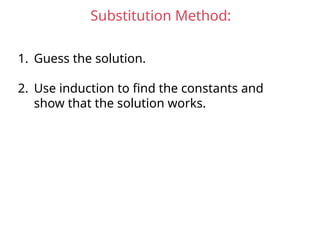
Substitution Method:
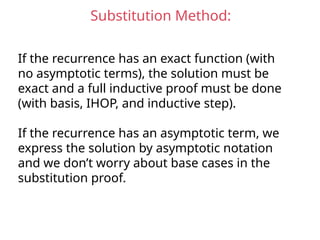
If therecurrence has an exact function (with
no asymptotic terms), the solution must be
exact and a full inductive proof must be done
(with basis, IHOP, and inductive step).
If the recurrence has an asymptotic term, we
express the solution by asymptotic notation
and we don’t worry about base cases in the
substitution proof.
13.
Substitution Method:
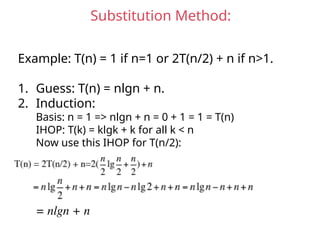
Example: T(n)= 1 if n=1 or 2T(n/2) + n if n>1.
1. Guess: T(n) = nlgn + n.
2. Induction:
Basis: n = 1 => nlgn + n = 0 + 1 = 1 = T(n)
IHOP: T(k) = klgk + k for all k < n
Now use this IHOP for T(n/2):
= nlgn + n
14.
Substitution Method:
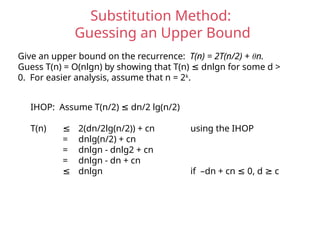
Guessing anUpper Bound
Give an upper bound on the recurrence: T(n) = 2T(n/2) + θn.
Guess T(n) = O(nlgn) by showing that T(n) dnlgn for some d >
≤
0. For easier analysis, assume that n = 2k
.
IHOP: Assume T(n/2) dn/2 lg(n/2)
≤
T(n) ≤ 2(dn/2lg(n/2)) + cn using the IHOP
= dnlg(n/2) + cn
= dnlgn - dnlg2 + cn
= dnlgn - dn + cn
≤ dnlgn if –dn + cn 0, d c
≤ ≥
15.
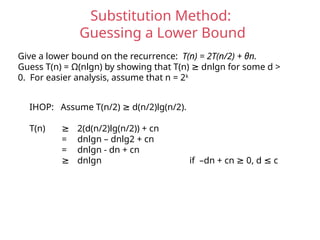
Substitution Method:
Guessing aLower Bound
Give a lower bound on the recurrence: T(n) = 2T(n/2) + θn.
Guess T(n) = Ω(nlgn) by showing that T(n) dnlgn for some d >
≥
0. For easier analysis, assume that n = 2k
IHOP: Assume T(n/2) d(n/2)lg(n/2).
≥
T(n) ≥ 2(d(n/2)lg(n/2)) + cn
= dnlgn – dnlg2 + cn
= dnlgn - dn + cn
≥ dnlgn if –dn + cn 0, d c
≥ ≤
16.
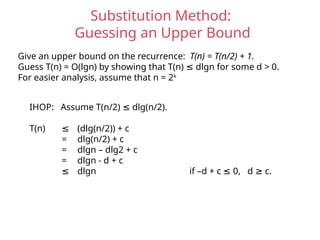
Substitution Method:
Guessing anUpper Bound
Give an upper bound on the recurrence: T(n) = T(n/2) + 1.
Guess T(n) = O(lgn) by showing that T(n) dlgn for some d > 0.
≤
For easier analysis, assume that n = 2k
IHOP: Assume T(n/2) dlg(n/2).
≤
T(n) ≤ (dlg(n/2)) + c
= dlg(n/2) + c
= dlgn – dlg2 + c
= dlgn - d + c
≤ dlgn if –d + c 0, d c.
≤ ≥
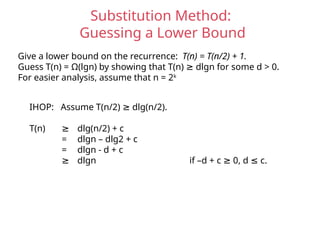
17.
Substitution Method:
Guessing aLower Bound
Give a lower bound on the recurrence: T(n) = T(n/2) + 1.
Guess T(n) = Ω(lgn) by showing that T(n) dlgn for some d > 0.
≥
For easier analysis, assume that n = 2k
IHOP: Assume T(n/2) dlg(n/2).
≥
T(n) ≥ dlg(n/2) + c
= dlgn – dlg2 + c
= dlgn - d + c
≥ dlgn if –d + c 0, d c.
≥ ≤
18.
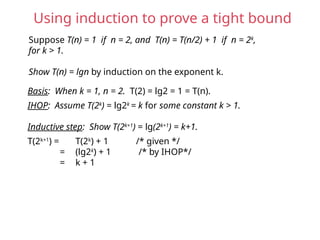
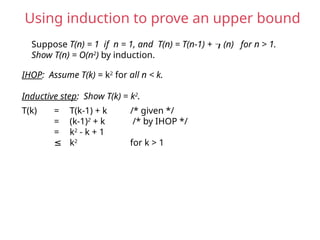
Using induction toprove a tight bound
Suppose T(n) = 1 if n = 2, and T(n) = T(n/2) + 1 if n = 2k
,
for k > 1.
Show T(n) = lgn by induction on the exponent k.
Basis: When k = 1, n = 2. T(2) = lg2 = 1 = T(n).
IHOP: Assume T(2k
) = lg2k
= k for some constant k > 1.
Inductive step: Show T(2k+1
) = lg(2k+1
) = k+1.
T(2k+1
) = T(2k
) + 1 /* given */
= (lg2k
) + 1 /* by IHOP*/
= k + 1
19.
Suppose T(n) =1 if n = 1, and T(n) = T(n-1) + (n) for n > 1.
Show T(n) = O(n2
) by induction.
IHOP: Assume T(k) = k2
for all n < k.
Inductive step: Show T(k) = k2
.
T(k) = T(k-1) + k /* given */
= (k-1)2
+ k /* by IHOP */
= k2
- k + 1
≤ k2
for k > 1
Using induction to prove an upper bound
20.
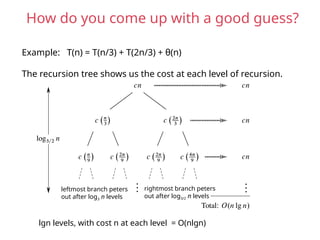
How do youcome up with a good guess?
Example: T(n) = T(n/3) + T(2n/3) + θ(n)
The recursion tree shows us the cost at each level of recursion.
leftmost branch peters
out after log3 n levels
rightmost branch peters
out after log3/2 n levels
lgn levels, with cost n at each level = O(nlgn)
21.
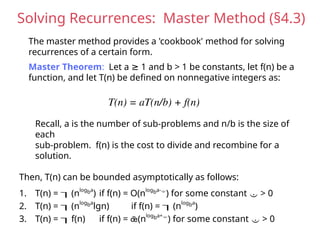
Solving Recurrences: MasterMethod (§4.3)
The master method provides a 'cookbook' method for solving
recurrences of a certain form.
Master Theorem: Let a 1 and b > 1 be constants, let f(n) be a
≥
function, and let T(n) be defined on nonnegative integers as:
T(n) = aT(n/b) + f(n)
Recall, a is the number of sub-problems and n/b is the size of
each
sub-problem. f(n) is the cost to divide and recombine for a
solution.
Then, T(n) can be bounded asymptotically as follows:
1. T(n) = (nlogba
) if f(n) = O(nlogba-
) for some constant > 0
2. T(n) = (nlogba
lgn) if f(n) = (nlogba
)
3. T(n) = f(n) if f(n) = (nlogba+
) for some constant > 0
22.
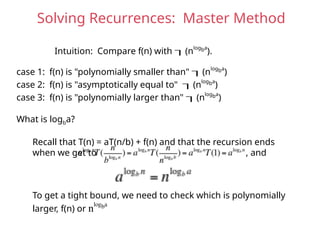
Solving Recurrences: MasterMethod
Intuition: Compare f(n) with (nlogba
).
case 1: f(n) is "polynomially smaller than" (nlogba
)
case 2: f(n) is "asymptotically equal to" (nlogba
)
case 3: f(n) is "polynomially larger than" (nlogba
)
What is logba?
Recall that T(n) = aT(n/b) + f(n) and that the recursion ends
when we get to , and
To get a tight bound, we need to check which is polynomially
larger, f(n) or nlogba
23.
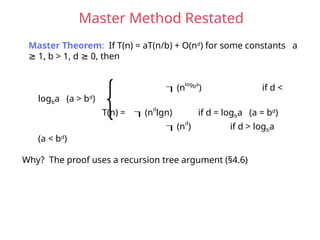
Master Method Restated
MasterTheorem: If T(n) = aT(n/b) + O(nd
) for some constants a
1, b > 1, d 0, then
≥ ≥
(nlogba
) if d <
logba (a > bd
)
T(n) = (n
d
lgn) if d = logba (a = bd
)
(nd
) if d > logba
(a < bd
)
Why? The proof uses a recursion tree argument (§4.6)
24.
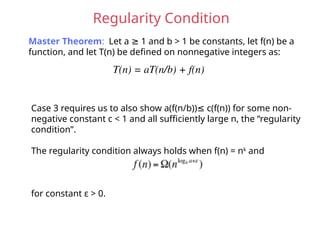
Regularity Condition
Master Theorem:Let a 1 and b > 1 be constants, let f(n) be a
≥
function, and let T(n) be defined on nonnegative integers as:
T(n) = aT(n/b) + f(n)
Case 3 requires us to also show a(f(n/b)) c(f(n)) for some non-
≤
negative constant c < 1 and all sufficiently large n, the “regularity
condition”.
The regularity condition always holds when f(n) = nk
and
for constant ε > 0.
25.
Solving Recurrences: MasterMethod (§4.3)
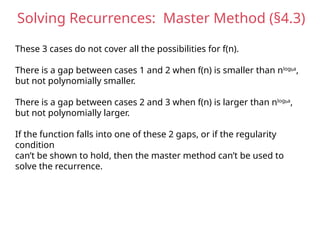
These 3 cases do not cover all the possibilities for f(n).
There is a gap between cases 1 and 2 when f(n) is smaller than nlogba
,
but not polynomially smaller.
There is a gap between cases 2 and 3 when f(n) is larger than nlogba
,
but not polynomially larger.
If the function falls into one of these 2 gaps, or if the regularity
condition
can’t be shown to hold, then the master method can’t be used to
solve the recurrence.
26.
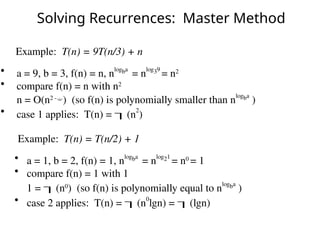
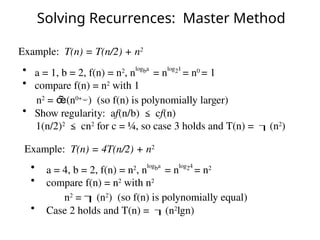
Solving Recurrences: MasterMethod
Example: T(n) = 9T(n/3) + n
• a = 9, b = 3, f(n) = n, nlogba
= nlog39
= n2
• compare f(n) = n with n2
n = O(n2 -
) (so f(n) is polynomially smaller than nlogba
)
• case 1 applies: T(n) = (n
2
)
• a = 1, b = 2, f(n) = 1, n
logba
= n
log21
= n0
= 1
• compare f(n) = 1 with 1
1 = (n0
) (so f(n) is polynomially equal to n
logba
)
• case 2 applies: T(n) = (n0
lgn) = (lgn)
Example: T(n) = T(n/2) + 1
27.
Solving Recurrences: MasterMethod
Example: T(n) = T(n/2) + n2
• a = 1, b = 2, f(n) = n2
, nlogba
= nlog21
= n0
= 1
• compare f(n) = n2
with 1
n2
= (n0+
) (so f(n) is polynomially larger)
• Show regularity: af(n/b) ≤ cf(n)
1(n/2)2
≤ cn2
for c = ¼, so case 3 holds and T(n) = (n2
)
Example: T(n) = 4T(n/2) + n2
• a = 4, b = 2, f(n) = n2
, nlogba
= nlog24
= n2
• compare f(n) = n2
with n2
n2
= (n2
) (so f(n) is polynomially equal)
• Case 2 holds and T(n) = (n2
lgn)
28.
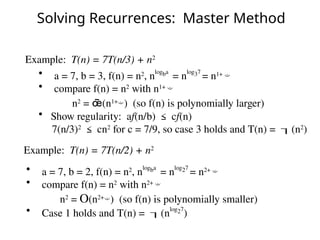
Solving Recurrences: MasterMethod
Example: T(n) = 7T(n/2) + n2
Example: T(n) = 7T(n/3) + n2
• a = 7, b = 3, f(n) = n2
, n
logba
= n
log37
= n1+
• compare f(n) = n2
with n1+
n2
= (n1+
) (so f(n) is polynomially larger)
• Show regularity: af(n/b) ≤ cf(n)
7(n/3)2
≤ cn2
for c = 7/9, so case 3 holds and T(n) = (n2
)
• a = 7, b = 2, f(n) = n2
, nlogba
= nlog27
= n2+
• compare f(n) = n2
with n2+
n2
= O(n2+
) (so f(n) is polynomially smaller)
• Case 1 holds and T(n) = (nlog27
)
#1 Ask Debra, is this equivalent to finding a closed form solution?
#2 Recall that the running time of merge-sort was written as a recurrence. We will see many
other recurrences throughout the course and we need to develop techniques for solving them.
#3 Recall that the running time of merge-sort was written as a recurrence. We will see many
other recurrences throughout the course and we need to develop techniques for solving them.
#4 Ask Debra, is this equivalent to finding a closed form solution?
#5 Recall that the running time of merge-sort was written as a recurrence. We will see many
other recurrences throughout the course and we need to develop techniques for solving them.
#6 Summation of x^k as k goes from 0 to n = (x^(n+1) - 1)/(x - 1).
Also show the iterative expansion of the recurrence for merge sort: T(n) = 2T(n/2) + n
#7 Summation of x^k as k goes from 0 to n = (x^(n+1) - 1)/(x - 1).
Also show the iterative expansion of the recurrence for merge sort: T(n) = 2T(n/2) + n
#8 Summation of x^k as k goes from 0 to n = (x^(n+1) - 1)/(x - 1).
Also show the iterative expansion of the recurrence for merge sort: T(n) = 2T(n/2) + n
#9 Recall that the running time of merge-sort was written as a recurrence. We will see many
other recurrences throughout the course and we need to develop techniques for solving them.
#10 Recall that the running time of merge-sort was written as a recurrence. We will see many
other recurrences throughout the course and we need to develop techniques for solving them.
#11 We have seen the solution to this recurrence. Is T(n) = O(n)?
Basis: n = 1. T(1) = 2(1/2) + 1 = 2. Is 2 <= c? Yes, if c >=2.
Show T(n) = big omega of nlgn.
#12 We have seen the solution to this recurrence. Is T(n) = O(n)?
Basis: n = 1. T(1) = 2(1/2) + 1 = 2. Is 2 <= c? Yes, if c >=2.
Show T(n) = big omega of nlgn.
#13 We have seen the solution to this recurrence. Is T(n) = O(n)?
Basis: n = 1. T(1) = 2(1/2) + 1 = 2. Is 2 <= c? Yes, if c >=2.
Show T(n) = big omega of nlgn.
#14 We have seen the solution to this recurrence. Is T(n) = O(n)?
Basis: n = 1. T(1) = 2(1/2) + 1 = 2. Is 2 <= c? Yes, if c >=2.
Show T(n) = big omega of nlgn.
#15 We have seen the solution to this recurrence. Is T(n) = O(n)?
Basis: n = 1. T(1) = 2(1/2) + 1 = 2. Is 2 <= c? Yes, if c >=2.
Show T(n) = big omega of nlgn.
#16 We have seen the solution to this recurrence. Is T(n) = O(n)?
Basis: n = 1. T(1) = 2(1/2) + 1 = 2. Is 2 <= c? Yes, if c >=2.
Show T(n) = big omega of nlgn.
#17 We have seen the solution to this recurrence. Is T(n) = O(n)?
Basis: n = 1. T(1) = 2(1/2) + 1 = 2. Is 2 <= c? Yes, if c >=2.
Show T(n) = big omega of nlgn.
#18 We have seen the solution to this recurrence. Is T(n) = O(n)?
Basis: n = 1. T(1) = 2(1/2) + 1 = 2. Is 2 <= c? Yes, if c >=2.
Show T(n) = big omega of nlgn.
#19 We have seen the solution to this recurrence. Is T(n) = O(n)?
Basis: n = 1. T(1) = 2(1/2) + 1 = 2. Is 2 <= c? Yes, if c >=2.
Show T(n) = big omega of nlgn.
#20 We have seen the solution to this recurrence. Is T(n) = O(n)?
Basis: n = 1. T(1) = 2(1/2) + 1 = 2. Is 2 <= c? Yes, if c >=2.
Show T(n) = big omega of nlgn.
#21 Write more general version of case 2 on board.
#23 Write more general version of case 2 on board.
#24 Write more general version of case 2 on board.
#25 Write more general version of case 2 on board.
#31 If time permits, look at recurrence for binary search.
T(n) = T(n/2) + 1
#32 Write more general version of case 2 on board.
#33 Add costs and times column on board.
Best case:
- always find that A[i] < = key the first time while is tested in line 4.
- Running time, T(n) = an + b for constants a and b.
Worst case
- always find that A[i] > key in while loop test of line 4.
- have to compare key to all elements to left of the jth position (j - 1) elements.
- summation j as j goes from 1 to n is known as an arithmetic series. This series will appear often in analyses.
* show value of summations in while loop
- Running time is an^2 + bn + c for constants a, b, and c
![Solving recurrence for n!
Algorithm F(n)
Input: a positive integer n
Output: n!
1. if n=0
2. return 1
3. else
4. return F(n-1) * n
T(n) = T(n-1) + 1
T(0) = 0
We can solve this recurrence (ie, find an expression of the running
time that is not given in terms of itself) using backward substitution.
T(n) = T(n-1) + 1 subst T(n-1) = T(n-2) + 1
= [T(n-2) + 1] + 1 = T(n-2) + 2
subst T(n-2) = T(n-3) + 1
=[T(n-3) + 1] + 2 = T(n-3) + 3…
…
=T(n-i)+i = … = T(n-n)+n = 0 + n
Therefore, this algorithm has linear running
time.](https://image.slidesharecdn.com/7351407-250713104246-16431b45/85/recurrence-relation-is-explained-in-this-5-320.jpg)
![Solving Recurrences: Backward Substitution
Example: T(n) = 2T(n/2) + n (look familiar?)
T(n) = 2T(n/2) + n
= 2[2T(n/4) + n/2] + nexpand T(n/2)
= 4T(n/4) + n + n simplify
= 4[2T(n/8) + n/4] + n + n expand T(n/4)
= 8T(n/8) + n + n + n simplify…notice a pattern?
= . . . . . .
= 2lgn
T(n/2lgn
) + . . . + n + n + n after lgn iterations
= c2lgn
+ nlgn
= cn + nlgn 2lgn
= nlg2
= n
= (nlgn)](https://image.slidesharecdn.com/7351407-250713104246-16431b45/85/recurrence-relation-is-explained-in-this-6-320.jpg)
![Solving Recurrences: Backward Substitution
Example: T(n) = 4T(n/2) + n
T(n) = 4T(n/2) + n
= 4[4T(n/4) + n/2] + n expand T(n/2)
= 16T(n/4) + 2n + n simplify 16 = 42
= 16[4T(n/8) + n/4] + 2n + n expand T(n/4)
= 64T(n/8) + 4n + 2n + n simplify 64 = 43
= . . . . . .
= 4lgn
T(n/2lgn
) + . . . + 4n + 2n + n after lgn iterations
= c4lgn
+ n convert to summation
= cnlg4
+ n (2lgn
- 1) 4lgn
= nlg4
= n2
= cn2
+ n(n - 1) 2lgn
= nlg2
= n
= (n
2
)](https://image.slidesharecdn.com/7351407-250713104246-16431b45/85/recurrence-relation-is-explained-in-this-7-320.jpg)
![Solving Recurrences: Backward Substitution
Example: T(n) = T(n/2) + 1
T(n) = T(n/2) + 1
= [T(n/4) + 1] + 1 expand T(n/2)
= T(n/4) + 2 simplify
= [T(n/8) + 1] + 2 expand T(n/4)
= T(n/8) + 3 simplify
= . . . . . .
= T(n/2lgn
) + lgn 2lgn
= nlg2
= n
= c + lgn
= (lgn)](https://image.slidesharecdn.com/7351407-250713104246-16431b45/85/recurrence-relation-is-explained-in-this-8-320.jpg)
![Binary Search (non-recursive)
Algorithm BinarySearch(A[1…n], k)
Input: a sorted array A of n comparable items and search key k
Output: Index of array’s element that is equal to k or -1 if k not
found
1. l = 1; r =n
2. while l r
≤
3. m = (l + r)/2
4. if k = A[m] return m
5. else if k < A[m] r = m – 1
6. else l = m + 1
7. return -1
What is the running time of this algorithm for an input of size n?
Are there best- and worst-case input instances?](https://image.slidesharecdn.com/7351407-250713104246-16431b45/85/recurrence-relation-is-explained-in-this-9-320.jpg)
![Binary Search (recursive)
Algorithm BinarySearchRec(A[1…n], k, l, r)
Input: a sorted array A of n comparable items, search key k,
leftmost
and rightmost index positions in A
Output: Index of array’s element that is equal to k or -1 if k not
found
1. if (l > r) return -1
2. else
3. m = (l + r)/2
4. if k = A[m] return m
5. else if k < A[m] return BinarySearchRec(A, k, l, m-1)
6. else return BinarySearchRec(A, k, m+1, r)](https://image.slidesharecdn.com/7351407-250713104246-16431b45/85/recurrence-relation-is-explained-in-this-10-320.jpg)