PUSH DOWN AUTOMATA
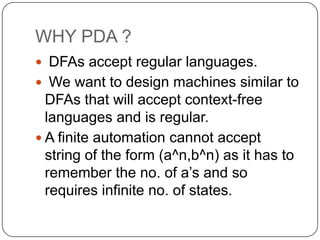
WHY PDA ?
 DFAs accept regular languages.
 We want to design machines similar to
DFAs that will accept context-free
languages and is regular.
 A finite automation cannot accept
string of the form (a^n,b^n) as it has to
remember the no. of a’s and so
requires infinite no. of states.
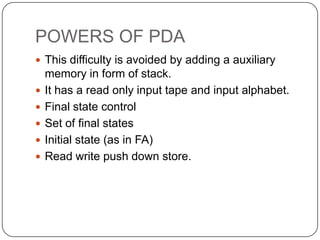
POWERS OF PDA
 This difficulty is avoided by adding a auxiliary
memory in form of stack.
 It has a read only input tape and input alphabet.
 Final state control
 Set of final states
 Initial state (as in FA)
 Read write push down store.
PDA MODEL
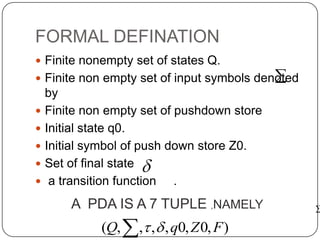
FORMAL DEFINATION
 Finite nonempty set of states Q.
 Finite non empty set of input symbols denoted
by
 Finite non empty set of pushdown store
 Initial state q0.
 Initial symbol of push down store Z0.
 Set of final state
 a transition function .



A PDA IS A 7 TUPLE ,NAMELY
 ),0,0,,,,( FZqQ 
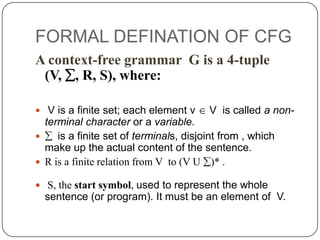
FORMAL DEFINATION OF CFG
A context-free grammar G is a 4-tuple
(V, , R, S), where:
 V is a finite set; each element v  V is called a non-
terminal character or a variable.
  is a finite set of terminals, disjoint from , which
make up the actual content of the sentence.
 R is a finite relation from V to (V U )* .
 S, the start symbol, used to represent the whole
sentence (or program). It must be an element of V.
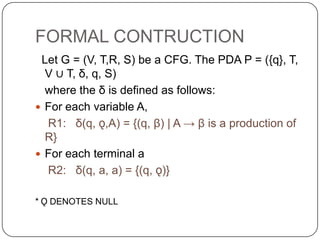
FORMAL CONTRUCTION
Let G = (V, T,R, S) be a CFG. The PDA P = ({q}, T,
V ∪ T, δ, q, S)
where the δ is defined as follows:
 For each variable A,
R1: δ(q, ǫ,A) = {(q, β) | A → β is a production of
R}
 For each terminal a
R2: δ(q, a, a) = {(q, ǫ)}
* Ǫ DENOTES NULL
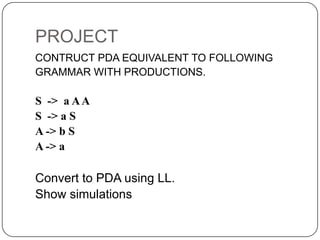
PROJECT
CONTRUCT PDA EQUIVALENT TO FOLLOWING
GRAMMAR WITH PRODUCTIONS.
S -> a AA
S -> a S
A -> b S
A -> a
Convert to PDA using LL.
Show simulations
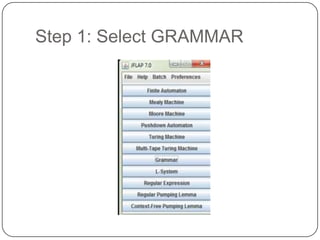
Step 1: Select GRAMMAR
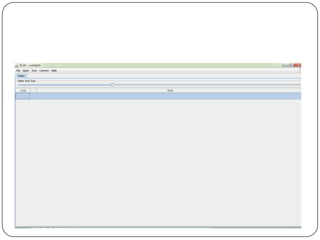
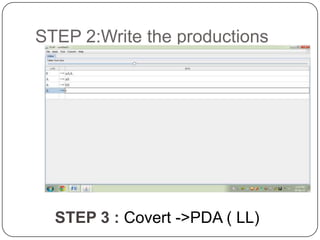
STEP 2:Write the productions
STEP 3 : Covert ->PDA ( LL)
OUTPUT :
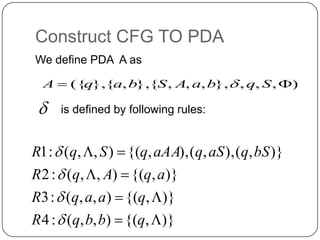
Construct CFG TO PDA
We define PDA A as
is defined by following rules:
),,,},,,,{},,{},({  SqbaASbaqA 

)},{(),,(:4
)},{(),,(:3
)},{(),,(:2
)},(),,(),,{(),,(:1




qbbqR
qaaqR
aqAqR
bSqaSqaAAqSqR




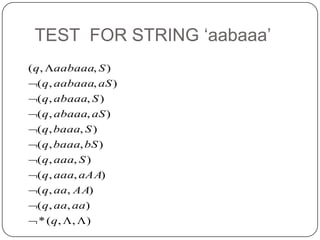
TEST FOR STRING ‘aabaaa’
),,(*
),,(
),,(
),,(
),,(
),,(
),,(
),,(
),,(
),,(
),,(











q
aaaaq
AAaaq
aAAaaaq
Saaaq
bSbaaaq
Sbaaaq
aSabaaaq
Sabaaaq
aSaabaaaq
Saabaaaq
THANK YOU

Push down automata

  • 1.
  • 2.
    WHY PDA ? DFAs accept regular languages.  We want to design machines similar to DFAs that will accept context-free languages and is regular.  A finite automation cannot accept string of the form (a^n,b^n) as it has to remember the no. of a’s and so requires infinite no. of states.
  • 3.
    POWERS OF PDA This difficulty is avoided by adding a auxiliary memory in form of stack.  It has a read only input tape and input alphabet.  Final state control  Set of final states  Initial state (as in FA)  Read write push down store.
  • 4.
  • 5.
    FORMAL DEFINATION  Finitenonempty set of states Q.  Finite non empty set of input symbols denoted by  Finite non empty set of pushdown store  Initial state q0.  Initial symbol of push down store Z0.  Set of final state  a transition function .    A PDA IS A 7 TUPLE ,NAMELY  ),0,0,,,,( FZqQ 
  • 6.
    FORMAL DEFINATION OFCFG A context-free grammar G is a 4-tuple (V, , R, S), where:  V is a finite set; each element v  V is called a non- terminal character or a variable.   is a finite set of terminals, disjoint from , which make up the actual content of the sentence.  R is a finite relation from V to (V U )* .  S, the start symbol, used to represent the whole sentence (or program). It must be an element of V.
  • 7.
    FORMAL CONTRUCTION Let G= (V, T,R, S) be a CFG. The PDA P = ({q}, T, V ∪ T, δ, q, S) where the δ is defined as follows:  For each variable A, R1: δ(q, ǫ,A) = {(q, β) | A → β is a production of R}  For each terminal a R2: δ(q, a, a) = {(q, ǫ)} * Ǫ DENOTES NULL
  • 8.
    PROJECT CONTRUCT PDA EQUIVALENTTO FOLLOWING GRAMMAR WITH PRODUCTIONS. S -> a AA S -> a S A -> b S A -> a Convert to PDA using LL. Show simulations
  • 9.
  • 11.
    STEP 2:Write theproductions STEP 3 : Covert ->PDA ( LL)
  • 12.
  • 13.
    Construct CFG TOPDA We define PDA A as is defined by following rules: ),,,},,,,{},,{},({  SqbaASbaqA   )},{(),,(:4 )},{(),,(:3 )},{(),,(:2 )},(),,(),,{(),,(:1     qbbqR qaaqR aqAqR bSqaSqaAAqSqR    
  • 14.
    TEST FOR STRING‘aabaaa’ ),,(* ),,( ),,( ),,( ),,( ),,( ),,( ),,( ),,( ),,( ),,(            q aaaaq AAaaq aAAaaaq Saaaq bSbaaaq Sbaaaq aSabaaaq Sabaaaq aSaabaaaq Saabaaaq
  • 15.