Asymptotic Notation 1
Growth of Functions and
Aymptotic Notation
• When we study algorithms, we are interested in
characterizing them according to their efficiency.
• We are usually interesting in the order of growth
of the running time of an algorithm, not in the
exact running time. This is also referred to as the
asymptotic running time.
• We need to develop a way to talk about rate of
growth of functions so that we can compare
algorithms.
• Asymptotic notation gives us a method for
classifying functions according to their rate of
growth.
Asymptotic Notation 2
Big-O Notation
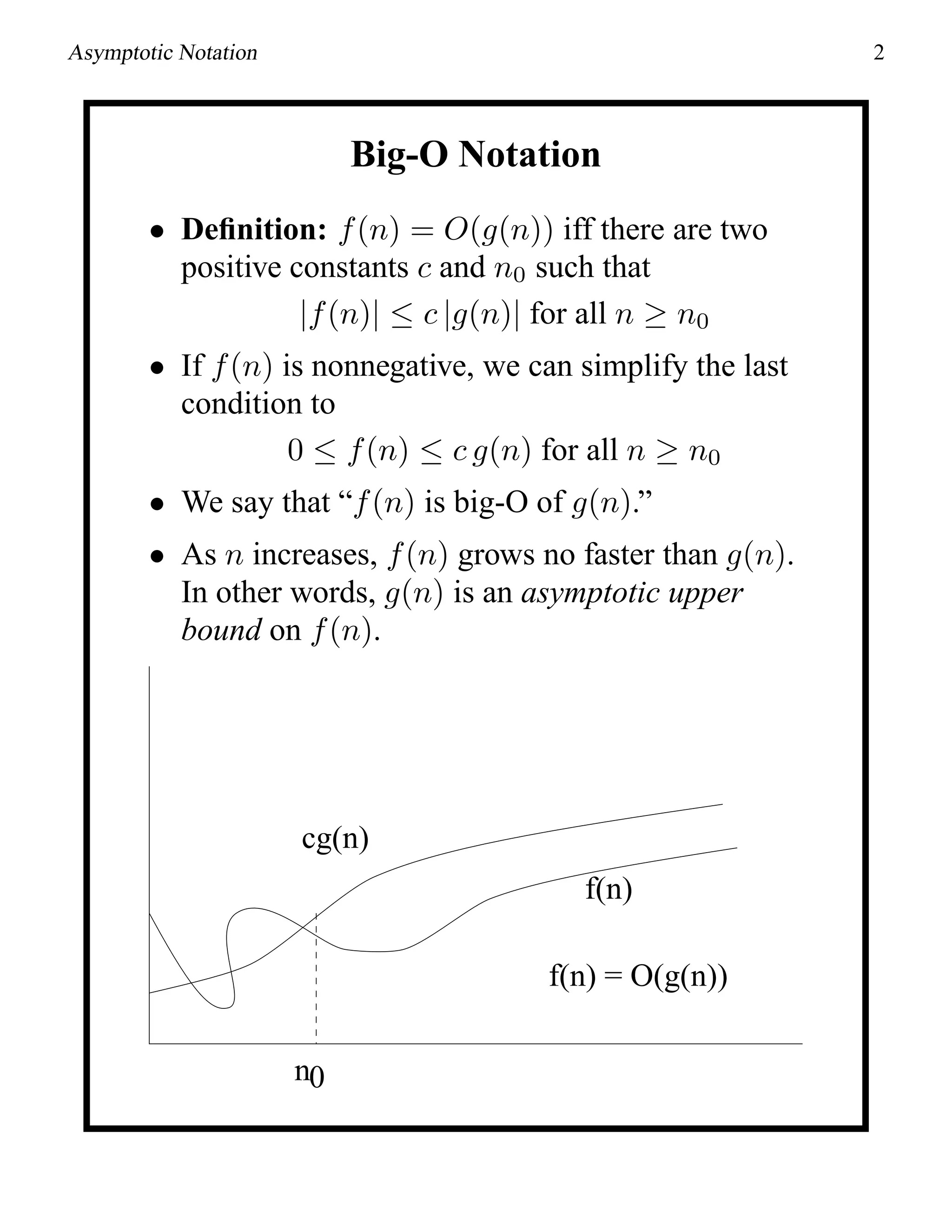
• Definition: f(n) = O(g(n)) iff there are two
positive constants c and n0 such that
|f(n)| ≤ c |g(n)| for all n ≥ n0
• If f(n) is nonnegative, we can simplify the last
condition to
0 ≤ f(n) ≤ c g(n) for all n ≥ n0
• We say that “f(n) is big-O of g(n).”
• As n increases, f(n) grows no faster than g(n).
In other words, g(n) is an asymptotic upper
bound on f(n).
f(n) = O(g(n))
n0
cg(n)
f(n)
Asymptotic Notation 3
Example: n2
+ n = O(n3
)
Proof:
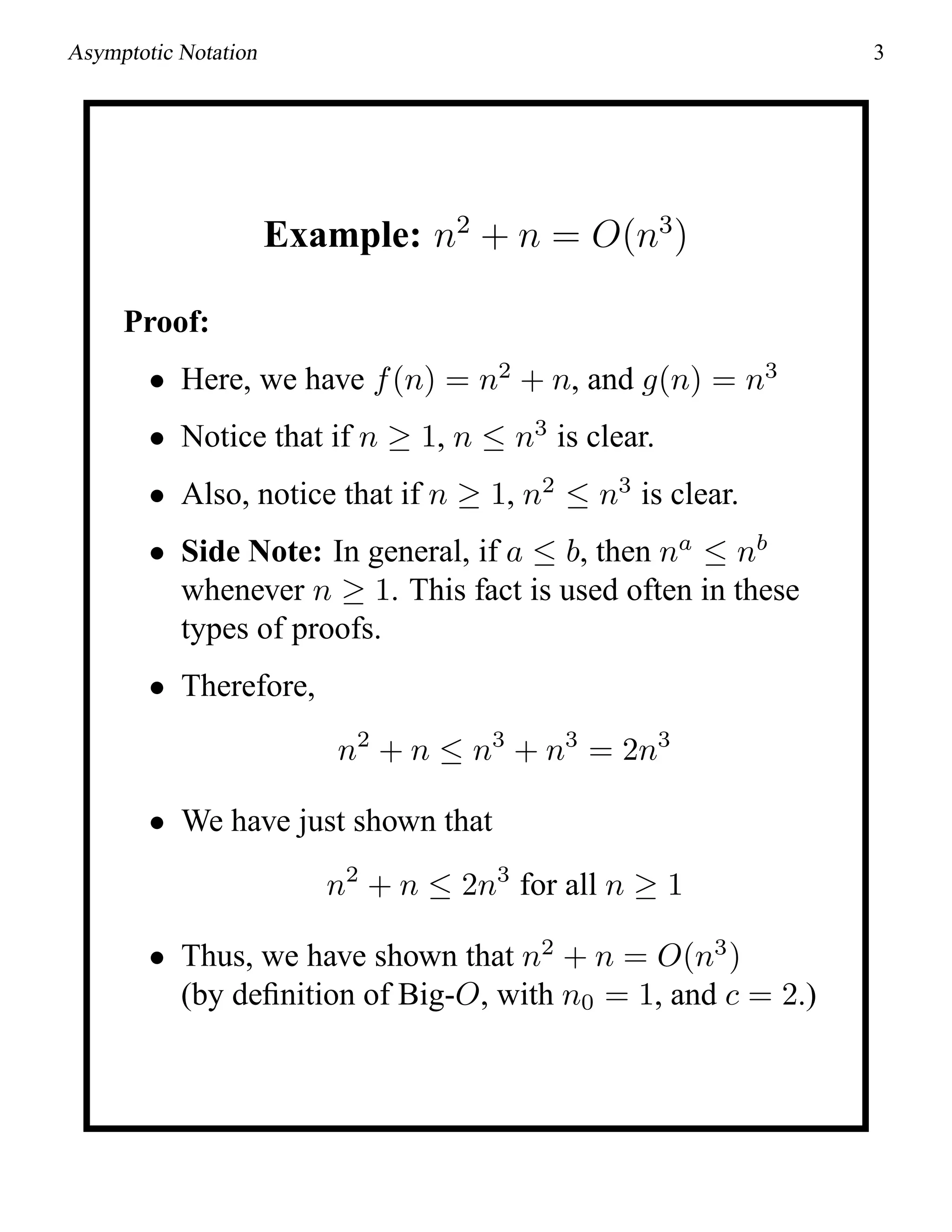
• Here, we have f(n) = n2
+ n, and g(n) = n3
• Notice that if n ≥ 1, n ≤ n3
is clear.
• Also, notice that if n ≥ 1, n2
≤ n3
is clear.
• Side Note: In general, if a ≤ b, then na
≤ nb
whenever n ≥ 1. This fact is used often in these
types of proofs.
• Therefore,
n2
+ n ≤ n3
+ n3
= 2n3
• We have just shown that
n2
+ n ≤ 2n3
for all n ≥ 1
• Thus, we have shown that n2
+ n = O(n3
)
(by definition of Big-O, with n0 = 1, and c = 2.)
Asymptotic Notation 4
Big-Ω notation
• Definition: f(n) = Ω(g(n)) iff there are two
positive constants c and n0 such that
|f(n)| ≥ c |g(n)| for all n ≥ n0
• If f(n) is nonnegative, we can simplify the last
condition to
0 ≤ c g(n) ≤ f(n) for all n ≥ n0
• We say that “f(n) is omega of g(n).”
• As n increases, f(n) grows no slower than g(n).
In other words, g(n) is an asymptotic lower bound
on f(n).
n0
cg(n)
f(n)
f(n) = O(g(n))
Asymptotic Notation 5
Example: n3
+ 4n2
= Ω(n2
)
Proof:
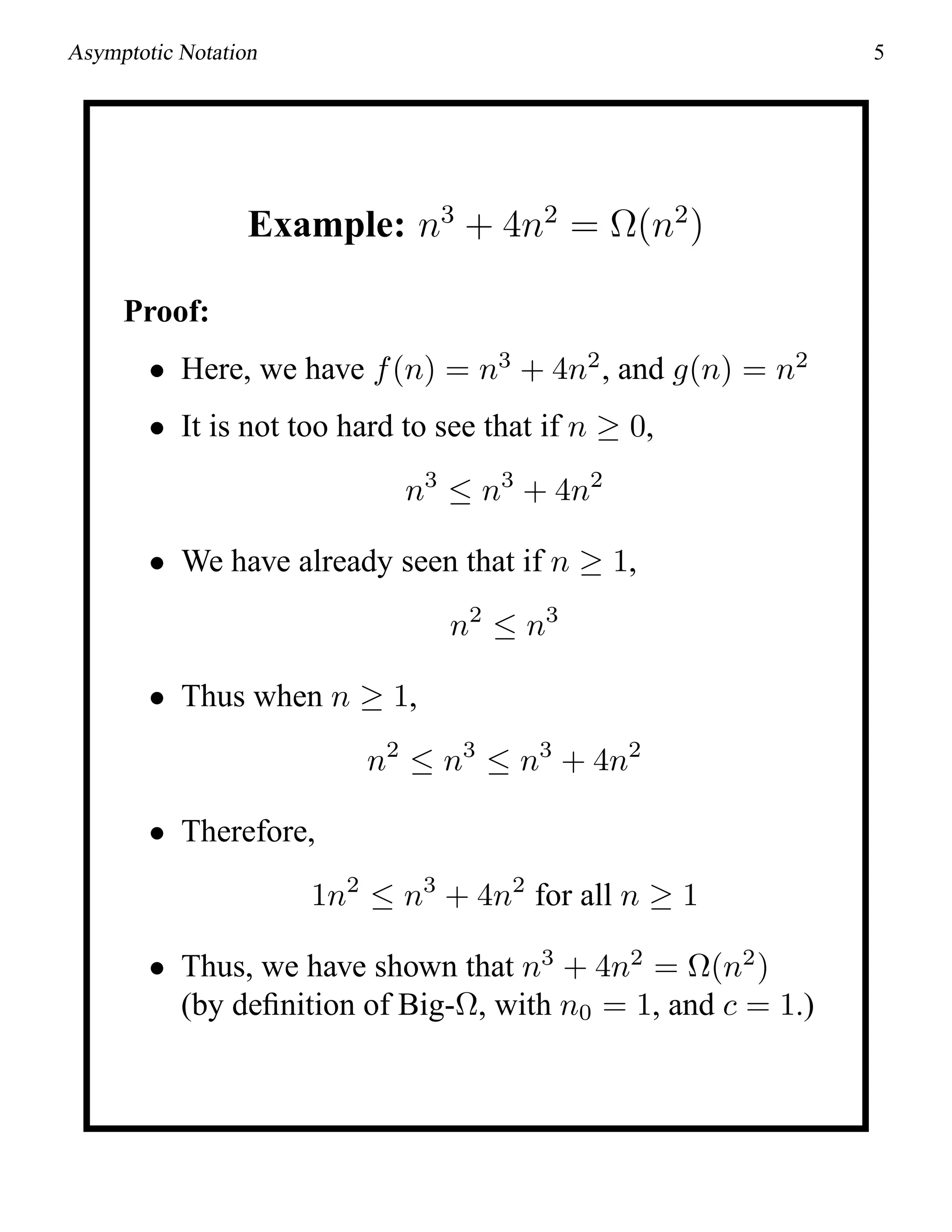
• Here, we have f(n) = n3
+ 4n2
, and g(n) = n2
• It is not too hard to see that if n ≥ 0,
n3
≤ n3
+ 4n2
• We have already seen that if n ≥ 1,
n2
≤ n3
• Thus when n ≥ 1,
n2
≤ n3
≤ n3
+ 4n2
• Therefore,
1n2
≤ n3
+ 4n2
for all n ≥ 1
• Thus, we have shown that n3
+ 4n2
= Ω(n2
)
(by definition of Big-Ω, with n0 = 1, and c = 1.)
Asymptotic Notation 6
Big-Θ notation
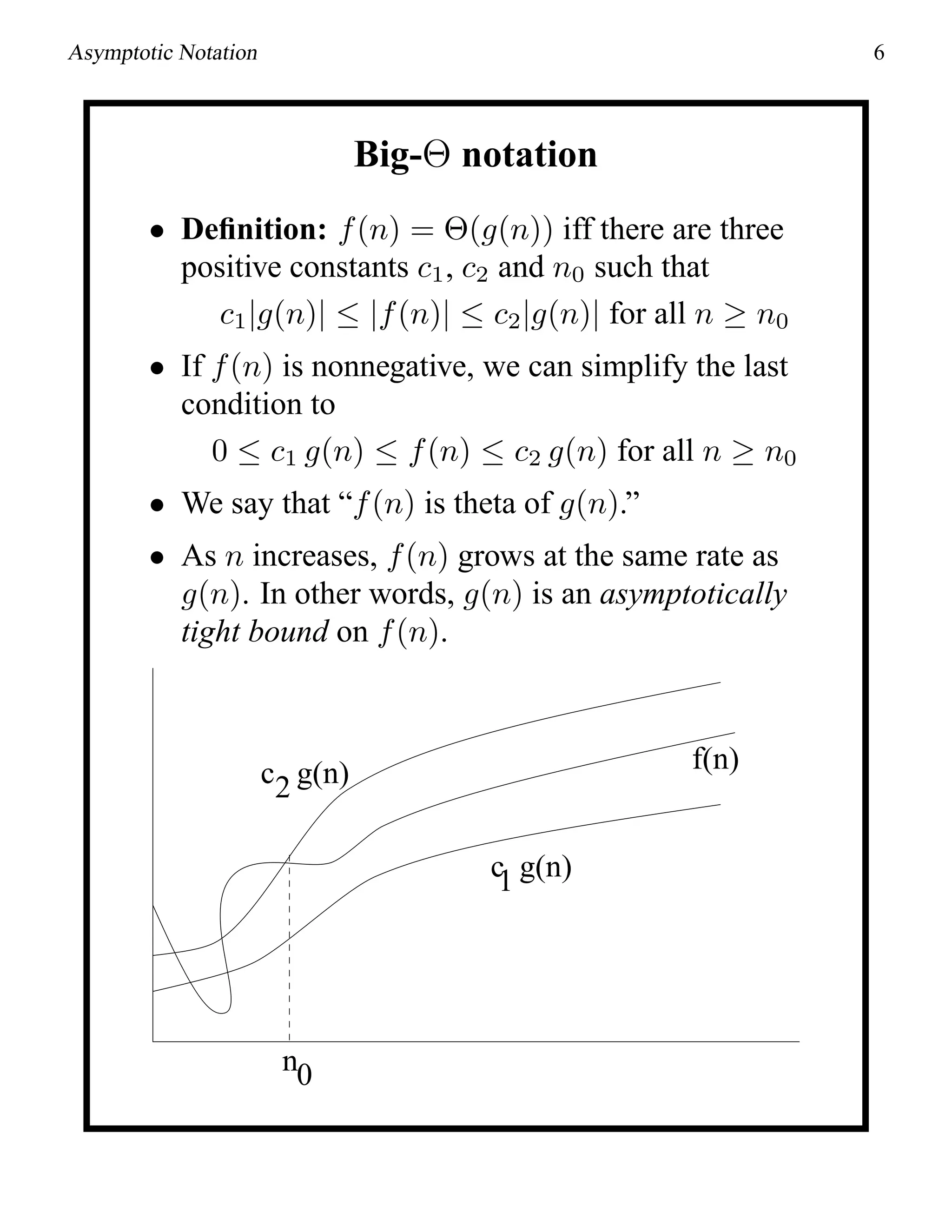
• Definition: f(n) = Θ(g(n)) iff there are three
positive constants c1, c2 and n0 such that
c1|g(n)| ≤ |f(n)| ≤ c2|g(n)| for all n ≥ n0
• If f(n) is nonnegative, we can simplify the last
condition to
0 ≤ c1 g(n) ≤ f(n) ≤ c2 g(n) for all n ≥ n0
• We say that “f(n) is theta of g(n).”
• As n increases, f(n) grows at the same rate as
g(n). In other words, g(n) is an asymptotically
tight bound on f(n).
c2 g(n)
c1 g(n)
f(n)
n0
Asymptotic Notation 7
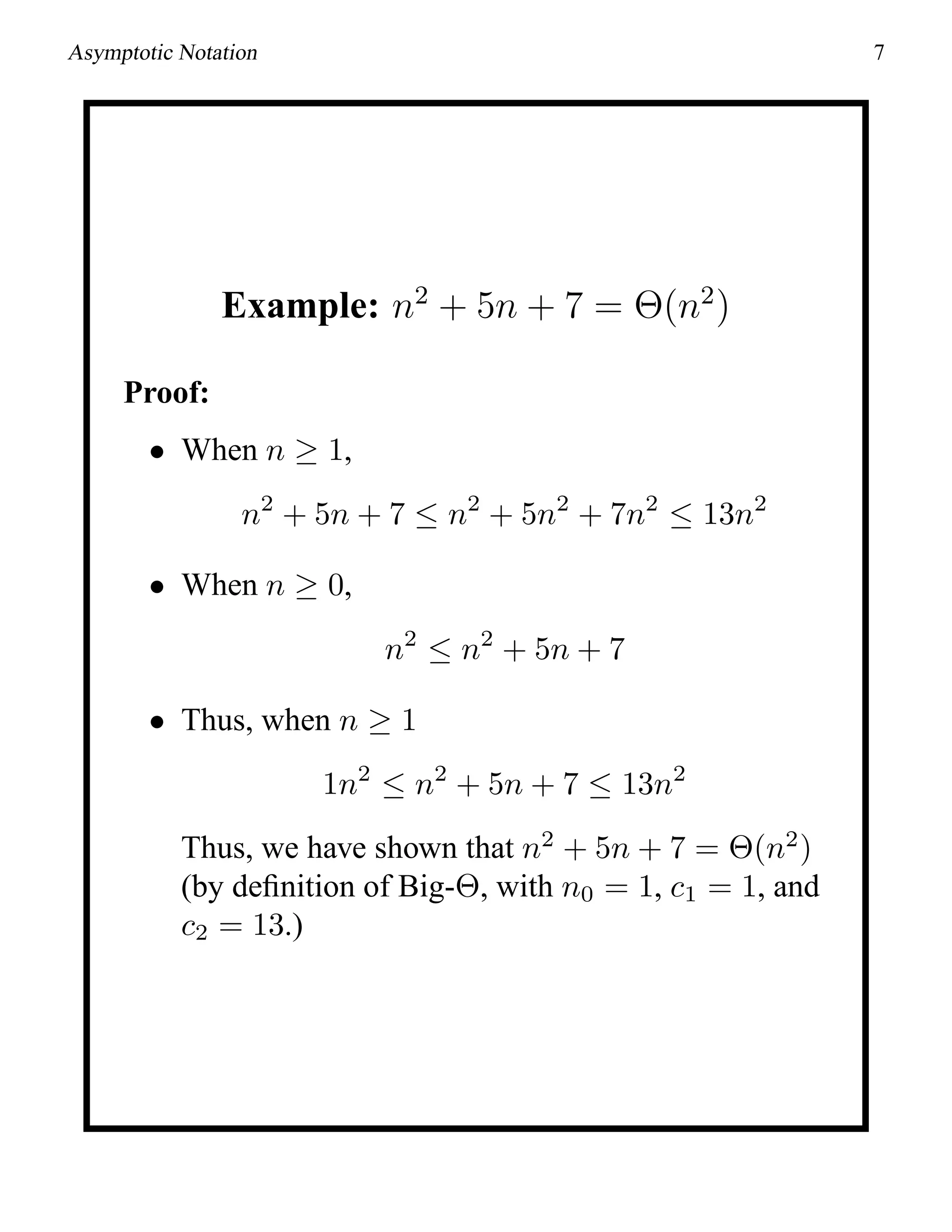
Example: n2
+ 5n + 7 = Θ(n2
)
Proof:
• When n ≥ 1,
n2
+ 5n + 7 ≤ n2
+ 5n2
+ 7n2
≤ 13n2
• When n ≥ 0,
n2
≤ n2
+ 5n + 7
• Thus, when n ≥ 1
1n2
≤ n2
+ 5n + 7 ≤ 13n2
Thus, we have shown that n2
+ 5n + 7 = Θ(n2
)
(by definition of Big-Θ, with n0 = 1, c1 = 1, and
c2 = 13.)
Asymptotic Notation 8
Arithmetic of Big-O, Ω, and Θ notations
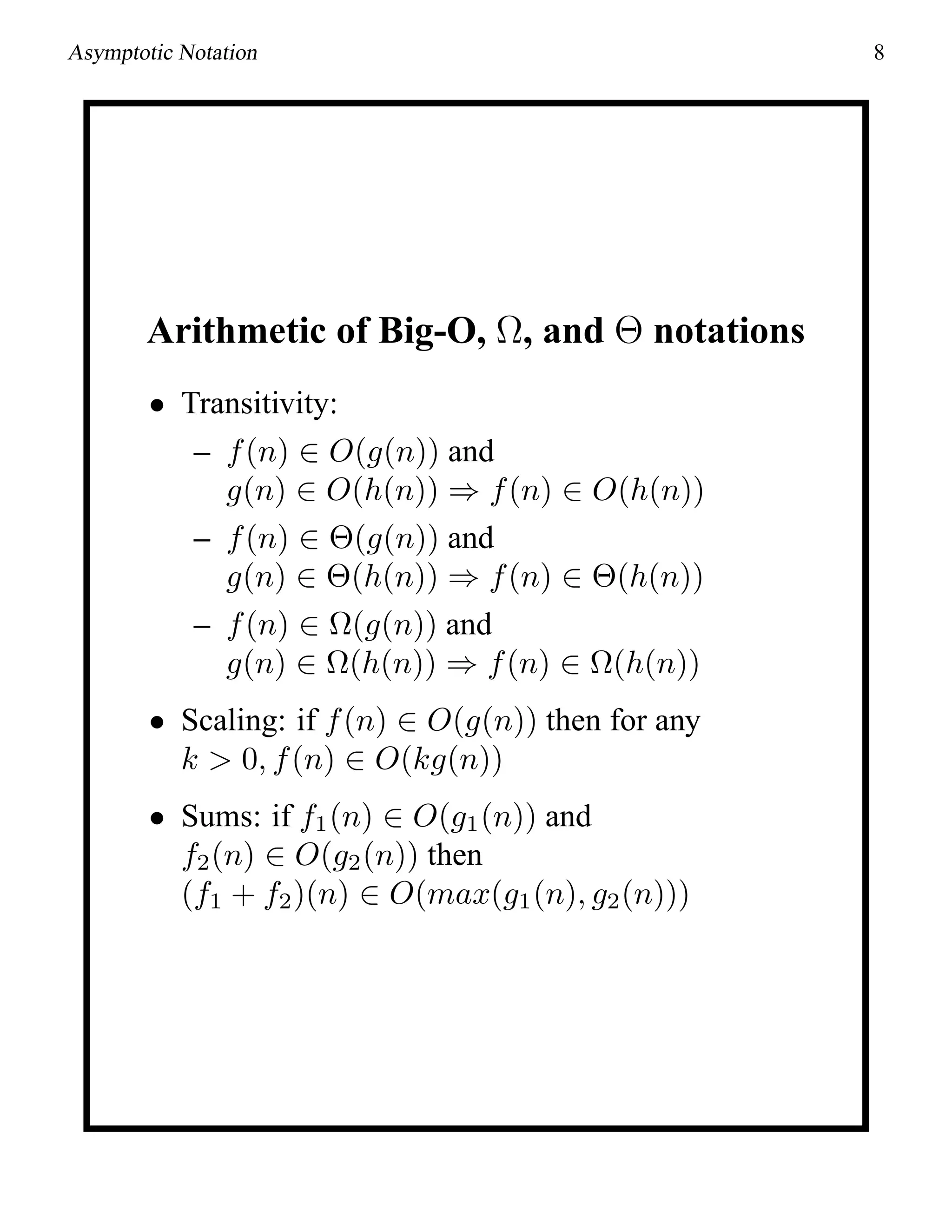
• Transitivity:
– f(n) ∈ O(g(n)) and
g(n) ∈ O(h(n)) ⇒ f(n) ∈ O(h(n))
– f(n) ∈ Θ(g(n)) and
g(n) ∈ Θ(h(n)) ⇒ f(n) ∈ Θ(h(n))
– f(n) ∈ Ω(g(n)) and
g(n) ∈ Ω(h(n)) ⇒ f(n) ∈ Ω(h(n))
• Scaling: if f(n) ∈ O(g(n)) then for any
k > 0, f(n) ∈ O(kg(n))
• Sums: if f1(n) ∈ O(g1(n)) and
f2(n) ∈ O(g2(n)) then
(f1 + f2)(n) ∈ O(max(g1(n), g2(n)))
Asymptotic Notation 9
Strategies for Big-O
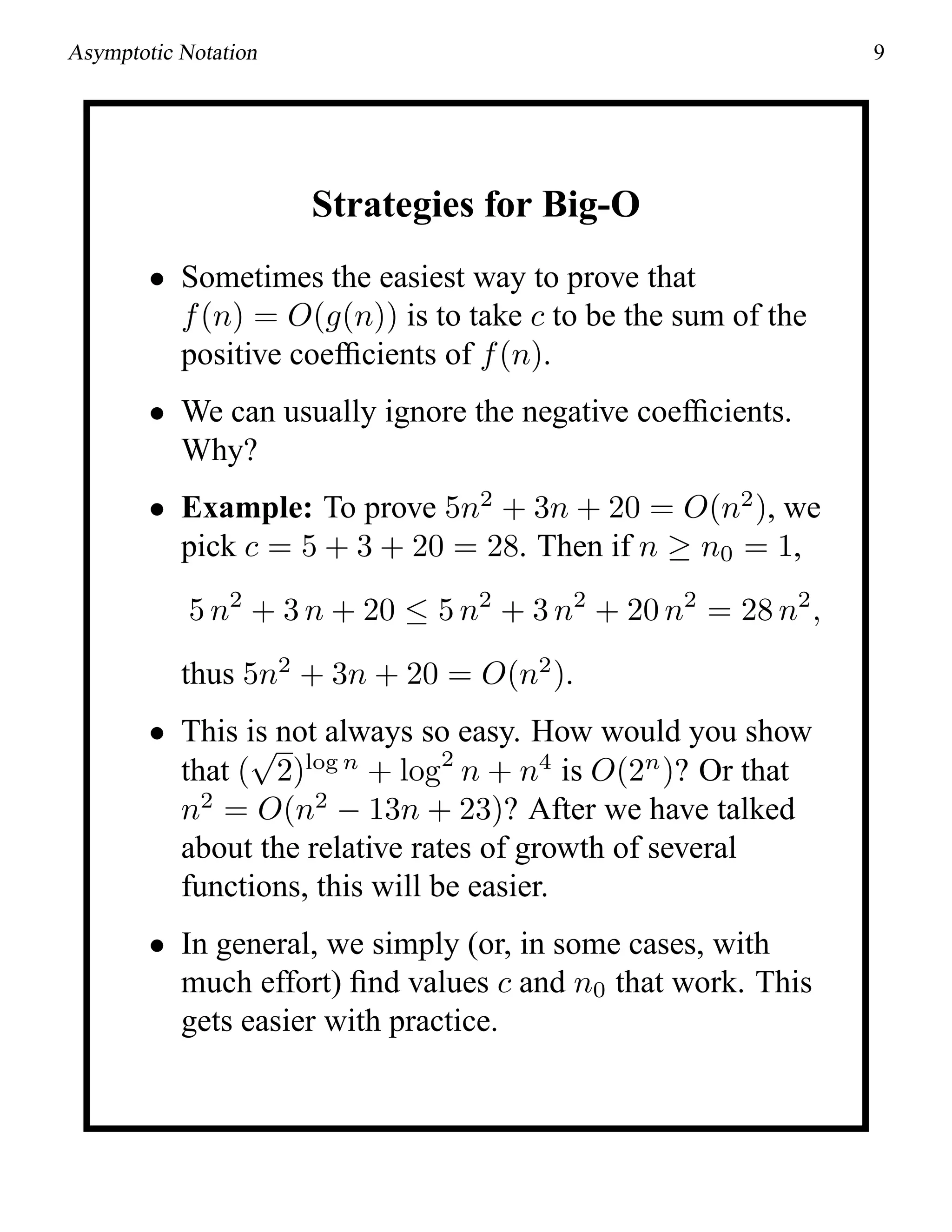
• Sometimes the easiest way to prove that
f(n) = O(g(n)) is to take c to be the sum of the
positive coefficients of f(n).
• We can usually ignore the negative coefficients.
Why?
• Example: To prove 5n2
+ 3n + 20 = O(n2
), we
pick c = 5 + 3 + 20 = 28. Then if n ≥ n0 = 1,
5 n2
+ 3 n + 20 ≤ 5 n2
+ 3 n2
+ 20 n2
= 28 n2
,
thus 5n2
+ 3n + 20 = O(n2
).
• This is not always so easy. How would you show
that (
√
2)log n
+ log2
n + n4
is O(2n
)? Or that
n2
= O(n2
− 13n + 23)? After we have talked
about the relative rates of growth of several
functions, this will be easier.
• In general, we simply (or, in some cases, with
much effort) find values c and n0 that work. This
gets easier with practice.
Asymptotic Notation 10
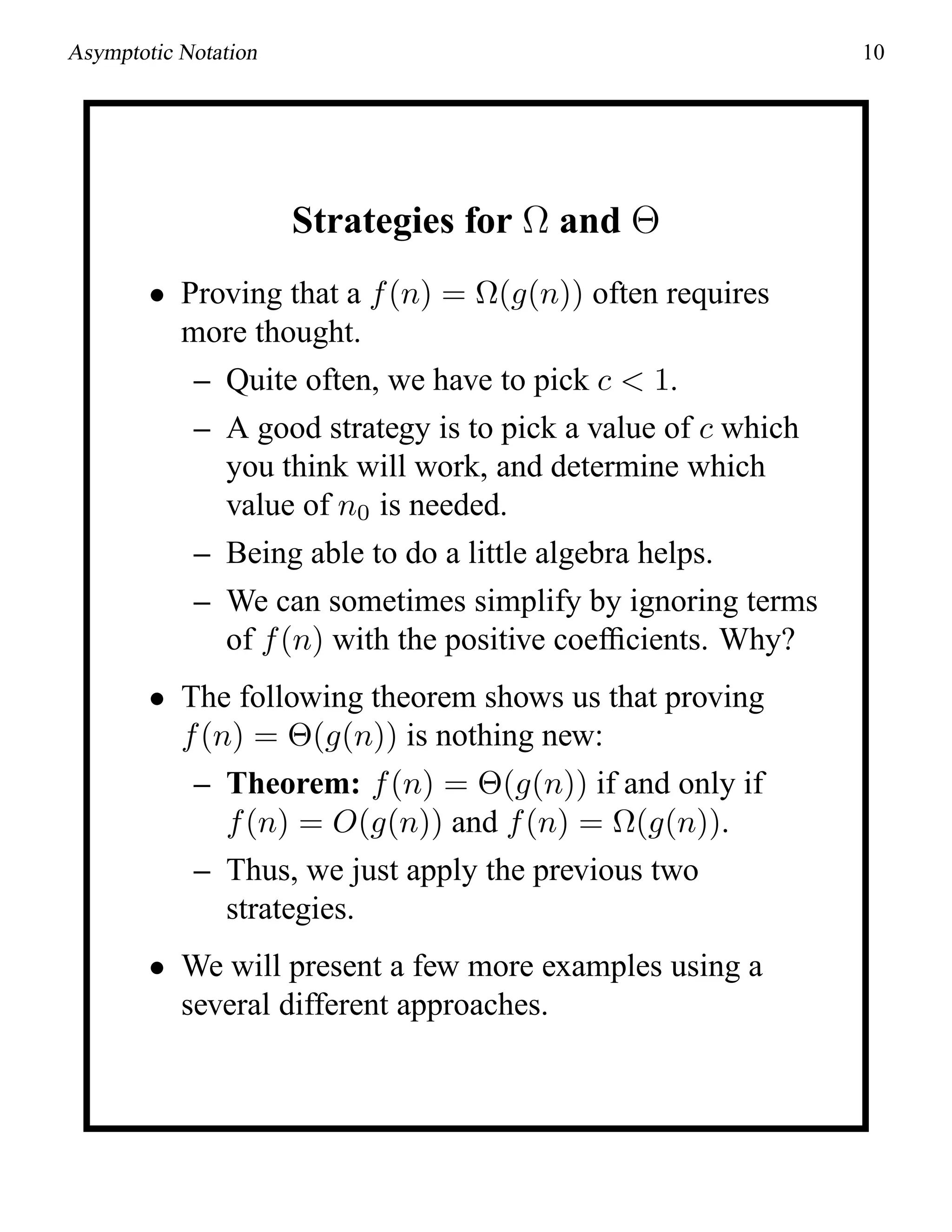
Strategies for Ω and Θ
• Proving that a f(n) = Ω(g(n)) often requires
more thought.
– Quite often, we have to pick c < 1.
– A good strategy is to pick a value of c which
you think will work, and determine which
value of n0 is needed.
– Being able to do a little algebra helps.
– We can sometimes simplify by ignoring terms
of f(n) with the positive coefficients. Why?
• The following theorem shows us that proving
f(n) = Θ(g(n)) is nothing new:
– Theorem: f(n) = Θ(g(n)) if and only if
f(n) = O(g(n)) and f(n) = Ω(g(n)).
– Thus, we just apply the previous two
strategies.
• We will present a few more examples using a
several different approaches.
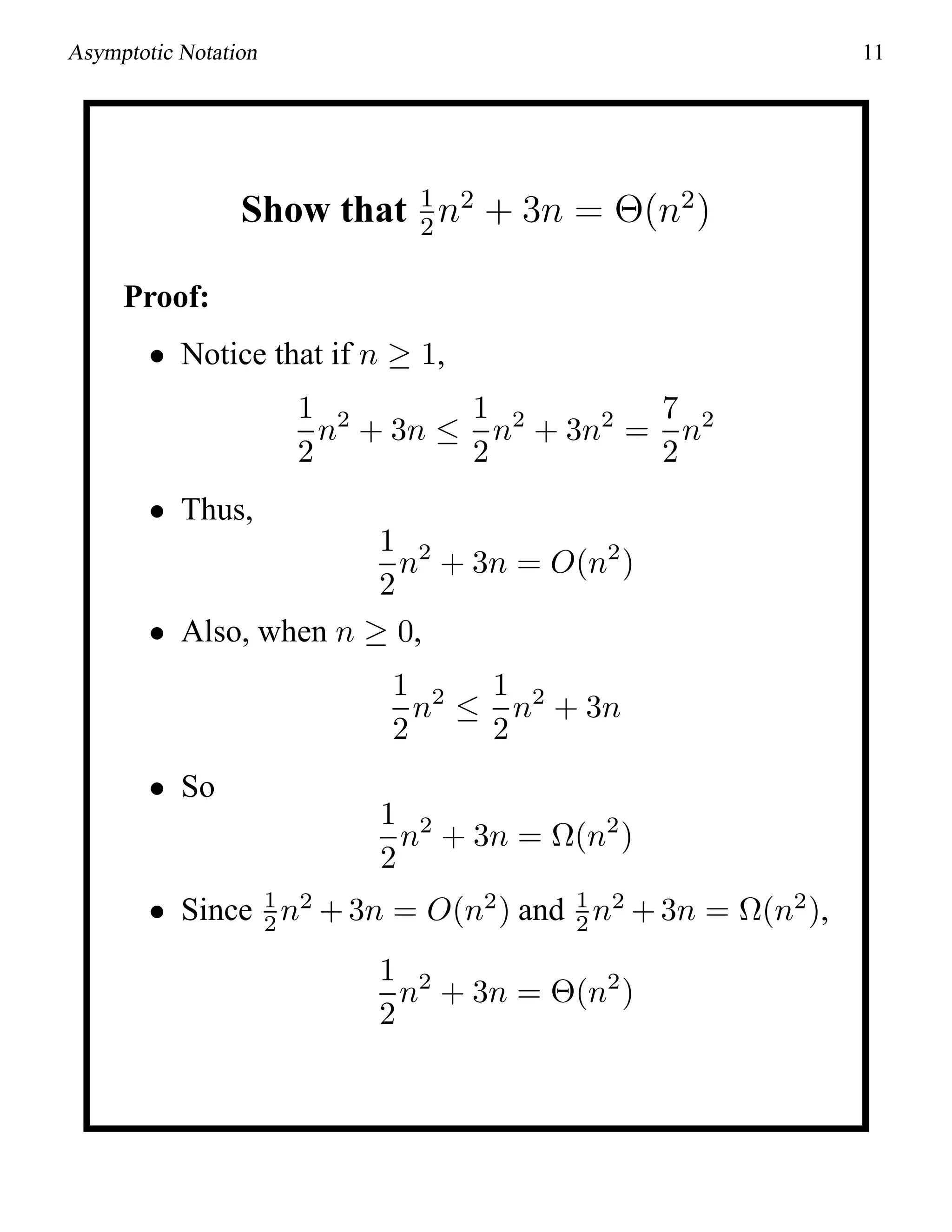
Asymptotic Notation 11
Show that 1
2
n2
+ 3n = Θ(n2
)
Proof:
• Notice that if n ≥ 1,
1
2
n2
+ 3n ≤
1
2
n2
+ 3n2
=
7
2
n2
• Thus,
1
2
n2
+ 3n = O(n2
)
• Also, when n ≥ 0,
1
2
n2
≤
1
2
n2
+ 3n
• So
1
2
n2
+ 3n = Ω(n2
)
• Since 1
2 n2
+3n = O(n2
) and 1
2 n2
+3n = Ω(n2
),
1
2
n2
+ 3n = Θ(n2
)
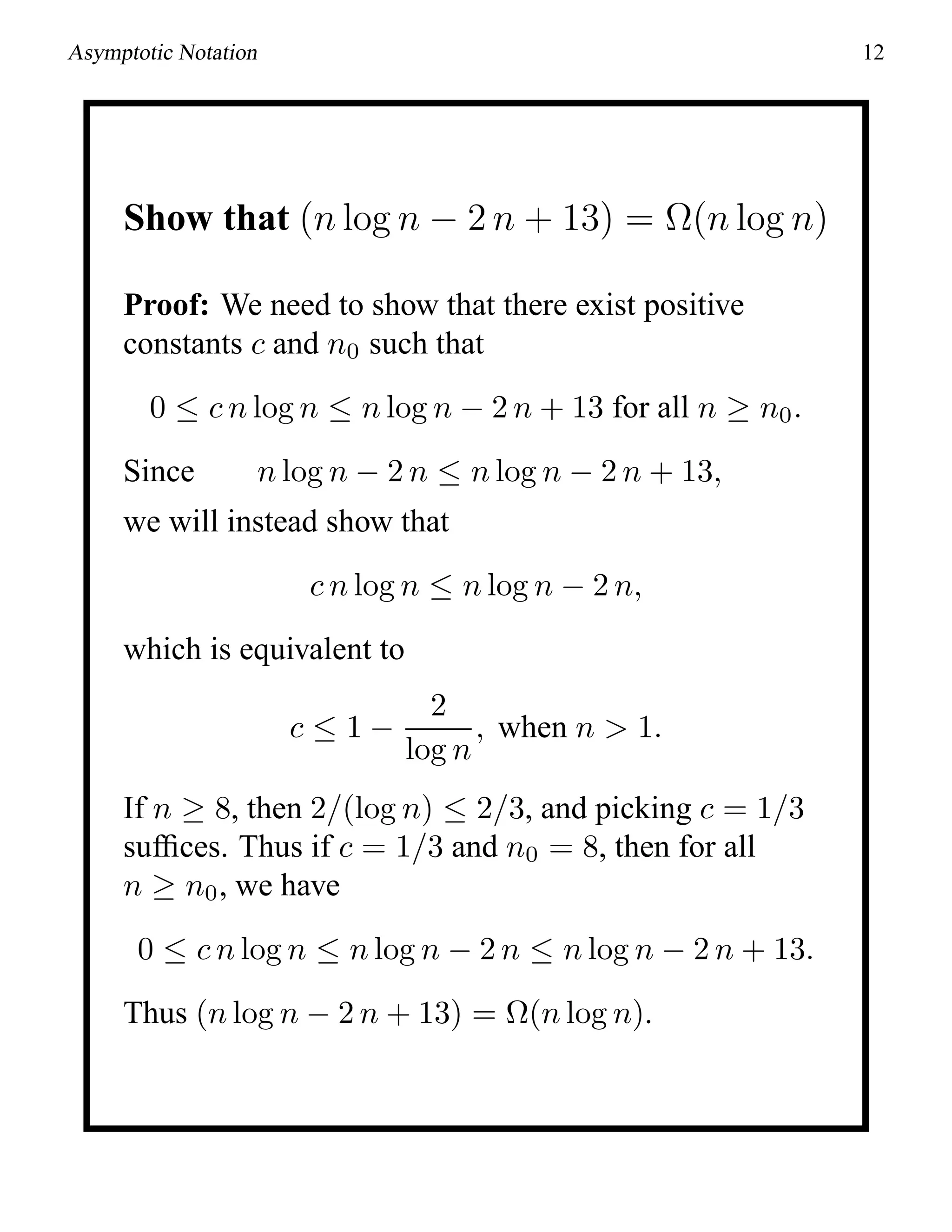
Asymptotic Notation 12
Show that (n log n − 2 n + 13) = Ω(n log n)
Proof: We need to show that there exist positive
constants c and n0 such that
0 ≤ c n log n ≤ n log n − 2 n + 13 for all n ≥ n0.
Since n log n − 2 n ≤ n log n − 2 n + 13,
we will instead show that
c n log n ≤ n log n − 2 n,
which is equivalent to
c ≤ 1 −
2
log n
, when n > 1.
If n ≥ 8, then 2/(log n) ≤ 2/3, and picking c = 1/3
suffices. Thus if c = 1/3 and n0 = 8, then for all
n ≥ n0, we have
0 ≤ c n log n ≤ n log n − 2 n ≤ n log n − 2 n + 13.
Thus (n log n − 2 n + 13) = Ω(n log n).
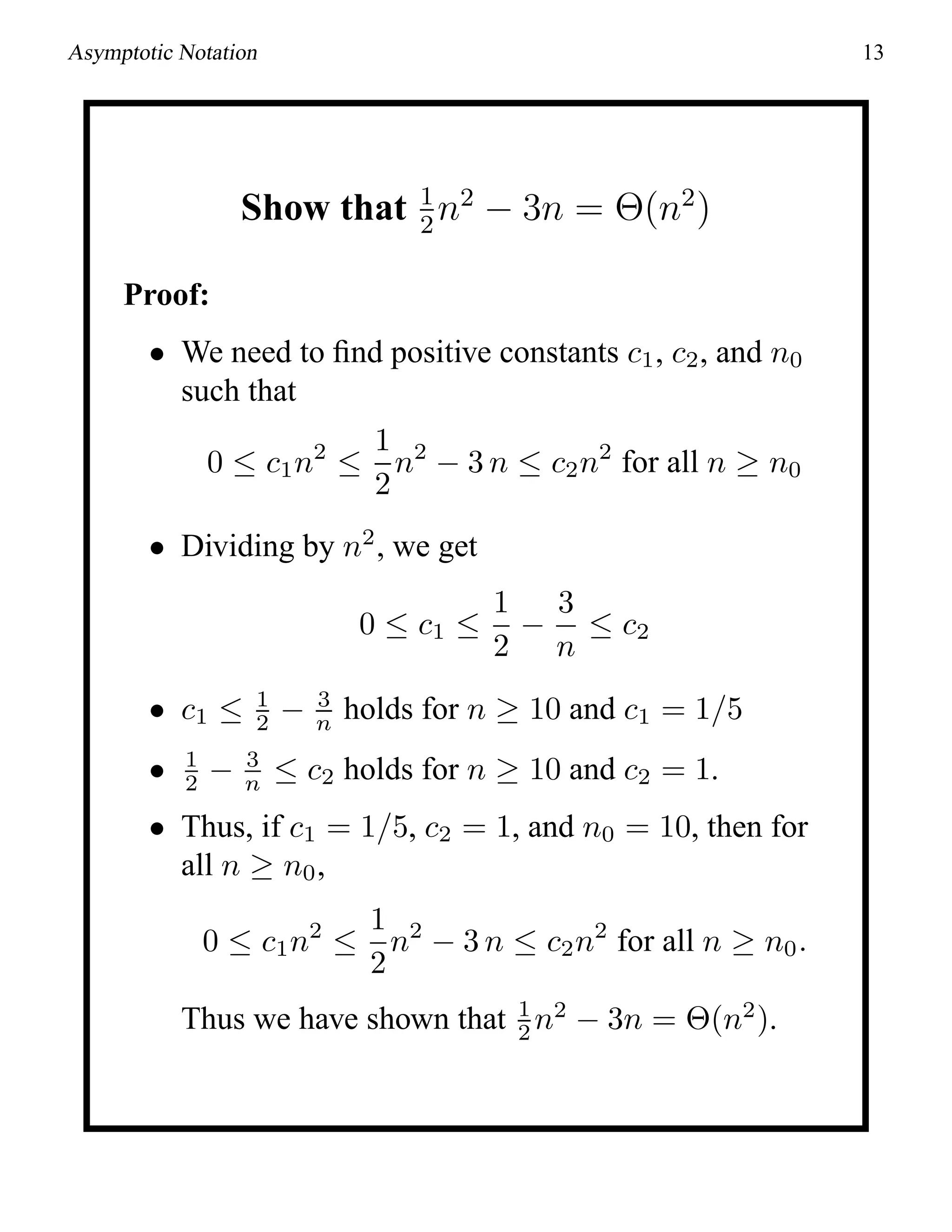
Asymptotic Notation 13
Show that 1
2
n2
− 3n = Θ(n2
)
Proof:
• We need to find positive constants c1, c2, and n0
such that
0 ≤ c1n2
≤
1
2
n2
− 3 n ≤ c2n2
for all n ≥ n0
• Dividing by n2
, we get
0 ≤ c1 ≤
1
2
−
3
n
≤ c2
• c1 ≤ 1
2 − 3
n holds for n ≥ 10 and c1 = 1/5
• 1
2 − 3
n ≤ c2 holds for n ≥ 10 and c2 = 1.
• Thus, if c1 = 1/5, c2 = 1, and n0 = 10, then for
all n ≥ n0,
0 ≤ c1n2
≤
1
2
n2
− 3 n ≤ c2n2
for all n ≥ n0.
Thus we have shown that 1
2 n2
− 3n = Θ(n2
).
Asymptotic Notation 14
Asymptotic Bounds and Algorithms
• In all of the examples so far, we have assumed we
knew the exact running time of the algorithm.
• In general, it may be very difficult to determine
the exact running time.
• Thus, we will try to determine a bounds without
computing the exact running time.
• Example: What is the complexity of the
following algorithm?
for (i = 0; i < n; i ++)
for (j = 0; j < n; j ++)
a[i][j] = b[i][j] * x;
Answer: O(n2
)
• We will see more examples later.
Asymptotic Notation 15
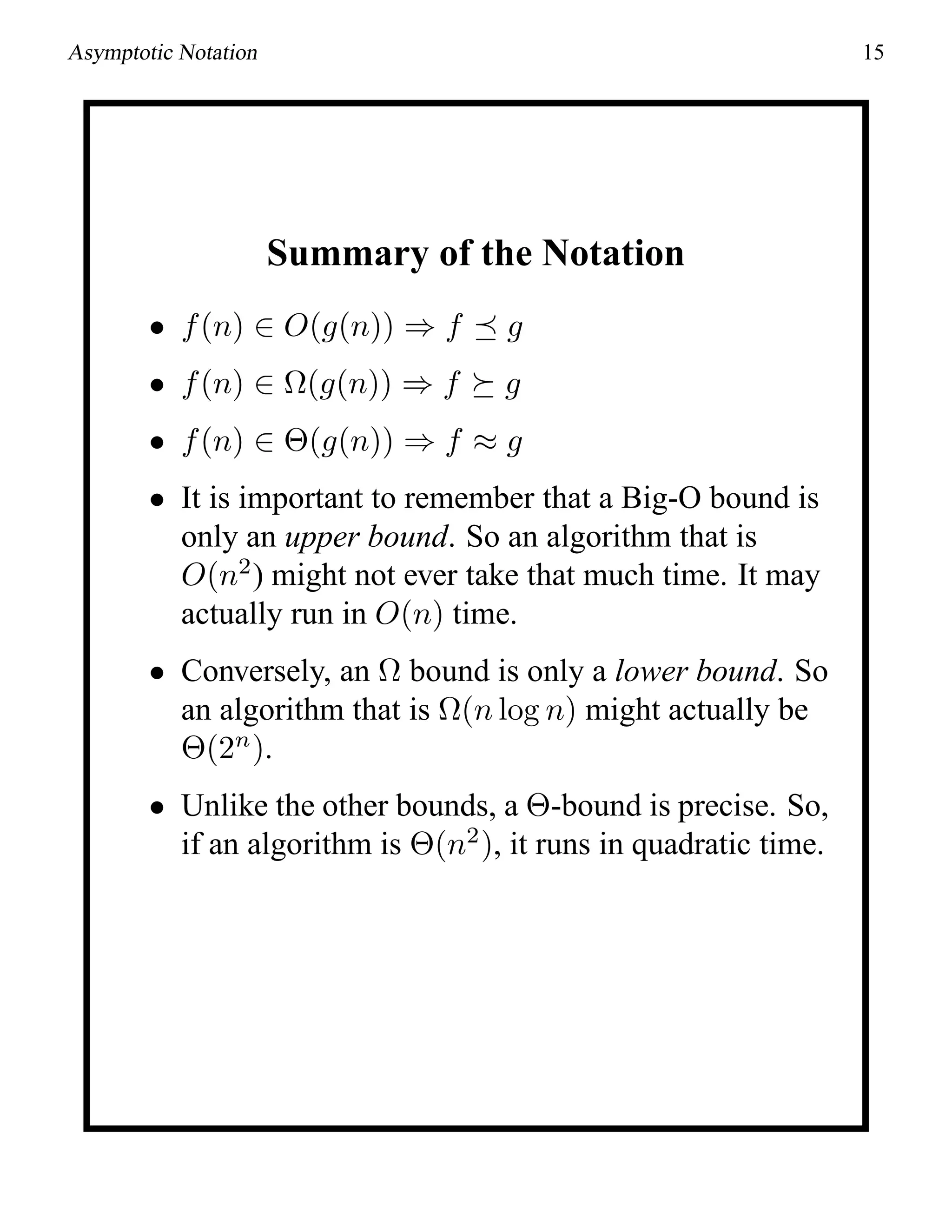
Summary of the Notation
• f(n) ∈ O(g(n)) ⇒ f g
• f(n) ∈ Ω(g(n)) ⇒ f g
• f(n) ∈ Θ(g(n)) ⇒ f ≈ g
• It is important to remember that a Big-O bound is
only an upper bound. So an algorithm that is
O(n2
) might not ever take that much time. It may
actually run in O(n) time.
• Conversely, an Ω bound is only a lower bound. So
an algorithm that is Ω(n log n) might actually be
Θ(2n
).
• Unlike the other bounds, a Θ-bound is precise. So,
if an algorithm is Θ(n2
), it runs in quadratic time.
Asymptotic Notation 16
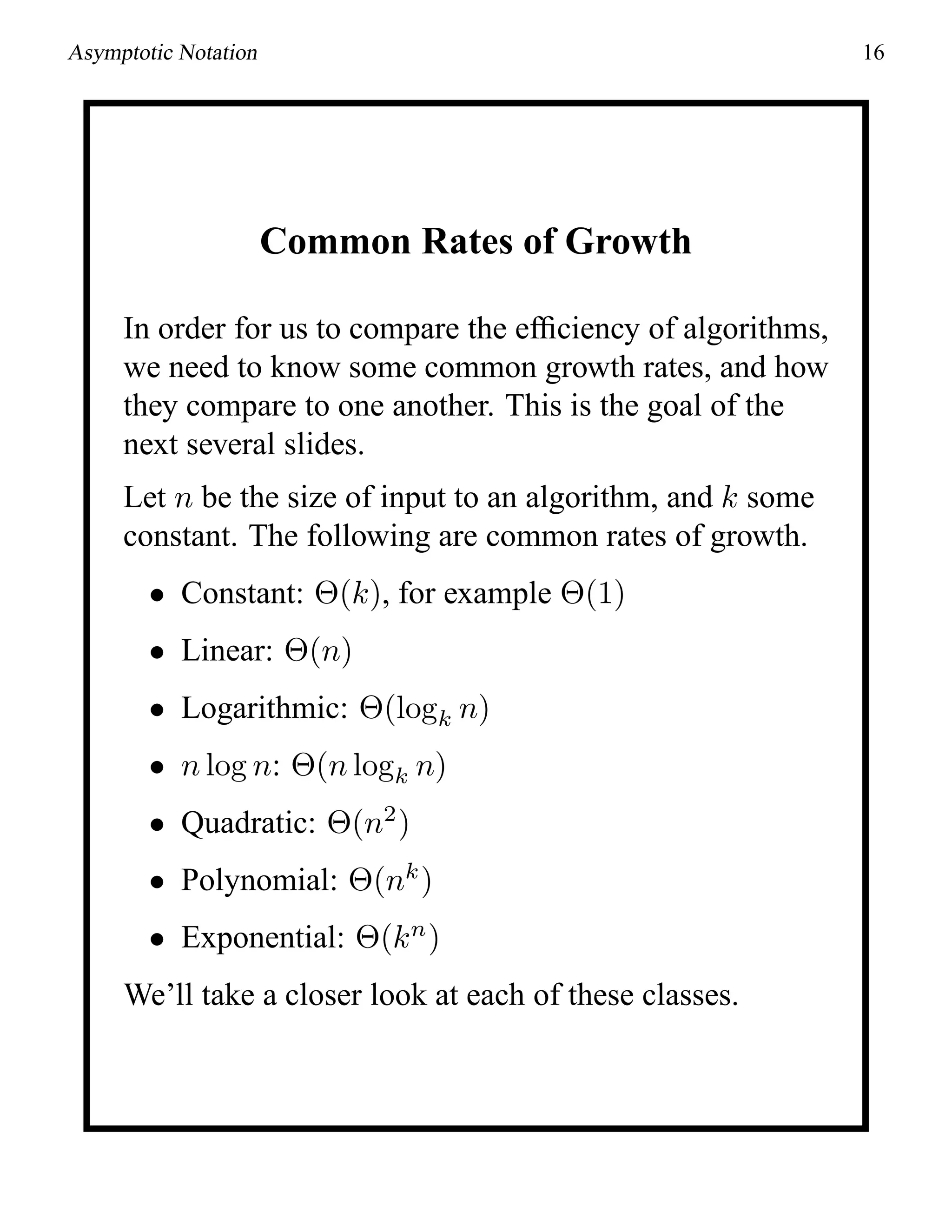
Common Rates of Growth
In order for us to compare the efficiency of algorithms,
we need to know some common growth rates, and how
they compare to one another. This is the goal of the
next several slides.
Let n be the size of input to an algorithm, and k some
constant. The following are common rates of growth.
• Constant: Θ(k), for example Θ(1)
• Linear: Θ(n)
• Logarithmic: Θ(logk n)
• n log n: Θ(n logk n)
• Quadratic: Θ(n2
)
• Polynomial: Θ(nk
)
• Exponential: Θ(kn
)
We’ll take a closer look at each of these classes.
Asymptotic Notation 17
Classification of algorithms - Θ(1)
• Operations are performed k times, where k is
some constant, independent of the size of the
input n.
• This is the best one can hope for, and most often
unattainable.
• Examples:
int Fifth_Element(int A[],int n) {
return A[5];
}
int Partial_Sum(int A[],int n) {
int sum=0;
for(int i=0;i<42;i++)
sum=sum+A[i];
return sum;
}
Asymptotic Notation 18
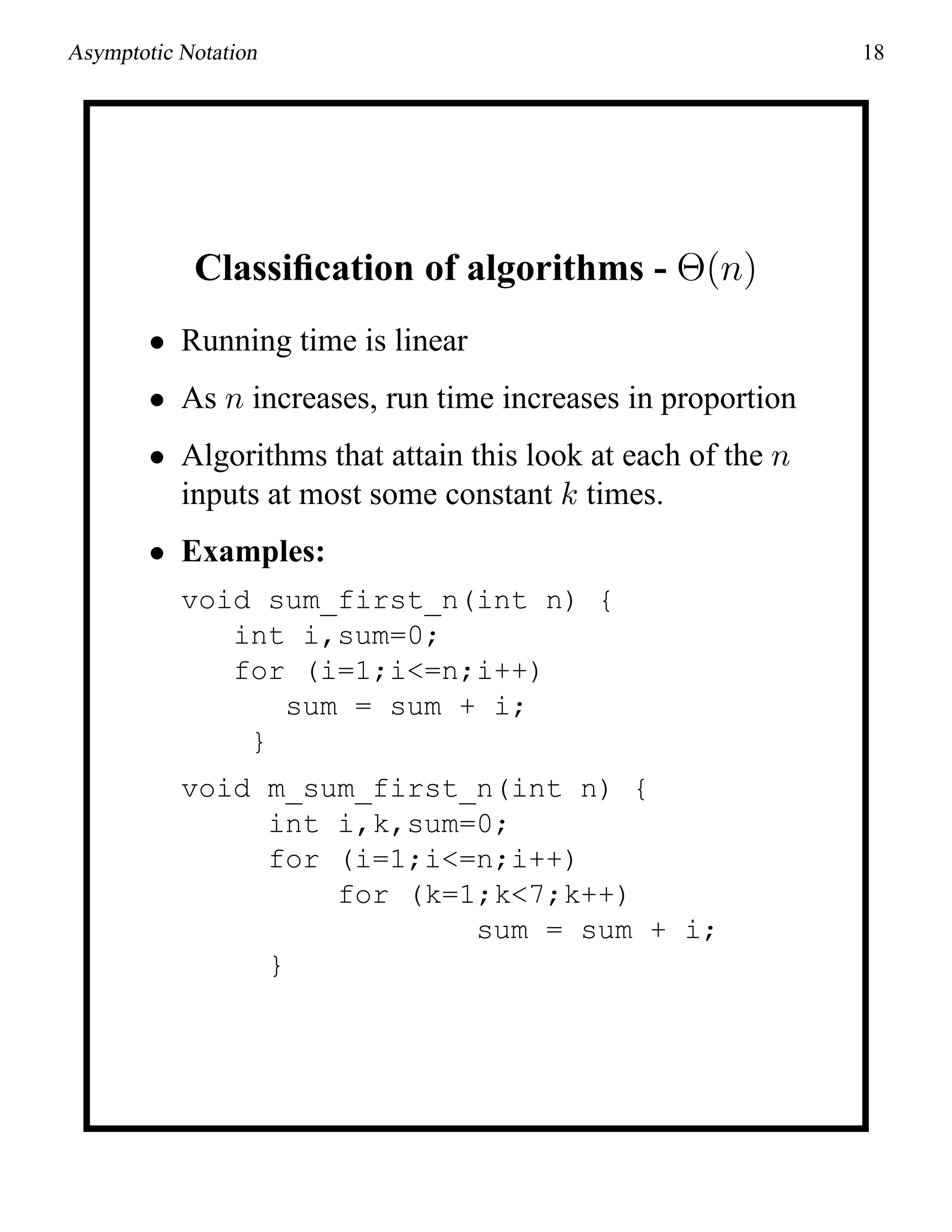
Classification of algorithms - Θ(n)
• Running time is linear
• As n increases, run time increases in proportion
• Algorithms that attain this look at each of the n
inputs at most some constant k times.
• Examples:
void sum_first_n(int n) {
int i,sum=0;
for (i=1;i<=n;i++)
sum = sum + i;
}
void m_sum_first_n(int n) {
int i,k,sum=0;
for (i=1;i<=n;i++)
for (k=1;k<7;k++)
sum = sum + i;
}
Asymptotic Notation 19
Classification of algorithms - Θ(log n)
• A logarithmic function is the inverse of an
exponential function, i.e. bx
= n is equivalent to
x = logb n)
• Always increases, but at a slower rate as n
increases. (Recall that the derivative of log n is 1
n ,
a decreasing function.)
• Typically found where the algorithm can
systematically ignore fractions of the input.
• Examples:
int binarysearch(int a[], int n, int val)
{
int l=1, r=n, m;
while (r>=1) {
m = (l+r)/2;
if (a[m]==val) return m;
if (a[m]>val) r=m-1;
else l=m+1; }
return -1;
}
Asymptotic Notation 20
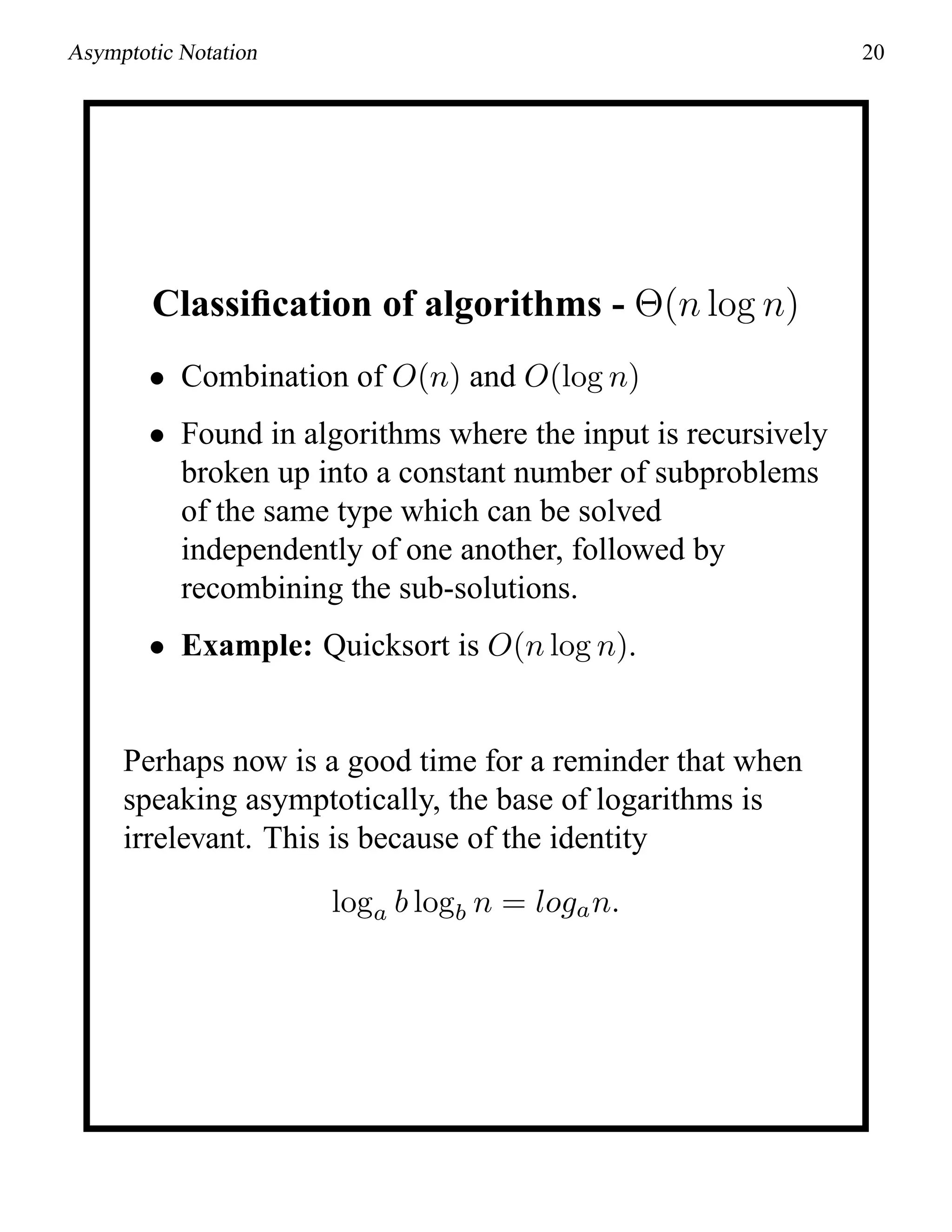
Classification of algorithms - Θ(n log n)
• Combination of O(n) and O(log n)
• Found in algorithms where the input is recursively
broken up into a constant number of subproblems
of the same type which can be solved
independently of one another, followed by
recombining the sub-solutions.
• Example: Quicksort is O(n log n).
Perhaps now is a good time for a reminder that when
speaking asymptotically, the base of logarithms is
irrelevant. This is because of the identity
loga b logb n = logan.
Asymptotic Notation 21
Classification of algorithms - Θ(n2
)
• We call this class quadratic.
• As n doubles, run-time quadruples.
• However, it is still polynomial, which we consider
to be good.
• Typically found where algorithms deal with all
pairs of data.
• Example:
int *compute_sums(int A[], int n) {
int M[n][n];
int i,j;
for (i=0;i<n;i++)
for (j=0;j<n;j++)
M[i][j]=A[i]+A[j];
return M;
}
• More generally, if an algorithm is Θ(nk
) for
constant k it is called a polynomial-time
algorithm.
Asymptotic Notation 22
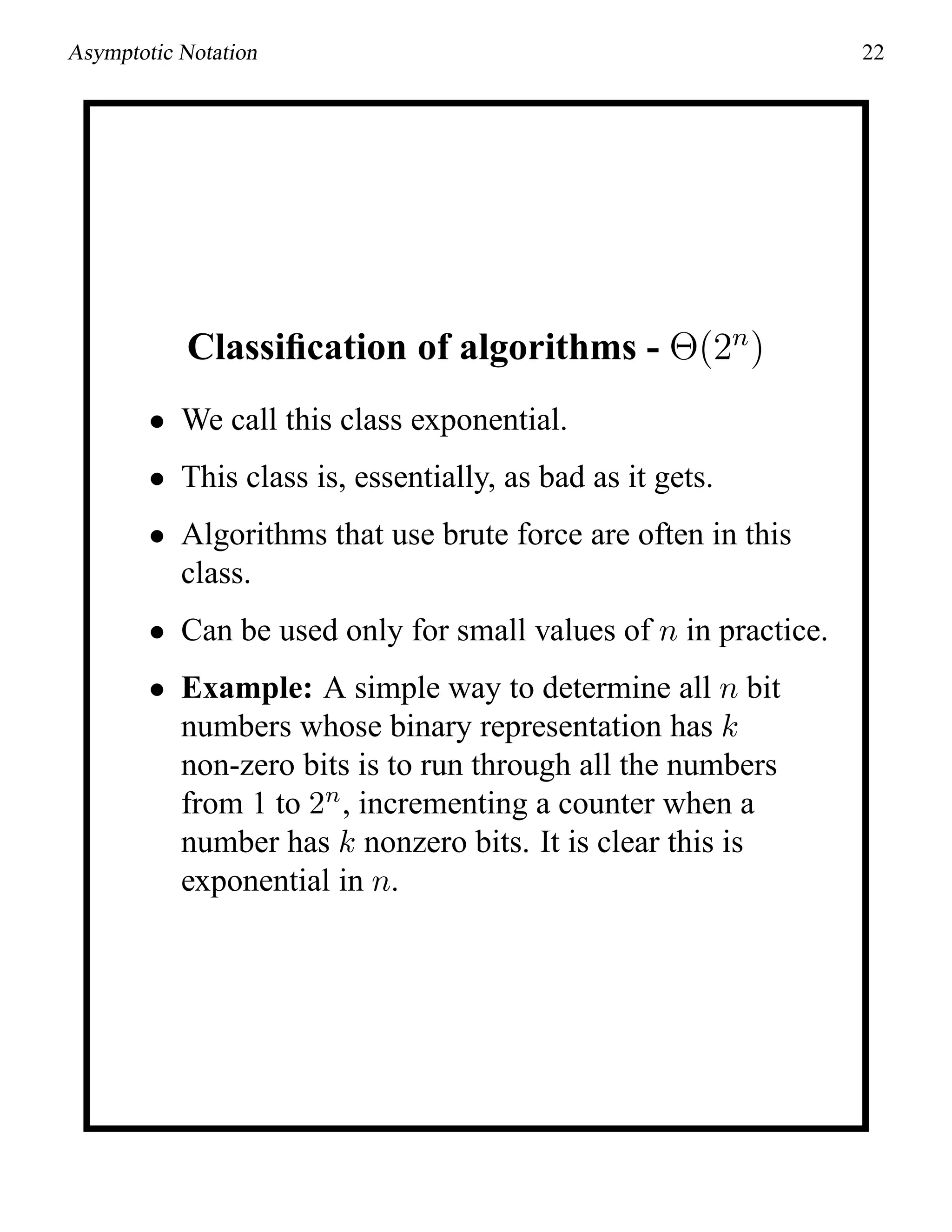
Classification of algorithms - Θ(2n
)
• We call this class exponential.
• This class is, essentially, as bad as it gets.
• Algorithms that use brute force are often in this
class.
• Can be used only for small values of n in practice.
• Example: A simple way to determine all n bit
numbers whose binary representation has k
non-zero bits is to run through all the numbers
from 1 to 2n
, incrementing a counter when a
number has k nonzero bits. It is clear this is
exponential in n.
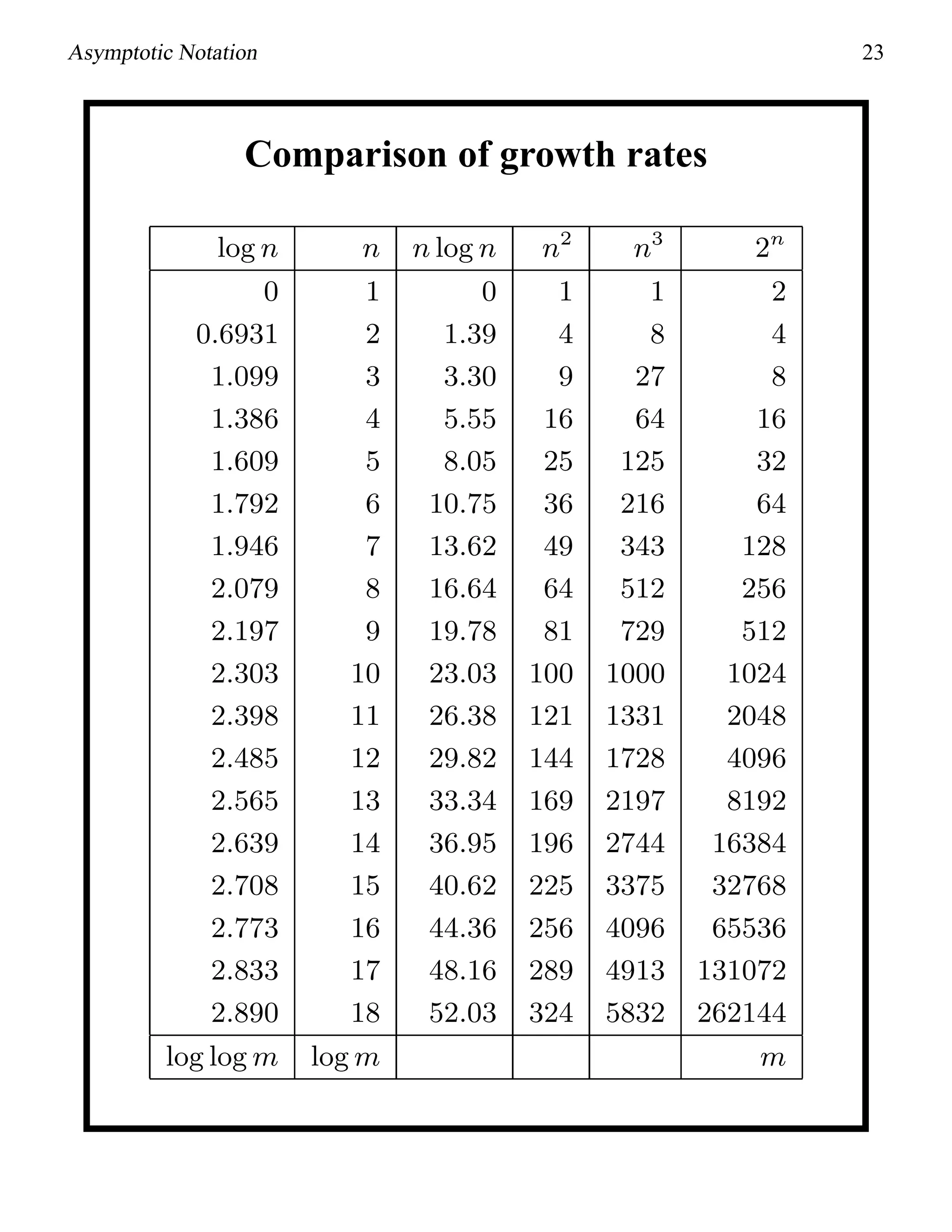
Asymptotic Notation 23
Comparison of growth rates
log n n n log n n2
n3
2n
0 1 0 1 1 2
0.6931 2 1.39 4 8 4
1.099 3 3.30 9 27 8
1.386 4 5.55 16 64 16
1.609 5 8.05 25 125 32
1.792 6 10.75 36 216 64
1.946 7 13.62 49 343 128
2.079 8 16.64 64 512 256
2.197 9 19.78 81 729 512
2.303 10 23.03 100 1000 1024
2.398 11 26.38 121 1331 2048
2.485 12 29.82 144 1728 4096
2.565 13 33.34 169 2197 8192
2.639 14 36.95 196 2744 16384
2.708 15 40.62 225 3375 32768
2.773 16 44.36 256 4096 65536
2.833 17 48.16 289 4913 131072
2.890 18 52.03 324 5832 262144
log log m log m m
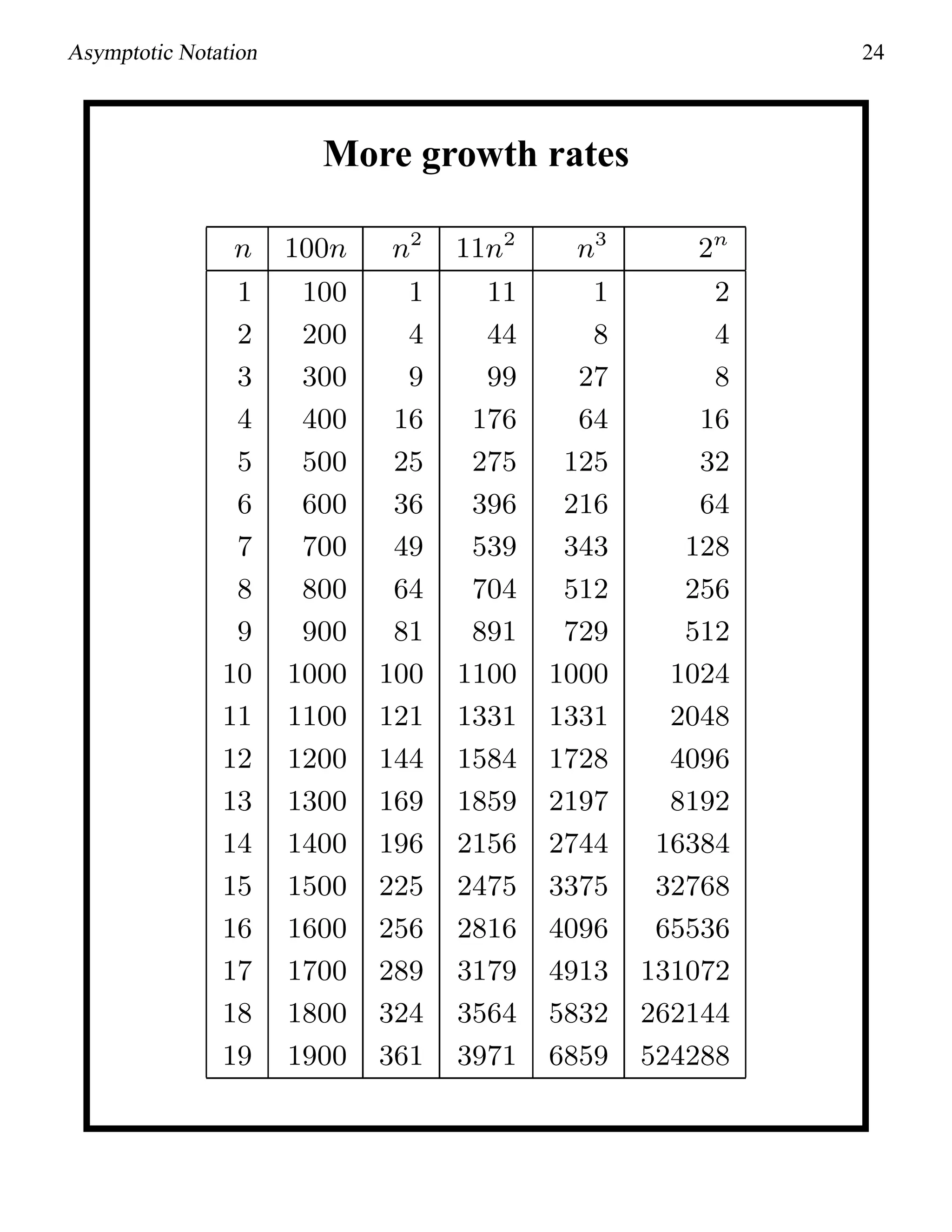
Asymptotic Notation 24
More growth rates
n 100n n2
11n2
n3
2n
1 100 1 11 1 2
2 200 4 44 8 4
3 300 9 99 27 8
4 400 16 176 64 16
5 500 25 275 125 32
6 600 36 396 216 64
7 700 49 539 343 128
8 800 64 704 512 256
9 900 81 891 729 512
10 1000 100 1100 1000 1024
11 1100 121 1331 1331 2048
12 1200 144 1584 1728 4096
13 1300 169 1859 2197 8192
14 1400 196 2156 2744 16384
15 1500 225 2475 3375 32768
16 1600 256 2816 4096 65536
17 1700 289 3179 4913 131072
18 1800 324 3564 5832 262144
19 1900 361 3971 6859 524288
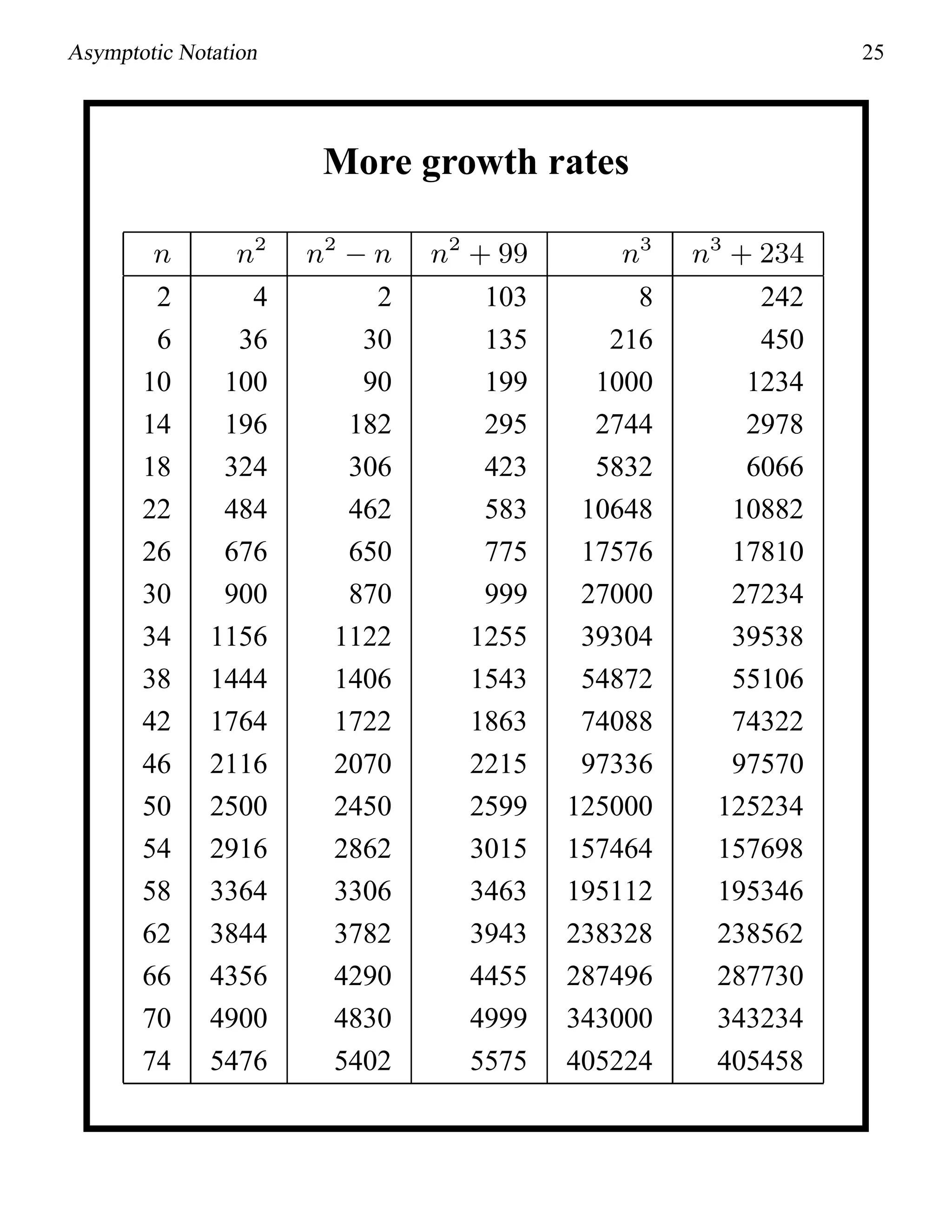
Asymptotic Notation 25
More growth rates
n n2
n2
− n n2
+ 99 n3
n3
+ 234
2 4 2 103 8 242
6 36 30 135 216 450
10 100 90 199 1000 1234
14 196 182 295 2744 2978
18 324 306 423 5832 6066
22 484 462 583 10648 10882
26 676 650 775 17576 17810
30 900 870 999 27000 27234
34 1156 1122 1255 39304 39538
38 1444 1406 1543 54872 55106
42 1764 1722 1863 74088 74322
46 2116 2070 2215 97336 97570
50 2500 2450 2599 125000 125234
54 2916 2862 3015 157464 157698
58 3364 3306 3463 195112 195346
62 3844 3782 3943 238328 238562
66 4356 4290 4455 287496 287730
70 4900 4830 4999 343000 343234
74 5476 5402 5575 405224 405458
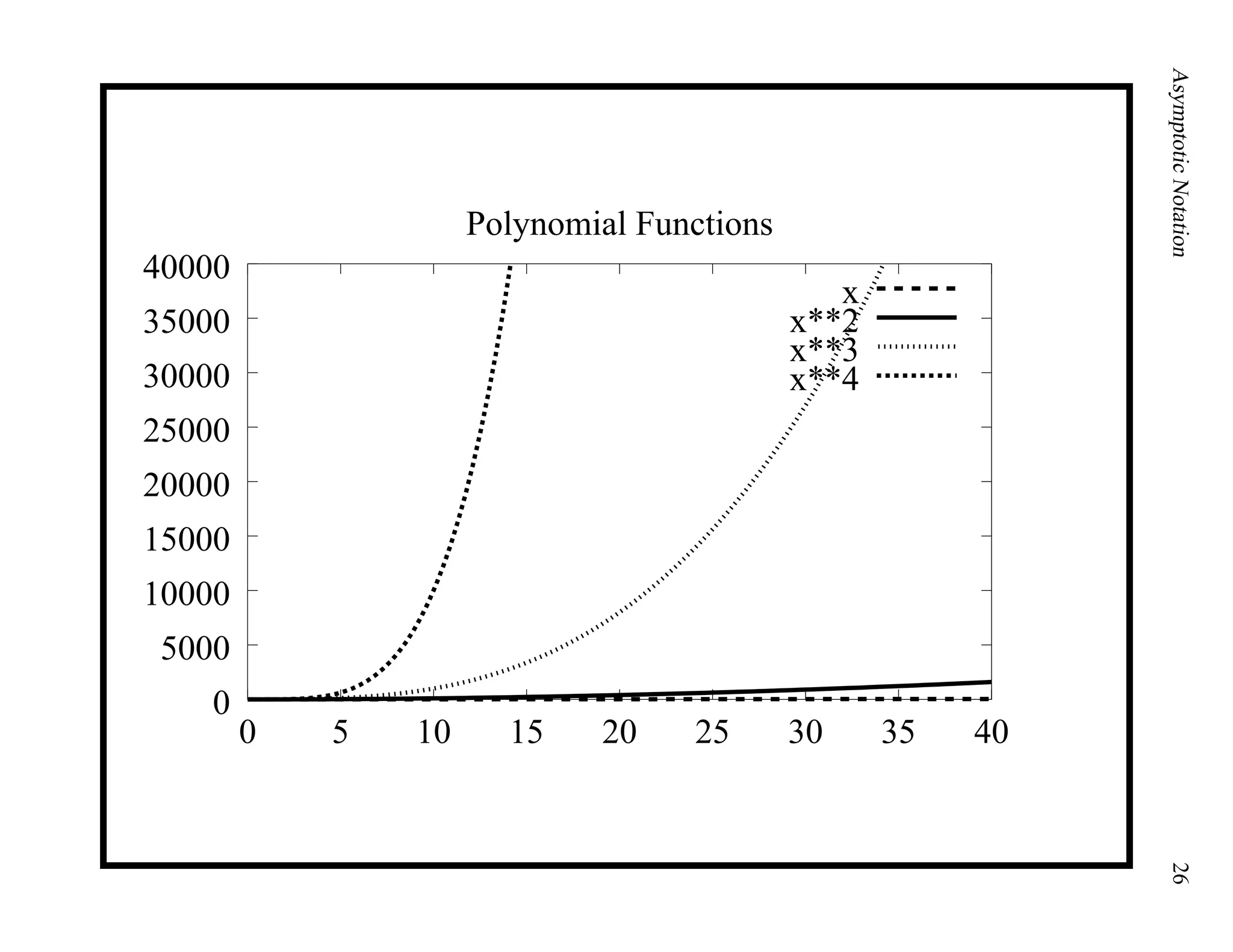
AsymptoticNotation26
0
5000
10000
15000
20000
25000
30000
35000
40000
0 5 10 15 20 25 30 35 40
Polynomial Functions
x
x**2
x**3
x**4
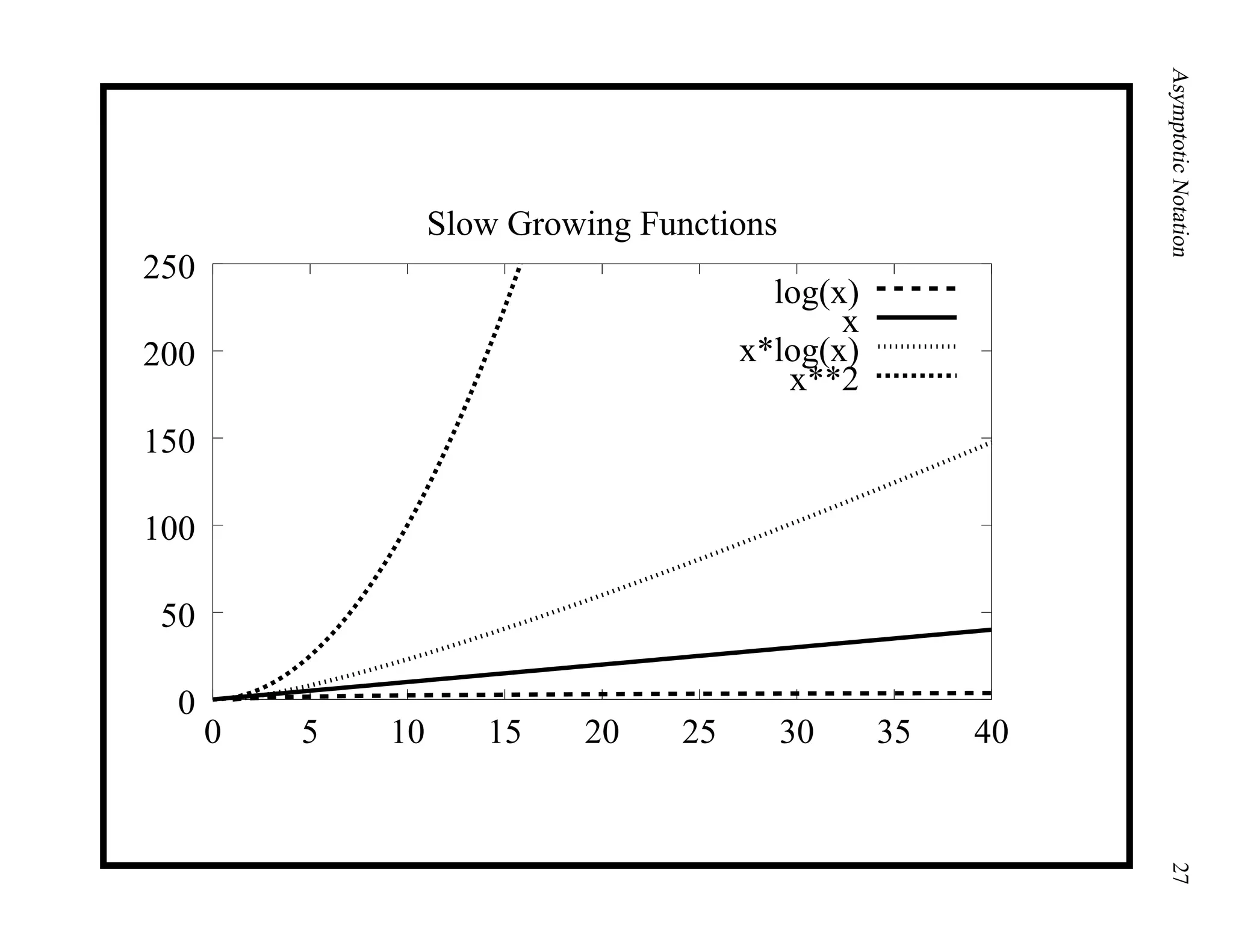
AsymptoticNotation27
0
50
100
150
200
250
0 5 10 15 20 25 30 35 40
Slow Growing Functions
log(x)
x
x*log(x)
x**2
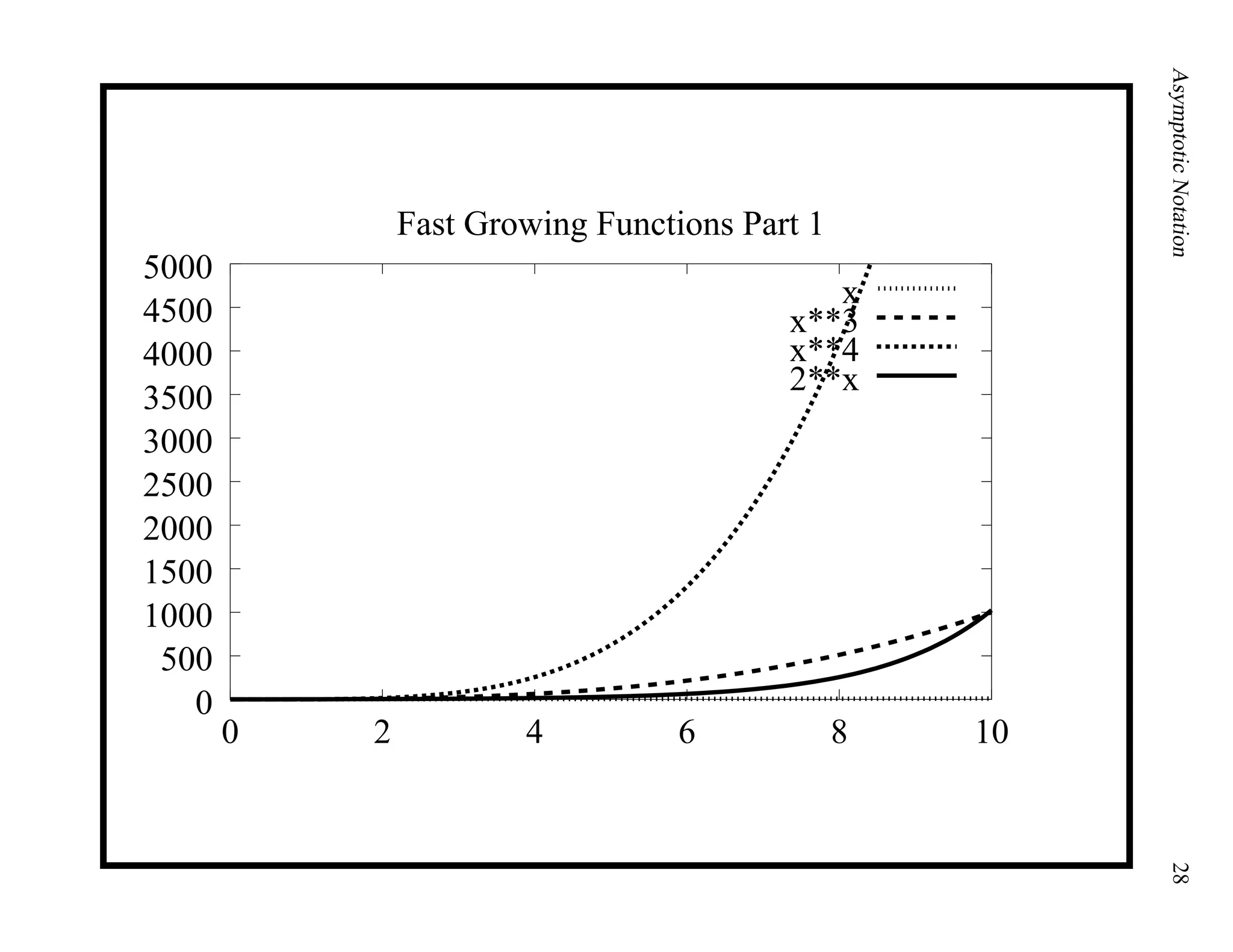
AsymptoticNotation28
0
500
1000
1500
2000
2500
3000
3500
4000
4500
5000
0 2 4 6 8 10
Fast Growing Functions Part 1
x
x**3
x**4
2**x
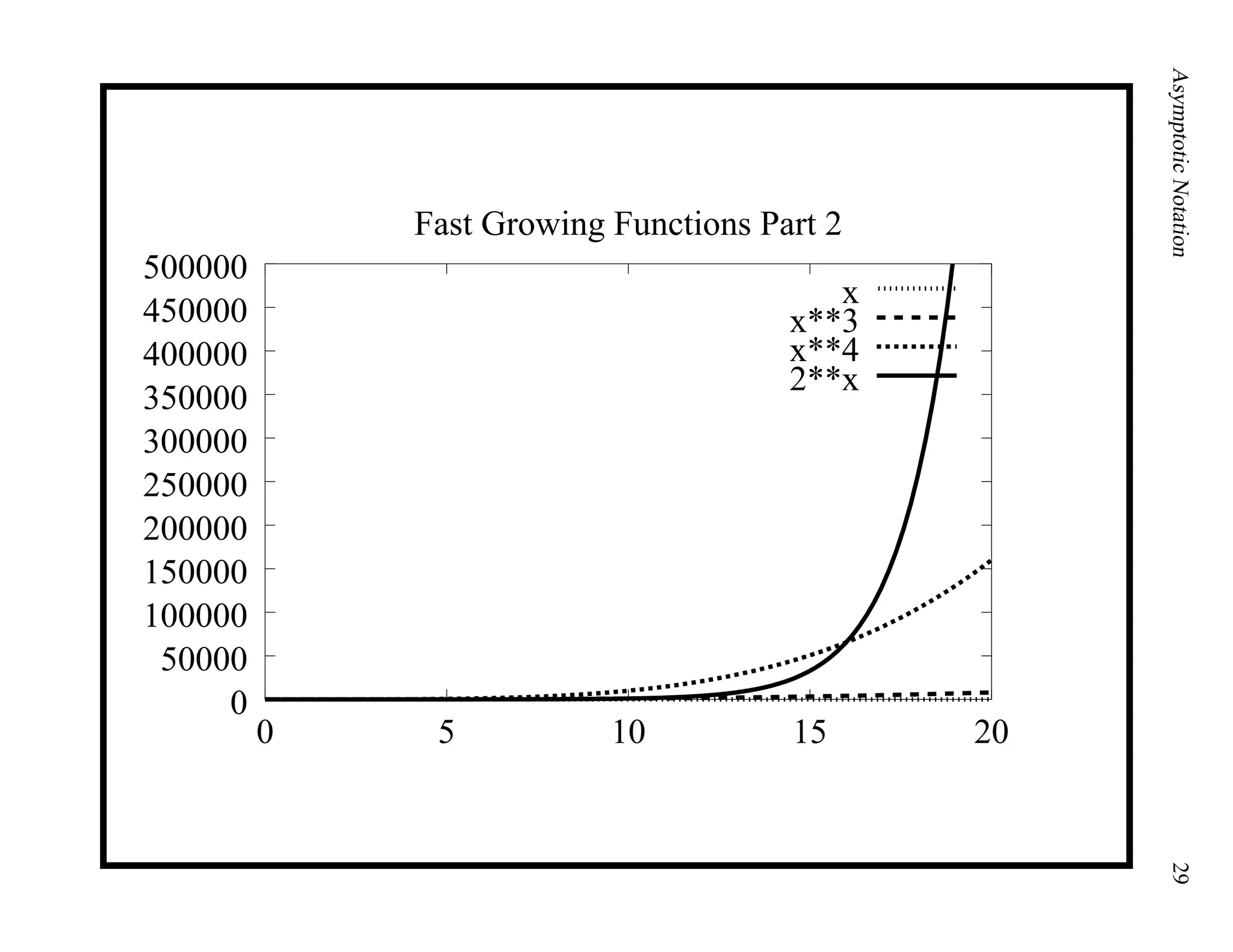
AsymptoticNotation29
0
50000
100000
150000
200000
250000
300000
350000
400000
450000
500000
0 5 10 15 20
Fast Growing Functions Part 2
x
x**3
x**4
2**x
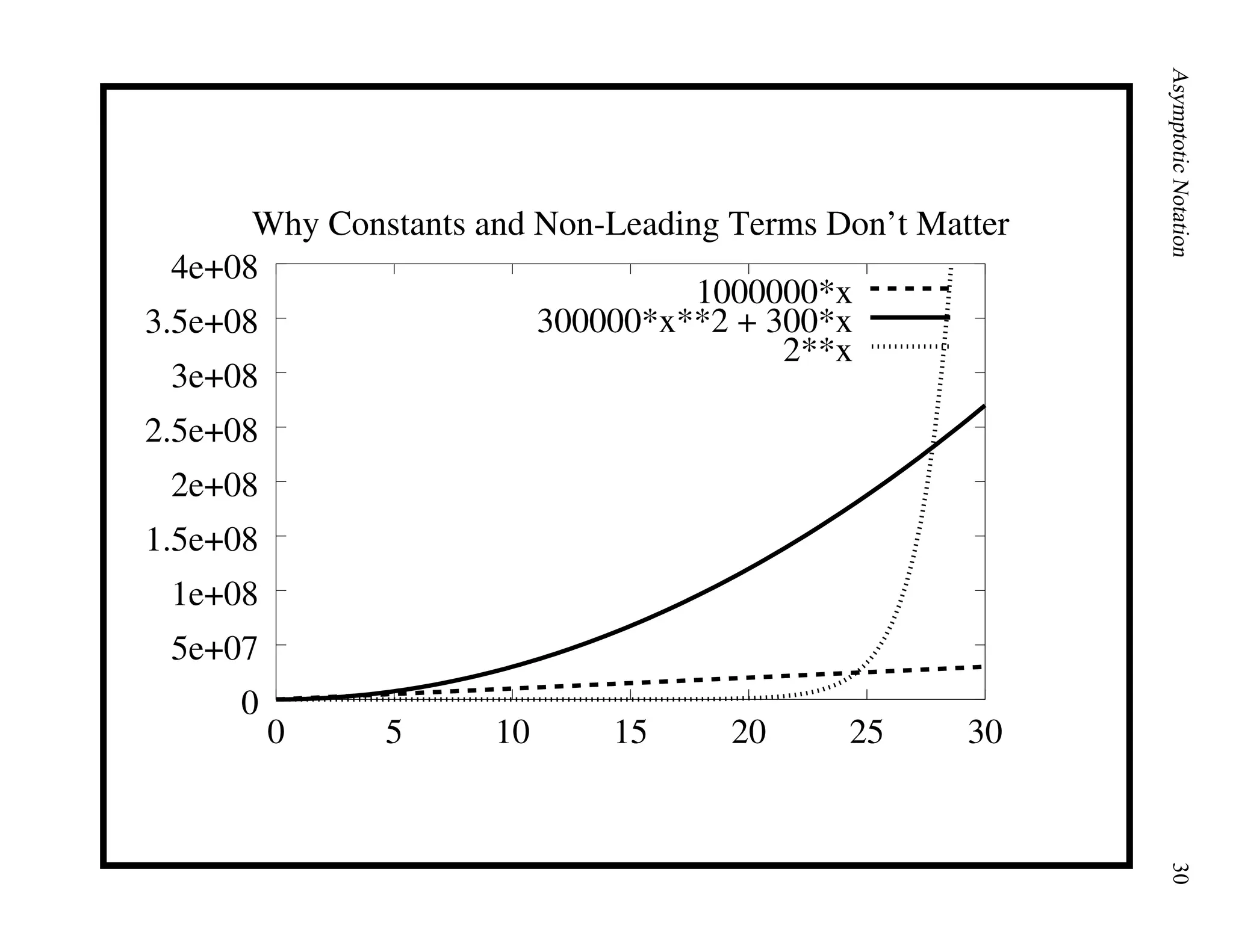
AsymptoticNotation30
0
5e+07
1e+08
1.5e+08
2e+08
2.5e+08
3e+08
3.5e+08
4e+08
0 5 10 15 20 25 30
Why Constants and Non-Leading Terms Don’t Matter
1000000*x
300000*x**2 + 300*x
2**x
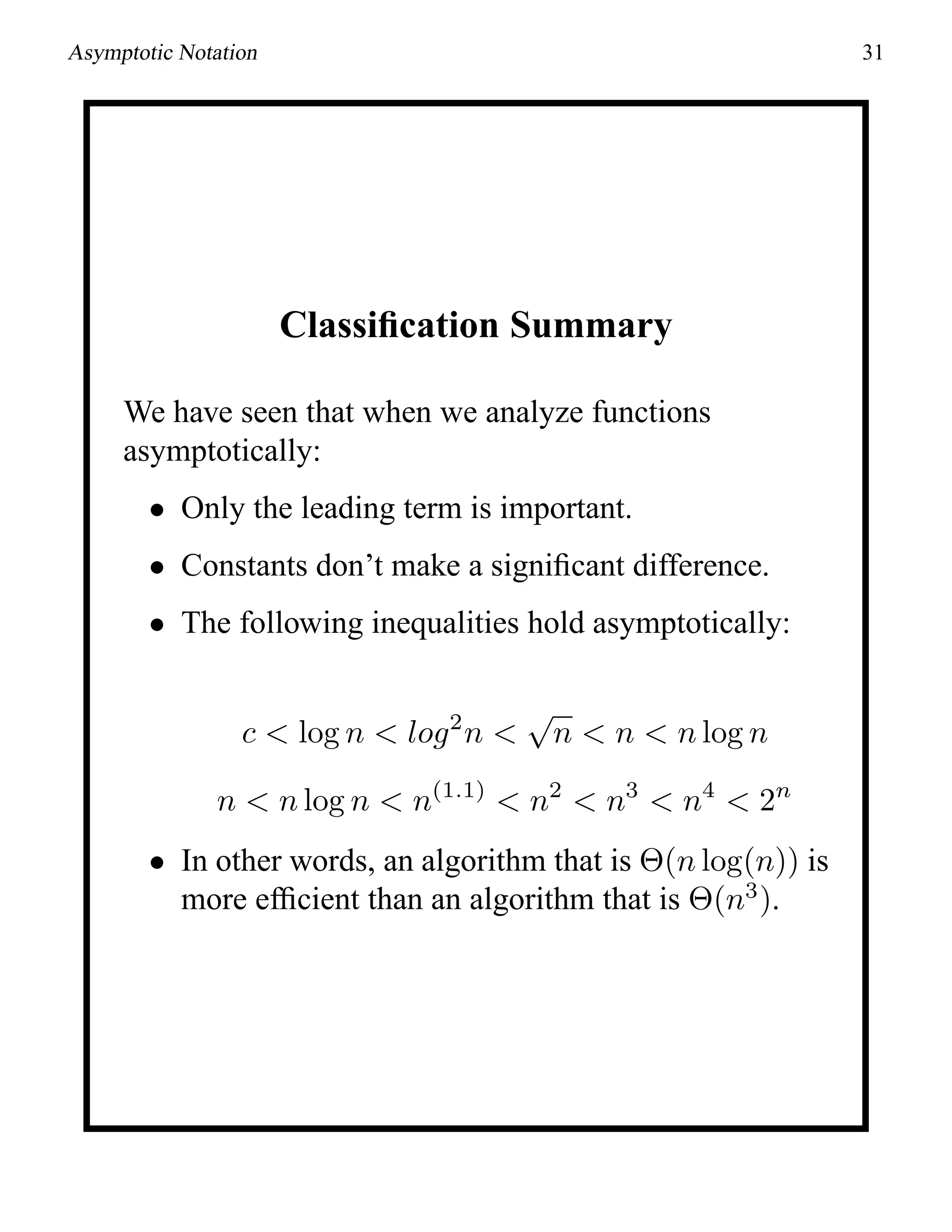
Asymptotic Notation 31
Classification Summary
We have seen that when we analyze functions
asymptotically:
• Only the leading term is important.
• Constants don’t make a significant difference.
• The following inequalities hold asymptotically:
c < log n < log2
n <
√
n < n < n log n
n < n log n < n(1.1)
< n2
< n3
< n4
< 2n
• In other words, an algorithm that is Θ(n log(n)) is
more efficient than an algorithm that is Θ(n3
).

Asymptotic notation

  • 1.
    Asymptotic Notation 1 Growthof Functions and Aymptotic Notation • When we study algorithms, we are interested in characterizing them according to their efficiency. • We are usually interesting in the order of growth of the running time of an algorithm, not in the exact running time. This is also referred to as the asymptotic running time. • We need to develop a way to talk about rate of growth of functions so that we can compare algorithms. • Asymptotic notation gives us a method for classifying functions according to their rate of growth.
  • 2.
    Asymptotic Notation 2 Big-ONotation • Definition: f(n) = O(g(n)) iff there are two positive constants c and n0 such that |f(n)| ≤ c |g(n)| for all n ≥ n0 • If f(n) is nonnegative, we can simplify the last condition to 0 ≤ f(n) ≤ c g(n) for all n ≥ n0 • We say that “f(n) is big-O of g(n).” • As n increases, f(n) grows no faster than g(n). In other words, g(n) is an asymptotic upper bound on f(n). f(n) = O(g(n)) n0 cg(n) f(n)
  • 3.
    Asymptotic Notation 3 Example:n2 + n = O(n3 ) Proof: • Here, we have f(n) = n2 + n, and g(n) = n3 • Notice that if n ≥ 1, n ≤ n3 is clear. • Also, notice that if n ≥ 1, n2 ≤ n3 is clear. • Side Note: In general, if a ≤ b, then na ≤ nb whenever n ≥ 1. This fact is used often in these types of proofs. • Therefore, n2 + n ≤ n3 + n3 = 2n3 • We have just shown that n2 + n ≤ 2n3 for all n ≥ 1 • Thus, we have shown that n2 + n = O(n3 ) (by definition of Big-O, with n0 = 1, and c = 2.)
  • 4.
    Asymptotic Notation 4 Big-Ωnotation • Definition: f(n) = Ω(g(n)) iff there are two positive constants c and n0 such that |f(n)| ≥ c |g(n)| for all n ≥ n0 • If f(n) is nonnegative, we can simplify the last condition to 0 ≤ c g(n) ≤ f(n) for all n ≥ n0 • We say that “f(n) is omega of g(n).” • As n increases, f(n) grows no slower than g(n). In other words, g(n) is an asymptotic lower bound on f(n). n0 cg(n) f(n) f(n) = O(g(n))
  • 5.
    Asymptotic Notation 5 Example:n3 + 4n2 = Ω(n2 ) Proof: • Here, we have f(n) = n3 + 4n2 , and g(n) = n2 • It is not too hard to see that if n ≥ 0, n3 ≤ n3 + 4n2 • We have already seen that if n ≥ 1, n2 ≤ n3 • Thus when n ≥ 1, n2 ≤ n3 ≤ n3 + 4n2 • Therefore, 1n2 ≤ n3 + 4n2 for all n ≥ 1 • Thus, we have shown that n3 + 4n2 = Ω(n2 ) (by definition of Big-Ω, with n0 = 1, and c = 1.)
  • 6.
    Asymptotic Notation 6 Big-Θnotation • Definition: f(n) = Θ(g(n)) iff there are three positive constants c1, c2 and n0 such that c1|g(n)| ≤ |f(n)| ≤ c2|g(n)| for all n ≥ n0 • If f(n) is nonnegative, we can simplify the last condition to 0 ≤ c1 g(n) ≤ f(n) ≤ c2 g(n) for all n ≥ n0 • We say that “f(n) is theta of g(n).” • As n increases, f(n) grows at the same rate as g(n). In other words, g(n) is an asymptotically tight bound on f(n). c2 g(n) c1 g(n) f(n) n0
  • 7.
    Asymptotic Notation 7 Example:n2 + 5n + 7 = Θ(n2 ) Proof: • When n ≥ 1, n2 + 5n + 7 ≤ n2 + 5n2 + 7n2 ≤ 13n2 • When n ≥ 0, n2 ≤ n2 + 5n + 7 • Thus, when n ≥ 1 1n2 ≤ n2 + 5n + 7 ≤ 13n2 Thus, we have shown that n2 + 5n + 7 = Θ(n2 ) (by definition of Big-Θ, with n0 = 1, c1 = 1, and c2 = 13.)
  • 8.
    Asymptotic Notation 8 Arithmeticof Big-O, Ω, and Θ notations • Transitivity: – f(n) ∈ O(g(n)) and g(n) ∈ O(h(n)) ⇒ f(n) ∈ O(h(n)) – f(n) ∈ Θ(g(n)) and g(n) ∈ Θ(h(n)) ⇒ f(n) ∈ Θ(h(n)) – f(n) ∈ Ω(g(n)) and g(n) ∈ Ω(h(n)) ⇒ f(n) ∈ Ω(h(n)) • Scaling: if f(n) ∈ O(g(n)) then for any k > 0, f(n) ∈ O(kg(n)) • Sums: if f1(n) ∈ O(g1(n)) and f2(n) ∈ O(g2(n)) then (f1 + f2)(n) ∈ O(max(g1(n), g2(n)))
  • 9.
    Asymptotic Notation 9 Strategiesfor Big-O • Sometimes the easiest way to prove that f(n) = O(g(n)) is to take c to be the sum of the positive coefficients of f(n). • We can usually ignore the negative coefficients. Why? • Example: To prove 5n2 + 3n + 20 = O(n2 ), we pick c = 5 + 3 + 20 = 28. Then if n ≥ n0 = 1, 5 n2 + 3 n + 20 ≤ 5 n2 + 3 n2 + 20 n2 = 28 n2 , thus 5n2 + 3n + 20 = O(n2 ). • This is not always so easy. How would you show that ( √ 2)log n + log2 n + n4 is O(2n )? Or that n2 = O(n2 − 13n + 23)? After we have talked about the relative rates of growth of several functions, this will be easier. • In general, we simply (or, in some cases, with much effort) find values c and n0 that work. This gets easier with practice.
  • 10.
    Asymptotic Notation 10 Strategiesfor Ω and Θ • Proving that a f(n) = Ω(g(n)) often requires more thought. – Quite often, we have to pick c < 1. – A good strategy is to pick a value of c which you think will work, and determine which value of n0 is needed. – Being able to do a little algebra helps. – We can sometimes simplify by ignoring terms of f(n) with the positive coefficients. Why? • The following theorem shows us that proving f(n) = Θ(g(n)) is nothing new: – Theorem: f(n) = Θ(g(n)) if and only if f(n) = O(g(n)) and f(n) = Ω(g(n)). – Thus, we just apply the previous two strategies. • We will present a few more examples using a several different approaches.
  • 11.
    Asymptotic Notation 11 Showthat 1 2 n2 + 3n = Θ(n2 ) Proof: • Notice that if n ≥ 1, 1 2 n2 + 3n ≤ 1 2 n2 + 3n2 = 7 2 n2 • Thus, 1 2 n2 + 3n = O(n2 ) • Also, when n ≥ 0, 1 2 n2 ≤ 1 2 n2 + 3n • So 1 2 n2 + 3n = Ω(n2 ) • Since 1 2 n2 +3n = O(n2 ) and 1 2 n2 +3n = Ω(n2 ), 1 2 n2 + 3n = Θ(n2 )
  • 12.
    Asymptotic Notation 12 Showthat (n log n − 2 n + 13) = Ω(n log n) Proof: We need to show that there exist positive constants c and n0 such that 0 ≤ c n log n ≤ n log n − 2 n + 13 for all n ≥ n0. Since n log n − 2 n ≤ n log n − 2 n + 13, we will instead show that c n log n ≤ n log n − 2 n, which is equivalent to c ≤ 1 − 2 log n , when n > 1. If n ≥ 8, then 2/(log n) ≤ 2/3, and picking c = 1/3 suffices. Thus if c = 1/3 and n0 = 8, then for all n ≥ n0, we have 0 ≤ c n log n ≤ n log n − 2 n ≤ n log n − 2 n + 13. Thus (n log n − 2 n + 13) = Ω(n log n).
  • 13.
    Asymptotic Notation 13 Showthat 1 2 n2 − 3n = Θ(n2 ) Proof: • We need to find positive constants c1, c2, and n0 such that 0 ≤ c1n2 ≤ 1 2 n2 − 3 n ≤ c2n2 for all n ≥ n0 • Dividing by n2 , we get 0 ≤ c1 ≤ 1 2 − 3 n ≤ c2 • c1 ≤ 1 2 − 3 n holds for n ≥ 10 and c1 = 1/5 • 1 2 − 3 n ≤ c2 holds for n ≥ 10 and c2 = 1. • Thus, if c1 = 1/5, c2 = 1, and n0 = 10, then for all n ≥ n0, 0 ≤ c1n2 ≤ 1 2 n2 − 3 n ≤ c2n2 for all n ≥ n0. Thus we have shown that 1 2 n2 − 3n = Θ(n2 ).
  • 14.
    Asymptotic Notation 14 AsymptoticBounds and Algorithms • In all of the examples so far, we have assumed we knew the exact running time of the algorithm. • In general, it may be very difficult to determine the exact running time. • Thus, we will try to determine a bounds without computing the exact running time. • Example: What is the complexity of the following algorithm? for (i = 0; i < n; i ++) for (j = 0; j < n; j ++) a[i][j] = b[i][j] * x; Answer: O(n2 ) • We will see more examples later.
  • 15.
    Asymptotic Notation 15 Summaryof the Notation • f(n) ∈ O(g(n)) ⇒ f g • f(n) ∈ Ω(g(n)) ⇒ f g • f(n) ∈ Θ(g(n)) ⇒ f ≈ g • It is important to remember that a Big-O bound is only an upper bound. So an algorithm that is O(n2 ) might not ever take that much time. It may actually run in O(n) time. • Conversely, an Ω bound is only a lower bound. So an algorithm that is Ω(n log n) might actually be Θ(2n ). • Unlike the other bounds, a Θ-bound is precise. So, if an algorithm is Θ(n2 ), it runs in quadratic time.
  • 16.
    Asymptotic Notation 16 CommonRates of Growth In order for us to compare the efficiency of algorithms, we need to know some common growth rates, and how they compare to one another. This is the goal of the next several slides. Let n be the size of input to an algorithm, and k some constant. The following are common rates of growth. • Constant: Θ(k), for example Θ(1) • Linear: Θ(n) • Logarithmic: Θ(logk n) • n log n: Θ(n logk n) • Quadratic: Θ(n2 ) • Polynomial: Θ(nk ) • Exponential: Θ(kn ) We’ll take a closer look at each of these classes.
  • 17.
    Asymptotic Notation 17 Classificationof algorithms - Θ(1) • Operations are performed k times, where k is some constant, independent of the size of the input n. • This is the best one can hope for, and most often unattainable. • Examples: int Fifth_Element(int A[],int n) { return A[5]; } int Partial_Sum(int A[],int n) { int sum=0; for(int i=0;i<42;i++) sum=sum+A[i]; return sum; }
  • 18.
    Asymptotic Notation 18 Classificationof algorithms - Θ(n) • Running time is linear • As n increases, run time increases in proportion • Algorithms that attain this look at each of the n inputs at most some constant k times. • Examples: void sum_first_n(int n) { int i,sum=0; for (i=1;i<=n;i++) sum = sum + i; } void m_sum_first_n(int n) { int i,k,sum=0; for (i=1;i<=n;i++) for (k=1;k<7;k++) sum = sum + i; }
  • 19.
    Asymptotic Notation 19 Classificationof algorithms - Θ(log n) • A logarithmic function is the inverse of an exponential function, i.e. bx = n is equivalent to x = logb n) • Always increases, but at a slower rate as n increases. (Recall that the derivative of log n is 1 n , a decreasing function.) • Typically found where the algorithm can systematically ignore fractions of the input. • Examples: int binarysearch(int a[], int n, int val) { int l=1, r=n, m; while (r>=1) { m = (l+r)/2; if (a[m]==val) return m; if (a[m]>val) r=m-1; else l=m+1; } return -1; }
  • 20.
    Asymptotic Notation 20 Classificationof algorithms - Θ(n log n) • Combination of O(n) and O(log n) • Found in algorithms where the input is recursively broken up into a constant number of subproblems of the same type which can be solved independently of one another, followed by recombining the sub-solutions. • Example: Quicksort is O(n log n). Perhaps now is a good time for a reminder that when speaking asymptotically, the base of logarithms is irrelevant. This is because of the identity loga b logb n = logan.
  • 21.
    Asymptotic Notation 21 Classificationof algorithms - Θ(n2 ) • We call this class quadratic. • As n doubles, run-time quadruples. • However, it is still polynomial, which we consider to be good. • Typically found where algorithms deal with all pairs of data. • Example: int *compute_sums(int A[], int n) { int M[n][n]; int i,j; for (i=0;i<n;i++) for (j=0;j<n;j++) M[i][j]=A[i]+A[j]; return M; } • More generally, if an algorithm is Θ(nk ) for constant k it is called a polynomial-time algorithm.
  • 22.
    Asymptotic Notation 22 Classificationof algorithms - Θ(2n ) • We call this class exponential. • This class is, essentially, as bad as it gets. • Algorithms that use brute force are often in this class. • Can be used only for small values of n in practice. • Example: A simple way to determine all n bit numbers whose binary representation has k non-zero bits is to run through all the numbers from 1 to 2n , incrementing a counter when a number has k nonzero bits. It is clear this is exponential in n.
  • 23.
    Asymptotic Notation 23 Comparisonof growth rates log n n n log n n2 n3 2n 0 1 0 1 1 2 0.6931 2 1.39 4 8 4 1.099 3 3.30 9 27 8 1.386 4 5.55 16 64 16 1.609 5 8.05 25 125 32 1.792 6 10.75 36 216 64 1.946 7 13.62 49 343 128 2.079 8 16.64 64 512 256 2.197 9 19.78 81 729 512 2.303 10 23.03 100 1000 1024 2.398 11 26.38 121 1331 2048 2.485 12 29.82 144 1728 4096 2.565 13 33.34 169 2197 8192 2.639 14 36.95 196 2744 16384 2.708 15 40.62 225 3375 32768 2.773 16 44.36 256 4096 65536 2.833 17 48.16 289 4913 131072 2.890 18 52.03 324 5832 262144 log log m log m m
  • 24.
    Asymptotic Notation 24 Moregrowth rates n 100n n2 11n2 n3 2n 1 100 1 11 1 2 2 200 4 44 8 4 3 300 9 99 27 8 4 400 16 176 64 16 5 500 25 275 125 32 6 600 36 396 216 64 7 700 49 539 343 128 8 800 64 704 512 256 9 900 81 891 729 512 10 1000 100 1100 1000 1024 11 1100 121 1331 1331 2048 12 1200 144 1584 1728 4096 13 1300 169 1859 2197 8192 14 1400 196 2156 2744 16384 15 1500 225 2475 3375 32768 16 1600 256 2816 4096 65536 17 1700 289 3179 4913 131072 18 1800 324 3564 5832 262144 19 1900 361 3971 6859 524288
  • 25.
    Asymptotic Notation 25 Moregrowth rates n n2 n2 − n n2 + 99 n3 n3 + 234 2 4 2 103 8 242 6 36 30 135 216 450 10 100 90 199 1000 1234 14 196 182 295 2744 2978 18 324 306 423 5832 6066 22 484 462 583 10648 10882 26 676 650 775 17576 17810 30 900 870 999 27000 27234 34 1156 1122 1255 39304 39538 38 1444 1406 1543 54872 55106 42 1764 1722 1863 74088 74322 46 2116 2070 2215 97336 97570 50 2500 2450 2599 125000 125234 54 2916 2862 3015 157464 157698 58 3364 3306 3463 195112 195346 62 3844 3782 3943 238328 238562 66 4356 4290 4455 287496 287730 70 4900 4830 4999 343000 343234 74 5476 5402 5575 405224 405458
  • 26.
    AsymptoticNotation26 0 5000 10000 15000 20000 25000 30000 35000 40000 0 5 1015 20 25 30 35 40 Polynomial Functions x x**2 x**3 x**4
  • 27.
    AsymptoticNotation27 0 50 100 150 200 250 0 5 1015 20 25 30 35 40 Slow Growing Functions log(x) x x*log(x) x**2
  • 28.
    AsymptoticNotation28 0 500 1000 1500 2000 2500 3000 3500 4000 4500 5000 0 2 46 8 10 Fast Growing Functions Part 1 x x**3 x**4 2**x
  • 29.
  • 30.
    AsymptoticNotation30 0 5e+07 1e+08 1.5e+08 2e+08 2.5e+08 3e+08 3.5e+08 4e+08 0 5 1015 20 25 30 Why Constants and Non-Leading Terms Don’t Matter 1000000*x 300000*x**2 + 300*x 2**x
  • 31.
    Asymptotic Notation 31 ClassificationSummary We have seen that when we analyze functions asymptotically: • Only the leading term is important. • Constants don’t make a significant difference. • The following inequalities hold asymptotically: c < log n < log2 n < √ n < n < n log n n < n log n < n(1.1) < n2 < n3 < n4 < 2n • In other words, an algorithm that is Θ(n log(n)) is more efficient than an algorithm that is Θ(n3 ).