Modeling and Simulation of Business
Dr. Rami Gharaibeh
1
UNDERSTANDING REALITY
2
PREFACE
UNDERSTANDING REALITY
3
PREFACE
UNDERSTANDING REALITY
4
PREFACE
UNDERSTANDING REALITY
5
PREFACE
UNDERSTANDING REALITY
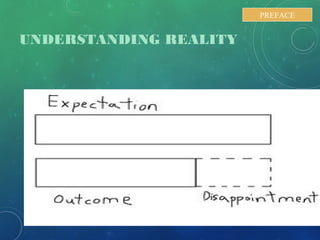
wrong understanding of reality leads to wrong
expectations
6
PREFACE
UNDERSTANDING REALITY
7
PREFACE
WHAT IS A BUSINESS MODEL?
A business model is a simple representation of
the complex reality of a particular organization.
Business models are useful for understanding
how a business is organized, who interacts
with whom, what goals and strategies are
being pursued, what work the business
performs, and how it performs that work.
8
PREFACE
BUSINESS MODELING
We need to learn how to create a business
model that represents the reality of a
business.
9
PREFACE
BUSINESS MODELING VS. SOFTWARE
MODELING
A software model is a model of software
applications and databases and other
information technology artifacts.
10
PREFACE
BUSINESS MODELING VS. SOFTWARE
MODELING
A business model is a model of a business, a
model of what people do and how they
interact.
11
PREFACE
BUSINESS MODELING VS. SOFTWARE
MODELING
in both cases we are modeling the actions
and interactions among several elements.
• Different elements
• Different techniques
• Different tools
12
PREFACE
BUSINESS MODELING
Creating a good business model is a complex
skill, and like any complex skill, it requires
time, knowledge, practice, and patience to
learn.
13
PREFACE
MODELING DISCIPLINES
Four distinct business modeling disciplines
• Business process models
• Business motivation models
• Business organization models
• Business rule models
14
PREFACE
MODELING DISCIPLINES
Business process models
capture how a business performs its work, the
step-by-step activities that are performed.
15
PREFACE
MODELING DISCIPLINES
Business motivation models
Capture the goals and strategies of a
business. what a business is attempting to do
and how those attempts fit into its changing
environment.
16
PREFACE
MODELING DISCIPLINES
Business organization models
capture who performs the work in an
organization and who they interact with, both
inside the organization and outside.
17
PREFACE
MODELING DISCIPLINES
business rule models
capture the constraints on a business the
external constraints from regulations and
laws, and the internal constraints from
policies, rules, and other guidance.
18
PREFACE
INTEGRATING THE FOUR
DISCIPLINES
To be more effective, business modelers
need to understand all four disciplines.
They need to create models that include
multiple disciplines.
19
PREFACE
INTEGRATING THE FOUR
DISCIPLINES
A business process is useful, but it is more
useful when accompanied by details about
the goals of the business, the organizations
that participate in the process, and the rules
and policies that guide the process.
20
PREFACE
INTEGRATING THE FOUR
DISCIPLINES
The four disciplines represent four dimensions
that should be reflected in the model:
What is the process, how does it serve my
goals, who should do what, what rules govern
the people while implementing the process
21
PREFACE
INTEGRATING THE FOUR
DISCIPLINES
example
any hospital includes the business process of emergency
admission. To completely model this business process the
BPM will model all activities:
• taking patient information
• Patient examination
• Patient referral to labs and ray
• Ray imaging
• Ray image reporting
22
PREFACE
INTEGRATING THE FOUR
DISCIPLINES
example
any hospital includes the business process of emergency
admission. To completely model this business process the
BMM will show the link with the hospital goals :
• taking patient information
• Patient examination
• Patient referral to labs and ray
• Ray imaging
• Ray image reporting
23
PREFACE
INTEGRATING THE FOUR
DISCIPLINES
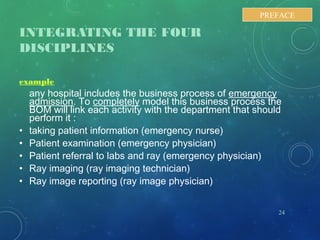
example
any hospital includes the business process of emergency
admission. To completely model this business process the
BOM will link each activity with the department that should
perform it :
• taking patient information (emergency nurse)
• Patient examination (emergency physician)
• Patient referral to labs and ray (emergency physician)
• Ray imaging (ray imaging technician)
• Ray image reporting (ray image physician)
24
PREFACE
INTEGRATING THE FOUR
DISCIPLINES
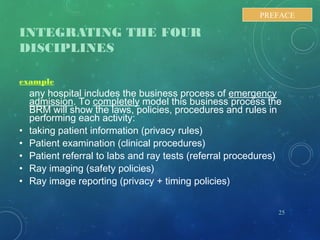
example
any hospital includes the business process of emergency
admission. To completely model this business process the
BRM will show the laws, policies, procedures and rules in
performing each activity:
• taking patient information (privacy rules)
• Patient examination (clinical procedures)
• Patient referral to labs and ray tests (referral procedures)
• Ray imaging (safety policies)
• Ray image reporting (privacy + timing policies)
25
PREFACE
MODELING STANDARDS
Standards are important in business modeling. A
model created by one group of people should be
understandable by others.
Others should be able to update the model when
business circumstances change. Models created in
one modeling tool should be readable and
changeable by other tools.
26
PREFACE
CHAPTER ONE
WHY BUSINESS MODELING
27
ANSWER TWO QUESTIONS
what is a business model?
why create one?
28
CHAPTER ONE
WHAT IS A BUSINESS MODEL?
A business model is a simple representation of the
complex reality of a business.
29
CHAPTER ONE
ALERTALERT
By business model we do not mean “how the
company makes money”.
we mean a model that describes the details of a
business: its goals, organizations, business
processes, or business rules.
30
CHAPTER ONE
WHAT IS A BUSINESS MODEL?
example
Any city has a complex reality that includes locations of
places, thousands of roads, thousands of pipe routes,
thousands of cable routes, etc.
31
CHAPTER ONE
WHAT IS A BUSINESS MODEL?
example
to be able to deal with the complexity of a city, we make
maps. Maps of roads and locations. Maps for electrical
cable. Maps for water pipes, etc.
Each of these maps is considered a model. The model will
help us make good decisions on how to go to places, or
where to dig to find the electrical cable or water pipe.
32
CHAPTER ONE
WHAT IS A BUSINESS MODEL?
Businesses have complex reality. To be able to
manage this reality and solve business problems, we
need to create business models.
33
CHAPTER ONE
THE RISE OF BUSINESS
MODELING
Businesspeople are increasingly using models to
communicate. Over the last fifteen years, increasing
numbers of people have built business models:
models of the business processes of their
organization, the goals and strategies, or the policies
and rules.
34
CHAPTER ONE
THE RISE OF BUSINESS
MODELING
What’s driving the growth of business
modeling?
1
IT organizations are using business models to
align IT initiatives with business needs.
35
CHAPTER ONE
THE RISE OF BUSINESS
MODELING
What’s driving the growth of business modeling?
2
Models help with the implementation of change.
If nothing changes, you don’t need models, just
as you don’t need a street map if you never travel
anywhere.
36
CHAPTER ONE
THE RISE OF BUSINESS
MODELING
What’s driving the growth of business
modeling?
3
the need to manage increasing complexity.
Complexity is the key problem in business
today. Decisions are harder now because
there is more to consider.
37
CHAPTER ONE
THE RISE OF BUSINESS
MODELING
What’s driving the growth of business modeling?
3
Businesses have become more complex. Twenty
years ago, businesses were easier to
understand. There were fewer business
processes, fewer products and services, less
data stored in databases, fewer business
partners, and fewer lines of business.
38
CHAPTER ONE
BUSINESS VALUE OF BUSINESS
MODELS
39
CHAPTER ONE
•Communication between people
•Training and learning
•Persuasion and selling
•Analysis of a business situation
•Compliance management
•Development of software requirements
•Knowledge management and reuse
BUSINESS VALUE OF BUSINESS
MODELS
40
CHAPTER ONE
Communication between people
Business is a communication-intensive activity.
Business people give presentations about company
performance. Business people talk to their clients and
their suppliers about new products and services.
Business colleagues talk to each other about the
changing competitive environment. Much of business
is communication.
Business models are better for conveying complex
business information.
BUSINESS VALUE OF BUSINESS
MODELS
41
CHAPTER ONE
Training and learning
People learn in two ways. They learn from their own experience,
via trial and error, and they learn from other people’s
experiences, via conversations, books, or classroom material.
Learning from other people’s experiences is of course cheaper,
faster, and less risky. We allow others to make mistakes instead
of making our own. Business models are one way of learning
from other people’s experience. First, a model is built of the
expert’s knowledge of the business rules or the business
process. Then many novices can study the model to learn what
the expert knows.
BUSINESS VALUE OF BUSINESS
MODELS
42
CHAPTER ONE
Persuasion and selling
In business, persuasion is ubiquitous. When we sell a
customer on a product, we are persuading. When we
pitch a new initiative to our management, we are
persuading. When we convince employees to embrace
a business process change, we are persuading.
Persuasion is communication, of course, but it is
communication in service of a goal: convincing
someone to take action favorable to us, to our
organization, or to themselves. Business models are
useful for persuasion.
BUSINESS VALUE OF BUSINESS
MODELS
43
CHAPTER ONE
Analysis
insight is power. Analyzing a business model is particularly useful
when you have a decision to make. The different alternative
scenarios can be modeled and the models then analyzed and
compared. For example, you may compare different business
process scenarios to see which is the lowest cost. That low-cost
scenario can be compared to today’s business process so that
you can understand what activities need to change, what new
activities need to be performed, what activities should be
automated, and what skills you will need to learn.
BUSINESS VALUE OF BUSINESS
MODELS
44
CHAPTER ONE
Compliance management
Businesses must comply with law, government regulations, and
other guidance. They must comply with terms of contractual
agreements with their lenders, suppliers, and customers.
Corporate employees must comply with corporate policies.
Compliance often impacts financial results. Sometimes the impact
is larger than money; noncompliance can lead to jail. A business
needs to design processes to ensure compliance. And when
regulations change, it needs to understand the impact of the new
regulations on its business.
BUSINESS VALUE OF BUSINESS
MODELS
45
CHAPTER ONE
Requirements for software development
Requirements provide a description of what a proposed software
application should do. Without detailed requirements, application
development projects fail. Business models capture this detail in a
way that is understandable to both the business users and the
software developers. Business users do not need to understand
how the system will be created; they need to understand how it
will support their need. Business models are a better form of
requirements for end users.
BUSINESS VALUE OF BUSINESS
MODELS
46
CHAPTER ONE
Knowledge management
Knowledge management is the practice of systematically
capturing knowledge from some people in an organization so that
the knowledge can be used by others elsewhere in the
organization. But knowledge management practices today
capture only half the relevant knowledge. Typical knowledge
management practices capture the explicit knowledge found in
existing documents but not the tacit knowledge found in people’s
heads. Tacit knowledge includes what people do and how they do
it. Tacit knowledge includes when each document is used and
why.
CASE STUDY
47
CHAPTER ONE
an implementation of an ERP system

Modeling and simulation ch 1

  • 1.
    Modeling and Simulationof Business Dr. Rami Gharaibeh 1
  • 2.
  • 3.
  • 4.
  • 5.
  • 6.
    UNDERSTANDING REALITY wrong understandingof reality leads to wrong expectations 6 PREFACE
  • 7.
  • 8.
    WHAT IS ABUSINESS MODEL? A business model is a simple representation of the complex reality of a particular organization. Business models are useful for understanding how a business is organized, who interacts with whom, what goals and strategies are being pursued, what work the business performs, and how it performs that work. 8 PREFACE
  • 9.
    BUSINESS MODELING We needto learn how to create a business model that represents the reality of a business. 9 PREFACE
  • 10.
    BUSINESS MODELING VS.SOFTWARE MODELING A software model is a model of software applications and databases and other information technology artifacts. 10 PREFACE
  • 11.
    BUSINESS MODELING VS.SOFTWARE MODELING A business model is a model of a business, a model of what people do and how they interact. 11 PREFACE
  • 12.
    BUSINESS MODELING VS.SOFTWARE MODELING in both cases we are modeling the actions and interactions among several elements. • Different elements • Different techniques • Different tools 12 PREFACE
  • 13.
    BUSINESS MODELING Creating agood business model is a complex skill, and like any complex skill, it requires time, knowledge, practice, and patience to learn. 13 PREFACE
  • 14.
    MODELING DISCIPLINES Four distinctbusiness modeling disciplines • Business process models • Business motivation models • Business organization models • Business rule models 14 PREFACE
  • 15.
    MODELING DISCIPLINES Business processmodels capture how a business performs its work, the step-by-step activities that are performed. 15 PREFACE
  • 16.
    MODELING DISCIPLINES Business motivationmodels Capture the goals and strategies of a business. what a business is attempting to do and how those attempts fit into its changing environment. 16 PREFACE
  • 17.
    MODELING DISCIPLINES Business organizationmodels capture who performs the work in an organization and who they interact with, both inside the organization and outside. 17 PREFACE
  • 18.
    MODELING DISCIPLINES business rulemodels capture the constraints on a business the external constraints from regulations and laws, and the internal constraints from policies, rules, and other guidance. 18 PREFACE
  • 19.
    INTEGRATING THE FOUR DISCIPLINES Tobe more effective, business modelers need to understand all four disciplines. They need to create models that include multiple disciplines. 19 PREFACE
  • 20.
    INTEGRATING THE FOUR DISCIPLINES Abusiness process is useful, but it is more useful when accompanied by details about the goals of the business, the organizations that participate in the process, and the rules and policies that guide the process. 20 PREFACE
  • 21.
    INTEGRATING THE FOUR DISCIPLINES Thefour disciplines represent four dimensions that should be reflected in the model: What is the process, how does it serve my goals, who should do what, what rules govern the people while implementing the process 21 PREFACE
  • 22.
    INTEGRATING THE FOUR DISCIPLINES example anyhospital includes the business process of emergency admission. To completely model this business process the BPM will model all activities: • taking patient information • Patient examination • Patient referral to labs and ray • Ray imaging • Ray image reporting 22 PREFACE
  • 23.
    INTEGRATING THE FOUR DISCIPLINES example anyhospital includes the business process of emergency admission. To completely model this business process the BMM will show the link with the hospital goals : • taking patient information • Patient examination • Patient referral to labs and ray • Ray imaging • Ray image reporting 23 PREFACE
  • 24.
    INTEGRATING THE FOUR DISCIPLINES example anyhospital includes the business process of emergency admission. To completely model this business process the BOM will link each activity with the department that should perform it : • taking patient information (emergency nurse) • Patient examination (emergency physician) • Patient referral to labs and ray (emergency physician) • Ray imaging (ray imaging technician) • Ray image reporting (ray image physician) 24 PREFACE
  • 25.
    INTEGRATING THE FOUR DISCIPLINES example anyhospital includes the business process of emergency admission. To completely model this business process the BRM will show the laws, policies, procedures and rules in performing each activity: • taking patient information (privacy rules) • Patient examination (clinical procedures) • Patient referral to labs and ray tests (referral procedures) • Ray imaging (safety policies) • Ray image reporting (privacy + timing policies) 25 PREFACE
  • 26.
    MODELING STANDARDS Standards areimportant in business modeling. A model created by one group of people should be understandable by others. Others should be able to update the model when business circumstances change. Models created in one modeling tool should be readable and changeable by other tools. 26 PREFACE
  • 27.
  • 28.
    ANSWER TWO QUESTIONS whatis a business model? why create one? 28 CHAPTER ONE
  • 29.
    WHAT IS ABUSINESS MODEL? A business model is a simple representation of the complex reality of a business. 29 CHAPTER ONE
  • 30.
    ALERTALERT By business modelwe do not mean “how the company makes money”. we mean a model that describes the details of a business: its goals, organizations, business processes, or business rules. 30 CHAPTER ONE
  • 31.
    WHAT IS ABUSINESS MODEL? example Any city has a complex reality that includes locations of places, thousands of roads, thousands of pipe routes, thousands of cable routes, etc. 31 CHAPTER ONE
  • 32.
    WHAT IS ABUSINESS MODEL? example to be able to deal with the complexity of a city, we make maps. Maps of roads and locations. Maps for electrical cable. Maps for water pipes, etc. Each of these maps is considered a model. The model will help us make good decisions on how to go to places, or where to dig to find the electrical cable or water pipe. 32 CHAPTER ONE
  • 33.
    WHAT IS ABUSINESS MODEL? Businesses have complex reality. To be able to manage this reality and solve business problems, we need to create business models. 33 CHAPTER ONE
  • 34.
    THE RISE OFBUSINESS MODELING Businesspeople are increasingly using models to communicate. Over the last fifteen years, increasing numbers of people have built business models: models of the business processes of their organization, the goals and strategies, or the policies and rules. 34 CHAPTER ONE
  • 35.
    THE RISE OFBUSINESS MODELING What’s driving the growth of business modeling? 1 IT organizations are using business models to align IT initiatives with business needs. 35 CHAPTER ONE
  • 36.
    THE RISE OFBUSINESS MODELING What’s driving the growth of business modeling? 2 Models help with the implementation of change. If nothing changes, you don’t need models, just as you don’t need a street map if you never travel anywhere. 36 CHAPTER ONE
  • 37.
    THE RISE OFBUSINESS MODELING What’s driving the growth of business modeling? 3 the need to manage increasing complexity. Complexity is the key problem in business today. Decisions are harder now because there is more to consider. 37 CHAPTER ONE
  • 38.
    THE RISE OFBUSINESS MODELING What’s driving the growth of business modeling? 3 Businesses have become more complex. Twenty years ago, businesses were easier to understand. There were fewer business processes, fewer products and services, less data stored in databases, fewer business partners, and fewer lines of business. 38 CHAPTER ONE
  • 39.
    BUSINESS VALUE OFBUSINESS MODELS 39 CHAPTER ONE •Communication between people •Training and learning •Persuasion and selling •Analysis of a business situation •Compliance management •Development of software requirements •Knowledge management and reuse
  • 40.
    BUSINESS VALUE OFBUSINESS MODELS 40 CHAPTER ONE Communication between people Business is a communication-intensive activity. Business people give presentations about company performance. Business people talk to their clients and their suppliers about new products and services. Business colleagues talk to each other about the changing competitive environment. Much of business is communication. Business models are better for conveying complex business information.
  • 41.
    BUSINESS VALUE OFBUSINESS MODELS 41 CHAPTER ONE Training and learning People learn in two ways. They learn from their own experience, via trial and error, and they learn from other people’s experiences, via conversations, books, or classroom material. Learning from other people’s experiences is of course cheaper, faster, and less risky. We allow others to make mistakes instead of making our own. Business models are one way of learning from other people’s experience. First, a model is built of the expert’s knowledge of the business rules or the business process. Then many novices can study the model to learn what the expert knows.
  • 42.
    BUSINESS VALUE OFBUSINESS MODELS 42 CHAPTER ONE Persuasion and selling In business, persuasion is ubiquitous. When we sell a customer on a product, we are persuading. When we pitch a new initiative to our management, we are persuading. When we convince employees to embrace a business process change, we are persuading. Persuasion is communication, of course, but it is communication in service of a goal: convincing someone to take action favorable to us, to our organization, or to themselves. Business models are useful for persuasion.
  • 43.
    BUSINESS VALUE OFBUSINESS MODELS 43 CHAPTER ONE Analysis insight is power. Analyzing a business model is particularly useful when you have a decision to make. The different alternative scenarios can be modeled and the models then analyzed and compared. For example, you may compare different business process scenarios to see which is the lowest cost. That low-cost scenario can be compared to today’s business process so that you can understand what activities need to change, what new activities need to be performed, what activities should be automated, and what skills you will need to learn.
  • 44.
    BUSINESS VALUE OFBUSINESS MODELS 44 CHAPTER ONE Compliance management Businesses must comply with law, government regulations, and other guidance. They must comply with terms of contractual agreements with their lenders, suppliers, and customers. Corporate employees must comply with corporate policies. Compliance often impacts financial results. Sometimes the impact is larger than money; noncompliance can lead to jail. A business needs to design processes to ensure compliance. And when regulations change, it needs to understand the impact of the new regulations on its business.
  • 45.
    BUSINESS VALUE OFBUSINESS MODELS 45 CHAPTER ONE Requirements for software development Requirements provide a description of what a proposed software application should do. Without detailed requirements, application development projects fail. Business models capture this detail in a way that is understandable to both the business users and the software developers. Business users do not need to understand how the system will be created; they need to understand how it will support their need. Business models are a better form of requirements for end users.
  • 46.
    BUSINESS VALUE OFBUSINESS MODELS 46 CHAPTER ONE Knowledge management Knowledge management is the practice of systematically capturing knowledge from some people in an organization so that the knowledge can be used by others elsewhere in the organization. But knowledge management practices today capture only half the relevant knowledge. Typical knowledge management practices capture the explicit knowledge found in existing documents but not the tacit knowledge found in people’s heads. Tacit knowledge includes what people do and how they do it. Tacit knowledge includes when each document is used and why.
  • 47.
    CASE STUDY 47 CHAPTER ONE animplementation of an ERP system